
Kids and teens · Updated 2026-11-08
Divorce Small Group Activities for Elementary Students (Changing Families Group, Free Printable)
Ready-made printable: Changing Families Divorce Small Group Curriculum for School Counselors Holiday 20% off: about $11.04, was $14 (EUR 12) · instant digital download
Buy on Etsy
Divorce small group activities give elementary students whose parents are separating or divorcing a predictable place to name feelings, learn that the divorce is not their fault, plan for two homes or new routines, and find adults who can help. A good changing families group does not ask children to tell family secrets, does not take a side, and does not try to fix the adults. This guide is written for US school counselors (and the school social workers, school psychologists and child therapists who run similar groups) who want a practical, neutral way to run a divorce group for about grades 2 to 5.
You will get a plain language model of what a changing families group can and cannot do, twelve activities you can actually run (with time, group size, materials, steps and a debrief), an eight session starter plan, a nine step HowTo, a section on consent and custody paperwork, adaptations, tips, mistakes, myths, three fictional examples, when-not guidance, verified research notes, eight FAQs and a free three page US Letter printable: Changing Families Group Steps, My Two Homes and Support Plan and a Practice Log with nine pocket cards.
This page is the counselor small-group how-to. It sits beside, and is not a substitute for, our divorce worksheets for kids (individual work, protective factors and talking tips for parents), divorce activities for teens (ages about 12 to 18), grief activities for kids, emotional regulation worksheets for kids, the circle of control worksheet, the I statements worksheet, the coping skills list for kids and icebreaker activities for counseling groups. For parents and parent coaches, see parenting worksheets.
We draw on published research and public guidance without claiming any affiliation or endorsement, including the Amato meta-analyses (1991 and 2001), Hetherington and Kelly (2002), Kelly and Emery (2003), Buchanan, Maccoby and Dornbusch (1991) on feeling caught between parents, the published evaluations of the Children of Divorce Intervention Program (CODIP) by JoAnne Pedro-Carroll and colleagues, the New Beginnings trial (Wolchik and colleagues, 2002), the American Academy of Child and Adolescent Psychiatry guide "Children and Divorce," and the parent rights rule in the Family Educational Rights and Privacy Act (FERPA). Full citations are below. The printable is an original Lotus and Tulip layout, not a copy of CODIP or of any paid curriculum.
This guide is educational. A changing families group does not diagnose a student, does not treat anxiety, depression, trauma or any other condition, and does not replace counseling, family therapy or legal advice. The activities are skill practice aids for counselors, not a standalone trial and not a manualized protocol. They are not affiliated with ASCA, CODIP or any named program. If a student is thinking about suicide or self-harm, call or text 988 (Suicide and Crisis Lifeline) or text HOME to 741741 (Crisis Text Line). For immediate danger, call 911. If a student describes abuse, neglect, domestic violence at home or a plan to take them away, stop the activity, follow your mandated reporting procedure and use a written safety plan where it fits. A group is not the right tool for a child who is not safe.
What a divorce small group is (and is not)
Most counselors meet the same students every year: the second grader who cries every Monday after a weekend at the other parent's apartment, the fourth grader whose homework is always "at Dad's," the quiet child who suddenly stops eating lunch, the student who asks the counselor whether the divorce happened because they were bad. A changing families group is a short, structured series of sessions where four to six of these students practice a few useful things together.
In plain words, a divorce group helps students:
- Feel less alone. Meeting peers whose families are also changing is often the most powerful part. Many children believe they are the only one.
- Name and handle feelings. Sad, angry, relieved, worried, confused and guilty can all show up in the same week. All of them are allowed.
- Correct misconceptions. The biggest one is "it is my fault." Others are "if I am good enough they will get back together" and "I have to pick a side."
- Plan practical life. Switch days, packing, homework at two homes, holidays, and what stays the same.
- Sort what they can control. They cannot control the divorce. They can control how they ask for help, how they calm their body and what they pack.
- Find support. At least one adult at school and one at home, plus friends or relatives.
A divorce group is not:
- A place to tell family secrets. Students never have to say why their parents split, what happened in court or who said what. Activities are built so they can participate without details.
- Therapy for the family. The counselor works with the child at school. Adult conflict, co-parenting plans and parent mental health belong with other professionals.
- A custody tool. Nothing in the group should be used to decide where a child lives. School counselors are not custody evaluators.
- A grief group, exactly. Divorce involves loss, and some activities overlap with a grief group, but nobody died and the other parent usually remains part of the child's life. When a parent has died, use a grief group such as our grief group curriculum for students.
Core ideas that keep a divorce group honest
1. Most children adjust, and what happens around the divorce matters
The research picture is more balanced than the scary headlines. Meta-analyses by Paul Amato and colleagues found that children of divorced parents score somewhat lower on average on school, behavior and emotional measures than children in continuously married families, but the differences are small and there is a lot of overlap. E. Mavis Hetherington's long term work, summarized with John Kelly in 2002, found that around three quarters of children from divorced families were functioning within the normal range. Joan Kelly and Robert Emery (2003) reached a similar conclusion: divorce raises the risk of problems, but most children do not develop lasting difficulties. Tell your group this in kid words: "Lots of kids have families that change, and lots of kids end up okay. This group is about helping that happen."
2. Conflict and feeling caught hurt more than the divorce itself
Across studies, ongoing high conflict between parents and feeling caught in the middle are among the strongest risks. Buchanan, Maccoby and Dornbusch (1991) studied adolescents in divorced homes and found that feeling caught between parents was linked to more depression and deviant behavior. The group cannot stop adult conflict. It can teach children that carrying messages, keeping secrets for a parent and choosing sides are grown up jobs, not kid jobs, and give them a script to say so.
3. The group must stay neutral
You will hear one side of a story from a seven year old. Do not agree that a parent is bad, and do not defend a parent either. Use neutral language such as "your mom's house" and "your dad's house," or "home one" and "home two." Say "grown ups made a grown up decision." Families include stepparents, grandparents, two moms, two dads and single parents. Activities should work for all of them, and for a child who has only one home with new routines.
4. Structure helps
The school based programs with the best evidence used a predictable shape: a short check-in, a teaching point, a hands-on activity, a practice and a closing. CODIP versions ran about 10 to 16 weekly sessions. A school counselor's eight session group is shorter, so keep the same routine every week and choose fewer goals.
5. Parents are part of the plan
Programs that worked with parents as well as children, such as New Beginnings, showed effects years later. A school group cannot run a parent program, but you can send a neutral letter, share coping skills the child is practicing and point families to support.
Twelve divorce small group activities
Each activity lists time, group size, materials, steps and a debrief question. Times assume a 30 to 40 minute elementary block with four to six students in about grades 2 to 5. Activities 1 to 8 map onto the eight session plan below; 9 to 12 are swaps and extensions.
1. Group agreements and the no-details rule
Time: 15 minutes. Group size: 4 to 6. Materials: chart paper, markers, printable page 1, a pass signal (a hand on the table or a card turned over).
Steps: Tell students the group is for kids whose families are changing in some way, and that nobody has to share why. Ask what would help everyone feel safe enough to talk. Write four to six agreements in their words: we take turns, we can pass, we do not laugh at anyone's family, what we share stays here, and nobody has to tell family details. Add the adult promise in plain words: "If someone is being hurt or might hurt themselves, I have to get help, because safety comes first." Practice one pass round so students see that passing is fine.
Debrief: "Why do you think we have a rule that nobody has to tell family details?" Teaching point: you can get help with feelings without telling anyone's private story.
2. Not alone: the paper chain
Time: 15 to 20 minutes. Group size: 4 to 6. Materials: paper strips, tape, markers.
Steps: Each student writes or draws one thing they like (a food, a game, a pet) on a strip. Link the strips into a chain. Then add a second round: each student writes one word for how they felt when they first learned about the change, or chooses "pass." Read the feeling words aloud without names. Point out repeats: "Three of us wrote worried. Two wrote mad. One wrote relieved. All of those happen."
Debrief: "What did you notice about the words?" Teaching point: other kids have similar feelings, and different feelings are normal too. Relief is allowed, especially if home was loud before.
3. Families come in many shapes
Time: 20 minutes. Group size: 4 to 6. Materials: blank paper, crayons, optional picture books about different family shapes.
Steps: Students draw "the people who take care of me" in any shape they choose: houses, circles, a tree, a map. Pets count. Grandparents count. Students may draw one home or two. Give no instructions about who must be included. Walk around and ask about what they drew, not about what they left out. Share in pairs if they wish, describing only one person.
Debrief: "Is there one right way for a family to look?" Teaching point: families can change shape and still be families.
4. Feelings and body clues
Time: 20 minutes. Group size: 4 to 6. Materials: a body outline, colored pencils, a feelings chart or our feelings wheel.
Steps: Read a short fictional vignette (a child packing for the other home on a Friday). Ask what the child might feel. Students color where each feeling shows up in a body outline (tight stomach, hot face, heavy chest, tired legs). Then each student marks one feeling of their own and where they feel it. Teach one calming tool that fits the body clue: slow breathing for a tight chest, a wall push for angry arms, a drink of water and a stretch for tired. Our breathing exercises for kids page has options.
Debrief: "Which body clue shows up first for you?" Teaching point: noticing a body clue early gives you time to use a tool.
5. Kid jobs and grown up jobs sort
Time: 20 minutes. Group size: 4 to 6. Materials: two baskets or two columns on chart paper, a stack of job cards you write in advance.
Steps: Write cards such as: deciding where the family lives, going to school, paying bills, playing with friends, fixing grown up arguments, telling Mom what Dad said, feeling feelings, keeping a grown up secret, doing homework, deciding if parents get back together, asking for a hug. Students sort each card into Kid jobs or Grown up jobs. Discuss the tricky ones. Carrying messages and keeping secrets for an adult go in the grown up pile. End with the group saying together: "The divorce is a grown up decision. It is not my fault, and I cannot fix it."
Debrief: "Which card surprised you?" Teaching point: kids are not responsible for causing, fixing or managing adult relationships. Give a script for message carrying: "Can you tell her yourself, please? I do not want to be the messenger."
6. Two homes, one me: switch day planner
Time: 20 to 25 minutes. Group size: 4 to 6. Materials: printable page 2, a simple calendar page, sticky notes.
Steps: Ask what makes switch days hard (forgetting things, saying goodbye, different rules, a long drive). Students make a packing list for the things that matter to them: homework folder, a comfort item, a charger, sports gear. Then list what stays the same no matter which home they are in: their school, their friends, their name, their pet at one home, the counselor. For a student with one home and new routines (a parent moved out, a new apartment, a grandparent now helps with mornings), use "my new routine" instead of "two homes."
Debrief: "What is one thing you can do the night before a switch day?" Teaching point: a plan makes change feel smaller.
7. Circle of control
Time: 20 minutes. Group size: 4 to 6. Materials: two circles drawn on paper (inside: I can control; outside: I cannot control), slips of paper.
Steps: Students sort slips: whether parents live together, my breathing, the court schedule, what I pack, whether my parents argue, who I ask for help, how I talk to my sibling, the weather on visit day. Then each student writes one thing that worries them and decides where it goes. If it is outside, they choose one small action from inside the circle that helps them cope with it. Our circle of control worksheet has a printable version.
Debrief: "What is one thing inside your circle you can do this week?" Teaching point: focusing on what you can control lowers worry.
8. I feel sentences and my support team
Time: 20 to 25 minutes. Group size: 4 to 6, then pairs. Materials: sentence frames, a hand outline for the support team.
Steps: Teach the frame "I feel ___ when ___. I need ___." Model with something small: "I feel worried when I do not know which home I am going to. I need a calendar on the fridge." Students practice in pairs with role cards (forgetting a library book at the other home, wanting to call a parent at bedtime, feeling stuck in the middle). Then each student traces a hand and writes one helper on each finger: an adult at school, an adult at home, a friend, a relative, and one more. Our I statements worksheet covers the frame in more depth.
Debrief: "Who on your hand could you talk to this week?" Teaching point: asking for what you need is a skill, and every child needs at least one adult to ask.
9. Feelings in waves
Time: 15 minutes. Group size: 4 to 6. Materials: paper, crayons.
Steps: Draw a line with waves to show how feelings rise and fall over a week. Students mark the high points (bedtime, switch days, a holiday, a birthday) and the calm points. Then they write one tool next to each high point. This works well before a holiday break.
Debrief: "When is your biggest wave, and what can help?" Teaching point: big feelings come and go, and you can plan for the predictable waves.
10. Worry box with a helper slot
Time: 15 minutes. Group size: 4 to 6. Materials: a small box, slips.
Steps: Students write worries anonymously and put them in the box. The counselor reads a few aloud without names and the group brainstorms "What could a kid do?" and "Who could help?" Skip any slip that names a person or hints at safety concerns, and follow up privately on those. Our worry worksheet for kids can extend this.
Debrief: "Did anyone's worry sound like yours?" Teaching point: shared worries are lighter.
11. Holiday and special day plan
Time: 20 minutes. Group size: 4 to 6. Materials: a simple planning page.
Steps: Before Thanksgiving, winter break, birthdays or Mother's and Father's Day activities, students plan: Where will I probably be? What tradition do I want to keep? What new tradition could I try? Who can I call if I miss someone? Gently remind classroom teachers that a "make a card for your dad" activity may need an "or another grown up who cares for you" option.
Debrief: "What is one tradition you want to keep, even if it looks different?" Teaching point: holidays can feel different and still be good.
12. Coping toolkit and a note to my future self
Time: 25 minutes. Group size: 4 to 6. Materials: an envelope or paper bag per student, cards, printable page 3 pocket cards.
Steps: Students choose four to six tools that worked during the group (a breathing pattern, a packing list, an I feel sentence, a helper's name, a calm-down song, a drawing) and put cards for each in their toolkit. Then they write or draw a note to themselves for a hard day: "Remember, it is not your fault. You can talk to ___." Close with a certificate and a short celebration. Our coping skills list for kids has more tool ideas.
Debrief: "Which tool will you use first?" Teaching point: the group ends, but the tools and the helpers stay.
An eight session starter plan (skills practice, not a certified protocol)
Each session runs about 30 to 40 minutes for four to six students and follows the same shape: check-in (feelings face or number), review of the last take-home, one teaching point, one activity, a closing round and a small take-home challenge.
| Session | Focus | Activity | Take-home |
|---|---|---|---|
| 1 | Welcome, you are not alone | Agreements and the no-details rule; paper chain | Notice one person who makes you feel safe |
| 2 | Families come in many shapes | The people who take care of me drawing | Share your drawing with someone if you want |
| 3 | All the feelings | Feelings and body clues, one calming tool | Use the tool once and notice the body clue |
| 4 | It is not my fault | Kid jobs and grown up jobs sort | Practice the messenger script |
| 5 | Two homes, one me | Switch day planner, what stays the same | Make or use a packing list |
| 6 | What I can control | Circle of control | Do one thing inside your circle |
| 7 | Speaking up and getting support | I feel sentences and support team hand | Use one I feel sentence with a helper |
| 8 | My coping toolkit and celebration | Toolkit, note to future self, certificate | Keep the toolkit somewhere you can find it |
Use the pre and post check from session 1 and session 8 to show growth in simple terms (for example, "I know it is not my fault" and "I have an adult I can talk to"). Keep expectations realistic. A good outcome is a student who can name a feeling, say "that is a grown up job," pack for a switch day and name an adult helper, even if they still miss the old family.
How to run a divorce small group, step by step
- Screen for safety and fit first. Read teacher referrals and talk briefly with each student. A student who is in crisis, describes abuse or domestic violence, or is in the middle of an emergency custody dispute needs individual support and your reporting path first, not a group. Use 988, HOME to 741741, 911 and your school's procedures when safety is in question.
- Check consent and custody paperwork. Follow your district policy on parent consent for small groups. Check the student file for court orders or legal documents that limit a parent's rights. Under FERPA, schools give full rights to either parent unless they have evidence of a court order, state statute or legally binding document that specifically revokes those rights. Ask your administrator when a situation is unclear.
- Send a neutral letter. Describe the group as a skills group for students whose families are changing, list the topics (feelings, not my fault, two homes, control, support) and make clear that students are not asked to share family details or take sides. Offer to send the letter to both parents where appropriate.
- Form a balanced group. Four to six students within about two grade levels works well. Avoid putting siblings in the same group, and think twice before placing two students whose families know each other well.
- Set agreements and the no-details rule. Build agreements in session 1, practice passing and explain the limits of confidentiality in kid words.
- Teach not alone and all feelings are okay. Use the paper chain, the family drawing and the body clues activity. Normalize relief and anger as well as sadness.
- Correct the misconceptions. Run the kid jobs and grown up jobs sort, say "not my fault" out loud and practice the messenger script.
- Plan practical life and control. Use the switch day planner and circle of control. Adapt "two homes" to "new routines" for any student with one home.
- Build support and close well. Practice I feel sentences, map a support team, make a coping toolkit and celebrate. Plan a check-in about four to six weeks later and offer individual counseling or a community referral for students who are still struggling.
Consent, custody papers and staying out of the middle
Divorce groups raise paperwork questions that other groups do not. These points are general information, not legal advice; your district's policy and counsel come first.
- Consent. Many districts require written parent consent for ongoing small group counseling. Some require it from only one parent, some recommend notifying both. Know your policy before you send letters.
- Parent rights under FERPA. The federal rule at 34 CFR 99.4 says schools give full rights under FERPA to either parent unless the school has been provided with evidence of a court order, state statute or legally binding document relating to matters such as divorce, separation or custody that specifically revokes those rights. In practice, a noncustodial parent can usually see the student's education records.
- Your notes. Keep group notes factual and brief. Write what you would be comfortable with either parent reading.
- Requests to take sides. If a parent asks you to write a letter about which home is better, or asks what the child said about the other parent, explain kindly that your role is to support the student at school. If you receive a subpoena or a request to testify, talk to your administrator and district counsel before responding.
- Safety overrides everything. Suspected abuse or neglect is reported according to your state law and district procedure, whatever a parent asks.
Adaptations
- Kindergarten to grade 1. Use more drawing, puppets and picture books, shorter sessions (20 to 25 minutes) and fewer words. CODIP developed a separate version for this age because young children understand divorce differently. Our K-2 coping skills group curriculum gives the feelings and calming tools at this level.
- Grades 4 to 5. Add more talk about loyalty, fairness, new partners and stepfamilies, and role plays about message carrying. Older students also like writing a "what I wish adults knew" list (shared anonymously).
- Grades 6 to 8. Do not stretch the elementary group upward. Use our divorce activities for teens, which cover loyalty binds, two-home logistics and not being a messenger in teen language.
- Students with one home. A parent may have moved away, be deployed, be incarcerated or simply not be involved. Replace "two homes" with "my routines," keep the same feelings and control work, and never ask why. For a student with a parent in jail or prison, our incarcerated parent worksheets for kids add honest words and a free staying connected plan.
- New stepfamilies. Add a session on new people and new rules: what is the same, what is different and who to talk to when it feels unfair.
- English learners. Use visual feelings charts, sentence frames and partner work. Check whether family letters should go out in the home language.
- Students with ADHD or autism. Keep the same session shape every time, give a visual agenda, add movement breaks and use concrete picture cards for the kid jobs sort. Our free visual schedule printable can help with switch days.
- Individual counseling. Every activity works one to one. Skip the paper chain and use the sort, the planner and the support hand.
- Telehealth. Use a shared screen for the sort and the circle of control, and check that the child is in a private space where a parent is not listening, especially for loyalty topics.
Tips for school counselors
- Time it with the school year. Groups before winter break help with holiday planning. Groups in early spring catch students after a hard holiday season.
- Brief teachers in one paragraph. Tell teachers that a student is in a changing families group (with permission) and ask them to send homework and notices to both homes when that is allowed.
- Watch for two-home logistics problems. Missing homework is often a backpack problem, not a motivation problem. A second set of supplies or a digital copy can solve more than a lecture.
- Keep your language neutral. Say "your mom's house" or "your other home," not "your real home."
- Celebrate small wins. A child who packs their own folder or uses one I feel sentence has made progress.
- Close the loop. Check in with each student four to six weeks after the last session. Some will want an individual follow-up, some will be fine.
- Know your referrals. Keep a short list of local family therapists, sliding scale clinics and parenting after divorce programs to share with families who ask.
Common mistakes
- Asking why the parents split up. It invites private details, loyalty conflict and sometimes information about abuse that needs a different response.
- Agreeing that a parent is bad. Even if a story sounds awful, you are hearing one side from a child. Stay warm and neutral, and act on safety concerns through the proper channel.
- Promising things will be fine or that parents will reunite. Say instead, "I do not know what will happen, and I will help you with whatever happens."
- Making it a grief group by default. Some activities overlap, but treating divorce like a death can confuse children whose other parent is still involved.
- Grouping siblings together. Siblings may hold back or contradict each other. Place them in separate groups.
- Skipping the practical work. Feelings work matters, but switch day planning and backpack systems often change the school day most.
- Running the group with no follow-up. Eight sessions will not fix a high conflict situation. Plan individual support for students who need more.
Myths about divorce groups
- Myth: divorce always damages children. On average the differences are small, and most children function within the normal range. What happens around the divorce, especially conflict and feeling caught, matters a great deal.
- Myth: kids should not talk about it at school. School is where many children spend most of their awake hours, and a structured group with clear agreements can be a calm place to practice skills.
- Myth: the group will make them sadder by bringing it up. The goal is skills and support, not reliving events. Activities are built so students choose what to share.
- Myth: young children do not notice. Young children often notice a lot and may blame themselves, which is why "not my fault" is a core message.
- Myth: if a child seems fine, they do not need the group. Some children hide worry to protect a parent. Invite, do not force.
- Myth: a worksheet is enough. Effective programs combine accurate information, feelings work, coping skills, peer support and work with parents. A worksheet can carry the message; it cannot replace the relationships.
Three fictional examples
These examples are invented to show how the activities fit together. They are not real students.
Maya, grade 3: "If I behave better they will get back together"
Maya's teacher referred her for perfectionism and tears over small mistakes. In session 4 she sorted "deciding if parents get back together" into the kid jobs pile, then moved it after a peer said, "That is a grown up thing." The counselor did not argue; she asked Maya what she thought a kid could do instead. Maya chose "tell Mom I miss Dad" from her support plan. By session 8 her pre and post check showed movement on "it is not my fault." She still missed the old routine, which is normal.
Jordan, grade 5: homework always at the other home
Jordan's grades were slipping because his folder kept getting left behind on switch days. In session 5 he made a packing checklist and taped it inside his backpack. With his permission, the counselor asked his teacher to post assignments online and send a duplicate set of key materials. The group's I feel practice helped him ask his dad for a homework spot at the new apartment. His missing work dropped within three weeks.
Lena, grade 4: a pause for safety
In session 7, while practicing I feel sentences, Lena said she was scared at one home because of yelling and that "someone got hurt." The counselor calmly ended the round, thanked her for telling, met with her privately right after group and followed the school's mandated reporting procedure. Lena continued with individual support and a written safety plan, and the counselor gave the family crisis resources including 988, text HOME to 741741 and 911 for emergencies. Lena rejoined the group later only after the safety plan was in place. The group was never the tool for that problem.
How this page compares to nearby Lotus and Tulip guides
| Page | Best for | Format |
|---|---|---|
| This page | School counselors running a changing families group, grades 2 to 5 | Small group activities, session plan, consent notes |
| Small group counseling permission slip and parent letter | Getting parent permission and student assent before session 1 | Consent how-to (ASCA, FERPA, opt in vs opt out, state examples) with a free letter, filled example and permission log |
| Divorce worksheets for kids | Individual work and parent guidance | Worksheets, talking tips, protective factors |
| Divorce activities for teens | Ages about 12 to 18 | Teen activities on loyalty binds and two homes |
| Grief activities for kids | A death in the family | Memory and feelings activities |
| Parenting worksheets | Parents and parent coaches | Calm connection, limits and repair |
| Worry check in sheet for anxiety groups | Students whose main issue is anxiety | Anxiety group check-ins |
When not to use these activities
- A student is in crisis. Thoughts of suicide or self-harm call for 988, HOME to 741741, 911 if there is immediate danger, and your school's crisis procedure, not a group session.
- Abuse, neglect or domestic violence. Report as required and plan individual support first.
- A parent has died. Use a grief group. The grief group curriculum for students is built for bereavement.
- An active custody fight where the child is being asked to testify or choose. Individual support and careful coordination with your administrator usually fit better than a group.
- Severe symptoms. Ongoing panic, school refusal, self-harm or major behavior changes need assessment and a referral to a mental health professional.
- The student does not want to join. Invite and explain, but do not force. Offer individual check-ins instead.
Free 3 page divorce small group printable (US Letter)
Download the free printable and use it in a small group, a one to one session or a classroom lesson on family change.
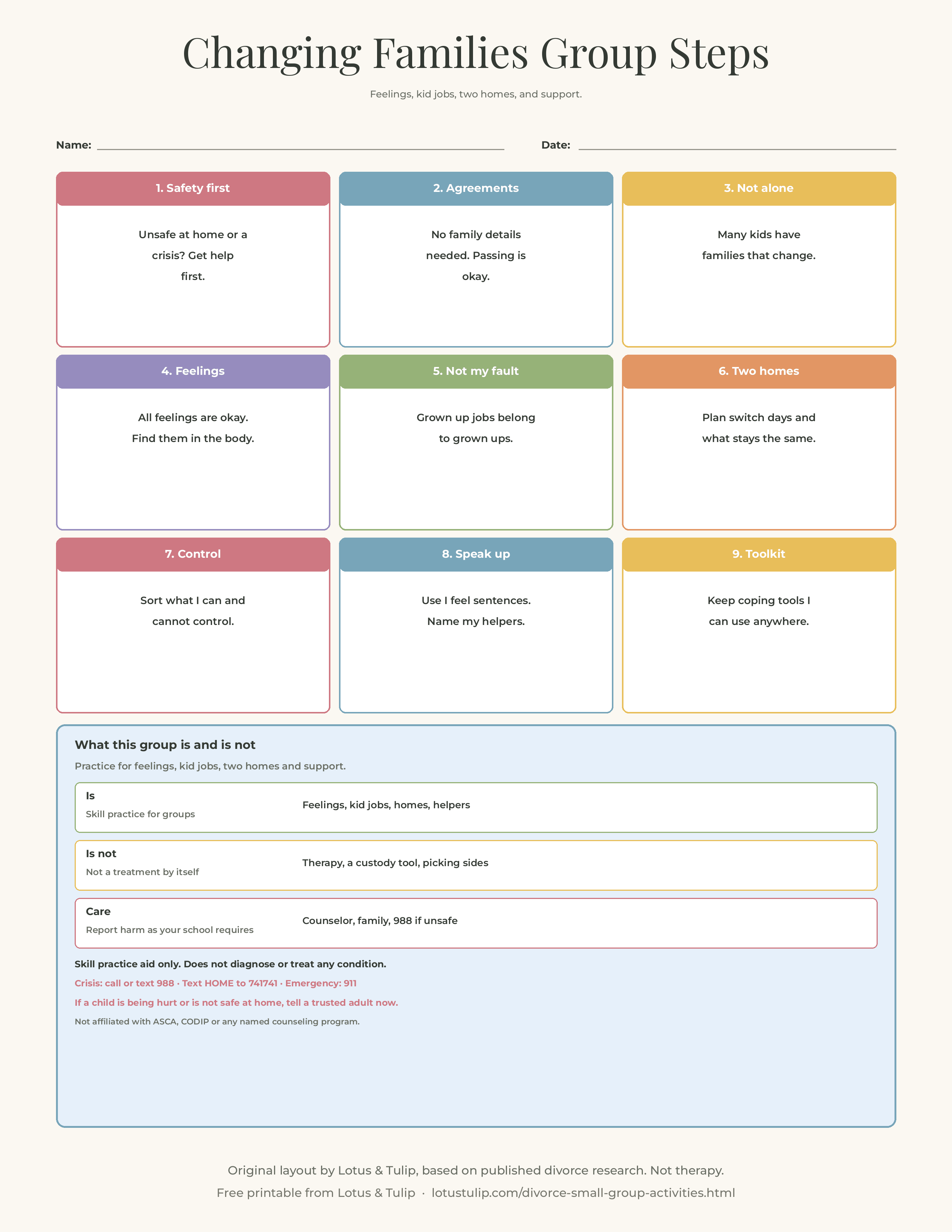
- Page 1: Changing Families Group Steps. Nine steps that match the HowTo, what this group is and is not, and crisis resources including 988, the Crisis Text Line and 911.
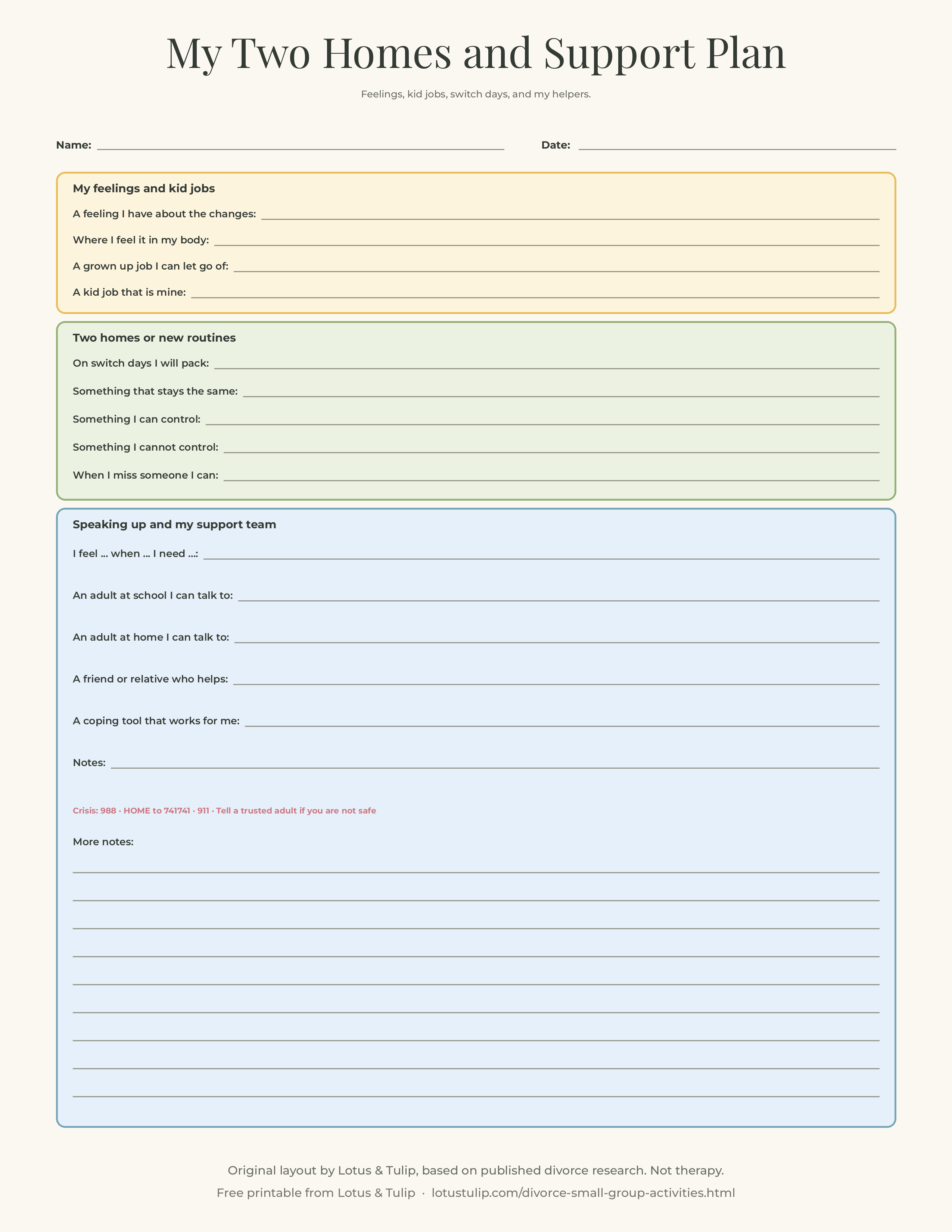
- Page 2: My Two Homes and Support Plan. Space for a feeling and its body clue, a grown up job to let go of, a switch day packing list, what stays the same, what I can and cannot control, an I feel sentence and a support team.
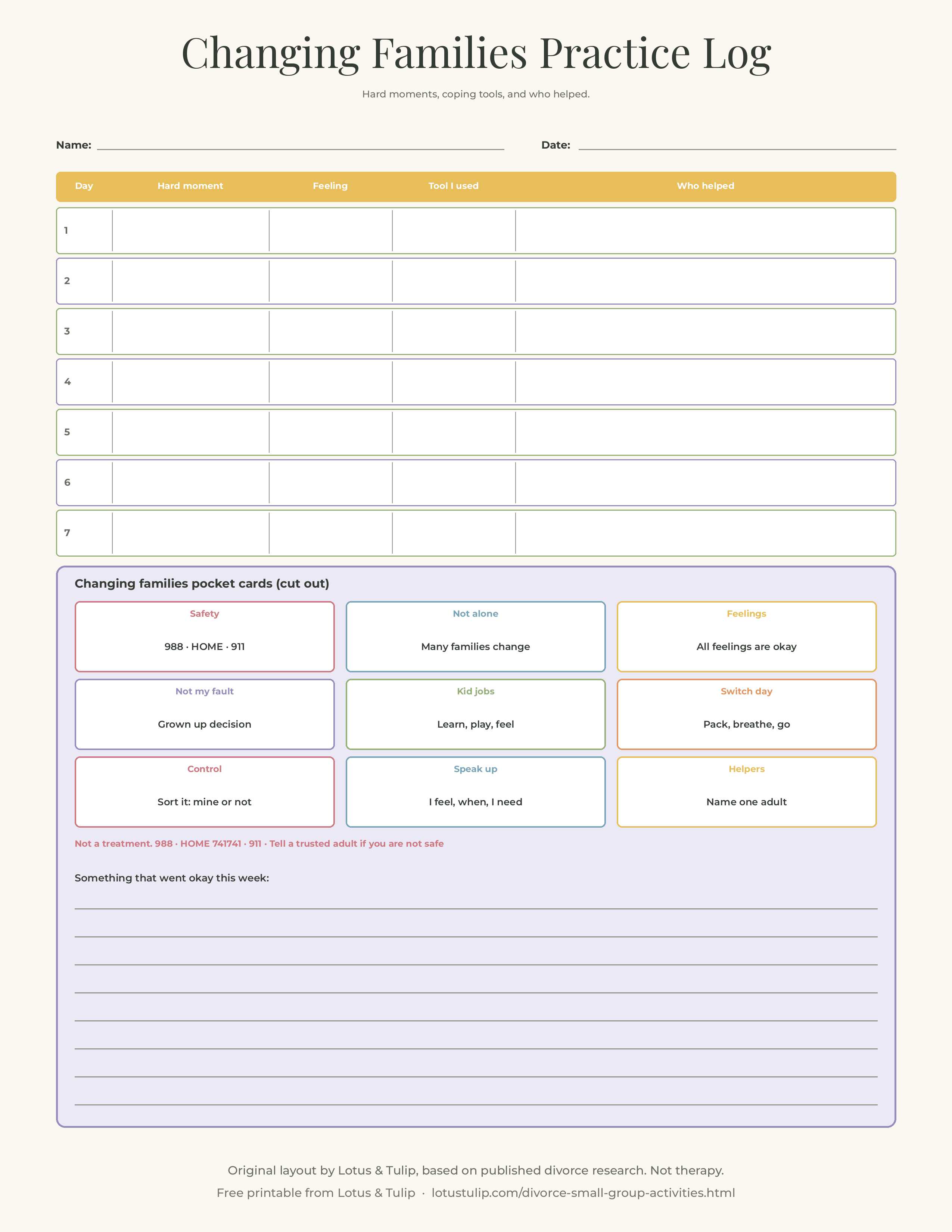
- Page 3: Practice Log. Seven rows for hard moments, feelings, tools and who helped, plus nine pocket cards.
Download free PDF · Page 1 PNG · Page 2 PNG · Page 3 PNG
Research notes (verified, with caveats)
- Amato PR, Keith B. Parental divorce and the well-being of children: a meta-analysis. Psychological Bulletin. 1991;110(1):26-46. Children of divorced parents scored somewhat lower on average on measures such as achievement, conduct, psychological adjustment, self-concept and social relations; the differences were small.
- Amato PR. Children of divorce in the 1990s: an update of the Amato and Keith (1991) meta-analysis. Journal of Family Psychology. 2001;15(3):355-370. Pooled 67 studies from the 1990s with similar, modest differences.
- Hetherington EM, Kelly J. For Better or For Worse: Divorce Reconsidered. W. W. Norton; 2002. About 25 percent of youth from divorced families had serious social, emotional or psychological problems compared with about 10 percent from families that stayed together; read the other way, around three quarters functioned within the normal range.
- Kelly JB, Emery RE. Children's adjustment following divorce: risk and resilience perspectives. Family Relations. 2003;52(4):352-362. Divorce raises risk, but most children do not develop lasting problems; conflict, parenting quality and economic change matter.
- Buchanan CM, Maccoby EE, Dornbusch SM. Caught between parents: adolescents' experience in divorced homes. Child Development. 1991;62(5):1008-1029. Feeling caught between parents was linked to poorer adjustment.
- Pedro-Carroll JL, Cowen EL. The Children of Divorce Intervention Program: an investigation of the efficacy of a school-based prevention program. Journal of Consulting and Clinical Psychology. 1985;53(5):603-611. The first CODIP evaluation, a 10 week group for 72 fourth to sixth grade suburban children randomly assigned to immediate or delayed intervention, combined support, clarifying misconceptions and training in problem solving, communication and anger control, and reported improvement from parent, teacher, group leader and child perspectives, including lower self-reported anxiety.
- Alpert-Gillis LJ, Pedro-Carroll JL, Cowen EL. The Children of Divorce Intervention Program: development, implementation, and evaluation of a program for young urban children. Journal of Consulting and Clinical Psychology. 1989;57(5):583-589. A 16 session, 45 minute weekly group for second and third graders (52 program children, groups of about six) with units on feelings and family changes, coping skills, child-parent relationships and self perceptions; program children improved more than comparison groups on most measures.
- Pedro-Carroll JL, Alpert-Gillis LJ, Cowen EL. An evaluation of the efficacy of a preventive intervention for 4th-6th grade urban children of divorce. Journal of Primary Prevention. 1992. A 14 session version with 57 participants showed improvements on parent, child and group leader measures.
- Pedro-Carroll JL, Sutton SE, Wyman PA. A two-year follow-up evaluation of a preventive intervention for young children of divorce. School Psychology Review. 1999;28(3):467-476. The kindergarten and first grade version reported benefits two years later; samples were small, so treat CODIP findings as encouraging rather than definitive.
- Wolchik SA, Sandler IN, Millsap RE, et al. Six-year follow-up of preventive interventions for children of divorce: a randomized controlled trial. JAMA. 2002;288(15):1874-1881. In 240 families with children aged 9 to 12, about 11 percent in the mother plus child program had a diagnosed mental disorder at follow-up compared with about 23.5 percent in the comparison condition.
- American Academy of Child and Adolescent Psychiatry. Children and Divorce. Facts for Families No. 1. Advises telling children simply and honestly, making clear they did not cause the divorce and avoiding pressure to choose sides.
- US Department of Education. Family Educational Rights and Privacy Act regulations, 34 CFR 99.4 (rights of parents). Schools give full FERPA rights to either parent unless provided with evidence of a court order, state statute or legally binding document that specifically revokes them.
The activities on this page are original skill practice ideas drawn from the themes these programs share: support, feelings, accurate information, coping skills and help from adults. They are not CODIP, they have not been tested in a randomized trial and they are not a manualized protocol.
Divorce small group activities: FAQ
What are divorce small group activities?
They are structured activities a school counselor runs with four to six students whose parents are separating or divorcing. They cover feelings, the message that the divorce is not the child's fault, two homes or new routines, what a child can control and who can help. Students do not have to share family details.
What grade levels is a divorce group for?
This page is written for about grades 2 to 5. Kindergarten and first grade need shorter sessions, more drawing and simpler words. For about grades 6 and up, use divorce activities written for teens instead of stretching an elementary group upward.
How many sessions should a divorce group have?
Many school counselors run six to eight weekly sessions of 30 to 40 minutes. Published school programs such as CODIP ran about 10 to 16 sessions. A shorter group should stick to a few clear goals and plan a follow-up check-in about four to six weeks after it ends.
Do I need both parents' consent?
Follow your district policy. Some districts require consent from one parent and some recommend notifying both. Under FERPA, schools give full rights to either parent unless they have evidence of a court order, state statute or legally binding document that specifically revokes those rights. Check the student file and ask your administrator if anything is unclear.
Do divorce groups for kids actually work?
School based programs such as the Children of Divorce Intervention Program reported improvements in adjustment and lower anxiety compared with children who did not take part, though samples were small. Programs that also work with parents, such as New Beginnings, showed effects years later. A short school group is best seen as support and skill practice, not a cure.
What should I do if a student shares something unsafe in group?
Calmly pause the activity, thank the student and talk with them privately right away. Follow your mandated reporting procedure for suspected abuse, neglect or domestic violence. If a student is thinking about suicide or self-harm, call or text 988, text HOME to 741741 and call 911 if there is immediate danger.
Can a student with only one home join?
Yes. Replace "two homes" with "my new routines" and keep the feelings, not my fault, control and support activities. Never ask why a parent is not involved.
Is the free printable a copy of the paid curriculum?
No. The free three page set is an original companion with group steps, a two homes and support plan and a practice log. The paid Changing Families curriculum is an eight session pack with lesson plans, student pages and forms. The printable is not a preview of that PDF and is not CODIP material.