
Kids and teens · Kindness, social emotional learning and World Kindness Day · Updated 2026-11-04
Kindness activities for kids: World Kindness Day ideas, kindness worksheets and a free printable
Ready-made printable: Social Skills Small Group Curriculum for School Counselors, Grades 2 to 5 Holiday 20% off: about $11.04, was $14 (EUR 12) · instant digital download
Buy on Etsy
Most adults who work with children have seen both sides of kindness. A second grader quietly hands a pencil to the new student without being asked. A fifth grade "kindness week" turns into a contest about who can post the most good deeds on the bulletin board, and the kids who really needed someone to sit with them at lunch are still eating alone on Friday. Kindness can be taught, but how you teach it matters a lot.
This guide is for school counselors, teachers and parents in the US who want kindness activities that actually change how children treat each other, not just a themed day. It covers World Kindness Day 2026, what research says about kindness and children (including where the evidence is thin), the principles that make kindness activities work, ideas by age, a 30 day kindness challenge, a ready to use World Kindness Day week plan for schools, a step by step way to run kindness activities, common mistakes, and a free three page kindness printable with Kindness Bingo, a kindness plan and a reflection page.
Jump to the free kindness activities printable
When is World Kindness Day 2026?
World Kindness Day is held every year on November 13. In 2026 it falls on a Friday, which makes the school week of Monday, November 9 to Friday, November 13 a natural kindness week. The day was introduced in 1998 by the World Kindness Movement, a coalition of kindness organizations from different countries. The date marks the opening day of the movement's first conference in Tokyo in 1998, and the movement itself grew out of a declaration signed in Tokyo in 1997, with roots in Japan's Small Kindness Movement.
A few related dates are easy to mix up. World Kindness Day (November 13) is international. Random Acts of Kindness Day in the US is usually observed in February, and many schools also run kindness themed activities during National Bullying Prevention Month in October. This guide is written around November 13, but every activity here works any week of the year.
What the research says about kindness and children
Kindness activities are popular partly because they feel good. It is worth knowing what is actually supported by evidence, because it shapes how you run them.
Doing kind acts can increase how much classmates like each other. In a study published in PLoS ONE in 2012, Kristin Layous, Sonja Lyubomirsky and colleagues asked 415 students aged 9 to 11 in 19 Vancouver classrooms to do three kind acts a week for four weeks. A comparison group visited three places a week instead. Both groups reported higher well-being by the end, with no clear difference between them, but students in the kindness group gained significantly more peer acceptance: classmates nominated them more often as someone they wanted to work with. This is one study, in one city, over one month, so treat it as promising rather than proven. Its most useful lesson is the specific one: kindness seemed to help children's social standing more than it changed their mood.
The effect on the giver's happiness is real but modest. A 2018 meta-analysis by Oliver Scott Curry and colleagues in the Journal of Experimental Social Psychology pooled 27 experiments (about 4,000 participants, mostly adults) and found that performing kind acts had a small to medium effect on the giver's well-being. The authors also noted that most of the studies were small and underpowered. In plain terms: kindness tends to make people feel a bit better, but it is not a mental health treatment, and you should not promise children it will fix how they feel.
Even very young children seem to find giving rewarding. In another 2012 PLoS ONE study, Lara Aknin, Kiley Hamlin and Elizabeth Dunn found that toddlers under two showed more happiness when giving treats to a puppet than when receiving treats themselves, and more still when they gave away one of their own. The sample was small (about 20 toddlers), so it is best read as an interesting finding, not a rule.
Rewards can backfire. Felix Warneken and Michael Tomasello (2008, Developmental Psychology) found that 20 month olds who were given a toy reward for helping later helped less once rewards stopped than toddlers who had been praised or given nothing. Praise did not have this effect. This is one small study with very young children, but it fits a wider body of work on how external rewards can crowd out a child's own reasons for doing something. It is the main reason this guide recommends no prizes for kindness.
How acts are spread out may matter, a little. Sonja Lyubomirsky, Kennon Sheldon and David Schkade (2005) described a six week study in which college students did five kind acts a week. Students who did all five on one day reported a boost in well-being, while those who spread them across the week did not. This was a small study of adults and has not been well replicated, so do not build your whole plan around it. One practical take: a dedicated "kindness day" each week may feel more meaningful than scattering acts so thinly that nobody notices them.
Many young people think adults care more about achievement than kindness. Harvard's Making Caring Common project surveyed more than 10,000 US middle and high school students for its 2014 report The Children We Mean to Raise. Almost 80 percent chose achievement or happiness as their top priority over caring for others, and about 80 percent said their parents cared more about achievement or happiness than about their being caring. Surveys like this cannot tell us how kind teens actually are, but they suggest a useful message for adults: if kindness matters to you, children need to hear it and see it, explicitly and often.
Taken together: kindness activities are a reasonable, low cost way to strengthen classroom relationships and give children practice caring for others. The evidence is strongest for social benefits and weaker for big mood changes, and the way you run the activity (choice, no prizes, real people, real needs) probably matters as much as which activity you pick.
Seven principles for kindness activities that work
- Specific beats general. "Be kind" is too vague for most children. "Invite someone new to sit with you at lunch" is something a child can actually do and notice.
- Let children choose. Choosing their own acts gives children ownership. Offer a menu (like the Kindness Bingo card) rather than assigning the same act to everyone.
- No prizes, no leaderboards. Thank children and name what you saw, but do not hand out stickers per kind act or rank students by number of good deeds. Competition shifts the focus from the other person to winning.
- Keep it about the other person. Teach children to ask "What would help?" and to accept "No thank you." Kindness that ignores what the other person wants is not really kindness.
- Notice the effect. A short reflection afterwards ("How do you think they felt? How did you feel?") helps children connect their action to someone else's experience. This builds perspective taking, which is the heart of empathy.
- Keep it free and low pressure. Kind acts should never depend on money. Children from families on tight budgets should be able to take part fully.
- Include kindness to self. Children who are harsh with themselves often struggle to be warm with others. A small "be kind to yourself" step normalizes self compassion, and pairs well with positive self talk.
Kindness activities for kids by age
| Age | What kindness looks like | Activities that fit |
|---|---|---|
| Preschool and K to 2 | Helping, sharing, noticing when someone is sad, saying thank you. Young children learn mostly by copying adults and through praise of specific actions. | Kindness Bingo with an adult reading the squares, a class "helping hands" chart (no names ranked), kind words practice with puppets, drawing pictures for school helpers, reading picture books about kindness and talking about the characters' feelings. |
| Grades 3 to 5 | Including others, standing up kindly, repairing after a mistake, kindness to people outside their friend group. | Kindness Bingo, a weekly kindness plan, secret kindness partners within the class, thank you notes to school staff, role plays of including someone who is left out, short reflections after kind acts. |
| Middle school | Kindness when peers are watching, online kindness, resisting gossip and exclusion, kindness across groups. | Student designed kindness challenges, anonymous kind notes (with adult checks for safety), "kindness online" discussions, cross age projects such as reading with younger students, reflection on what makes kindness hard. |
| High school | Kindness as values and action: service, inclusion, standing up against unfairness, caring for friends who struggle. | Service learning tied to real community needs, peer mentoring, gratitude letters, student led kindness weeks, discussing the Making Caring Common findings and what students think adults really value. |
Kindness activities for the classroom and school counseling
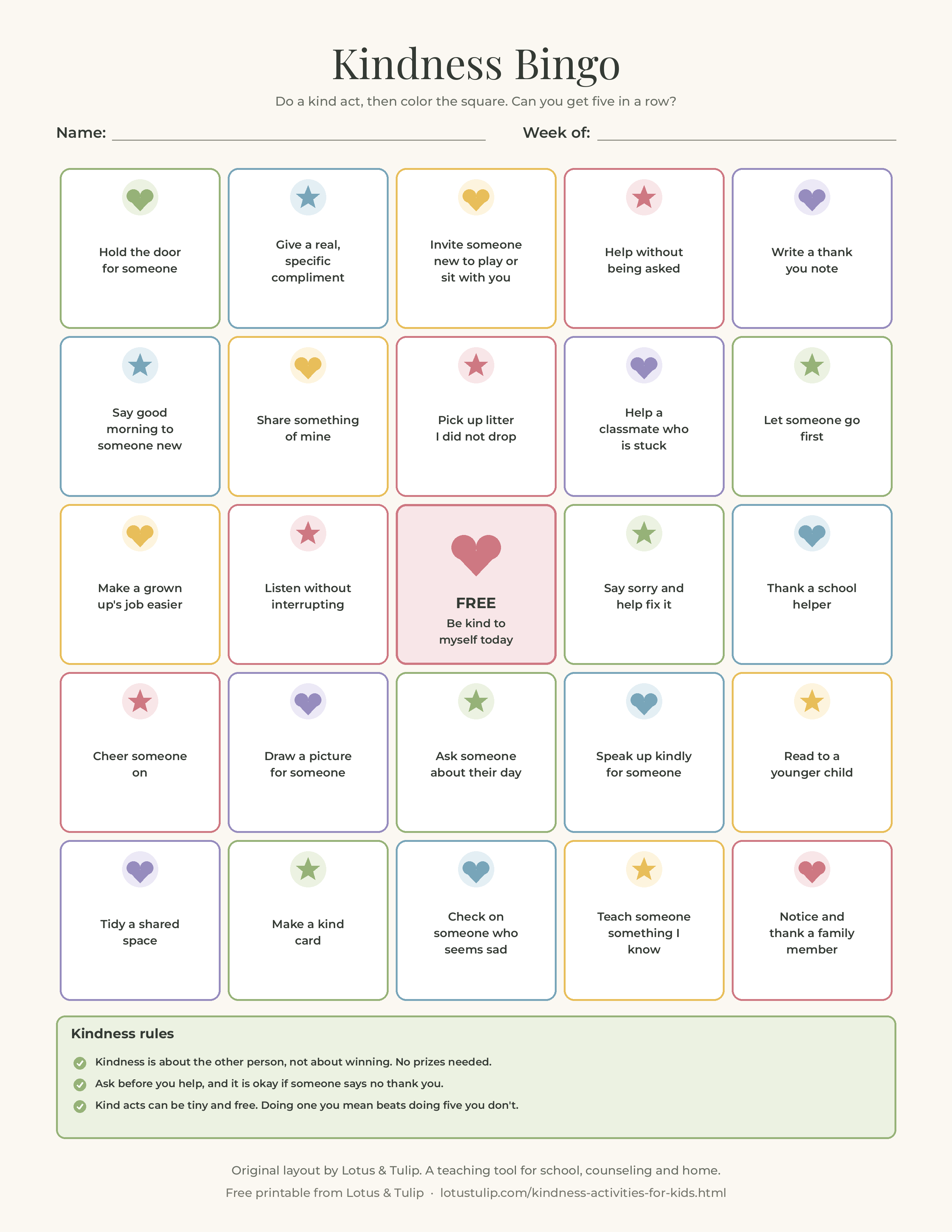
- Kindness Bingo. Each child gets a card of 24 kind acts plus a free square. They color a square after doing the act and aim for five in a row over a week. The free printable below has a ready made card. The goal is not to "win," so do not give prizes for bingo; celebrate the class total instead if you want a group goal.
- Kind words wall. Brainstorm kind phrases together ("Do you want to join us?", "Take your time," "That was brave"), write them on a poster and practice saying them out loud. Many children know they should be kind but have no words ready in the moment.
- Thank a school helper. Classes write or draw thank you notes for custodians, cafeteria staff, bus drivers, office staff and aides. Ask each child to name something specific the person does.
- Secret kindness partners. Each child draws a classmate's name and does small, free kind acts for them for a week, then shares who they had at the end. Check that every child has a partner who will follow through.
- Kindness role plays. Act out short scenarios: a classmate drops their books, someone is left out of a game, a friend is teased. Practice what to say and do. For harder situations, pair this with the conflict resolution worksheet.
- Buddy reading. Older students read with younger ones. Cross age projects give older children a real chance to help and younger children a friendly face in the hallway.
- Kindness reflection circle. At the end of the week, students share one kind thing they did or noticed. Ask "How do you think it felt for them?" rather than "Who did the most?"
- Gratitude and kindness together. Gratitude is noticing kindness we receive. A gratitude journal (see the gratitude worksheet for kids) pairs well with kindness activities, especially in November around Thanksgiving.
Kindness activities at home
- Family kindness plan. Choose one kind act per family member for the week and check in at dinner. Use the My Kindness Plan page in the printable.
- Notice kindness out loud. When you see your child be kind, name it specifically: "You waited so your brother could catch up. That was thoughtful." Specific praise teaches more than "good job."
- Kindness to neighbors. Help carry groceries, make a card for an older neighbor, rake leaves together. Choose acts your child can see the effect of.
- Talk about kindness you see in books, shows and the news. Ask what the character noticed, what they did and how the other person felt.
- Model it, including repair. When you are unkind (every parent is sometimes), apologize and fix it. Children learn as much from seeing repair as from seeing perfect behavior.
30 day kindness challenge for kids
Use this list as a daily challenge in November, or let children pick from it at their own pace. Every item is free.
- Smile and say good morning to three people.
- Hold the door for someone.
- Give a specific compliment ("I like how you explained that").
- Help with a chore without being asked.
- Write a thank you note to a teacher or school helper.
- Invite someone new to play or sit with you.
- Let someone else go first.
- Pick up litter you did not drop.
- Listen to someone without interrupting.
- Tell a family member one thing you appreciate about them.
- Share a snack, toy or game.
- Draw a picture for someone.
- Help a classmate who is stuck.
- Say sorry for a mistake and help fix it.
- Be kind to yourself: say one kind thing to yourself.
- Ask someone how their day is going, and really listen.
- Cheer for someone else's success.
- Read to a younger child or sibling.
- Tidy a shared space at school or home.
- Check on someone who seems sad.
- Make a kind card for a neighbor or relative.
- Teach someone something you know how to do.
- Thank a bus driver, cafeteria worker or custodian by name.
- Include someone who is left out of a game.
- Speak up kindly when someone is being teased (or tell an adult).
- Leave a kind note for a family member to find.
- Do one kind thing for an animal or for nature (fill a bird feeder, water a plant).
- Write down three kind things someone did for you this month.
- Help a younger student find their way or learn a rule.
- Plan one kind act for next month.
World Kindness Day week plan for schools (November 9 to 13, 2026)
| Day | Theme | Activity |
|---|---|---|
| Monday, Nov 9 | What is kindness? | Class discussion: what kindness looks like, sounds like and feels like. Hand out Kindness Bingo cards. Brainstorm the kind words wall. |
| Tuesday, Nov 10 | Kind words | Practice kind phrases with partners and role plays. Each student writes one kind note to a classmate (teacher checks that every student receives one). |
| Wednesday, Nov 11 | Kindness to school helpers | Thank you notes or drawings for custodians, cafeteria staff, bus drivers, office staff and aides. Many schools are closed or hold assemblies on Veterans Day, so move this to Thursday if needed. |
| Thursday, Nov 12 | Including others | Role plays about joining in and including someone who is left out. Students fill in the My Kindness Plan page for the weekend. |
| Friday, Nov 13 | World Kindness Day | Kindness reflection circle and the Kindness Reflection page. Celebrate the class total of bingo squares as a group, not individual winners. Optional: a cross age buddy activity. |
One important note for counselors and administrators: a kindness week is a good thing, but it is not a bullying prevention plan. Bullying needs clear policies, adult supervision, a way for students to report safely and follow up with the students involved. Use kindness activities alongside that work, not instead of it.
How to use kindness activities with kids, step by step
- Start with what kindness means. Ask children for examples of kindness they have received or seen. Write down specific actions, not just words like "nice."
- Teach a few kind words and actions. Practice phrases and simple acts out loud so children have something ready to use in the moment.
- Offer a menu, not an assignment. Give each child the Kindness Bingo card or the 30 day list and let them choose which acts to do.
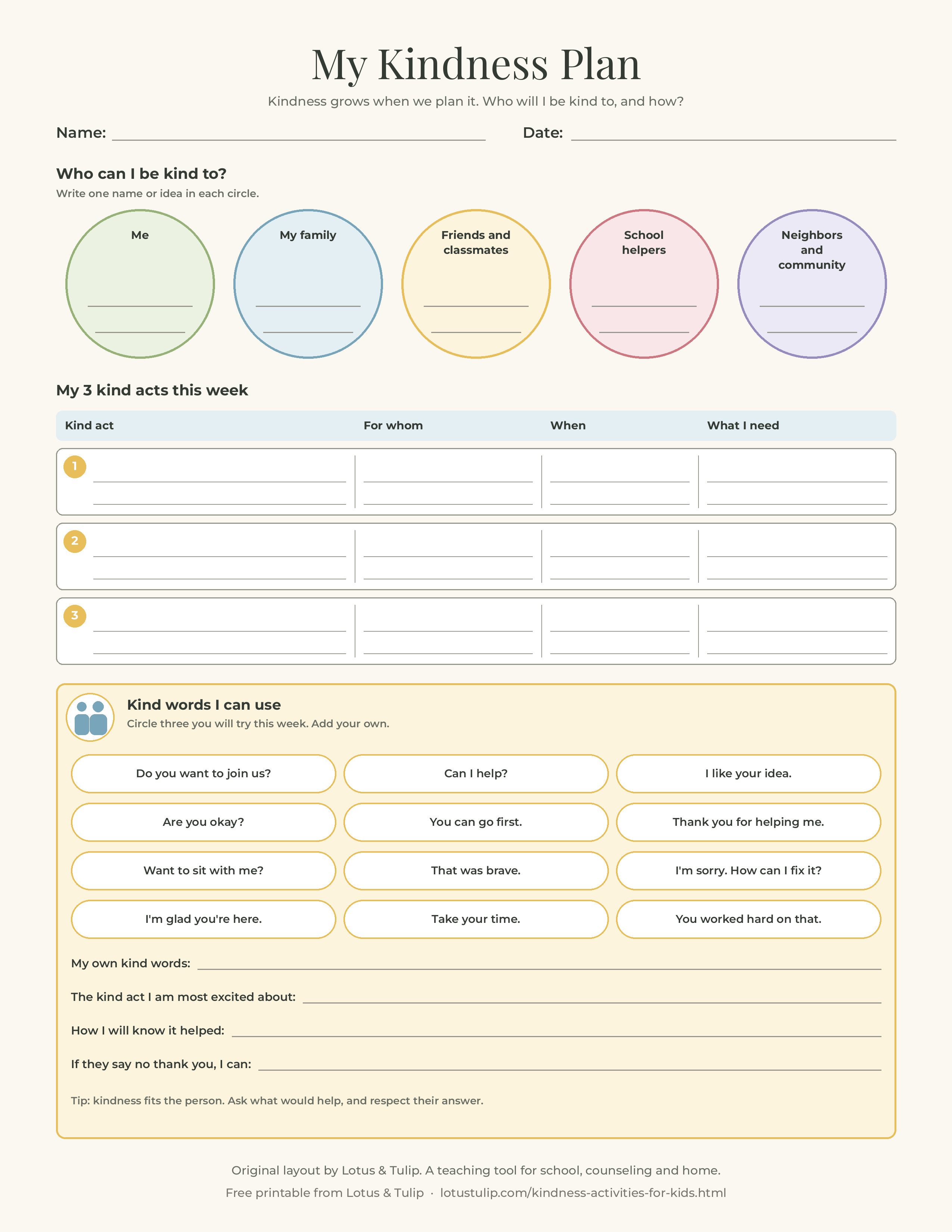
- Plan who and when. Use the My Kindness Plan page so children pick three acts, who they are for and when they will do them. Planning makes follow through much more likely.
- Teach asking first. Practice "Can I help?" and accepting "No thank you" calmly, so kindness respects what the other person wants.
- Do the acts during the week. Build in time at school where possible (for example, writing notes in class), so kindness does not depend on what happens at home.
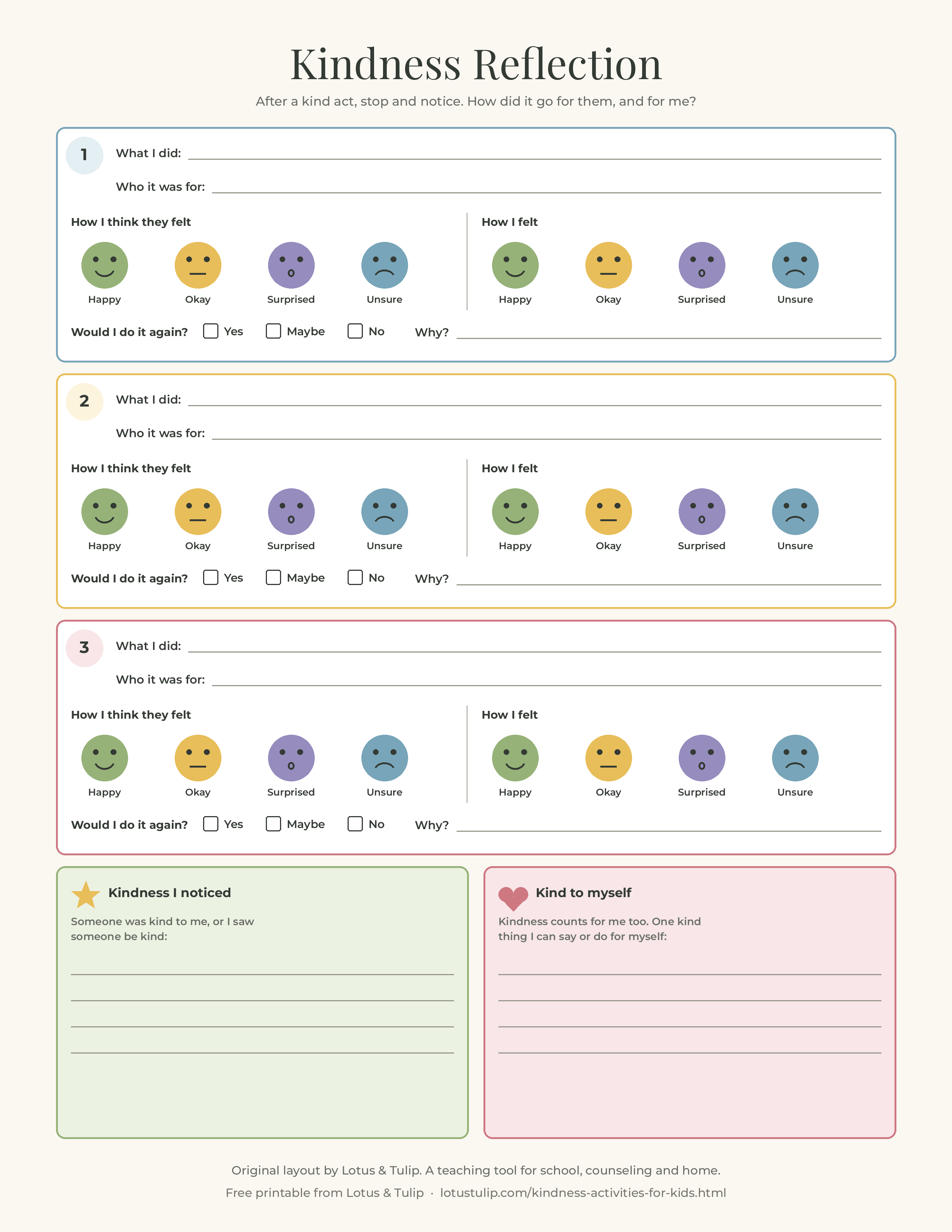
- Reflect after each act. Children use the Kindness Reflection page to note what they did, how they think the other person felt and how they felt.
- Notice and name kindness, without prizes. Thank children specifically for what you saw. Celebrate group effort rather than ranking individuals.
- Keep it going after the week. Choose one kindness routine to keep, such as a weekly reflection circle or a monthly thank you note, so kindness is part of the culture and not a one day event.
Tips for school counselors, teachers and parents
- Counselors: kindness activities fit well into classroom lessons on friendship, empathy and inclusion. For students who struggle socially, small groups on friendship skills or social skills give more practice than a whole class week can.
- Teachers: watch for students who never receive a kind note or are never chosen. Quietly make sure every child is included, for example by assigning secret kindness partners yourself.
- Parents: talk about kindness at dinner as often as you talk about grades or sports. The Making Caring Common survey suggests many children assume adults care most about achievement.
- Everyone: repair matters. When children are unkind, the goal is to help them notice the effect and fix it, not to shame them. The I statements worksheet helps children say how they feel without blaming.
Common mistakes with kindness activities
- Turning kindness into a competition. Leaderboards, prizes per kind act and "kindest student" awards tend to reward visible acts and can leave quieter children out.
- Performative kindness. Asking students to film or post their kind acts, or making kindness about being seen, shifts the focus away from the other person. Keep acts private by default.
- Acts that cost money. Bring a gift or buy a treat challenges exclude families on tight budgets. Keep every act free.
- Kindness that ignores consent. Hugging someone who does not want a hug or "helping" someone who did not ask is not kind. Teach asking first.
- A single day and done. One assembly rarely changes behavior. Short, repeated practice and reflection do more.
- Using kindness to paper over bullying. Asking a student who is being bullied to "be kind" to the student bullying them is not appropriate. Bullying needs adult action.
Free kindness activities printable (PDF)
This free printable is an original Lotus & Tulip design, sized for US Letter paper and suited to about ages 6 to 12 (grades 1 to 6) in classrooms, counseling sessions, small groups and at home. Younger children can use it with an adult reading and writing for them, and older students can adapt it for a class kindness challenge. It has three pages:
- Page 1: Kindness Bingo. A 5 by 5 bingo card with 24 free kind acts (hold the door, invite someone new to play, thank a school helper, check on someone who seems sad, teach someone something I know and more) and a free center square, "be kind to myself today." It includes simple kindness rules: no prizes needed, ask before you help, and one kind act you mean beats five you don't.
- Page 2: My Kindness Plan. A "who can I be kind to?" row (me, my family, friends and classmates, school helpers, neighbors and community), a table to plan three kind acts with who, when and what I need, a bank of twelve kind words to circle and try, and prompts for my own kind words, how I will know it helped and what I can do if someone says no thank you.
- Page 3: Kindness Reflection. Three reflection cards (what I did, who it was for, how I think they felt, how I felt, would I do it again and why), plus a "kindness I noticed" box and a "kind to myself" box.
Download the free kindness activities printable (PDF, 3 pages, US Letter)
Prefer single images? Page 1: Kindness Bingo (PNG) · Page 2: My Kindness Plan (PNG) · Page 3: Kindness Reflection (PNG)
Free to print for your own use and for use with your own students, clients or children. Please link to this page rather than re-uploading the file.
Related resources
- Friendship worksheets for kids (free printable)
- Gratitude worksheet for kids (free printable)
- Self esteem worksheets for kids (free printable)
- Conflict resolution worksheet (free printable)
- I statements worksheet (free printable)
- Positive self talk worksheet (free printable)
- Emotional regulation worksheets for kids (free printable)
- Social skills small group curriculum
Sources
- Aknin, L. B., Hamlin, J. K., and Dunn, E. W. (2012). Giving leads to happiness in young children. PLoS ONE, 7(6), e39211.
- Curry, O. S., Rowland, L. A., Van Lissa, C. J., Zlotowitz, S., McAlaney, J., and Whitehouse, H. (2018). Happy to help? A systematic review and meta-analysis of the effects of performing acts of kindness on the well-being of the actor. Journal of Experimental Social Psychology, 76, 320 to 329.
- Layous, K., Nelson, S. K., Oberle, E., Schonert-Reichl, K. A., and Lyubomirsky, S. (2012). Kindness counts: prompting prosocial behavior in preadolescents boosts peer acceptance and well-being. PLoS ONE, 7(12), e51380.
- Lyubomirsky, S., Sheldon, K. M., and Schkade, D. (2005). Pursuing happiness: the architecture of sustainable change. Review of General Psychology, 9(2), 111 to 131.
- Making Caring Common Project, Harvard Graduate School of Education (2014). The Children We Mean to Raise: The Real Messages Adults Are Sending About Values.
- Warneken, F., and Tomasello, M. (2008). Extrinsic rewards undermine altruistic tendencies in 20-month-olds. Developmental Psychology, 44(6), 1785 to 1788.
- World Kindness Movement. History of World Kindness Day and the World Kindness Movement. theworldkindnessmovement.org.
Kindness activities for kids: FAQ
When is World Kindness Day 2026?
World Kindness Day is on November 13 every year. In 2026 it falls on Friday, November 13, so many schools will run a kindness week from Monday, November 9 to Friday, November 13. The day was introduced in 1998 by the World Kindness Movement.
What are some easy kindness activities for kids?
Easy, free kindness activities include holding the door, giving a specific compliment, inviting someone new to play, writing a thank you note to a school helper, helping without being asked, listening without interrupting and checking on someone who seems sad. Kindness Bingo and a 30 day kindness challenge give children a menu to choose from.
How do you teach kindness to kids?
Teach kindness with specific actions and words rather than general rules, let children choose their own kind acts, model kindness yourself, name kindness when you see it and help children reflect on how their actions made others feel. Avoid prizes for each kind act, since rewards can shift the focus from the other person to winning.
Do kindness activities really work?
There is some good evidence. In a 2012 study of 415 students aged 9 to 11, doing three kind acts a week for four weeks increased peer acceptance compared with a control activity, and a 2018 meta-analysis found that kind acts have a small to medium positive effect on the giver's well-being. Most studies are small, so the benefits are real but modest, and how the activities are run matters.
Should kids get rewards for being kind?
Specific praise and thanks are helpful, but material rewards for each kind act are best avoided. In one study, toddlers who were rewarded with a toy for helping later helped less than toddlers who were praised or not rewarded. Celebrate group effort and the effect on others instead of handing out prizes.
What age is the free kindness printable for?
The free printable suits about ages 6 to 12 (grades 1 to 6) in classrooms, counseling sessions, small groups or at home. Younger children can use it with an adult reading and writing for them, and older students can adapt it for a class kindness challenge.
What can schools do for World Kindness Day?
Schools can run a kindness week with a different theme each day: what kindness means, kind words, thanking school helpers, including others and a reflection circle on November 13. Keep acts free, avoid competitions and pair the week with ongoing work on friendship, inclusion and bullying prevention.