
Kids and teens · Emotional regulation and coping · Updated 2026-11-04
Emotional regulation worksheets for kids: self regulation strategies and activities that actually help (free printable)
Ready-made printable: Coping Skills Cards for Kids and Teens Holiday 20% off: about $5.52, was $7 (EUR 6) · instant digital download
Buy on Etsy
Every adult who works with children has seen it. A seven year old loses a board game and the pieces go flying. A fourth grader freezes at the whiteboard and then melts down at recess. A twelve year old gets a text, goes silent, and slams a door an hour later for no reason anyone can see. We often call these "behavior problems," but underneath most of them is the same missing skill: the ability to notice a big feeling, get it to a manageable size, and choose what to do next. That skill is emotional regulation, and the good news is that it can be taught. The less comfortable news is that it is not taught by worksheets alone, and that a lot of what gets shared online about it overstates the evidence. This guide is written for US school counselors, teachers, child and teen therapists and parents. It covers what emotional regulation is and is not, how it develops from co-regulation to self regulation, what the research honestly shows (including its limits), a simple Stop, Notice, Choose routine, self regulation strategies for kids sorted by when they work best, a nine step plan for teaching the skill, emotional regulation activities for kids and teens, tips for classrooms and for home, common mistakes, and when regulation struggles are a sign that a child needs more help. It ends with a free three page printable: a "My Feelings Signals" body map with a 1 to 5 feelings scale, a "Stop, Notice, Choose" regulation plan with a strategy menu, and a weekly regulation tracker.
Jump to the free emotional regulation worksheets printable
What emotional regulation is (and what it is not)
Emotional regulation is the set of things we do, consciously or automatically, to influence which emotions we have, when we have them, how strongly we feel them and how we express them. That definition comes from the psychologist James Gross, whose 1998 review helped turn emotion regulation into its own research field. Notice what the definition does not say. It does not say "getting rid of feelings" or "staying calm all the time." Regulation can mean calming down, but it can also mean letting sadness run its course, turning nervous energy into focus, or even turning feelings up, such as getting excited enough to start a hard task.
In schools you will often hear the broader term self regulation. Self regulation includes managing emotions, but also attention, thinking and behavior: waiting a turn, shifting from recess to math, sticking with a hard problem. CASEL, the organization behind the most widely used US framework for social and emotional learning (SEL), groups these skills under self-management, one of its five core competencies alongside self-awareness, social awareness, relationship skills and responsible decision-making. CASEL describes self-management as the ability to manage one's emotions, thoughts and behaviors effectively in different situations and to achieve goals. Emotional regulation sits right at the center of that.
Three things emotional regulation is not:
- It is not suppression. Telling a child to "stop crying" or "calm down right now" asks them to hide the outside of a feeling while the inside keeps going. As you will see below, research on hiding feelings is not encouraging.
- It is not compliance. A quiet child is not automatically a regulated child. Some children who never cause trouble are holding a lot inside. The goal is a child who can feel, name and handle emotions, not one who has learned to go silent.
- It is not a personality trait you either have or lack. Regulation develops over many years, it varies with sleep, hunger, stress and setting, and it improves with practice and support.
How regulation develops: co-regulation comes first
Babies cannot regulate themselves at all. They regulate through us: we rock, feed, soothe and name what is happening. Over childhood the balance slowly shifts from adult-led regulation to self regulation, but it never shifts all the way. Even teenagers and adults lean on other people when feelings get big. This supported process is called co-regulation.
A practice brief from the Office of Planning, Research and Evaluation (OPRE) at the US Administration for Children and Families, written by Katie Rosanbalm and Desiree Murray at Duke University in 2017, describes co-regulation across development as resting on three kinds of caregiver support:
- A warm, responsive relationship, where the child feels safe, cared for and understood, especially in moments of stress.
- A structured environment that keeps demands manageable: predictable routines, clear expectations, and buffers against too much stress at once.
- Teaching, modeling and coaching regulation skills, with practice at a level that fits the child's age, and help in the moment.
The brief also makes a point that is easy to skip: the adult's own regulation comes first. A dysregulated adult cannot co-regulate a dysregulated child. That is why so many of the steps later in this guide start with you.
| Age | What regulation usually looks like | What adults typically provide |
|---|---|---|
| Preschool (3 to 5) | Big, fast feelings; tantrums still common; beginning to use simple words for feelings and wait briefly | Lots of co-regulation, naming feelings out loud, predictable routines, simple calming routines practiced together |
| Early elementary (5 to 8) | More feeling words; can use a taught strategy with a reminder; still needs adults for big upsets | Teaching specific strategies, visual reminders, coaching in the moment, praise for effort |
| Upper elementary (8 to 11) | Can notice body clues and rate intensity; starting to plan ahead for known triggers | Helping the child build a personal plan, problem solving after upsets, gradually fading prompts |
| Middle and high school (11 to 18) | More complex feelings, more privacy, peer stress and sleep changes; regulation can dip temporarily in early adolescence | Respectful coaching, more choice, help with thinking strategies, staying available rather than stepping back entirely |
Ages are rough guides, not checklists. Children with ADHD, autism, anxiety, trauma histories or language delays often need more co-regulation for longer, and that is fine.
What the research honestly says
Emotional regulation is one of the better studied areas in child development, but popular articles often stretch the findings. Here is what we think can be said fairly, with the limits flagged.
The process model: regulation can happen at different moments
Gross's 1998 process model describes five families of regulation strategies, ordered by when they act as an emotion unfolds: situation selection (choosing whether to enter a situation), situation modification (changing the situation), attentional deployment (shifting attention, such as distraction), cognitive change (changing how you think about the situation, often called reappraisal) and response modulation (changing the response once the feeling is here, such as breathing or hiding your expression). The first four act before the emotion is in full swing; the last acts after. This model is useful for kids because it shows that regulation is not just "what you do in the meltdown." Planning ahead counts too.
Some strategies tend to work better than others, with caveats
A 2012 meta-analysis by Webb, Miles and Sheeran in Psychological Bulletin pooled 306 experimental comparisons of strategies from the process model. Overall, cognitive change strategies had a small to moderate effect on emotional outcomes, response modulation a small one, and attentional deployment on average close to zero. The details matter: distraction helped somewhat, while concentrating on the feeling in a ruminative way made things worse. Hiding the outward expression of an emotion changed expression, but trying to suppress the experience or the thoughts behind it did little or nothing. Reappraisal, especially taking another perspective, was among the more effective approaches. The important caveat: these were mostly short laboratory experiments, largely with adults, using things like sad film clips. They tell us about direction, not about a sixth grader in a real hallway.
A second meta-analysis, by Aldao, Nolen-Hoeksema and Schweizer in 2010, looked at 114 studies of how strategies relate to symptoms of anxiety, depression, eating problems and substance use. Rumination, avoidance and suppression were linked to more symptoms; problem solving and reappraisal were linked to fewer. Again, a caveat: these are mostly correlations in adolescents and adults, so they show association, not cause.
Regulation matters for children's wellbeing
Nancy Eisenberg and colleagues have spent decades studying emotion-related self regulation in children. Their 2010 review in the Annual Review of Clinical Psychology summarizes a large body of work linking lower regulation, especially lower effortful control, to more behavior problems and to some internalizing problems such as anxiety. A frequently cited long-term study, Moffitt and colleagues in PNAS in 2011, followed 1,037 children in Dunedin, New Zealand, from birth to age 32 and found that childhood self-control predicted adult health, finances and criminal convictions in a gradient, even after accounting for IQ and family social class. That study measured broad self-control rather than emotional regulation specifically, and it is observational, so it cannot prove that improving self-control causes better outcomes. It does show why the skill is worth attention.
Teaching these skills in school can help
Durlak and colleagues' 2011 meta-analysis in Child Development combined 213 universal school based SEL programs with more than 270,000 students from kindergarten through high school. Compared with controls, students in SEL programs showed better social and emotional skills, attitudes and behavior, and an 11 percentile point gain in academic achievement. Programs worked best when they were sequenced, active, focused and explicit (SAFE) and when they were implemented well. Fewer studies had long-term follow-up, so lasting effects are less certain. The OPRE review of self regulation interventions from birth through young adulthood (Murray, Rosanbalm and Christopoulos, 2016) covered nearly 300 intervention studies and found generally small to medium effects, with no single approach clearly best. Its recommendations include combining emotional and cognitive skills, supporting caregivers' co-regulation, and sustaining practice across settings.
Naming feelings may take some of the edge off
A popular phrase says "name it to tame it." There is a real study behind it: Lieberman and colleagues (2007, Psychological Science) found that putting feelings into words reduced activity in the amygdala, a brain region involved in emotional responses. It was a small brain imaging study of 30 adults, and it does not prove that labeling feelings regulates children's emotions in daily life. It fits well with everyday clinical practice, which is why our worksheet uses naming, but we would not oversell it.
A note on popular programs
Many schools use The Zones of Regulation®, a framework created by Leah Kuypers that sorts feelings into colored zones. It is a trademarked program and Lotus & Tulip is not affiliated with it in any way; the free printable on this page is our own original design and is not a Zones of Regulation resource. If your school uses it, the ideas here can sit alongside it. In fairness to readers, a 2024 research review by Mason, Leaf and Gerhardt in The Journal of Special Education concluded that the program does not yet have enough empirical evidence to meet standards for an evidence-based practice. That does not mean it is useless; it means it, like most classroom tools (including ours), has not been rigorously tested.
The honest bottom line: regulation skills matter, they develop through relationships and practice, school programs show modest benefits, reappraisal and problem solving look more helpful than suppression and rumination, and a worksheet is a structure for practice, not a treatment by itself.
The Stop, Notice, Choose routine
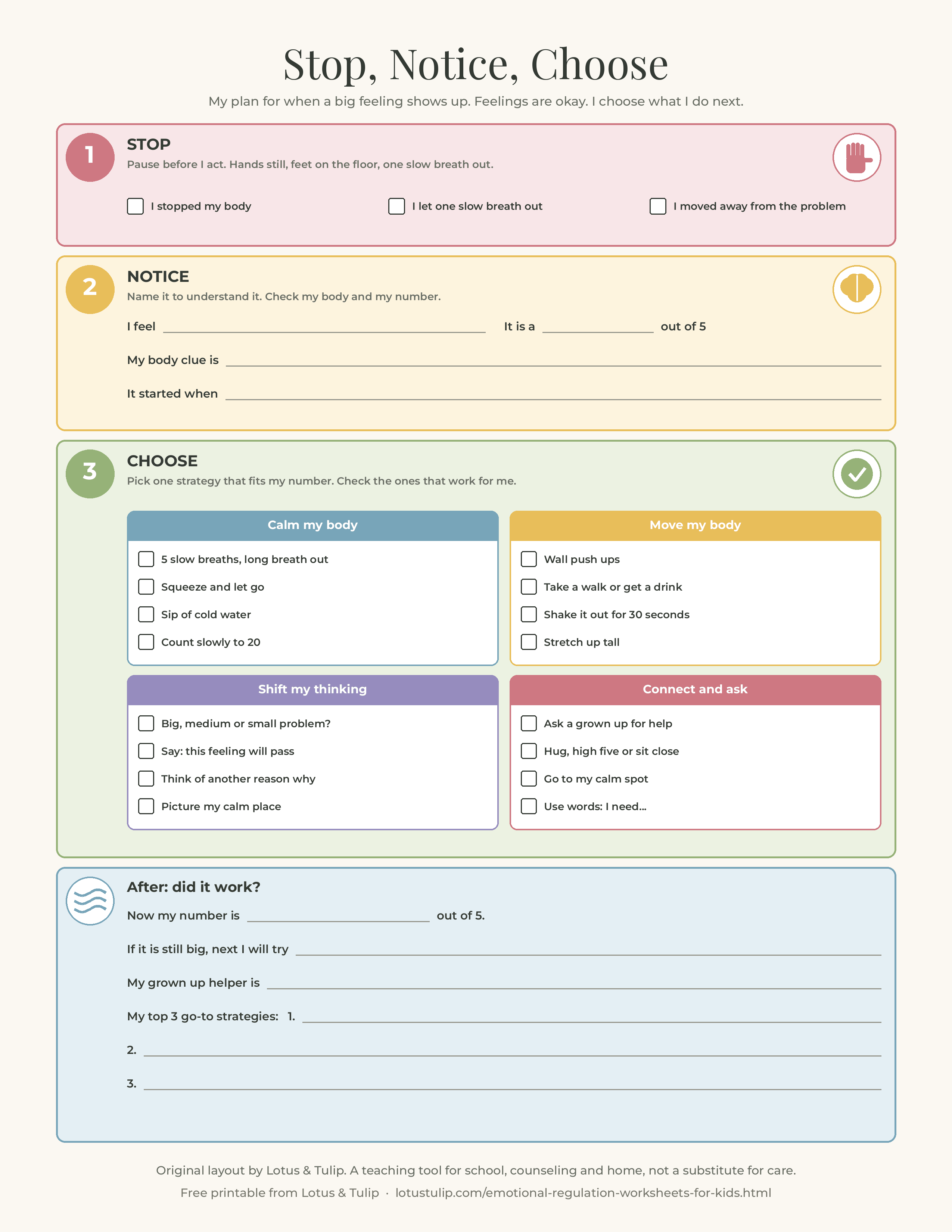
Children cannot use a complicated process when a feeling is already at a 4 out of 5. They need something short enough to remember in the moment and concrete enough to practice when calm. Our free printable is built around three steps:
- Stop. Pause the body before acting: hands still, feet on the floor, one slow breath out, or step away from the problem. This buys a few seconds between the feeling and the action.
- Notice. Name the feeling, rate it from 1 to 5, and spot the body clue. This draws on the idea of affect labeling and helps the child pick a strategy that fits the size of the feeling.
- Choose. Pick one strategy from a personal menu: calm the body, move the body, shift the thinking, or connect and ask for help. Then check: did it work? If not, try another.
The routine is deliberately plain. It is not a branded program, and there is nothing magic about the words. What matters is that the child practices it many times while calm so that it is available when upset. You can use it next to whatever language your school already uses.
Know the signals: body clues and feelings intensity
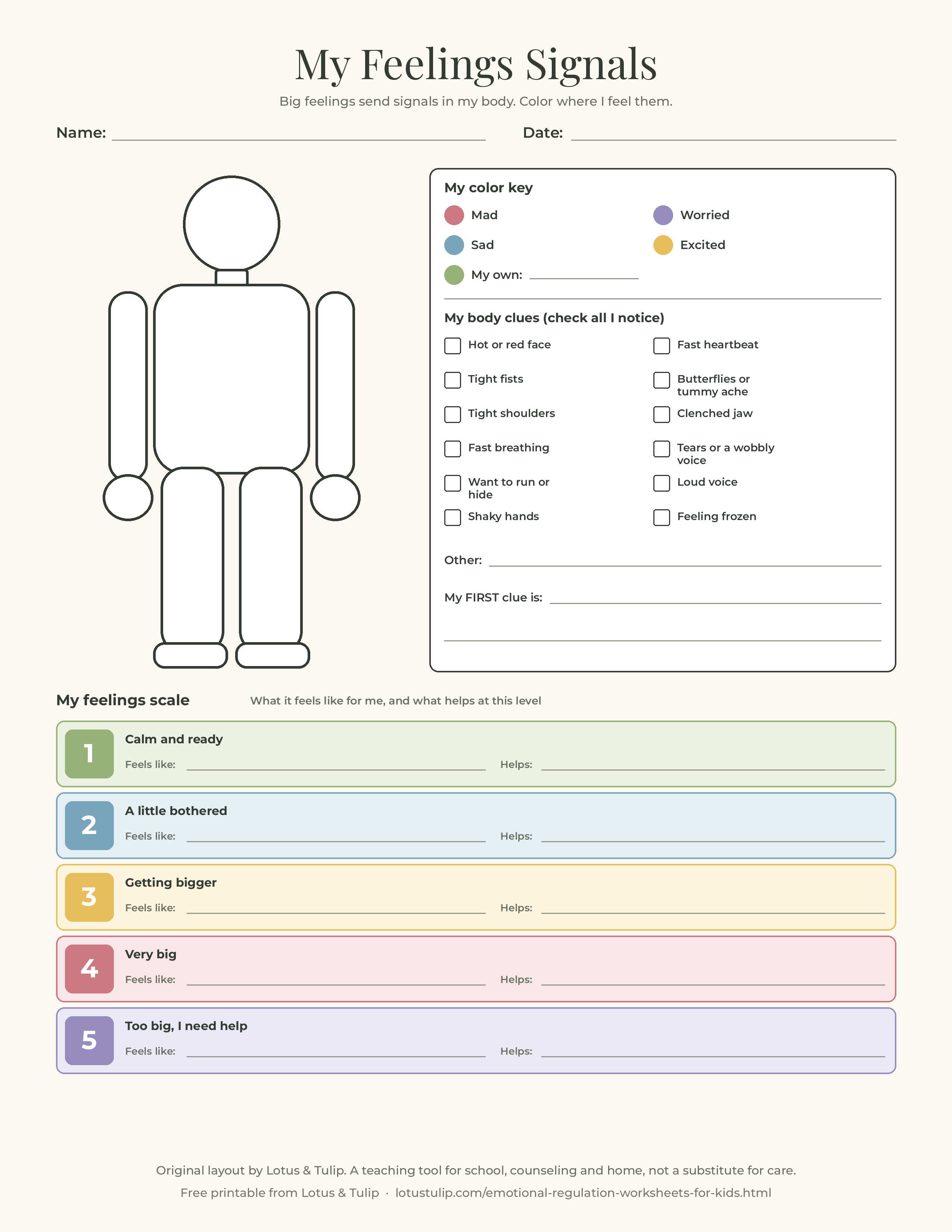
Most children notice a feeling only when it is already huge. The earlier they can spot it, the more strategies will still work. Body clues are the easiest place to start because they are concrete: hot face, tight fists, fast heartbeat, butterflies, clenched jaw, a wobbly voice, wanting to run or hide, feeling frozen. Page 1 of the printable asks children to color where they feel different emotions on a body outline, check their own clues, and write down their very first clue. For more feeling words, pair it with our feelings wheel printable.
Next comes intensity. A 1 to 5 scale ("calm and ready" up to "too big, I need help") helps children understand that the same feeling comes in different sizes, and that different sizes need different tools. At a 2, a child might just need to name it and keep going. At a 4, thinking strategies are usually too hard; the body needs to calm first. At a 5, the job is to get safe and get an adult. Our feelings thermometer printable goes deeper on intensity, and older children and teens may connect with the idea of staying inside their comfort range, covered in our window of tolerance worksheet.
Self regulation strategies for kids, sorted by when they work
The process model suggests a useful way to organize strategies: some work best before a feeling gets big, some during, and some after. Most "calm down" lists only cover the middle. Here is a fuller menu.
Before: plan ahead (situation selection and modification)
- Spot predictable triggers. Transitions, losing games, hunger after school, crowded hallways. A trigger the child can name is a trigger they can plan for.
- Change the setup. A heads up before transitions, a visual schedule, a quieter seat, a snack before homework, a break card the child can use without asking out loud.
- Practice the hard thing in small doses. Play short games where losing is expected and celebrated as practice.
During, when the feeling is small to medium (attention and thinking)
- Shift attention. Count backward, name five things you can see, think about a favorite place. Our 5 4 3 2 1 grounding worksheet turns this into a routine. Distraction is a short-term tool, not a way of life, but it helps.
- Size the problem. Ask "is this a big, medium or small problem?" and "does my reaction match the problem?" Our size of the problem worksheet has scenario cards for practice.
- Think of another explanation. "Maybe she didn't wave because she didn't see me." This is reappraisal for kids, and it is among the more promising strategies in the research.
- Use a coping phrase. "This feeling will pass." "I can do hard things." "I can ask for help."
During, when the feeling is big (body first)
- Slow breathing with a long breath out. See our breathing exercises for kids for child friendly versions like balloon and five finger breathing.
- Move. Wall push ups, a walk, jumping, shaking out arms and legs. Movement uses up the energy a big feeling brings.
- Squeeze and release, cold water, a drink. Simple sensory resets. Teens may like the temperature and intense exercise ideas in our DBT TIPP skills worksheet.
- Go to a calm spot. Not as a punishment, but as a place the child chooses. Our guide to calm down corner ideas covers setup and how to keep it from becoming an escape.
- Connect. Sit close to a trusted adult, a hug, or simply a calm voice saying "I'm here." Co-regulation is a strategy too, at every age.
After: reflect and repair
- Debrief when calm, not during. What happened, what did your body feel, what did you try, what will you try next time?
- Repair. If someone was hurt, help the child make it right. This is a skill, not a punishment.
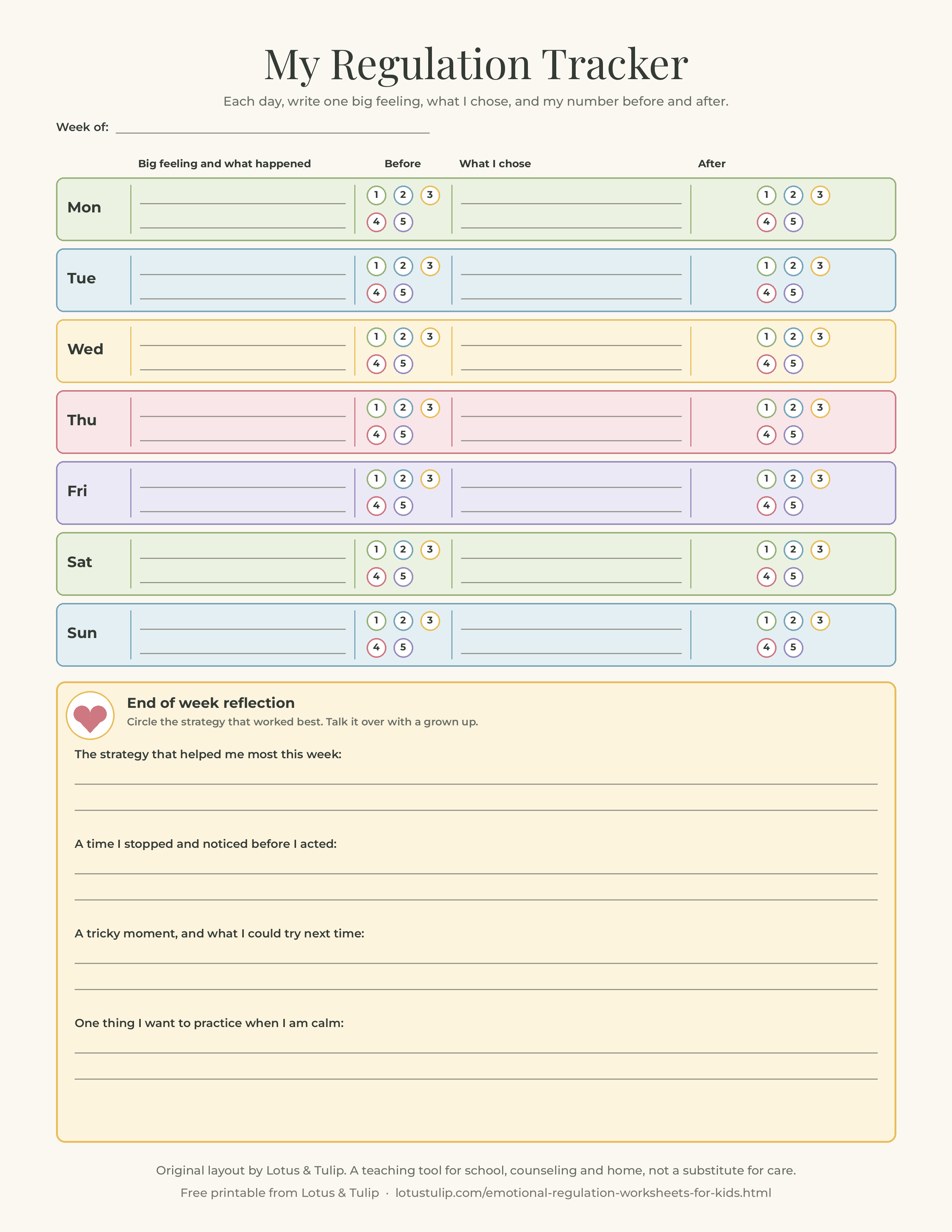
- Track it. A simple weekly tracker (page 3 of our printable) helps children and adults see patterns: which times of day, which triggers, which strategies actually lower the number.
For a longer list of tools a child can choose from, see our coping skills list for kids. For anger in particular, the anger iceberg worksheet helps children look at the feelings underneath. For worry, use the worry worksheet for kids.
How to teach emotional regulation to kids, step by step
- Regulate yourself first. Before you respond to a child's big feeling, check your own: slow your breathing, lower your voice, soften your face. Your calm is the first strategy the child borrows.
- Teach when calm, not in the meltdown. Introduce feelings words, the 1 to 5 scale and strategies during calm, everyday moments. Nobody learns a new skill at a 5.
- Map the body clues. Use the My Feelings Signals page to help the child color where they feel different emotions and identify their very first warning sign.
- Build a shared feelings scale. Fill in what each level from 1 to 5 looks and feels like for this particular child, and what helps at each level.
- Introduce Stop, Notice, Choose. Model it out loud yourself ("I'm noticing I'm frustrated, about a 3, my shoulders are tight, I'm going to take a breath"), then walk the child through it with low stakes examples.
- Let the child choose their own strategy menu. Try out each strategy together, then let the child check the ones that actually work for them. A strategy they picked is a strategy they will use.
- Practice in small, real situations. Rehearse with role play and games, then coach in mild real moments (a small disappointment, a short wait) before expecting it in big ones.
- Coach in the moment, briefly. When a feeling rises, offer short prompts: "Stop. What number?" "Which one from your menu?" Fewer words work better as feelings get bigger.
- Reflect and track over time. Use the weekly tracker to look back together, celebrate any time the child stopped before acting, adjust the plan, and slowly fade your prompts as the child takes over.
Emotional regulation activities for kids
Practice works best when it is short, active and repeated. These activities are suitable for counseling sessions, classrooms and home.
- Feelings charades. Act out a feeling with face and body only; others guess the feeling and the number on the 1 to 5 scale.
- Body clue detective. After reading a picture book, pause and ask: "What might the character's body be feeling? What was their first clue?"
- Strategy taste test. Try one strategy a day for a week when calm, then rate it with a thumbs up, sideways or down. Keep the winners on the menu.
- Turn it up, turn it down. Play music or a drumbeat; children move fast for high energy and slow for low energy, practicing shifting on purpose.
- Freeze games. Simon says, red light green light and freeze dance give younger children fun, low stakes practice in stopping.
- Problem size sort. Sort scenario cards into big, medium and small piles and match each to a reaction size.
- Another reason why. Read a frustrating situation and brainstorm three other explanations. This is reappraisal practice disguised as a game.
- Calm kit build. Children make a small box or bag with items that help them (a stress ball, a picture, a breathing card) and practice using it.
- Breathing buddies. Younger children lie down with a stuffed animal on their belly and watch it rise and fall with slow breaths.
- Stop, Notice, Choose role play. Act out common triggers (being told no, losing a game, a friend saying something mean) and practice the routine aloud.
- Daily check ins. A quick morning rating of feelings and energy, like our daily check in for students, builds the habit of noticing.
- Weekly wins. End each week by reading the tracker together and naming one moment the child is proud of handling.
Emotional regulation for teens
Teens often reject anything that looks babyish, and they have good reason to want privacy. Adapt rather than abandon the same ideas:
- Use their language: "stress level," "how loud is it in your head," or a 1 to 10 scale instead of colors or cartoons.
- Emphasize thinking strategies and planning ahead, which suit their growing abilities, while keeping body strategies available for very high stress.
- Explore the connection between sleep, screens, caffeine and mood without lecturing. Simple self monitoring often teaches more than advice.
- Offer choice and privacy, such as a tracker kept in their own notebook or phone, shared only if they want.
- Many teens find structured skills like those in DBT useful; a therapist can tell you whether a formal DBT program is appropriate.
Tips for counselors and teachers
- Make it classwide. A short daily check in and a shared strategy menu on the wall reduce stigma and give everyone the same language.
- Use SAFE principles. Lessons that are sequenced, active, focused and explicit were linked to better outcomes in the Durlak meta-analysis. One poster is not a curriculum.
- Plan for transitions. Many classroom meltdowns cluster around changes of activity. A heads up, a timer and a clear first step help.
- Offer a non-verbal way to ask for a break. A card on the desk lets a child at a 4 get help without having to talk.
- Debrief privately. Never process a child's meltdown in front of peers. Use the tracker one to one, later.
- Connect with home. Send the strategy menu home so parents use the same words. Consistency across settings was one of the recommendations in the OPRE intervention review.
- Run a small group. Children who need more practice benefit from a short, structured group with explicit skills, role play and weekly tracking.
Tips for parents: co-regulation at home
Eisenberg, Cumberland and Spinrad's 1998 review of how parents socialize emotion concluded that how adults respond to children's emotions matters. Punitive or dismissive reactions ("stop being a baby," "there's nothing to cry about") were generally associated with poorer emotional competence, while supportive responses and talking about emotions were generally associated with better outcomes. These are mostly correlational findings, but they match what most families notice. In practice:
- Connect before you correct. "You're really frustrated. That game was hard to lose." Then, when calmer, deal with the thrown pieces.
- Accept all feelings, not all behaviors. "It's okay to be angry. It's not okay to hit. Let's find another way."
- Keep your words few during a meltdown. Stay close, stay calm, and save the lesson for later.
- Protect the basics. Sleep, food and movement make everything easier. A tired, hungry child has a much shorter fuse.
- Name your own feelings and strategies. "I'm getting stressed about being late, so I'm going to take a breath." Children learn regulation by watching.
- Celebrate attempts. Notice every time the child stops, names a feeling or tries a strategy, even if it does not fully work.
Common mistakes to avoid
- Teaching only during meltdowns. Skills need to be learned when calm to be usable when upset.
- Treating calm as the only goal. The aim is flexible handling of feelings, not a child who never feels upset.
- Using the calm spot as a time out. If the calm corner feels like punishment, children will avoid it.
- Too many strategies. Three to five well practiced tools beat a list of thirty.
- Using colors or numbers to judge children. "You're on a 5 again" can shame. Use the scale to help, not to label.
- Expecting worksheets to do it alone. Worksheets structure practice; relationships and repetition do the teaching.
- Ignoring the adult side. If adults yell, the child learns yelling. Your own regulation is part of the intervention.
When regulation struggles are a sign of something more
All children have meltdowns. Talk to your child's pediatrician, school counselor or a licensed mental health professional if outbursts are frequent, very intense or last a long time for the child's age; if they happen in most settings and are getting worse; if the child often hurts themselves, others or property; if the child seems persistently sad, anxious or irritable; if regulation problems sit alongside signs of ADHD, autism, learning difficulties, sleep problems or trauma; or if school, friendships or family life are seriously affected. These patterns do not mean something is "wrong" with a child, but they often mean the child needs assessment and more support than a worksheet can provide. If a child talks about wanting to die or about harming themselves, take it seriously and get help right away. In the US, call or text 988 (the Suicide and Crisis Lifeline) any time for support, or call 911 if someone is in immediate danger. A worksheet is a teaching tool, not a substitute for assessment or treatment.
Free emotional regulation worksheets printable (PDF)
This free printable is an original Lotus & Tulip design, sized for US Letter paper and suited to about ages 6 to 12 (elementary and early middle school), counseling sessions, small groups, classrooms and home. Younger children can use it with an adult writing for them, and older students can adapt it. It has three pages:
- Page 1: My Feelings Signals. A body outline to color with a personal color key (mad, worried, sad, excited and your own), a checklist of twelve body clues, a space for "my first clue," and a 1 to 5 feelings scale from "calm and ready" to "too big, I need help" with room to write what each level feels like and what helps.
- Page 2: Stop, Notice, Choose. The three step regulation plan: Stop with three body checks, Notice with "I feel," "it is a _ out of 5," body clue and trigger lines, and Choose with a sixteen item strategy menu in four groups (calm my body, move my body, shift my thinking, connect and ask), plus an "after: did it work?" check, a grown up helper and a top three strategies list.
- Page 3: My Regulation Tracker. A Monday to Sunday tracker for one big feeling a day, a before and after number from 1 to 5 and the strategy chosen, plus an end of week reflection: what helped most, a time I stopped and noticed before acting, a tricky moment and what to try next, and one thing to practice when calm.
Download the free emotional regulation worksheets printable (PDF, 3 pages, US Letter)
Prefer single images? Page 1: My Feelings Signals body map (PNG) · Page 2: Stop, Notice, Choose regulation plan (PNG) · Page 3: My Regulation Tracker (PNG)
Free to print for your own use and for use with your own students, clients or children. Please link to this page rather than re-uploading the file.
Related resources
- Frustration tolerance worksheets for kids: what to do in the stuck moment, with a free frustration meter
- Interoception activities for kids (free printable): help children notice body clues before feelings get big
- Coping skills list for kids (free printable)
- Breathing exercises for kids (free printable)
- Calm down corner ideas (free printable)
- Feelings thermometer printable
- Feelings wheel printable
- Size of the problem worksheet (free printable)
- Window of tolerance worksheet (free printable)
- Worry worksheet for kids (free printable)
- Skin picking and hair pulling worksheets for kids: a habit detective page and busy hands plan for kids who pick or pull
Sources
- Aldao, A., Nolen-Hoeksema, S., and Schweizer, S. (2010). Emotion-regulation strategies across psychopathology: a meta-analytic review. Clinical Psychology Review, 30(2), 217 to 237.
- CASEL. What is the CASEL framework? Collaborative for Academic, Social, and Emotional Learning, casel.org.
- Durlak, J. A., Weissberg, R. P., Dymnicki, A. B., Taylor, R. D., and Schellinger, K. B. (2011). The impact of enhancing students' social and emotional learning: a meta-analysis of school-based universal interventions. Child Development, 82(1), 405 to 432.
- Eisenberg, N., Cumberland, A., and Spinrad, T. L. (1998). Parental socialization of emotion. Psychological Inquiry, 9(4), 241 to 273.
- Eisenberg, N., Spinrad, T. L., and Eggum, N. D. (2010). Emotion-related self-regulation and its relation to children's maladjustment. Annual Review of Clinical Psychology, 6, 495 to 525.
- Gross, J. J. (1998). The emerging field of emotion regulation: an integrative review. Review of General Psychology, 2(3), 271 to 299.
- Lieberman, M. D., Eisenberger, N. I., Crockett, M. J., Tom, S. M., Pfeifer, J. H., and Way, B. M. (2007). Putting feelings into words: affect labeling disrupts amygdala activity in response to affective stimuli. Psychological Science, 18(5), 421 to 428.
- Mason, B. K., Leaf, J. B., and Gerhardt, P. F. (2024). A research review of the Zones of Regulation program. The Journal of Special Education.
- Moffitt, T. E., et al. (2011). A gradient of childhood self-control predicts health, wealth, and public safety. Proceedings of the National Academy of Sciences, 108(7), 2693 to 2698.
- Murray, D. W., Rosanbalm, K., Christopoulos, C., and Hamoudi, A. (2015). Self-Regulation and Toxic Stress: Foundations for Understanding Self-Regulation from an Applied Developmental Perspective. OPRE Report 2015-21. Administration for Children and Families, US Department of Health and Human Services.
- Murray, D. W., Rosanbalm, K., and Christopoulos, C. (2016). Self-Regulation and Toxic Stress Report 3: A Comprehensive Review of Self-Regulation Interventions from Birth through Young Adulthood. OPRE Report 2016-34. Administration for Children and Families, US Department of Health and Human Services.
- Rosanbalm, K. D., and Murray, D. W. (2017). Caregiver Co-regulation Across Development: A Practice Brief. OPRE Brief 2017-80. Administration for Children and Families, US Department of Health and Human Services.
- Webb, T. L., Miles, E., and Sheeran, P. (2012). Dealing with feeling: a meta-analysis of the effectiveness of strategies derived from the process model of emotion regulation. Psychological Bulletin, 138(4), 775 to 808.
- The Zones of Regulation® is a registered trademark of its owner, created by Leah Kuypers. Lotus & Tulip is not affiliated with, endorsed by or connected to The Zones of Regulation.
Emotional regulation worksheets for kids: FAQ
What is emotional regulation in kids?
Emotional regulation is a child's growing ability to notice feelings, manage how strong they get and choose how to express them. It is not about never being upset; it is about handling feelings flexibly. Young children rely heavily on adults (co-regulation) and gradually take over more of the job themselves through childhood and adolescence.
At what age do kids learn to regulate their emotions?
Regulation develops gradually from infancy into early adulthood. Preschoolers begin to use simple words and brief waiting, elementary age children can learn and use specific strategies with reminders, and older children can plan ahead for triggers. Even teens and adults still need support from others when stress is high, so co-regulation never fully disappears.
What are some self regulation strategies for kids?
Useful strategies include slow breathing with a long breath out, movement such as wall push ups or a short walk, squeezing and releasing muscles, a sip of cold water, counting or grounding, sizing the problem, thinking of another explanation, using a coping phrase, going to a calm spot, and asking a trusted adult for help. Plan ahead strategies, like warnings before transitions, count too.
Do emotional regulation worksheets actually work?
Worksheets give structure to practice, but they are not effective on their own. Research on school social and emotional learning programs shows modest benefits when skills are taught in a sequenced, active, explicit way and practiced consistently. Use worksheets as part of regular teaching, coaching and reflection with a supportive adult.
What is the difference between self regulation and emotional regulation?
Emotional regulation is about managing feelings. Self regulation is broader and includes managing attention, thoughts and behavior, such as waiting a turn, shifting between tasks and sticking with hard work. In practice they overlap heavily, and CASEL groups them together under self-management.
Is this the same as The Zones of Regulation?
No. The Zones of Regulation® is a trademarked program created by Leah Kuypers, and Lotus & Tulip is not affiliated with it. Our free printable uses its own original Stop, Notice, Choose routine and a 1 to 5 feelings scale. You can use it alongside whatever framework your school already uses.
When should I worry about a child's emotional outbursts?
Talk to a pediatrician, school counselor or licensed mental health professional if outbursts are frequent, very intense or long lasting for the child's age, happen across most settings, involve hurting themselves or others, or come with persistent sadness, anxiety or serious problems at school or home. In the US, call or text 988 for crisis support, or 911 in an emergency.