
Kids and teens · School counseling · Updated 2026-11-04
Conflict resolution worksheet: steps, activities and scenarios for kids and students, with a free printable
Ready-made printable: Social Skills Small Group Curriculum for School Counselors, Grades 2 to 5 Holiday 20% off: about $11.04, was $14 (EUR 12) · instant digital download
Buy on Etsy
Two students both want the last red marker. Two friends both want to choose the recess game. A group project falls apart because one partner did not do their half. None of these is an emergency, but each one can turn into shouting, tears or a trip to the office if nobody knows what to do next. Conflict resolution is the set of skills that lets children work out problems like these with words. This guide is for US school counselors, teachers, child and family therapists and parents. It explains what conflict resolution means for kids, how ordinary conflict differs from bullying, what the research on school conflict resolution programs actually shows, a six step process students can learn, how to teach it, activities for classrooms and small groups, and how to use the same steps at home. It ends with a free three page printable: a six step problem solving worksheet, 18 conflict scenario cards plus blanks, and a win-win planner for a peace talk.
Jump to the free conflict resolution worksheet
What is conflict resolution for kids?
A conflict is a disagreement in which two people want different things, or want the same thing and cannot both have it. Conflict is a normal part of growing up. Children share space, toys, time, attention and friends all day, so disagreements are guaranteed. The goal is not a classroom with no conflict. The goal is students who can handle conflict without hurting anyone and, ideally, find a solution that works for both sides.
Conflict resolution for kids usually means a few teachable skills used in order: calming down first, saying what you feel and need without blaming, listening to the other side, naming the problem fairly, thinking of several possible solutions, agreeing on one that is fair to both, and checking later whether it worked. Adults use the same skills in families, workplaces and negotiations. Children simply need them broken into smaller, more concrete steps, with lots of practice on low stakes problems.
In the CASEL framework that many US schools use for social and emotional learning, conflict resolution sits mainly under relationship skills, which CASEL describes as including the capacity to "work collaboratively to problem solve and negotiate conflict constructively", with "resolving conflicts constructively" listed as an example. It also draws on self-management (calming down), social awareness (taking the other person's perspective) and responsible decision-making (identifying solutions and thinking about consequences). That makes it a useful skill to name when you document SEL goals or plan a Tier 2 group.
Conflict or bullying? Know the difference first
Before teaching any conflict resolution steps, adults need to be clear about one thing: bullying is not a conflict, and it should not be handled with peer mediation or a "work it out together" talk. The US government site StopBullying.gov describes bullying as unwanted, aggressive behavior among school aged children that involves a real or perceived power imbalance and is repeated, or has the potential to be repeated, over time.
- A conflict is usually between people with roughly equal power. Both sides have something they want, both may share some responsibility, and both can take part in finding a solution.
- Bullying is one sided. One student uses power (size, popularity, numbers, information) to hurt another, again and again or with the threat of it happening again.
Putting a targeted child in a room with the student who bullies them and asking them to "find a win-win" sends the message that both share the blame, and it can make things worse. StopBullying.gov specifically advises against using conflict resolution or peer mediation for bullying. Bullying needs adult action under your school's policy. The worksheet in this guide includes a clear "stop and get an adult right away" box for exactly this reason, and the same applies whenever someone is hurt, scared, threatened, or the problem involves safety.
What does the research say?
School conflict resolution education has been studied for decades, and the evidence is encouraging, with honest limits.
In 1996, David W. Johnson and Roger T. Johnson of the University of Minnesota reviewed the research on conflict resolution and peer mediation programs in elementary and secondary schools in the journal Review of Educational Research. They noted many methodological problems in the studies, but concluded that conflicts among students happen often, that untrained students tend to use strategies that ignore the ongoing relationship and lead to destructive outcomes, that training does seem to teach students negotiation and mediation procedures, that trained students tend to use them, and that this tends to reduce the number of student conflicts referred to teachers and administrators.
A later meta-analysis by Wendy Garrard and Mark Lipsey, published in Conflict Resolution Quarterly in 2007, pooled 36 controlled studies of conflict resolution education in US K to 12 schools, covering 4,971 students. Students who took part showed less antisocial behavior than comparison students, with an overall effect size of .26. The effects were larger for teenagers aged about 14 to 17 (.53) and young adolescents aged about 10 to 13 (.22) than for children aged about 5 to 9 (.06), and different program types, such as peer mediation and direct skills teaching, produced similar results. The authors were careful to say the research base is small and uneven in quality.
What this means in practice: teaching conflict resolution skills is a reasonable, evidence informed use of class or group time, especially from upper elementary onward. For the youngest students, keep expectations realistic. They benefit from a very short script, lots of adult coaching and repetition, and calm down skills first.
Positions and interests: the idea that makes win-win possible
One of the most useful ideas for students comes from the field of negotiation. In Getting to Yes (1981), Roger Fisher and William Ury of the Harvard Negotiation Project described four principles: separate the people from the problem, focus on interests rather than positions, invent options for mutual gain, and use objective criteria. The second principle is the one children can grasp quickly.
A position is what someone says they want: "I want the orange." An interest is why they want it. The book tells the story of two sisters arguing over one orange. They split it in half. One sister eats the fruit of her half and throws away the peel. The other uses the peel of her half to bake a cake and throws away the fruit. If they had asked each other why, each could have had everything she needed.
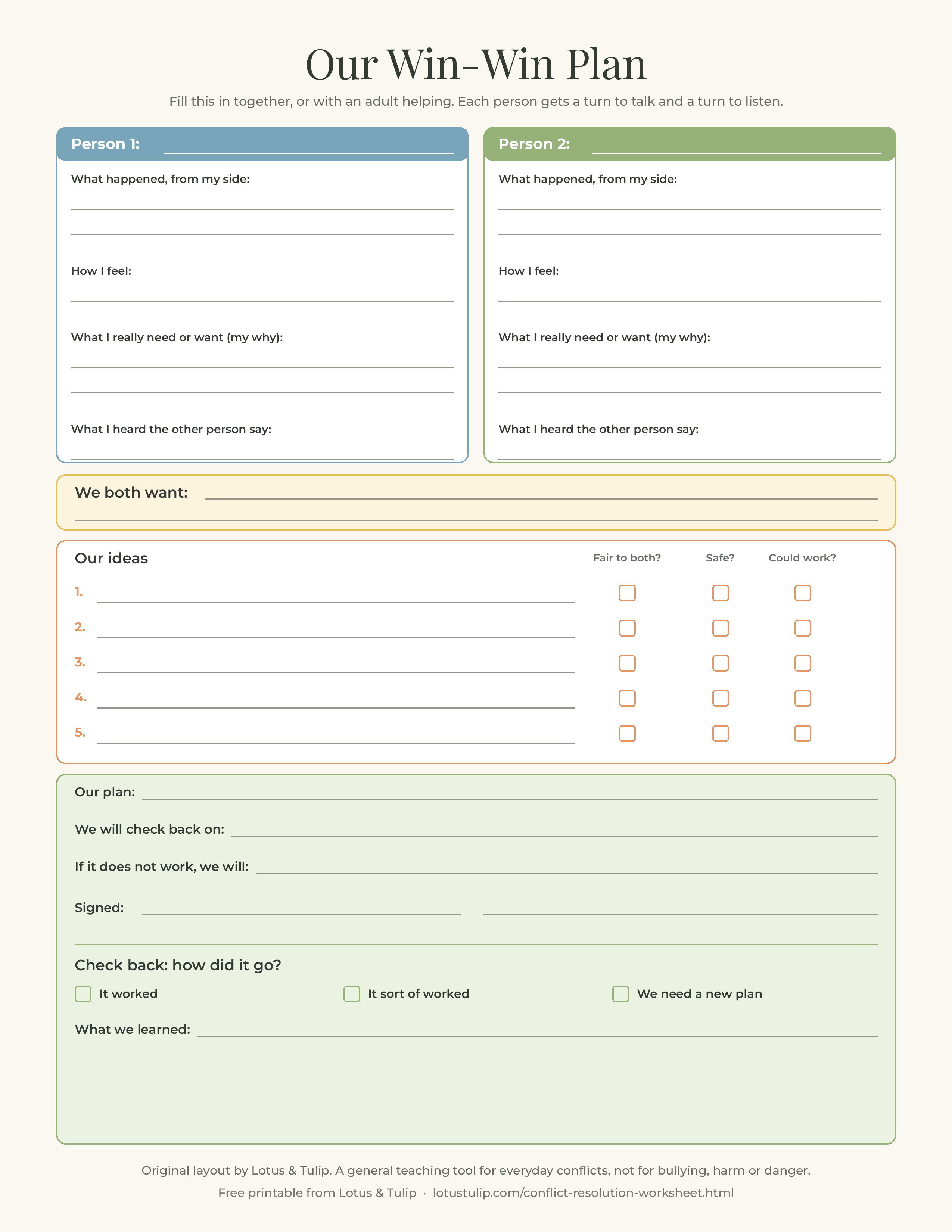
Students meet the same pattern all the time. Two kids fight over the same chair, but one wants to see the board and the other wants to sit next to a friend. Two friends argue about which game to play, but one mostly wants to run around and the other wants to be included. When students learn to ask "What do you really need?", solutions appear that neither saw when they were stuck on positions. Page 3 of the printable has a "What I really need or want (my why)" line for each person for this reason.
The six conflict resolution steps for students
There are many good versions of conflict resolution steps. The one on the free worksheet uses six, written in kid friendly words:
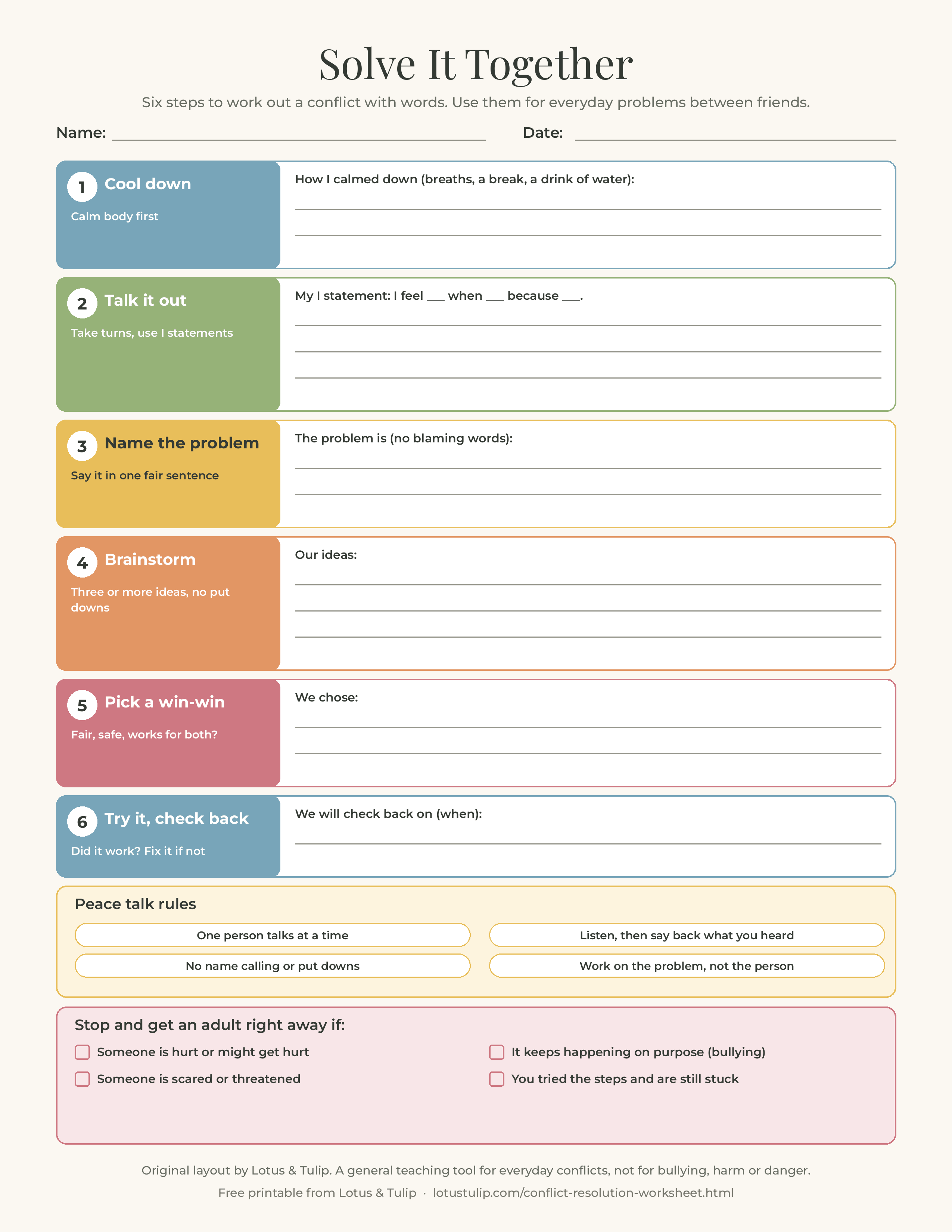
- Cool down. Nobody solves a problem while their heart is racing. Take some slow breaths, take a short break, get a drink of water, or use a calm down spot. If either person is still too upset, wait.
- Talk it out. Take turns. Each person says what happened from their side using an I statement, such as "I feel frustrated when the game changes in the middle, because I thought we agreed." The listener says back what they heard before replying.
- Name the problem. Together, say the problem in one fair sentence with no blaming words: "We both want the red marker, and there is only one."
- Brainstorm. Think of at least three possible solutions. No put downs while brainstorming; silly ideas are allowed because they often lead to good ones.
- Pick a win-win. Check each idea: is it fair to both of us, is it safe, and could it actually work? Choose one you both agree to.
- Try it and check back. Agree when you will check whether it worked. If it did not, go back to step 4 or ask an adult for help.
For kindergarten and first grade, shrink this to three steps: calm down, say how you feel, pick a fair idea. Many early elementary classrooms use a short menu of choices such as take turns, share, trade, play something else or ask an adult. Some schools use branded programs with their own steps or wheels; the free worksheet here is an original, general tool and is not tied to any program, so it can sit alongside whatever your school already uses.
How to teach conflict resolution, step by step
- Teach it on a calm day. Introduce the steps when nothing is going on, not in the middle of a fight. Students learn a script far better when they are not upset, and it is ready when they need it.
- Build feelings vocabulary first. Children cannot say "I feel left out" if they only know mad, sad and happy. Use a feelings wheel and practice naming feelings in stories and pictures.
- Practice calm down skills. Step 1 only works if students have a few calming strategies they have already practiced. The coping skills list for kids and the calm down corner steps help here.
- Separate conflict from bullying. Teach students the difference in plain words: a conflict is a disagreement between people who both have a say, while bullying is someone using power to hurt someone else on purpose, often again and again. Tell them bullying always goes to an adult.
- Model the six steps out loud. Act out a small conflict with a colleague or a puppet and narrate each step. Then act it out badly and ask students to spot which step was skipped.
- Teach I statements and listening. Step 2 rests on two skills: saying how you feel without blame and repeating back what you heard. The I statements worksheet has a full lesson and practice cards.
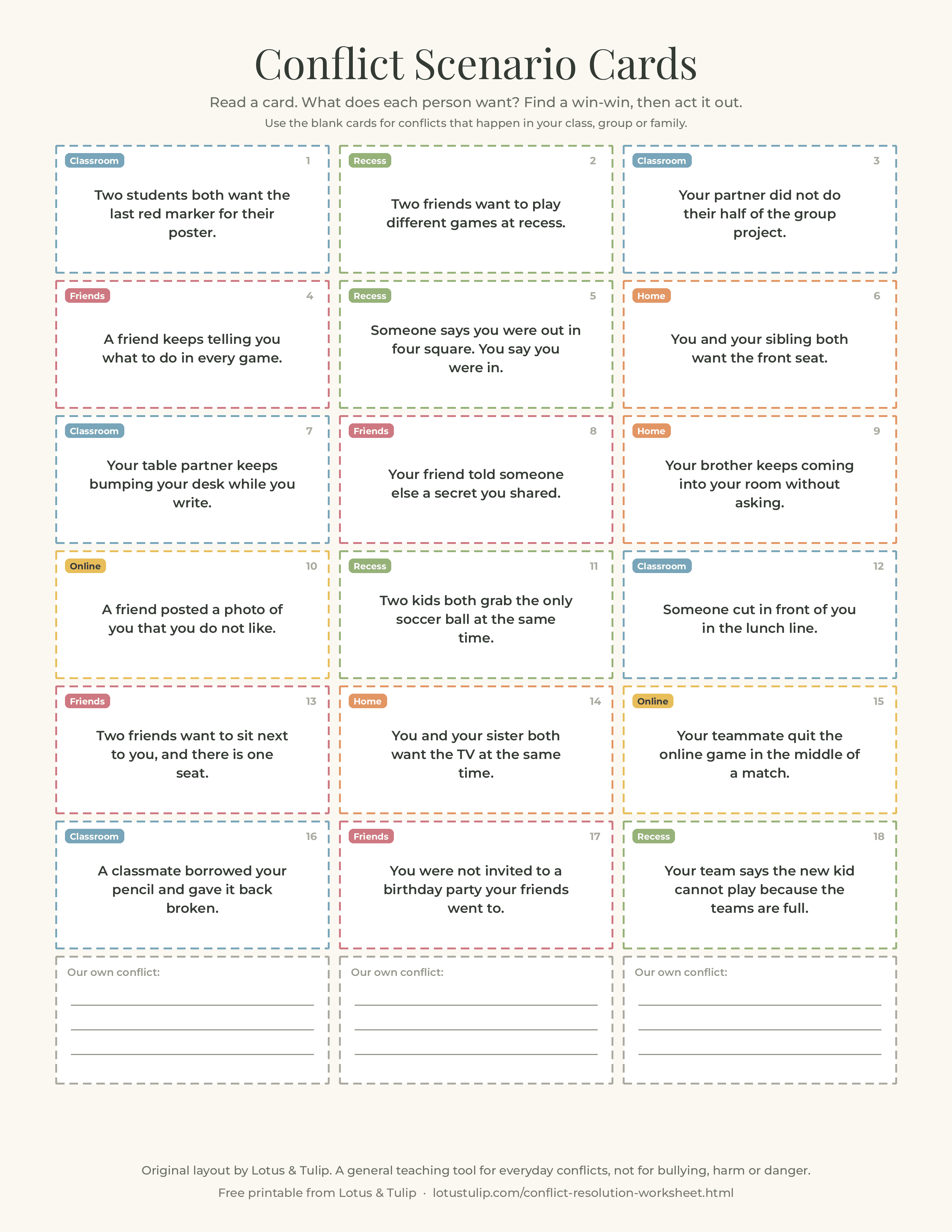
- Practice with scenario cards. Use the 18 scenario cards on page 2. In pairs, students pick a card, decide what each person might really want, brainstorm three solutions and act out the one they choose.
- Coach real conflicts with the planner. When a real, everyday conflict happens and both students are calm, sit with them and fill in the win-win plan on page 3. Over time, step back and let them lead.
- Check back and celebrate effort. A day or two later, ask how the plan is going. Praise students for trying the steps, even when the first plan did not work, and help them pick a new one if needed.
Conflict resolution activities for kids and students
- The orange problem. Hold up an orange and tell the two sisters story, stopping before the ending. Ask groups to suggest solutions, then reveal what each sister really wanted. Follow up with "What do you really need?" on a few scenario cards.
- Scenario card role plays. Pairs draw a card, act out the conflict for 30 seconds, then freeze. The audience suggests which step comes next, and the actors try it.
- Brainstorm race. Give small groups one scenario and two minutes to list as many solutions as possible, then sort them into fair to both, fair to one, and unsafe.
- Win-win, win-lose, lose-lose. For one scenario, ask students to invent an outcome where both lose, one where one person wins, and one where both get what they need. Discuss which feels best a week later.
- Fix the skipped step. Read a short story where two characters skip cooling down or jump straight to a solution. Students find the missing step and rewrite the ending.
- Peace talk spot. Set up two chairs, a copy of the six steps and a few win-win plans. Students can ask to use the spot when they have a conflict, with an adult nearby.
- Exit ticket. Each student writes one conflict that happened this week (no names) and which step would have helped most.
For students who argue about how big a problem is, pair this with the size of the problem worksheet. A student who rates a broken pencil like an emergency is not ready for step 2 yet.
Conflict resolution for middle and high school students
Older students handle the same six steps, but their conflicts look different: group chat drama, friendship breakups, rumors, dating conflicts, sports teams and arguments with parents about rules. Teenagers also tend to reject anything that feels babyish, so adapt the language and the scenarios.
- Talk about conflict styles: avoiding, giving in, competing, compromising and collaborating. Ask students which style they use most with friends and with family, and when each one makes sense.
- Write scenarios from their world, such as a screenshot shared without permission, being left out of a group chat, or a teammate who keeps missing practice.
- Practice online conflict skills: waiting before replying, moving a hard conversation from text to in person, and not adding to a pile on.
- Consider a peer mediation program if your school has the staff to train and supervise it. The research above found peer mediation and direct skills teaching produced similar results, so either can work.
Our middle school friendship group covers group chats, conflict and repair over eight sessions, including a five step conflict plan and an I statement practice page.
Using conflict resolution steps at home
Sibling fights are the most common conflicts many children face, and the same steps work at home. When a fight starts, separate first and let everyone cool down. Then sit both children down and give each a turn to talk while the other listens and repeats back. Ask, "What do you each really want?" and invite them to brainstorm solutions before you suggest any. Write the agreed plan on page 3 of the printable and stick it on the fridge.
A few habits help: resist deciding who started it, since that usually restarts the fight; praise children when they work something out on their own; and model the steps in your own disagreements, out loud. "I feel frustrated when we're running late, because I hate rushing. Let's think of three ways to make mornings easier" teaches more than any worksheet.
Step in right away, rather than coaching, if anyone is being hurt, if one child is much older or stronger and keeps overpowering the other, or if the same child is always the target. That is not a fair conflict anymore.
Common mistakes
- Skipping the cool down. Starting the talk while someone is still furious usually makes it worse.
- Forcing an apology. "Say sorry" on command teaches words without meaning. Invite repair once the problem is understood.
- The adult solves it. Handing down a solution ends the conflict today but teaches nothing for tomorrow. Coach the steps instead.
- Treating bullying as a conflict. Never mediate bullying. Follow your school's bullying policy.
- Only teaching it after trouble. If students only hear about conflict resolution when they are in trouble, they learn that it is a punishment.
- Expecting a perfect solution. Many conflicts end in a fair compromise rather than a perfect win-win, and that is fine. The skill is working it out without harm.
Free conflict resolution worksheet (printable PDF)
This free printable is an original Lotus & Tulip design, sized for US Letter paper. It has three pages:
- Page 1: Solve It Together. The six steps (cool down, talk it out, name the problem, brainstorm, pick a win-win, try it and check back) with writing space for each, four peace talk rules, and a "stop and get an adult right away" checklist.
- Page 2: conflict scenario cards. 18 numbered everyday conflicts from the classroom, recess, friendships, home and online, plus 3 blank cards for conflicts from your own class or family.
- Page 3: our win-win plan. A peace talk planner for two people: what happened from each side, feelings, what each person really needs, what each heard, what we both want, five ideas with fair, safe and could work checks, the plan, a check back date and a short reflection.
Download the free conflict resolution worksheet (PDF, 3 pages, US Letter)
Prefer single images? Page 1: six step worksheet (PNG) · Page 2: 18 scenario cards and 3 blanks (PNG) · Page 3: win-win plan (PNG)
Free to print for use with your own students, clients or children. Please link to this page rather than re-uploading the file. A general teaching tool for everyday conflicts, not for bullying, harm or safety concerns, and not a substitute for individual counseling.
Related resources
- Sibling rivalry worksheets for kids: when the conflicts are between brothers and sisters, free sibling feelings map and fair play plan
- Tattling vs telling worksheet (free printable): when to tell an adult, with a 12 scenario sort and a telling plan
- I statements worksheet (free printable)
- Size of the problem worksheet (free printable)
- Positive self talk worksheet (free printable)
- Anger iceberg worksheet (free printable)
- DEAR MAN worksheet, DBT scripts for teens and adults (free printable)
- Calm down corner ideas and steps printable
FAQ
What are the steps of conflict resolution for kids?
A simple six step version is: cool down, talk it out with I statements while the other person listens, name the problem in one fair sentence, brainstorm at least three solutions, pick a win-win that is fair, safe and could work, then try it and check back later. Younger children can use three steps: calm down, say how you feel, pick a fair idea.
What is a conflict resolution worksheet?
A conflict resolution worksheet walks a student through solving a disagreement step by step on paper, usually with space to write their feelings, the problem, possible solutions and the chosen plan. It is used in counseling sessions, small groups, classrooms and at home, ideally after both people have calmed down.
What age can children learn conflict resolution?
Preschool and kindergarten children can learn very simple steps with lots of adult coaching, such as calming down and choosing to take turns or trade. The full six step process tends to work well from about second or third grade, and research on school programs found larger effects for early and middle adolescents than for young children.
Do conflict resolution programs in schools work?
The evidence is encouraging. A 2007 meta-analysis by Garrard and Lipsey of 36 controlled studies in US K to 12 schools found that students in conflict resolution education showed less antisocial behavior than comparison students, with larger effects for teenagers. An earlier review by Johnson and Johnson (1996) found that trained students learned and used negotiation and mediation procedures.
Should bullying be handled with conflict resolution?
No. Bullying involves a power imbalance and repeated or likely repeated harm, so it is not a conflict between equals. StopBullying.gov advises against conflict resolution or peer mediation for bullying. Students should tell a trusted adult, and the school should respond under its bullying policy.
What is a win-win solution for kids?
A win-win solution is one where both people get what they really need. It often appears when students ask why the other person wants something, not just what they want, like the two sisters in Getting to Yes who both wanted an orange, one for the fruit and one for the peel.
Is this conflict resolution worksheet free?
Yes. It is free to print for use with your own students, clients or children. Please link to this page rather than re-uploading the file.