
Therapist worksheets · Mood tracking · Updated 2026-11-05
Mood Tracker Printable: Weekly Charts, Kids Feelings Trackers and How to Use Them Well
Ready-made printable: Kids Feelings and Social Skills Worksheets for Counselors and Therapists Fillable PDF, 20 pages: feelings thermometer, calm down plan, friendship skills check, kind words cards and more
Holiday 20% off: about $11.04, was $14 (EUR 12) · instant digital download
Try it free first: download a fillable sample (feelings thermometer and calm-down plan, PDF, 240 KB). Type into it on screen, then get the full pack. No email needed.

A mood tracker is a simple record of how you feel over time. You rate mood on a number scale, circle a face, or jot a short note, then look back for patterns. People use mood trackers as therapy homework, parenting or school check-ins, and personal self monitoring. Done well, a chart turns vague days into information you can talk about with a counselor, teacher or trusted adult. Done poorly, it can become a scoreboard for self criticism. This guide shows both sides.
You will learn what a mood tracker is, what research actually says about mood monitoring in CBT and behavioral activation, which scales work for kids and adults, how therapists, school counselors and parents use trackers differently, which patterns to notice without diagnosing, and the mistakes that make tracking backfire. You also get a free three page US Letter printable: a weekly mood tracker, a mood pattern map, and a kids feelings tracker with a short adult review.
This page is educational. It is not therapy, a diagnosis tool or a substitute for care from a licensed clinician. If mood dips include thoughts of suicide, self harm or danger to others, get urgent help. In the US, call or text 988, text HOME to 741741, or call 911 in an emergency.
Jump to the free mood tracker printable (PDF) · How to use a mood tracker, step by step · What the research says
What a mood tracker is
At its simplest, a mood tracker answers: How did I feel, and when? Formats vary:
- Daily rating: one 0 to 10 score at the end of the day, plus a short note.
- Multiple check-ins: morning, afternoon and evening ratings on the same sheet.
- Faces or color charts: useful for kids and for anyone who finds numbers awkward.
- Multi-column logs: mood plus sleep, energy, anxiety, activities, triggers or wins.
- Weekly review pages: space to spot patterns after several days of data.
A mood tracker is not the same as a clinical screening questionnaire. Tools like the PHQ-9 or GAD-7 are designed for periodic assessment with cutoffs and clinical interpretation. A printable chart is a day to day self monitoring aid. It can sit beside clinical measures, but it does not replace them.
People reach for mood trackers for a few overlapping reasons. Therapy clients track between sessions so the week is visible, not reconstructed from memory. Parents and teachers use a feelings chart for morning or end of day check-ins. Teens use a private journal page when big feelings feel hard to say out loud. Adults managing depression, anxiety, ADHD or chronic illness look for links between sleep, conflict, meds timing and mood. School counselors fold a one line mood check into a daily check in for students.
What the research says (honestly)
Self monitoring of mood and activity sits inside several well studied traditions. It is not magic, and it is not harmless for everyone.
Behavioral theories and activity diaries
Peter Lewinsohn's behavioral theory of depression argued that low mood is tightly linked to reduced contact with rewarding activity. Early behavioral treatments asked people to track activities and mood so they could see the connection and schedule more pleasant or mastery based events. That diary logic still lives in modern behavioral activation (BA). In BA protocols shaped by Neil Jacobson, Christopher Martell, Sona Dimidjian and colleagues, clients often rate mood alongside activities so therapist and client can see which actions help, which drain, and where avoidance has taken over. Our behavioral activation worksheet and the paid depression and behavioral activation worksheets pack build on that same idea.
CBT thought and mood monitoring
Aaron Beck's cognitive therapy treated mood as something you observe, not only something that happens to you. Classic CBT homework includes mood ratings next to situations and automatic thoughts. A mood number is a bridge into a CBT thought record: when mood drops, you look at the thought that rode along with it. Mood monitoring alone is rarely the whole treatment. It is the measuring stick that makes cognitive and behavioral experiments interpretable.
Ecological momentary assessment vs paper charts
Researchers often use ecological momentary assessment (EMA): short prompts on a phone or device many times a day in real life. Reviews by Shiffman, Stone and Hufford, and later EMA methods papers, show that real time sampling reduces recall bias compared with end of week reconstruction. Paper mood charts are coarser. They are still useful for therapy homework and classrooms because they need no app login, work offline, and keep privacy simple. Honest tradeoff: paper is easier to abandon, easier to fill in from memory at midnight, and harder to analyze statistically. For most counseling and school uses, a clean weekly sheet beats a fancy app no one opens.
When tracking helps
Across CBT and BA, self monitoring is treated as an active ingredient: clients notice patterns, bring clearer data to session, and gain a sense of agency. Activity and mood diaries are standard in BA manuals and many depression protocols. In school settings, brief feelings check-ins can help staff spot a child who is struggling before a crisis. For parents, a shared faces chart can make "How was school?" less of a dead end.
When tracking can backfire
Tracking is not automatically good. Some people use a mood chart as fuel for rumination: they stare at low numbers, rehash every bad hour, and feel worse. Symptom focused monitoring can increase distress for people who already check their body or mood obsessively. App studies of mood logging are mixed; engagement drops fast, and a subset of users report that constant rating keeps attention stuck on symptoms. Clinical guidance that fits the evidence:
- Pause or simplify if tracking increases panic, shame or compulsive checking.
- Pair ratings with skills or valued action, not with self punishment.
- Review on a schedule (for example, once with your therapist) instead of refreshing the chart all day.
- Stop tracking during acute crisis and use safety skills first. See crisis lines below.
Bottom line: mood monitoring is a common, useful homework tool inside CBT and BA, with a long clinical history. A free printable is a practice aid, not a treatment trial. If charts make you feel worse, that is data too. Change the plan.
Scales people use
Pick the simplest scale that the person will actually fill in.
0 to 10 mood
Define the anchors out loud. Example: 0 = the worst I have felt lately, 5 = mixed or okay, 10 = the best I have felt lately. Keep anchors personal and recent so the scale stays meaningful. Some clinicians prefer 0 to 100. For homework, 0 to 10 is enough.
Faces scales for kids
Younger children often do better with faces than with numbers. Five faces from very sad to great is enough for a home or classroom chart. Pair faces with color if that helps, but avoid implying that "yellow is bad." The free printable's first page offers both numbers and faces. A feelings thermometer and a feelings wheel help kids name the feeling before they rate it.
Energy, sleep and anxiety columns
Mood is one channel. Many useful charts add:
- Sleep: hours or a rest quality rating.
- Energy: low, medium, high.
- Anxiety or worry: 0 to 10, separate from overall mood.
- Activities: what you did, not only how you felt.
- Triggers: conflict, news, pain, caffeine, loneliness.
- Wins: one thing that went okay, even on a hard day.
More columns are not better. Two or three fields beat a spreadsheet that never gets opened. Page 2 of the free printable is a pattern map for triggers, sleep, energy and what helped.
How to use a mood tracker, step by step
- Choose your audience and goal. Therapy homework, parenting check-in, classroom morning meeting, or private adult journal. Write the goal at the top so the chart does not turn into random scoring.
- Pick one primary scale. 0 to 10 for teens and adults, faces for younger kids. Agree on what 0, 5 and 10 mean.
- Decide frequency. Once daily at a fixed time, or morning and evening. Three times a day is plenty for most people. More than that often becomes noise.
- Add at most two helper columns. Sleep and one note, or energy and a trigger word. Leave room for a win.
- Fill it in close to the moment. Rate after breakfast, after school, or before bed. Avoid reconstructing a whole week on Sunday night if you can help it.
- Review on a schedule. Once a week alone, or with a therapist, counselor or parent. Ask: What helped? What drained me? What needs a small experiment next week?
- Link ratings to action. Low mood plus zero activity suggests a BA step. Spikes after conflict suggest a skills or boundaries plan. Panic after poor sleep suggests sleep and anxiety tools, not more self blame.
- Watch for tracking harm. If the chart fuels rumination, shrink it to three days, switch to faces only, or pause and use regulation skills instead.
- Store it privately and share on purpose. Kids' charts shared with teachers need consent rules. Adult charts in a shared house need a private place. Bring the page to session rather than screenshotting every dip to a group chat.
How to fill one: daily vs three times a day
Once daily works when the goal is a weekly overview. Evening ratings capture the shape of the day. Morning ratings capture overnight mood and sleep hangover. Pick one and stick to it for two weeks before changing.
Morning / afternoon / evening helps when mood swings inside a day, when meds effects matter, or when school vs home feels like two different worlds. Keep notes short: three words max per cell.
Kids: circle a face at the same routine moment (backpack time, dinner, bedtime). Adults supply the pencil and the calm tone. Do not interrogate. "Thanks for showing me" beats "Why is it sad again?"
Teens: offer privacy. A teen may track alone and share a weekly average, not every cell. Respect that. Pushing for full disclosure can kill honesty.
Adults: pair the chart with one valued action on low days. Tracking without action can feel like watching a storm through a window.
How therapists, school counselors and parents use trackers differently
Therapists
In outpatient care, mood trackers are homework. The clinician looks for links to thoughts, avoidance, sleep, substances, relationships and treatment targets. A dip after a weekend alone might lead to a BA schedule. A spike after a critical thought might lead to a thought record. A flat low week with poor sleep might lead to medical follow up, not only more worksheets. Trackers also document response to meds changes when a prescribing clinician is involved (facts only: dates and ratings, not DIY dose advice).
School counselors
Counselors use brief check-ins, not 20 column journals. A faces row on a daily sheet, a feelings thermometer in a small group, or a weekly average can flag students who need a quiet conversation. Keep language school safe. Avoid diagnostic labels on hallway charts. Pair with emotional regulation worksheets for kids and anxiety worksheets for kids when a child needs skills, not only ratings.
Parents
At home, the chart is a conversation starter and a co-regulation cue. If a child points to a low face, offer presence and a coping choice before problem solving. Parents can track their own mood too; kids notice adult tone. Modeling "I'm at a 4 and I'm going to take a walk" teaches more than lectures.
Patterns to look for (without diagnosing)
Patterns are hypotheses, not labels. Useful questions:
- Sleep: Do low mood days follow short or broken nights?
- Conflict: Do ratings drop after arguments, group chats or family tension?
- Weekends vs weekdays: Is isolation on Saturday as hard as Monday deadlines?
- Meds or schedule changes: Did ratings shift after a known change (discuss with the prescriber, do not adjust on your own)?
- Activity: Are the better days the ones with movement, people or outdoor time?
- Window of tolerance: Do spikes look like hyperarousal or shutdown? The window of tolerance worksheet helps name that range.
Do not turn a home chart into a diagnosis of depression, bipolar disorder or anything else. Sustained low mood, loss of interest, sleep collapse, or any safety concern deserves a professional assessment.
Weekly mood tracker vs mood journal
Searchers often type "mood journal printable" and "weekly mood tracker" for related but not identical tools. A weekly tracker is dense: many cells, few words, built for pattern spotting across seven days. A mood journal leaves longer lines for narrative. Most people benefit from starting with a tracker, then adding a journal paragraph on two or three days that mattered. If you write pages every night and never look back, switch to a weekly grid for two weeks and compare. The free printable's page 1 is the weekly grid. Page 2 is the reflective middle ground: short notes organized by theme rather than a freeform diary.
For kids, "mood chart for kids" and "feelings tracker printable" usually mean faces, colors or stickers, not essays. Keep the child version visual. Save the narrative review for the adult or teen section on page 3.
Building a mood chart for kids at home and school
A good kids chart is short, predictable and low shame. Place it where the routine already lives: by the backpack hook, on the fridge, or inside a counselor folder. Use the same five faces every day so the child is not relearning the scale. When a low face appears, try this order: name it ("Looks like a low day"), validate ("That makes sense if lunch was loud"), offer one skill or choice, then move on. Saving a big talk for later protects the child from feeling interviewed at the worst moment.
Classrooms can use a private version (clipboards or folders) instead of a public wall of sad faces. Public charts risk teasing and performance smiling. Counselors running groups can open with a one face check, then teach a skill from emotional regulation or anxiety pages. Parents who want more than a chart can fold feelings vocabulary into the kids feelings pack linked above.
Using a tracker inside behavioral activation
In BA, the mood number is not the goal. The goal is contact with sources of pleasure, mastery and values based routine. A practical loop looks like this: track mood and one activity for a week, circle the higher mood days, ask what was different, schedule two small repeats of those differences, track again. If every high rating day included daylight or a short walk, that is a candidate experiment. If every low day included skipped meals and late screens, that is a candidate experiment too. Keep experiments tiny. A fifteen minute walk beats a gym membership fantasy that never starts.
When thoughts are the main driver of a dip, step from the mood cell into a thought record. When the body is outside the window of tolerance, regulate first, rate later. Tracking is a flashlight. Skills and activation are the walking.
Common mistakes
- Tracking too many variables. Twelve columns guarantee abandonment. Start with mood plus one note.
- Never reviewing. Data without a weekly look back is busywork. Put a 10 minute review on the calendar.
- Using it as self punishment. "I was a 2, so I am a failure" is not monitoring. Soften the language: "Tuesday was hard. What helped a little?"
- Comparing yourself to someone else's 8. Scales are personal. Your 6 may be someone else's 9.
- Filling the whole week from memory. That reintroduces the bias EMA was invented to avoid. Missed days are okay. Leave them blank.
- Ignoring safety. A chart full of zeros with hopeless notes is a reason to seek help, not a reason to keep coloring faces alone.
- Forcing kids to perform happiness. If a child always circles the smiley to please adults, the tool is broken. Thank honesty, including sad faces.
A worked example (fictional)
Jordan, 29, started a weekly mood tracker in BA therapy for low mood. For two weeks Jordan rated mood once each evening and noted one activity. Pattern: ratings of 2 to 3 on nights with no plans and late scrolling; ratings of 5 to 6 on days with a short walk and one text to a friend. Experiment for week three: schedule two 15 minute walks and one coffee with a coworker. The chart did not "cure" depression. It made the avoidance loop visible enough to change.
Maya, age 8, used faces at dinner. Low faces clustered on days with loud lunchrooms. The counselor did not diagnose. The team added a quiet lunch option twice a week and taught a calm down plan with the feelings thermometer. Ratings rose on those days. The chart guided support, not blame.
Therapist and counselor tips
- Introduce the chart in session and fill day one together.
- Ask what would make tracking feel doable for seven days, not perfect forever.
- Review collaboratively: client interprets first, clinician adds hypotheses second.
- Connect lows to skills menus and highs to reinforcement of what worked.
- For trauma activated clients, keep monitoring light and optional; safety and window of tolerance work may come first.
- Document clinical decisions in your notes. The client's printable stays theirs.
When to pause tracking and get extra help
Pause or simplify if tracking increases rumination, panic or compulsive checking. Seek licensed care for persistent low mood, loss of interest, major sleep change, or substance use that is escalating. Get urgent help for thoughts of suicide, self harm or violence.
- In the US, call or text 988 (988 Suicide and Crisis Lifeline) any time.
- Text HOME to 741741 to reach the Crisis Text Line.
- Call 911 if someone is in immediate danger.
Free mood tracker printable (PDF)
The free mood tracker printable has three pages in US Letter size:
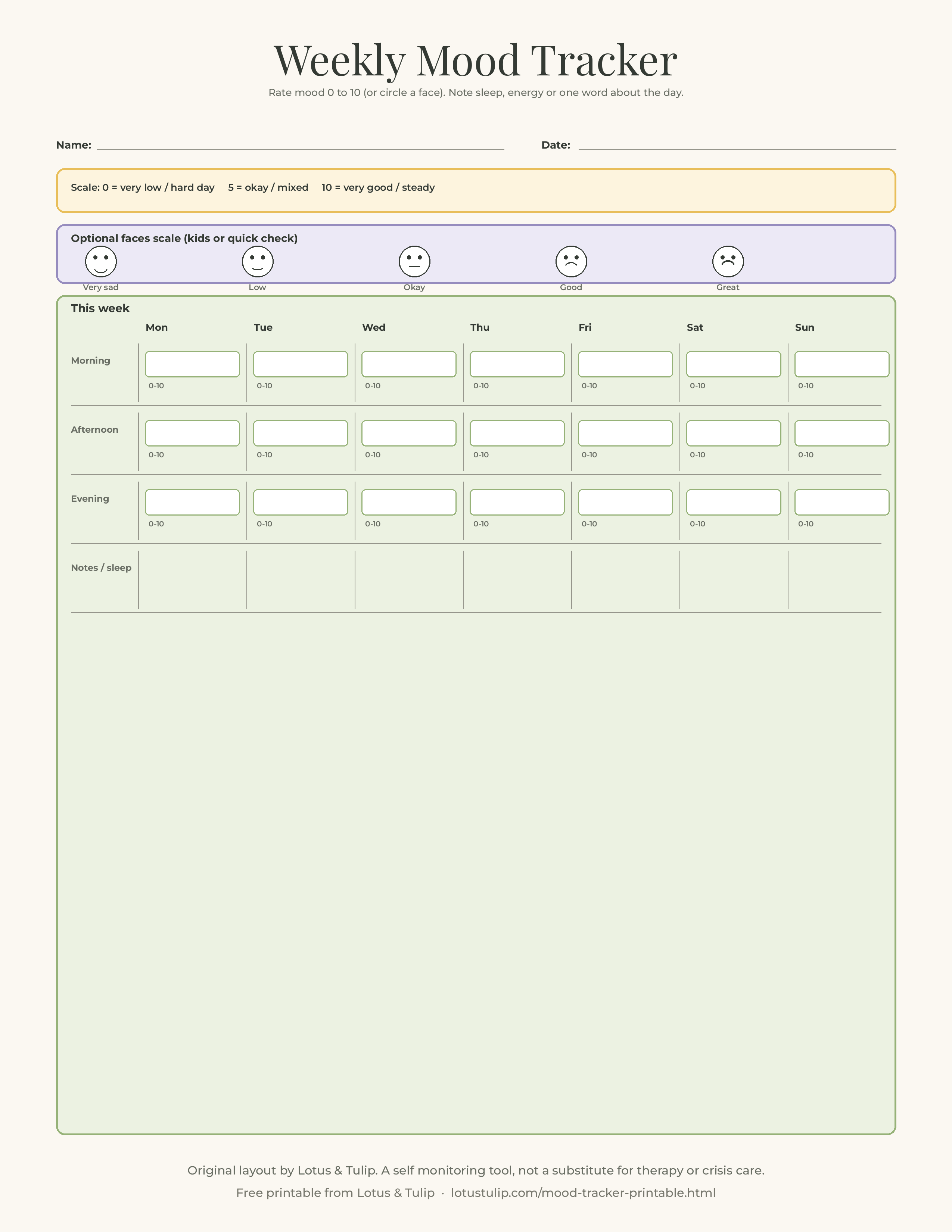
- Page 1: Weekly Mood Tracker. Seven days with morning, afternoon and evening 0 to 10 boxes, an optional faces scale, and a notes or sleep row.
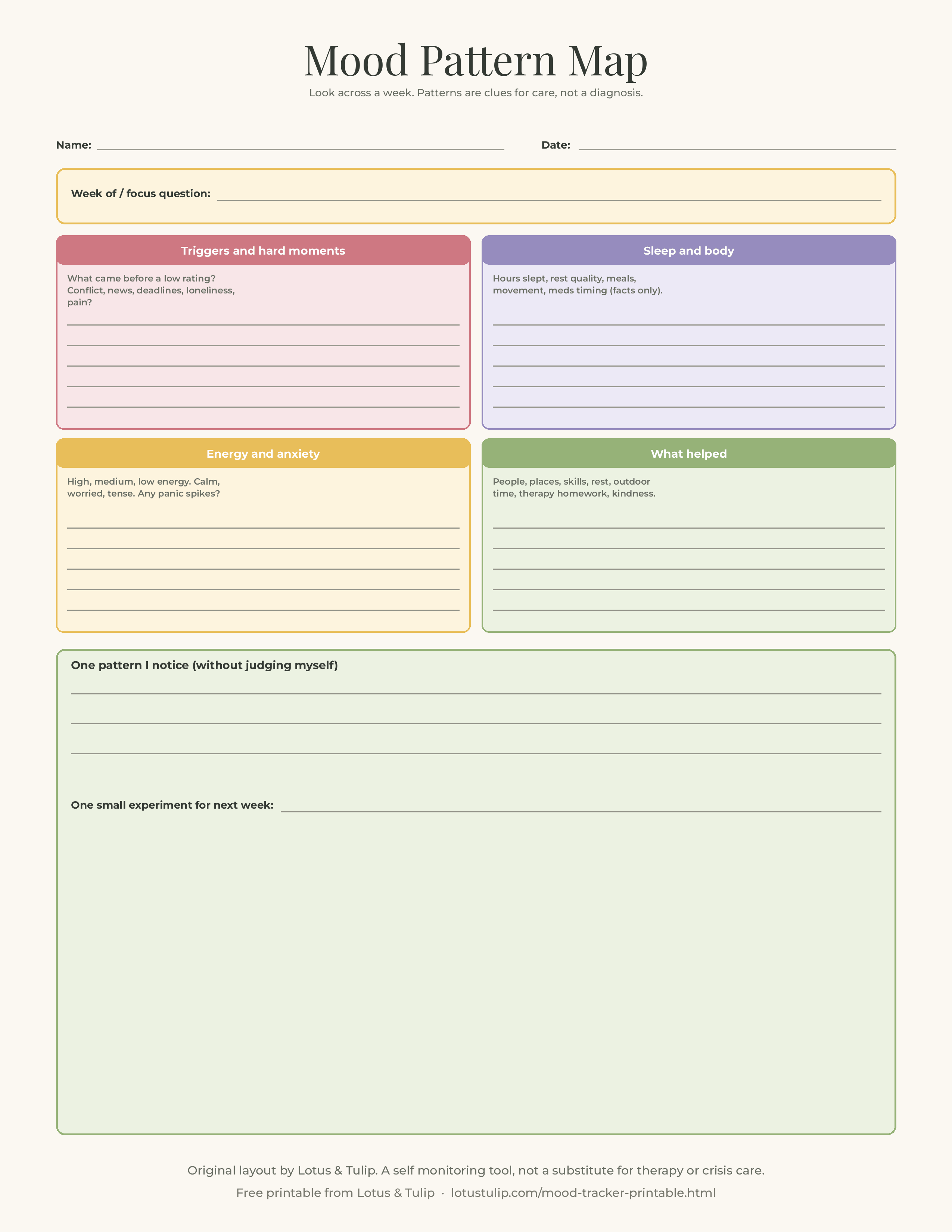
- Page 2: Mood Pattern Map. Boxes for triggers, sleep and body, energy and anxiety, and what helped, plus space for one pattern and one small experiment.
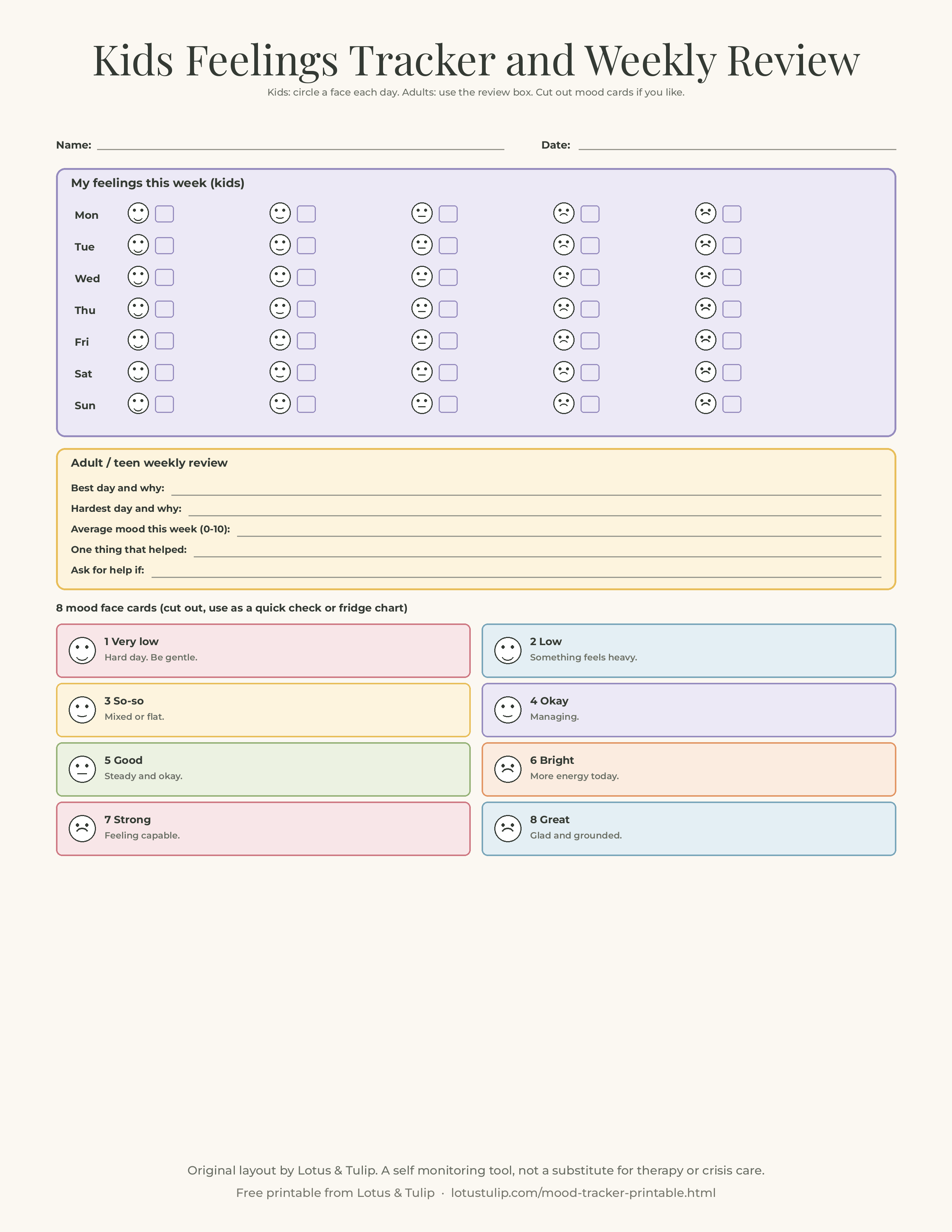
- Page 3: Kids Feelings Tracker and Weekly Review. Daily face circles for kids, an adult or teen review block, and eight cut out mood face cards.
Download the free mood tracker printable (PDF, 3 pages, US Letter)
Prefer single images? Page 1: Weekly Mood Tracker (PNG) · Page 2: Mood Pattern Map (PNG) · Page 3: Kids Feelings Tracker (PNG)
Free to print for your own use and for use with your own clients, students, or groups. This is an original layout by Lotus & Tulip, not an official form from any treatment manual, and not a diagnostic measure. Please link to this page rather than re-uploading the file.
Related resources
- Daily check in for students: short school friendly mood and needs check.
- Feelings thermometer printable: rate intensity before you problem solve.
- Feelings wheel printable: find a more precise feeling word.
- Behavioral activation worksheet: turn low mood data into small actions.
- Anxiety worksheets for kids: brave steps when worry dominates the chart.
- Emotional regulation worksheets for kids: body signals and choose a skill.
- Window of tolerance worksheet: map hyperarousal and shutdown.
- CBT thought record worksheet: look at thoughts that travel with mood dips.
- Depression and behavioral activation worksheets: fuller BA pack for clinicians.
- Kids feelings and social skills worksheets: naming feelings and social skills for ages 5 to 11.
Sources
- Lewinsohn, P. M. Behavioral approaches to depression. In classic behavioral theory and pleasant events scheduling literature; mood and activity diaries as assessment and intervention tools.
- Beck, A. T., Rush, A. J., Shaw, B. F., and Emery, G. (1979). Cognitive Therapy of Depression. Guilford. Mood and thought monitoring as CBT homework.
- Martell, C. R., Dimidjian, S., and Herman-Dunn, R. (2010). Behavioral Activation for Depression: A Clinician's Guide. Guilford. Activity and mood monitoring in BA.
- Jacobson, N. S., Martell, C. R., and Dimidjian, S. (2001). Behavioral activation treatment for depression: Returning to contextual roots. Clinical Psychology: Science and Practice.
- Shiffman, S., Stone, A. A., and Hufford, M. R. (2008). Ecological momentary assessment. Annual Review of Clinical Psychology, 4, 1 to 32.
- Cuijpers, P., van Straten, A., and Warmerdam, L. (2007). Behavioral activation treatments of depression: A meta-analysis. Clinical Psychology Review. Supports activity focused treatments that commonly include monitoring.
- Honest caveat: mood tracking apps and paper diaries show mixed engagement; for some users, symptom focused monitoring can increase rumination. Use clinically, review collaboratively, and pause if harm appears. No major trial tests this three page printable alone as a treatment.
- 988 Suicide and Crisis Lifeline, 988lifeline.org. Crisis Text Line, crisistextline.org.
Free depression starter pack: Want more real pages? The free depression worksheets for therapists starter pack adds the low mood cycle, a daily activity and mood log, an activity menu, break it into small steps, a weekly activity plan and a support and safety page from our paid depression and behavioral activation set (8 pages, client use license, no email).
Mood tracker printable: FAQ
What is a mood tracker printable used for?
A mood tracker printable is a paper chart for rating how you feel over days or weeks. People use it for therapy homework, school or home check-ins, and spotting links between sleep, stress, activities and mood. It is a self monitoring aid, not a diagnosis.
What scale should I use, numbers or faces?
Teens and adults often do well with 0 to 10 if you define the anchors. Younger kids usually prefer faces. You can offer both. Consistency matters more than the exact scale.
How often should I fill out a mood tracker?
Once a day or morning and evening is enough for most people. Three check-ins a day can help with fast swings. More than that often adds noise and abandonment. Review the week on a schedule.
Can mood tracking make anxiety or rumination worse?
Yes, for some people. If rating mood becomes compulsive checking or a shame spiral, simplify or pause. Pair any tracking with skills and valued action, and talk with a clinician if distress rises.
Is a mood tracker the same as a depression screening test?
No. Screeners like the PHQ-9 are structured questionnaires with clinical cutoffs. A mood chart is day to day monitoring. You can use both, but do not treat a home chart as a diagnosis.
How can parents use a mood chart with kids?
Keep it short, use faces, pick a routine moment, and thank honesty. Respond to a low face with calm presence and a coping choice before diving into questions. Share school charts only with clear consent rules.
Can I print the free mood tracker for clients or students?
Yes. The free PDF is an original Lotus & Tulip layout that you can print for your own use and for your own clients, students or groups. Please link to this page instead of re-uploading the file.