
Kids and teens · CBT for children ages 5 to 12 · Updated 2026-11-14
CBT worksheets for kids: how to teach thoughts, feelings and brave steps, what research shows and a free printable

Ages 5 to 11: Kids Feelings and Social Skills Worksheets, incl. feelings detective, body clues, feelings thermometer and a worry box Holiday 20% off: about $11.04, was $14 (EUR 12) · fillable PDF, instant digital download
Buy on EtsyTry it free first: download a fillable sample (feelings thermometer and calm-down plan, PDF, 240 KB). Type into it on screen, then get the full pack. No email needed.
Ages 12 and up: CBT Worksheets for Teens, incl. a thought check, 12 thinking traps, a behavior experiment and coping cards Holiday 20% off: about $11.04, was $14 (EUR 12) · instant digital download
Buy on EtsyKids and teens bundle: Kids and Teens Worksheets Bundle (feelings, anger, self esteem, social anxiety) Holiday 20% off: about $22.08, was $28 (EUR 24) · 80 pages, instant digital download
Buy on EtsyCognitive behavioral therapy (CBT) rests on one idea that even young children can understand: what we think, how we feel and what we do are connected. Change one, and the others shift too. A child who thinks "Everyone will laugh at me" feels scared, stays quiet and never finds out that most classmates were not paying attention. A child who learns to catch that thought, check it and try a small brave step breaks the loop.
This guide is for school counselors, child therapists, teachers and parents of kids about 5 to 12. It explains CBT in words children understand, what the research shows (including where it is weaker), the main kinds of CBT worksheets for kids and what each one is for, a list of kid friendly thinking traps, nine steps to use the worksheets well, how to adapt them by age, common mistakes and three short examples. It ends with a free 2 page printable: My Thought Detective and My Brave Steps.
Download the free CBT worksheets for kids (PDF, 2 pages, US Letter)
Direct download, no email or sign up. See the pages first. Working with a teenager? See our CBT worksheets for teens.
What CBT is, in words kids understand
Most children grasp CBT fastest as a triangle with three corners: think, feel and do. You can draw it on a whiteboard in ten seconds. Then walk through a real moment from the child's week:
- Think: "My brain told me: I'm going to get it wrong."
- Feel: "I felt nervous. My tummy hurt and my face got hot."
- Do: "I didn't put my hand up, and I asked to go to the nurse."
Then ask the key question: "If your brain had told you something different, like 'It's okay to get it wrong while I'm learning', how might you have felt, and what might you have done?" That is the whole model in one conversation. Everything else in CBT for kids builds on it: noticing feelings and body clues, catching thoughts, checking whether they are true and helpful, and practicing brave actions so the child learns from experience, not just from talk.
A phrase many counselors use: thoughts are guesses, not facts. Children are often relieved to hear that their brain can be wrong, and that checking a thought is a skill, like checking your spelling.
Who CBT worksheets for kids are for
Anxiety is the most common reason children are referred for CBT, and it is common. Based on parent reports in national US survey data for 2023 to 2024, the CDC reports that about 11% of children ages 3 to 17 had current, diagnosed anxiety. CBT ideas are also used for low mood, anger, worry about school, perfectionism and everyday stress, and specialized forms of CBT are used for OCD and trauma. Those specialized treatments should be delivered by trained clinicians, not worksheets alone.
The worksheets on this page are teaching and practice tools. They suit small group and individual counseling, classroom social emotional lessons, therapy homework and calm conversations at home. They are not a test, a diagnosis or a substitute for treatment.
What the research shows, honestly
CBT has more research behind it than any other talking therapy for anxious children. The headline finding is good news, with some honest limits.
- CBT helps many anxious children, though not all. A Cochrane review by Anthony James and colleagues (2020) pooled 87 randomized trials with 5,964 children and teenagers under 19 who had an anxiety disorder. After treatment, 49.4% of young people who had CBT no longer met criteria for their main anxiety diagnosis, compared with 17.8% of those on a waiting list or getting no treatment. That works out to about one extra child recovering for every three treated. The same review found little clear evidence that CBT beats usual care or other active treatments, and rated much of the evidence as moderate or low quality.
- How it compares with medication. In the Child/Adolescent Anxiety Multimodal Study (CAMS), John Walkup and colleagues (2008, New England Journal of Medicine) randomly assigned 488 children ages 7 to 17 with separation anxiety, generalized anxiety or social anxiety to 14 sessions of CBT, the medication sertraline, both, or a placebo pill for 12 weeks. Rates of being much or very much improved were 59.7% with CBT, 54.9% with sertraline, 80.7% with the combination and 23.7% with placebo. CBT was linked with less insomnia, tiredness and restlessness than sertraline. Medication decisions belong with a child's doctor.
- Thought work and brave steps both matter. Using weekly ratings from the CAMS CBT sessions, Tara Peris and colleagues (2015, Journal of Consulting and Clinical Psychology) found that progress sped up after children started cognitive restructuring (changing anxious self talk) and again after they started exposure tasks (gradually facing feared situations). Adding relaxation training had limited impact. Three quarters of the children in the study were 12 or younger. This is why the free printable below pairs a thought page with a brave steps ladder.
- Young children can benefit when CBT is adapted and parents are involved. In a trial by Hirshfeld-Becker and colleagues (2010, Journal of Consulting and Clinical Psychology), 64 children ages 4 to 7 (average age 5.4) with anxiety disorders were assigned to parent and child CBT or a 6 month waiting list. Among children who completed the study, 69% of the CBT group were much or very much improved, compared with 32% of the waiting list group, and gains held at one year follow up.
- Parents can be the main route of change. Eli Lebowitz and colleagues (2020, Journal of the American Academy of Child and Adolescent Psychiatry) compared 12 sessions of child CBT with 12 parent only sessions of a program called SPACE (Supportive Parenting for Anxious Childhood Emotions) in 124 children ages 7 to 14. The parent program worked as well as child CBT on anxiety outcomes, and it reduced family accommodation, the well meant ways parents step in to help a child avoid fears, more than CBT did.
- Age changes how CBT should look. In a review of CBT with 5 to 8 year olds, Grave and Blissett (2004, Clinical Psychology Review) questioned whether standard, talk heavy CBT fits children this young, noting that younger children in the studies they reviewed tended to do less well than older ones. Their conclusion was not that young children cannot benefit, but that the approach has to fit their development.
Two practical lessons follow. First, for younger children, lean on pictures, play, simple language and a parent or teacher as coach. Second, do not stop at talking about thoughts. Children learn most when they try a brave step and see what actually happens.
The main kinds of CBT worksheets for kids, and what each is for
- Feelings faces and feelings words. Children cannot work with a feeling they cannot name. Start here with kids who say "bad" or "fine" about everything. See our feelings wheel printable.
- Body clues. Where does worry or anger show up in my body? Tummy, heart, face, fists. Body clues are often easier for young children to notice than thoughts.
- Feelings thermometer. Rating a feeling from 0 to 10 helps children notice that feelings come in sizes and change. It also lets you measure progress. See our feelings thermometer printable.
- Think, feel, do triangle. Maps one real moment onto the three corners. The best first CBT worksheet for most children ages 7 and up. See our CBT triangle worksheet.
- Thought bubbles and thought catching. Drawing a character with an empty thought bubble makes the invisible visible. Ask: "What was your brain telling you?"
- Thinking traps. Kid friendly names for common unhelpful thinking patterns (see the list below). Children enjoy spotting traps in cartoon characters before they spot their own.
- Detective questions and helpful thoughts. Checking a thought like a detective: what are the clues? Then writing a thought that is true and helpful, not just positive. See our positive self talk worksheet.
- Brave ladders. A short list of steps from easiest to hardest toward something worry makes the child avoid. This is the exposure part of CBT, and the research above suggests it matters. See our worry worksheet for kids.
- Problem solving steps. For problems that are real, not just worries: name the problem, list ideas, pick one, try it, check how it went. See our problem solving worksheet for kids.
- Coping plans. A short, personal list of things that calm the body before or after a brave step, such as slow breathing. See our coping skills list for kids.
Kid friendly thinking traps
Adult CBT uses terms like "catastrophizing" and "overgeneralization". Children do better with names they can picture. These are the six on the free printable, in our own wording:
- Fortune teller: "I just know it will go wrong." Predicting a bad ending with no real clues.
- Mind reader: "I know they think I'm dumb." Guessing what others think without asking.
- All or nothing: "I always mess up. I never get picked." Words like always, never and totally.
- Making it huge: "This is the worst thing ever." Turning a small or medium problem into a giant one. Pairs well with our size of the problem worksheet.
- Blaming me: "It's all my fault my friends argued." Taking the blame for things that are not, or not only, yours.
- Missing the good: "Today was terrible" after one bad moment in an okay day. Only seeing what went wrong.
Tell children that everyone falls into thinking traps, adults included. The goal is to notice the trap, not to never fall in. For older children and adults, our cognitive distortions worksheet covers the full list.
How to use CBT worksheets for kids, step by step
- Start with a real, recent moment. Pick something from the last few days that was a medium size problem, not the biggest fear. Medium moments are easier to think about calmly.
- Teach the triangle first. Draw think, feel and do, and fill it in together with the real moment. Use a cartoon character or a story first if the child is shy about their own example.
- Name the feeling and rate it. Ask what the child felt, where in the body, and how big from 0 to 10. Drawing counts as an answer for younger or less confident writers.
- Catch the thought. Ask "What was your brain telling you?" or "What would the thought bubble say?" Write the child's own words, even if they are short.
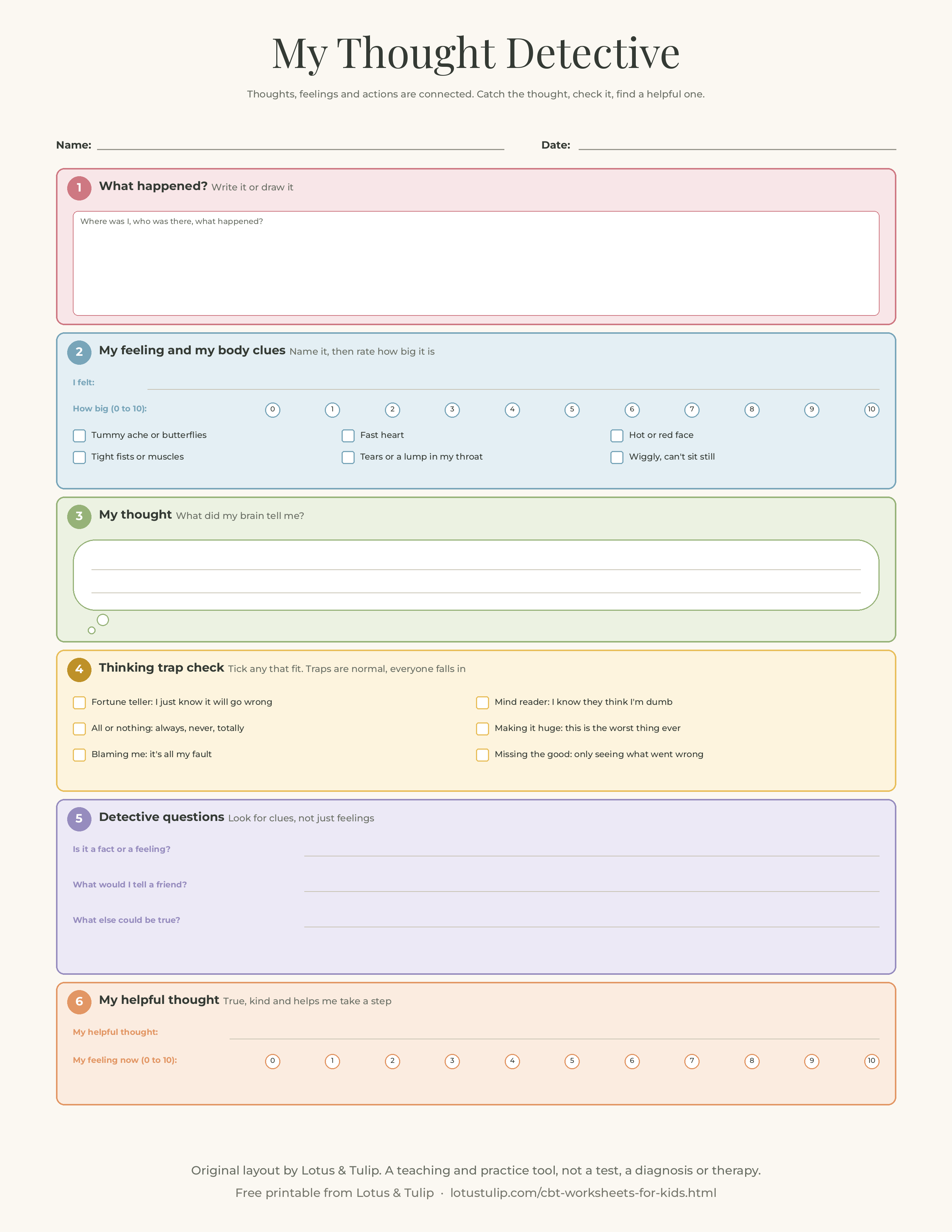
- Spot the thinking trap. Read the trap names together and let the child pick any that fit. Keep it light: traps are normal, and spotting one is a win.
- Be a thought detective. Ask the three detective questions: Is it a fact or a feeling? What would I tell a friend? What else could be true? Then help the child write a helpful thought that is true and kind, not forced positive.
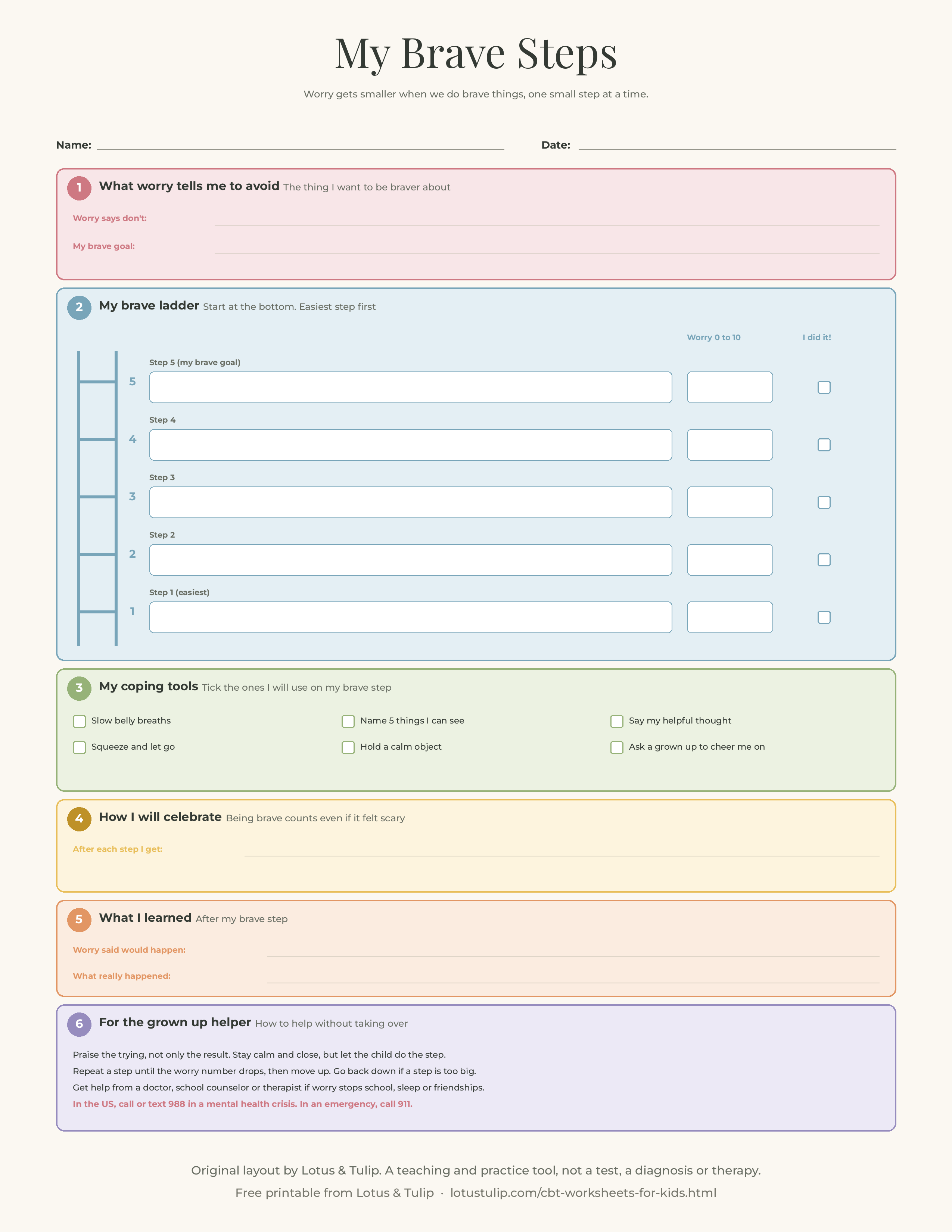
- Plan a small brave step. If the thought made the child avoid something, build a short brave ladder, easiest step first. Each step should feel a little scary but doable, around 3 or 4 out of 10.
- Practice the step, then check what happened. Do the step soon, ideally more than once. Afterwards, compare what worry said would happen with what really happened. That comparison is where much of the learning happens.
- Involve the grown ups and review weekly. Share the plan with a parent or teacher, praise effort, and move up the ladder once a step feels easy. If worry or low mood stops school, sleep, eating or friendships, or a child talks about wanting to die, get professional help quickly. In the US, call or text 988 in a crisis, or call 911 in an emergency.
How to adapt CBT worksheets by age
- Ages 5 to 7: Focus on feelings, body clues and brave steps more than thought checking. Use pictures, puppets, stories and drawing. Keep sessions to 10 to 15 minutes of worksheet time. Coach the parent or teacher, since the Hirshfeld-Becker trial above worked through parents and children together.
- Ages 8 to 10: Most children can now catch a thought and spot a thinking trap with help. Use the thought detective page, cartoon examples and simple ladders. Rewards for brave effort work well.
- Ages 11 to 12: Children can usually weigh evidence and write their own helpful thoughts. Use school and friendship examples, give them more choice and start moving toward teen style pages. Our CBT worksheets for teens are written for ages 12 to 18.
- Children with ADHD, autism or learning differences: Shorten pages, use visual supports, practice in the real situation and check understanding often. The Cochrane review above found no consistent difference in outcomes between samples with and without autism.
Common mistakes
- Talking only about thoughts. Worksheets that never lead to a brave step miss the part of CBT children often learn most from. Pair every thought page with an action.
- Pushing "positive thinking". "Everything will be great!" is not believable and can feel dismissive. Aim for helpful and true: "It might be hard, and I can handle hard things."
- Starting with the biggest fear. A brave ladder that starts too high leads to escape, and escape teaches that the fear was right. Start low and climb.
- Rescuing too fast. Answering for the child, or letting worry decide every plan, can keep anxiety going. Lebowitz and colleagues call this family accommodation. Stay warm and close, but let the child do the step.
- Making it homework they can fail. Messy, short or drawn answers are fine. A worksheet that feels like a test turns into one more thing to worry about.
- Using worksheets instead of treatment. For moderate or severe anxiety, depression, OCD, trauma or any safety concern, worksheets support treatment from a qualified professional. They do not replace it.
Examples
- A second grader and reading aloud: A 7 year old cried every time it was her turn to read. With her counselor she drew the triangle: think "Everyone will laugh", feel scared (8 out of 10, tummy ache), do hide in the bathroom. Her brave ladder started with reading one sentence to the counselor, then to a friend, then two sentences in a small group. After three weeks she read a short paragraph in her reading group. Her worry number before reading dropped from 8 to 4.
- A fourth grader and a lost game: A 9 year old shouted "I'm the worst, I always lose" and quit soccer practice. In a small group he spotted two traps, all or nothing and making it huge. The detective question "What would I tell a friend?" helped him write "I lost today, and I scored last week. I can practice." The group then role played losing a board game calmly.
- A parent and bedtime worries: A parent noticed she was staying in her 10 year old's room for an hour every night because of worry about burglars. With a therapist she used a brave ladder: sitting in the doorway, then checking in every 5 minutes, then every 10, then a goodnight and a check in the morning. She praised his bravery each morning. Within a month he was falling asleep on his own most nights. For more on worry, see our anxiety worksheets for kids.
Free printable: CBT worksheets for kids
This free printable is an original Lotus & Tulip design on US Letter, in our own wording. It is not a published questionnaire or a manualized treatment program and gives no score. Page 1, My Thought Detective, walks one moment around the triangle: what happened (write or draw), my feeling and how big from 0 to 10, body clues to tick, my thought in a thought bubble, a thinking trap check with six kid friendly traps, three detective questions and my helpful thought with a second rating. Page 2, My Brave Steps, turns the thought into action: what worry tells me to avoid and my brave goal, a five step brave ladder with a worry rating and an "I did it!" box for each step, my coping tools, how I will celebrate, what I learned (what worry said would happen and what really happened) and notes for the grown up helper with US crisis lines.
Download the free CBT worksheets for kids (PDF, 2 pages, US Letter)
Prefer single images? Page 1: My Thought Detective (PNG) · Page 2: My Brave Steps (PNG)
Free to print for your own child, students, clients or groups. Please link to this page rather than re-uploading the file. A teaching and practice tool, not a test, a diagnosis or a substitute for therapy. In the US, call or text 988 in a mental health crisis. In immediate danger, call 911.
Buy the kids feelings worksheets on Etsy
Related resources
- OCD worksheets for kids: exposure and response prevention for kids, a free boss back ladder
- Depression worksheets for kids: feelings weather check and little lifts plan for ages 5 to 12
- Anxiety worksheets for kids: signs of anxiety, what helps and a brave plan
- Worry worksheet for kids: worry time, a worry box and brave steps
- Positive self talk worksheet for kids and teens: turn an unhelpful thought into a helpful one
- CBT triangle worksheet: thoughts, feelings and behaviors explained
- Feelings thermometer printable: rate how big a feeling is
- Emotional regulation worksheets for kids: calm the body before working on thoughts
- Problem solving worksheet for kids: 5 steps for real problems
- Breathing exercises for kids: coping tools for a brave step
- CBT worksheets for teens: pages written for ages 12 to 18
- All counseling resources for kids and teens
FAQ
What age can children start CBT?
Children as young as 4 to 7 have benefited from CBT that was adapted for their age and delivered with a parent, as in a 2010 randomized trial of 64 young children with anxiety. For this age, CBT leans on play, pictures, body clues and brave steps, with parents as coaches. Most children can work with thought catching and thinking traps from about age 7 or 8.
What is a CBT worksheet for kids?
It is a printable page that teaches one CBT skill in child friendly language: naming feelings, noticing body clues, catching a thought, spotting a thinking trap, finding a helpful thought or planning a brave step. Good worksheets use real moments from the child's life and lead to an action, not just writing.
Does CBT work for children with anxiety?
For many children, yes. A 2020 Cochrane review of 87 trials found that about half of young people with an anxiety disorder no longer met criteria for their main diagnosis after CBT, compared with about 18% on waiting lists. It does not work for every child, and the evidence that it beats other active treatments is limited, so progress should be checked and the plan adjusted.
Can parents use CBT worksheets at home?
Yes, as practice and teaching tools. Use real, medium size moments, keep it short and praise effort. Research on a parent based program (SPACE) suggests that parents gradually reducing accommodation of a child's fears, while staying warm and supportive, can help a lot. If anxiety is severe or not improving, involve a pediatrician, school counselor or child therapist.
How can school counselors use these worksheets?
They fit individual check ins, small groups on worry or stress and classroom lessons. Teach the triangle with a story first, use the thought detective page with a shared example, then let each student build a private brave ladder. Share a short note home so parents can praise brave steps.
What is the difference between CBT for kids and CBT for teens?
The model is the same, but CBT for younger children uses simpler words, more pictures and play, shorter sessions and more parent involvement, and leans more on feelings, body clues and brave steps than on weighing evidence. Teens can handle full thought records, behavior experiments and more independence.
When should a child see a professional instead?
Get help from a doctor, school counselor or licensed therapist if worry, sadness or anger lasts for weeks, keeps a child from school, sleep, eating or friendships, or if the child talks about self harm or wanting to die. In the US, call or text 988 in a mental health crisis, or call 911 in an emergency.
Sources
- Centers for Disease Control and Prevention. Data and statistics on children's mental health (2023 to 2024 data). cdc.gov/children-mental-health/data-research.
- Grave, J., and Blissett, J. (2004). Is cognitive behavior therapy developmentally appropriate for young children? A critical review of the evidence. Clinical Psychology Review, 24(4), 399 to 420.
- Hirshfeld-Becker, D. R., Masek, B., Henin, A., and others (2010). Cognitive behavioral therapy for 4 to 7 year old children with anxiety disorders: A randomized clinical trial. Journal of Consulting and Clinical Psychology, 78(4), 498 to 510.
- James, A. C., Reardon, T., Soler, A., James, G., and Creswell, C. (2020). Cognitive behavioural therapy for anxiety disorders in children and adolescents. Cochrane Database of Systematic Reviews, 2020(11), CD013162.
- Lebowitz, E. R., Marin, C., Martino, A., Shimshoni, Y., and Silverman, W. K. (2020). Parent-based treatment as efficacious as cognitive-behavioral therapy for childhood anxiety: A randomized noninferiority study of Supportive Parenting for Anxious Childhood Emotions. Journal of the American Academy of Child and Adolescent Psychiatry, 59(3), 362 to 372.
- Peris, T. S., Compton, S. N., Kendall, P. C., and others (2015). Trajectories of change in youth anxiety during cognitive behavior therapy. Journal of Consulting and Clinical Psychology, 83(2), 239 to 252.
- Walkup, J. T., Albano, A. M., Piacentini, J., and others (2008). Cognitive behavioral therapy, sertraline, or a combination in childhood anxiety. New England Journal of Medicine, 359(26), 2753 to 2766.