
Kids and teens · Updated 2026-11-07
Problem Solving Activities for Teens (with Free Printable)
Ready-made printable: Executive Function Group Curriculum Holiday 20% off: about $11.04, was $14 (EUR 12) · instant digital download
Buy on EtsyTry it free first: download session 1 free (group at a glance, lesson plan and student page, PDF, 69 KB). Run it with your group, then get all 8 sessions. No email needed.

Problem solving activities for teens are short, optional practice tools that help middle and high school students cool the body first, define one problem in fair words, size the problem, name a goal, brainstorm options (quantity then quality), pick and plan, try one step, review and repair, log practice, and know when to stop for safety. Teen problem solving is not the same as our younger problem solving worksheet for kids and not only size-of-problem matching, flexible thinking lists, conflict scripts, impulse STOP loops, or coping menus. Grades, group chats, homework piles, friendship repair, family logistics, and jobs raise the stakes. So does honesty that problem solving is a practiced sequence, not ignoring feelings, not adults solving every mess for them, not a cure for ADHD or anxiety, and not endless rumination dressed up as planning.
This Lotus and Tulip page is a teen-focused problem solving activities guide with an original free three page US Letter printable. It targets searches families and helpers actually use: problem solving activities for teens, problem solving worksheets for teenagers, teen decision making activities, and teaching teens problem solving skills. It is distinct from our problem solving worksheet for kids (younger five step practice), size of the problem worksheet, flexible thinking worksheet, circle of control worksheet, impulse control activities for teens, conflict resolution activities for teens, coping skills worksheets for teens, executive functioning worksheets for kids, goal setting worksheet for students, anger management activities for teens, and emotional regulation activities for teens. Those neighbors help. This page centers adolescent problem solving: what it is and is not, cool then define, size and goal, brainstorm then pick and plan, try and review, school and home tips, honest research including D'Zurilla and Nezu social problem-solving / PST neighbors, school SEL / ASCA neighbors, and Diamond executive function planning neighbors with caveats, and a free practice plan.
We credit Thomas D'Zurilla and Arthur Nezu (social problem-solving and problem-solving therapy / PST traditions) as neighbors for structured define, generate, decide, implement, and review steps. We credit ASCA and school SEL neighbors for counselor-friendly decision making language, without claiming endorsement. We credit Adele Diamond executive function planning neighbors for educational planning skills, not as proof that this sheet remits clinical disorders. Clear non-affiliation: we are not affiliated with those authors, any branded PST curriculum, any scale publisher, or any school district program. This printable is an original educational layout, not a copy of any copyrighted worksheet and not a diagnosis or treatment. It does not claim to treat ADHD, anxiety disorders, or any diagnosis.
This guide is educational. It is not therapy, not medical advice, and not a diagnosis. If thoughts of ending your life, plans to harm yourself or someone else, or a medical emergency show up, stop the worksheet and get help now: in the US, call or text 988, text HOME to 741741, or call 911. Our safety plan worksheet is a better first tool in that moment. Nearby tools: problem solving for kids, size of the problem, flexible thinking, circle of control, impulse control for teens, conflict resolution for teens, coping skills for teens, executive functioning for kids, goal setting for students, anger for teens, and emotional regulation for teens.
Jump to the free problem solving activities printable (PDF) · How to use problem-solving activities for teens, step by step · Worked examples · Comparisons
What problem solving is and is not for teens
Problem solving (educational working definition for this page) means cooling enough to think, defining one solvable or partly solvable problem in fair words, sizing it, naming a goal, generating options, choosing a plan, trying one step, and reviewing what helped. It is a practiced sequence, not a personality trait you either have or lack.
Problem solving is not:
- Ignoring feelings. Feelings are data. Cool the body first so thinking can come online. Skipping feelings to "just fix it" often backfires.
- Adults solving every mess for them. Adults can coach, scaffold, and set non-negotiable safety rules. Doing all the thinking for a teen blocks skill growth.
- A cure for ADHD or anxiety. ADHD, anxiety, and related patterns may need clinical assessment, accommodations, and care. A three page practice sheet does not diagnose or treat ADHD, anxiety disorders, depression, or any disorder.
- Endless rumination. Replaying the same worry loop without a define, goal, option, try, or review step is not problem solving. It is stuck spinning.
- A replacement for safety. When there is acute danger, self-harm risk, or violence, the priority is safety planning and trusted adult help, not a polished brainstorm list.
Teen problem solving response skills include:
- Safety sort first when crisis risk, self-harm talk, acute danger, or aggression that could harm someone is present.
- Honest definition: cool, define, size, goal, options, plan, try, and review are allowed. Ignoring feelings, adult takeover of every step, ADHD/anxiety-cure claims, and rumination-as-planning are out.
- Cool body first then define the problem in one fair sentence.
- Size of the problem awareness and a clear goal so effort matches stakes.
- Brainstorm quantity then quality, pick and plan, try one tiny step, review and repair.
- Logging what helped and bridging to size-of-problem, flexible thinking, circle of control, impulse, conflict, coping, EF, goal setting, anger, or ER neighbors when needed.
- Knowing when not to push: after acute trauma activation, during medical emergency, or when the exercise feels like blaming the teen for ADHD or anxiety patterns without support, pause and prefer safety and care.
Why teens need teen-shaped problem solving (not only kids worksheets)
Teen life raises the stakes. School conflicts, group chat drama, homework piles, friendship repair, family logistics, jobs, and graded deadlines collide. Kids worksheets that use cartoon five-step posters can feel babyish. Adult lectures that ignore sleep debt and peer status can miss the mark. Teen-shaped problem solving respects privacy, developmental load, and the difference between a practice script and a safety plan.
Cool, define, size, goal, brainstorm, pick, try, review. Cool buys thinking room (feet, breath, rate heat 0 to 10). Define one problem without character attacks. Size it (1 small to 5 huge) and name a goal you can influence. Brainstorm many options before judging. Pick one and plan the first tiny step. Try. Review what helped and repair when needed.
Scenes in plain language. School conflict with a peer or teacher, group chat pile-ons, homework and project piles, friendship repair after a fight, family logistics (rides, chores, shared space), and first jobs or shifts. Teens can strengthen what is available without pretending every scene is equally easy at home or school.
Why not only size-of-problem, flexible thinking, conflict, or impulse pages? Size-of-problem pages train reaction scale. Flexible thinking opens options from a stuck thought. Conflict pages train speak-listen-repair. Impulse pages train pause-before-act. Problem solving centers the full define-to-review loop for many problem types, not only anger or urges. Keep those neighbors linked; teach one tool clearly before stacking four.
How to use problem-solving activities for teens, step by step
- Safety sort. If acute crisis, self-harm plans, imminent harm, substance emergency, or violence risk, pause. Use crisis pathways first: 988, HOME to 741741, or 911 when needed. Prefer a safety plan in that moment. Do not force problem-solving drills in crisis.
- Define problem solving honestly. Agree out loud: cool body, define one problem, size it, name a goal, brainstorm, pick and plan, try, and review are allowed. Ignoring feelings, adult takeover of every step, ADHD/anxiety-cure claims, and rumination-as-planning are out.
- Cool the body first. Rate heat 0 to 10. Feet on floor, one slow breath, short walk, or water. If heat is 8+, delay the define step until cooler. Pair with anger for teens or emotional regulation for teens when heat is the stuck point.
- Define the problem. One fair sentence. Facts plus impact. No character attacks ("they are always toxic"). Prefer "I have three overdue assignments and a shift tonight" over vague "my life is a mess."
- Size the problem and name a goal. Rough size 1 small to 5 huge. Goal you can partly influence. Pair with size of the problem and circle of control when control vs influence is stuck. Pair with goal setting for students when the goal needs a longer plan.
- Brainstorm options (quantity then quality). List at least three to five options before judging. Include ask-an-adult and wait-and-cool options. Then mark quality: helpful, maybe, drop. Pair with flexible thinking when black-and-white thoughts block options.
- Pick and plan. Choose one option that fits values, safety, and size. Plan the first tiny step only (who, when, where, what if it stalls). Skip heroics that collapse under pressure.
- Try, then review and repair. Do the tiny step. Note what helped even a little. Same is allowed. Repair when needed (apology, cleanup, redo). Shame spirals are not practice.
- Log and bridge. Record practice on the log page. Bridge to safety plan, problem solving for kids (younger scaffold), impulse control for teens, conflict for teens, coping skills for teens, or executive functioning for kids when those are the main load.
Practice on lower-stakes problems first when possible. Skill grows with reps and with adults who coach without shaming or solving every step.
Problem solving activities teens will actually try
Cool-then-define card (about three to five minutes). Boxes: heat 0-10, cool move, one fair problem sentence. Mark the stuck scene for this week. Plan one cool move before defining.
Size + goal drill. Size 1-5. Goal in one line. Circle of control check: what I control / influence / cannot control. Cousin of size of the problem and circle of control.
Brainstorm quantity then quality. Five options fast, no judging. Then star two, drop one. Include ask-adult and wait options. Cousin of flexible thinking.
Pick + plan scripts (examples, rewrite in your words). "I will email the teacher tonight asking for a makeup window." "I will draft a repair text, wait ten minutes, then send." "I will break the pile into three 20-minute blocks." "I will ask for a ride swap and offer a trade." Pair with goal setting when multi-day steps are needed.
Try, review, repair. If the plan flopped, note what blocked it and what a smaller next step could be. Repair when needed. Rumination without a new try is not review.
Neighbor bridges. When the job is pause-before-act, prefer impulse control for teens. When the job is speak-listen-repair in conflict, prefer conflict for teens. When the job is a coping menu, prefer coping skills for teens. When the job is EF planners, prefer executive functioning for kids or the paid EF group curriculum.
School counselor, therapist, and parent tips
School counselor tips. Short meetings favor: safety sort, honest definition, cool, one define sentence, size + goal, two to three options, one tiny plan. Groups can use optional role-plays with low-stakes prompts (homework pile, group chat, ride logistics). Never force public sharing of self-harm, family violence, or substance details. Follow district crisis protocols if risk appears. Pair with ASCA-aligned school support language without claiming this page is an official ASCA product. Do not use the sheet to diagnose ADHD or anxiety.
Therapist tips. Stay in the client's language. Separate problem-solving skill gaps, trauma responses, sleep debt, ADHD patterns, and anxiety spirals out loud without diagnosing from a printable. If "just make a plan" increases shame for a teen with ADHD ("I already know the steps and still can't start"), stop and switch to validation, accommodations talk, or clinical care pathways. Measure function: slightly clearer define sentence, one plan tried, less freeze-or-ruminate extremes.
Parent tips. Offer, do not force. Model your own cool-define-plan out loud without humiliation. Do not turn the worksheet into a new weapon ("if you had problem solving skills you would..."). Do not use problem-solving talk to silence valid anger about unfair treatment. Validate that some family rules are non-negotiable for safety while still allowing practice and repair. Ask the school what supports exist when ADHD evaluation, anxiety care, or 504/IEP needs are the real issue.
Worked fictional examples
Teen example, school conflict after a lab group blowup (fictional): Avery, age 15, wants to quit the group after a partner blamed them publicly, heat rated 8. Safety sort: no crisis, but grade and reputation risk. Cool: water, walk to counselor office, heat to 5. Define: "I need a fair way to finish the lab without another public blame." Size 3. Goal: finish the lab and ask for a group reset. Brainstorm: quit / talk to teacher / text partner a calm ask / request mediation. Pick: talk to teacher after school. Plan: write three bullet points, ask for five minutes. Log on the free plan page. Bridge to conflict for teens if speak-listen-repair is next.
Teen example, homework pile before a weekend job (fictional): Sam, age 16, three overdue assignments plus a Saturday shift, stuckness rated 7. Safety sort: no crisis. Cool: five minutes, phone in another room. Define: "I have three tasks and one shift, and I keep freezing." Size 4 for the pile, goal: submit two of three before Saturday. Brainstorm: all-nighter / ask for one extension / 20-minute blocks / trade shift / ask parent for quiet hour. Pick: one extension ask + two 20-minute blocks tonight. Act: draft email, set timer. Bridge to executive functioning or goal setting when planners are the load.
Teen example, friendship repair after a group chat pile-on (fictional): Riley, age 14, left out of screenshots, heat rated 9. Safety sort: no self-harm talk, but social exclusion. Cool: delay reply, feet and breath. Define: "I want to know if we are still friends and stop the pile-on." Size 3. Goal: one honest check-in with one friend, not the whole chat. Brainstorm: blast the group / ignore forever / text one friend / ask counselor for peer mediation. Pick: text one friend a calm check-in. Plan: draft offline, wait ten minutes, send. Bridge to impulse control for teens if hot-reply urge is stuck, or emotional regulation for teens if naming heat is the load.
School counselor note (fictional): In a twelve minute meeting, a counselor helps a student cool, write one define sentence, size the problem, list three options, and pick one tiny step plus a privacy ask (journal vs share). Optional practice, never forced public self-harm or family violence detail. Follow district crisis protocols if risk appears. For groups, pair with EF or social skills curricula rather than stacking every worksheet in one period. Do not frame the printable as an ADHD or anxiety assessment.
Teen problem solving vs kids problem solving, size of problem, flexible thinking, circle of control, conflict teens, impulse teens, goal setting, coping teens
| Teen problem solving (this page) | Kids problem solving | Size of problem | Flexible thinking | Circle of control | Conflict teens | Impulse teens | Goal setting | Coping teens | |
|---|---|---|---|---|---|---|---|---|---|
| Main job | Cool, define, size, goal, brainstorm, pick, try, review, log, safety | Younger five step practice | Match reaction size to problem size | Stuck thought to other options | Sort control / influence / out of control | Cool, name, speak, listen, options, repair | Cue, STOP/THINK/CHOOSE/ACT/CHECK | Goals and multi-step plans | Menu of coping moves |
| Best early use | When teens need a full define-to-review loop across school, chat, homework, friendship, family, jobs | When younger kids need simpler steps | When overreactions vs problem size are stuck | When black-and-white thoughts block options | When control vs influence is stuck | When conflict talk and repair are the load | When pause-before-act is the load | When longer goals need steps | When a coping menu helps |
| Output | Cool plan, define sentence, size/goal, options, tiny plan, log | Kids problem solving plan | Size match plan | Options list | Control sort | Conflict plan | Impulse plan | Goal planner | Coping plan |
| Cross link | This page | Kids problem solving | Size of the problem | Flexible thinking | Circle of control | Conflict teens | Impulse teens | Goal setting | Coping teens |
These tools cooperate. Teen problem solving builds the define-to-review loop. Kids problem solving simplifies for younger ages. Size of the problem matches reaction scale. Flexible thinking opens options. Circle of control sorts influence. Conflict trains speak-listen-repair. Impulse trains pause-before-act. Goal setting stretches multi-day plans. Coping offers a menu. Teach one tool clearly before stacking four on day one.
What helps vs common myths
What often helps: cool body first, fair define sentences, size and goal clarity, brainstorm quantity before quality, tiny pick-and-plan steps, adult coaching without takeover, safety planning when risk is high, and skill printables used as practice aids.
Myths to drop:
- "If you were smart you would just figure it out." Intelligence is not the same as a practiced cool-define-plan-try loop under stress.
- "Feelings get in the way, so ignore them." Feelings are data. Cooling makes thinking usable. Ignoring heat often leads to worse plans.
- "Adults should just fix it." Scaffolding helps. Solving every step for a teen blocks skill growth.
- "Problem solving worksheets cure ADHD or anxiety." They are optional practice aids. Assessment, accommodations, and clinical care matter when ADHD or anxiety patterns are present. This page does not treat those conditions.
- "More thinking always means better solving." Rumination without try and review is not problem solving.
- "Research proves every teen problem-solving drill always works." Effects are often small and context dependent. Honesty protects trust.
Common mistakes
- Skipping safety sort when self-harm, violence, or substance emergency risk is present.
- Skipping cool and defining while heat is still 8+, which leads to unfair sentences and poor plans.
- Vague slogans ("just solve it") instead of a define sentence, size, goal, and tiny step.
- Judging options too early so brainstorming collapses into one stuck idea.
- Using kids-only materials that feel babyish and get rejected.
- Claiming the sheet treats ADHD or anxiety or replaces evaluation and supports.
- Stacking every neighbor worksheet on day one without teaching one tool clearly.
- Using it in acute crisis instead of safety first.
- Treating the worksheet as therapy. Paper supports practice. It does not replace a clinician, school policy, or crisis care when problems are severe or lasting.
When not to use this worksheet
Good early uses: a teen who can name a concrete problem scene, mild to moderate stuckness with adult support available, homework between counseling sessions, school counseling check-ins, groups with low-stakes prompts and opt-out, and building a cool-define-size-goal-brainstorm-pick-try-review sequence.
Prefer another tool first when:
- Acute safety risk or medical emergency: stabilize and get help (988, HOME to 741741, 911). Prefer a safety plan.
- When ADHD evaluation or anxiety care is the real next step: prefer appropriate assessment and supports. Do not claim this printable treats ADHD or anxiety.
- When pause-before-act is the whole stuck point: prefer impulse control activities for teens.
- When conflict speak-listen-repair is the load: prefer conflict resolution activities for teens.
- When naming and riding feelings is the load: prefer emotional regulation activities for teens.
- When the exercise increases shame: stop, validate, and switch tools.
What the research says (honestly)
Problem solving activities and worksheets are a skill practice aid, not a standalone RCT treatment. Do not claim this free printable remits ADHD, anxiety disorders, depression, ODD, trauma, or any diagnosis.
D'Zurilla and Nezu social problem-solving / PST lineage neighbor. Thomas D'Zurilla and Arthur Nezu's social problem-solving and problem-solving therapy (PST) traditions are neighbors for structured define, generate alternatives, decide, implement, and review steps used in many educational and counseling contexts. Credit with clear non-affiliation. This page is not a copy of any PST manual or scale and does not claim those research effect sizes for this three page sheet.
ASCA / school SEL neighbors. School counseling and SEL frameworks often discuss responsible decision making, student problem solving, and safety in educational language. Credit as neighbors with clear non-affiliation. This page is not an official ASCA product and is not a district curriculum.
Diamond executive function / planning neighbors. Adele Diamond's work on executive functions, including planning and related skills, is a neighbor for educational plan-and-try skills. Credit with clear non-affiliation. This is a neighbor, not proof that this printable remits clinical disorders or treats ADHD.
Honest limits. Effects of brief skill sheets are often small. Context matters. Problem-solving talk can backfire if used to shame teens with ADHD or anxiety patterns, or to demand endless planning when sleep, trauma, or crisis cues dominate. Adult support, school policy, accommodations when indicated, and clinical care when indicated matter. No study tests this three page Lotus and Tulip printable alone.
Free problem solving activities printable for teens (PDF)
The free problem solving activities printable has three pages in US Letter size:
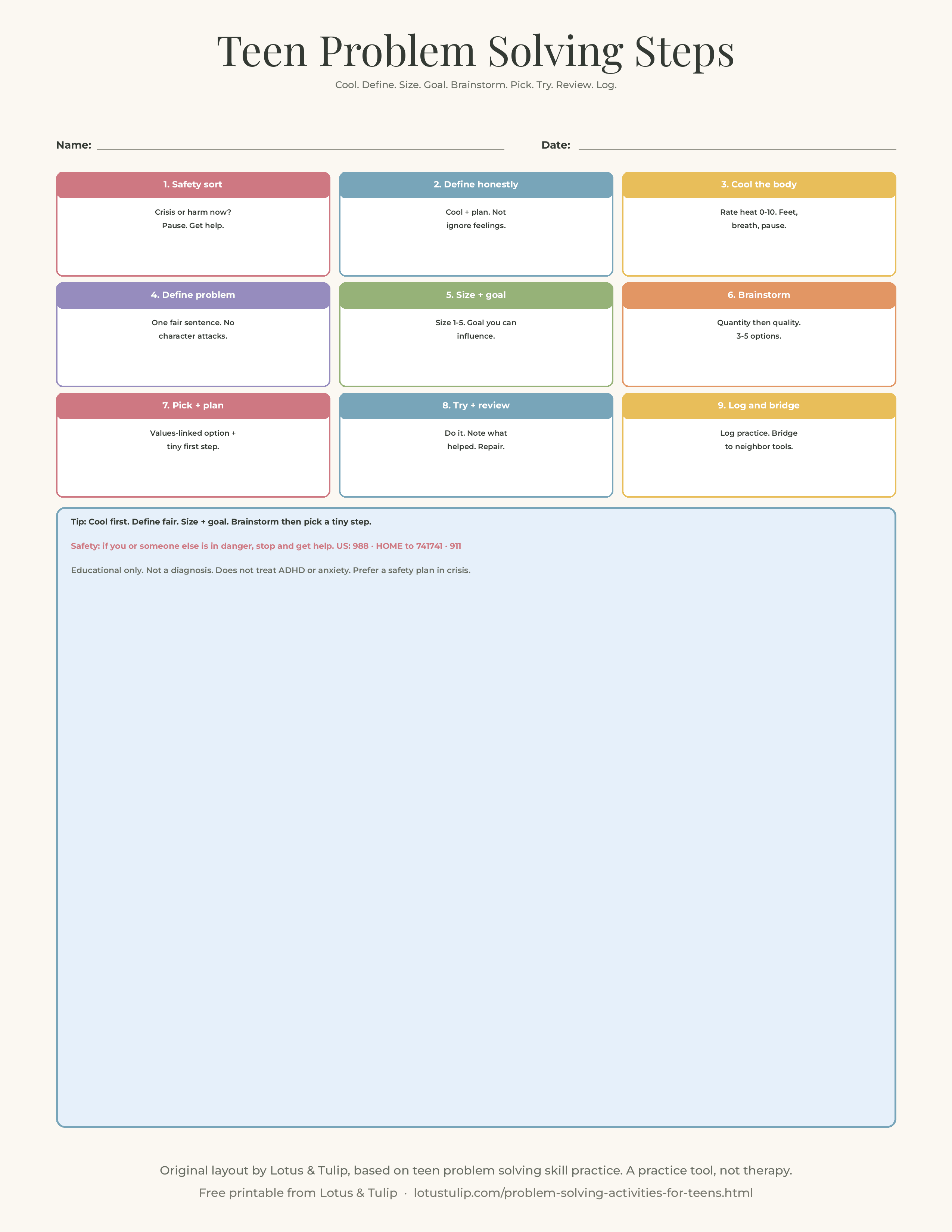
- Page 1: Teen Problem Solving Steps. Sequence matching the HowTo: safety sort, honest definition, cool body, define, size and goal, brainstorm, pick and plan, try and review, log and bridge, plus safety reminders.
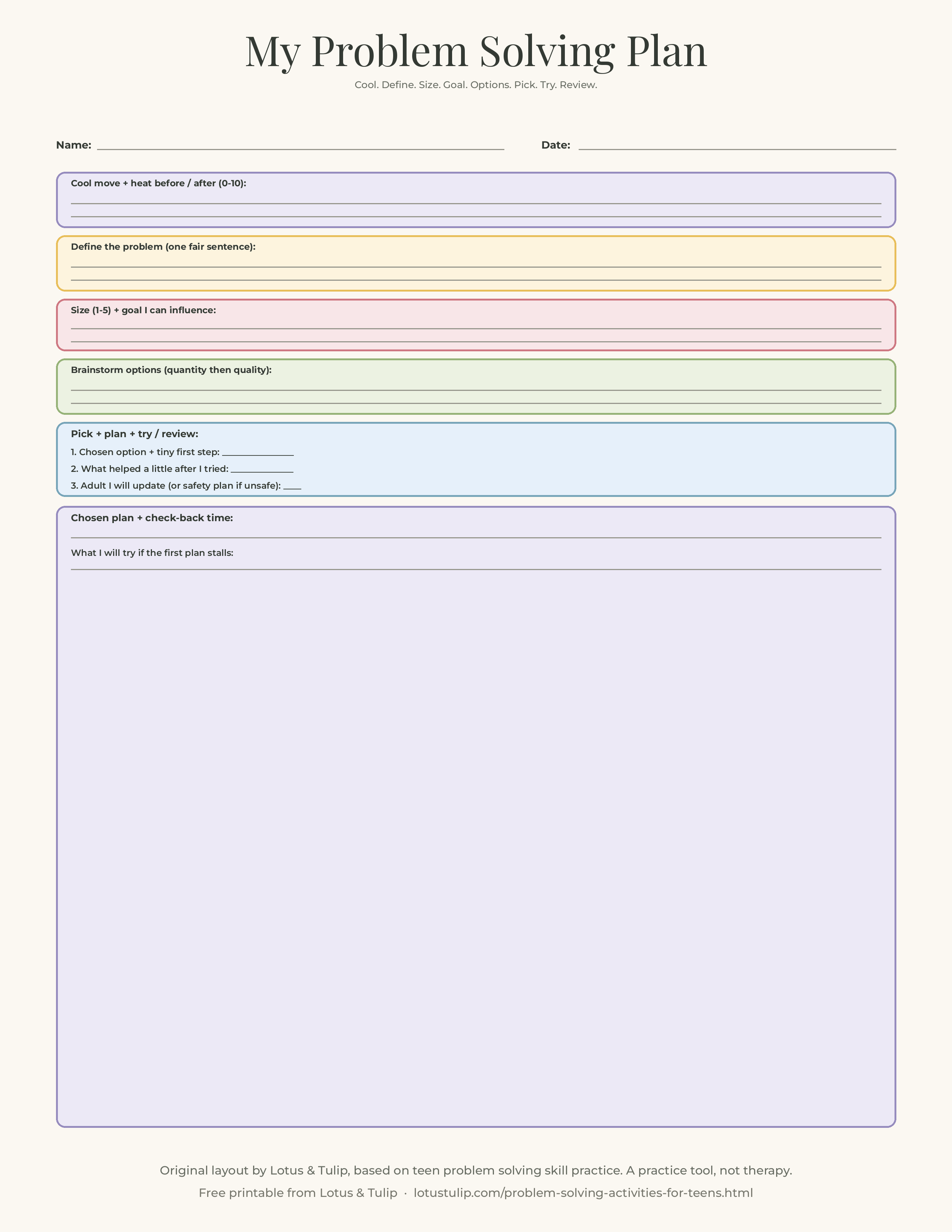
- Page 2: My Problem Solving Plan. Fill in cool move, define sentence, size and goal, brainstorm options, pick and plan, try/review, and check-back.
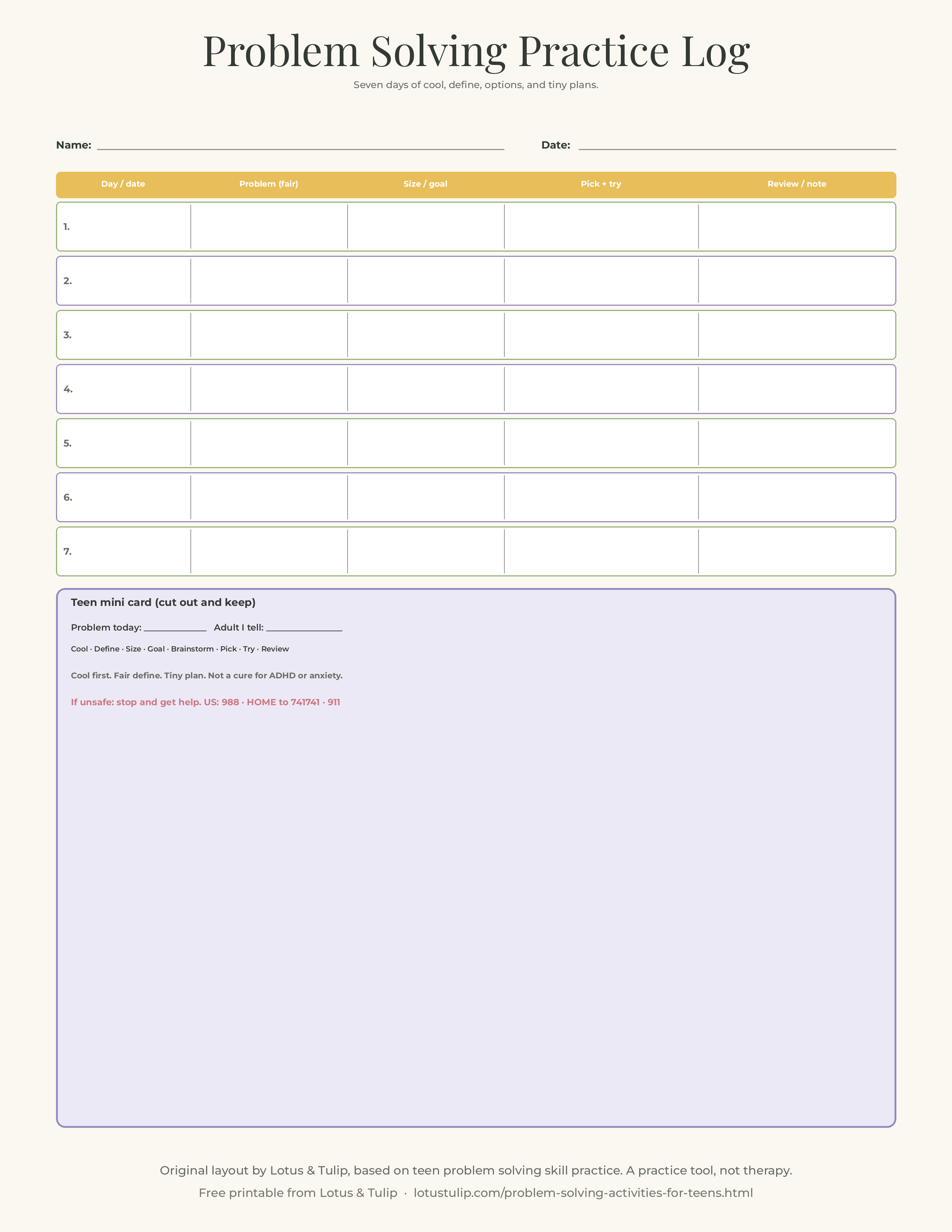
- Page 3: Practice Log + teen mini card. Seven day rows plus a cut out reminder for cool, define, size, goal, brainstorm, pick, try, review, log.
Download the free problem solving activities printable for teens (PDF, 3 pages, US Letter)
Prefer single images? Page 1: Teen Problem Solving Steps (PNG) · Page 2: My Problem Solving Plan (PNG) · Page 3: Practice Log (PNG)
Free to print for your own use and for use with your own clients, students, or groups. This is an original layout by Lotus & Tulip, based on teen problem solving skill practice associated with D'Zurilla and Nezu social problem-solving / PST neighbors, ASCA / school SEL neighbors, and Diamond executive function planning neighbors, with clear non-affiliation. It is not affiliated with those authors, any scale publisher, or any specific treatment or curriculum package, does not treat ADHD or anxiety, and is not a substitute for therapy. Please link to this page rather than re-uploading the file.
Related resources
- Problem solving worksheet for kids: younger five step practice.
- Size of the problem worksheet: match reaction size to problem size.
- Flexible thinking worksheet: stuck thought to other options.
- Circle of control worksheet: sort control, influence, out of control.
- Impulse control activities for teens: STOP / THINK / CHOOSE / ACT / CHECK.
- Conflict resolution activities for teens: cool, name, speak, listen, options, repair.
- Coping skills worksheets for teens: menu of coping moves.
- Executive functioning worksheets for kids: broader EF checklist and planners.
- Goal setting worksheet for students: goals and multi-step plans.
- Anger management activities for teens: cue, number, cool-down, repair.
- Emotional regulation activities for teens: name, rate, ride, choose.
- Safety plan worksheet: when the moment is about staying safe and alive.
- Problem solving worksheet for adults: the adult version, based on problem solving therapy.
Sources
- D'Zurilla and Nezu social problem-solving and problem-solving therapy (PST) traditions as neighbors for structured define, generate, decide, implement, and review steps. Educational credit with clear non-affiliation. Not a claim that this printable remits clinical disorders or treats ADHD or anxiety.
- ASCA and school SEL neighbors for counselor-friendly student decision making and problem solving language. Educational credit with clear non-affiliation. Not an official ASCA product.
- Diamond executive function and planning neighbors for educational plan-and-try skills. Educational credit with clear non-affiliation. Neighbor, not proof for this three page sheet.
- Honest caveat: teen problem solving drills are a skill practice aid, not an RCT of this printable. Shame-based use and ADHD/anxiety-cure claims can backfire. Adult support, accommodations, and clinical care when indicated matter.
Problem solving activities for teens: FAQ
What are problem solving activities for teens?
They are short, optional practice tools for cooling the body, defining one problem in fair words, sizing it, naming a goal, brainstorming options, picking and planning, trying one step, reviewing and repairing, and logging practice. They are educational skill aids, not therapy.
Is problem solving the same as ignoring feelings?
No. Feelings are data. Cool first so thinking can work. Ignoring heat often leads to unfair definitions and poor plans. Toughness theater and rumination-as-planning are not the goals of this page.
Does this printable treat ADHD or anxiety?
No. This page does not diagnose or treat ADHD, anxiety disorders, or any disorder. Teens who may need evaluation deserve appropriate assessment, accommodations, and clinical care. A three page practice sheet is not that care.
Can school counselors use it with teens?
Yes, often in short meetings with safety sort, cool, one define sentence, size and goal, a few options, and one tiny plan. Keep practice optional and school safe. Follow crisis protocols when risk appears. Do not use the page as a diagnosis or as forced public sharing of self-harm or family violence.
How is this different from the kids problem solving worksheet?
The kids page uses younger five step practice. This teen page adds cool-first, size and goal, quantity-then-quality brainstorming, try/review/repair, and teen scenes (school conflict, group chats, homework piles, friendship repair, family logistics, jobs). Link both; do not force a babyish sheet on a teen who will reject it.
When should I not use this worksheet?
Do not use it as the first move in acute safety risk, medical emergency, when ADHD or anxiety evaluation is the real next step and the sheet is being sold as a cure, or when the exercise increases shame. Stabilize and get help when needed: 988, HOME to 741741, or 911. Prefer a safety plan in crisis.
Is this affiliated with D'Zurilla, Nezu, Diamond, or ASCA?
No. This is an original Lotus and Tulip educational layout. We credit research and school counseling lineages with clear non-affiliation and do not reproduce copyrighted manuals or claim official endorsement.