
Therapist worksheets · Updated 2026-11-06
Cognitive Restructuring Worksheet: CBT Thought Challenging with a Free Printable
Ready-made printable: CBT Worksheets for Therapists Fillable PDF, 20 pages: thought record, exposure ladder, activity logs, coping cards and 0 to 10 rating scales
Holiday 20% off: about $11.04, was $14 (EUR 12) · instant digital download
Try it free first: download a fillable sample (thought record and evidence for and against, PDF, 105 KB). Type into it on screen, then get the full pack. No email needed.

Cognitive restructuring is a core Cognitive Behavioral Therapy (CBT) skill. You identify a hot automatic thought, gather evidence for and against it, build a more balanced or useful alternative, re rate the emotion, and often choose a small next action. Clinicians also call it cognitive reframing, thought challenging, or cognitive reappraisal when the same idea appears in emotion regulation research. Done well, it is collaborative and concrete. Done poorly, it becomes "just think positive" or an attempt to erase feelings.
Aaron T. Beck and colleagues built collaborative empiricism into cognitive therapy from the start: therapist and client investigate thoughts together rather than the therapist handing down verdicts. Cognitive restructuring is the umbrella skill that sits across thought records, Socratic questioning, Check the Facts style fact checking, and behavioral experiments. This Lotus and Tulip page frames restructuring as that umbrella: situation, emotion and intensity, hot thought, evidence for, evidence against, balanced thought, re rate emotion, optional action, and review. Credit the Beck CBT lineage honestly. This page and printable are an original educational layout. We are not affiliated with the Beck Institute, any textbook publisher, or any specific treatment package, and this is not a copy of any copyrighted worksheet.
This guide covers what cognitive restructuring is and is not, when to use it versus when safety or another tool fits better, a nine step how to, fictional adult and teen examples, a short bridge to thinking traps without re listing every distortion, comparisons with thought records, Socratic questioning, Check the Facts, cognitive defusion, ABC and ABCDE, and behavioral experiments, kids and teens adaptations, school counselor and therapist tips, common mistakes, an honest research section with caveats, seven FAQs, and a free three page US Letter printable.
This guide is educational. It is not therapy, not medical advice, and not a diagnosis. If thoughts of ending your life, plans to harm yourself or someone else, or a medical emergency show up, stop the worksheet and get help now: in the US, call or text 988, text HOME to 741741, or call 911. Our safety plan worksheet is a better first tool in that moment. For nearby CBT tools, see the CBT thought record worksheet, the cognitive distortions worksheet, the Socratic questioning worksheet, the Check the Facts worksheet, the core beliefs worksheet, and the behavioral experiment worksheet.
Jump to the free cognitive restructuring worksheet (PDF) · How to use cognitive restructuring, step by step · Worked examples · Comparisons
What cognitive restructuring is (and what it is not)
In CBT, automatic thoughts, intermediate beliefs, and core beliefs often shape mood and behavior. Cognitive restructuring is the practice of examining a specific hot thought in a specific situation, testing how well the evidence supports it, and writing a balanced alternative that still takes the facts seriously. The goal is not to gaslight feelings or force cheerfulness. The goal is a conclusion that is more accurate, more useful, or both, so emotion intensity can ease enough for values based action.
Core idea: thoughts are hypotheses, not courtroom verdicts. You do not have to believe every first draft your mind produces. You also do not have to pretend pain is not real. Validation of the feeling often opens the door for evidence work: "It makes sense that your body is loud after three sleepless nights. Let us look at the thought that is fueling the spike."
Cognitive restructuring often sits inside a larger CBT cycle: notice a situation and emotion, catch the hot thought, examine it (sometimes with Socratic questioning), write a balanced thought on a thought record, design a behavioral experiment when talk alone is not enough, and review what was learned. Treat restructuring as a technique inside CBT, not as a standalone treatment brand.
A cognitive restructuring worksheet on paper is a practice aid. It can help a client slow a hot thought between sessions, help a trainee keep columns clean, or help a school counselor give a teen a short, concrete sequence. It is not a substitute for training, supervision, or a living therapeutic relationship.
Not positive thinking. Positive thinking replaces a harsh thought with a cheerful slogan that the person does not believe. Balanced thinking keeps what is true (including hard facts) and adds what was ignored or discounted. "I failed this quiz" can become "I failed this quiz. I have passed others. I can ask for help and study one chapter tonight." That is restructuring. "Everything is fine and I am amazing" is often not.
Not gaslighting feelings. Emotion can be valid even when a prediction is exaggerated. Someone can feel terrified and still examine a catastrophic forecast. Arguing someone out of a feeling in the same minute their body is alarmed usually increases shame. Validate first. Then examine the thought.
When to use cognitive restructuring (and when not to)
Good early uses: anxiety driven predictions, harsh self criticism after a specific event, all or nothing conclusions about work or relationships, rumination that circles the same untested claim, and homework between CBT sessions when a thought record already helps.
Prefer another tool first when:
- Acute safety risk or medical emergency: stabilize and get help (988, HOME to 741741, 911). Prefer a safety plan.
- Psychosis or severe dissociation that makes shared reality testing confusing or unsafe in the moment: follow clinical judgment and stabilize first.
- Flooded emotion where the person cannot answer even clarifying questions: shift to grounding, TIPP style crisis skills, or validation before returning to thought work.
- When experience would teach more than debate: design a behavioral experiment or graded exposure instead of another worksheet column.
- When the job is unhooking rather than disproving: cognitive defusion (ACT) may fit better than evidence for and against.
How to use cognitive restructuring, step by step
- Check safety and fit. If acute crisis, psychosis that blocks shared reality testing, or the person cannot engage safely, pause. Use crisis pathways first: 988, HOME to 741741, or 911 when needed. Prefer a safety plan in that moment.
- Name the situation. One concrete scene: who, where, when. Prefer Tuesday after the meeting over "my whole life."
- Name the emotion and intensity. Word plus 0 to 100 (or 0 to 10). Anxiety 80/100 is clearer than "bad."
- Catch the hot thought in the person's words. One sentence. The hottest prediction or self judgment, not a paragraph of history.
- Evidence for the thought. Facts that support it. Stay concrete. Past patterns can count if they are specific, not global "always."
- Evidence against or that does not fit. Facts that weaken the absolute claim. What a caring friend would notice. What Future You might add. Optional: gentle link to a thinking trap via the cognitive distortions worksheet after discovery, not as a gotcha.
- Write a balanced or alternative thought. Accurate, believable, and useful. Client words first. Not a cheer slogan.
- Re rate the emotion. Same scale. Note any drop or shift. Optional tiny action that fits the new conclusion (send the email, ask one question, sit for ten minutes).
- Review next time. What stuck? What still feels true? Adjust. Use the free practice log for short reps between sessions. Bridge to a behavioral experiment when talk circles.
Practice on ordinary thoughts first. Skill grows with concrete scenes and honest evidence, not with one perfect debate.
Worked fictional examples
Adult example (fictional): Jordan, age 34, gets a short critical note from a manager about one slide. Situation: Wednesday 4 p.m., email subject "Please revise slide 7." Emotion: anxiety 75/100, shame 60/100. Hot thought: "One mistake means I will be fired." Evidence for: a past job ended after cumulative criticism; sleep has been poor this week so threat feels louder. Evidence against: manager praised Jordan last month; two peers also got revision notes this week; the email asks for a revision, not a termination meeting. Balanced thought Jordan owns: "This email is feedback on one slide. I am anxious partly because of a past job. I can revise today and ask one clarifying question tomorrow." Re rated anxiety: 45/100. Optional action: revise slide 7 before leaving, calendar a check in question for tomorrow morning.
Teen example (fictional): Sam, age 15, sits down late at lunch. Two friends are quiet and staring at notes. Hot thought: "Everyone at this table hates me." Emotion: sadness 70/100, embarrassment 65/100. Situation: Thursday lunch, late arrival after a makeup quiz. Evidence for: the table was quiet when Sam sat down. Evidence against: group chat still includes Sam; one friend waved; both friends mentioned a hard test earlier. Balanced thought: "They were stressed about the test. Quiet is not the same as hate. I can stay for ten minutes and check again." Re rated sadness: 40/100. Tiny next step: sit for ten minutes tomorrow and rate the thought again after. Written on the free mini card.
School counselor note (fictional): In a twelve minute meeting, a counselor helps a student fill situation, emotion number, hot thought, one fact for, one fact against, and one balanced sentence. No lecture. Same spirit as full CBT restructuring, compressed for school time.
Cognitive restructuring vs thought records, Socratic questioning, Check the Facts, defusion, ABC, and behavioral experiments
| Cognitive restructuring | Thought record | Socratic questioning | Check the Facts / defusion | ABC / ABCDE | Behavioral experiment | |
|---|---|---|---|---|---|---|
| Main job | Umbrella skill: hot thought to balanced thought and optional action | Written columns for situation, mood, thought, evidence, balanced thought | Live guided discovery through curious questions | DBT: match emotion to facts; ACT: unhook from thoughts | Ellis: Activating event, Beliefs, Consequences (+ Disputing, Effective belief) | Test a prediction in real life |
| Best early use | When a clear hot thought can be examined on paper or aloud | When writing slows hot thoughts enough to examine | When talk can open information the client already has | When intensity or fusion blocks cool evaluation | When REBT style disputing fits the formulation | When talk circles and experience would teach more |
| Output | Balanced thought, re rated emotion, optional next step | Filled columns and a revised thought | Client owned conclusion and noticed evidence | Fact check or defusion practice | Disputed belief and effective new belief | Prediction, test, outcome, learning |
| Cross link | This page | Thought record | Socratic questioning | Check the Facts · Defusion | ABC model | Behavioral experiment |
These tools cooperate. A thought record is often the written form of cognitive restructuring. Socratic questioning is the live questioning skill that fills those columns. Distortion labels can be offered gently after discovery via the cognitive distortions worksheet, not as a "gotcha." Check the Facts and defusion help when emotion or fusion blocks cool evaluation. ABC and ABCDE are a neighboring REBT frame with cross links on that page. Behavioral experiments settle debates that words cannot. Teach one tool clearly before stacking four on day one. Related neighbors: the CBT triangle worksheet, the core beliefs worksheet, and the worry tree worksheet.
Common thinking traps (short bridge)
Thinking traps (cognitive distortions) are common patterns such as catastrophizing, mind reading, all or nothing thinking, and discounting the positive. This page does not re list every trap. Use the cognitive distortions worksheet when a label helps the client notice a pattern. Offer labels after evidence work, in the client's language, and only if the label reduces shame rather than adding it. Restructuring can work without naming a trap at all.
Kids, teens, school counselor, and therapist tips
Kids. Prefer short scenes ("what happened at recess") and simple words ("helpful thought" instead of "cognitive restructuring"). Draw or use one sentence lines. Pair with feelings words and a tiny next step. Keep practice optional and playful.
Teens. Prefer concrete school or peer scenes. Let them reject jargon. "Thought check" or "evidence check" often lands better than "cognitive restructuring." Keep next steps tiny and within their real control. Pair with CBT worksheets for teens style pages when a written thought record helps.
School counselors. Short meetings favor a compressed sequence: situation, emotion number, hot thought, one fact for, one fact against, one balanced sentence, one step. Groups can practice with low stakes "what would you tell a friend" prompts. Follow district crisis protocol if risk appears. Optional practice, never forced disclosure.
Therapist tips:
- Stay in the client's language. Reflect their verbs. Do not overwrite their thought with your favorite reframe.
- Validate the feeling before evidence work. Curiosity without validation often lands as cross examination.
- Keep scenes concrete. Abstract philosophy rarely changes Tuesday's email anxiety.
- Balanced does not mean cheerful. Accurate and useful beats peppy and false.
- Re rate emotion every time. It teaches the brain that examination can shift intensity.
- Bridge to action when talk stalls. Design a small behavioral experiment or a values based step. See the treatment plan template when structure helps.
- Coordinate with other modalities. DBT Check the Facts, ACT defusion, and Socratic questioning can sit beside classic restructuring when the formulation calls for it.
- Measure function. Ask what changed: clearer thoughts, more balanced conclusions the client owns, experiments completed, less shame after sessions.
Common mistakes
- Positive thinking slogans the person does not believe, instead of balanced thoughts grounded in evidence.
- Arguing feelings away in the same minute the body is still alarmed.
- Skipping the situation, so the talk stays abstract and useless.
- Only collecting evidence for the hot thought, or only collecting evidence against, instead of both.
- Using distortion labels as weapons before the client feels understood.
- Using it in acute crisis instead of safety first.
- Treating the worksheet as therapy. Paper supports practice. It does not replace a clinician when problems are severe or lasting.
- Never bridging to behavior. Some thoughts only loosen after a real world test.
What the research says (honestly)
Cognitive restructuring is a technique inside CBT, not a standalone intervention with its own large RCT literature testing "cognitive restructuring worksheets alone" as a complete treatment. Do not claim this free printable remits diagnoses.
CBT package evidence. Hofmann, Asnaani, Vonk, Sawyer, and Fang (2012), in Cognitive Therapy and Research, reviewed meta analyses on the efficacy of CBT across many conditions and summarized a large literature supporting CBT as an evidence based approach for a range of problems, with variation by diagnosis and study quality. Treat that as package level encouragement for CBT informed practice, not as proof that filling a restructuring worksheet alone is a complete therapy.
Component note. Cognitive restructuring (examining and modifying unhelpful thoughts) is a widely taught CBT component alongside behavioral strategies. Technique level evidence for restructuring in isolation is more limited than package level CBT findings. Many effective protocols combine cognitive and behavioral work. Credit the Beck teaching tradition for collaborative empiricism and thought examination; wording and forms vary by source and edition.
Honest caveat. Use restructuring as a conversation and homework tool inside a coherent plan. For severe depression, trauma, psychosis, OCD, or acute risk, use disorder appropriate care and crisis pathways. No study tests this three page Lotus and Tulip printable alone.
Free cognitive restructuring worksheet (PDF)
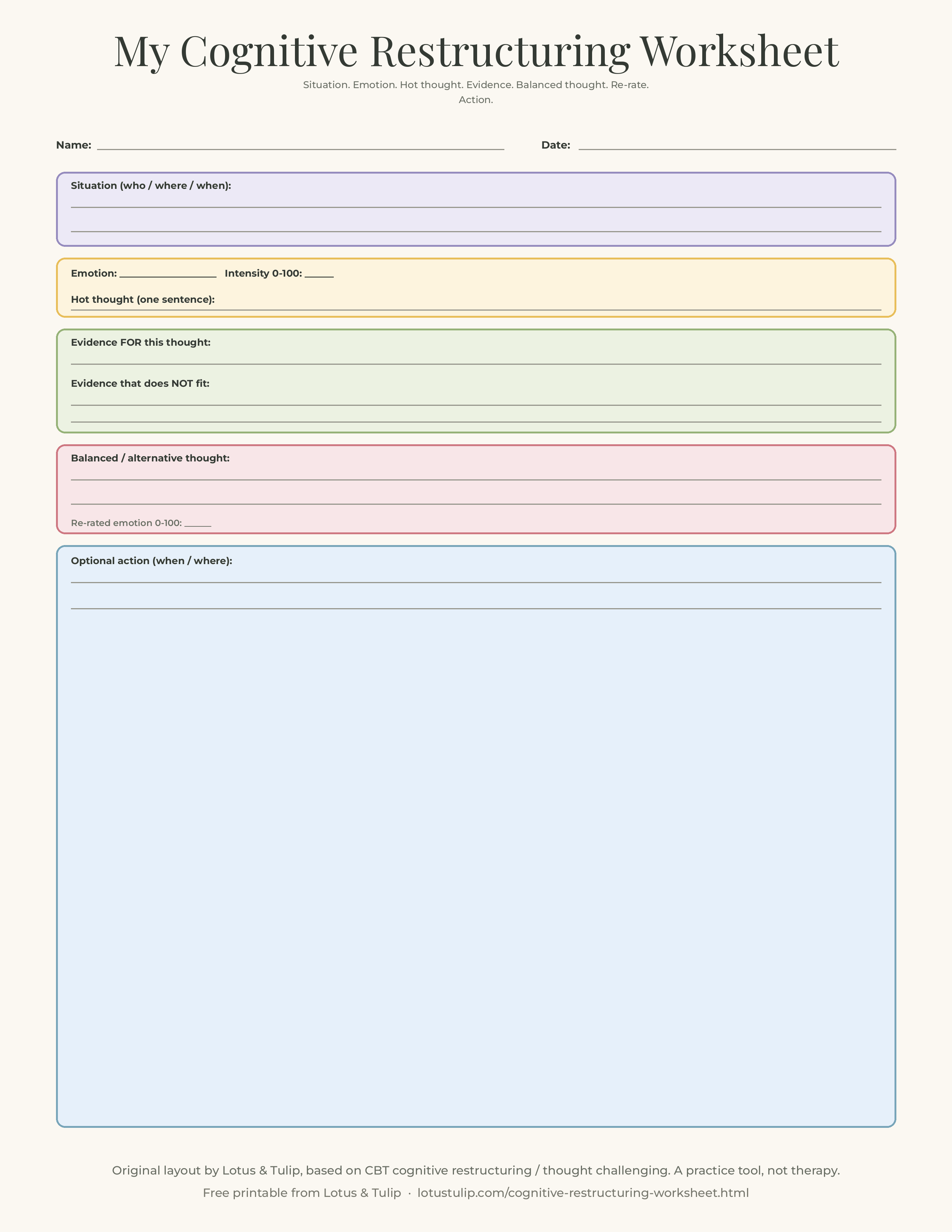
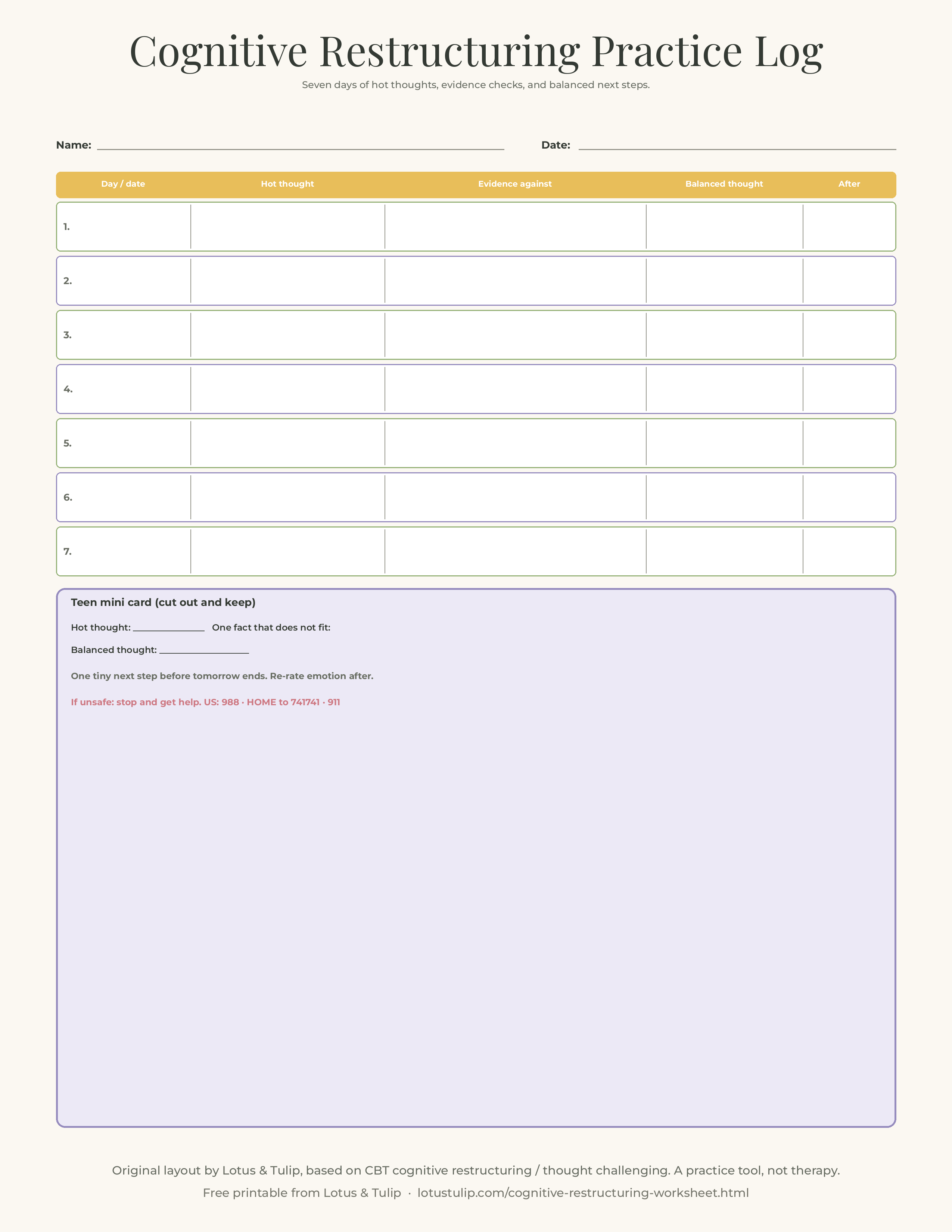
The free cognitive restructuring printable has three pages in US Letter size:
- Page 1: Cognitive Restructuring Steps card. Eight step sequence from situation through review, plus safety reminders.
- Page 2: My Cognitive Restructuring Worksheet. Fill in situation, emotion and intensity, hot thought, evidence for and against, balanced thought, re rated emotion, and optional action.
- Page 3: Practice Log + teen mini card. Seven day rows plus a cut out reminder for hot thought, one fact against, balanced thought, and a tiny next step.
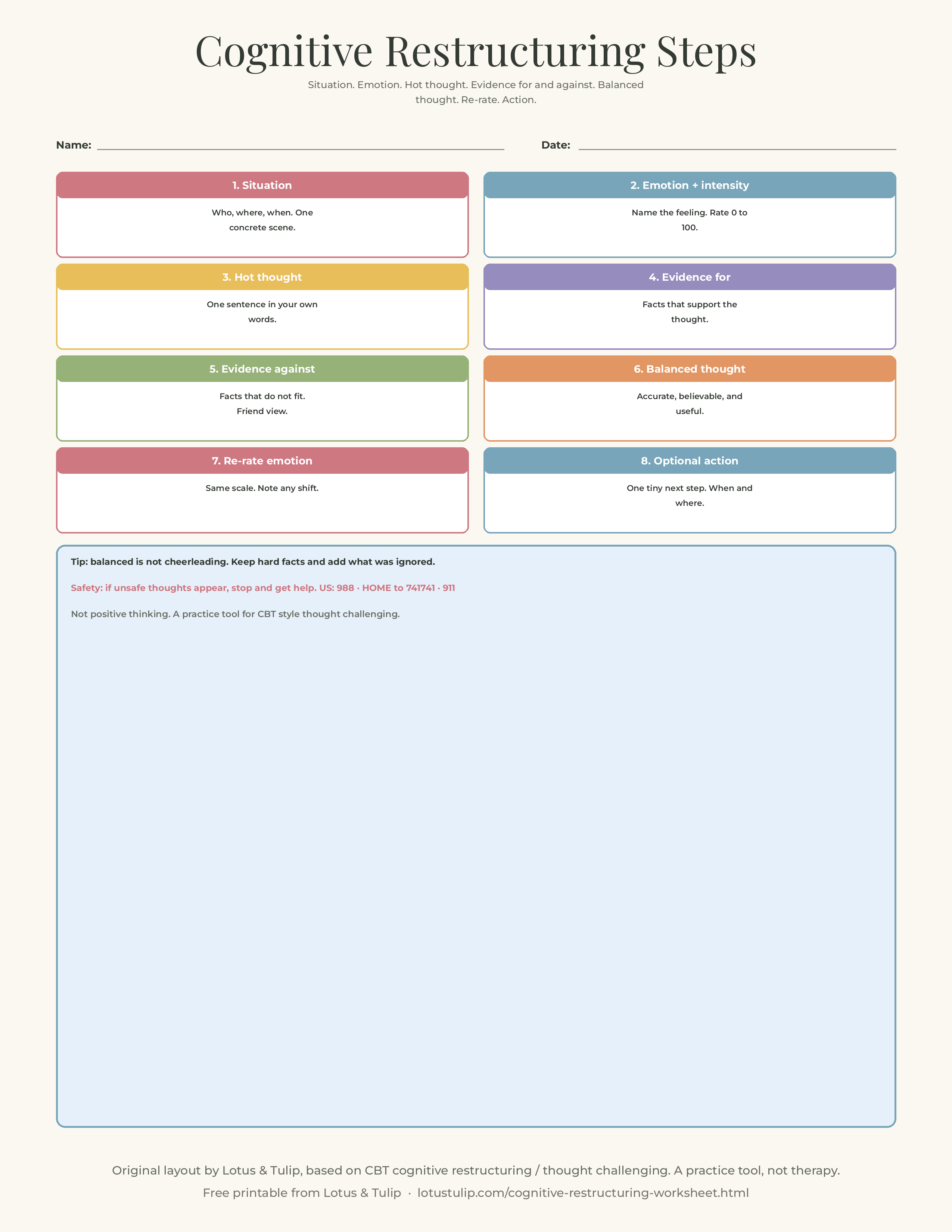
Download the free cognitive restructuring worksheet (PDF, 3 pages, US Letter)
Prefer single images? Page 1: Cognitive Restructuring Steps (PNG) · Page 2: My Cognitive Restructuring fill in (PNG) · Page 3: Practice Log (PNG)
Free CBT starter pack: Want more pages for the same session? The free CBT worksheets starter pack adds an evidence for and against page and a balanced thought builder, plus four more real worksheets from our CBT set (8 pages, client use license, no email).
Free to print for your own use and for use with your own clients, students, or groups. This is an original layout by Lotus & Tulip, based on CBT cognitive restructuring and thought challenging teaching associated with Aaron T. Beck and colleagues. It is not affiliated with those authors, the Beck Institute, or any specific treatment package, and is not a substitute for therapy. Please link to this page rather than re-uploading the file.
Related resources
- CBT thought record worksheet: write and rebalance hot thoughts.
- Cognitive distortions worksheet: thinking trap labels used gently.
- Socratic questioning worksheet: guided discovery questions.
- Check the Facts worksheet: DBT emotion vs facts skill.
- Cognitive defusion worksheet: ACT unhooking from thoughts.
- Behavioral experiment worksheet: test predictions in real life.
- Core beliefs worksheet: deeper belief work over time.
- CBT triangle worksheet: thoughts, feelings, behaviors.
- ABC model worksheet: Ellis ABC and disputing.
- Worry tree worksheet: plan vs cope decision tool.
- Therapy treatment plan template: goals, objectives, interventions.
- Safety plan worksheet: when the moment is about staying alive.
Sources
- Beck, A. T., and colleagues. Cognitive therapy / CBT teaching tradition including collaborative empiricism, automatic thoughts, and cognitive restructuring / thought examination. Credit the lineage; wording and forms vary by source and edition. Not affiliated with the Beck Institute.
- Hofmann, S. G., Asnaani, A., Vonk, I. J. J., Sawyer, A. T., and Fang, A. (2012). The efficacy of cognitive behavioral therapy: A review of meta-analyses. Cognitive Therapy and Research, 36(5), 427 to 440. Package level CBT review across conditions; not evidence for cognitive restructuring worksheets alone or for this printable.
- Honest caveat: cognitive restructuring is a technique inside CBT. Package level reviews are not the same as technique only RCTs, and no study tests this three page Lotus and Tulip printable alone.
Cognitive restructuring worksheet: FAQ
What is cognitive restructuring in CBT?
Cognitive restructuring is examining a hot automatic thought in a specific situation, gathering evidence for and against it, and writing a more balanced or useful alternative, then often re rating the emotion and choosing a small next action. It is also called cognitive reframing or thought challenging. In CBT it is tied to collaborative empiricism in the Beck tradition.
Is cognitive restructuring the same as positive thinking?
No. Positive thinking replaces a harsh thought with a cheerful slogan. Balanced restructuring keeps what is true (including hard facts) and adds what was ignored. The new thought should be believable, not peppy and false.
How is this different from a thought record or Socratic questioning?
A thought record is a common written form of cognitive restructuring. Socratic questioning is the live questioning skill that often fills that form. This page treats restructuring as the umbrella skill and cross links those tools.
How is this different from Check the Facts, defusion, ABC, or a behavioral experiment?
Check the Facts (DBT) matches emotion intensity to facts. Defusion (ACT) unhooks from thoughts without needing to disprove them. ABC and ABCDE are an REBT frame for beliefs and disputing. A behavioral experiment tests a prediction in real life when talk is not enough. They work best as neighbors, not rivals.
Can teens and school counselors use it?
Yes, often with plain "thought check" or "evidence check" language instead of jargon. Keep steps tiny, optional, and school safe. Follow crisis protocol when risk appears.
Does a cognitive restructuring worksheet work on its own?
A worksheet is a practice aid, not a standalone treatment. CBT package reviews (including Hofmann et al. 2012) speak to CBT as an approach, not to this free page alone. Use it inside counseling or therapy, and get licensed care for persistent or severe problems.
When should I not use cognitive restructuring?
Do not use it as the first move in acute safety risk, medical emergency, or when the person is too flooded to answer even clarifying questions. Stabilize and get help first when needed: 988, HOME to 741741, or 911. Use a safety plan when staying alive is the job. Prefer experiments or exposure when experience would teach more than another column.