
Therapist worksheets · Updated 2026-11-06
Worry Tree Worksheet: CBT Decision Tool for Kids and Adults, with a Free Printable
Ready-made printable: Worry Group Curriculum Holiday 20% off: about $11.04, was $14 (EUR 12) · instant digital download
Buy on Etsy
A worry tree is a simple CBT decision tool. You name one worry, then ask a branching question: is this a current problem I can do something about? If yes, you make a concrete plan and take a step. If no, you use coping skills, schedule a limited worry time if that helps, and let the worry go for now. The tree shape is a teaching picture, not a magic tree. It separates solvable problems from hypothetical spirals so the brain stops treating every "what if" as an urgent to do list.
Counselors, therapists, and parents use worry trees with children, teens, and adults because the fork is easy to remember under stress. Kids versions often appear in CBT for childhood anxiety programs associated with Paul Stallard and related clinical teaching (we are not affiliated with Stallard or any textbook publisher). Adult versions sit next to worry postponement, problem solving, and circle of control work. This guide explains what a worry tree is, how kids and adult versions differ, how it compares with a circle of control worksheet, a general worry worksheet, and a thought record, a nine step how to, fictional worked examples, school counselor tips, therapist tips, parent tips, common mistakes, and what the research actually supports. You also get a free three page US Letter printable: Worry Tree Steps, My Worry Tree fill in, and a Practice Log with a teen mini card.
This guide is educational. It is not therapy, not medical advice, and not a diagnosis. If thoughts of ending your life, plans to harm yourself or someone else, or a medical emergency show up, stop the worksheet and get help now: in the US, call or text 988, text HOME to 741741, or call 911. Our safety plan worksheet is a better first tool in that moment. For nearby worry tools, see the worry worksheet for kids (detective, worry time, brave steps) and the circle of control worksheet.
Jump to the free worry tree worksheet (PDF) · How to use a worry tree, step by step · Worked examples · Comparisons
What a worry tree is
Worry trees answer a practical question: should I problem solve this, or should I cope and park it? Rumination and worry often blend those jobs. The mind rehearses a future catastrophe as if it were a project plan, then feels stuck because there is no next step that fits. The tree forces a fork.
Typical branches:
- Name the worry in one plain sentence. "What if I fail the test" is better than a fog of "school is bad."
- Ask: is this a current problem I can do something about (today, this week, or within my real control)?
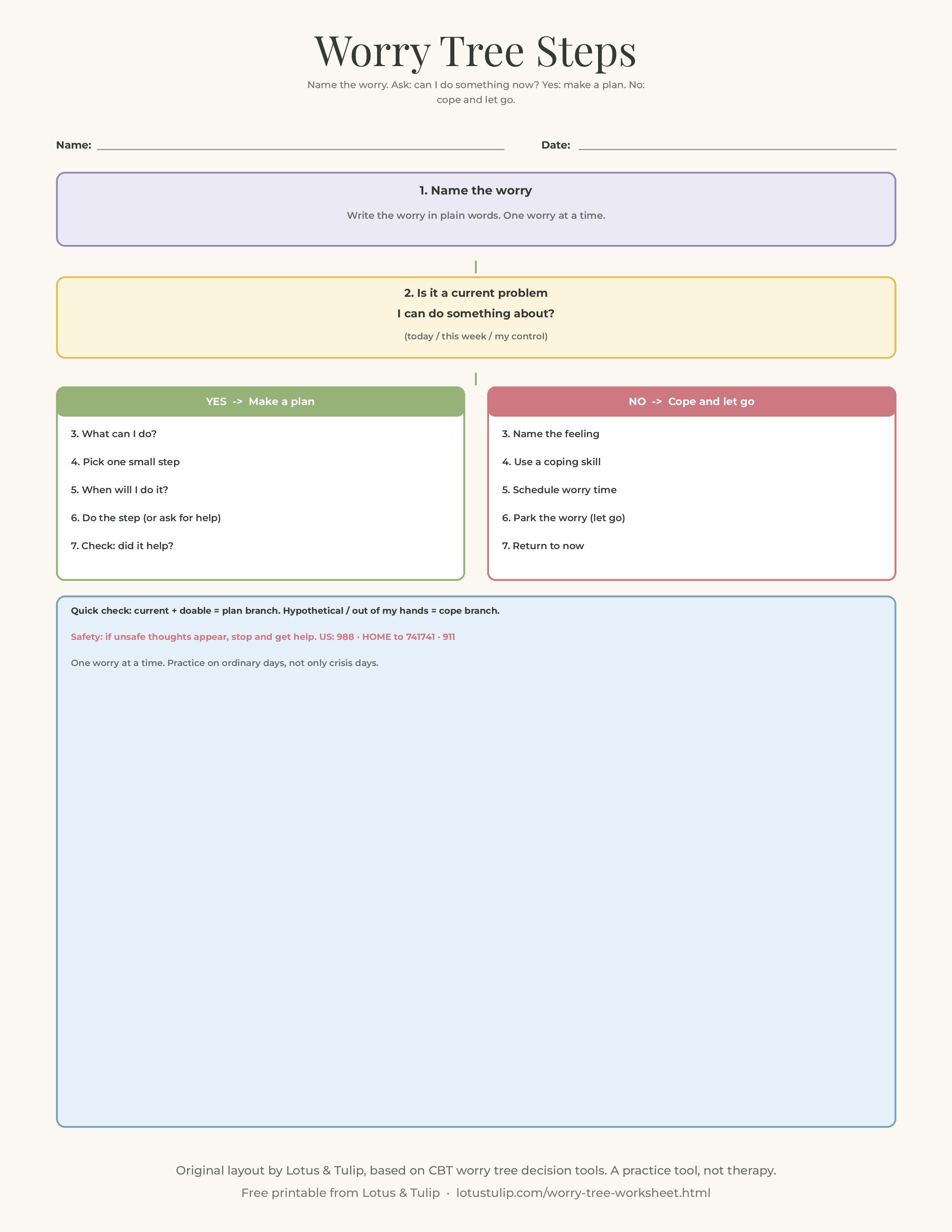
- Yes branch: brainstorm options, pick one small step, set when and where, do it or ask for help, then review.
- No branch: notice the feeling in the body, use a coping skill, optionally schedule a short worry time later, park the worry, and return attention to the present activity.
That structure sits at the meeting point of three CBT ideas. Problem solving skills (classic work by D'Zurilla and Goldfried and later CBT adaptations) teach people to treat solvable problems as plans, not as endless mental rehearsal. Worry postponement (associated with Borkovec and related GAD research traditions) teaches that open ended worry can be contained in a planned window instead of hijacking every hour. Child focused CBT teaching, including materials in Stallard's Thinking Good, Feeling Better / CBT with Children lineage, often uses tree style decision pictures so younger clients can see the fork without dense jargon. Credit the lineages. This Lotus and Tulip printable is an original layout, not a copy of any publisher worksheet, and we are not affiliated with those authors or presses.
A worry tree is a sorting tool. It is not exposure therapy by itself, not a full GAD protocol, and not a promise that anxiety will disappear after one page.
Why counselors use it
Under anxiety, kids and adults often do two unhelpful things at once: they try to solve the unsolvable, and they avoid the solvable. A worry tree makes that pattern visible in one minute. School counselors can run it on a whiteboard in a small group. Therapists can use it as a session opener or as homework after teaching the fork live. Parents can coach one worry at bedtime without turning the night into a debate tournament.
The tool also protects coping skills from misuse. Deep breathing is a poor stand in for calling the teacher about a missing assignment. Likewise, a perfect action plan will not settle a "what if an asteroid hits" spiral. Matching the branch to the job is the skill.
Adult vs kids versions
Kids versions keep language concrete, use pictures or a drawn tree, and often add a helper adult for the plan branch. Questions sound like: "Is this something happening soon that you can do a little bit about?" Coping on the no branch may be a short body skill, a worry box, or a scheduled five minute worry time with a parent. Keep practice optional and short. Never force a child to "stop worrying" as a rule. For younger detective style pages (spot the worry, brave steps ladder), use the sibling worry worksheet for kids.
Teen versions can name the fork more sharply: current and doable versus hypothetical or out of my hands. Teens often need help noticing social media fueled "what if everyone hates me" loops that feel urgent but have no next action today. The free page 3 mini card is designed as a cut out reminder.
Adult versions may add work, money, health, and relationship worries with clearer language about control and influence. Adults still benefit from one worry at a time. Many adults stack ten worries into one fog and call it productivity. The tree slows that stack.
Worry tree vs circle of control vs worry worksheet vs thought record
| Worry tree | Circle of control | Worry worksheet for kids | Thought record | |
|---|---|---|---|---|
| Main job | Decide: plan now or cope and park | Sort what I control, influence, or cannot control | Detect worry, use worry time, build brave steps | Examine a hot thought with evidence and a balanced alternative |
| Best early use | When the person is stuck looping and needs a fork | When everything feels equally urgent and ownership is confused | When a child needs playful mapping and exposure style brave steps | When a specific automatic thought needs cognitive restructuring |
| Output | A plan step or a coping + park plan | Items placed in control / influence / outside circles | Worry notes, worry time plan, ladder steps | Rated belief change on a thought |
| Cross link | This page | Circle of control worksheet | Worry worksheet for kids | CBT thought record |
These tools cooperate. A circle of control can feed the worry tree decision (outside my control usually means the no branch). A thought record can follow if the plan branch reveals a hot prediction ("If I ask, they will hate me") that needs testing. A kids worry worksheet can sit beside the tree when the child needs detective language or a brave steps ladder rather than a binary fork. Do not photocopy three tools into one confusing sheet on day one. Teach one, then bridge.
Related neighbors: CBT triangle, ABC model, behavioral experiment, and anxiety worksheets for kids.
How to use a worry tree, step by step
- Settle enough to write. If the person is flooded, stabilize first with grounding, paced breathing, or a short break. A tree filled at a 10 out of 10 panic is usually scribbles, not a plan. Crisis first: 988, HOME to 741741, or 911 when safety is the issue.
- Name one worry in plain words. One sentence. If there are ten, pick the loudest for the next ten minutes. Park the rest on a list for later.
- Ask the fork question. "Is this a current problem I can do something useful about?" Current means happening or about to happen in a real window. Do something useful means a step within skill, role, and resources, not a fantasy fix.
- If yes, list options briefly. Three is enough. Include asking for help as a valid option. Perfection is not required.
- Pick the smallest useful step. "Email the teacher" beats "become a perfect student." Write when and where. Put it on a calendar if needed.
- If no, name the feeling and body signal. Tight chest, restless legs, stomach drop. Then choose one coping skill that fits the setting (classroom safe skills differ from home skills).
- Optional: schedule worry time. For example, 10 minutes at 4:30 pm with a notebook. Outside that window, return to the present task. This is worry postponement, not suppression forever.
- Park the worry and return to now. A worry box, a sticky note in a folder, or a simple "not for this hour" line can mark the park. Then do the next real activity for two minutes.
- Review with a one line note. On the free practice log: date, short worry, Y or N, what you did, after rating 0 to 10, and one learning. Learning beats a perfect tree drawing.
Practice on ordinary Tuesdays. Skill grows with short reps, not only on the worst night of the month.
Worked fictional examples
Kid example (fictional): Maya, age 9, worries "What if nobody sits with me at lunch tomorrow?" Fork: is this a current problem she can do something about? Partly yes. She cannot control other kids' choices, but she can take a small social step. Yes branch plan: ask one classmate in the morning if they want to sit together, and tell the counselor if lunch still feels hard. No branch skills for the leftover "what if they say no forever" spiral: three belly breaths, squeeze a stress ball, and put the leftover worry in the worry box until after school worry time. She does both: a plan for the doable piece, coping for the hypothetical tail.
Adult example (fictional): Jordan worries at 1 am: "What if I get laid off next year and lose the house?" Fork: current and doable tonight? No. There is no layoff notice, and 1 am is not a finance meeting. No branch: write the worry on a note for Saturday morning money review (worry time), do a short body scan or paced breathing, and return to a wind down routine. On Saturday, if job risk is real, the yes branch appears: update the resume, check emergency fund numbers, talk with a partner. The tree stops Jordan from running a full career crisis at 1 am without a next step that fits the hour.
Notice both examples allow mixed answers. Real worries often have a doable slice and a hypothetical slice. Split them. Plan the slice you can touch. Cope with the rest.
School counselor tips
- Teach the fork on the board first. Draw a simple tree. Practice with low stakes worries ("forgot pencil") before big social fears.
- Keep groups skills based and optional. Students can pass. Follow district crisis protocol if risk appears. Use 988 / HOME to 741741 / 911 language when your setting requires it.
- Match the yes branch to school reality. Helpful adults, email templates, and office hours beat vague "just be brave."
- Use the no branch for test night spirals and friendship "what ifs" that have no action until morning.
- Bridge tools. Pair with circle of control, worry worksheet for kids, breathing exercises, and 5 4 3 2 1 grounding when body alarm is high.
- Send home one page, not a binder. The free PDF is enough for practice between sessions.
Therapist tips
- Practice live before homework. Fill one tree together so the client hears your decision criteria out loud.
- Watch for avoidance disguised as coping. "I will just breathe" on a solvable email is the no branch used to dodge. Name it kindly and shift to plan.
- Watch for over planning disguised as control. Endless yes branch lists with no smallest step is another trap.
- Link to the wider plan. GAD protocols may include worry time, cognitive restructuring, and exposure. A tree is one sorting skill inside that plan.
- Trauma and OCD notes. Intrusions and compulsions need disorder specific care. Do not force a worry tree as the only tool for OCD rituals or trauma memories. Collaborate with the case formulation.
- Measure function. Ask what changed after a week: fewer 2 am spirals, faster start on solvable tasks, less arguing with hypotheticals.
Parent tips
- Coach, do not interrogate. "Want to try the tree with one worry?" beats "Stop worrying right now."
- Validate first. "That worry makes sense why your body feels tight." Then fork.
- Be the helper on the plan branch when needed. Kids often need an adult to send the email or role play the ask.
- Protect sleep. Late night yes branch projects rarely help. Use no branch and a morning plan slot.
- Model your own tree out loud sometimes. Kids learn when adults show "this is not solvable at 9 pm; I am parking it."
- Get help early if worry shrinks school, sleep, or friendships for weeks. A printable is not a substitute for assessment.
Common mistakes
- Stacking ten worries on one tree. One at a time.
- Calling everything "no" to avoid hard conversations.
- Calling everything "yes" and writing impossible plans.
- Skipping the body on the no branch. Coping needs a real skill, not only "don't think about it."
- Using worry time as all day rumination with a fancy name. Keep the window short and contained.
- Shame for needing the no branch. Parking a hypothetical is skill, not weakness.
- Treating the worksheet as treatment. Persistent anxiety, panic, OCD, trauma, or depression need licensed care.
What the research says (honestly)
There is strong evidence for CBT packages for childhood anxiety, and related evidence for problem solving and worry management strategies in adult CBT. There is not a large trial literature that isolates this exact three page Lotus and Tulip worry tree printable on its own. Treat the page as a teaching aid inside a broader plan.
CBT for childhood and adolescent anxiety. James, Reardon, Soler, James, and Creswell (2020), in a Cochrane review of 87 randomized trials (5,964 participants), found that CBT probably increases short term remission of primary anxiety diagnoses compared with wait list or no treatment (about 49.4% vs 17.8%; odds ratio about 5.45; moderate quality evidence for that comparison). The same review found little clear evidence that CBT is superior to usual care or alternative treatments, with confidence limited by evidence quality. That supports offering CBT style skills for youth anxiety. It does not prove that a single free worksheet remits diagnoses.
Problem solving. D'Zurilla and Goldfried's classic problem solving framework (and later CBT adaptations) underpins the yes branch: define the problem, generate options, choose, act, review. Problem solving training appears inside many CBT protocols for anxiety and depression as a component skill.
Worry postponement and GAD traditions. Borkovec and colleagues' work on worry as a verbal, future oriented process helped shape treatments that limit open ended worry and teach alternative responses, including scheduled worry time in some protocols. Worry postponement is a clinical strategy with a research lineage. It is not a claim that parking a thought erases GAD.
Child CBT teaching materials. Stallard's Thinking Good, Feeling Better and related CBT with Children resources popularized accessible worksheets and decision pictures for young people. Credit that teaching tradition. This page is not affiliated with those books and is not a reproduction of their copyrighted sheets.
Honest caveat. Program level CBT evidence is not the same as printable level evidence. Use the worry tree to teach a fork. For severe or lasting anxiety, seek a qualified clinician.
Free worry tree worksheet (PDF)
The free worry tree printable has three pages in US Letter size:
- Page 1: Worry Tree Steps card. Flowchart style: name the worry, ask if you can do something, yes plan steps, no coping steps, and safety reminders.
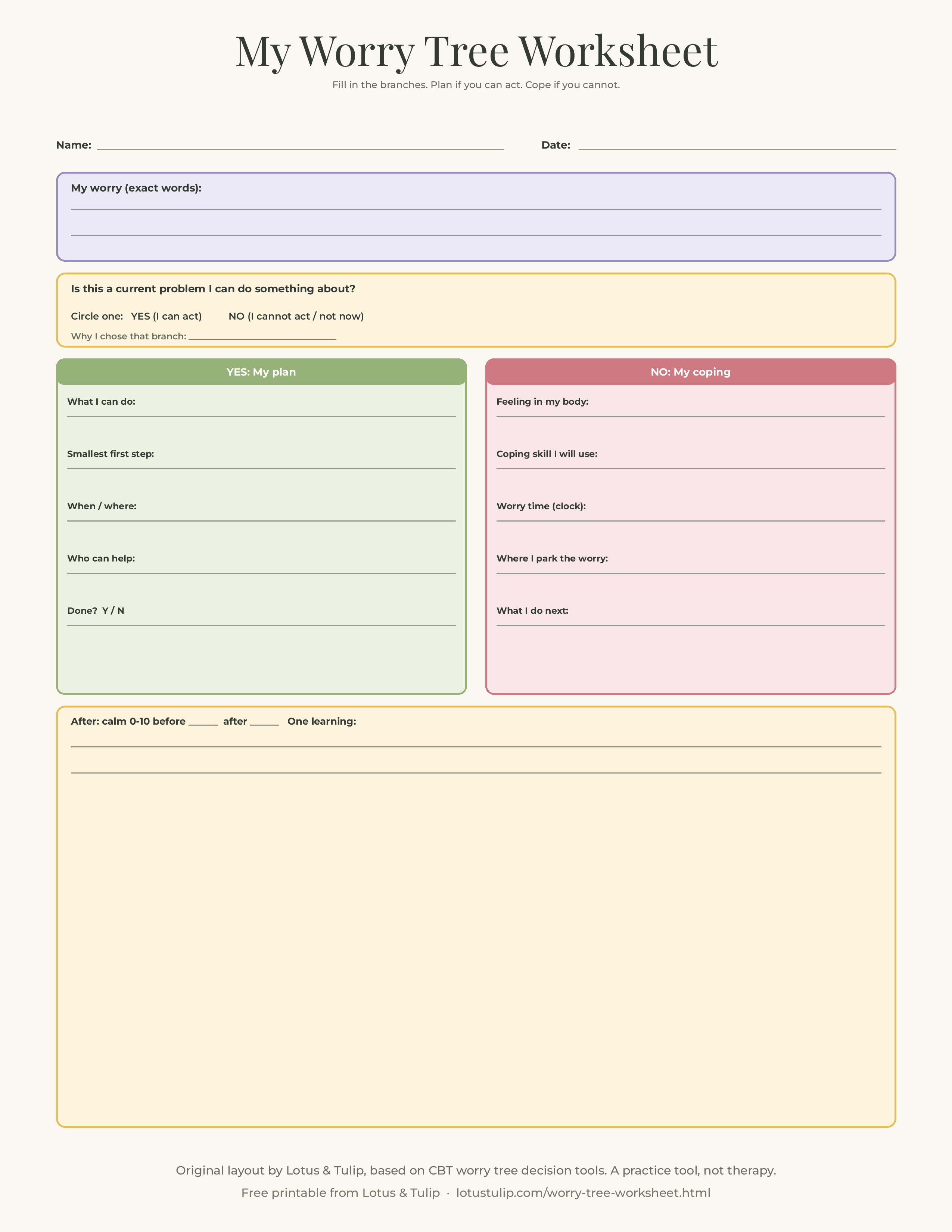
- Page 2: My Worry Tree Worksheet. Fill in branches with a plan box and a coping box, plus before and after ratings.
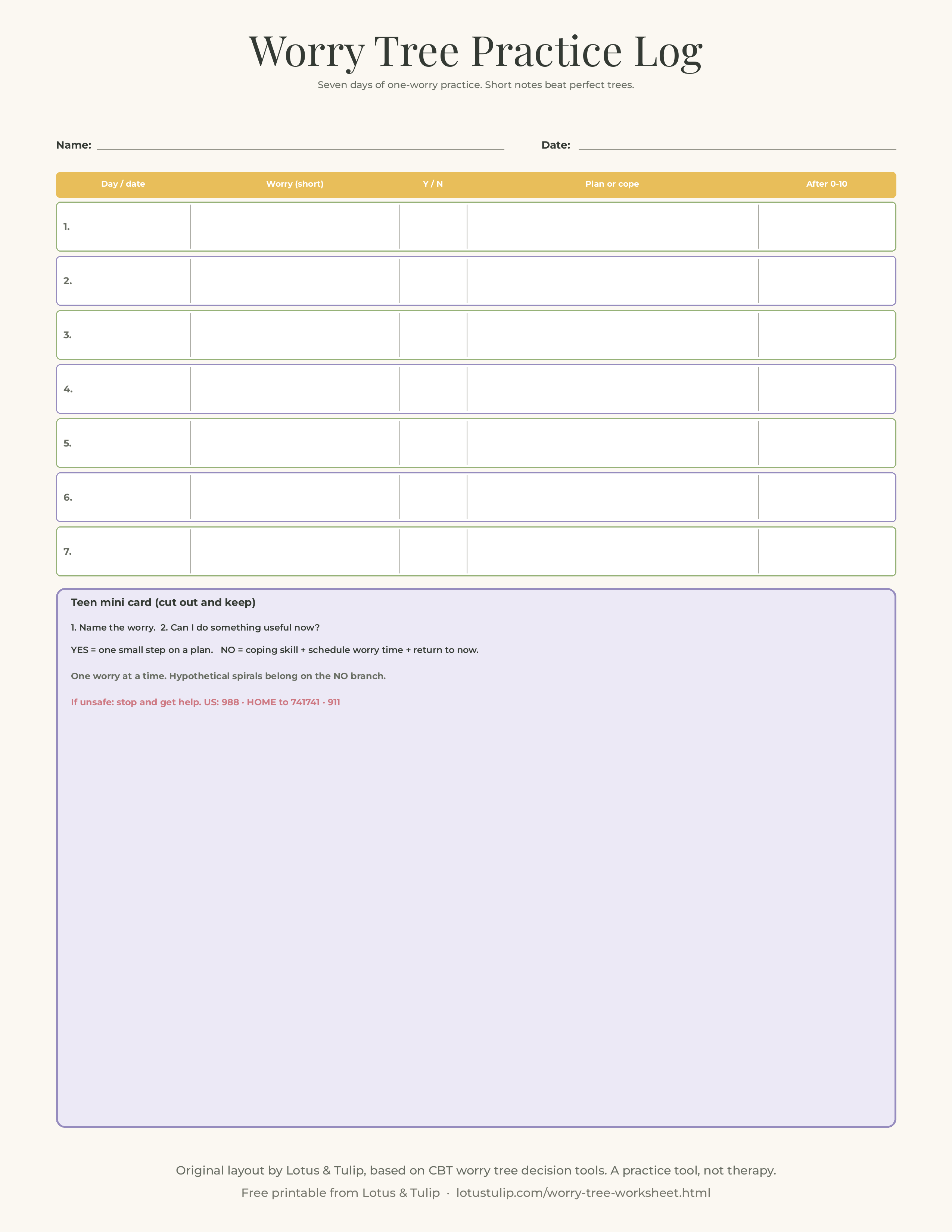
- Page 3: Practice Log + teen mini card. Seven day rows plus a cut out reminder for the fork.
Download the free worry tree worksheet (PDF, 3 pages, US Letter)
Prefer single images? Page 1: Worry Tree Steps (PNG) · Page 2: My Worry Tree fill in (PNG) · Page 3: Practice Log (PNG)
Free anxiety starter pack: The free anxiety worksheets starter pack adds a worry log for tracking real worries between sessions, plus the anxiety cycle, probability and catastrophe, a fear ladder, grounding and a support and safety page from our paid anxiety set.
Free to print for your own use and for use with your own clients, students, or groups. This is an original layout by Lotus & Tulip, based on CBT worry tree decision tools as taught in child and adult CBT worry work. It is not affiliated with Paul Stallard, any textbook publisher, or any specific treatment package, and is not a substitute for therapy. Please link to this page rather than re-uploading the file.
Related resources
- Worry worksheet for kids: detective, worry time, and brave steps (sibling page, different job).
- Worry time worksheet: postpone worries to one daily window, then sort them with the tree (free plan and log).
- Circle of control worksheet: sort control, influence, and outside.
- CBT thought record: examine a hot thought with evidence.
- Anxiety worksheets for kids: alarm, thought check, brave plan.
- Breathing exercises for kids: skills for the no branch.
- 5 4 3 2 1 grounding worksheet: when the body alarm is loud.
- Problem solving worksheet for kids: deeper yes branch practice.
- Safety plan worksheet: when the moment is about staying alive, not sorting worries.
- Catastrophizing worksheet: for adults, follow the "what if" chain and weigh the worst, best and most likely outcomes (free printable).
- Problem solving worksheet for adults: when the worry is a real problem you can act on, with a free map and plan
Sources
- James, A. C., Reardon, T., Soler, A., James, G., and Creswell, C. (2020). Cognitive behavioural therapy for anxiety disorders in children and adolescents. Cochrane Database of Systematic Reviews, 2020(11), CD013162. 87 RCTs, 5,964 participants; CBT probably increases short term primary anxiety remission vs wait list or no treatment (about 49.4% vs 17.8%; OR about 5.45; moderate quality for that comparison); little clear superiority vs usual care or alternative treatments.
- D'Zurilla, T. J., and Goldfried, M. R. (1971). Problem solving and behavior modification. Journal of Abnormal Psychology, 78(1), 107 to 126. Classic problem solving framework that informs plan style CBT skills.
- Borkovec, T. D., and related GAD / worry research tradition (including later clinical adaptations of worry postponement). Worry as a future oriented verbal process; treatments often limit open ended worry and teach alternative responses. Component strategy evidence, not a claim about this printable alone.
- Stallard, P. Thinking Good, Feeling Better and related CBT with Children resources. Accessible child CBT teaching materials including decision style worksheets in that lineage. Credit only; not affiliated; this page is an original Lotus and Tulip layout, not a reproduction.
- Honest caveat: no study tests this three page Lotus and Tulip printable alone. Package level CBT evidence is not the same as worksheet level evidence.
Worry tree worksheet: FAQ
What is a worry tree worksheet?
A worry tree worksheet is a CBT decision tool. You name one worry, then ask whether it is a current problem you can do something about. If yes, you make a plan. If no, you cope, optionally schedule worry time, and park the worry. It is a sorting skill, not a full therapy program by itself.
How do you use a worry tree step by step?
Settle enough to write, name one worry, ask the fork question, take a small plan step on the yes branch or use coping and parking on the no branch, then write a short review note. The nine step section and free printable walk through the same sequence.
Is a worry tree the same as a circle of control?
No. A circle of control sorts what you control, influence, or cannot control. A worry tree decides whether to plan now or cope and park. They pair well: items outside your control usually belong on the no branch. See our circle of control worksheet page for the circle tool.
How is this different from the worry worksheet for kids?
Our worry worksheet for kids focuses on detective language, worry time, and brave steps ladders. This worry tree page focuses on the classic plan versus cope decision fork used in CBT worry work for kids and adults. Use them as siblings, not duplicates.
Can adults use a worry tree?
Yes. Adults often need the same fork for work, money, health, and relationship spirals, especially at night when no useful action fits the hour. The free printable includes adult friendly plan and coping boxes and a teen mini card.
Does a worry tree worksheet work on its own?
A worksheet is a practice aid, not a standalone treatment. CBT packages for childhood anxiety have broader evidence (including the 2020 Cochrane review by James and colleagues) than any single free page. Use the tree inside counseling, therapy, or a structured plan, and get licensed care for persistent or severe problems.
When should I not use a worry tree?
Do not use it as the first move in acute safety risk, medical emergency, or when the person is too flooded to choose a branch. Stabilize and get help first when needed: 988, HOME to 741741, or 911. OCD rituals and trauma processing need disorder specific plans rather than a single tree sheet.