
Kids and teens · Problem solving skills and social emotional learning · Updated 2026-11-04
Problem solving worksheet for kids: 5 steps to teach problem solving skills, plus a free printable
Ready-made printable: Social Skills Small Group Curriculum for School Counselors, Grades 2 to 5 Holiday 20% off: about $11.04, was $14 (EUR 12) · instant digital download
Buy on Etsy
Every school day gives children dozens of small problems to solve. Two kids want the same swing. A worksheet makes no sense. A friend says something mean in the lunch line. Some children seem to handle these moments almost automatically. Others freeze, cry, hit, shut down or ask an adult to fix it every single time. The difference is rarely intelligence. Very often it is a set of thinking steps that some children have picked up and others have not been taught yet.
This guide is for school counselors, teachers and parents in the US who want to teach problem solving skills in a way that sticks. It covers what problem solving skills for kids actually are, what research says (and where it is limited), a simple five step model, how to adapt it by age, ideas for classrooms, counseling and home, a step by step way to teach it, common mistakes, and a free three page problem solving worksheet for kids with a steps chart, a solution checker and twelve practice cards.
Jump to the free problem solving worksheet for kids
What are problem solving skills for kids?
In everyday school language, problem solving skills are the steps a child uses to get from "something is wrong" to "I tried something that helped." For academic tasks that might mean rereading directions or trying a different strategy in math. This guide focuses on social and everyday problems: conflicts with friends, frustrating tasks, forgotten homework, unfair moments and big feelings that get in the way of thinking.
Most models used in schools break social problem solving into a handful of skills:
- Noticing and calming the body so the thinking part of the brain can work.
- Defining the problem in plain words, without blaming, and naming what you want.
- Generating more than one solution instead of grabbing the first idea.
- Thinking about consequences, including how a solution will affect other people.
- Choosing, trying and evaluating a solution, and having a plan B.
The Collaborative for Academic, Social, and Emotional Learning (CASEL) lists "responsible decision-making" as one of its five core social and emotional competencies, alongside self-awareness, self-management, social awareness and relationship skills. Problem solving lives mostly in responsible decision-making, but it leans on the other four. A child who cannot calm down (self-management) or guess how a classmate feels (social awareness) will struggle to solve a problem with that classmate, however many steps are on the poster.
What the research says about teaching problem solving
Problem solving training has a longer research history than many social emotional topics. It is still worth reading the evidence carefully, because the strongest studies are older, and results in clinical samples do not automatically apply to a typical classroom.
The basic steps come from adult psychology. In 1971 Thomas D'Zurilla and Marvin Goldfried published an influential paper in the Journal of Abnormal Psychology describing problem solving as a series of stages: general orientation, problem definition, generating alternatives, decision making and verification. Most kid friendly versions you will see today, including the one in this guide, are simplified descendants of that sequence.
Young children can learn to think of more solutions. Myrna Shure and George Spivack developed what became the I Can Problem Solve (ICPS) approach, which teaches young children to think of alternative solutions and consequences rather than telling them what to do. In a 1982 paper in the American Journal of Community Psychology, they reported on low income Black 4 and 5 year olds in Philadelphia: 113 children who received the training and 106 who did not. Trained children improved in problem solving thinking and in teacher rated behavior, the gains held for at least a year, and trained children who started out well adjusted were less likely to develop behavior difficulties later. This is encouraging, but it is one research team evaluating its own program decades ago, so treat it as solid early evidence rather than a guarantee.
Problem solving training is one of the better studied approaches for serious behavior problems. Alan Kazdin, Todd Siegel and Debra Bass (1992, Journal of Consulting and Clinical Psychology) randomly assigned 97 children aged 7 to 13 with severe antisocial behavior to problem solving skills training, parent management training, or both. Each approach helped, the combined treatment led to the biggest improvements, and effects were still visible at a one year follow up. These were clinic referred children receiving many sessions with trained therapists, so a classroom worksheet is not the same intervention. What carries over is the idea that problem solving can be taught, and that it works best when the adults around the child are involved too.
How a child reads a situation matters before any steps begin. Nicki Crick and Kenneth Dodge (1994, Psychological Bulletin) described a social information processing model in which children encode cues, interpret them, choose goals, generate responses and evaluate them before acting. A recurring finding in this line of research is that some aggressive children are quicker to assume that an accidental bump or an ambiguous comment was hostile. In practice, that is why the "say the problem" step on the worksheet asks children to describe what happened without blaming. Checking the story is part of solving the problem.
What the evidence does not show. There is no good evidence that a single worksheet, used once, changes behavior. The studies that found effects used repeated practice over weeks, with adults coaching children in real situations. Use the free printable below as one tool inside that kind of practice, not as the whole plan.
The 5 step problem solving model for kids
The free printable uses a five step model. It is deliberately short, so children can remember it under stress, and each step has a picture cue for nonreaders.
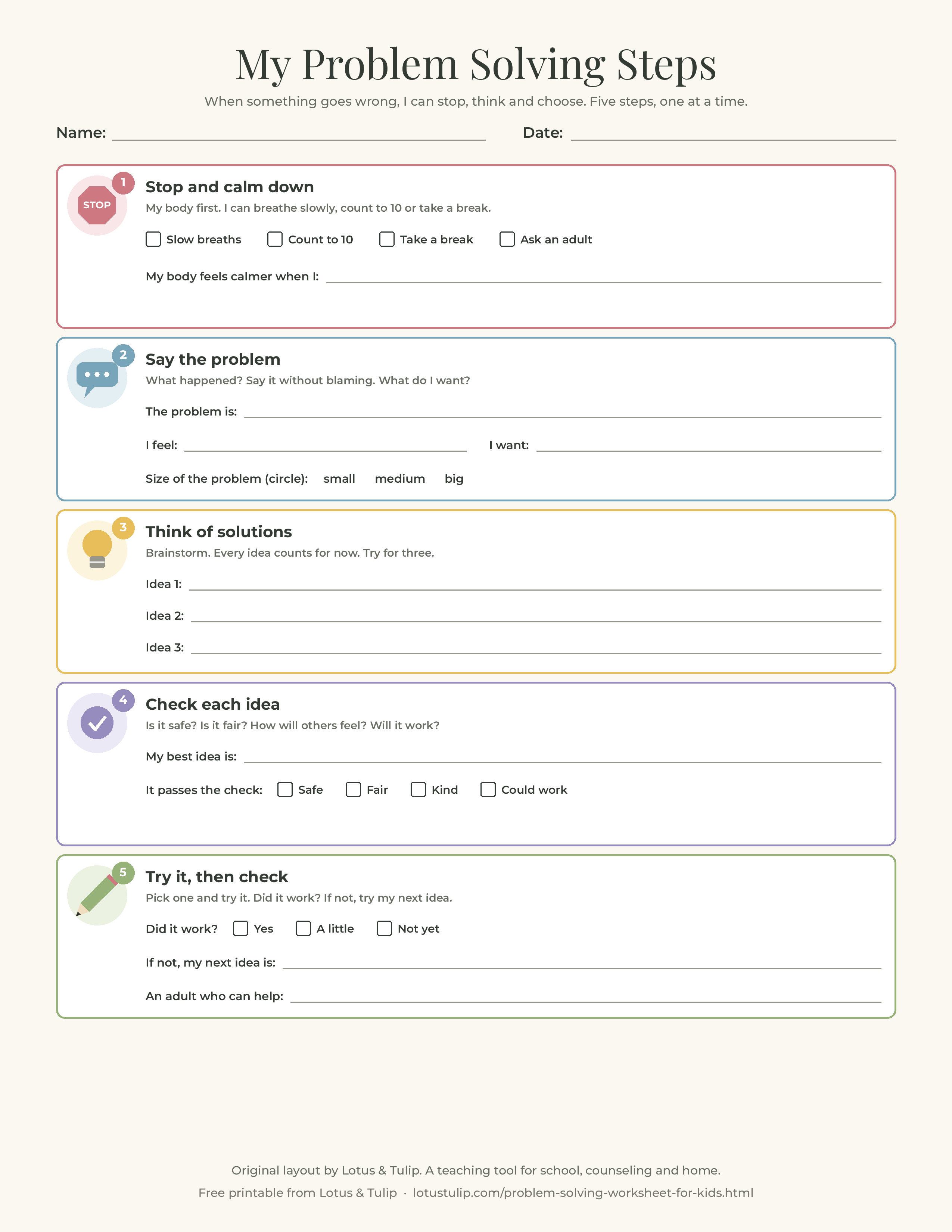
- Stop and calm down. Breathe slowly, count to ten, take a short break or ask an adult. Nobody solves problems well while flooded with anger or panic.
- Say the problem. "Maya and I both want the last swing" is a problem statement. "Maya is mean" is a blame statement. Add how you feel and what you want, and decide whether it is a small, medium or big problem.
- Think of solutions. Brainstorm at least three ideas before judging any of them. Silly ideas are allowed at this stage, because they often lead to a good one.
- Check each idea. Ask four questions: Is it safe? Is it fair? How will others feel? Will it work? An idea with a "no" goes back to the drawing board.
- Try it, then check. Pick the best idea and try it. Afterward, ask whether it worked. If not, move to plan B, and remember who can help.
The four checks in step 4 are the heart of the model. Children who struggle with problem solving often generate only one solution, and it is usually the first thing that pops into their heads (grab it, hit, quit, cry, tell). Teaching them to run every idea through the same quick checks slows down that first impulse without shaming it.
Problem solving skills by age
Ages 4 to 6 (preschool to kindergarten). Keep it to three steps: calm down, think of ideas, try one. Act problems out with puppets or stuffed animals. Shure's ICPS work with young children started with word concepts like "same and different," "if and then" and "might and maybe," which you can practice in ordinary moments: "If you grab the truck, then what might happen?" Write for the child and let them point to pictures.
Ages 6 to 8 (grades 1 to 3). Introduce all five steps with the steps chart. Children at this age can usually generate two or three ideas with support and can start to judge "fair" and "safe." Practice with the scenario cards before real conflicts, so the steps feel familiar when emotions are high.
Ages 9 to 12 (grades 4 to 6). Use the solution checker and encourage independent brainstorming. This age group is ready to think about other people's perspectives in more depth, about short term versus long term consequences, and about problems with no perfect answer. Peer conflicts at this age often involve group dynamics, so practice scenarios with friends, exclusion and choosing sides.
Teens. The same steps apply, with more complex problems: schedules, money, online conflicts, choices about friends and safety. Teens tend to resist anything that looks childish, so present the model as a decision making tool rather than a worksheet, and let them apply it to their own real problems.
Problem solving activities for the classroom
- Teach the steps before you need them. Introduce one step a day for a week. Model each step with a low stakes problem of your own: "I forgot my coffee and I am grumpy. Let me stop and take a breath first."
- Use a problem of the day. Read one practice card at morning meeting. Students brainstorm solutions in pairs, then the class runs the best two through the four checks.
- Post the steps chart near the calm down corner or the class meeting area, so you can point to it during real conflicts instead of lecturing.
- Use literature. Pause a read aloud at the moment a character faces a problem and ask, "What are three things she could do? Which one passes the checks?"
- Hold class meetings for group problems. When a problem belongs to the whole class (the line up is chaos, the classroom library is a mess), use the same steps as a group. Children see the model work on something real.
- Connect it to academic work. "Stop, say the problem, try another strategy" works for a hard math problem too. Children who see the same steps in different settings are more likely to use them.
Problem solving in school counseling and small groups
School counselors often meet the students who most need problem solving skills: children referred for fights, frequent meltdowns, peer conflict or impulsive choices. A few practical ideas:
- Build a small group around it. Four to six students, six to eight sessions, one step per session, with role plays and a real problem from the week at every meeting.
- Pair it with emotional regulation. Step 1 is where many students get stuck. If a child cannot calm down, spend more sessions on coping skills before moving on. The emotional regulation worksheets for kids and coping skills list for kids pair well with this.
- Use the worksheet after an incident, not during. Once a student is calm, walk through what happened with the five steps. Ask what they did at each step and what they could try next time. This turns a discipline moment into practice.
- Check the story. For students who often assume others meant to hurt them, add a question at step 2: "What else could have happened? Is there another way to see it?" This reflects the social information processing research described above.
- Loop in teachers and families. Share the steps chart so adults use the same words. Kazdin's research found the strongest effects when parents were involved alongside the child.
Teaching problem solving at home
Parents get more practice opportunities than anyone. A few habits help:
- Resist fixing it immediately. When a child brings a problem, try "That sounds hard. What could you do?" before offering your own idea. Children who are always rescued do not get practice.
- Brainstorm together. Write every idea down, including the silly ones, and then check them together. Siblings arguing over a toy is a perfect practice problem.
- Think aloud about your own problems. "The store is out of what I need for dinner. I could go to another store, make something else, or order takeout. Let me check which one works best tonight."
- Solve repeating problems collaboratively. Ross Greene's Collaborative and Proactive Solutions approach, described in his book The Explosive Child, suggests solving predictable problems ahead of time and together: share your concern, hear your child's concern, and look for a solution that works for both of you. Homework battles, screen time and morning routines are good candidates.
- Praise the process. "You stopped and thought about how your brother would feel. That was good problem solving" teaches more than "Good job."
How to teach problem solving to kids, step by step
- Introduce the idea of a problem. Talk about how everyone has problems every day, and that problems can be solved. Share a small problem of your own and how you solved it.
- Teach the calm down step first. Practice slow breathing, counting and asking for a break when everyone is calm. Make it clear that calming down is the first step, not a punishment.
- Practice saying the problem. Read scenario cards and have children say the problem without blaming, plus how they feel and what they want. Sort problems into small, medium and big.
- Brainstorm solutions. Set a goal of three or more ideas for each scenario. Accept every idea at first and write them down.
- Check each idea. Use the solution checker to ask if each idea is safe, fair, kind to others and likely to work. Let children discover why some ideas fail the checks.
- Choose and plan. Pick the best idea, decide what to say or do and when, and choose a plan B.
- Role play. Act out the chosen solution. Role play is where children practice the words they will need in real life.
- Apply it to real problems and reflect. When a real problem happens, coach the steps once the child is calm. Afterward, use the "How did it go?" box to reflect on what worked and what to try next time.
Tips that make problem solving lessons work
- Practice when calm, coach when upset. Children learn steps during calm practice and only later use them in heated moments. Expect weeks of practice before you see it happen on its own.
- Keep the language identical. If the poster says "Is it safe? Is it fair?", every adult should ask exactly that. Consistent words become a mental script.
- Value more ideas, not perfect ideas. The early skill is generating alternatives. Celebrate the third idea, even when it is a weak one.
- Let children experience natural consequences when safe. If a plan fails, step 5 exists for exactly that. "That did not work. What is your plan B?" teaches persistence.
- Use real problems from the class. After a week of practice cards, invite children to suggest anonymous problems from their own lives.
- Remember that some problems belong to adults. Bullying, safety concerns and anything that frightens a child are adult problems. Teach children that telling a trusted adult is sometimes the best solution, and make sure you respond when they do.
Common mistakes when teaching problem solving
- Skipping the calm down step. Asking an angry child to brainstorm solutions usually fails. Calm first, then think.
- Adults supplying the answer. It is faster to tell a child what to do, but it skips the practice that builds the skill.
- Treating the worksheet as a consequence. If the problem solving sheet only appears after trouble, children learn to dread it. Use it for practice and for good problems too.
- Expecting one lesson to change behavior. The research behind problem solving training involved many sessions and real life coaching.
- Ignoring the other child's view. Solutions that only work for one person tend to restart the conflict. The "How will others feel?" check exists for this reason.
- Using problem solving for every problem. Some problems, like a disability related challenge or a child who is being bullied, need adult support, accommodations or protection, not a better strategy from the child.
Free problem solving worksheet for kids (PDF)
This free printable is an original Lotus & Tulip design, sized for US Letter paper and suited to about ages 6 to 12 (grades 1 to 6) in classrooms, counseling sessions, small groups and at home. Younger children can use it with an adult reading and writing for them. It has three pages:
- Page 1: My Problem Solving Steps. A five step worksheet with picture cues: stop and calm down (with four calm down choices), say the problem (the problem, I feel, I want, and a small, medium or big circle), think of solutions (three ideas), check each idea (safe, fair, kind, could work), and try it, then check (did it work, my next idea, an adult who can help).
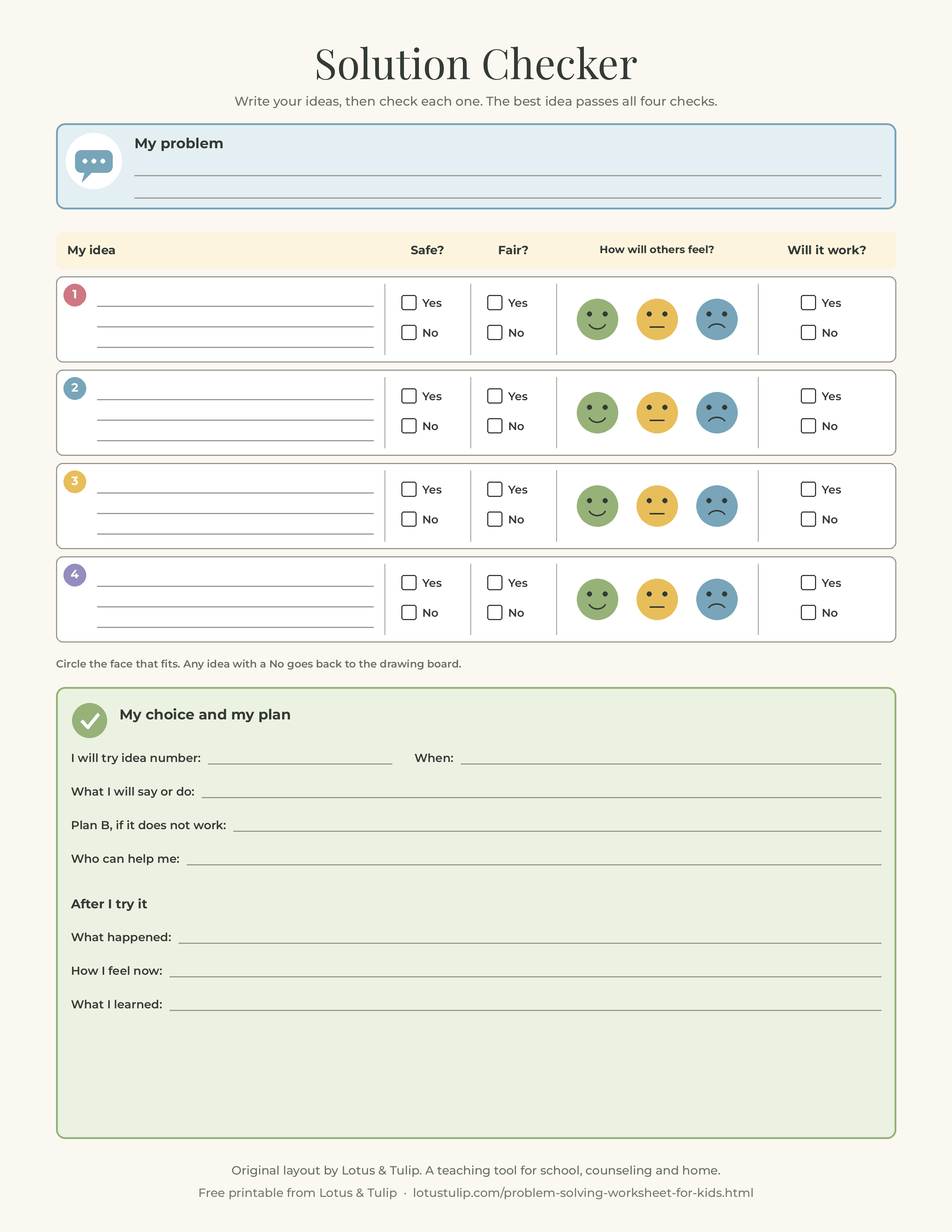
- Page 2: Solution Checker. A table for four ideas, each checked with safe, fair, how will others feel (three faces to circle) and will it work, followed by my choice and my plan (idea number, when, what I will say or do, plan B, who can help) and an after I try it section.
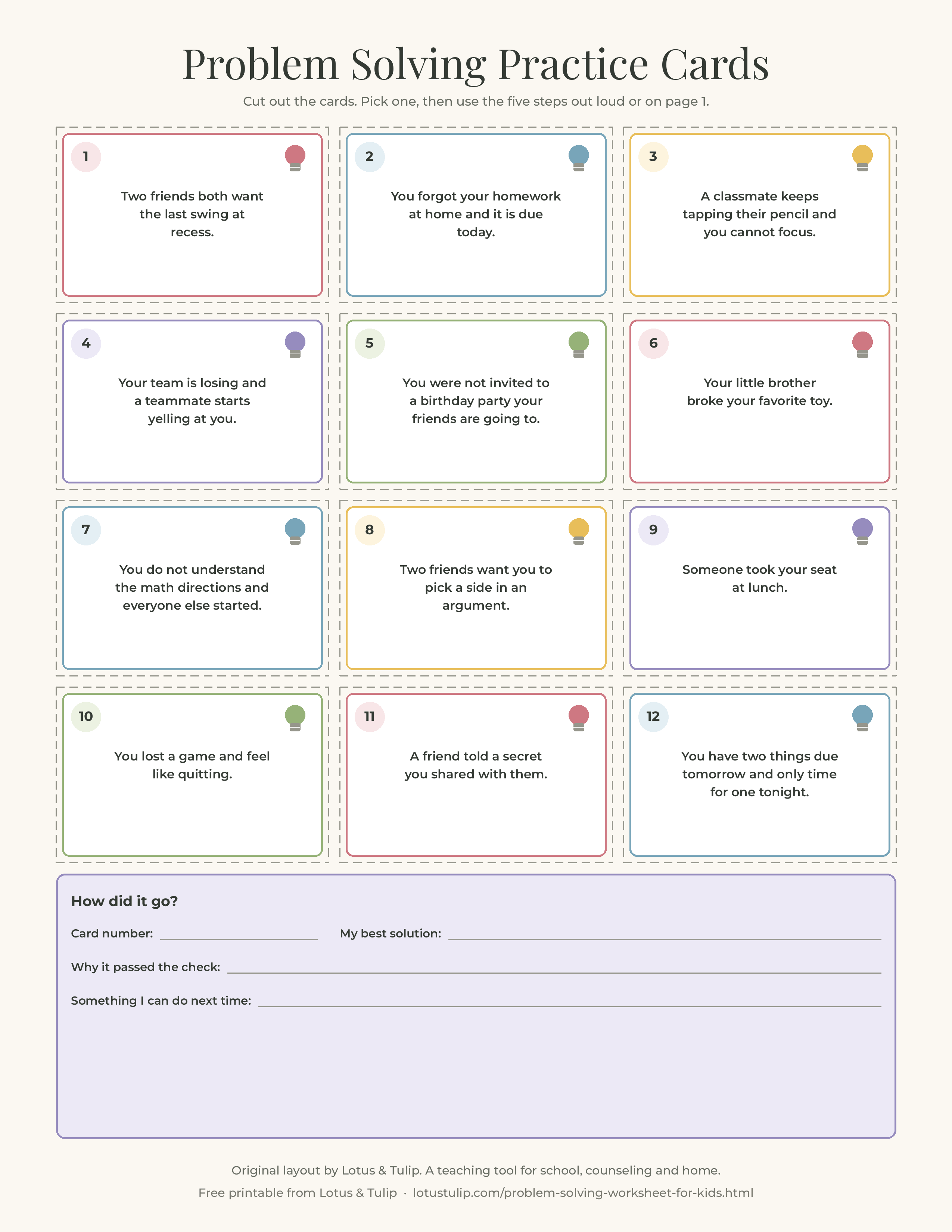
- Page 3: Problem Solving Practice Cards. Twelve cut out scenario cards (the last swing, forgotten homework, a teammate yelling, not being invited to a party, a friend who shared a secret, two things due tomorrow and more) plus a "How did it go?" reflection box.
Download the free problem solving worksheet for kids (PDF, 3 pages, US Letter)
Prefer single images? Page 1: My Problem Solving Steps (PNG) · Page 2: Solution Checker (PNG) · Page 3: Practice Cards (PNG)
Free to print for your own use and for use with your own students, clients or children. Please link to this page rather than re-uploading the file.
Related resources
- Resilience activities for kids (free printable)
- Size of the problem worksheet (free printable)
- Conflict resolution worksheet (free printable)
- I statements worksheet (free printable)
- Emotional regulation worksheets for kids (free printable)
- Friendship worksheets for kids (free printable)
- Kindness activities for kids (free printable)
- Goal setting worksheet for students (free printable)
- Calm down corner ideas
Sources
- CASEL (Collaborative for Academic, Social, and Emotional Learning). The CASEL 5: core social and emotional competencies. casel.org.
- Crick, N. R., and Dodge, K. A. (1994). A review and reformulation of social information-processing mechanisms in children's social adjustment. Psychological Bulletin, 115(1), 74 to 101.
- D'Zurilla, T. J., and Goldfried, M. R. (1971). Problem solving and behavior modification. Journal of Abnormal Psychology, 78(1), 107 to 126.
- Greene, R. W. (1998). The Explosive Child. HarperCollins.
- Kazdin, A. E., Siegel, T. C., and Bass, D. (1992). Cognitive problem-solving skills training and parent management training in the treatment of antisocial behavior in children. Journal of Consulting and Clinical Psychology, 60(5), 733 to 747.
- Shure, M. B., and Spivack, G. (1982). Interpersonal problem-solving in young children: a cognitive approach to prevention. American Journal of Community Psychology, 10(3), 341 to 356.
Problem solving worksheet for kids: FAQ
What are the steps of problem solving for kids?
A simple model for kids has five steps: stop and calm down, say the problem, think of solutions, check each idea (is it safe, is it fair, how will others feel, will it work) and try it, then check whether it worked. Younger children can start with three steps: calm down, think of ideas, try one.
How do you teach problem solving skills to kids?
Teach the steps during calm moments with practice scenarios and role play, use the same words every time, and coach children through the steps after real problems once they are calm. Ask "What could you do?" before offering your own solution, and praise the process rather than just the outcome.
What age should kids learn problem solving skills?
Children can start learning simple problem solving as preschoolers. Research on the I Can Problem Solve approach worked with 4 and 5 year olds. Most children can use a five step model with support by about age 6 to 8 and more independently by 9 to 12.
What is a problem solving worksheet?
A problem solving worksheet walks a child through the steps of solving a problem in writing: naming the problem and feelings, brainstorming solutions, checking each solution and planning what to try. It works best as part of repeated practice and coaching, not as a one time task or a punishment.
How do I help a child who only thinks of one solution?
Make brainstorming a game with a goal of three ideas, accept silly ideas at first, and model your own brainstorming out loud. Practice with scenario cards when the child is calm. Over time, ask "What else could you do?" before checking any idea.
Is problem solving the same as conflict resolution?
They overlap. Problem solving is the general skill of working through any problem, including frustrating tasks and forgotten homework. Conflict resolution applies those steps to disagreements between people, with extra skills like I statements and compromise. See the conflict resolution worksheet for a version focused on two people.
Is this problem solving printable free?
Yes. The three page problem solving worksheet for kids is free to print for your own use and for use with your own students, clients or children. Please link to this page rather than re-uploading the file.