
Kids and teens · Tics and Tourette syndrome in children ages 5 to 12 · Updated 2026-11-14
Tic worksheets for kids: tics and Tourette syndrome explained, what research shows and a free tic toolbox plan

Ages 5 to 11: Kids Feelings and Social Skills Worksheets, incl. feelings detective, body clues, a feelings thermometer, a coping skills menu and a calm down plan Holiday 20% off: about $11.04, was $14 (EUR 12) · fillable PDF, instant digital download
Buy on EtsyTry it free first: download a fillable sample (feelings thermometer and calm-down plan, PDF, 240 KB). Type into it on screen, then get the full pack. No email needed.
When ADHD comes along: ADHD Worksheets for Therapists, coaching style pages for starting tasks, planning time, managing impulses and tracking what helps Holiday 20% off: about $11.04, was $14 (EUR 12) · fillable PDF, instant digital download
Buy on EtsyTry it free first: download a fillable sample (break it down and getting unstuck, PDF, 282 KB). Type into it on screen, then get the full pack. No email needed.
Kids and teens bundle: Kids and Teens Worksheets Bundle (feelings, anger, self esteem, social anxiety) Holiday 20% off: about $22.08, was $28 (EUR 24) · 80 pages, instant digital download
Buy on EtsyIt started with blinking. Then a sniff that never turned into a cold, a little throat clear, a shoulder that jerks up during homework. Your child says "I can't help it," a relative says "just tell him to stop," and the teacher has sent a note home. Tics are common in childhood, they are not a bad habit or bad behavior, and for most children they are milder than people fear. When tics do get in the way, there is a well studied behavioral treatment, the Comprehensive Behavioral Intervention for Tics (CBIT), and a few simple tools families and schools can use alongside it.
This guide is for parents, teachers, school counselors and child therapists supporting children about 5 to 12. It explains what tics and Tourette syndrome are, how tics usually change over childhood, what research shows (including its limits), why "just stop it" backfires, what tic worksheets can and cannot do, eight kinds of worksheets and activities, nine steps to use them, age adaptations, the school side, common mistakes and three short examples. It ends with a free 2 page printable: Getting to Know My Tics and My Tic Toolbox Plan.
Safety first: if a child talks about wanting to die or hurting themselves, call or text 988 (the 988 Suicide and Crisis Lifeline). If anyone is in immediate danger, call 911. See your pediatrician soon if tics start very suddenly together with new fears, rituals or big behavior changes, if a tic causes pain or injury, or if you are not sure whether a movement is a tic.
Download the free tic worksheets for kids (PDF, 2 pages, US Letter)
Direct download, no email or sign up. See the pages first. Repeated behaviors that look different from tics? See skin picking and hair pulling worksheets for kids and OCD worksheets for kids.
What tics are, in plain words
Tics are sudden, quick, repeated movements or sounds that a child does not choose to make. The CDC compares them to hiccups: you do not want to hiccup, but your body does it anyway. A child may be able to hold a tic back for a short while, but it is hard work, and the tic usually comes out later.
- Motor tics are movements, such as blinking, eye rolling, nose scrunching, grimacing, shoulder shrugging, head jerking or arm jerking.
- Vocal tics are sounds, such as sniffing, throat clearing, coughing, humming, grunting or repeating a word.
- Simple tics use one or a few body parts. Complex tics combine several movements in a pattern, such as touching an object, bending and jumping.
Tourette syndrome is diagnosed when a child has had both motor and vocal tics (not necessarily at the same time) for at least a year, starting before age 18. When only motor or only vocal tics last over a year, doctors call it a persistent (chronic) tic disorder, and tics that last less than a year are called provisional tics. Despite how it is shown on TV, swearing tics (coprolalia) are not needed for a diagnosis, and most people with Tourette syndrome never have them (CDC).
Many children, especially from about age 10, notice a feeling just before a tic: an itch, pressure, tingling, tightness or a sense that something is "not just right." Clinicians call this a premonitory urge. Doing the tic brings brief relief. Younger children often cannot describe an urge at all. In a study of 42 youth with tic disorders, a questionnaire about these urges worked well for older children but not for children 10 and younger (Woods and colleagues, 2005). Both are normal.
How tics usually change over childhood
Knowing the typical course helps parents worry less and plan better. Leading neurology guidelines say clinicians must explain this natural history to families (Pringsheim and colleagues, 2019).
- Onset: symptoms usually begin between ages 5 and 10, often with motor tics of the head and neck (CDC). In a Yale cohort of children with Tourette syndrome, tics began on average at 5.6 years (Leckman and colleagues, 1998).
- Waxing and waning: tics come and go, change type and get worse during some weeks. Excitement, stress, tiredness and being asked about tics can bring more of them, and focused, engaging activities often bring fewer (Conelea and Woods, 2008).
- The peak years: in the same Yale cohort, tics were at their worst on average around age 10. In another Yale follow up of 46 children, the average age at worst ever tic severity was 10.6 years (Bloch and colleagues, 2006).
- The teen years: in the 1998 cohort, nearly half were virtually tic free by age 18, and in the 2006 study, 85% reported that their tics decreased during adolescence. Some people keep tics into adulthood (CDC).
Only a qualified professional can diagnose a tic disorder. Your pediatrician can rule out other causes, and may refer you to a child neurologist, developmental pediatrician or psychologist. Specialists have also described sudden, complex "tic like" behaviors that appeared during the COVID-19 pandemic, mostly in teen girls and young women, which differ from typical childhood tics and need a different approach (Pringsheim and colleagues, 2021). This is another reason to get a proper evaluation instead of self diagnosing.
What the research shows, honestly
- Tics are common. A meta-analysis of 13 studies of children estimated Tourette syndrome at 0.77% of children (1.06% of boys and 0.25% of girls) and provisional (transient) tics at 2.99%, making them the most common tic disorder in childhood (Knight and colleagues, 2012). Many children are never diagnosed: in US national surveys, parents reported a Tourette syndrome diagnosis for 0.19% of children aged 6 to 17 in 2011 to 2012 (Bitsko and colleagues, 2014) and 0.3% in 2016 to 2017 (Charania and colleagues, 2022).
- Other conditions often come along. In the 2016 to 2017 survey, 83.2% of children with a Tourette diagnosis also had another mental, behavioral or developmental condition. ADHD affects an estimated 30% to 50% of people with Tourette syndrome, and guidelines recommend checking for ADHD, OCD, anxiety, mood and behavior problems (Pringsheim and colleagues, 2019). Often these cause more day to day difficulty than the tics themselves.
- Bullying is a real risk. Parents reported bullying victimization for 56.1% of children with Tourette syndrome, compared with 21.6% of children without it (Charania and colleagues, 2022). Protecting a child socially matters as much as the tics.
- CBIT works for many children. In a randomized trial of 126 children aged 9 to 17 with Tourette or chronic tic disorder, 8 sessions of CBIT over 10 weeks led to "much" or "very much" improvement in 52.5% of children, compared with 18.5% receiving supportive therapy and education. Tic severity scores fell from 24.7 to 17.1 (compared with 24.6 to 21.1), and 87% of responders still showed benefit 6 months later (Piacentini and colleagues, 2010). CBIT combines tic awareness, a competing response (a gentle, voluntary movement that makes the tic harder to do), relaxation and changes to everyday situations that make tics worse.
- The effect holds across trials. A meta-analysis of 8 randomized trials with 438 participants found medium to large effects for behavior therapy, comparable to those reported for antipsychotic medication, with about one person helped for every three treated (McGuire and colleagues, 2014). The American Academy of Neurology guideline recommends offering CBIT as an initial treatment option, before medication, for people who have access to it, and says it can be delivered by video when in person care is not available (Pringsheim and colleagues, 2019).
- Holding tics in does not cause a "rebound." Many people believe tics come back stronger after a child holds them in. In a small lab study of 7 children, tics were lower during suppression and stayed below baseline afterward, with no rebound (Himle and Woods, 2005). That said, constant suppression is tiring, and nobody should demand it.
- Younger children and online options. CBIT was tested mostly in children 9 and older. A family based adaptation for children 5 to 8 (CBIT-JR) had 15 children and a 54% response rate in an open trial without a control group (Bennett and colleagues, 2020), and the guideline notes there is little evidence on efficacy under age 9. A UK trial of 224 children aged 9 to 17 found that online, therapist supported exposure and response prevention for tics reduced tics more than online education, though the difference was modest (Hollis and colleagues, 2021).
- The limits. We found no trials of tic worksheets on their own. Worksheets are tools inside the approach that has evidence, behavior therapy for tics, usually guided by a trained therapist. Treatments rarely make tics disappear completely, and families should expect improvement rather than a cure (Pringsheim and colleagues, 2019).
Why "just stop it" backfires
When tics are loud or frequent, it is natural to say "Stop sniffing!" or "Can you not do that at dinner?" These reactions are understandable, and they usually make things harder.
- Attention can increase tics. Pointing out tics, asking about them or watching closely tends to bring more of them, not fewer (Conelea and Woods, 2008).
- Stress feeds tics. Scolding, punishment and teasing raise stress and tension, which are among the most common triggers for tics.
- It sends the wrong message. A child who is told to stop something they cannot control learns that their body is bad. That shame often hurts more than the tic.
- What helps instead: keep a calm, matter of fact attitude. Do not comment on tics in the moment, keep normal rules for behavior that is not a tic, praise effort and strengths, and talk about tics openly but briefly at calm times. If your child wants to work on a tic that bothers them, that is a job for a plan and, ideally, a CBIT trained therapist.
What tic worksheets can and cannot do
They can: help a child understand that tics are common and nothing to be ashamed of, notice their own tics and warning feelings, spot situations that make tics louder or quieter, practice a competing response chosen with a therapist, plan supports at home and school, and give parents, teachers and clinicians one shared language.
They cannot: diagnose a tic disorder or Tourette syndrome, tell tics apart from other movement problems or seizures, replace a CBIT trained therapist or medical care, or make tics go away for good. Tics wax and wane no matter what anyone does, so a bad week is not a sign the plan has failed.
8 kinds of tic worksheets and activities for kids
- Tic explainer page. A kid friendly picture of what tics are ("like hiccups your body does") with the child's own words. A good first page for children who feel weird or blamed.
- My tics list. Which tics happen now, which body part, motor or sound. Lists change often, so date each one.
- Louder and quieter map. Situations that bring more tics (excitement, tiredness, worry, screens, after school, being asked about tics) and fewer (sports, music, drawing, focused play). Patterns often appear in a week or two.
- Warning feeling finder. For older children: where in the body the urge starts and what it feels like (itchy, tight, tingly, pressure). This is the moment a competing response starts.
- Competing response practice. A gentle, less noticeable action that is hard to do at the same time as the tic, held for about a minute or until the urge fades. For example, slow belly breathing for sniffing or throat clearing, gently pressing the lips together for mouth tics, or slow, gentle blinks for hard eye blinking. Choose these with a therapist, practice when calm, and never force them.
- Calm body skills. Breathing and muscle relaxation lower general tension. Our breathing exercises for kids and coping skills list for kids have ideas.
- School support plan. Supports the child wants at school: a break pass, a quiet place to tic, extra time on tests, a seat that is not front and center, a short talk to the class if the child chooses. See the school section below.
- Practice record with stars. A weekly chart for noticing the urge, practicing the response and doing something fun. Reward practice, not "tic free" days, because tic counts go up and down on their own.
How to use tic worksheets for kids, step by step
- Get a checkup first. See your pediatrician to confirm these are tics and to check for other conditions. Ask for a referral to a CBIT trained therapist if tics cause pain, embarrassment, teasing or problems at school.
- Explain tics simply. At a calm time, say: "Tics are something your brain and body do, a bit like hiccups. Lots of kids have them. It's not your fault, and you're not in trouble." Let your child ask questions.
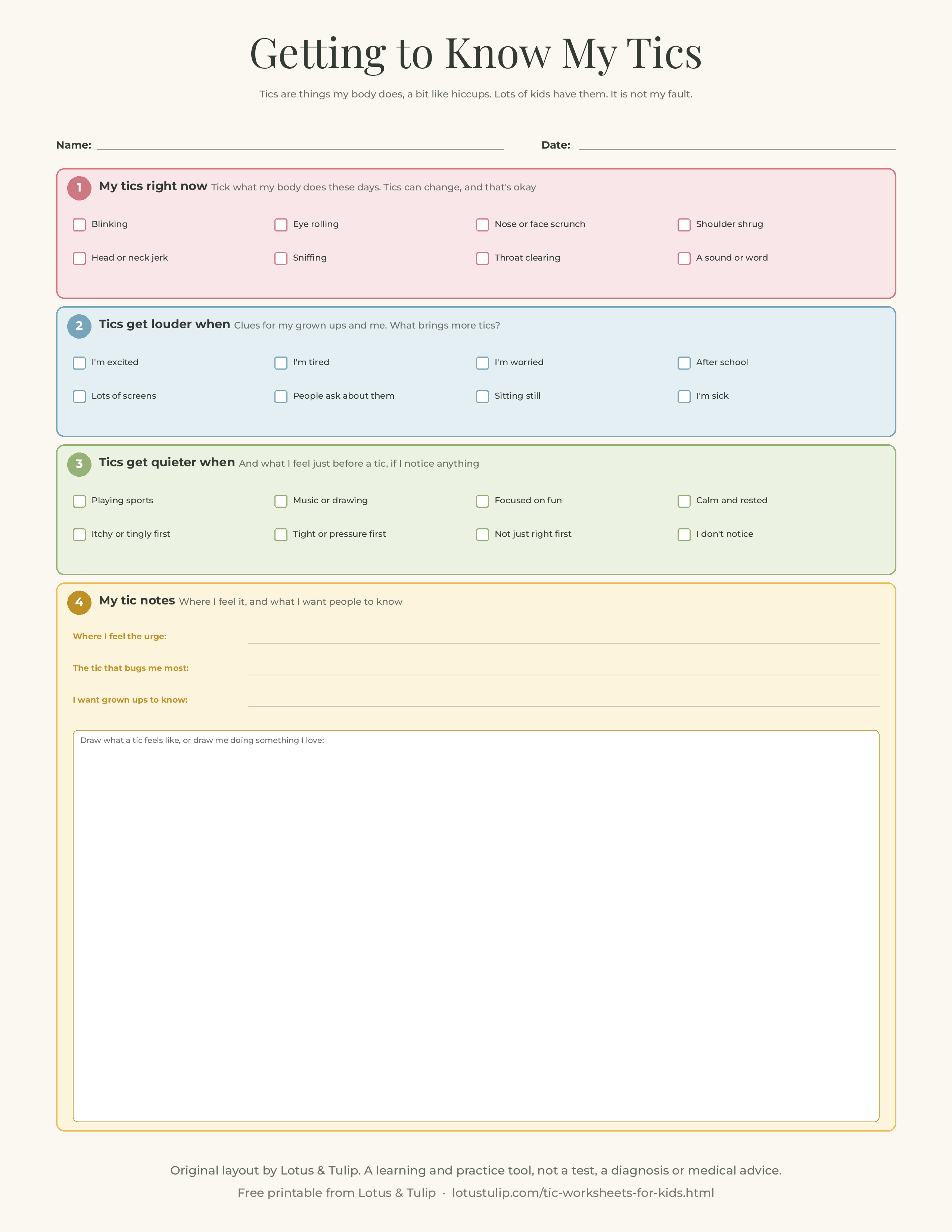
- Get to know the tics together. On Getting to Know My Tics, tick the tics your child has, when they get louder and quieter, and what your child feels just before. Fill it in over a few days, without watching your child closely all day.
- Decide whether to work on a tic. Many tics need no treatment at all. Watchful waiting is an accepted choice when tics do not cause problems (Pringsheim and colleagues, 2019). Only work on a tic your child wants to change.
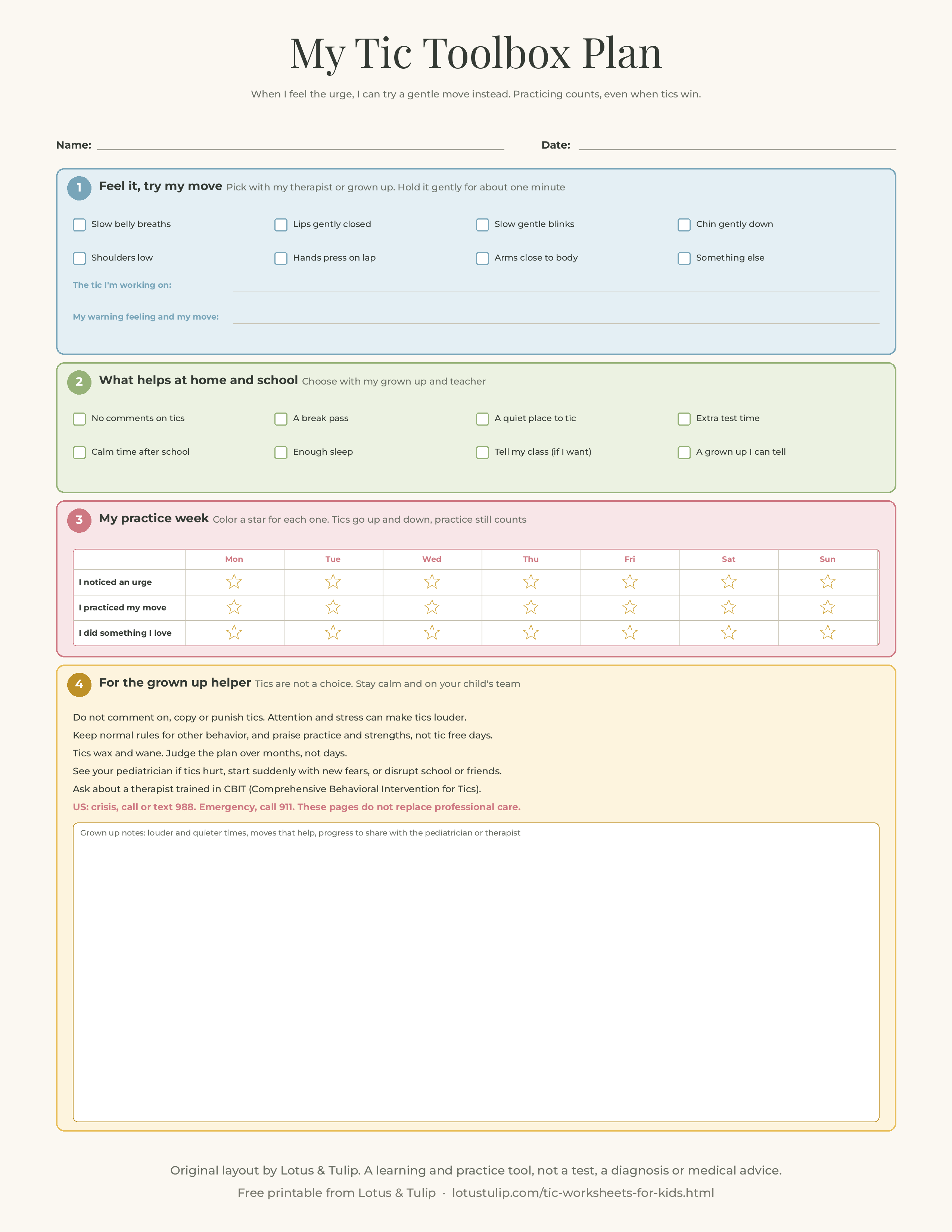
- Pick one tic and one competing response. On My Tic Toolbox Plan, write the tic your child is working on, the warning feeling and a gentle competing response. Ideally choose it with a therapist. Start with the tic that bothers your child most, not the one that bothers adults most.
- Practice when calm. Practice the competing response for a minute at a time, several times a day, during easy moments like reading together. It is a skill to learn, like riding a bike.
- Change the situations that make tics louder. Use the louder and quieter map. Plan rest after busy school days, protect sleep and stop commenting on tics. Keep normal expectations: tics should not get a child out of chores or homework, and they should never be punished.
- Track practice, not tics. Each day, color stars for noticing the urge, practicing the response and doing something your child loves. Praise effort.
- Review every week or two. Look at the plan together: what helped, what did not, what changed. Expect waves. If tics or worry, attention or mood get worse, check in with your pediatrician or therapist and bring the worksheets.
How to adapt it by age
- Ages 5 to 7: keep it short and playful. Explain tics with the hiccups picture, focus on the louder and quieter map and calm body games, and let parents do most of the planning. Many young children cannot feel an urge yet, which is fine. Parents can focus on reducing attention to tics and keeping life calm and predictable.
- Ages 8 to 10: let the child fill in Getting to Know My Tics, try finding the warning feeling and practice one competing response with a therapist. Add a small reward for practice chosen together.
- Ages 11 to 12: respect privacy and independence. Let them lead the plan, choose which tic to work on and decide who at school knows. Talk about friends, teasing and how they want to explain tics to peers.
Supporting a child with tics at school
- Ignore tics kindly. Do not comment on, imitate or punish tics. Treat them as part of the child, and keep normal expectations for behavior that is not a tic.
- Offer a way out. A break pass or a quiet place to go lets a child release tics in private when they build up, without asking in front of everyone.
- Adjust tests and seating. Extra time, a separate room for tests and a seat that is not front and center help a child who is working hard to hold tics in. Written work can be slower if tics affect hands or eyes.
- Teach the class, if the child wants. Guidelines recommend psychoeducation for teachers and peers, and the Tourette Association of America has resources for schools (Pringsheim and colleagues, 2019). Let the child choose whether to be there or even help explain.
- Watch for bullying. Children with tics are bullied far more often than other children. Step in early and involve the school counselor. Our bullying worksheets for kids can help.
- Make it official if needed. Supports such as breaks, test accommodations and a quiet space can be written into a 504 plan or IEP when tics or related conditions affect learning. Share the tic toolbox plan with the teacher so home and school use the same words.
Common mistakes
- Asking a child to stop tics. Tics are not a choice. Asking for constant suppression adds stress and shame.
- Talking about tics all the time. Frequent questions and reminders draw attention to tics, which can bring more of them.
- Measuring progress by tic counts alone. Tics wax and wane. Judge the plan over months, and celebrate practice, confidence and friendships.
- Treating every behavior as a tic. Not every hard moment is a tic. Keep calm, consistent rules for other behavior, and ask the therapist when you are not sure.
- Missing what comes along. ADHD, anxiety, OCD, sleep and mood problems are common with tics and often matter more. Ask your pediatrician to check.
- Waiting too long for help. Tics that hurt, disrupt school or lead to teasing, or a child who is upset about them, deserve an evaluation and a CBIT trained therapist.
Examples
- Noah, 6: blinked hard and sniffed for weeks. His parents saw the pediatrician, who confirmed simple tics. They stopped asking about them, explained tics as "brain hiccups" and used the louder and quieter map. Tics were worse after long screen time and tired evenings, so they added quiet play before bed. The blinking faded over the next months, and the sniff came and went.
- Maya, 9: had a neck jerk that made her neck sore and a throat clearing tic that classmates mocked. With a CBIT therapist she found the tight feeling in her neck before the tic and practiced gently holding her chin down with relaxed shoulders. For the throat clearing, she learned slow belly breaths. Her teacher gave her a break pass and stepped in on the teasing.
- Ethan, 12: has Tourette syndrome and ADHD. His tics bothered him less than homework and forgetting things. His family and school counselor focused first on his ADHD plan and test accommodations in his 504 plan, then worked on one vocal tic he wanted to change. He chose to help his teacher explain Tourette syndrome to his class.
Free printable: tic worksheets for kids
This printable is an original Lotus & Tulip layout. It is not a screening questionnaire or a diagnostic tool and gives no score. Page 1, Getting to Know My Tics, has ticks for my tics right now, what makes tics louder, what makes tics quieter and what I feel just before, plus lines for notes and a box to draw how tics feel. Page 2, My Tic Toolbox Plan, has lines for the one tic I am working on, my warning feeling and my competing response, eight gentle response ideas, a home and school support menu, a 7 day star chart for noticing the urge, practicing and doing something I love, and notes for the grown up helper with US 988 and 911 numbers.
Download the free tic worksheets for kids (PDF, 2 pages, US Letter)
Prefer single images? Page 1: Getting to Know My Tics (PNG) · Page 2: My Tic Toolbox Plan (PNG)
Free to print for your own child, students, clients or groups. Please link to this page rather than re-uploading the file. A learning and practice tool that does not replace professional advice. In a mental health crisis, call or text 988. In an emergency, call 911.
Buy the kids feelings worksheets on Etsy
Related resources
- Skin picking and hair pulling worksheets for kids: habit reversal for body focused repetitive behaviors
- OCD worksheets for kids: when repeated behaviors are driven by fears and rules
- Anxiety worksheets for kids: when worry makes tics louder
- ADHD worksheets: focus, planning and impulse tools
- Bullying worksheets for kids: rude vs mean vs bullying and upstander skills
- Breathing exercises for kids: calm body skills that support a tic plan
- Self esteem worksheets for kids: when tics or teasing hurt confidence
- All counseling resources for kids and teens
FAQ
What causes tics in children?
Tics come from the brain and nervous system. Tourette syndrome and other tic disorders run in families, and research points to a strong genetic part. Tics are not caused by bad parenting, and children do not do them on purpose. Stress, excitement and tiredness can make tics louder, but they do not cause the condition.
Are tics in kids normal?
Short lived tics are common in childhood. A meta-analysis estimated that about 3% of children have provisional tics, and many fade within months. Tics that last over a year are called a persistent tic disorder or, with both motor and vocal tics, Tourette syndrome. See your pediatrician if you are unsure or if tics cause problems.
Should I tell my child to stop their tics?
No. Tics are not a choice, and asking a child to stop adds stress and shame and can draw more attention to the tics. Stay calm, do not comment in the moment and keep normal expectations for other behavior. If a tic bothers your child, a CBIT trained therapist can teach a competing response.
What is CBIT for tics?
The Comprehensive Behavioral Intervention for Tics teaches children to notice their tics and warning urges, use a gentle competing response that makes the tic harder to do, use relaxation, and change everyday situations that make tics worse. In a randomized trial of 126 children aged 9 to 17, 52.5% were much improved with CBIT, compared with 18.5% with supportive therapy.
Do tics go away with age?
Often they get better. Tics usually peak around age 10 and decrease during the teen years. In one Yale cohort, nearly half of young people with Tourette syndrome were virtually tic free by age 18, though some people keep tics into adulthood.
When should I see a doctor about my child's tics?
See your pediatrician if tics last more than a few weeks, cause pain or injury, disrupt school or friendships, upset your child, or start very suddenly together with new fears, rituals or behavior changes. If your child talks about wanting to die or hurting themselves, call or text 988, and call 911 in an emergency.
How can teachers help a student with tics?
Ignore tics kindly and never punish them, offer a break pass and a quiet place, allow extra time or a separate room for tests, step in on teasing early, and offer a class talk if the child wants one. Supports can be written into a 504 plan or IEP when needed.
Sources
- Bennett, S. M., Capriotti, M., Bauer, C., and colleagues (2020). Development and open trial of a psychosocial intervention for young children with chronic tics: the CBIT-JR study. Behavior Therapy, 51(4), 659 to 669.
- Bitsko, R. H., Holbrook, J. R., Visser, S. N., and colleagues (2014). A national profile of Tourette syndrome, 2011 to 2012. Journal of Developmental and Behavioral Pediatrics, 35(5), 317 to 322.
- Bloch, M. H., Peterson, B. S., Scahill, L., and colleagues (2006). Adulthood outcome of tic and obsessive-compulsive symptom severity in children with Tourette syndrome. Archives of Pediatrics and Adolescent Medicine, 160(1), 65 to 69.
- Centers for Disease Control and Prevention. About Tourette syndrome. cdc.gov/tourette-syndrome (updated August 2026).
- Charania, S. N., Danielson, M. L., Claussen, A. H., and colleagues (2022). Bullying victimization and perpetration among US children with and without Tourette syndrome. Journal of Developmental and Behavioral Pediatrics, 43(1), 23 to 31.
- Conelea, C. A., and Woods, D. W. (2008). The influence of contextual factors on tic expression in Tourette's syndrome: a review. Journal of Psychosomatic Research, 65(5), 487 to 496.
- Himle, M. B., and Woods, D. W. (2005). An experimental evaluation of tic suppression and the tic rebound effect. Behaviour Research and Therapy, 43(11), 1443 to 1451.
- Hollis, C., Hall, C. L., Jones, R., and colleagues (2021). Therapist-supported online remote behavioural intervention for tics in children and adolescents in England (ORBIT): a multicentre, parallel group, single-blind, randomised controlled trial. Lancet Psychiatry, 8(10), 871 to 882.
- Knight, T., Steeves, T., Day, L., and colleagues (2012). Prevalence of tic disorders: a systematic review and meta-analysis. Pediatric Neurology, 47(2), 77 to 90.
- Leckman, J. F., Zhang, H., Vitale, A., and colleagues (1998). Course of tic severity in Tourette syndrome: the first two decades. Pediatrics, 102(1), 14 to 19.
- McGuire, J. F., Piacentini, J., Brennan, E. A., and colleagues (2014). A meta-analysis of behavior therapy for Tourette syndrome. Journal of Psychiatric Research, 50, 106 to 112.
- Piacentini, J., Woods, D. W., Scahill, L., and colleagues (2010). Behavior therapy for children with Tourette disorder: a randomized controlled trial. JAMA, 303(19), 1929 to 1937.
- Pringsheim, T., Okun, M. S., Müller-Vahl, K., and colleagues (2019). Practice guideline recommendations summary: treatment of tics in people with Tourette syndrome and chronic tic disorders. Neurology, 92(19), 896 to 906.
- Pringsheim, T., Ganos, C., McGuire, J. F., and colleagues (2021). Rapid onset functional tic-like behaviors in young females during the COVID-19 pandemic. Movement Disorders, 36(12), 2707 to 2713.
- Woods, D. W., Piacentini, J., Himle, M. B., and Chang, S. (2005). Premonitory Urge for Tics Scale (PUTS): initial psychometric results and examination of the premonitory urge phenomenon in youths with tic disorders. Journal of Developmental and Behavioral Pediatrics, 26(6), 397 to 403.
- Tourette Association of America. tourette.org (information for families and schools, and a provider directory).
Lotus & Tulip is not affiliated with the researchers, agencies or organizations named on this page. Names in the examples are invented. This page is educational and does not replace professional advice, diagnosis or treatment.