
Kids and teens · Body focused repetitive behaviors in children ages 5 to 12 · Updated 2026-11-14
Skin picking and hair pulling worksheets for kids: why kids pick and pull, what research shows and a free busy hands plan

Ages 5 to 11: Kids Feelings and Social Skills Worksheets, incl. feelings detective, body clues, a feelings thermometer, a coping skills menu and a calm down plan Holiday 20% off: about $11.04, was $14 (EUR 12) · fillable PDF, instant digital download
Buy on EtsyTry it free first: download a fillable sample (feelings thermometer and calm-down plan, PDF, 240 KB). Type into it on screen, then get the full pack. No email needed.
For clinicians: OCD and ERP Worksheets for Therapists, the OCD cycle, exposure ladder, practice record and a family accommodation plan Holiday 20% off: about $9.20, was $12 (EUR 10) · fillable PDF, instant digital download
Buy on EtsyKids and teens bundle: Kids and Teens Worksheets Bundle (feelings, anger, self esteem, social anxiety) Holiday 20% off: about $22.08, was $28 (EUR 24) · 80 pages, instant digital download
Buy on EtsyYou notice the bald patch on the side of your daughter's head, the missing eyelashes, the scabs on your son's fingers that never get a chance to heal, the bitten nails, the bleeding lip. You ask them to stop, and they really try. A minute later, during a cartoon or a spelling test, their hands are back at it, often without them noticing. Skin picking, hair pulling, nail biting and similar habits are known as body focused repetitive behaviors, or BFRBs. They are common, they are not a sign of bad parenting or a weak will, and they respond best to a specific kind of skills practice.
This guide is for parents, teachers, school counselors and child therapists supporting children about 5 to 12. It explains what BFRBs are, when a habit becomes a bigger problem, how they show up at different ages, what research shows (including its limits), why nagging and punishing backfire, what worksheets can and cannot do, eight kinds of worksheets and activities, nine steps to use them, age adaptations, the school side, common mistakes and three short examples. It ends with a free 2 page printable: My Habit Detective and My Busy Hands Plan.
Safety first: if a child hurts themselves on purpose, or talks about wanting to die, call or text 988 (the 988 Suicide and Crisis Lifeline). If anyone is in immediate danger, call 911. See your pediatrician for picked spots that look infected, bald patches, or if your child swallows or chews the hair they pull.
Download the free skin picking and hair pulling worksheets for kids (PDF, 2 pages, US Letter)
Direct download, no email or sign up. See the pages first. Worried about other repeated behaviors? See OCD worksheets for kids and anxiety worksheets for kids.
What skin picking and hair pulling are, in plain words
Body focused repetitive behaviors are habits where the hands repeatedly pick, pull, bite or rub at the body. The most common ones in children are:
- Skin picking: picking at scabs, bumps, cuticles, dry skin, pimples or smooth skin, sometimes until it bleeds.
- Hair pulling: pulling out hair from the scalp, eyelashes or eyebrows. When it is severe and persistent, doctors call it trichotillomania, or hair pulling disorder.
- Nail biting, lip and cheek chewing: often milder, but they can also cause pain, bleeding and infection.
Children rarely do these things to cause pain. Picking and pulling usually feel soothing, satisfying or relieving, or they happen on autopilot. In a survey of 133 young people aged 10 to 17 with hair pulling (Franklin and colleagues, 2008), most reported tension before pulling and relief or gratification right after. That feeling of relief is what keeps the habit going, and why "just stop" rarely works. In the DSM-5, hair pulling disorder and skin picking (excoriation) disorder are grouped with obsessive compulsive and related disorders, but researchers note they are treated differently from OCD (Grant and Chamberlain, 2016).
Clinicians often describe two styles. Automatic picking or pulling happens without awareness, for example while reading or watching TV. Focused picking or pulling is more deliberate, for example searching for a "wrong" hair or a rough spot to smooth out. Many children do both, and the worksheets on this page help with both.
A habit vs a bigger problem
Lots of children bite their nails or fiddle with a scab now and then. It may be more than an ordinary habit when:
- Visible damage: there are bald patches, missing eyelashes or eyebrows, open sores, scars or skin that cannot heal.
- Repeated attempts to stop: the child wants to stop or has been asked many times, and cannot.
- Distress: the child feels ashamed, hides it with hats, long sleeves or makeup, or gets upset about how it looks.
- Daily life: it takes a lot of time, gets in the way of homework or sleep, or leads to teasing or avoiding swimming, sleepovers or haircuts.
- Health: picked spots get infected, or the child chews or swallows hair. Swallowed hair can, rarely, build up into a hairball in the stomach (a trichobezoar) that needs medical care, and a published case report describes this in a young child (Menon and colleagues, 2015).
Only a qualified professional can diagnose trichotillomania or skin picking disorder. Dermatologists are often the first doctors families see (Nemeh and Hogeling, 2022), and your pediatrician can check the skin and scalp, rule out medical causes of hair loss or itching, and refer you on. The lists on this page are for noticing, not labeling.
How BFRBs show up, by age
- Under 5: some toddlers and preschoolers twirl and pull hair while falling asleep, sucking a thumb or feeding. In a survey of parents of 110 children up to age 10 who pulled hair (Walther and colleagues, 2014), preschoolers were less aware of pulling, less likely to feel tension first and less impaired than school age children. Many of these early habits are mild, but see your pediatrician if there is visible hair loss.
- Ages 5 to 8: picking at scabs and fingers, nail biting, eyelash pulling during quiet times such as TV, car rides and bedtime. Children often say "I don't know I'm doing it."
- Ages 9 to 12: the habit can become more focused and private: searching for coarse hairs, picking at pimples or bumps in the mirror, longer sessions in the bathroom or bedroom. Shame and hiding often start here. In the 2008 youth survey, scalp hair was the most common pulling site, followed by eyelashes and eyebrows.
- The tween years and puberty: skin changes such as acne can trigger new picking, and hair pulling often begins or worsens around this age. In a US survey of 10,169 adults, women with hair pulling disorder reported an average onset age of 14.8 (Grant, Dougherty and Chamberlain, 2020).
What the research shows, honestly
- These are common conditions. Grant and Chamberlain (2016) describe community point prevalence estimates for trichotillomania of 0.5% to 2.0%. In a survey of 10,169 US adults aged 18 to 69, 1.7% reported current trichotillomania (Grant, Dougherty and Chamberlain, 2020) and 2.1% reported current skin picking disorder, with 3.1% reporting it at some point in their life (Grant and Chamberlain, 2020). These are adult surveys. Good prevalence data for children are still missing.
- Anxiety and low mood often come along. In the adult skin picking survey, the most commonly reported other conditions were generalized anxiety (63.4%), depression (53.1%) and panic disorder (27.7%). In the youth hair pulling survey, anxiety and depressive symptoms were somewhat elevated and rose with pulling severity (Franklin and colleagues, 2008). It is worth checking on worry and mood, not only the habit.
- Habit reversal is the core treatment. Habit reversal training was first described by Azrin and Nunn in 1973. The simplified versions used today center on awareness of the habit and its warning signs, a competing response (doing something with the hands that makes picking or pulling impossible for a minute or so) and support from others. A meta-analysis of 18 studies with 575 participants found a large effect of habit reversal for repetitive behaviors including nail biting, thumb sucking and tics (d = 0.80; Bate and colleagues, 2011).
- Behavior therapy works for children who pull hair. In the first randomized trial for pediatric trichotillomania, 24 young people aged 7 to 17 received either eight weekly sessions of behavior therapy or a minimal attention control. Behavior therapy reduced severity more, and gains held through an 8 week maintenance phase (Franklin and colleagues, 2011). A follow up analysis found that the youngest children did at least as well as older ones, although the numbers were small (Franklin, Edson and Freeman, 2010).
- Across trials, behavior therapy outperforms medication. A meta-analysis of 11 randomized trials for trichotillomania found a large pooled effect for behavior therapy (1.41) and a moderate one for serotonin reuptake inhibitor medications (0.41), and called for more medication trials in youth (McGuire and colleagues, 2014). For skin picking, a systematic review found that only behavioral treatments beat inactive control conditions in randomized trials (Schumer, Bartley and Bloch, 2016).
- What works for adults may not work for kids. In a placebo controlled trial with 39 children and teens aged 8 to 17 with hair pulling, the supplement N-acetylcysteine was no better than placebo (25% vs 21% responders). The authors recommend referring children to behavior therapy before trying medication (Bloch and colleagues, 2013).
- Access to good help is a real problem. Among youth in the 2008 survey who had received treatment for hair pulling, parents rated only 17% as much or very much improved. In a survey of 760 adults with skin picking, people tended to rate the treatment they had found as poor (Tucker and colleagues, 2011). Looking for a therapist who specifically knows habit reversal or behavior therapy for BFRBs matters.
- The limits. We found no trials of BFRB worksheets on their own. Worksheets are tools inside the approach that has evidence, behavior therapy with habit reversal, usually guided by a trained therapist. Pediatric trials are small, many surveys are online convenience samples, and data on skin picking in children are especially thin (Nemeh and Hogeling, 2022).
Why nagging and punishing backfire
When you see your child picking or pulling, it is natural to say "Stop it!", slap a hand away or take away screen time. These reactions are understandable, and they usually make things worse.
- Nagging adds tension. Many children pick or pull to relieve tension. Constant reminders add stress, and stress can feed the urge.
- Punishment drives it into hiding. Children learn to pick or pull where nobody can see: in the bathroom, under the covers, at the back of the classroom. The habit continues, but now with shame and secrecy, which makes it harder to help.
- It does not teach a skill. Willpower alone is weak against an automatic habit. Children need to notice the habit, know what to do instead and have the environment on their side.
- What helps instead: treat the habit as the problem, not the child. Agree on a kind, private signal to use when you notice it (a word, a touch on the shoulder), praise your child for catching it themselves, and work on the plan together when everyone is calm.
What skin picking and hair pulling worksheets can and cannot do
They can: help a child understand that this is a common habit and not something gross or bad, become a "habit detective" who spots when, where and why it happens, choose a competing response and blockers, track practice so progress is visible, and give parents, teachers and therapists one shared plan.
They cannot: diagnose trichotillomania or skin picking disorder, treat an infection or check for medical causes of hair loss, replace a therapist trained in behavior therapy for a child with visible damage or distress, or stop a habit overnight. Expect slips. Every catch, even a late one, is progress.
8 kinds of skin picking and hair pulling worksheets and activities for kids
- Habit detective log. When, where, what the child was doing and how they felt before and after. Patterns often appear within a week: screens, homework, bedtime, car rides, the bathroom mirror.
- Warning signs map. The first clues: a hand drifting to the head, an itchy or tingly feeling, a bumpy spot, a "wrong" feeling hair, boredom, worry. Catching the early clue is easier than stopping in the middle.
- Competing response practice. A short action that keeps the hands busy and makes picking or pulling impossible for about a minute: soft fists, pressing fingertips together, sitting on the hands, squeezing putty. It is practiced when calm, many times.
- Fidget and sensory swap menu. Objects that give the hands similar feelings: putty, a smooth stone, textured fidgets, a koosh ball, a soft brush for hair twirlers. Children choose and test them.
- Helpers and blockers plan. Changing the environment so the habit is harder to start: bandages on favorite picking fingers, cotton gloves at bedtime, short smooth nails, a hat or hood, less time at the mirror, lotion for dry skin. Clinicians call this stimulus control.
- Feelings check. If picking or pulling rises with worry, boredom or tiredness, a feelings check and calm down tools help. Our coping skills list for kids and breathing exercises for kids have ideas.
- Urge wave practice. Older children can learn that urges rise and fall like a wave if they ride them out. Our urge surfing worksheet explains the idea for teens and adults.
- Practice record with stars. A weekly chart for catching it, using the swap and asking for help. Reward trying and catching, not perfect days.
How to use skin picking and hair pulling worksheets for kids, step by step
- Start with a calm, kind talk. Choose a relaxed moment. Say: "Lots of kids have a habit their hands do without asking. It's not your fault, and we can work on it together." Avoid talking about it in front of siblings or friends.
- Check the body first. Look gently at skin and scalp. If there are bald patches, sores that look infected, or your child chews or swallows hair, see your pediatrician before or alongside the worksheets.
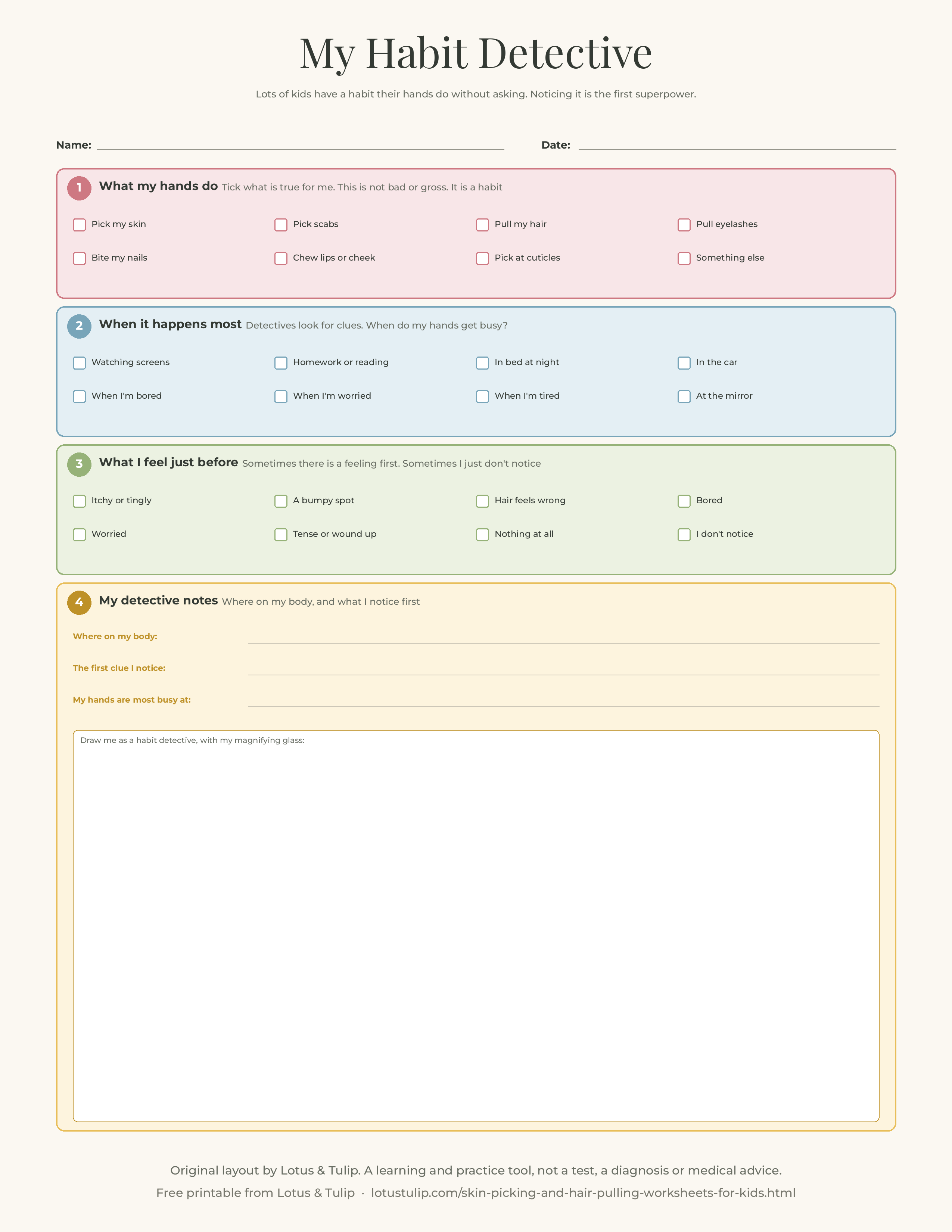
- Become habit detectives. On My Habit Detective, tick what the hands do, when it happens most and what your child feels just before. Fill in a few days of real observations. Many children do not notice at first, and that is fine.
- Find the first clue. Ask: "What happens right before? Where does your hand go first?" Write the first clue the child notices. This is the moment to catch.
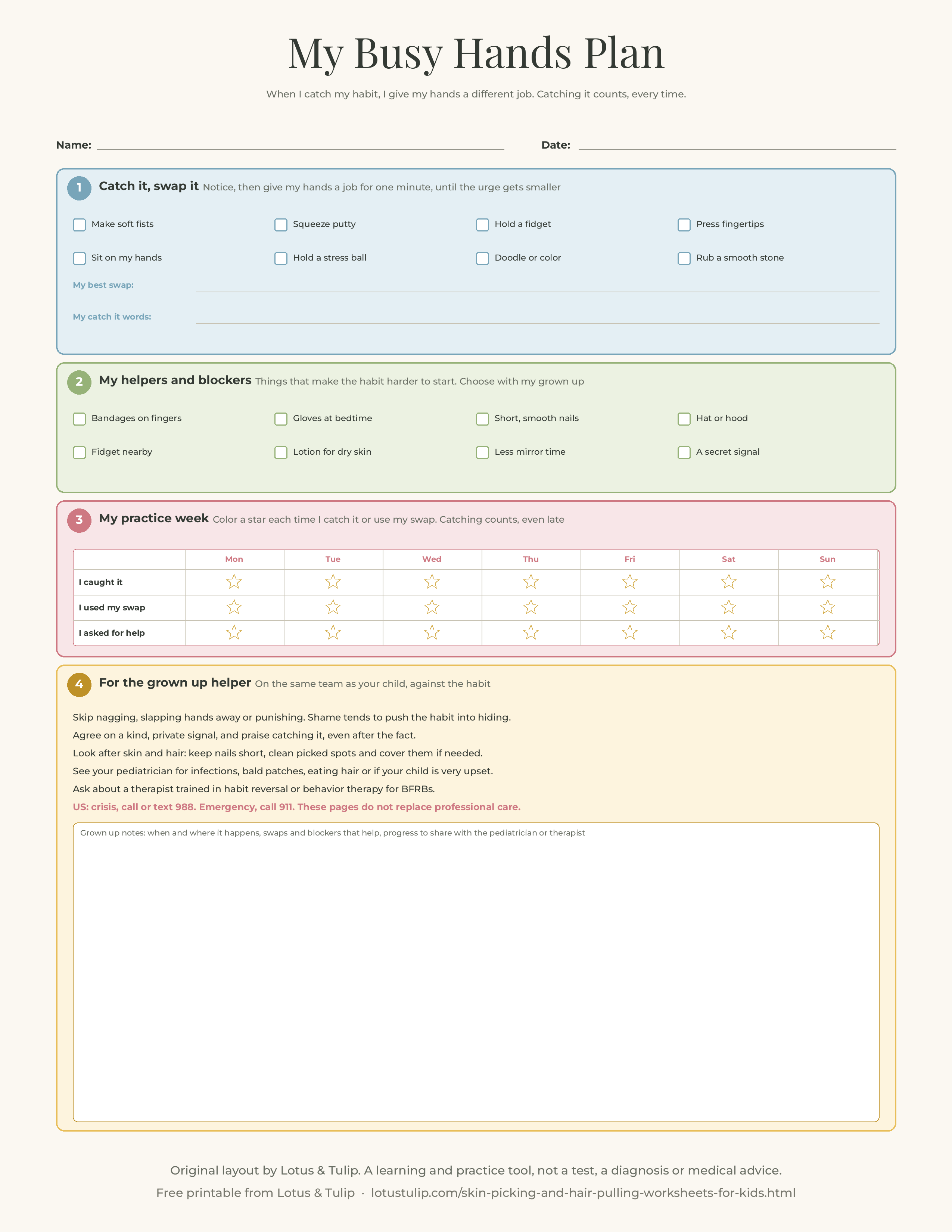
- Pick a swap and practice it. On My Busy Hands Plan, choose one competing response, such as soft fists for one minute, and practice it several times a day when calm, so it becomes automatic.
- Add helpers and blockers. Pick two or three changes, such as bandages on fingers during homework, gloves at bedtime or a fidget next to the TV. Let your child choose, so it feels like help, not punishment.
- Agree on a private signal. Decide together what you will say or do if you notice the habit, like a code word. Use it gently, then step back.
- Track and praise catching. Each day, color stars for times your child caught it, used the swap or asked for help. Praise catching, even after the fact. Expect the habit to come and go.
- Review weekly and get help if needed. Look at the plan together: which clues, swaps and blockers worked? If there is visible damage, distress, or little change after several weeks, ask for a therapist trained in habit reversal or behavior therapy for BFRBs, and bring the worksheets along.
How to adapt it by age
- Ages 5 to 7: keep it playful and short. Give the habit a silly name, act as "habit detectives" together, use stickers for catches and choose one simple swap, like squeezing a ball. Parents do most of the noticing and the environment changes.
- Ages 8 to 10: let the child fill in the detective page and test two or three swaps. Add a small weekly reward for practice chosen together, and involve them in picking blockers.
- Ages 11 to 12: respect privacy. Let them keep the log, decide who knows, and lead the plan. Talk about feelings, stress and skin changes such as acne, and offer a therapist if they want one.
Supporting a child with skin picking or hair pulling at school
- Allow quiet fidgets. A small fidget, putty or a textured strip under the desk gives hands a job during tests, reading and listening time.
- Use a private signal. Agree with the child on a discreet cue, never a public "stop picking." Calling it out in front of peers adds shame.
- Know the high risk times. Independent reading, tests, videos and waiting times are often when picking or pulling increases. Planned movement or tasks with hands help.
- Watch for teasing. Bald patches, missing eyelashes or scabs can lead to comments. Step in early and talk with the school counselor.
- Make it official if needed. Supports such as fidgets, breaks or a bandage policy can be written into a 504 plan or IEP when the condition affects learning. Share the busy hands plan with the teacher so home and school use the same words.
Common mistakes
- Calling it gross or bad. Shame fuels hiding. Treat it as a common habit you can work on together.
- Constant reminders. One gentle private signal is enough. Ten "stop it"s a day add stress.
- Taking over the plan. A plan the child helped choose works better than rules imposed from outside.
- Expecting a quick stop. Habits fade with practice over weeks and often come back during stress. Slips are normal.
- Ignoring the skin. Clean and cover picked spots, keep nails short and treat dry skin or acne. Healthy skin gives fewer things to pick at.
- Waiting too long for help. Visible damage, infection, swallowing hair or real distress deserve a medical check and a therapist who knows BFRBs.
Examples
- Lily, 6: pulled her eyelashes while watching cartoons. Her dad called it "Mr. Tug," put a basket of soft fidgets by the couch and played habit detective with her. She earned a sticker each time she caught Mr. Tug. Over a few weeks, her eyelashes started to grow back, with occasional slips on tired days.
- Marcus, 9: picked his fingertips until they bled during homework and tests. Using the detective page, he and his mom saw it happened most during math. He chose putty as his swap, wore bandages on two fingers during homework, and his teacher agreed on a pencil tap as a private signal.
- Aisha, 12: pulled hair from her scalp in her room at night and hid the patch with a headband. When her mom noticed, she stayed calm and asked if she wanted help. They saw her pediatrician, then a therapist trained in habit reversal. Aisha now keeps her own log, wears gloves in bed and uses a smooth stone when she studies.
Free printable: skin picking and hair pulling worksheets for kids
This printable is an original Lotus & Tulip layout. It is not a screening questionnaire or a diagnostic tool and gives no score. Page 1, My Habit Detective, has ticks for what my hands do, when it happens most and what I feel just before, lines for where on my body and the first clue I notice, and a box to draw myself as a habit detective. Page 2, My Busy Hands Plan, has a catch it, swap it section with eight competing responses, a helpers and blockers menu, a 7 day star chart for catching it, using my swap and asking for help, and notes for the grown up helper with US 988 and 911 numbers.
Download the free skin picking and hair pulling worksheets for kids (PDF, 2 pages, US Letter)
Prefer single images? Page 1: My Habit Detective (PNG) · Page 2: My Busy Hands Plan (PNG)
Free to print for your own child, students, clients or groups. Please link to this page rather than re-uploading the file. A learning and practice tool that does not replace professional advice. In a mental health crisis, call or text 988. In an emergency, call 911.
Buy the kids feelings worksheets on Etsy
Related resources
- Tic worksheets for kids: when repeated blinking, sniffing or jerking movements are tics, with a free tic toolbox plan
- OCD worksheets for kids: when repeated behaviors are driven by fears and rules
- Anxiety worksheets for kids: when worry feeds the habit
- Emotional regulation worksheets for kids: calming the body and big feelings
- Coping skills list for kids: more swaps for stressful moments
- Habit tracker worksheet: how habits form and how to break them, for adults
- Urge surfing worksheet: riding out urges for teens and adults
- Self esteem worksheets for kids: when shame about the habit hurts confidence
- All counseling resources for kids and teens
FAQ
Why does my child pick their skin or pull their hair?
Picking and pulling usually feel soothing, satisfying or relieving, or they happen on autopilot during quiet activities like screens, reading or bedtime. Many children feel tension or an itchy, tingly urge first and relief afterward, which keeps the habit going. Boredom, worry and tiredness often make it worse. It is not a sign of bad parenting or a lack of willpower.
What are body focused repetitive behaviors (BFRBs)?
BFRBs are repeated habits where the hands pick, pull, bite or rub at the body, such as skin picking, hair pulling (trichotillomania), nail biting and lip or cheek chewing. When they cause visible damage and distress and the person cannot stop, a professional may diagnose hair pulling disorder or skin picking (excoriation) disorder.
Should I tell my child to stop picking or pulling?
Constant reminders and punishment usually add stress and push the habit into hiding. Instead, talk calmly about it as a common habit, agree on one kind, private signal, praise your child for catching it themselves and work on a plan together with swaps and blockers.
What can I give my child to keep their hands busy?
Good swaps give the hands a similar feeling or make picking and pulling impossible for a minute: putty, a stress ball, a smooth stone, textured fidgets, making soft fists or pressing fingertips together. Blockers such as bandages on fingers, cotton gloves at bedtime, short nails or a hat also help. Let your child test and choose.
What is the treatment for hair pulling and skin picking in children?
Behavior therapy that includes habit reversal training has the strongest evidence. It teaches awareness of the habit and its warning signs, a competing response and support from others, often with changes to the environment. A randomized trial in young people aged 7 to 17 found behavior therapy reduced hair pulling more than a control condition. Ask for a therapist trained in behavior therapy for BFRBs.
When should I see a doctor about my child's skin picking or hair pulling?
See your pediatrician if there are bald patches, missing eyelashes or eyebrows, sores that look infected, scarring, if your child chews or swallows pulled hair, or if the habit causes real distress or gets in the way of daily life. If your child hurts themselves on purpose or talks about wanting to die, call or text 988, and call 911 in an emergency.
How can teachers help a student who picks or pulls?
Allow quiet fidgets, agree on a private signal instead of calling it out, plan for high risk times such as tests and independent reading, step in early if peers tease, and coordinate with parents and the school counselor. Supports can be written into a 504 plan or IEP when needed.
Sources
- Azrin, N. H., and Nunn, R. G. (1973). Habit-reversal: a method of eliminating nervous habits and tics. Behaviour Research and Therapy, 11(4), 619 to 628.
- Bate, K. S., Malouff, J. M., Thorsteinsson, E. T., and Bhullar, N. (2011). The efficacy of habit reversal therapy for tics, habit disorders, and stuttering: a meta-analytic review. Clinical Psychology Review, 31(5), 865 to 871.
- Bloch, M. H., Panza, K. E., Grant, J. E., Pittenger, C., and Leckman, J. F. (2013). N-acetylcysteine in the treatment of pediatric trichotillomania: a randomized, double-blind, placebo-controlled add-on trial. Journal of the American Academy of Child and Adolescent Psychiatry, 52(3), 231 to 240.
- Franklin, M. E., Edson, A. L., and Freeman, J. B. (2010). Behavior therapy for pediatric trichotillomania: exploring the effects of age on treatment outcome. Child and Adolescent Psychiatry and Mental Health, 4, 18.
- Franklin, M. E., Edson, A. L., Ledley, D. A., and Cahill, S. P. (2011). Behavior therapy for pediatric trichotillomania: a randomized controlled trial. Journal of the American Academy of Child and Adolescent Psychiatry, 50(8), 763 to 771.
- Franklin, M. E., Flessner, C. A., Woods, D. W., and colleagues (2008). The child and adolescent trichotillomania impact project: descriptive psychopathology, comorbidity, functional impairment, and treatment utilization. Journal of Developmental and Behavioral Pediatrics, 29(6), 493 to 500.
- Grant, J. E., and Chamberlain, S. R. (2016). Trichotillomania. American Journal of Psychiatry, 173(9), 868 to 874.
- Grant, J. E., and Chamberlain, S. R. (2020). Prevalence of skin picking (excoriation) disorder. Journal of Psychiatric Research, 130, 57 to 60.
- Grant, J. E., Dougherty, D. D., and Chamberlain, S. R. (2020). Prevalence, gender correlates, and co-morbidity of trichotillomania. Psychiatry Research, 288, 112948.
- McGuire, J. F., Ung, D., Selles, R. R., and colleagues (2014). Treating trichotillomania: a meta-analysis of treatment effects and moderators for behavior therapy and serotonin reuptake inhibitors. Journal of Psychiatric Research, 58, 76 to 83.
- Menon, V., Shaik, S., and Mohan, P. (2015). Very early onset trichotillomania presenting with recurrent trichobezoar: conventional wisdom questioned. International Journal of Trichology, 7(1), 36 to 37.
- Nemeh, M. N., and Hogeling, M. (2022). Pediatric skin picking disorder: a review of management. Pediatric Dermatology, 39(3), 363 to 368.
- Schumer, M. C., Bartley, C. A., and Bloch, M. H. (2016). Systematic review of pharmacological and behavioral treatments for skin picking disorder. Journal of Clinical Psychopharmacology, 36(2), 147 to 152.
- Tucker, B. T., Woods, D. W., Flessner, C. A., Franklin, S. A., and Franklin, M. E. (2011). The Skin Picking Impact Project: phenomenology, interference, and treatment utilization of pathological skin picking in a population-based sample. Journal of Anxiety Disorders, 25(1), 88 to 95.
- Walther, M. R., Snorrason, I., Flessner, C. A., and colleagues (2014). The trichotillomania impact project in young children (TIP-YC): clinical characteristics, comorbidity, functional impairment and treatment utilization. Child Psychiatry and Human Development, 45(1), 24 to 31.
- The TLC Foundation for Body-Focused Repetitive Behaviors. bfrb.org (information and a directory of BFRB informed providers).
Lotus & Tulip is not affiliated with the researchers, agencies or organizations named on this page. Names in the examples are invented. This page is educational and does not replace professional advice, diagnosis or treatment.