
Kids and teens · OCD support for children ages 5 to 12 · Updated 2026-11-14
OCD worksheets for kids: how OCD shows up in children, what research shows and a free boss back plan

Ages 5 to 11: Kids Feelings and Social Skills Worksheets, incl. feelings detective, body clues, a feelings thermometer, a coping skills menu and a calm down plan Holiday 20% off: about $11.04, was $14 (EUR 12) · fillable PDF, instant digital download
Buy on EtsyTry it free first: download a fillable sample (feelings thermometer and calm-down plan, PDF, 240 KB). Type into it on screen, then get the full pack. No email needed.
For clinicians: OCD and ERP Worksheets for Therapists, the OCD cycle, exposure ladder, practice record and a family accommodation plan Holiday 20% off: about $9.20, was $12 (EUR 10) · fillable PDF, instant digital download
Buy on EtsyKids and teens bundle: Kids and Teens Worksheets Bundle (feelings, anger, self esteem, social anxiety) Holiday 20% off: about $22.08, was $28 (EUR 24) · 80 pages, instant digital download
Buy on EtsyA child who washes their hands until they crack, asks "Are you sure?" twenty times before bed, has to tap the door frame an even number of times, or cannot finish homework because every letter has to look "just right" is not being difficult on purpose. Obsessive compulsive disorder (OCD) feels to a child like a bossy voice that will not stop until they obey, and every time they obey, the voice gets a little louder.
This guide is for parents, teachers, school counselors and child therapists supporting children about 5 to 12. It explains how OCD differs from normal childhood rituals, how it shows up at different ages, what research shows about treatment (including its limits), why reassurance and "helping" can keep OCD going, what OCD worksheets for kids can and cannot do, eight kinds of worksheets, nine steps to use them, age adaptations, the school side, common mistakes and three short examples. It ends with a free 2 page printable: Meet My Bossy OCD and My Boss Back Ladder.
These pages support a trained clinician, they do not replace one. OCD in children is very treatable, and the best evidence is for cognitive behavioral therapy with exposure and response prevention (ERP), ideally with a therapist trained in it and with parents involved. Use these worksheets to understand OCD and to practice the steps your child's therapist plans, not as a home treatment on their own.
Safety first: if a child talks about wanting to die or hurting themselves, call or text 988 (the 988 Suicide and Crisis Lifeline). If a child is in immediate danger, call 911. If OCD or tics appear suddenly and severely over a few days, contact your pediatrician promptly.
Download the free OCD worksheets for kids (PDF, 2 pages, US Letter)
Direct download, no email or sign up. See the pages first. Working with teens or adults: ERP worksheets for OCD and intrusive thoughts worksheet.
What OCD is, in plain words
OCD has two parts. Obsessions are unwanted thoughts, pictures, urges or "not right" feelings that pop into the mind again and again and cause fear, disgust or discomfort. Compulsions are things a child feels driven to do to make that feeling go away or to stop something bad from happening: washing, checking, counting, repeating, arranging, confessing, asking for reassurance or doing something "until it feels right." Compulsions can be visible or happen silently in the head, such as counting or saying a special word.
The trap is that compulsions work, briefly. The fear drops, so the brain learns that the ritual was needed, and the next time the obsession comes back stronger. Treatment breaks that loop.
Unwanted strange thoughts are not the problem on their own. Almost everyone has them: in a study of 777 university students at 15 sites in 13 countries on six continents (Radomsky and colleagues, 2014), 93.6% reported at least one unwanted intrusive thought in the previous three months. What makes it OCD is how much time the thoughts and rituals take, how upsetting they are and how much they get in the way of daily life.
Normal rituals vs OCD
Young children love routines: the same bedtime story, the cup that has to be blue, lining up toys. That is normal development, and it usually fades by school age. The US Agency for Healthcare Research and Quality (AHRQ) notes that repetitive, ritualistic behaviors can be part of normal development, which is one reason OCD in children can be hard to recognize. Signs that it may be more than a phase:
- Time: rituals take a lot of time each day (DSM-5 gives more than one hour a day as an example), or make the child late, stuck or exhausted.
- Distress: the child is very upset, panicky or angry if a ritual is interrupted or cannot be done.
- Interference: it gets in the way of school, homework, sleep, meals, friends or family life.
- Drive: the child feels they have to do it, often because "something bad will happen" or it just feels wrong until it is done, and they may know it does not make sense.
- Family pulled in: parents are answering the same questions, washing extra, checking things or changing routines so the child can cope.
Only a qualified professional can diagnose OCD. Some signs overlap with anxiety, tics, autism, ADHD and eating problems, and children often have more than one. The lists on this page are for noticing, not labeling.
How OCD shows up in children, by age
- Common worries (obsessions): germs, dirt and getting sick; something bad happening to a parent; fears of hurting someone or of having done something wrong; needing things even, symmetrical or "just right"; and worries about being bad or breaking rules.
- Common rituals (compulsions): washing and cleaning, checking locks, doors or homework, counting, tapping or touching, repeating words or actions, ordering and arranging, rereading or rewriting, confessing and asking for reassurance again and again.
- Ages 5 to 7: children often cannot explain why they do a ritual. They may simply say "it feels wrong" or melt down. AHRQ notes that in younger children, obsessions are frequently hidden or poorly put into words, and that children may show rituals such as blinking or breathing patterns rather than the washing and checking adults expect.
- Ages 8 to 10: rituals often show up around school and bedtime, and children may hide them out of embarrassment. Homework that takes hours because of erasing and rewriting is a common clue.
- Ages 11 to 12: children are more able to describe obsessions, including upsetting thoughts about harm, religion or sex that they are often ashamed of. They need to hear clearly that having a thought is not the same as wanting it or doing it.
- Sudden onset: NIMH describes PANS and PANDAS as rare conditions with a very sudden, severe onset of OCD or restricted eating in children before puberty, often with other changes such as anxiety, mood swings, bedwetting or handwriting changes. Typical OCD usually builds over weeks, months or years. If symptoms explode over a few days, see your pediatrician.
What the research shows, honestly
- OCD in children is not rare. AHRQ's 2024 systematic review on OCD in children states that OCD is seen in as many as 1% to 3% of children and adolescents, that about half of all cases begin in childhood or adolescence, and that boys typically show symptoms earlier (7 to 9 years) than girls (11 to 13 years). NIMH notes that OCD usually starts between late childhood and young adulthood.
- CBT with ERP is the first line treatment. The 2012 American Academy of Child and Adolescent Psychiatry (AACAP) Practice Parameter recommends CBT that includes exposure and response prevention as first line treatment for mild to moderate OCD in young people, and combined CBT and an SSRI medicine for some, particularly with more severe symptoms. AHRQ's 2024 review, which included 71 randomized trials, found that in person ERP and ERP by telehealth both work better than a waitlist, and that ERP alone or with an SSRI is probably more effective than an SSRI alone.
- The landmark trial. In the Pediatric OCD Treatment Study (POTS Team, 2004, JAMA), 112 young people aged 7 to 17 received 12 weeks of CBT, sertraline, both, or placebo. Remission rates were 53.6% for the combination, 39.3% for CBT alone, 21.4% for sertraline alone and 3.6% for placebo. Combined treatment and CBT alone did not differ significantly on remission.
- Young children benefit too, with parents involved. In POTS Jr (Freeman and colleagues, 2014, JAMA Psychiatry), 127 children aged 5 to 8 received 14 weeks of family based CBT with ERP or family based relaxation training. 72% of children in family based CBT were rated much or very much improved, compared with 41% in relaxation training. Relaxation alone was not enough.
- Gains tend to last. A 2026 meta-analysis of long term follow up after CBT for OCD (Öst and colleagues, Cognitive Behaviour Therapy; 47 studies, 2,817 participants, adults and children) found that improvements were maintained an average of 2.5 years after treatment, with child studies showing further improvement over time.
- Family "help" can keep OCD going. In a study of 65 young people with OCD (Peris and colleagues, 2008), family accommodation was the norm: 56% of parents gave reassurance and 46% took part in rituals on a daily basis. Reviews link accommodation with more severe symptoms and poorer outcomes (Lebowitz, Panza and Bloch, 2016), which is why good child OCD treatment coaches parents to step back gradually.
- Outlook. A meta-analysis of 16 samples with 521 participants followed for 1 to 15.6 years (Stewart and colleagues, 2004) found that full OCD persisted in 41% on average, lower than many expected. Earlier onset, longer duration, other conditions and a poor first response to treatment predicted more persistence, which is a good reason to get effective help early.
The practical message: OCD worksheets for kids do not cure OCD. They help a child understand that OCD is a brain trick, notice its demands, rate fear and practice small, planned steps of not obeying, which is the core of ERP. The real engine is gradual, repeated practice, guided by a trained clinician and supported by calm, confident parents.
Why reassurance and rescuing backfire
When a child asks "Are my hands clean? Are you sure? Promise?", answering feels kind. It also works as a compulsion: the fear drops for a moment, and OCD learns to ask again. The same goes for washing the child's clothes extra times, checking the locks with them, or letting OCD decide which route to drive. Parents do this out of love, and blaming them helps no one. The fix is not to stop everything at once, which can lead to big meltdowns, but to step back in planned small steps with the child's therapist, while showing warmth and confidence: "That sounds like OCD asking. I know this feels hard, and I know you can handle it."
What OCD worksheets for kids can and cannot do
- Can: explain OCD in kid words, help a child give OCD a name and see it as separate from themselves, map what OCD says and what it makes them do, rate fear from 0 to 10, build a step by step ladder, record practice and learning, and help the family track accommodation.
- Cannot: diagnose OCD, tell OCD apart from tics, autism or PANS, or replace ERP with a trained clinician. Pushing a child into hard exposures without a plan can backfire and make them less willing to try. Using calming tools to make a fear go away during an exposure can also turn into a new ritual.
8 kinds of OCD worksheets for kids
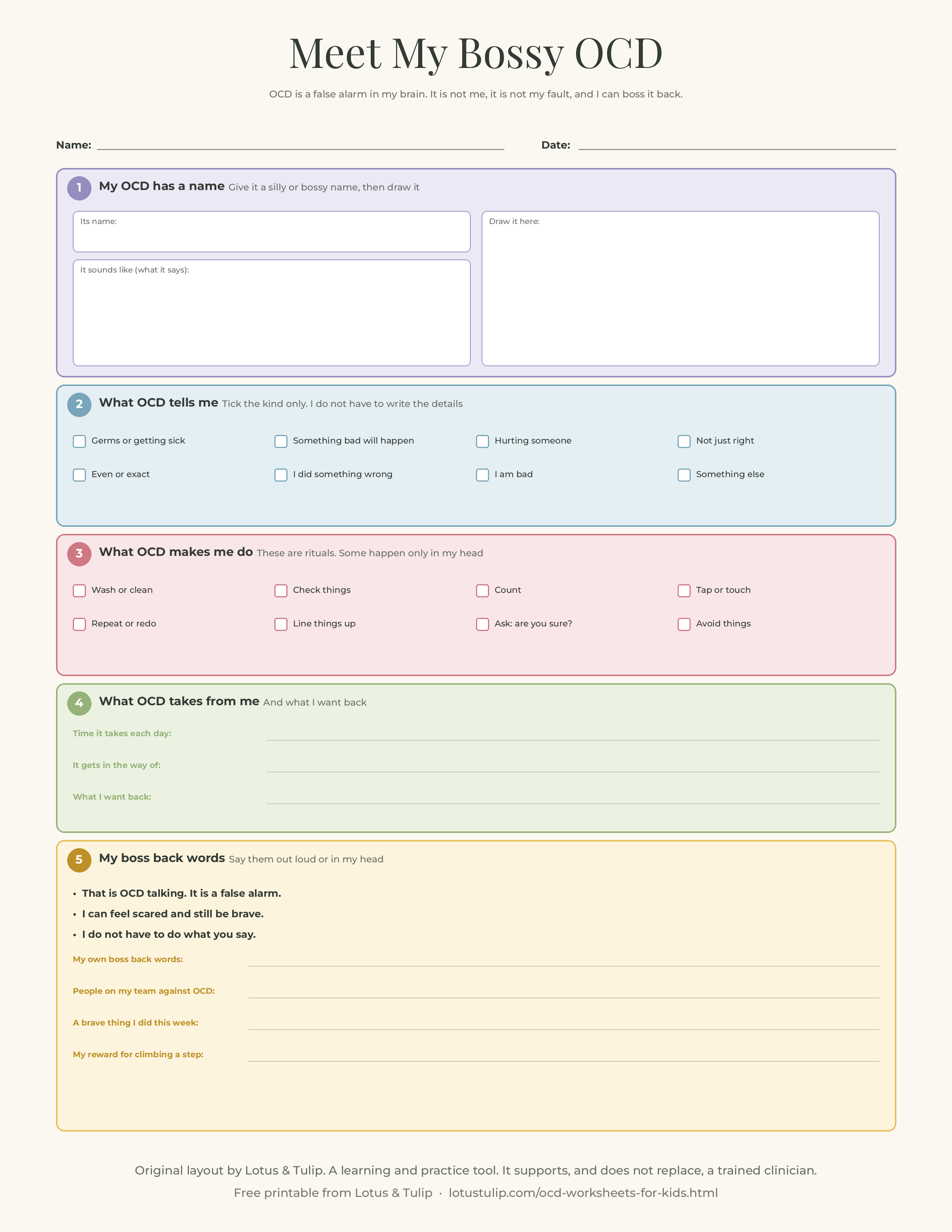
- Meet my OCD. The child gives OCD a silly or bossy nickname and draws it. Many child OCD programs, including the CBT manual by March and Mulle (1998), use this kind of externalizing so the child and family team up against OCD instead of fighting each other.
- What OCD tells me. Ticks for the kind of worry (germs, harm, just right, being bad) without having to write out details that feel scary or shameful.
- What OCD makes me do. A list of rituals, including hidden ones such as counting in your head and asking for reassurance.
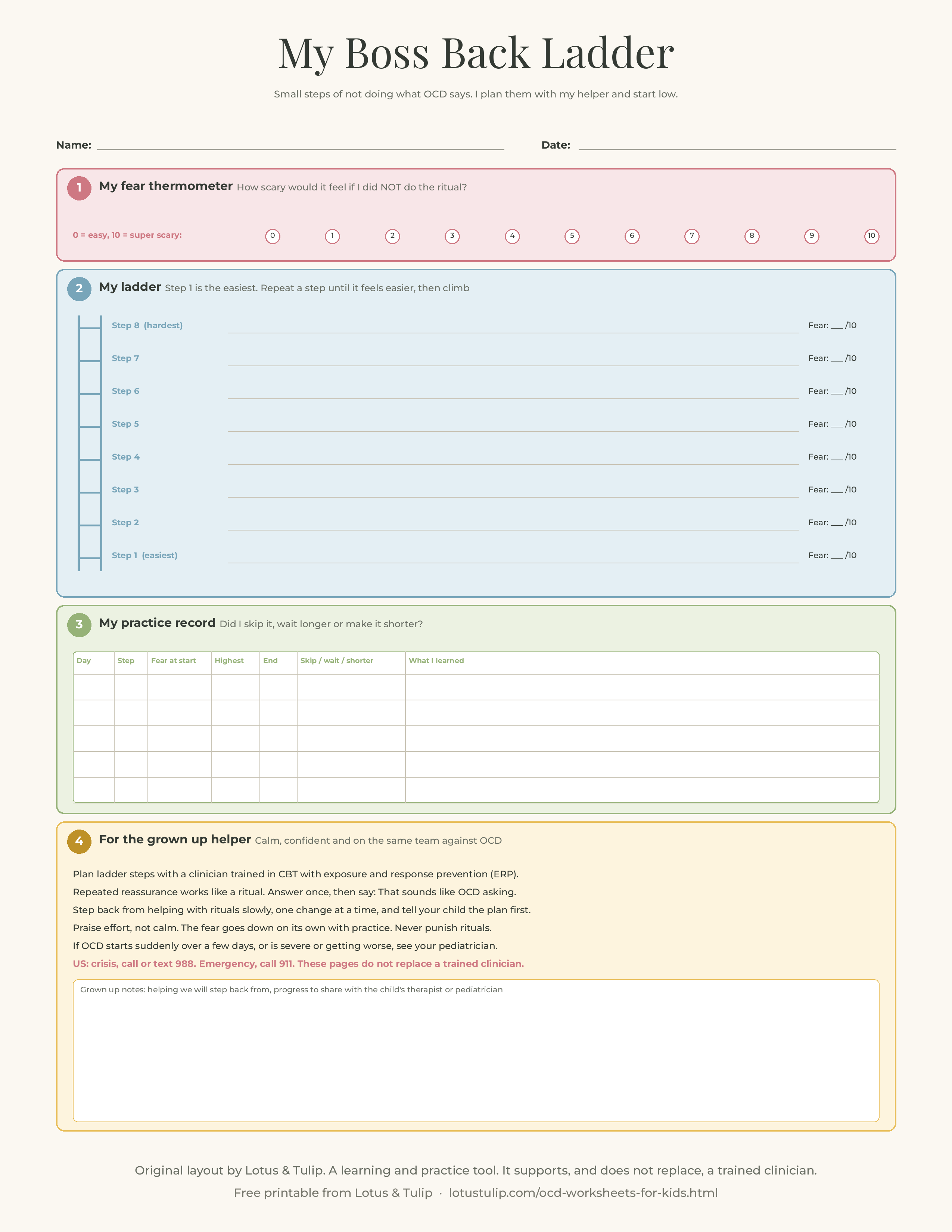
- My fear thermometer. A 0 to 10 scale the child uses to rate how scary each situation feels without the ritual. Our feelings thermometer printable shows the idea.
- What OCD takes from me. What OCD steals (time, sleep, play, fun) and what the child wants back. This builds motivation.
- My boss back ladder. Steps from easier to harder, each a small way of not doing what OCD says, with a fear rating. It is the child version of an exposure hierarchy.
- Practice record. Fear at the start, at the peak and at the end, whether the ritual was skipped, delayed or shortened, and what the child learned.
- Family helper plan. Where the family is helping OCD (answering repeat questions, joining rituals, changing plans) and one small step back at a time, agreed with the therapist.
How to use OCD worksheets for kids, step by step
- Get an assessment first. Talk to your pediatrician or a child psychologist, and ask for a clinician trained in CBT with exposure and response prevention for children. The International OCD Foundation (iocdf.org) has a directory. Use these pages alongside that care.
- Explain OCD as a brain trick. "OCD is like a false alarm in your brain. It says something bad will happen unless you do a ritual. It is not you, it is not your fault, and we can learn to boss it back."
- Name it and draw it. On Meet My Bossy OCD, let the child choose a name (Mr. Worry Bug, the Bossy Brain) and draw it. From now on, the family talks about what "it" wants, not what the child wants.
- Map what OCD says and what it makes me do. Tick the kinds of worries and rituals. The child does not have to describe upsetting thoughts in detail. Calmly accept whatever they share.
- Rate the fear. For each situation, ask: "If you did not do the ritual, how scary would it feel, 0 to 10?" Write the numbers down.
- Build the boss back ladder with the therapist. Choose 6 to 8 steps from about 2 to 3 up to 8 or 9. Each step is a way to skip, delay or shorten a ritual, or to face a trigger without the ritual. Start where the child feels "a bit scary but I can do it."
- Practice one step often. Repeat the same step, ideally daily, until it feels much easier, then move up. Let the fear rise and fall on its own without checking, washing or reassurance. Praise effort, not perfect calm.
- Record and learn. On the practice record, note fear at the start, peak and end, and what the child learned ("the feeling went down by itself," "nothing bad happened," "I can handle it even when it feels wrong").
- Step back from accommodation, slowly, and review weekly. With the therapist, pick one family accommodation to reduce at a time, and tell the child the plan in advance. Review progress each week. If symptoms are severe, getting worse or taking over daily life, or a child talks about wanting to die, get help right away: call or text 988, or call 911 in an emergency.
How to adapt it by age
- Ages 5 to 7: Parents do most of the writing and play a big role, as in POTS Jr. Use a stuffed animal or puppet as the "OCD bully" the child can boss back. Keep ladders short (4 to 5 steps), use stickers and celebrate every try.
- Ages 8 to 10: Most children can fill in both pages with support. Use the 0 to 10 thermometer and let them choose the next ladder step from two options. Make it a team game: "Who is winning this week, you or the Bossy Brain?"
- Ages 11 to 12: Let the child lead more and explain the OCD loop in more detail. They may have taboo thoughts they are ashamed of; normalize them, and let them write only the type of thought. Our intrusive thoughts worksheet and ERP worksheets for OCD fit mature 12 year olds and teens.
- With anxiety or worry too: Many children with OCD also have other anxiety. See anxiety worksheets for kids and CBT worksheets for kids.
Using these worksheets in school
OCD often shows up at school as lateness, frequent bathroom trips, erasing until the paper tears, rereading the same line, asking teachers "Is this right?" over and over, or avoiding shared supplies. School counselors and teachers can help by learning the child's plan from parents or the therapist, using the same OCD nickname and language, answering a repeat question once and then gently pointing back to the plan, and allowing agreed supports for a while, such as extra time or a "good enough" homework rule. A 504 plan can formalize supports when OCD affects learning. Never single the child out in front of peers, and do not run exposures in class unless they are part of the clinician's plan.
Common mistakes
- Endless reassurance. Answering the same question again and again feeds OCD. Answer once, then reflect the feeling and point to the plan.
- Stopping all accommodation overnight. Sudden changes can cause huge meltdowns. Step back gradually, with a plan and the therapist's guidance.
- Treating it as bad behavior. Punishing rituals adds shame and pushes them into hiding. Team up against OCD instead.
- Using relaxation as the main treatment. Calming skills help with general stress, but in POTS Jr relaxation training alone did much less than CBT with ERP.
- Climbing too fast. A ladder step that is a 10 out of 10 usually fails. Start at a step the child agrees to and repeat it.
- Waiting it out. OCD rarely fades on its own once it takes over daily life, and earlier effective treatment is linked with better outcomes.
Examples
- A 6 year old with "just right" rituals: A kindergartner had to put on and take off his socks until they "felt even," making the family late every morning. With the therapist, his parents named it "Mr. Fussy," and he drew it as a grumpy sock. His ladder started with one extra try instead of many, then socks on once with a timer and a sticker. Mornings were calmer after a few weeks.
- A 9 year old with germ fears: A third grader washed her hands 30 times a day and asked her mom "Are my hands clean?" all evening. Her boss back ladder moved from touching a doorknob and waiting five minutes before washing, to eating a snack after recess with only a quick normal wash. Her mom answered each reassurance question once, then said, "That sounds like the Germ Bully. You can handle not knowing." Her family based ERP sessions used the same plan.
- An 11 year old with harm thoughts: A fifth grader was terrified by thoughts of hurting his little sister and avoided being near her. On Meet My Bossy OCD, he ticked "scary thoughts about hurting someone" without writing details. His therapist explained that the thoughts upset him because they are the opposite of what he wants, and his ladder included sitting next to his sister while reading. His parents were reassured to learn that intrusive harm thoughts are a common OCD theme.
Free printable: OCD worksheets for kids
This printable is an original Lotus & Tulip layout. It is not a screening questionnaire or a diagnostic tool, it is not the CY-BOCS or any rating scale, and it gives no score. Page 1, Meet My Bossy OCD, explains OCD as a brain false alarm in kid words, with a box to name and draw OCD, the kinds of things OCD tells me (tick the kind only), what OCD makes me do, what OCD takes from me, and my boss back words. Page 2, My Boss Back Ladder, has a 0 to 10 fear thermometer, an 8 step ladder with fear ratings, a practice record (fear at start, peak and end, skipped, delayed or shortened, what I learned) and notes for the grown up helper on reassurance, accommodation, when to get help and US crisis lines.
Download the free OCD worksheets for kids (PDF, 2 pages, US Letter)
Prefer single images? Page 1: Meet My Bossy OCD (PNG) · Page 2: My Boss Back Ladder (PNG)
Free to print for your own child, students, clients or groups. Please link to this page rather than re-uploading the file. A learning and practice tool that supports, and does not replace, a trained clinician. In a mental health crisis, call or text 988. In an emergency, call 911.
Buy the kids feelings worksheets on Etsy
Related resources
- Tic worksheets for kids: tics and Tourette syndrome, how they differ from compulsions and how CBIT helps
- ERP worksheets for OCD: exposure hierarchy and response prevention for teens and adults
- Intrusive thoughts worksheet: why unwanted thoughts stick and when it may be OCD
- Exposure hierarchy worksheet: build a fear ladder step by step
- Anxiety worksheets for kids: worry, body clues and brave steps
- CBT worksheets for kids: thought detective and brave steps
- Separation anxiety worksheet for kids: a goodbye plan and brave apart ladder
- Free OCD and ERP worksheets for therapists: an 8 page starter pack
- All counseling resources for kids and teens
- Skin picking and hair pulling worksheets for kids: when repeated picking, pulling or nail biting is a body focused habit, not OCD
FAQ
What are OCD worksheets for kids?
They are printable pages that help children understand OCD as a brain false alarm, give it a name, notice what it tells them and makes them do, rate fear from 0 to 10, and practice small planned steps of not obeying it on a boss back ladder. They support, and do not replace, CBT with exposure and response prevention guided by a trained clinician.
What are signs of OCD in a child?
Signs include rituals that take a lot of time, such as washing, checking, counting, repeating, arranging or redoing things until they feel right, repeated reassurance questions, big distress when a ritual is interrupted, homework that takes hours because of rewriting, and avoiding things like germs or certain numbers. Young children may not be able to explain why. Only a qualified professional can diagnose OCD.
How common is OCD in children?
A 2024 US government systematic review (AHRQ) states that OCD is seen in as many as 1% to 3% of children and adolescents and that about half of all cases begin in childhood or adolescence. Boys tend to show symptoms earlier, around 7 to 9, and girls around 11 to 13.
What is the best treatment for OCD in children?
Cognitive behavioral therapy with exposure and response prevention (ERP) is the recommended first line treatment for mild to moderate OCD in young people, with an SSRI medicine added for some children, especially with more severe symptoms. In a trial of children aged 5 to 8, 72% improved with family based CBT compared with 41% with relaxation training.
Should I reassure my child when OCD makes them ask the same question?
Answering once is fine, but repeated reassurance works like a compulsion and keeps OCD going. With your child's therapist, plan to step back gradually: answer once, name it ("That sounds like OCD asking"), show warmth and confidence, and point to the plan. Do not stop everything at once.
Is it OCD or just a phase?
Routines and "just so" preferences are common in young children and usually fade. It may be OCD if rituals take a lot of time, cause strong distress when interrupted, get in the way of school, sleep or family life, or pull family members in. If you are unsure, ask your pediatrician for an assessment. If symptoms start suddenly and severely over a few days, see the pediatrician promptly.
Can teachers help a child with OCD at school?
Yes. Learn the child's plan from the family or therapist, use the same language, answer a repeat question once and then point back to the plan, allow agreed supports such as extra time, and avoid singling the child out. A 504 plan can formalize supports. Exposure practice in school should follow the clinician's plan.
Sources
- Agency for Healthcare Research and Quality (2024). Steele, D. W., Caputo, E. L., Kanaan, G., and colleagues. Diagnosis and Management of Obsessive Compulsive Disorders in Children. Comparative Effectiveness Review No. 276, and AHRQ key questions background document. effectivehealthcare.ahrq.gov.
- American Academy of Child and Adolescent Psychiatry (2012). Practice parameter for the assessment and treatment of children and adolescents with obsessive-compulsive disorder. Journal of the American Academy of Child and Adolescent Psychiatry, 51(1), 98 to 113.
- American Psychiatric Association (2013). Diagnostic and Statistical Manual of Mental Disorders, fifth edition (DSM-5), obsessive-compulsive disorder.
- Freeman, J., Sapyta, J., Garcia, A., and colleagues (2014). Family-based treatment of early childhood obsessive-compulsive disorder: the Pediatric Obsessive-Compulsive Disorder Treatment Study for Young Children (POTS Jr). JAMA Psychiatry, 71(6), 689 to 698.
- Lebowitz, E. R., Panza, K. E., and Bloch, M. H. (2016). Family accommodation in obsessive-compulsive and anxiety disorders: a five-year update. Expert Review of Neurotherapeutics, 16(1), 45 to 53.
- March, J. S., and Mulle, K. (1998). OCD in Children and Adolescents: A Cognitive-Behavioral Treatment Manual. Guilford Press.
- National Institute of Mental Health. Obsessive-compulsive disorder (OCD), and PANS and PANDAS: questions and answers. nimh.nih.gov.
- Öst, L. G., Andersson, E., Clefberg, L., and colleagues (2026). Long-term follow-up of cognitive behavior therapy for obsessive-compulsive disorder in adults and children: a systematic review and meta-analysis. Cognitive Behaviour Therapy, online ahead of print.
- Pediatric OCD Treatment Study (POTS) Team (2004). Cognitive-behavior therapy, sertraline, and their combination for children and adolescents with obsessive-compulsive disorder. JAMA, 292(16), 1969 to 1976.
- Peris, T. S., Bergman, R. L., Langley, A., and colleagues (2008). Correlates of accommodation of pediatric obsessive-compulsive disorder: parent, child, and family characteristics. Journal of the American Academy of Child and Adolescent Psychiatry, 47(10), 1173 to 1181.
- Radomsky, A. S., Alcolado, G. M., Abramowitz, J. S., and colleagues (2014). Part 1. You can run but you can't hide: intrusive thoughts on six continents. Journal of Obsessive-Compulsive and Related Disorders, 3(3), 269 to 279.
- Stewart, S. E., Geller, D. A., Jenike, M., and colleagues (2004). Long-term outcome of pediatric obsessive-compulsive disorder: a meta-analysis and qualitative review of the literature. Acta Psychiatrica Scandinavica, 110(1), 4 to 13.
Lotus & Tulip is not affiliated with the researchers, agencies or organizations named on this page. This page is educational and does not replace professional advice, diagnosis or treatment.