
Therapist worksheets · Time management, planning and ADHD · Updated 2026-11-13
Time management worksheet for adults: why plans slip, what the research shows, and how to plan a realistic week step by step (free printable)
When ADHD is part of it: ADHD Worksheets for Therapists, incl. a time estimation log, daily top three, task breakdown, external brain and routine builder Holiday 20% off: about $11.04, was $14 (EUR 12) · fillable PDF, instant digital download
Buy on EtsyTry it free first: download a fillable sample (break it down and getting unstuck, PDF, 282 KB). Type into it on screen, then get the full pack. No email needed.
The thoughts behind the stalls: CBT Worksheets for Therapists, 20 pages including thought records, core beliefs and an exposure ladder Holiday 20% off: about $11.04, was $14 (EUR 12) · fillable PDF, instant digital download
Buy on EtsyTry it free first: download a fillable sample (thought record and evidence for and against, PDF, 105 KB). Type into it on screen, then get the full pack. No email needed.
A full caseload: Therapist Worksheets Mega Bundle (8 packs incl. CBT, anxiety, DBT, ACT, grief and ADHD) Holiday 20% off: about $35.88, was $45 (EUR 39) · fillable PDFs for all 8 packs plus 160 printable pages, instant digital download
Buy on EtsyMonday starts with a to do list of fourteen items. By Wednesday, six of them have moved to Thursday, an urgent email has eaten the morning, and the one task that mattered most has not been started. By Friday the list is longer than it was on Monday. Most adults know this week. Many blame themselves for being lazy or disorganized, buy a new planner and try harder, and the same week happens again.
This guide is for adults and the therapists, counselors and coaches who work with them. It explains why plans slip so reliably, what research says time management does and does not do, nine practical steps, common mistakes and examples. It ends with a free 2 page printable: My Time Map, which shows where your time really goes, and My Weekly Time Plan, a simple plan built around three priorities, a first step, set times and buffers.
Download the free time management worksheet (PDF, 2 pages, US Letter)
Direct download, no email or sign up. See the pages first.
What a time management worksheet is, and what it is not
It is a structured page for planning and reviewing how you use time. A good one does three things: it compares what you planned with what really happened, it narrows a long list down to a few priorities, and it turns those priorities into specific times and first steps. The review part matters as much as the plan, because it is how your estimates get more accurate.
It is not a productivity contest. The aim is not to fill every minute. A realistic plan usually has fewer tasks, more buffer and more rest than an ambitious one, and it gets done more often.
It is not a test or a diagnosis. Struggling with time is common and has many causes: too much work, unclear priorities, stress, low mood, sleep problems, caregiving, or ADHD. The worksheet can help you see the pattern; a clinician can help you understand the cause when it keeps getting in the way.
Why plans slip: four reasons that are not laziness
1. We underestimate how long things take. In a classic study by Buehler, Griffin and Ross (1994), 37 psychology students predicted when they would finish their honors thesis. Their best estimate averaged 33.9 days; the real average was 55.5 days, and only 29.7% finished by the date they predicted. Even their "everything goes as poorly as it possibly could" estimate (48.6 days) was too short. The researchers found that people picture how the task will go and ignore how similar tasks went before. When students were asked to connect their prediction to relevant past experiences, the optimistic bias disappeared. This is called the planning fallacy, and it is why page 1 starts with an estimate versus actual log.
2. Unfinished tasks keep tugging at attention. Masicampo and Baumeister (2011) found that unfinished goals caused intrusive thoughts during an unrelated reading task and poorer performance on other tasks. When participants made a specific plan for the unfinished goal, those effects went away, as long as the plan was earnest. In practice: writing down when and how you will do something can quiet it until then. That is the job of the top three, the if-then plans and the parking lot on page 2.
3. Switching between tasks costs time. Experiments on task switching, such as Rubinstein, Meyer and Evans (2001), found that people are slower when they switch between tasks than when they repeat one, and that the cost grows when the rules of the tasks are more complex. Checking email between paragraphs of a report feels efficient but adds up. Focus blocks with one task each reduce the number of switches.
4. Too many priorities means no priorities. A list of fourteen items treats them all as equal. Sorting tasks by importance and timing, and choosing three that matter most this week, makes it easier to protect time for them before urgent but less important tasks fill the day.
What the research says time management does
- It is linked with performance, and even more with wellbeing. A meta-analysis by Aeon, Faber and Panaccio (2021) pooled 158 studies with 53,957 participants. Time management was moderately related to job performance (correlations around r = .25), academic achievement and wellbeing, and moderately negatively related to distress. The link with wellbeing, especially life satisfaction, was somewhat stronger than with performance. The studies were mostly correlational, so they show an association rather than proof of cause.
- Specific if-then plans help people follow through. A meta-analysis by Gollwitzer and Sheeran (2006) of 94 independent tests found a medium to large effect (d = 0.65) of implementation intentions, plans of the form "if situation X, then I will do Y", on reaching goals.
- Structured skills training helps adults with ADHD. In a randomized trial, Solanto and colleagues (2010) assigned 88 adults with ADHD to a 12 week meta-cognitive therapy group focused on time management, organization and planning, or to supportive therapy. The skills group improved more on inattention symptoms, and after adjusting for baseline severity, the odds of treatment response were about 5.4 times higher. This is one trial, in a well educated clinical sample, but it supports teaching these skills directly.
Put together: time management is not a cure all, but planning from real data, choosing a few priorities, making specific plans and reviewing them weekly are reasonable, research informed habits. They seem to matter at least as much for how people feel as for what they get done.
How to use a time management worksheet, step by step
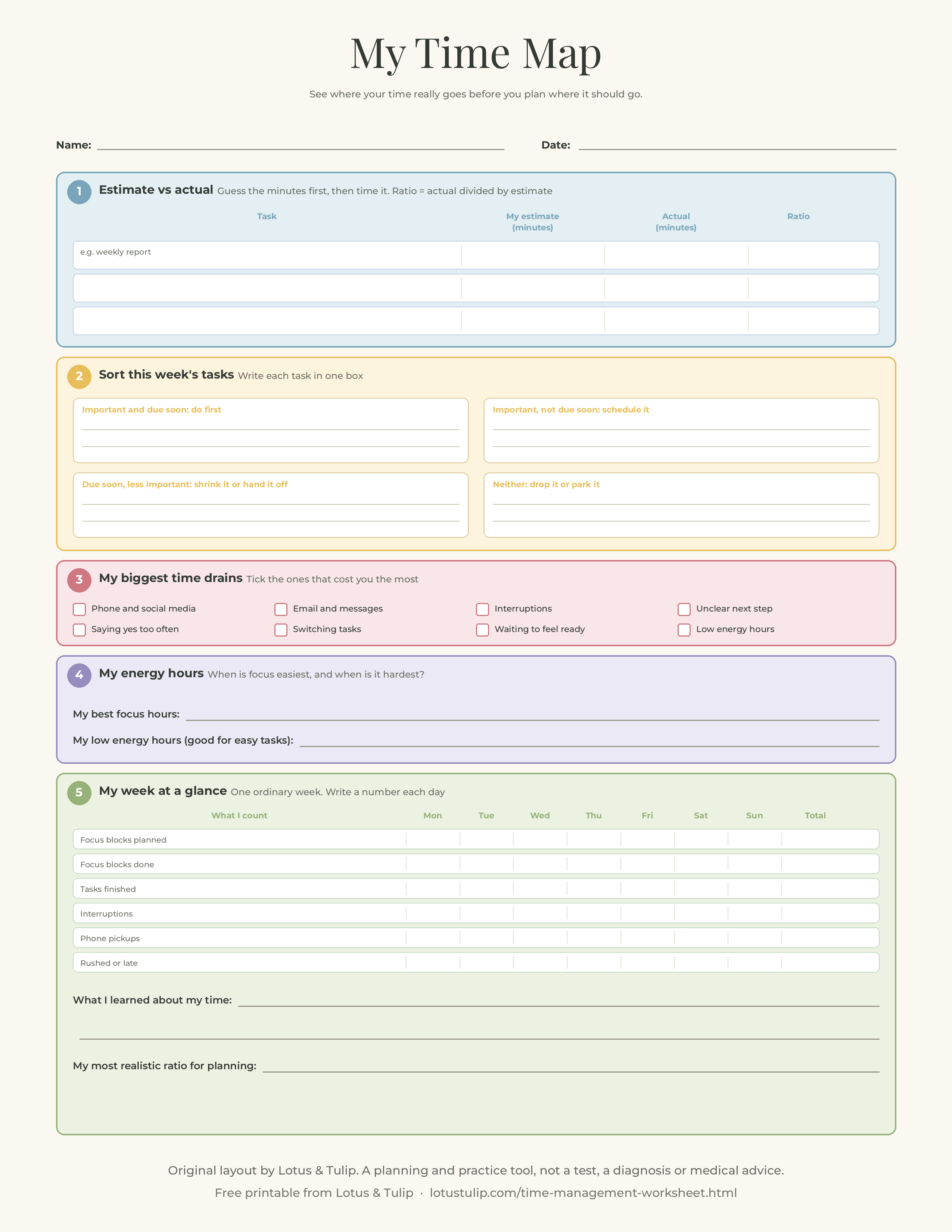
- Log estimate versus actual. On page 1, write three ordinary tasks, guess the minutes before you start, then time them. Divide actual by estimate. A ratio of 1.5 means tasks take half again as long as you think. Use your own ratio when you plan, not your hopes.
- Sort the week's tasks. Put each task in one of four boxes: important and due soon, important but not due soon, due soon but less important, or neither. Most people find the second box is where their real priorities sit and where nothing gets scheduled.
- Find your biggest time drains. Tick the ones that cost you most: phone and social media, email and messages, interruptions, an unclear next step, saying yes too often, switching tasks, waiting to feel ready or working in low energy hours. Pick one to work on first.
- Map your energy hours. Write when focus comes most easily and when it is hardest. Save your best hours for the hardest task and your low energy hours for email, errands and admin.
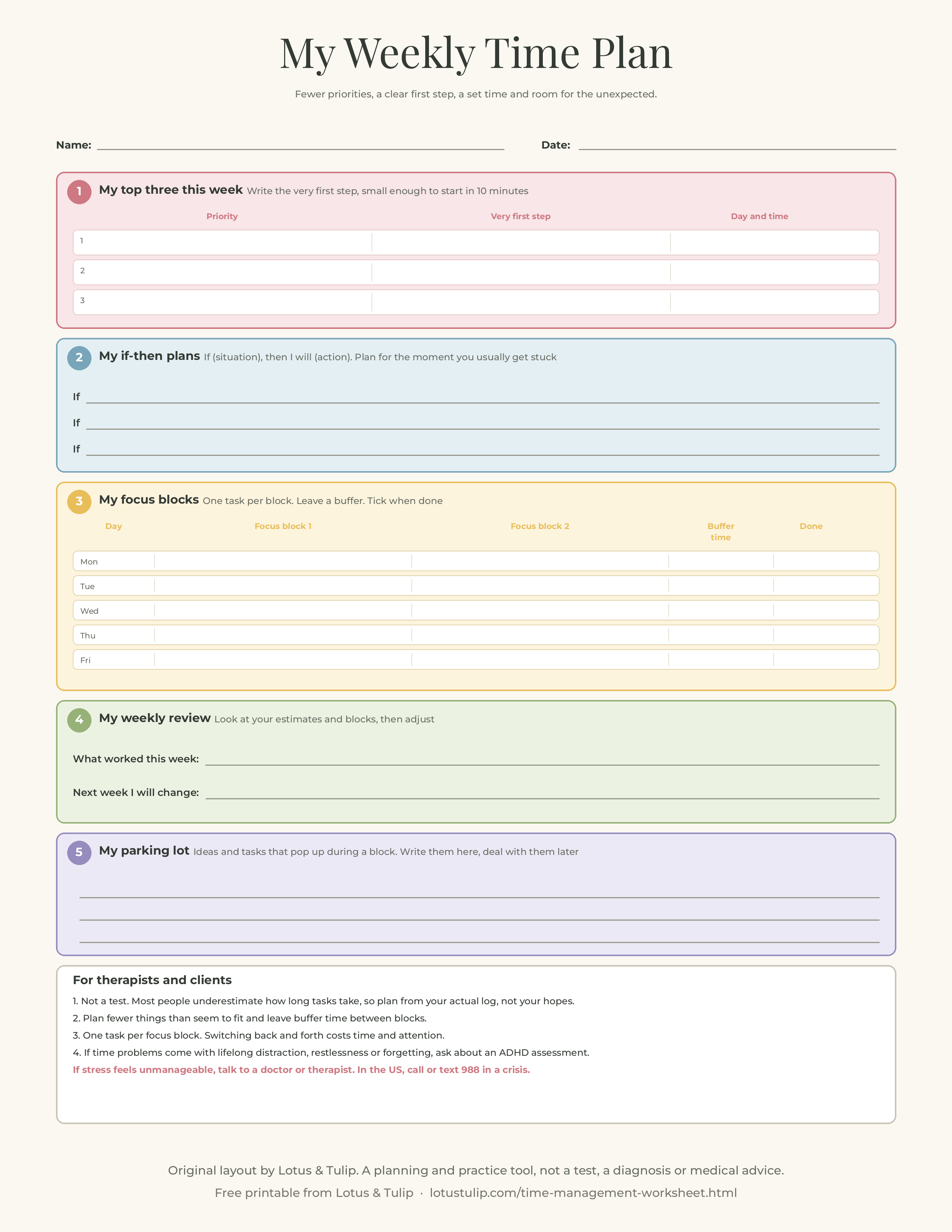
- Choose three priorities for the week. On page 2, write no more than three. For each, write the very first step, small enough to start in ten minutes ("open the report and write three headings", not "write the report"), and the day and time you will start. The procrastination worksheet helps when starting is the hard part.
- Write if-then plans for sticking points. Think of the moment you usually get stuck and plan for it: "If I open my laptop at 9, then I start the report before email." "If a coworker asks for something during a focus block, then I write it in my parking lot and answer at 11."
- Book focus blocks with buffers. Give each priority a block of time with one task in it, and leave buffer time after it for overruns and the unexpected. Plan fewer blocks than seem to fit; your estimate ratio from step 1 tells you how many fewer.
- Use the parking lot. When an idea or new task pops up during a block, write it in the parking lot and go back to the task. Deal with the list at a set time.
- Review weekly and adjust. At the end of the week, fill in the week at a glance tally (blocks planned and done, tasks finished, interruptions, phone pickups, rushed or late), note what worked and choose one change for next week. Small, steady adjustments beat a new system every Monday.
When low mood is draining energy for everything, the behavioral activation worksheet is a better starting point, and when the problem is saying yes to everyone, try the assertiveness worksheet.
Common mistakes
- Planning the ideal week. A plan that only works if nothing goes wrong will fail most weeks. Plan from your actual log and keep buffers.
- Too many priorities. If everything is a priority, the urgent tasks win. Three is enough; the rest can wait or go in the parking lot.
- Vague first steps. "Work on taxes" is hard to start. "Find last year's return and put it on the desk" is easy to start.
- Switching systems instead of reviewing. A new app or planner feels like progress, but the review is what improves your estimates. Keep the same simple sheet for at least a month.
- Treating it as a character flaw. Missing plans is very common. If it keeps happening despite good systems, look at workload, sleep, mood and attention, and talk to a clinician if it affects work, health or relationships.
Examples
- The project manager: Planned ten tasks a day and finished four. Her estimate log showed a ratio of 1.8 for writing tasks. She cut her daily plan to three focus blocks with 30 minutes of buffer after each, and moved email to 11 and 4. After three weeks, she was finishing most planned blocks and leaving work closer to on time.
- The graduate student: Kept "thesis" on his list for months without starting. His top three listed one first step, "write five bullet points for the methods section", at 9 every weekday before opening email. His if-then plan: "If I feel stuck, then I write the worst version for ten minutes." He reviewed his blocks each Friday with his advisor.
- The parent with ADHD: Often lost track of time and missed appointments. With her therapist, she used the time map to find her drains (phone, switching tasks), set timers for transitions, wrote all appointments in one calendar and kept a parking lot by the door. The worksheet became part of a broader ADHD plan alongside her medical care.
Free time management worksheet
This free printable is an original Lotus & Tulip layout on US Letter, in our own wording. Page 1, My Time Map, has an estimate versus actual log with a ratio column, a four box sort for the week's tasks, a time drains checklist, lines for your best and lowest energy hours, a week at a glance tally of focus blocks planned and done, tasks finished, interruptions, phone pickups and rushed or late tasks, and lines for what you learned. Page 2, My Weekly Time Plan, has your top three with a first step and a day and time, three if-then plans, a Monday to Friday focus block schedule with buffer time, a weekly review, a parking lot and short notes for therapists and clients.
Download the free time management worksheet (PDF, 2 pages, US Letter)
Prefer single images? Page 1: my time map (PNG) · Page 2: my weekly time plan (PNG)
Free to print for use with your own clients or for yourself. Please link to this page rather than re-uploading the file. A planning and practice tool, not a test, a diagnosis or a substitute for therapy or medical care. In the US, call or text 988 in a mental health crisis.
Related resources
- Burnout worksheet: when the problem is too much work, not poor planning
- Procrastination worksheet: when starting is the hard part
- ADHD worksheets: executive function, focus and time blindness
- Perfectionism worksheet for adults: when tasks take forever because they must be perfect
- Worry time worksheet: postpone looping worries to a daily slot
- Self care plan template: make room for rest in the week
- Time management activities for teens: the school counselor version
- All therapist worksheets: CBT, DBT, ACT and more
FAQ
What is a time management worksheet?
A time management worksheet is a structured page that helps you compare how long tasks really take with how long you expected, choose a few priorities, turn them into specific times and first steps, and review the week so your next plan is more realistic. Adults use them on their own, and therapists, counselors and coaches use them with clients.
Why do my tasks always take longer than I plan?
This is so common it has a name, the planning fallacy. In a well known study, students expected to finish their thesis in about 34 days and took about 56, and fewer than a third finished on time. People tend to imagine how a task will go instead of remembering how similar tasks went. Timing a few tasks and planning with your own estimate ratio helps.
Does time management actually work?
A meta-analysis of 158 studies with almost 54,000 participants found that time management is moderately linked with better job performance, academic achievement and wellbeing, and with less distress. The link with wellbeing was a little stronger than with performance. Most studies were correlational, so the evidence shows an association rather than proof that time management causes these outcomes.
Can a time management worksheet help with ADHD?
It can be one useful tool. A randomized trial of 88 adults with ADHD found that a group program teaching time management, organization and planning skills improved inattention more than supportive therapy. Worksheets work best as part of a broader plan that may include assessment, medical care and coaching or therapy. Only a qualified clinician can diagnose ADHD.
Is this time management worksheet free?
Yes. It is free to print for use with your own clients or for yourself. Please link to this page rather than re-uploading the file.
Sources
- Aeon, B., Faber, A., and Panaccio, A. (2021). Does time management work? A meta-analysis. PLOS ONE, 16(1), e0245066.
- Buehler, R., Griffin, D., and Ross, M. (1994). Exploring the "planning fallacy": Why people underestimate their task completion times. Journal of Personality and Social Psychology, 67(3), 366 to 381.
- Gollwitzer, P. M., and Sheeran, P. (2006). Implementation intentions and goal achievement: A meta-analysis of effects and processes. Advances in Experimental Social Psychology, 38, 69 to 119.
- Masicampo, E. J., and Baumeister, R. F. (2011). Consider it done! Plan making can eliminate the cognitive effects of unfulfilled goals. Journal of Personality and Social Psychology, 101(4), 667 to 683.
- Rubinstein, J. S., Meyer, D. E., and Evans, J. E. (2001). Executive control of cognitive processes in task switching. Journal of Experimental Psychology: Human Perception and Performance, 27(4), 763 to 797.
- Solanto, M. V., Marks, D. J., Wasserstein, J., and colleagues. (2010). Efficacy of meta-cognitive therapy for adult ADHD. American Journal of Psychiatry, 167(8), 958 to 968.