
Listening and social skills · Kids, school counselors, SLPs and special education · Updated 2026-11-12
Whole body listening worksheet: how to teach a flexible "my listening body" plan (free printable)
Social skills group: Social Skills Small Group Curriculum, Grades 2 to 5, 8 sessions with lesson plans and student pages Holiday 20% off: about $11.04, was $14 (EUR 12) · instant digital download
Buy on EtsyAges 5 to 11: Kids Feelings and Social Skills Worksheets, incl. naming feelings, body signals and calming down Holiday 20% off: about $11.04, was $14 (EUR 12) · fillable PDF, instant digital download
Buy on EtsyTry it free first: download a fillable sample (feelings thermometer and calm-down plan, PDF, 240 KB). Type into it on screen, then get the full pack. No email needed.
Visual supports: Visual Schedule and Behavior Supports, 23 pages with token boards, a reward menu, first then boards and 136 picture cards Holiday 20% off: about $6.44, was $8 (EUR 7) · instant digital download
Buy on Etsy"Listen!" is one of the most common words in any classroom, and one of the least explained. Whole body listening breaks it into concrete parts a child can actually do: think about the message, take in what you can see, keep your mouth free for listening, and set up your body so your brain can focus. Used well, it is a useful teaching tool. Used as a rule ("eyes on me, hands still, sit still"), it can get in the way of the very listening it is meant to build, especially for autistic children and children with ADHD.
This guide is for school counselors, speech-language pathologists, special education teachers, classroom teachers and parents. It covers where whole body listening came from, what each body part means, the honest critique and the more flexible "my listening body" approach, 9 teaching steps, activities and age adaptations. It ends with a free 2 page printable: a My Listening Body worksheet and a Listening Plan with a 5 day tracker.
Download the free whole body listening worksheet (PDF, 2 pages, US Letter)
Direct download, no email or sign up. See the pages first.
What whole body listening is (and where it came from)
The idea comes from a speech-language pathologist, Susanne Poulette Truesdale. Her short 1990 article, "Whole-Body Listening: Developing Active Auditory Skills", in the journal Language, Speech, and Hearing Services in Schools, described a lesson for first graders on the difference between hearing and listening, the active nature of listening, and how listeners can tell that they are listening well. Truesdale's point was that "listen" is abstract for young children, so it helps to name what listening looks like with specific parts of the body: the brain, eyes, mouth, hands, feet and seat.
Truesdale has always framed it as flexible. On her own site she writes that whole body listening is "a tool, not a rule", that listening with the eyes "does not suggest that children be expected to make or maintain steady eye contact", and that it should be modified for students with special needs, self-regulation difficulties or discomfort with eye contact.
The idea became much better known through a later adaptation by speech-language pathologists Elizabeth Sautter and Kristen Wilson, who in 2010 expanded it to include the ears, body and heart and introduced it to children through their Whole Body Listening Larry books (first published in 2011). Those characters and materials belong to their authors and publishers. This page and the free printable are our own original take on the general idea.
The body parts, the old cue and a flexible version
Here is how each part is often taught, and a flexible version that keeps the goal (taking in and thinking about the message) without demanding one way of looking or sitting.
| Body part | Common classroom cue | Flexible "my listening body" version |
|---|---|---|
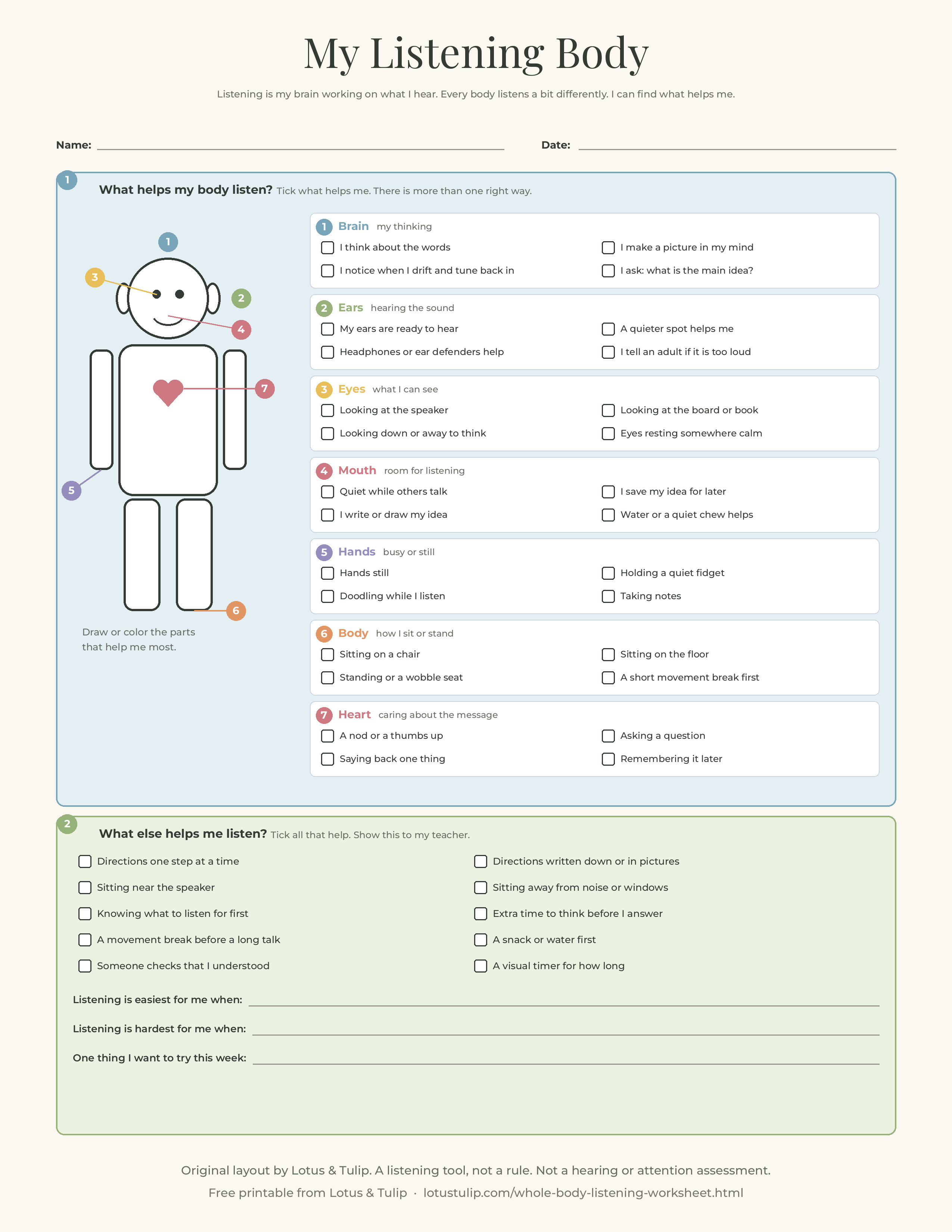
| Brain | Think about what is being said | Same. This is the heart of listening: making a picture in my mind, connecting it to what I know, noticing when I drift and tuning back in. |
| Ears | Both ears ready to hear | Ears ready, and I can tell an adult if it is too loud, too noisy, or if headphones or a quieter seat would help. |
| Eyes | Eyes on the speaker | Eyes on the speaker, the board, the book, or resting somewhere calm. Looking away to think is fine. |
| Mouth | Mouth quiet | Mouth free for listening, so I am not talking over the speaker. I can save my idea, write it down, or use a quiet chew if that helps me. |
| Hands | Hands still in your lap | Hands doing something that helps me focus and does not distract others: still, holding a fidget, doodling, or taking notes. |
| Feet and body | Feet on the floor, sit still, face the speaker | A body position that helps me focus: sitting, standing, a wobble seat, a band on the chair, or a short movement break. |
| Heart | Care about what the other person says | I show I care in my own way: a nod, a question, a comment later, or remembering what they told me. |
The critique, and why a flexible version works better
For years, posters based on whole body listening were often used as a checklist of required behaviors: eyes on the teacher, hands quiet, body still. Autistic adults and neurodiversity advocates pointed out that this measures how listening looks to the adult, not whether the child is actually taking in the message, and that some of these demands make listening harder.
The authors of the best known adaptation agreed. In a 2022 post on Everyday Regulation, the team behind the adaptation wrote that their earlier resources "created standards for listening behaviors" and "a model for compliance", which further marginalized neurodivergent ways of listening such as atypical eye contact, hand flapping and fidgeting. They revised the poster to ask what helps each child's body listen, and in 2023 released a rewritten book, Listen, Learn, and Grow. In a 2024 podcast interview, Sautter described how focusing on looking at the speaker, sitting still and keeping quiet can "really hinder listening" because the child's attention goes into performing compliance.
Research supports the flexible version:
- Eye contact can overload. In a qualitative study of first-hand accounts, Trevisan and colleagues (2017) found that many autistic teens and adults described eye contact as uncomfortable or even painful, with feelings of being invaded and sensory overload. Several described being unable to listen to someone while making eye contact at the same time.
- Looking away helps thinking. Doherty-Sneddon and colleagues (2002) found that 8 year olds looked away from an adult's face more when answering harder questions, as adults do. The authors concluded that children use gaze aversion to manage the effort of thinking, and that well timed looking away is something to encourage rather than discourage.
- Movement can help some children with ADHD. Sarver and colleagues (2015) observed 29 boys aged 8 to 12 with ADHD and 23 typically developing boys during working memory tasks. For the boys with ADHD, more gross motor movement went along with better working memory performance (though not to typical levels); for the typically developing boys, it went along with slightly lower performance. The authors cautioned against "overcorrecting" movement that may be functional.
An honest caveat: we found no controlled trials of whole body listening itself, in either its original or flexible form. It is best seen as a common sense teaching framework, not an evidence based intervention. The research above does not prove that fidgets or looking away help every child; it shows that "still and looking at me" is not a reliable sign of listening and that the right supports differ from child to child.
So the goal shifts from "show me you are listening" to "find out what helps you listen, and use it." That is the version this page and the free printable teach.
How to teach whole body listening, step by step
- Start with hearing vs listening. Hearing is sound reaching your ears; listening is your brain working on it. Truesdale's own comparison works well: a TV that is on but showing a blank screen is hearing; a TV tuned to a channel is listening.
- Put the brain first. Teach that the brain is the main listening part. Practice making a picture in your mind while you listen to a short sentence, then sharing what you pictured.
- Explore each body part with curiosity. Go through ears, eyes, mouth, hands, body and heart one at a time, asking "what helps your listening?" rather than telling children what each part must do.
- Experiment, do not assume. Try the same short listening task in different ways: looking at the speaker vs looking at a picture, hands still vs holding a fidget, sitting vs standing. Afterward, ask which way was easier and check what each child remembered.
- Let each child build a listening plan. Each child picks what helps them on the My Listening Body page. Expect different answers. Some will choose eye contact; others will choose looking at the floor.
- Agree on the one shared limit. The flexible version still has a boundary: my listening choices should not stop other people from listening. A silent fidget is fine; a noisy one may need a swap.
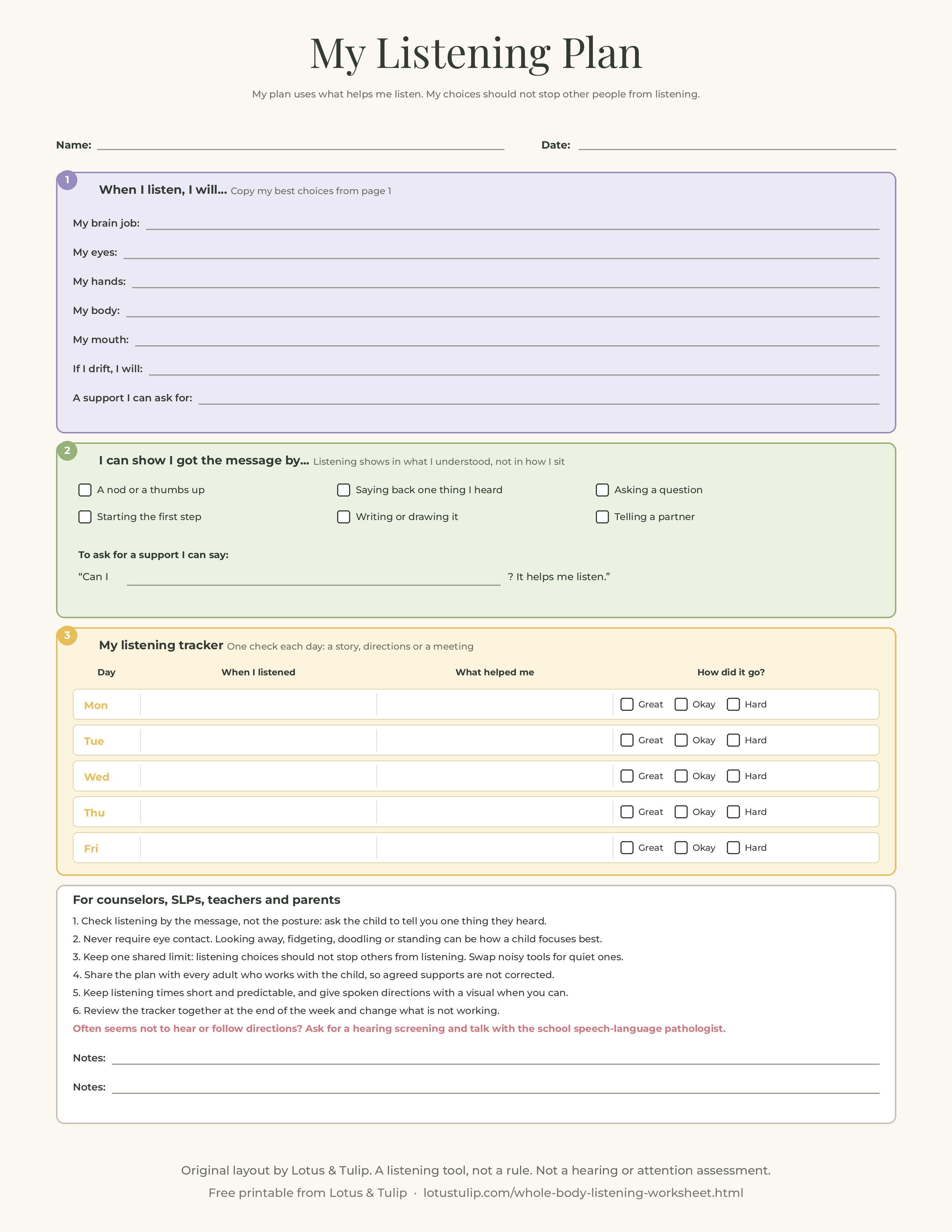
- Teach how to show listening without performing it. Give simple ways to show the speaker you got the message: a nod, a thumbs up, repeating back one thing, or asking a question. These are about the message, not the posture.
- Practice in short, real moments. Use the plan during a read aloud, morning meeting or direction giving for a week. Keep sessions short; asking young children to listen for long stretches is a big demand.
- Review and adjust. Use the 5 day tracker to notice what helped. Change the plan when something is not working, and share the plan with other adults so the child is not corrected for using an agreed strategy.
Whole body listening activities
- Tuned in or blank screen: read a short story; pause and ask "tuned in or blank screen?" Children check their own brain, not each other.
- Listening experiments: give three short spoken directions in three different conditions (looking at you, looking at a picture, holding a fidget) and compare how many each child remembered.
- Picture it: say a silly sentence ("a purple dog riding a bike") and have children draw what they pictured.
- Listen and do: simple two and three step directions ("touch your nose, then stand up") to practice holding information.
- Sound detective: close eyes or look down and count sounds in the room. Good for showing that eyes are not needed to listen.
- Repeat one thing: after a partner shares, each child repeats back one detail. This shows listening through the message.
- My listening tools box: let children test a few quiet options (fidget, doodle pad, wobble cushion, standing spot) and pick one for their plan.
- Listening plan role play: practice asking for a support: "Can I stand at the back during the story? It helps me listen."
- Distraction check: list what pulls attention away (noise, a friend, a hungry tummy) and one fix for each.
- Heart listening: partners share one thing about their weekend; the listener asks one follow up question.
Adapting it by age and need
- Pre-K and kindergarten. Use simple pictures and only two or three body parts at first (brain, ears, hands). Keep listening times short and give movement between them.
- Grades 1 to 3. Use the full My Listening Body page, listening experiments and the 5 day tracker. Practice during real read alouds.
- Grades 4 to 8. Drop the cartoonish feel. Frame it as "how my brain learns best", add note taking and self-advocacy ("Can I have the directions written down?").
- Autistic students. Never require eye contact. Offer looking at a visual, the speaker's shoulder or nowhere in particular. Respect stimming that is not unsafe, and add visual supports for directions.
- Students with ADHD. Build movement in rather than fighting it: standing options, quiet fidgets, short chunks of talk and directions given one at a time with a visual.
- Students with hearing, language or processing needs. Check hearing first, reduce background noise, give extra processing time and pair speech with visuals. A speech-language pathologist or audiologist can help.
Common mistakes
- Using it as a compliance checklist. Pointing at a poster to correct a child's posture teaches them to perform, not to listen.
- Requiring eye contact. Many children listen better when they look away. Check understanding by asking about the message.
- Treating stillness as attention. A still child can be lost; a moving child can be fully tuned in.
- One plan for the whole class. The point is that children find what works for them. Expect different plans.
- Forgetting the environment. Noise, seating, lighting and long talk times affect listening as much as any body part.
- Skipping hearing checks. A child who often "does not listen" may not hear well. Ask for a hearing screening when in doubt.
Free whole body listening worksheet
This free printable is an original Lotus & Tulip layout on US Letter. Page 1, My Listening Body, has a simple body outline with the listening parts (brain, ears, eyes, mouth, hands, body and heart), each with flexible choices a child can circle, plus a "what helps me listen" checklist. Page 2, My Listening Plan, turns those choices into a short plan with ways to show I got the message, a 5 day listening tracker, and a guide for adults.
Download the free whole body listening worksheet (PDF, 2 pages, US Letter)
Prefer single images? Page 1: my listening body (PNG) · Page 2: my listening plan (PNG)
Free to print for use with your own students, clients or children. Please link to this page rather than re-uploading the file. A teaching tool, not a speech, language, hearing or attention assessment.
Related resources
- Conversation skills worksheet (free printable): the five parts of a conversation, follow-up questions and a practice ladder
- Expected vs unexpected behavior worksheet (free printable): teach that the situation decides, not a behavior chart
- Personal space worksheet (free printable): another body based social skill for young kids
- Interoception activities for kids (free printable): noticing body clues that affect focus
- Tattling vs telling worksheet (free printable): when to tell an adult
- Self-monitoring checklist for students (free printable): track a listening goal over time
- Break card printable: a way to ask for a movement break
- Social skills worksheets for kids: conversation, joining in and taking turns
FAQ
What is whole body listening?
Whole body listening is a way of teaching children what listening involves by linking it to parts of the body: thinking with the brain, hearing with the ears, taking in visual information with the eyes, keeping the mouth free for listening, and setting up the hands and body so the brain can focus. It was first described by speech-language pathologist Susanne Poulette Truesdale in 1990.
Who created whole body listening?
Susanne Poulette Truesdale introduced it in a 1990 article in Language, Speech, and Hearing Services in Schools. Elizabeth Sautter and Kristen Wilson later adapted and popularized it in their Whole Body Listening Larry books, and have since revised those materials to be more neurodiversity affirming.
Is whole body listening bad for autistic kids?
The rigid version can be. Requiring eye contact, still hands and a still body can make listening harder for many autistic children and children with ADHD, and teaches them to hide how they focus best. A flexible version that asks each child what helps them listen, and respects looking away, fidgeting and moving, keeps the useful parts without those harms.
Do kids need eye contact to listen?
No. Many children and adults listen and think better when they look away, especially during hard tasks. Check listening by asking about the message, not by watching where a child's eyes are.
What age is whole body listening for?
It was first written for first graders and is most often used from preschool to about grade 3. Older students can use the same ideas framed as "how my brain learns best" and self-advocacy for supports.
Is this whole body listening worksheet free?
Yes. It is free to print for use with your own students, clients or children. Please link to this page rather than re-uploading the file.
Sources
- Doherty-Sneddon, G., Bruce, V., Bonner, L., Longbotham, S., and Doyle, C. (2002). Development of gaze aversion as disengagement from visual information. Developmental Psychology, 38(3), 438 to 445. doi:10.1037/0012-1649.38.3.438
- Everyday Regulation (2022). Whole Body Listening: time for a change. everydayregulation.com
- Greiner Huynh, M., Sautter, E., and Wilson, K. (2023). Listen, Learn, and Grow: A Whole Body Listening Larry Story to Help Kids Regulate, Listen, and Engage. PESI Publishing.
- Sarver, D. E., Rapport, M. D., Kofler, M. J., Raiker, J. S., and Friedman, L. M. (2015). Hyperactivity in attention-deficit/hyperactivity disorder (ADHD): impairing deficit or compensatory behavior? Journal of Abnormal Child Psychology, 43(7), 1219 to 1232. doi:10.1007/s10802-015-0011-1
- Tilt Parenting (2024). Episode 411: Elizabeth Sautter on the evolution of whole body listening. tiltparenting.com
- Trevisan, D. A., Roberts, N., Lin, C., and Birmingham, E. (2017). How do adults and teens with self-declared autism spectrum disorder experience eye contact? A qualitative analysis of first-hand accounts. PLoS ONE, 12(11), e0188446. doi:10.1371/journal.pone.0188446
- Truesdale, S. P. (1990). Whole-body listening: developing active auditory skills. Language, Speech, and Hearing Services in Schools, 21(3), 183 to 184. doi:10.1044/0161-1461.2103.183
- Truesdale Poulette, S. Whole Body Listening with Susanne. wholebodylisteningdotorg.wordpress.com
- Wilson, K., and Sautter, E. (2011). Whole Body Listening Larry at School. Social Thinking Publishing.