
Social skills · Kids, school counselors, SLPs and special education · Updated 2026-11-12
Expected vs unexpected behavior: how to teach it without turning it into a behavior chart (free worksheet)
Social skills group: Social Skills Small Group Curriculum, Grades 2 to 5, 8 sessions with lesson plans and student pages Holiday 20% off: about $11.04, was $14 (EUR 12) · instant digital download
Buy on EtsyAges 5 to 11: Kids Feelings and Social Skills Worksheets, incl. naming feelings, body signals and calming down Holiday 20% off: about $11.04, was $14 (EUR 12) · fillable PDF, instant digital download
Buy on EtsyTry it free first: download a fillable sample (feelings thermometer and calm-down plan, PDF, 240 KB). Type into it on screen, then get the full pack. No email needed.
Visual supports: Visual Schedule and Behavior Supports, 23 pages with token boards, a reward menu, first then boards and 136 picture cards Holiday 20% off: about $6.44, was $8 (EUR 7) · instant digital download
Buy on Etsy"Expected" and "unexpected" are some of the most used words in elementary social skills teaching, and some of the most misused. The idea is simple and genuinely useful: whether an action fits depends on the situation. Shouting is expected at a soccer game and unexpected in a library. The problem starts when the words become a polite replacement for "good" and "bad", and "that's unexpected" turns into a scolding.
This guide is for school counselors, speech-language pathologists, special education teachers, classroom teachers and parents. It covers where the vocabulary comes from, what it is meant to teach, what the research does and does not show, the fair criticism from autistic adults, 9 teaching steps, activities, examples by age and common mistakes. It ends with a free 2 page printable: an It Depends on the Situation sorting worksheet and a Read the Situation Plan with a 5 day tracker.
Download the free expected vs unexpected behavior worksheet (PDF, 2 pages, US Letter)
Direct download, no email or sign up. See the pages first.
Where "expected and unexpected" comes from
The terms come from the Social Thinking Methodology developed by speech-language pathologist Michelle Garcia Winner, where they are part of a larger set of teaching vocabulary. Social Thinking is a registered trademark of its owners; Lotus & Tulip is not affiliated with them, and this page and the free printable are our own original take on the general idea.
Winner has written plainly about how the words are meant to be used. In her article "It's Not About Appropriate vs. Inappropriate!", she explains that many adults have taken the vocabulary and used it "to scold, redirect, or reward a behavior" instead of teaching the reasons behind social expectations. Her key point is that "it's not the behavior that is expected or unexpected, it's the situation that dictates whether it is." She gives the example of a birthday party piñata: in a classroom, teachers and students act differently, but around a piñata both are likely laughing, yelling and swinging a stick.
The same article recommends teaching students to observe three things about a situation: where we are, who the people are, and what is happening. It also advises spending much more time noticing when students figure out what is expected than pointing out what is unexpected.
What expected and unexpected actually mean
- Expected means "what most people in this situation are probably thinking will happen." Expected actions tend to leave others feeling calm or comfortable, because nothing surprised them.
- Unexpected means "something people in this situation were not thinking would happen." It can lead to surprise, confusion, worry or annoyance. It can also lead to laughter and delight: a surprise party is unexpected on purpose.
- Neither word is a judgment of the child. An unexpected action is information about a mismatch between an action and a situation, not proof that a child is rude, bad or "inappropriate".
- Expectations come from hidden rules. Many of them are never said out loud: you do not stand right next to the one other person at an empty bus stop, you lower your voice when someone is crying. Myles, Trautman and Schelvan (2004) called these unstated rules the hidden curriculum, and argued that they need to be taught directly to children who do not pick them up on their own.
| The same action | Usually expected here | Usually unexpected here |
|---|---|---|
| Talking in a loud voice | On the playground, cheering at a game | In the library, during a test |
| Running fast | In a race at recess | In a crowded hallway |
| Asking a question | During a lesson, when you are confused | While a friend is crying about something else |
| Telling a joke | At lunch with friends | During a fire drill |
| Hugging | Your parent at pickup, if you both like hugs | A new kid you just met |
| Saying "I disagree" | In a class debate | About a friend's drawing they are proud of |
What the research shows (and does not)
The best known study is a small one. Crooke, Hendrix and Rachman (2008) taught a Social Thinking based group to six boys with Asperger syndrome or high functioning autism (the terms used at the time) for eight weekly 60 minute sessions. The approach explained the "why" behind social behavior and, unlike many earlier programs, did not use rewards or punishments. The boys showed significant pre to post increases in "expected" verbal behavior, "listening/thinking with eyes" and initiations, and decreases in "unexpected" behaviors overall.
An honest caveat: that study had six participants, no control group and was led by researchers connected to the approach. We found no large controlled trials of teaching the expected and unexpected vocabulary by itself. It is best seen as a clear way to talk about social situations, not a proven stand alone intervention. The study is also a reminder that its "expected" behaviors (like "thinking with eyes") reflect typical social norms, which leads to the criticism below.
The fair criticism, and how to teach it better
Many autistic adults and neurodiversity affirming clinicians have criticized how the vocabulary is used in practice. The main points are worth taking seriously:
- It can become compliance training with nicer words. When "unexpected" is said in a disappointed voice every time a child stims, fidgets or blurts, the child learns that how they naturally are is a problem.
- It can push masking. Hull and colleagues (2017) interviewed 92 autistic adults about camouflaging, the effort of hiding autistic traits to fit in. Many described it as exhausting, and the study linked it to anxiety and to threats to how they saw themselves. A social skills lesson should not teach a child to hide harmless differences.
- Expectations go both ways. Milton (2012) described the "double empathy problem": when autistic and non-autistic people misunderstand each other, the breakdown runs in both directions, not only from the autistic side. Non-autistic peers and adults can also learn to read and accept a child's way of communicating.
Social Thinking's own materials now stress the same direction: the vocabulary is meant to build social understanding and choice, not obedience. So in practice, teach it like this:
- Use the words to explain situations, not to label a child. "Talking loudly is unexpected in the library because people are reading" is teaching. "You're being unexpected" is a scolding.
- Present it as information the child can use to choose, not a rule they must follow. Knowing that most people expect quiet in a library lets a child decide what to do, ask for a break or find a different spot.
- Separate safety and kindness (worth teaching firmly) from harmless differences like stimming, looking away or fidgeting (not worth "fixing").
- Remember that adults are often the unexpected ones: changing plans without warning, talking fast, or using sarcasm. Model noticing and repairing your own mismatches.
How to teach expected vs unexpected behavior, step by step
- Start with surprise, not rules. Ask: "Has anyone ever done something that really surprised you? How did you feel?" This frames unexpected as "not what people thought would happen", including happy surprises.
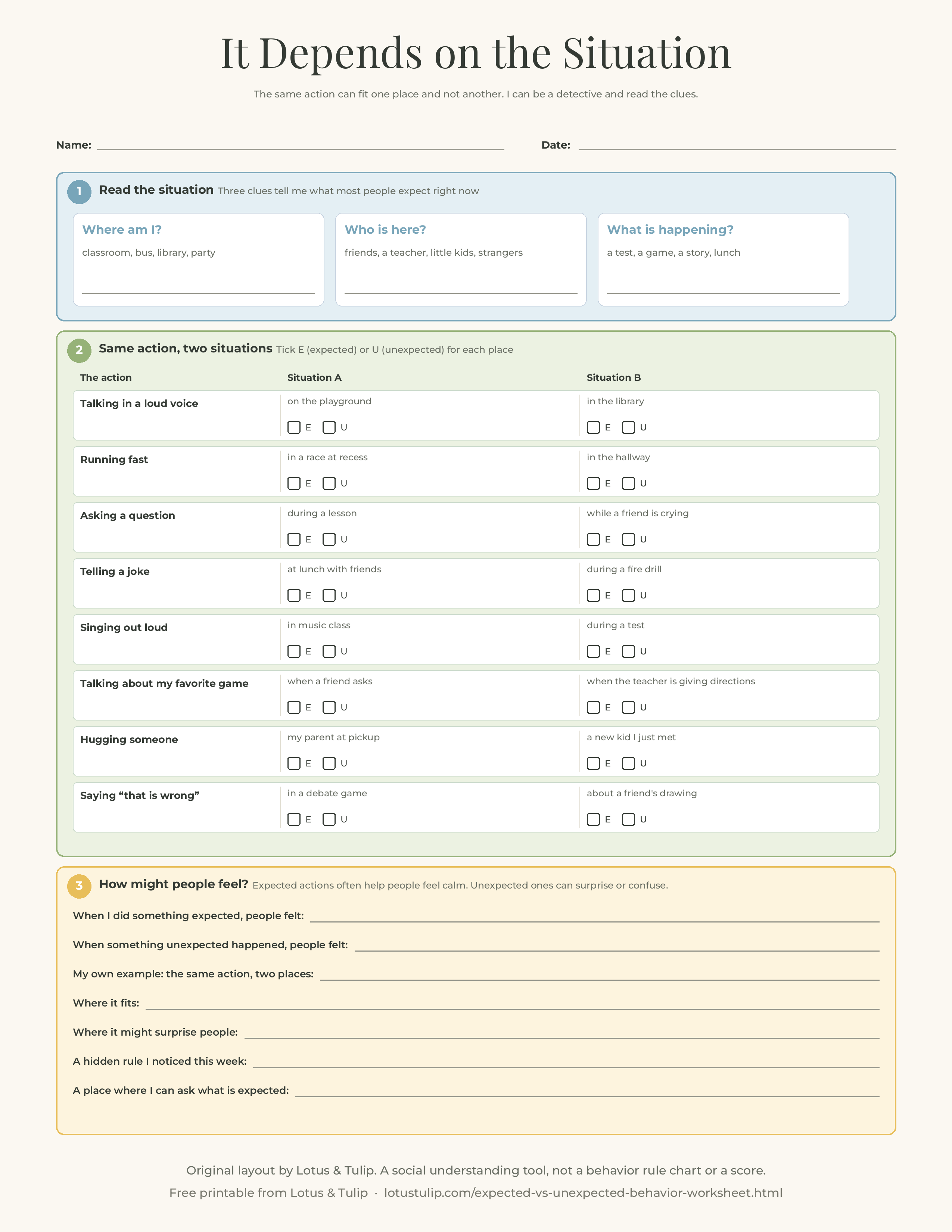
- Teach the three situation clues. Where am I, who is here, and what is happening? Practice naming them for familiar places: the lunchroom, a birthday party, the bus, a doctor's waiting room.
- Show that the same action changes. Pick one action (talking loudly, running, singing) and sort it across two situations. The first page of the free worksheet does exactly this with eight actions.
- Connect actions to feelings. Ask how people in the situation might feel and think. Expected actions usually help people feel calm; unexpected ones might cause surprise, confusion or worry. Keep it about people's reactions, not about being good or bad.
- Find the hidden rules. Ask: "What is something everyone here seems to know, but nobody says?" Write the class's hidden rules for one place together.
- Practice being a detective. Teach ways to figure out what is expected when you are not sure: watch what others are doing, look for a sign or a schedule, wait and listen first, or simply ask, "What do we do here?"
- Notice expected choices far more than unexpected ones. Say it specifically and warmly: "You noticed everyone was whispering in the library and you whispered too." If you must talk about an unexpected moment, do it calmly and later, not in front of peers.
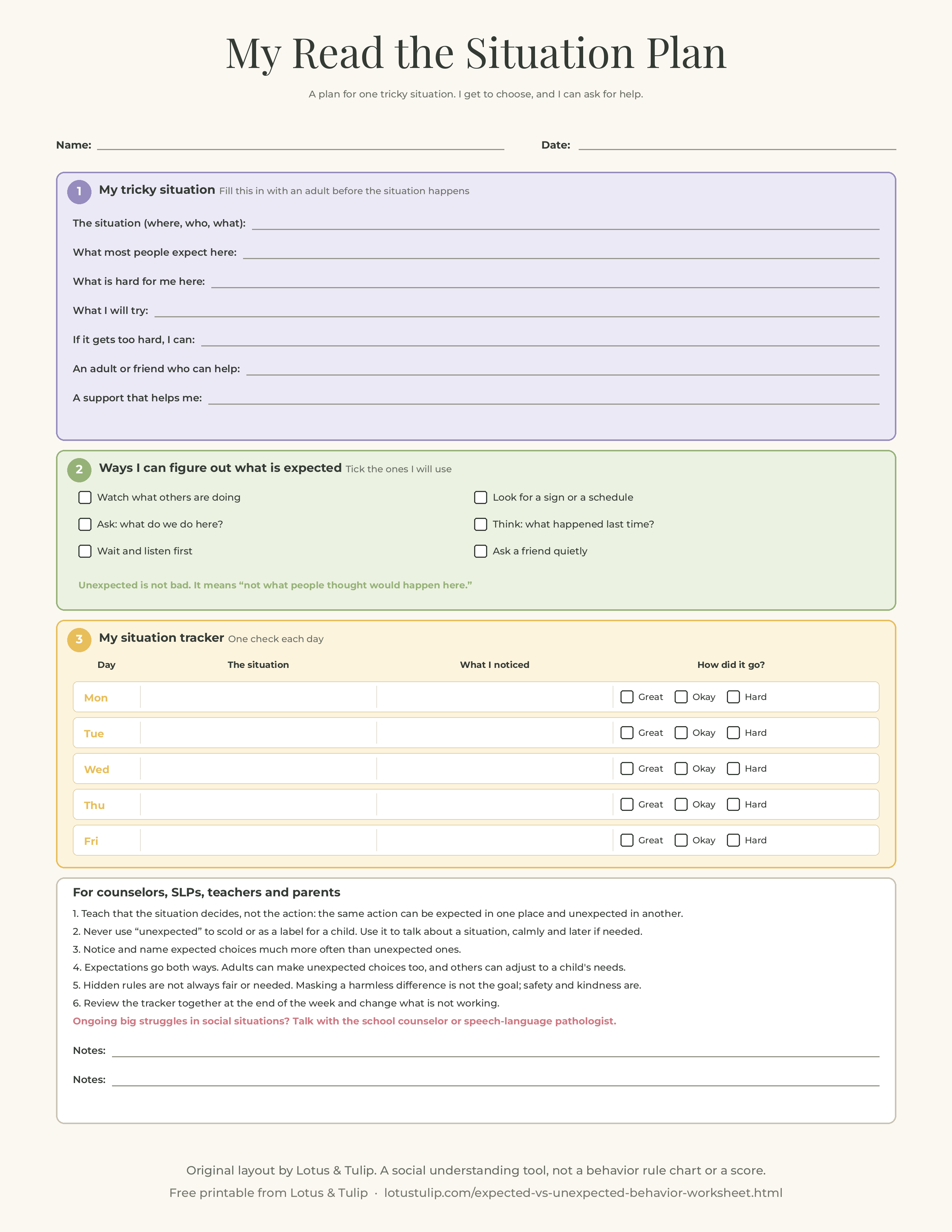
- Plan for one tricky situation. With the child, choose one real situation that is hard for them (an assembly, a group project, a family dinner) and fill in the Read the Situation Plan: what people expect, what is hard, what they will try, and what support helps.
- Track, review and adjust. Use the 5 day tracker for a week. Review it together, celebrate what worked and change the plan, or the situation, if something keeps being hard.
Expected vs unexpected activities
- Two place sort: write one action on a card and two places on the board; students decide where it fits and explain why.
- Situation detective: show a photo of a scene (a library, a beach, a classroom). Students name where, who and what, then predict two expected actions.
- Video pause: pause a short kid friendly clip and ask: "What do the characters expect will happen next? What would surprise them?"
- Hidden rule hunt: each student finds one unwritten rule at school this week and reports back.
- Same words, different place: practice the same sentence ("I don't like that") in a gentle voice and a loud voice, and talk about where each might fit.
- Happy surprises: list unexpected actions that make people smile (a kind note, a surprise party) to show that unexpected is not the same as bad.
- Adult mix up: the adult acts out an unexpected choice (wearing a winter hat in class, reading a book upside down) and students explain why it surprised them. This keeps the spotlight off the children.
- Repair practice: role play what to do after an unexpected moment: notice, say sorry if someone was hurt, and try again.
Examples by age
- Pre-K and kindergarten. Use pictures and only two situations at a time (inside and outside, quiet time and play time). Keep it to voice volume, running and taking turns.
- Grades 1 to 3. Use the full sorting worksheet, the three situation clues and the hidden rule hunt. Tie it to real moments like assemblies, field trips and indoor recess.
- Grades 4 to 8. Drop the cartoon feel. Talk about "reading the room", group chats, team sports and how expectations differ between friends, teachers and family. Include the idea that some hidden rules are unfair and can be questioned respectfully.
- Autistic students. Teach it as useful information about other people, never as a requirement to look or move a certain way. Do not label stimming, looking away or fidgeting as unexpected. Pair it with self-advocacy: how to ask what is expected and how to ask for supports.
- Students with ADHD. Focus on a few high impact situations (lesson time, transitions, group work) with a visual reminder and a planned movement option, rather than correcting every blurt.
Common mistakes
- Using "unexpected" as a reprimand. If the word always comes with a frown, it means "bad" to the child, whatever the lesson said.
- Labeling the child instead of the action. Say "that was unexpected for the library", never "you are unexpected".
- Treating every difference as a problem. Stimming, looking away and fidgeting are usually harmless and often help a child focus.
- Only teaching after something goes wrong. Teach in calm, neutral moments and preview tricky situations ahead of time.
- Forgetting that expectations are social, not universal. Families, cultures and communities differ. What is expected at one child's dinner table may not be at another's.
- Making it a points chart. Turning "expected" into stickers or a clip chart brings back exactly the reward and punishment model the vocabulary was meant to move beyond.
Free expected vs unexpected behavior worksheet
This free printable is an original Lotus & Tulip layout on US Letter. Page 1, It Depends on the Situation, teaches the three situation clues (where, who, what), has eight actions to sort as expected or unexpected in two different situations, and asks how people might feel and for the child's own example and a hidden rule they noticed. Page 2, My Read the Situation Plan, plans for one tricky situation, lists ways to figure out what is expected, adds a 5 day tracker and a guide for adults.
Download the free expected vs unexpected behavior worksheet (PDF, 2 pages, US Letter)
Prefer single images? Page 1: it depends on the situation (PNG) · Page 2: my read the situation plan (PNG)
Free to print for use with your own students, clients or children. Please link to this page rather than re-uploading the file. A social understanding teaching tool, not a behavior rating or an assessment.
Related resources
- Conversation skills worksheet (free printable): the five parts of a conversation, follow-up questions and a practice ladder
- Whole body listening worksheet (free printable): a flexible listening plan, without forced eye contact
- Personal space worksheet (free printable): a hidden rule many kids need taught directly
- Tattling vs telling worksheet (free printable): when to tell an adult
- Social story template (free printable): preview a tricky situation ahead of time
- Size of the problem worksheet: match a reaction to the size of a problem
- Flexible thinking worksheet: cope when plans or expectations change
- Social skills worksheets for kids: conversation, joining in and taking turns
FAQ
What is the difference between expected and unexpected behavior?
An expected behavior is what most people in a situation are thinking will happen, so it tends to leave them feeling calm or comfortable. An unexpected behavior is something people in that situation were not thinking would happen, so it can surprise or confuse them. The same action can be expected in one situation and unexpected in another.
Who came up with expected and unexpected behaviors?
The terms are part of the Social Thinking Methodology developed by speech-language pathologist Michelle Garcia Winner. Social Thinking is a trademark of its owners; this page is not affiliated with them.
Is expected vs unexpected the same as appropriate vs inappropriate?
It is not supposed to be. Winner has written that the vocabulary was designed to teach why social expectations exist in a given situation, not to scold or redirect. When it is used only to correct children, it works the same way as "inappropriate" and loses its point.
Is teaching expected and unexpected behavior harmful for autistic kids?
It can be when it is used to push compliance or to hide harmless autistic traits such as stimming or looking away, which can encourage masking. Taught as useful information about situations, with respect for the child's way of being and with adults adjusting too, it can help a child understand and choose, not just obey.
What age is this worksheet for?
The sorting worksheet works best for about ages 5 to 11, kindergarten through grade 5. Older students can use the plan page and talk about "reading the room" in more grown up situations like group chats and team sports.
Is this expected vs unexpected behavior worksheet free?
Yes. It is free to print for use with your own students, clients or children. Please link to this page rather than re-uploading the file.
Sources
- Crooke, P. J., Hendrix, R. E., and Rachman, J. Y. (2008). Brief report: measuring the effectiveness of teaching social thinking to children with Asperger syndrome (AS) and high functioning autism (HFA). Journal of Autism and Developmental Disorders, 38(3), 581 to 591. doi:10.1007/s10803-007-0466-1
- Hull, L., Petrides, K. V., Allison, C., Smith, P., Baron-Cohen, S., Lai, M.-C., and Mandy, W. (2017). "Putting on my best normal": social camouflaging in adults with autism spectrum conditions. Journal of Autism and Developmental Disorders, 47(8), 2519 to 2534. doi:10.1007/s10803-017-3166-5
- Milton, D. E. M. (2012). On the ontological status of autism: the "double empathy problem". Disability & Society, 27(6), 883 to 887. doi:10.1080/09687599.2012.710008
- Myles, B. S., Trautman, M. L., and Schelvan, R. L. (2004). The Hidden Curriculum: Practical Solutions for Understanding Unstated Rules in Social Situations. Autism Asperger Publishing Company.
- Winner, M. G. It's not about appropriate vs. inappropriate! Teaching expected and unexpected behaviors the right way. socialthinking.com
- Social Thinking. Neurodiversity and the Social Thinking Methodology. socialthinking.com