
Kids and teens · Updated 2026-11-07
Social Skills Activities for Teens (with Free Printable)
Ready-made printable: Social Skills Small Group Curriculum for School Counselors, Grades 2 to 5 Holiday 20% off: about $11.04, was $14 (EUR 12) · instant digital download
Buy on Etsy
Social skills activities for teens are practice tools that help middle and high school students read social cues, start or join conversations without freezing, listen and paraphrase, take another person's perspective, navigate digital norms (group chats, leaving out, screenshot ethics), make assertive asks and refusals, repair after awkward moments, and know when a friendship, conflict, bullying, or social anxiety page is a better fit. Teen social skills work is not a longer version of a kids social skills page. Grades, dating talk, group chats, locker clusters, sports benches, and part-time jobs raise the stakes. So does honesty that quiet teens are not broken, while stuck withdrawal, chronic exclusion, or repeated conflict deserve skill practice and, when severe or lasting, adult backup.
This Lotus and Tulip page is a teen-focused social skills activities guide with an original free three page US Letter printable. It targets searches families and helpers actually use: social skills activities for teens, social skills worksheets for teenagers, teen social skills group activities, social skills counseling activities for teens, and middle school social skills activities. It is distinct from our social skills worksheets for kids (elementary joining, turns, and basic cues), from social skills small group curriculum (session-ready group plan product), from friendship activities for teens (healthy vs unhealthy signals and peer repair as the whole page), from conflict resolution activities for teens (cool body, I-statements, fair compromise), from peer pressure worksheets for teens (values and refusal under pressure), from assertiveness worksheet (ask and refuse as the whole page), from bullying activities for teens (power imbalance, document, report, upstand), from icebreaker activities for counseling groups (warm-up games), from social anxiety worksheets for teens (fear of judgment and gentle facing), from I statements worksheet (speak without blame as the whole page), and from empathy worksheets for kids (younger perspective taking). Those neighbors help. This page centers adolescent social skill practice: reading cues, joining, listening, perspective, digital norms, assertive moves, and repair.
We credit research lineages associated with school social and emotional learning (SEL) and social competence work, ASCA mindsets and behaviors neighbors for school counseling, and the Durlak et al. 2011 school-based SEL meta-analysis as a neighbor. We credit those lineages with clear non-affiliation. We are not affiliated with those authors, CASEL, ASCA, any scale publisher, or any branded social skills curriculum. This printable is an original educational layout, not a copy of any copyrighted worksheet and not a diagnosis or treatment.
This guide is educational. It is not therapy, not medical advice, and not a diagnosis. It is not etiquette policing, not forced extroversion, and not a tool for diagnosing autism or social anxiety. If thoughts of ending your life, plans to harm yourself or someone else, or a medical emergency show up, stop the worksheet and get help now: in the US, call or text 988, text HOME to 741741, or call 911. Our safety plan worksheet is a better first tool in that moment. Nearby tools: social skills for kids, friendship for teens, conflict for teens, peer pressure for teens, assertiveness, bullying for teens, social anxiety for teens, emotion regulation for teens, I statements, and icebreakers.
Jump to the free social skills activities printable (PDF) · How to use social skills activities for teens, step by step · Worked examples · Comparisons
What teen social skills practice is (and is not)
Social skills practice for ages about 12 to 18 means rehearsing the moves that make peer and adult interactions more workable: noticing cues, opening and joining, listening, taking perspective, handling digital scenes, asking and refusing without aggression or freeze, and repairing after a miss. A hard week at lunch is common. Stuck isolation, chronic exclusion, or repeated blow-ups deserve skill practice and, when severe or lasting, adult backup.
Teen social skills practice is not etiquette policing that shames quiet or neurodivergent teens into fake smiling. It is not forced extroversion that treats every introvert as broken. It is not diagnosing autism, social anxiety, ADHD, or any condition from a printable. Prefer neighbors when the scene is mostly friendship health signals (friendship for teens), mostly fair fight repair (conflict for teens), mostly power imbalance and harm (bullying for teens), mostly fear of judgment with avoidance (social anxiety for teens), or mostly body flooding that blocks thinking (emotion regulation for teens).
Teen social skills include:
- Safety sort first when crisis risk, self-harm talk, or acute danger is present.
- Reading cues: face, tone, body, timing, and digital signals (read receipts, silence, group chat vibe).
- Starting and joining with a concrete opener and a backup exit.
- Listening and paraphrase: reflect what you heard before fixing or debating.
- Perspective taking: guess what the other person might feel or need without mind-reading as fact.
- Digital social norms: group chats, leaving people out, screenshot ethics, pile-ons, and when to step offline.
- Assertive ask and refuse with cross-links to assertiveness and peer pressure.
- Repair after awkward moments: short apology, clarify, or clean exit without spiraling.
- Knowing when another page is better: friendship, conflict, bullying, or social anxiety as the whole load.
Reading cues, joining, listening, perspective, and digital norms
Reading cues. Teens often miss or over-read signals under stress. Practice naming what you see and hear (tone, face, posture, reply speed) and separating observation from story ("they hate me"). Body cues matter: racing heart, tight chest, and freeze can block joining. Cool the body first when flooding is loud. Pair with emotional regulation activities for teens.
Starting and joining. Vague plans ("be more social") fail. Written openers with a backup ("I can leave after two minutes") are more doable. Start tiny: one question at lunch, not a perfect friend group overnight.
Listening and paraphrase. Many teens jump to advice or defense. A short reflect ("so you felt left out when the chat went quiet") builds trust before problem solving. Pair with I statements when speaking your side is the next job.
Perspective taking. Guess another view without treating the guess as proven fact. Ask, check, update. Younger empathy pages live at empathy for kids. This teens page keeps perspective practical for peer scenes.
Digital norms. Group chats, leaving someone out of a story, forwarding screenshots, and pile-ons create harm that looks small on a phone and large in a hallway. Practice: ask before sharing private messages, exit pile-ons, and choose in-person repair when the chat is escalating.
How to use social skills activities for teens, step by step
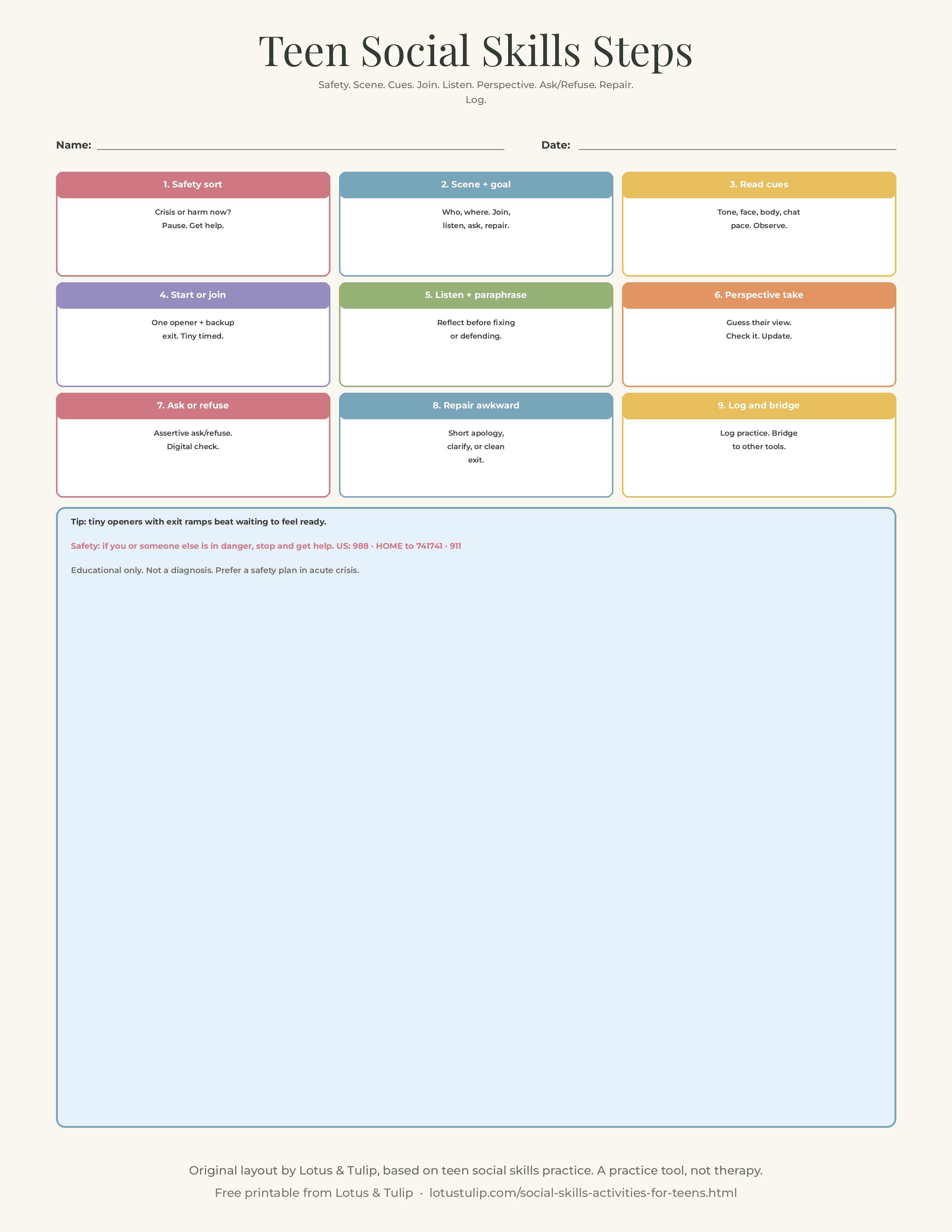
- Safety sort. If acute crisis, self-harm plans, or imminent harm, pause. Use crisis pathways first: 988, HOME to 741741, or 911 when needed. Prefer a safety plan in that moment. Do not force public social skill talk.
- Name the scene and goal. Who, where, in person or digital. Goal: join, listen, ask, refuse, repair, or step back. Keep it specific to one scene, not "fix my whole social life."
- Read cues. What do you see and hear (tone, face, body, chat pace)? Separate observation from the story you invent. Cool body first if flooding blocks thinking. Pair with emotion regulation for teens.
- Start or join. Write one opener and one backup exit. Tiny and timed beats grand and vague. Practice low stakes first when possible.
- Listen and paraphrase. Reflect what you heard before fixing, joking away, or defending. Use I statements when your own side needs clear words.
- Perspective take. Guess what the other person might feel or need. Check it out instead of treating the guess as fact. Bridge to empathy for kids for younger clients.
- Assertive ask or refuse (and digital check). Ask or refuse without aggression or freeze. Cross-link to assertiveness and peer pressure. For chats: no screenshot pile-ons, no leaving people out on purpose, exit when the group turns mean.
- Repair after awkward. Short apology, clarify intent, or clean exit. Do not spiral into over-apologizing or silent revenge. Prefer conflict for teens when a fair fight is the whole load, and friendship for teens when peer health signals are the job.
- Log and bridge. Record practice on the log page. Bridge to safety plan, bullying for teens, social anxiety for teens, icebreakers, or social skills for kids when those scenes fit better.
Practice naming and joining on lower-stakes scenes first when possible, then rely on the full sequence when hallway or chat pressure rises. Skill grows with reps and with adults who coach without shaming quiet teens into fake performance.
Assertive ask and refuse, repair, body cues, and adult tips
Assertive ask and refuse. Aggression pushes people away. Freeze leaves needs unspoken. Assertive scripts name the need, the ask, and the boundary. Full pages live at assertiveness and peer pressure.
Repair after awkward. Everyone misses a cue. Short repair ("sorry, that came out wrong") beats silent spiral. Prefer conflict tools when both sides need a fair plan.
Body cues and nervous system. Social scenes can spike heart rate, tight chest, and freeze. A brief cool-body step unlocks joining. Pair with emotion regulation for teens. Prefer social anxiety for teens when fear of judgment and avoidance are the whole load.
School counselor tips. Short meetings favor: safety sort, scene and goal, one cue read, one opener or repair script, one digital check. Groups can practice optional role-plays with clear exit ramps. Never force public "share your most embarrassing moment." Follow district crisis protocols if risk appears.
Therapist tips. Stay in the client's language. Separate quiet temperament, social anxiety, autism-related social learning needs, bullying power imbalance, and conflict patterns out loud without diagnosing from a printable. Protect before perform. Measure function: more initiated joins, clearer asks, fewer screenshot pile-ons, earlier adult asks when exclusion repeats.
Parent tips. Validate the feeling, coach the skill, do not force every hang or lecture away the awkwardness. Ask the school what supports exist for lunch and clubs. Do not turn the worksheet into a new weapon ("fill this or else"). Watch for bullying and safety risk and escalate early when needed.
Worked fictional examples
Teen example, joining a lunch table (fictional): Jordan, age 14, wants to sit with two classmates but freezes at the tray line. Scene: cafeteria, in person. Goal: join for five minutes. Safety sort: no crisis. Cues: open body language, one empty seat. Opener: "mind if I sit?" Backup: leave after two minutes if it feels wrong. Listen: notice the topic before changing it. Digital check: not needed. Repair plan: short exit line if awkward. Plan on the free social skills plan page.
Teen example, group chat left out (fictional): Avery, age 16, saw a group chat screenshot that excluded them from weekend plans. Scene: digital. Goal: assertive ask for clarity, then decide. Safety sort: no self-harm plan, mood is hurt. Cues: silence in the main chat, private screenshot. Assertive ask: "I saw plans for Saturday. Am I invited, or should I make other plans?" Digital check: do not forward the screenshot further. Bridge to friendship for teens for signal sorting, and to bullying for teens if exclusion repeats with power imbalance.
Teen example, awkward joke that landed wrong (fictional): Sam, age 15, made a joke that hurt a teammate. Scene: locker room. Goal: repair. Safety sort: no crisis. Perspective: teammate looked down and went quiet. Repair: "that joke was not okay. I am sorry." Listen: let them speak without defending. Bridge to conflict for teens if a fair plan is needed next.
School counselor note (fictional): In a twelve minute meeting, a counselor helps a student fill scene and goal, one cue read, one opener or repair script, and one digital check. Optional practice, never forced public sharing. Follow district crisis protocols if risk appears. For multi-session groups, pair with friendship or social skills curricula rather than stacking every worksheet in one period.
Teen social skills vs kids social skills, friendship teens, conflict teens, peer pressure, assertiveness, icebreakers, social anxiety
| Teen social skills (this page) | Kids social skills | Friendship teens | Conflict teens | Peer pressure | Assertiveness | Icebreakers | Social anxiety teens | |
|---|---|---|---|---|---|---|---|---|
| Main job | Cues, join, listen, perspective, digital norms, ask/refuse, repair, log | Elementary joining, turns, basic cues | Healthy vs unhealthy signals, peer repair | Cool body, I-statements, fair compromise | Values and refusal under pressure | Ask and refuse as whole page | Warm-up games | Fear of judgment, gentle facing |
| Best early use | When teens need practice joining and digital norms with adult support | When younger kids need basics | When friendship health is the load | When a fair fight is the load | When pressure to go along is the load | When ask/refuse is the whole focus | When a group needs a warm start | When fear and avoidance dominate |
| Output | Scene, goal, cues, opener, listen note, perspective, ask/refuse, repair, log | Kids social plan | Friendship plan | Conflict plan | Pressure plan | Assertive script | Icebreaker set | Anxiety facing plan |
| Cross link | This page | Kids social skills | Friendship teens | Conflict teens | Peer pressure | Assertiveness | Icebreakers | Social anxiety teens |
These tools cooperate. Teen social skills builds the cues-join-listen-repair loop. Kids social skills covers elementary basics. Friendship teens sorts peer health. Conflict teens runs fair fights. Peer pressure and assertiveness sharpen refusal and asks. Icebreakers warm a group. Social anxiety teens faces fear of judgment. Teach one tool clearly before stacking four on day one.
What helps vs common myths
What often helps: naming one scene and goal, reading cues without inventing stories, tiny openers with exit ramps, paraphrase before advice, perspective checks, digital ethics, assertive scripts, short repairs, optional counseling, peer practice that does not force performance, and skill printables used as practice aids.
Myths to drop:
- "Quiet teens are broken." Temperament varies. Skill practice helps joining when the teen wants it. Forced extroversion often backfires.
- "Just be yourself and friends appear." Some teens need rehearsed openers and repair lines. Practice is not fake; it is preparation.
- "If they ignore a group chat, it will blow over." Mild awkwardness sometimes passes. Repeated exclusion or pile-ons usually grow.
- "Screenshot everything for proof and share it." Documentation for adults can help in bullying. Public pile-ons usually worsen harm.
- "Social skills pages diagnose autism or social anxiety." They do not. Prefer clinical care when assessment is needed.
- "Only therapy or only worksheets work." Care is individual. This page is a practice aid, not a treatment plan.
Common mistakes
- Forcing public performance so quiet teens shut down.
- Setting huge goals (perfect friend group by Friday) that collapse by day two.
- Treating every awkward moment as bullying or every conflict as drama without sorting power imbalance.
- Ignoring safety risk while only talking joining skills.
- Using social anxiety exposure as the first response when the load is missing scripts, not fear of judgment.
- Using friendship or conflict pages as the only tool when the teen needs basic joining and digital norms first.
- Using it in acute crisis instead of safety first.
- Treating the worksheet as therapy. Paper supports practice. It does not replace a clinician, school policy, or crisis care when problems are severe or lasting.
When not to use this worksheet
Good early uses: a teen who can name a scene and a goal, mild to moderate joining or digital friction with adult support available, homework between counseling sessions, school counseling check-ins, and building a cues-join-listen-repair sequence.
Prefer another tool first when:
- Acute safety risk or medical emergency: stabilize and get help (988, HOME to 741741, 911). Prefer a safety plan.
- When bullying power imbalance is the whole load: prefer bullying activities for teens.
- When social anxiety exposure is the deep dive: prefer social anxiety worksheets for teens.
- When friendship health signals are the whole load: prefer friendship activities for teens.
- When a fair fight is the whole load: prefer conflict resolution activities for teens.
- When the teen is too flooded to engage: co-regulate first, then return to plan work. See emotion regulation for teens.
- When younger kids need elementary basics: prefer social skills worksheets for kids.
What the research says (honestly)
Social skills activities and worksheets are a skill practice aid, not a standalone RCT treatment. Do not claim this free printable remits autism, social anxiety disorder, conduct problems, or any diagnosis.
School SEL and social competence. School-based social and emotional learning programs and social competence work commonly aim to build skills such as relationship skills, responsible decision making, and self-management. Credit with clear non-affiliation to CASEL-style frameworks and related school SEL traditions. This is a map for helpers, not proof that this three page sheet remits clinical conditions.
ASCA mindsets and behaviors neighbors. School counseling frameworks associated with ASCA mindsets and behaviors often list interpersonal and communication skills as support targets. Credit with clear non-affiliation. Not a claim that this printable is an ASCA product or a required school protocol.
Durlak et al. 2011 SEL meta-analysis (neighbor). The Durlak et al. 2011 school-based SEL meta-analysis is often cited as finding that well-implemented SEL programs can improve social and emotional skills and related outcomes compared with control conditions, with important caveats about study quality, heterogeneity, and implementation. Credit with clear non-affiliation. This is not a claim that this printable alone produces those outcomes. No study tests this three page Lotus and Tulip printable alone.
Honest limits. These reviews are not technique-only RCTs of this printable. Adult support, school climate, bullying response, medical evaluation when indicated, and clinical care matter. Skill practice aids are neighbors to research, not replacements for it.
Free social skills activities printable for teens (PDF)
The free social skills activities printable has three pages in US Letter size:
- Page 1: Teen Social Skills Steps card. Sequence matching the HowTo: safety sort, name scene and goal, read cues, start or join, listen and paraphrase, perspective take, assertive ask or refuse (digital check), repair after awkward, log and bridge, plus safety reminders.
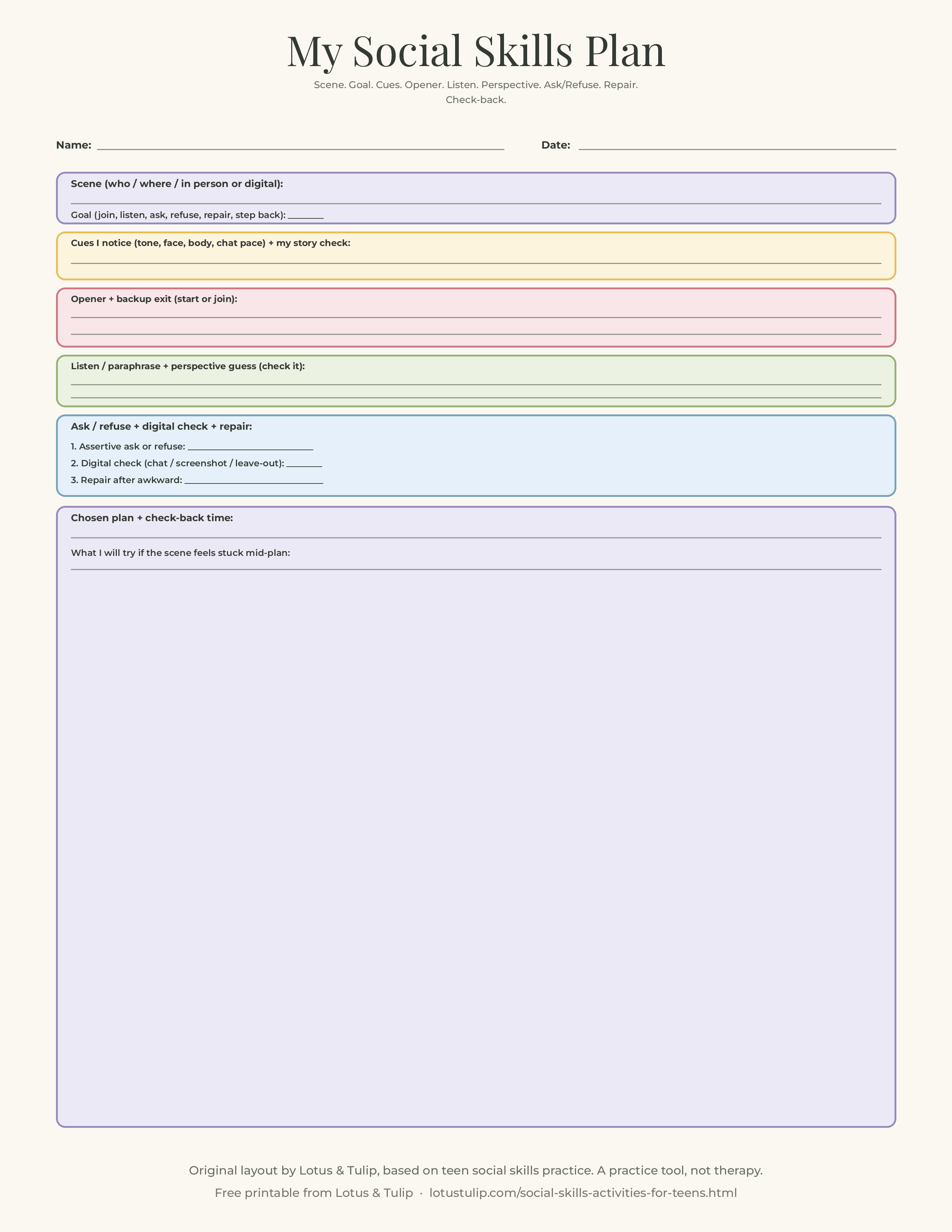
- Page 2: My Social Skills Plan. Fill in scene, goal, cues, opener, listen note, perspective, ask or refuse, digital check, repair, and check-back.
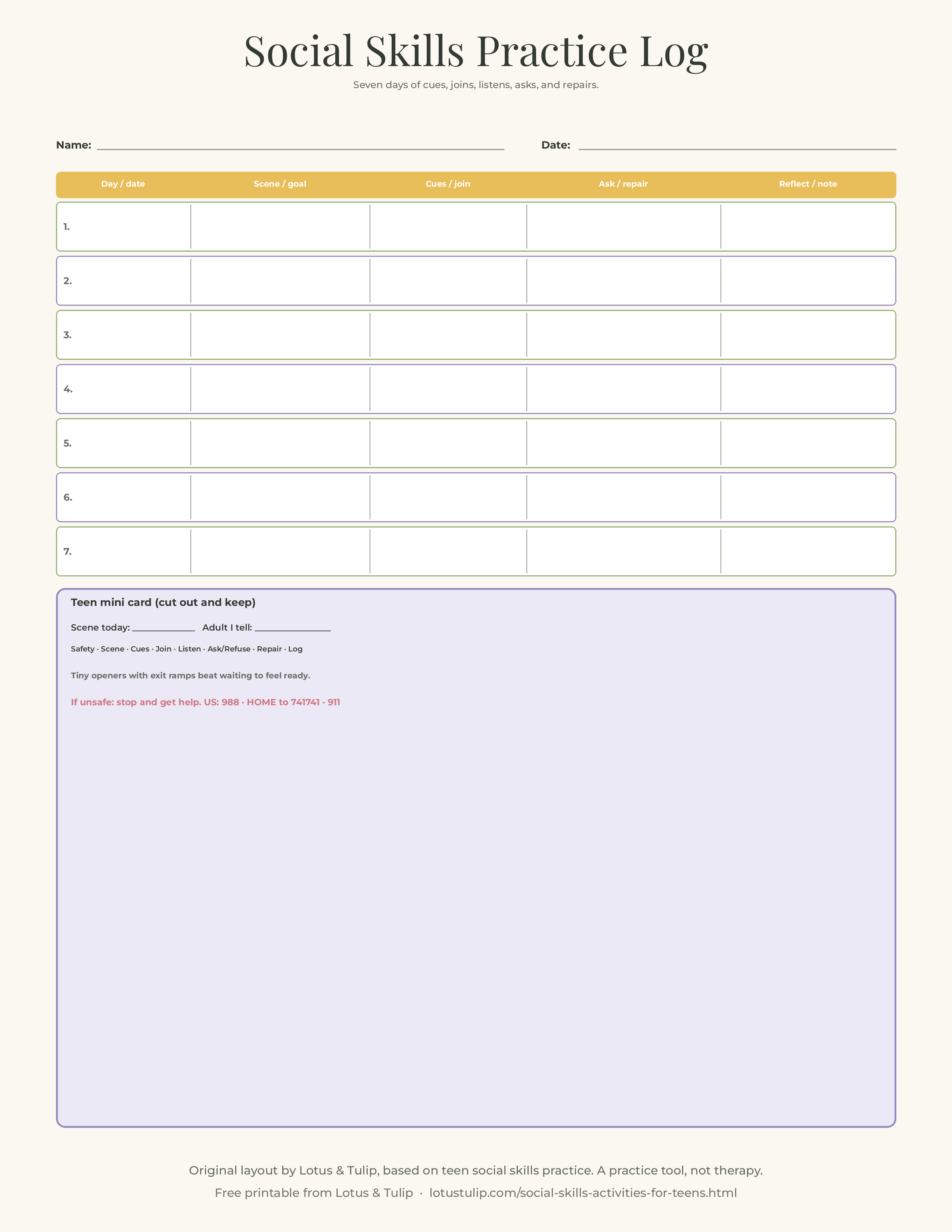
- Page 3: Practice Log + teen mini card. Seven day rows plus a cut out reminder for safety, scene, cues, join, listen, ask/refuse, repair, log.
Download the free social skills activities printable for teens (PDF, 3 pages, US Letter)
Prefer single images? Page 1: Teen Social Skills Steps (PNG) · Page 2: My Social Skills Plan (PNG) · Page 3: Practice Log (PNG)
Free to print for your own use and for use with your own clients, students, or groups. This is an original layout by Lotus & Tulip, based on teen social skills practice associated with school SEL / social competence / ASCA mindsets neighbors and the Durlak et al. 2011 SEL meta-analysis as a neighbor, with clear non-affiliation. It is not affiliated with those authors, CASEL, ASCA, any scale publisher, or any specific treatment or curriculum package, and is not a substitute for therapy. Please link to this page rather than re-uploading the file.
Related resources
- Social skills worksheets for kids: elementary joining, turns, basic cues.
- Social skills small group curriculum: session-ready group plan product.
- Friendship activities for teens: healthy vs unhealthy signals and peer repair.
- Conflict resolution activities for teens: cool body, I-statements, fair compromise.
- Peer pressure worksheets for teens: values and refusal under pressure.
- Assertiveness worksheet: ask and refuse as the whole page.
- Bullying activities for teens: power imbalance, document, report, upstand.
- Social anxiety worksheets for teens: fear of judgment and gentle facing.
- Emotional regulation activities for teens: cool body then choose.
- I statements worksheet: speak without blame.
- Icebreaker activities for counseling groups: warm-up games.
- Empathy worksheets for kids: younger perspective taking.
- Safety plan worksheet: when the moment is about staying safe and alive.
Sources
- School social and emotional learning (SEL) and social competence traditions. Educational credit with clear non-affiliation. Not a claim that this printable remits clinical conditions or diagnoses anything.
- ASCA mindsets and behaviors neighbors for school counseling interpersonal skills. Educational credit with clear non-affiliation. Not an ASCA product.
- Durlak et al. 2011 school-based SEL meta-analysis as a neighbor. Educational credit with clear non-affiliation. Not a claim that this printable alone produces meta-analysis outcomes.
- Honest caveat: teen social skills drills are a skill practice aid. Reviews are not the same as RCTs of this Lotus and Tulip printable. Adult support and clinical care when indicated matter.
Social skills activities for teens: FAQ
What are social skills activities for teens?
They are practice tools for reading cues, starting or joining conversations, listening and paraphrasing, taking perspective, handling digital norms, making assertive asks and refusals, repairing after awkward moments, and logging what helps. They are educational skill aids, not therapy.
Is this the same as social skills worksheets for kids?
No. The kids page covers elementary joining, turns, and basic cues. This teens page centers adolescent scenes: group chats, hallway clusters, assertive ask and refuse, digital ethics, and repair after awkward moments.
How is this different from friendship, conflict, or social anxiety pages for teens?
Friendship pages sort healthy vs unhealthy peer signals. Conflict pages run fair fights. Social anxiety pages focus on fear of judgment and gentle facing. This page centers the social skill loop: cues, join, listen, perspective, digital norms, ask/refuse, repair, log.
Can school counselors use it with teens?
Yes, often in short meetings with safety sort, scene and goal, one cue read, one opener or repair script, and one digital check. Keep practice optional and school safe. Follow crisis protocols when risk appears. Do not use the page as a diagnosis.
Does this diagnose autism or social anxiety?
No. This printable is a skill practice aid. Assessment belongs with qualified clinicians. Prefer social anxiety pages when fear and avoidance are the whole load, and clinical care when evaluation is needed.
When should I not use this worksheet?
Do not use it as the first move in acute safety risk, medical emergency, bullying power imbalance as the whole load, or when the teen is too flooded to engage. Stabilize and get help when needed: 988, HOME to 741741, or 911. Prefer a safety plan in crisis.
Is this affiliated with CASEL, ASCA, Durlak et al., or any SEL curriculum?
No. This is an original Lotus and Tulip educational layout. We credit research lineages with clear non-affiliation and do not reproduce copyrighted curriculum worksheets.