
Counselors and therapists · Updated 2026-11-07
Counseling Games for Kids: 12 Therapeutic Games (with Free Printable)
Ready-made printable: Play Therapy Games and Activities Holiday 20% off: about $7.36, was $9 (EUR 8) · instant digital download
Buy on Etsy
Counseling games for kids are ordinary games, or simple homemade ones, that a school counselor, therapist or social worker uses on purpose: to build trust, to make talking about feelings easier, to practice coping and social skills, and to give a child a safe place to lose, wait, take turns and try again. A block tower, a deck of cards, a pair of dice or a four in a row grid can do real work in a session when you add prompts, agreements and a short debrief. This guide gives you twelve therapeutic games you can run with what is already on your shelf, a way to pick the right game for the goal, three levels of prompt depth, a six session game based group, adaptations by age and need, worked fictional examples, honest research and a free three page printable.
It is written for elementary and middle school counselors, child and adolescent therapists, school psychologists and social workers, and for parents who want a calmer way to talk with a child at home. Most of the games work from about age 5 to about 14, and every game includes notes on how to adjust it for teens, small groups, telehealth and children who find talking hard.
This page is distinct from our icebreaker activities for counseling groups (first session openers only), social skills worksheets for kids, coping skills list for kids, feelings wheel printable and kindness activities for kids. Those pages teach one skill or tool. This one is about the game itself as a counseling method: how to turn play into conversation and practice without losing the fun.
We credit the sources this approach leans on, without claiming any affiliation or endorsement: Swank (2008) on using and modifying games in therapy; Schaefer and Reid on game play in child therapy; Schaefer and Drewes on the therapeutic powers of play; the Association for Play Therapy definition of play therapy; the American Academy of Pediatrics clinical report on the power of play (Yogman and colleagues, 2018); and the play therapy outcome reviews by Bratton and colleagues (2005) and Ray and colleagues (2015). The printable is an original Lotus and Tulip layout, not a copy of any of their materials.
This guide is educational. It is not therapy, not a diagnosis and not play therapy training. Games are a way to open conversation and practice skills; they are not a treatment for any disorder on their own. If a child shares abuse, thoughts of self harm, a plan to hurt someone or any immediate danger during a game, stop the game and follow your safety and reporting protocol. In a crisis in the US, call or text 988 (Suicide and Crisis Lifeline), text HOME to 741741 (Crisis Text Line), or call 911 for immediate danger.
What counseling games are (and what they are not)
A counseling game is any game with three extra layers added: a goal (what you want the child to practice or share), a talk rule (when and how prompts come up, such as "answer a prompt when you pull a numbered block"), and a debrief (what the child noticed and will try). Without those layers you are just playing, which can still build rapport. With them, the game becomes a structured, low pressure way to work on something.
Swank (2008), writing in the International Journal of Play Therapy, describes how games fit into social learning, cognitive behavioral, psychoanalytic and gestalt approaches, and how counselors can modify existing games or build their own for individual, family and group sessions. Drawing on Schaefer and Reid, she notes that game play has a few basic features: a goal, competition, interaction with others, rules, and thinking demands that ask more of a child than free play does. Each of those features is useful in counseling. Rules give practice following limits. Competition gives practice with winning and losing well. Interaction gives practice with turn taking, waiting and repair.
What counseling games are not.
- Not the same as play therapy. The Association for Play Therapy defines play therapy as "the systematic use of a theoretical model to establish an interpersonal process wherein trained play therapists use the therapeutic powers of play to help clients prevent or resolve psychosocial difficulties and achieve optimal growth and development." APT states that play therapy should be provided by licensed mental health professionals with specialized play therapy training and supervision. A school counselor using a prompt game is using a counseling technique, not delivering play therapy, and should describe it that way.
- Not a trick to make children talk. The game lowers pressure; it does not remove a child's right to stay quiet. Every prompt can be passed.
- Not a reward for good behavior or filler time. A game with no goal and no debrief can be fun, but it is not counseling.
- Not a replacement for evaluation or treatment. Persistent anxiety, depression, trauma symptoms or behavior problems need assessment and care from a qualified professional.
Why games work in counseling
Talking side by side is easier than talking face to face. Many children, and most guarded preteens, freeze when an adult asks "How are you feeling?" across a desk. A game gives everyone something to look at and do with their hands. The question arrives as part of the game ("You pulled a 14, read the card"), so it feels less like being put on the spot.
Games carry built in skills practice. Waiting for a turn, following rules, handling a tower that falls, losing a round, winning without gloating, asking for help and changing a plan are all social and emotional skills. In a game they happen naturally, in small doses, with a supportive adult right there to coach.
Play is developmentally right for children. The American Academy of Pediatrics clinical report "The Power of Play" (Yogman and colleagues, 2018, Pediatrics) describes play with caregivers and peers as a singular opportunity to build social emotional, cognitive, language and self regulation skills, and notes that the shared joy and attunement of play helps regulate the body's stress response. The report is about young children's development broadly, not about counseling games specifically, but it explains why play is a natural language for children.
Games have many therapeutic ingredients. Schaefer and Drewes, in The Therapeutic Powers of Play: 20 Core Agents of Change, group the change agents of play under facilitating communication, fostering emotional wellness, enhancing social relationships and increasing personal strengths. A good counseling game usually touches several of these at once: self expression, relationship building, problem solving and confidence.
Three levels of prompt depth
The single most useful idea in game based counseling is that not every prompt should be deep. If the first card a child reads is "What is the worst thing that ever happened to you?", the game stops being safe. Sort your prompts into three levels and move between them on purpose:
- Light (warm up and rapport). Favorites, would you rather, silly questions. "What is the best snack?", "Would you rather fly or be invisible?" These build trust and let the child learn that answering is easy and safe.
- Medium (feelings and coping). Everyday feelings and strategies. "When did you feel proud this week?", "What helps you calm down?", "Who do you talk to when you are worried?" Most of a session lives here.
- Deep (only with trust and time). Worries, losses, family, identity. "What do you wish adults knew about you?", "What is a worry you carry around?" Use these only when the relationship can hold them and there is time left to come back to light before the session ends.
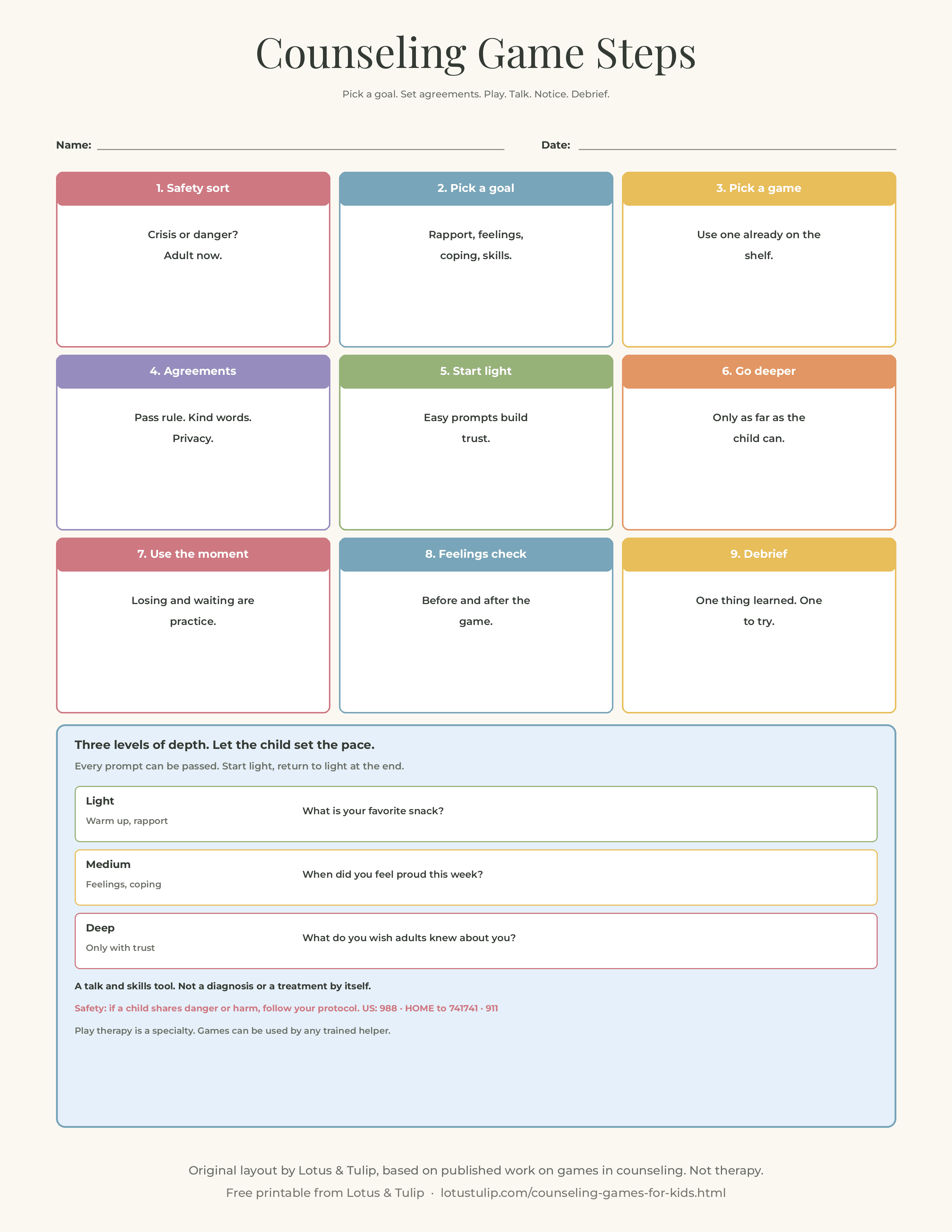
A simple rule: start light, spend most of the time in medium, visit deep only if the child leads you there, and always end light. Our free printable puts these three levels on page one so you can show the child how the game works.
Game agreements before you start
Read or create agreements together in the first minute. Agreements make the game feel safe and give you language to use if something goes wrong. Keep them short:
- Anyone can pass. Say "pass" or "ask me later". Passing is not losing points.
- We cheer, we do not tease. Mistakes and falling towers are part of the game.
- What we share stays here, unless someone is not safe. Explain the limits of confidentiality in words that fit the child's age and your setting's rules.
- The adult can pause the game. If feelings get big, we take a break and come back.
- One agreement the child adds. This gives the child real ownership.
12 counseling games for kids you can run tomorrow
Each game lists time, group size, materials and a debrief. They use generic games most offices already have (a tumbling block tower, a color matching card game, a four in a row grid, dice, any board game) plus a few that need only paper. We use generic names here; use whatever version you own.
1. Tumbling tower talk
Time: 15 to 25 minutes. Group: 1 to 4 players. Materials: a stacking block tower game; numbers 1 to 54 written on the blocks in pencil or on small stickers; a numbered prompt list.
Play as usual. When a player pulls a block, they read the number and answer that prompt from your list (or pass). Put light prompts on most numbers, medium on some and deep on only a few. When the tower falls, model a calm response out loud: "Oh no! Okay, deep breath. We get to build it again." That moment is often the most therapeutic part of the game.
Debrief: "What did you do in your body when the tower started to wobble? What did you say to yourself when it fell?"
2. Color card talk
Time: 15 to 20 minutes. Group: 2 to 6. Materials: any card game with four colors and numbers; a color key.
Assign a theme to each color, for example red for things that make me angry or frustrated, blue for sad or worried things, green for calm and coping, yellow for happy and proud. Every time a player plays a card, they answer a prompt from that color, or just name a time they felt that way. Action cards (skip, reverse, draw) can have their own prompts, such as "Skip: name something you would like to skip this week."
Debrief: "Which color was easiest to talk about? Which was hardest? Why do you think?"
3. Four in a row talk grid
Time: 15 minutes. Group: 2 (or two teams). Materials: a four in a row game and a paper strip with a theme above each column.
Tape a theme above each of the seven columns: school, friends, family, feelings, worries, coping, fun. When a player drops a disc into a column, they answer a question on that theme. The child chooses the column, so they control what they talk about, and you learn a lot from the columns they avoid.
Debrief: "I noticed you kept choosing fun and friends. Is there a column you might try next time?"
4. Roll and talk
Time: 10 to 20 minutes. Group: 1 to 8. Materials: two dice and a 6 by 6 grid of topics (36 squares).
Roll two dice; the first die picks the row and the second picks the column. Read the topic and answer it. Grids can be general (feelings, school, home) or focused on one target, such as worry, anger or friendship. A teen grid can include topics like group chats, pressure, sleep and future plans.
Debrief: "If you could add one square to this grid, what would it be?"
5. Any board game plus talk cards
Time: 20 to 30 minutes. Group: 2 to 4. Materials: any simple board game and a stack of prompt cards (feelings, coping, would you rather).
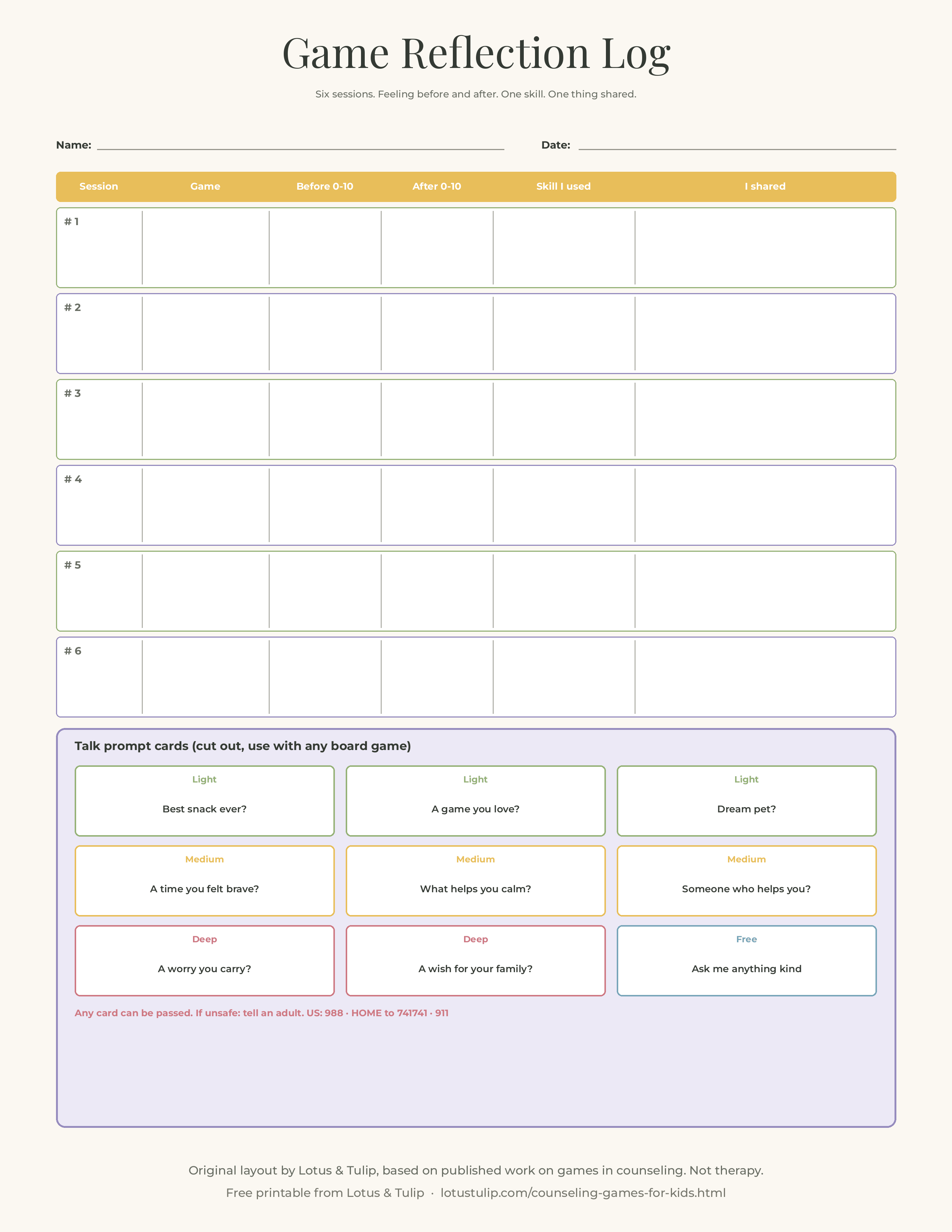
Add one rule to the game: when you land on a certain color, a special space or roll a double, draw a card. This works with almost any race game and is ideal when a child already loves a particular game. Our free printable includes nine cut out talk cards across the three depth levels to get you started.
Debrief: "Which card would you want to answer again next week?"
6. Feelings charades
Time: 10 to 15 minutes. Group: 2 to 10. Materials: feelings word cards (or a feelings wheel).
A player draws a feeling and acts it out with face and body only. Others guess. After each guess, ask: "Where do you feel that in your body?" and "When might someone feel this way at school?" This builds emotional vocabulary and helps children read other people's cues, which is useful for social skills work.
Debrief: "Which feelings were easy to guess and which looked alike? What can we do when we are not sure how someone feels?" (Answer: ask.)
7. Coping skills bingo
Time: 15 to 20 minutes. Group: 3 to 12. Materials: bingo cards with a coping skill in each square, and calling cards.
Call a coping skill. Before anyone marks it, the whole group tries it for a few seconds: five slow breaths, squeeze and release fists, name five things you see. The first player with a line reads their skills out loud and picks one they will use this week. Children leave having practiced a dozen skills, not just heard about them.
Debrief: "Which skill felt best in your body? When could you use it?" Write the answer on a coping skills list or toolbox page.
8. Would you rather warm up
Time: 5 to 10 minutes. Group: any size. Materials: none, or a short list.
Light questions ("Would you rather live in a treehouse or a castle?") are perfect for the first minutes of a session or a new group. Players move to one side of the room, hold up a card or just answer. To deepen gently, finish with one medium question: "Would you rather talk about a problem right away or think about it first?"
Debrief: "Did anyone choose something different from you? How did that feel?" This normalizes differences without pressure.
9. Toss and talk
Time: 10 minutes. Group: 3 to 12. Materials: a soft ball or beach ball with numbers or prompts written on it.
Toss the ball around the circle. Whoever catches it answers the prompt under their right thumb, or passes and tosses again. Movement helps restless children and lets quiet ones answer quickly while attention moves on. It is a good energy reset in the middle of a group.
Debrief: "What did you learn about someone today that you did not know before?"
10. Losing well practice round
Time: 10 to 15 minutes. Group: 2 to 4. Materials: any quick game the child can lose (a short card game or a single round of four in a row).
Before playing, plan for losing: "What will your body feel like if you lose? What will you say? What can you do?" Agree on a calm plan, such as one big breath, saying "good game" and choosing whether to play again. Then play several fast rounds. Praise the plan, not the winning: "You lost and you still said good game. That was hard and you did it." Swank (2008) and others describe competition as one of the useful features of games in therapy precisely because it gives practice with frustration in small, safe doses.
Debrief: "Rate how hard losing felt, 0 to 10. Did your plan help? What would you change?"
11. Feelings check before and after
Time: 2 minutes at the start and end. Group: any. Materials: a 0 to 10 scale or a feelings thermometer.
Not a game by itself, but it turns any game into data. At the start, the child marks how they feel and how big the feeling is. At the end, they mark again. Over several sessions the Game Reflection Log on page three of our printable shows whether play helps the child settle, and gives you something simple to share with a parent or teacher.
Debrief: "Your number went from 7 to 4. What do you think helped?"
12. Make your own game
Time: 20 to 40 minutes, can span two sessions. Group: 1 to 6. Materials: paper, markers, a die, tokens.
Swank (2008) describes how counselors and clients can modify existing games and create new ones. Invite the child or group to design a game about something they are working on: a board path from "worried" to "calm" with coping squares, a card game about friendship problems, a dice game of brave steps. The child decides how you win (or whether everyone wins together), what happens on special spaces and which prompts go in. Designing the game is itself the intervention: it needs planning, flexible thinking, cooperation and talking about the topic.
Debrief: "What would a younger kid learn from your game? Who would you like to play it with?"
How to choose the right game for the goal
| Goal | Good first games | Why it fits |
|---|---|---|
| Rapport with a new or guarded child | Would you rather, tumbling tower with light prompts, any board game | Low pressure, mostly light prompts, child can pass |
| Feelings vocabulary | Feelings charades, color card talk | Links feeling words to faces, bodies and situations |
| Coping skills practice | Coping skills bingo, roll and talk coping grid | Children try skills, not just name them |
| Frustration tolerance and sportsmanship | Losing well practice round, tumbling tower | Planned, small doses of losing with coaching |
| Turn taking and impulse control | Four in a row, tumbling tower, toss and talk | Waiting is built in; slow careful moves are rewarded |
| Group cohesion | Toss and talk, would you rather, make your own game | Everyone participates; cooperation can replace competition |
| Assessment of themes | Four in a row talk grid, roll and talk | Child's choices and avoidances show what matters |
A six session game based small group
This outline works for 3 to 6 students in grades 2 to 6, about 30 minutes per session. It is a light structure, not a scripted curriculum. Keep the same opening and closing every week so the group feels predictable.
| Session | Focus | Main game | Take away |
|---|---|---|---|
| 1 | Getting to know each other, agreements | Would you rather, then tumbling tower with light prompts | Group agreements signed |
| 2 | Feelings words | Feelings charades, color card talk | Three new feeling words |
| 3 | Calm tools | Coping skills bingo | One calm tool chosen |
| 4 | Losing and frustration | Losing well practice round | My losing plan |
| 5 | Friends and teamwork | Four in a row talk grid in teams, toss and talk | One kind thing to do this week |
| 6 | Celebrate and plan | Make your own game, play it together | Reflection log and certificate |
Open each session with the feelings check, read the agreements, play, and close with one sentence each: "Today I learned..." Use the Game Reflection Log to track each student across the six weeks. If you want fully scripted groups on a topic, see our social skills small group curriculum (now about $11.04 on Etsy, was $14), which has eight one page lesson plans and student pages for grades 2 to 5 and pairs well with games in every session.
Adaptations by age and need
- Kindergarten to grade 2. Keep games short (10 minutes), use pictures instead of written prompts, and prefer cooperative games where everyone wins. Read prompts aloud. Feelings charades and coping bingo with picture cards work well. For a full early grades group, see the K-2 Feelings Garden coping skills group (now about $11.04 on Etsy, was $14).
- Grades 3 to 5. The sweet spot for rule based games. Children this age often love competition and rules, which makes losing well and turn taking practice powerful. Add written prompt cards.
- Middle school and teens. Call it a game, not "play". Use teen prompts (group chats, pressure, sleep, plans), roll and talk, card games and make your own game. Let teens write some prompts. Many guarded teens open up more during a fast card game than in any interview.
- ADHD and impulsivity. Choose fast games with short waits, use movement (toss and talk), and build the pause into the rules: "Before your move, take one breath." Praise careful moves.
- Autistic children. Show the rules visually, keep the same game for several sessions, warn before transitions and changes, and accept other ways to answer (pointing, writing, choosing from options). Consider a visual schedule for the session.
- Anxious or selectively quiet children. Start with games that need no talking at all. Then allow answers by pointing to a card, writing, whispering to a puppet or answering yes or no. Never force speech.
- Children who have experienced trauma. Keep prompts light and medium, keep control with the child (they choose columns, they can pass), watch for signs of overwhelm and end with something regulating. Deep processing belongs with a trained trauma clinician.
- Telehealth. Use a shared screen roll and talk grid, a virtual die, would you rather or a card game played with a deck on each side of the camera. Keep sessions shorter.
- Families. Family members each answer the same prompt. Games give parents and children a structured way to hear each other, and many families keep playing at home.
How to use counseling games for kids, step by step
- Safety sort. Check whether the situation needs a game or a safety response. Disclosures of abuse, self harm or danger come first: follow your protocol and use 988, HOME to 741741, or 911 when needed, plus a safety plan with a qualified adult.
- Pick a goal. Decide what the game is for today: rapport, feelings words, coping, a social skill, frustration tolerance or group cohesion.
- Pick a game. Choose a game that fits the goal and the child's age, attention span and interests. A game the child already loves is often the best choice.
- Set agreements. Read the game agreements together: anyone can pass, we cheer and do not tease, privacy and its limits, and one agreement the child adds.
- Start light. Use easy, fun prompts first so the child learns that answering is safe.
- Go deeper only as far as the child can. Move into medium prompts on feelings and coping. Visit deep prompts only when trust and time allow, and follow the child's lead.
- Use the moment. Coach the skills that show up naturally: waiting, losing, winning kindly, asking for help, starting again after the tower falls.
- Check feelings before and after. Have the child rate their feeling at the start and end, and note any change in the reflection log.
- Debrief. End with one thing the child noticed or learned, one skill to try this week, and a light final prompt so the session ends calm.
You do not need every step every time. With a child you know well, steps 1 to 4 take a minute. With a new child, steps 4 and 5 may be the whole first session, and that is fine.
Tips for school counselors, therapists, teachers and parents
School counselors. Games fit naturally into small groups, lunch bunches and individual check ins. They also support the social and self management skills in the ASCA Student Standards: Mindsets and Behaviors for Student Success. Keep a "game kit" bin with a block tower, a color card deck, a four in a row game, dice and laminated prompt cards so you can start in seconds. Tell teachers what the game is for, so it is not seen as a reward or a break from class.
Therapists. Games work well in early sessions for engagement and in later sessions for skill rehearsal. Note what you observe: frustration responses, cheating, avoidance of certain themes, how the child handles winning. These observations can inform your clinical formulation. If you are not trained in play therapy, describe your work accurately as using games within counseling or therapy.
Teachers. Morning meeting and advisory periods are a good place for light and medium prompts in a game format. Keep deep prompts out of whole class games; refer students who share something worrying to the counselor.
Parents. A weekly family game night with a few feelings prompts can become a calm, regular time to talk. Let your child pick prompts and pass freely. Praise effort and good sportsmanship more than winning. Our Calm and Connected parenting worksheets include ideas for special time that pair well with games.
Worked fictional examples
Maya, age 8, school counseling. Maya was referred for "shutting down" in class when work felt hard. In the first session she would not answer questions, but she agreed to play tumbling tower. Her counselor used only light prompts and modeled a silly, calm reaction when the tower fell. In session three, Maya pulled a medium prompt, "What do you do when something is hard?", and said, "I hide under my hood." That became the starting point for a coping plan with two calm tools she practiced during coping bingo. Her feelings check moved from 8 to 4 by the end of most sessions.
Jordan, age 12, outpatient therapy. Jordan answered most questions with "I don't know". His therapist set up a four in a row talk grid and let Jordan choose columns. He avoided "family" for three weeks while talking easily about friends and video games. In week four, he dropped a disc in the family column and talked about his parents arguing at night. The therapist slowed down, stayed with that topic and ended with a light prompt. The game did not create the disclosure; it gave Jordan control over when it happened.
A fourth grade friendship group. Five students who argued constantly at recess spent session four on losing well. They planned what to do when they lost, then played several fast rounds of a card game. One student threw his cards in round one, used his plan in round two and said "good game" in round three. The group cheered. The counselor asked each student to use the same plan at recess and checked in with the recess aide the next week.
These examples are fictional composites for teaching purposes, not real clients.
Counseling games vs related guides
| Guide | Best when the main need is | Overlap with counseling games |
|---|---|---|
| Counseling games for kids (this page) | Using games as a counseling method for rapport, feelings and skills | All twelve games, three depth levels, six session group |
| Icebreaker activities for counseling groups | Opening the first session of a new group | Would you rather, toss and talk |
| Social skills worksheets for kids | Teaching specific social skills step by step | Turn taking, losing well, teamwork |
| Coping skills list for kids | Choosing calm tools | Coping skills bingo |
| Feelings wheel printable | Building feelings vocabulary | Feelings charades, color card talk |
| Impulse control worksheets for kids | Stop and think skills | Pause rules in fast games |
What helps vs common myths
- Myth: games are just a way to pass time. With a goal, a talk rule and a debrief, a game is a structured counseling activity. Without them, it is still useful for rapport, but be honest about what it is.
- Myth: if the child is having fun, nothing serious is happening. Fun lowers defenses. Some of the most important moments in a session come while hands are busy.
- Myth: you need expensive therapeutic games. Most counselors use ordinary games with added prompts. The AAP report on play makes a similar point for families: simple objects are often enough.
- Myth: using games makes you a play therapist. Play therapy is a specific clinical specialty with its own training and credentials. Using games is a technique any trained helper can use within their scope.
- What helps: clear agreements, mostly light and medium prompts, coaching skills in the moment, a short debrief and a feelings check that shows progress over time.
Common mistakes
- Starting too deep. A heavy first prompt can end trust before it starts.
- Letting the adult always win, or always lose. Children notice. Play honestly, and use losing as practice for both of you.
- Too many rules. Keep the original game simple and add one talk rule.
- Skipping the debrief. Two minutes of "What did you notice?" turns play into learning.
- Forcing answers. If a child passes often, that is information, not defiance.
- Ignoring group dynamics. In groups, watch for teasing and for one student answering for others. Return to the agreements.
- Not planning for disclosures. Know your reporting duties and what you will say if a child shares something serious during a game.
When games are not the right tool
- A crisis. Suicidal thoughts, self harm, abuse or immediate danger need a safety response, not a game. Use your protocol, 988, HOME to 741741, or 911, and a safety plan.
- Acute distress. A child who is panicking or dysregulated needs calming first. Games can come later in the session.
- Complex trauma processing. Games can support stabilization and rapport, but trauma processing belongs with a clinician trained in an evidence based trauma treatment.
- When competition triggers harm. For some children, competitive games lead to aggression or shutdown. Start with cooperative versions or skip competition entirely.
- When a game replaces needed care. If symptoms persist or worsen, refer for evaluation.
What the research says (honestly)
Play therapy has a research base, but it is not the same thing as prompt games. Bratton, Ray, Rhine and Jones (2005), in Professional Psychology: Research and Practice, meta analyzed 93 controlled play therapy outcome studies published between 1953 and 2000 and reported a large overall treatment effect, with larger effects for humanistic approaches and when parents were involved. Ray, Armstrong, Balkin and Jayne (2015), in Psychology in the Schools, reviewed 23 studies of child centered play therapy in elementary schools and found small to moderate effects on outcomes such as externalizing and internalizing problems, self efficacy and academic measures. These studies are about trained play therapists delivering a structured approach. They do not show that a set of prompt cards for a block tower works on its own, and we do not claim that.
Games in therapy are well described but less tested. Swank (2008) and Schaefer and Reid describe the theory and practice of game play in counseling: building rapport, engaging reluctant clients, practicing rules and frustration tolerance, and modifying games for individual, family and group work. This literature is mostly clinical and descriptive rather than controlled trials of specific games.
Play matters for development. The AAP clinical report by Yogman and colleagues (2018) summarizes evidence that play supports social emotional, cognitive, language and self regulation skills and helps form safe, stable and nurturing relationships. It is a developmental report, not a study of counseling games.
Bottom line. Counseling games are a reasonable, developmentally friendly way to build rapport and practice skills, used alongside, not instead of, evidence based approaches. Track simple outcomes such as feelings ratings, skill use and teacher or parent reports rather than promising specific results.
Free counseling games printable (PDF)
The free counseling games printable has three pages in US Letter size:
- Page 1: Counseling Game Steps. Nine steps that match the HowTo above (safety sort, goal, game, agreements, start light, go deeper, use the moment, feelings check, debrief), plus the three levels of prompt depth with examples.
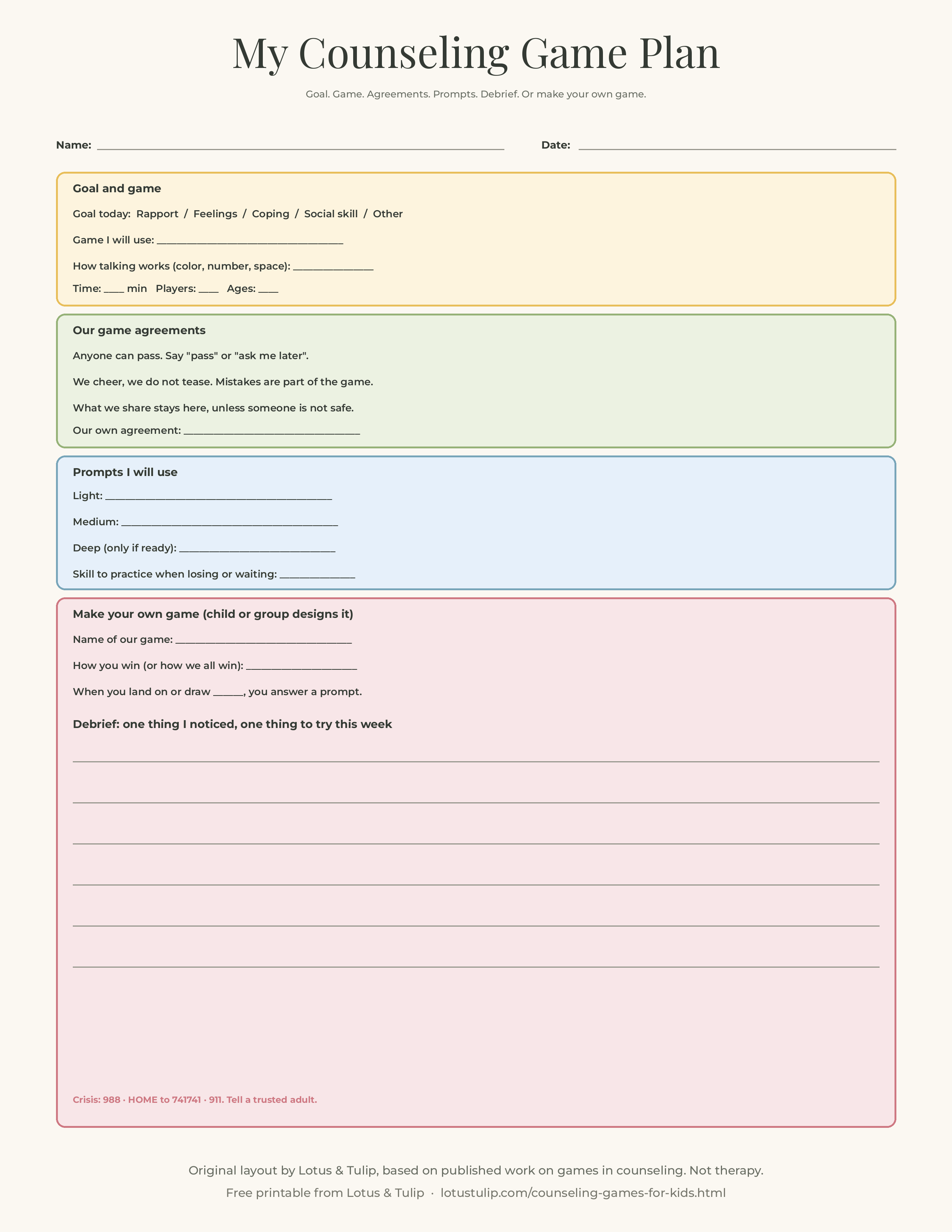
- Page 2: My Counseling Game Plan. Goal and game, how talking works, game agreements, light, medium and deep prompts, a skill for losing or waiting, a make your own game planner and debrief lines.
- Page 3: Game Reflection Log + talk prompt cards. Six sessions of game, feeling before and after, skill used and one thing shared, plus nine cut out talk cards to use with any board game.
Download the free counseling games printable (PDF, 3 pages, US Letter)
Prefer single images? Page 1: Counseling Game Steps (PNG) · Page 2: My Game Plan (PNG) · Page 3: Game Reflection Log (PNG)
Free to print for your own use and for use with your own students, clients or groups. This is an original layout by Lotus & Tulip, drawing on published work on games and play in counseling (Swank 2008; Schaefer and Reid; Schaefer and Drewes; Yogman et al. 2018). It is not affiliated with any author, agency, organization, game maker or curriculum named on this page, does not diagnose or treat any condition, and is not a substitute for therapy, evaluation or medical care. Please link to this page rather than re-uploading the file.
Related resources
- Counseling resources for kids and teens: worksheets, groups and coping cards in one place.
- School counselor small group curriculums: ready to teach eight session groups.
- Icebreaker activities for counseling groups: openers for session one.
- Coping skills list for kids: calm tools to practice during games.
- Feelings wheel printable: vocabulary for feelings charades and color card talk.
- Social skills worksheets for kids: skill steps behind turn taking and losing well.
- Safety plan worksheet: when the moment is about staying safe.
Sources
- Association for Play Therapy. Definition of play therapy and guidance on who should provide it. a4pt.org.
- Bratton, S. C., Ray, D., Rhine, T., and Jones, L. (2005). The efficacy of play therapy with children: A meta analytic review of treatment outcomes. Professional Psychology: Research and Practice, 36(4), 376 to 390.
- Ray, D. C., Armstrong, S. A., Balkin, R. S., and Jayne, K. M. (2015). Child centered play therapy in the schools: Review and meta analysis. Psychology in the Schools, 52(2), 107 to 123.
- Schaefer, C. E., and Drewes, A. A. (Eds.). (2014). The therapeutic powers of play: 20 core agents of change (2nd ed.). Wiley.
- Schaefer, C. E., and Reid, S. E. (Eds.). (2001). Game play: Therapeutic use of childhood games (2nd ed.). Wiley.
- Swank, J. M. (2008). The use of games: A therapeutic tool with children and families. International Journal of Play Therapy, 17(2), 154 to 167.
- Yogman, M., Garner, A., Hutchinson, J., Hirsh-Pasek, K., Golinkoff, R. M., Committee on Psychosocial Aspects of Child and Family Health, and Council on Communications and Media. (2018). The power of play: A pediatric role in enhancing development in young children. Pediatrics, 142(3), e20182058.
- American School Counselor Association. ASCA Student Standards: Mindsets and Behaviors for Student Success.
Counseling games for kids: FAQ
What are counseling games for kids?
They are ordinary or homemade games that a counselor or therapist uses with a clear goal, a talk rule and a debrief: for example a block tower with numbered prompts, a color card game with feelings themes, roll and talk dice grids, coping skills bingo or a losing well practice round.
Are counseling games the same as play therapy?
No. The Association for Play Therapy describes play therapy as a systematic, theory based approach delivered by trained play therapists, and says it should be provided by licensed mental health professionals with specialized training. Using games is a counseling technique that any trained helper can use within their scope.
What games do school counselors use most?
Many counselors keep a stacking block tower, a color matching card game, a four in a row game, dice and simple board games, and add prompt cards to each. Would you rather, feelings charades and coping skills bingo need little or no equipment.
How do I get a quiet or guarded child to talk during a game?
Start with light prompts, let the child choose topics (for example by choosing a column or color), allow passing, accept pointing or writing instead of speaking, and never force an answer. Talking side by side during a game is often easier than face to face questions.
Do counseling games work for teens?
Yes, if you frame them as games rather than play and use teen topics such as group chats, pressure, sleep and plans. Fast card games, roll and talk grids and having teens write their own prompts work especially well.
Is there research on therapeutic games?
Play therapy delivered by trained clinicians has meta analytic support (Bratton et al. 2005; Ray et al. 2015). Games within counseling are well described in the clinical literature (Swank 2008; Schaefer and Reid), but specific prompt games have not been tested as stand alone treatments. Use them as a rapport and skill practice tool alongside evidence based care.
What should I do if a child shares something serious during a game?
Pause the game, listen calmly, thank the child for telling you and follow your reporting and safety protocol. In the US, call or text 988, text HOME to 741741, or call 911 in an emergency, and use a safety plan with a qualified adult.