
School counselors · Small group counseling · Updated 2026-11-05
Icebreaker Activities for Counseling Groups: School Counselor Ideas, with a Free Printable
Ready-made printable: Social Skills Small Group Curriculum for School Counselors, Grades 2 to 5 Holiday 20% off: about $11.04, was $14 (EUR 12) · instant digital download
Buy on Etsy
The first ten minutes of a small counseling group often decide whether students settle in or stay guarded. Icebreaker activities for counseling groups are short, low risk openers that help members learn names, share just enough about themselves, and practice the skills the group will use later: listening, taking turns, and noticing feelings. Done well, they build safety and belonging. Done poorly, they feel like forced fun, run too long, or push students to share more than they are ready to share.
This guide is for US school counselors running elementary and middle school small groups. It covers why icebreakers matter without overselling them, trauma informed principles, concrete activities by category (name games, feelings check ins, movement, cooperative games, creative and art, values and strengths), a Session 1 opener plan for the first 10 to 15 minutes of an 8 session group, age band tips (K-2, grades 3 to 5, middle school), virtual and hybrid notes, common mistakes, a nine step how to, seven FAQs, and a free three page US Letter printable with an Icebreaker Menu, a Session Opener Plan, and Feelings Check In Cards plus a weekly opener tracker.
This guide is educational. It is not therapy and not a crisis protocol. If a student discloses thoughts of ending their life or serious harm during or after an icebreaker, pause the activity, follow your school crisis procedures, and get help: in the US, call or text 988, text HOME to 741741, or call 911 in an emergency. Our safety plan worksheet and district protocols come before any group game.
Jump to the free icebreaker printable (PDF) · How to run an icebreaker in a counseling group, step by step · Session 1 opener plan · Activity categories
Why icebreakers matter in school counseling small groups
Small groups ask students to sit with peers they may not know well, talk about feelings, and try new skills in front of others. That is a lot. A short icebreaker lowers the social temperature. It gives every student a predictable, low risk way to participate before the group goal work begins. It also lets the counselor model turn taking, opt outs, and confidentiality in the first minutes, not only in a spoken rule list.
Icebreakers support three practical aims:
- Safety. Students learn that the room has a rhythm: welcome, short share or game, then the lesson. Predictability reduces anxiety for many kids.
- Belonging. Hearing names, noticing who likes the same snack or sport, and laughing together (gently) helps students feel less alone in the group.
- Participation. Early success with a short turn makes it easier to try a longer share later in the curriculum.
They are not magic. An icebreaker will not fix chronic exclusion, bullying, or untreated anxiety. It will not replace a clear group agreement, careful screening, or solid lesson plans. Treat it as a warm up for the real work, not as the work itself.
Principles: low risk first, opt out, trauma informed caution
Before you pick a game, lock in these principles. They matter more than any single activity list.
- Low risk first. Early sessions should favor name games, preferences, and light feelings check ins. Save deeper personal stories for later, after trust and agreements are in place.
- Opt out is allowed. Students can pass, give a thumbs up only, or answer with a drawing. Opting out is participation in a different form. Never force a share to "prove" engagement.
- No forced trauma sharing. Do not use icebreakers that ask for the hardest thing that happened this week, family secrets, or detailed trauma stories. Counseling groups are not confession circles. If a student volunteers something heavy, thank them, contain it, and follow up privately with the right supports.
- Confidentiality, stated simply. Remind the group: what we share here stays here, except when safety requires an adult to help. Use language your district approves.
- Time boxing. Most icebreakers should take 5 to 12 minutes. If the opener eats half the session, the skill lesson suffers.
- Match the group goal. A worry group benefits from calm check ins. A social skills group benefits from joining in and listening games. A friendship group benefits from noticing strengths. The icebreaker should rehearse the skill, not fight it.
- Watch for shame in competition. Avoid elimination games, public ranking, and "last one out" formats. Cooperative and parallel structures keep dignity intact.
Icebreaker categories with concrete activities
Use this menu as a counselor toolbox. Pick one activity per session. Rotate categories across the 8 weeks so students do not get bored, and so quieter kids get different entry points.
Name games and get to know you
- Name and one favorite. Each student says their name and one low risk favorite (color, snack, animal, subject). Counselor models first.
- Name ball (soft toss). Say a peer's name, then toss a soft ball or beanbag. Keep the circle small. Offer a "pass to counselor" option.
- Two truths and one preference. Skip the classic "lie" version for early groups. Use two true facts and one favorite instead, so nobody has to invent deception on day one.
- Find your match cards. Hand out picture or word cards that pair (sun/moon, pencil/paper). Students quietly find their match and share names.
- Interview a partner (2 minutes). Ask one scripted question only: "What is something that helps you feel calm at school?" Partners introduce each other with one sentence.
Feelings check ins
- Weather report. "My mood weather is sunny / cloudy / stormy / windy." Pair with a feelings wheel for students who want a word.
- Number scale 1 to 5. Hold up fingers for energy or calm. No explanation required on week 1.
- Color check in. Point to a color that fits today's feeling. Optional one word share.
- Thumbs check. Thumbs up, sideways, or down for "how ready I feel for group today."
- Feelings card pick. Spread 8 to 12 feeling cards. Students pick one and may share or keep it private by placing it face down.
For classroom wide or morning use, see our daily check in for students guide. For worry focused groups, the anxiety small group curriculum page includes a worry check in sheet idea.
Movement icebreakers
- Stand if... Soft prompts only: "Stand if you like pizza." "Stand if you have a pet." Avoid sensitive prompts about home, money, or family structure.
- Move to the corner. Label corners with preferences (books, sports, art, games). Students walk to a corner and greet one person.
- Silent line up. Line up by birthday month or first letter of first name without talking. Then say names in order.
- Stretch and share. One gentle stretch, then one word for how the body feels (tired, buzzy, calm, sore).
- Mirror moves. Pairs take turns leading a 10 second silent movement. Builds attention without words.
Keep movement optional for students with mobility needs or sensory limits. Offer a seated version every time.
Cooperative games
- Group knot (gentle version). Small group holds a rope loop or joins hands carefully; untangle with calm voices. Skip if students are dysregulated.
- Keep the balloon up. Soft balloon, everyone helps keep it off the floor for 30 seconds. Celebrate the group, not individuals.
- Build a bridge. With paper and tape, build a bridge that can hold a toy car. Debrief: what helped us listen?
- One story, one sentence. Go around; each person adds one sentence to a silly story. No roasting.
- Human bingo (kind version). Squares like "likes dogs" or "has a younger sibling." Students find peers and write names. No points for finishing first.
Creative and art icebreakers
- Name doodle. Write your name and add one symbol that represents you. Share the symbol only if you want.
- Group mural square. Each student decorates a small square; assemble into a group poster for the folder or wall (with consent).
- Playdough feeling. Shape a feeling and show it. Words optional.
- Comic panel of my week. One panel only. Keep content school appropriate.
- Soundtrack of my day. Name a song mood (not necessarily a real title): calm piano, loud drums, quiet rain.
Values and strengths
- Strength card pick. Cards such as kind, curious, brave, helpful, creative. Pick one you used this week.
- Compliment circle (structured). Only after week 3 or 4. Use sentence stems: "I noticed you..." Keep it specific and brief.
- Helper hands. Trace a hand and write one way you can help the group. Post only with permission.
- My people. Draw or list one safe adult at school. Do not require family details.
Pair strengths work with empathy worksheets, kindness activities, and friendship worksheets when the group goal is peer skills.
Middle school adaptations
Middle schoolers often reject anything that feels "babyish." Keep the structure, change the packaging:
- Use "opener" or "check in" instead of "icebreaker game" if that word gets eye rolls.
- Offer written or phone-free digital polls on paper (emoji scales) so nobody has to perform.
- Allow one word or one meme description instead of a speech.
- Peer pressure, group chats, and belonging themes fit well. See peer pressure worksheets for teens for related skill work after the opener.
- Never use humiliation humor, roasting, or forced public vulnerability.
Virtual and hybrid notes
- Prefer chat check ins, reaction emojis, and breakout pairs of two over large unmuted circles.
- Send the prompt in chat so students can type if speaking feels hard.
- Keep cameras optional when district policy allows, and never punish a black screen in week 1.
- Test links and timers before the session. Tech friction kills warm ups.
Session 1 opener plan (first 10 to 15 minutes of an 8 session group)
Here is a concrete first session opener you can adapt. Total time: about 12 minutes, leaving the rest of the period for agreements, goals, and the first skill.
- Welcome and purpose (2 minutes). "This is a small group about [goal]. Today we will learn names and how group works."
- Opt out reminder (30 seconds). "You can pass. Passing is okay."
- Name and favorite (5 to 6 minutes). Counselor models. Go around once. Write names on a seating chart if helpful.
- Weather or thumbs check in (2 minutes). No long stories.
- Bridge to agreements (2 minutes). "Next we will write how we treat each other. Confidentiality and kindness come first."
Materials: name tags or seating chart, soft talking piece (optional), feelings cards or weather icons, timer. Success looks like: every student had a chance to speak or pass without shame, names are known, and you still have time for agreements. Reflection prompts for your notes: Who opted out? Who needed more structure? Which student may need a private check in before session 2?
Age bands: K-2, grades 3 to 5, middle school
K-2. Keep activities under 7 minutes. Use pictures, puppets, movement, and one word shares. Sitting still for a long circle is hard. Pair icebreakers with social skills worksheets for kids that use simple steps. The K-2 coping skills group curriculum fits this band when the group goal is feelings and calm tools.
Grades 3 to 5. This is the sweet spot for many school counseling icebreakers. Mix name games, cooperative tasks, and feelings check ins. Students can handle a short partner interview. Social skills, friendship, and worry groups all work well here.
Middle school. Prioritize dignity, choice, and relevance. Shorter verbal shares, more written options, and clear links to real social stress. Avoid sing song games unless students ask for them.
Common mistakes with counseling group icebreakers
- Too long. A 25 minute opener leaves no time for the skill that justified the referral.
- Too personal too soon. Asking for trauma, family conflict, or deepest fears in week 1 breaks safety.
- Competition that shames. Elimination, public scores, and "loser" labels teach the wrong lesson.
- Ignoring opt outs. Pressuring a pass student to "just try" teaches that no does not mean no.
- One size for every group. A grief group needs different openers than a social skills group.
- Skipping the debrief. Even 60 seconds of "what helped us listen?" connects the game to the goal.
- Using icebreakers as therapy. Processing heavy disclosures belongs in individual follow up and crisis protocols, not in a name game.
How to run an icebreaker in a counseling group, step by step
- Name the group goal for this session. Write it in one sentence so the opener can match it.
- Choose a low risk activity from one category. Prefer name, feelings check in, movement, or cooperative for early sessions.
- Set a timer and a clear end point. Most openers need 5 to 12 minutes. Say the time limit out loud.
- Prepare materials and a seated alternative. Cards, soft ball, paper, markers, or nothing but chairs. Always offer a non movement option.
- Model first, including an opt out example. Show a short answer and show how to pass without apology.
- State confidentiality and kindness in one line. Use district approved wording. Remind students that safety limits confidentiality.
- Run the activity and protect dignity. Interrupt teasing quickly. Redirect long shares. Keep turns short.
- Debrief in 60 to 90 seconds. Ask one question: "What helped us listen?" or "What felt easy or hard?"
- Bridge to the lesson and note follow ups. Move into the curriculum page. Privately note any student who needs a check in after group.
Tips for school counselors running openers
- Screen before you icebreak. Students in acute crisis, active bullying investigations, or who cannot yet sit safely with peers may need individual support first.
- Keep a talking piece optional. A soft object can slow turns. Skip it if it becomes a toy fight.
- Write names down. A seating chart or name tent saves you from guessing in week 2.
- Repeat one check in format for three weeks. Predictability helps anxious students. Then rotate.
- Link to curriculum pages. After the opener, open the session plan. Students should feel the shift: warm up, then skill.
- Document lightly. Note participation and any follow ups. Do not turn the icebreaker into a graded performance.
- Coordinate with teachers. If students leave class mid lesson, a calm return routine matters as much as the opener.
When the group goal is social skills, friendship, worry, self esteem, anger, or early elementary coping, use the matching curriculum so every opener leads into a planned activity and student page rather than a one off game.
What the research says (honestly)
Icebreakers themselves are rarely the subject of randomized trials. Be careful with claims that a name game "improves mental health." What we can say more honestly is that related ideas (belonging, school connectedness, and well run SEL programs) have research behind them, and icebreakers are one practical way counselors try to support those conditions in a small group room.
School connectedness and belonging. Public health and education sources have long linked students' sense of belonging at school with better academic and health related outcomes. The Centers for Disease Control and Prevention (CDC) and related school connectedness materials describe connectedness as feeling that adults and peers at school care about you as a person. That is a broad construct. A five minute icebreaker is one small contribution to a climate of care, not a complete connectedness program.
ASCA mindsets and behaviors. The American School Counselor Association (ASCA) Mindsets and Behaviors for Student Success frame what school counselors help students develop: learning strategies, self management, and social skills, alongside belief in their ability to succeed. Group openers that practice names, listening, and emotional vocabulary align with those social and self management skills when they are intentional. They are not a substitute for a full curriculum aligned to ASCA standards.
SEL programs vs icebreakers alone. Durlak, Weissberg, Dymnicki, Taylor, and Schellinger (2011) published a widely cited meta analysis of school based universal social and emotional learning (SEL) programs in Child Development. They found that well implemented SEL programs were associated with improved social and emotional skills, attitudes, behavior, and academic performance, on average, compared with controls. That study evaluates multi component SEL programs, not icebreaker activities alone. Do not cite Durlak et al. 2011 as proof that icebreakers work by themselves. Use it only as context for why skill focused group time matters when programs are intentional and well run.
Honest caveat. No trial has tested this free three page Lotus and Tulip printable, and no strong evidence claims that any single icebreaker list raises grades or reduces anxiety on its own. Use these activities as warm ups inside a planned counseling group with screening, agreements, and skill lessons.
Free icebreaker activities printable (PDF)
The free icebreaker printable has three pages in US Letter size:
- Page 1: Icebreaker Menu. Sixteen short activities in four groups (name and get to know, feelings check in, movement, cooperative), with space to star three picks for your current group.
- Page 2: Session Opener Plan. Group goal, activity pick, materials, time box, what success looks like, and reflection prompts for your notes.
- Page 3: Feelings Check In Cards and weekly opener tracker. Eight printable feeling prompt cards plus a Monday to Friday style tracker for which opener you used each group day.
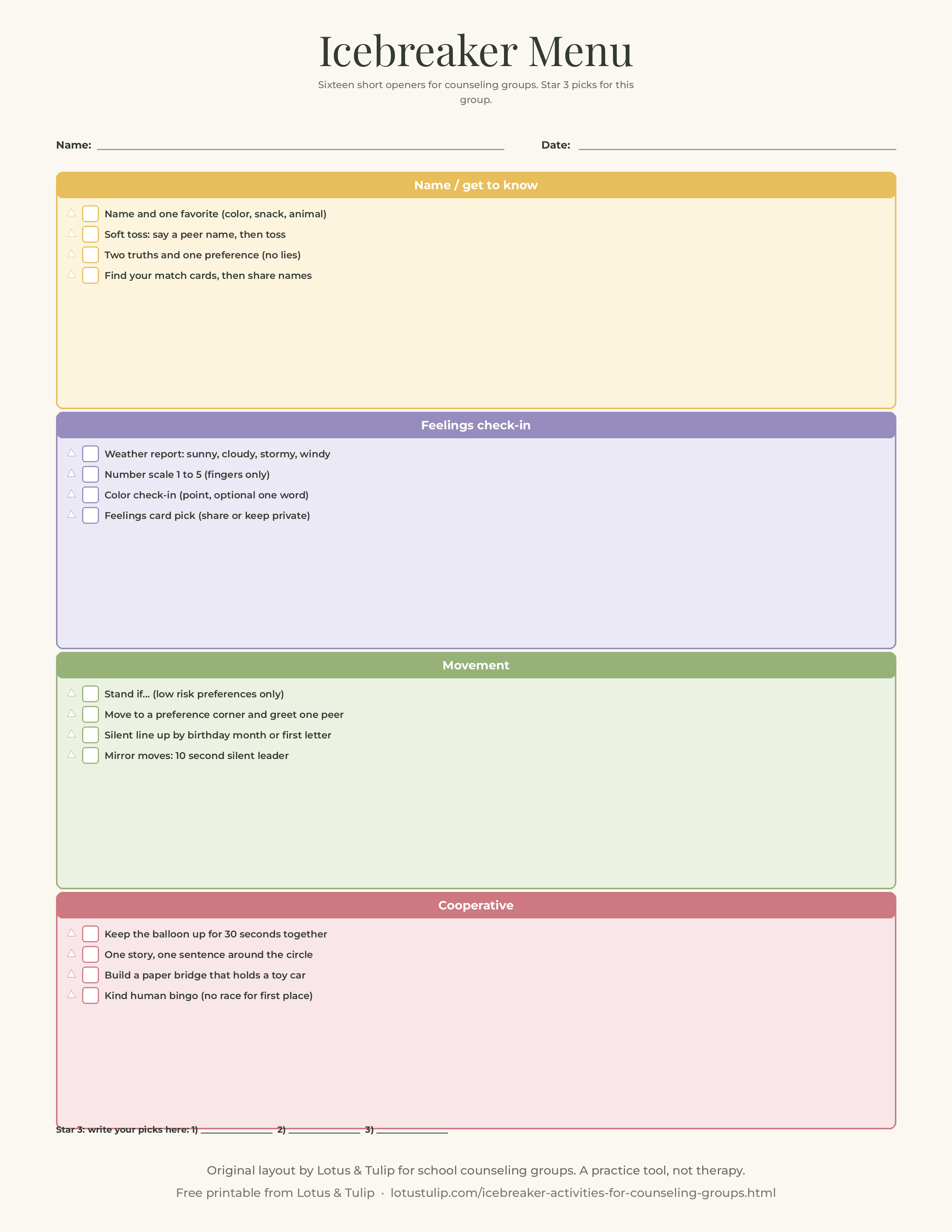
Download the free icebreaker activities printable (PDF, 3 pages, US Letter)
Prefer single images? Page 1: Icebreaker Menu (PNG) · Page 2: Session Opener Plan (PNG) · Page 3: Feelings cards and tracker (PNG)
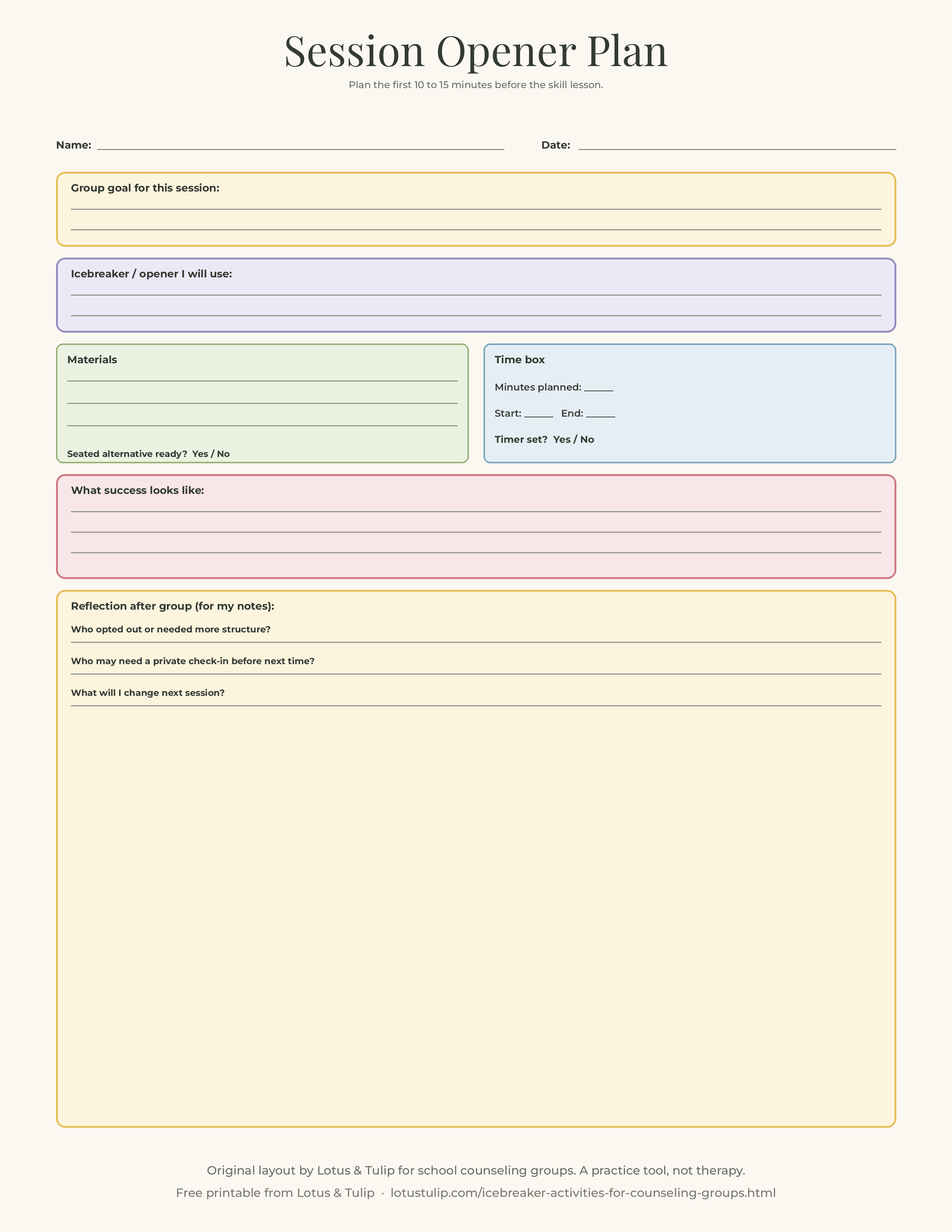
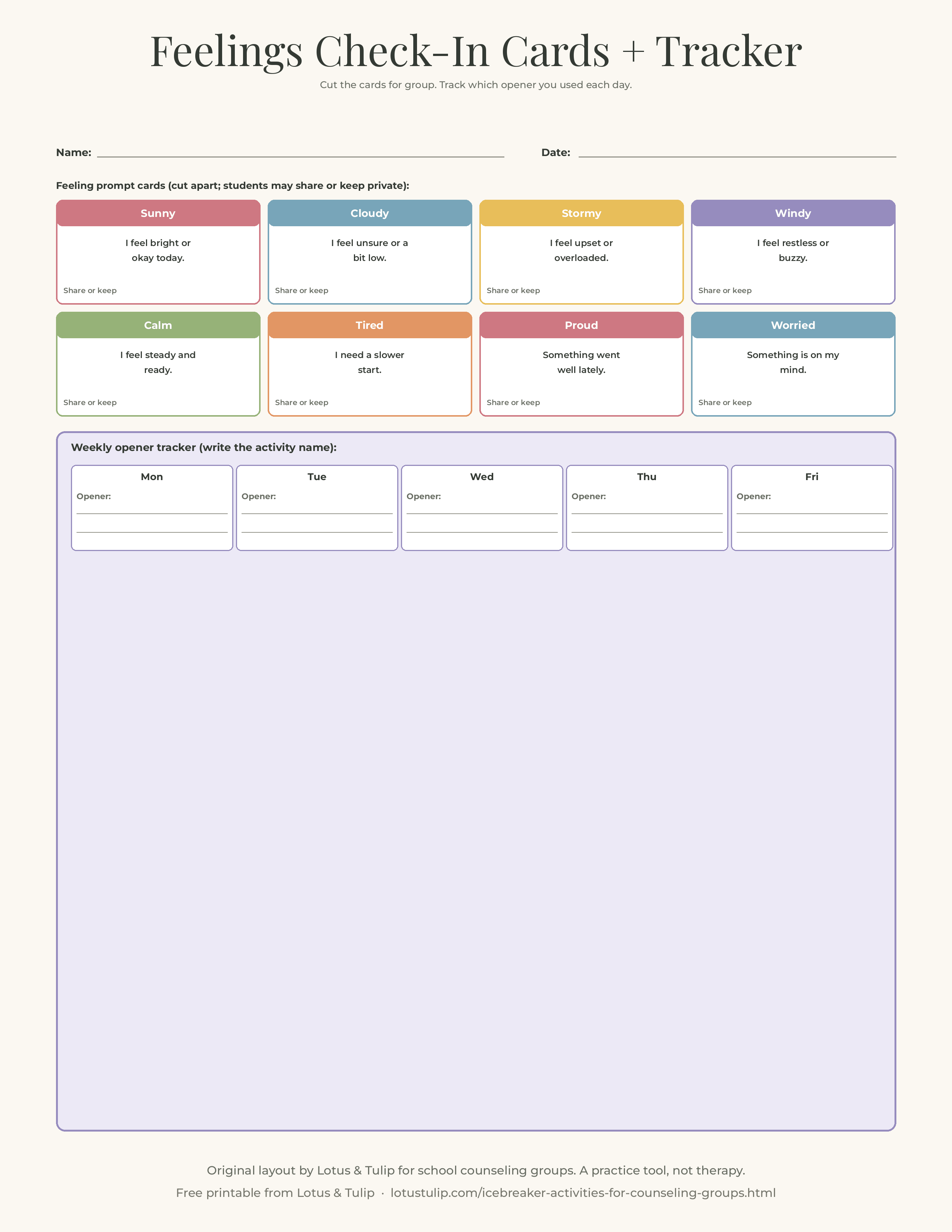
Free to print for your own use and for use with your own students or groups. This is an original layout by Lotus & Tulip for school counseling practice. It is not affiliated with ASCA or the CDC, and it is not a substitute for counseling, crisis response, or district policy. Please link to this page rather than re-uploading the file.
Related resources
- Small group counseling pre and post assessment: how to write, give, score and report it, with a free survey and results sheet
- Small group counseling permission slip and parent letter, with a free letter, filled example and permission log
- Social skills worksheets for kids: listening, joining in, and repair skills after the opener.
- Friendship worksheets for kids: joining, conversation, and healthy friendship habits.
- Daily check in for students: classroom and morning check in sheets.
- Empathy worksheets for kids: perspective taking activities.
- Kindness activities for kids: kindness week and challenge ideas.
- Small group counseling curriculum for anxiety: worry group planning and check in ideas.
- Peer pressure worksheets for teens: middle school social pressure skills.
- Feelings wheel printable: expand feeling vocabulary during check ins.
Sources
- American School Counselor Association (ASCA). ASCA Mindsets and Behaviors for Student Success. Framework for the knowledge, skills, and attitudes school counselors help students develop (learning strategies, self management skills, social skills, and related mindsets). Used here as program framing, not as a study of icebreakers.
- Centers for Disease Control and Prevention (CDC). School connectedness resources describing students' belief that adults and peers at school care about them. Connectedness is a broad climate factor; icebreakers are one small classroom or group practice that may support it.
- Durlak, J. A., Weissberg, R. P., Dymnicki, A. B., Taylor, R. D., and Schellinger, K. B. (2011). The impact of enhancing students' social and emotional learning: A meta analysis of school based universal interventions. Child Development, 82(1), 405 to 432. Meta analysis of SEL programs, not of icebreaker activities alone. Do not treat it as evidence that icebreakers by themselves produce SEL outcomes.
- Honest caveat: no study tests this three page Lotus and Tulip printable alone. The research above concerns school connectedness, ASCA skill frameworks, and multi component SEL programs.
Icebreaker activities for counseling groups: FAQ
What are icebreaker activities for counseling groups?
They are short, low risk openers used at the start of a counseling small group so students can learn names, share lightly, and practice listening before the main skill lesson. Good icebreakers take about 5 to 12 minutes, allow opt outs, and match the group goal.
How long should a school counseling icebreaker take?
Most should take 5 to 12 minutes, and rarely more than 15 in a standard group period. If the opener runs longer, cut prompts or switch to a thumbs check in so the curriculum still fits.
What icebreakers work for elementary small groups?
Name and favorite, weather report check ins, soft toss name games, stand if preference games, balloon keep up, and simple art doodles work well for grades K to 5 when they stay low risk and optional. Use pictures for K-2.
What icebreakers work for middle school counseling groups?
Call them openers or check ins. Use one word shares, emoji or number scales, written prompts, partner interviews with one scripted question, and strength card picks. Avoid babyish songs and forced roasting.
Are icebreakers trauma informed?
They can be, if you keep risk low, allow opt outs, avoid forcing trauma stories, time box, and follow confidentiality and crisis procedures. An icebreaker that demands deep disclosure is not trauma informed.
Do icebreakers improve school connectedness by themselves?
Not as a proven standalone intervention. School connectedness and belonging are broader climate factors. Icebreakers may help students feel welcome in a small group, which can support belonging, but they are not a complete connectedness program. Durlak et al. 2011 studied SEL programs, not icebreakers alone.
Where can I download a free icebreaker printable for counseling groups?
This page includes a free three page US Letter PDF: an Icebreaker Menu, a Session Opener Plan, and Feelings Check In Cards with a weekly opener tracker. Download links are in the free printable section above.