
Therapist worksheets · DBT interpersonal effectiveness · Updated 2026-11-05
GIVE and FAST Worksheet: DBT Interpersonal Effectiveness Skills Explained, with Examples and a Free Printable
Ready-made printable: DBT Worksheets for Therapists Fillable PDF, 20 pages: weekly diary card, chain analysis, pros and cons, crisis survival plan and 0 to 10 suffering scales
Holiday 20% off: about $11.04, was $14 (EUR 12) · instant digital download
Try it free first: download a fillable sample (weekly diary card and checking the facts, PDF, 234 KB). Type into it on screen, then get the full pack. No email needed.

You can ask clearly and still damage a relationship. You can keep the peace and still walk away ashamed. In Dialectical Behavior Therapy (DBT), those two problems have names: relationship effectiveness and self-respect effectiveness. The skills for them are GIVE and FAST.
This guide is for therapists, counselors, DBT skills group leaders, teens, and adults learning interpersonal effectiveness. It explains what GIVE and FAST are in Linehan's Interpersonal Effectiveness materials, when to use each skill next to DEAR MAN, letter by letter examples for adults and teens, a worked conversation, how the three skills combine, common mistakes, an honest look at the research, safety notes, and a free three page printable: a GIVE Skills card with practice planner, a FAST Skills card with self-respect check, and a combined DEAR MAN + GIVE + FAST conversation planner.
Jump to the free GIVE and FAST worksheets (PDF) · See worked examples
What interpersonal effectiveness is in DBT
Interpersonal effectiveness is one of the four DBT skills modules, alongside mindfulness, emotion regulation, and distress tolerance. In the second edition of DBT Skills Training Handouts and Worksheets (Guilford Press, 2015), the interpersonal effectiveness section teaches people how to ask for what they need, say no, and handle conflict without losing the relationship or their self-respect.
Linehan organizes the module around three kinds of effectiveness. Clients learn to ask, before a hard conversation: what matters most this time?
- Objective effectiveness (DEAR MAN): Did I get what I wanted, or successfully say no?
- Relationship effectiveness (GIVE): Is the relationship in the same or better shape afterward?
- Self-respect effectiveness (FAST): Do I still respect myself when it is over?
Most conversations need all three. The priority changes. With a boss over a schedule change, the objective may come first. With a grieving friend, the relationship may matter more than the request. With a pushy relative, self-respect may be the point even if the other person stays annoyed.
Our longer guide on DEAR MAN covers the objective skill in depth. This page is the companion for GIVE and FAST. Related pages on healthy boundaries, I statements, Wise Mind, and Check the Facts support the same work without repeating those full guides here.
When to use GIVE vs FAST vs DEAR MAN
Use this quick decision frame in session or homework:
- Lead with DEAR MAN when the main goal is getting something specific (a raise conversation, a clear no to overtime, asking a partner to share childcare) and you need a script that does not wander.
- Lead with GIVE when the relationship is fragile, the other person is hurting, you tend to sound harsh when stressed, or repairing connection matters more than winning the point.
- Lead with FAST when you tend to over apologize, abandon your values to keep peace, lie to smooth things over, or leave conversations feeling small and resentful.
In practice, clients often draft a DEAR MAN script, then run a GIVE pass (soften tone, add validation, check for attacks) and a FAST pass (cut unnecessary apologies, check values and truth). The free printable on this page is built for that three pass prep.
Do not use GIVE as a reason to stay in an unsafe relationship, or FAST as a reason to never compromise. GIVE is warmth inside a real conversation. FAST is self-respect inside a real conversation. Neither skill replaces safety planning, boundary setting, or leaving when leaving is required.
GIVE letter by letter
GIVE is the relationship effectiveness skill. In Linehan's Interpersonal Effectiveness Handouts (2015), it stands for Gentle, Interested, Validate, Easy manner. The aim is to keep or improve the relationship while you ask, say no, or resolve a conflict.
G: Gentle
Gentle means no attacks, no threats, no judging, and no sneering. You can still be firm. You do not call the other person names, stack old fights, or say "you always" and "you never." Describe behavior. Skip character assassination.
Harsh version: "You are so selfish. You never care about anyone but yourself."
Gentle version: "When the dishes sat for three days, I felt overloaded and I need us to pick a shared plan."
I: Interested
Interested means you listen. You do not interrupt to reload your next point. You ask a short clarifying question. You show with your face and body that the other person exists. Interest is not agreement. It is attention.
Closed version: talking over them, checking your phone, rehearsing your rebuttal.
Interested version: "I want to make sure I heard you. Are you saying the Tuesday shift is the hard part, or the whole week?"
V: Validate
Validate means you acknowledge the other person's feelings, wants, or situation out loud, even when you will still ask for something different. Validation is not approval of harmful behavior. It is recognizing that their experience makes sense from their point of view.
Invalidating version: "That is ridiculous. You have nothing to be upset about."
Validating version: "It makes sense you are stressed. Your deadline is real. I still need to talk about how we share evenings this week."
Many clients confuse validation with giving in. Teach the difference early. You can validate and still say no. You can validate and still keep your request.
E: Easy manner
Easy manner means a light, warm tone where it fits. A little humor. Soft eyes. Soft shoulders. Not sarcasm dressed as jokes, and not forced cheerfulness in a serious talk. Easy manner lowers threat so the other person can hear the content.
Tight version: clenched jaw, clipped one word answers, eye rolls.
Easy manner version: a slower pace, a small smile if appropriate, "I am on your team even when we disagree."
FAST letter by letter
FAST is the self-respect effectiveness skill. In the same 2015 handouts, it stands for Fair, Apologies (no over apologizing), Stick to values, Truthful. The aim is to leave the conversation able to look yourself in the eye.
F: Fair
Fair means fair to yourself and fair to the other person. Do not bully. Do not abandon your own needs to keep temporary peace. Look for a balance that both of you could respect on a calm day.
Unfair to self: agreeing to every request, then exploding later.
Unfair to other: stacking demands with no room for their limits.
Fair: "I can cover Thursday. I cannot cover both Thursday and Saturday. Which one helps you more?"
A: Apologies (no unnecessary apologies)
The A in FAST is about not over apologizing. Do not apologize for having an opinion, for asking, for existing, or for taking up space. Do apologize when you have actually harmed someone. That distinction matters.
Over apology: "Sorry, sorry, I know this is stupid, but maybe if it is not too much trouble could you possibly..."
Clean ask: "I need to ask about switching the Friday meeting."
Real apology when owed: "I raised my voice yesterday. That was not okay. I am sorry."
S: Stick to values
Stick to your values means do not sell out what matters for short term approval. If honesty, loyalty, sobriety, parenting priorities, or faith commitments are on the line, name them privately before the talk and do not trade them for peace.
Values slip: laughing along with a cruel joke about a friend to stay liked.
Values stick: "I am not comfortable talking about them that way."
T: Truthful
Truthful means no lying, no exaggerating, no acting helpless when you are not, and no making up excuses. Truth can be brief. You do not owe every detail. You do owe honesty about what you can and cannot do.
Untruthful: "I would love to, but my car is broken" when the car is fine and you simply do not want to go.
Truthful: "I am going to say no to Saturday. I need a rest day."
Worked examples
Adult example: asking a partner for evening coverage
Alex is 34. Their partner works late three nights a week. Alex wants one protected evening to attend a class. Priority this time: objective first, relationship close behind, self-respect as the floor.
- DEAR MAN sketch: Describe the late nights and the class time. Express feeling stretched. Assert the ask for Tuesday evenings. Reinforce that both get more energy if Alex has one protected night. Stay mindful if the partner changes the subject. Appear confident. Negotiate a trial for four weeks.
- GIVE pass: Gentle language with no "you never help." Interested question about the partner's work crunch. Validate that the partner's job stress is real. Easy manner: calm tone, sit side by side rather than across a table like a hearing.
- FAST pass: Fair offer (Alex still covers two late nights). No apology for wanting the class. Stick to the value of keeping a personal goal alive. Truthful about how resentment is building instead of pretending everything is fine.
Sample lines Alex might use: "I know your project is intense right now, and that matters. I feel depleted on the nights I solo everything after work. I want Tuesday evenings for my class for the next four weeks. I will still handle Thursday and Friday evenings. Can we try that and check in after a month?"
Teen example: saying no to a group hang that breaks a curfew
Sam is 16. Friends want a late movie that ends after curfew. Sam's priority: self-respect and keeping trust with parents, without nuking the friendship.
- DEAR MAN sketch: Describe the invite and the curfew. Express wanting to hang out. Assert a no to the late show, and an alternate (weekend matinee). Reinforce that Sam wants to keep hanging out. Broken record if pressured. Confident posture. Negotiate a different night.
- GIVE pass: No insults about "you always push." Listen to why the late show matters to them. Validate that missing the premiere feels disappointing. Easy manner: warm text, not a lecture.
- FAST pass: Fair to self and friends. No "sorry for having a curfew" loop. Stick to the value of honesty with parents. Truthful: do not invent a fake family emergency.
Sample text: "I want to go to a movie with you. I cannot do the late show because of curfew. I can do the weekend afternoon show. I am not going to lie to my parents about it."
Worked conversation: GIVE and FAST without a full DEAR MAN script
Not every moment needs a written DEAR MAN. Sometimes GIVE and FAST alone repair a tone mid conversation.
Riley is talking with a sibling about holiday plans. Riley hears their own voice getting sharp. Mid talk, they pause and apply GIVE: soften the next sentence, ask what the sibling wants most about the holiday, validate that traditions matter, lighten the tone. Then FAST: stay fair about whose house hosts, stop apologizing for bringing up the topic, stick to the value of including a relative who is usually left out, stay truthful about travel limits. The content of the plan may still be negotiated. The self-respect and relationship get protected in real time.
How GIVE and FAST combine with DEAR MAN
A useful teaching metaphor: DEAR MAN is the script, GIVE is the warmth, FAST is the backbone. Clients who only learn DEAR MAN often sound like a memo. Clients who only learn GIVE may never ask. Clients who only learn FAST may sound rigid.
A practical prep order:
- Clarify the priority: objective, relationship, or self-respect.
- Draft DEAR MAN in short lines.
- Run GIVE: remove attacks, add one validation, plan one interested question, check tone.
- Run FAST: cut fake apologies, check fairness, name the value at stake, remove excuses.
- Role play once cooperative, once difficult.
- After the real talk, score all three kinds of effectiveness from 0 to 10.
For boundaries work that sits next to these skills, see healthy boundaries worksheets. For cleaner feeling statements inside Describe and Express, see I statements. When emotion intensity is distorting what you are about to say, Check the Facts and Wise Mind help before you walk into the conversation.
How to teach GIVE and FAST, step by step
- Teach the three effectiveness goals first. Draw Objective, Relationship, and Self-respect as three columns. Have clients rate which one matters most for a real upcoming talk before you teach any letters.
- Link GIVE and FAST to DEAR MAN explicitly. Show a cold DEAR MAN script, then the same script with GIVE, then with FAST. Let the group hear the difference out loud.
- Teach GIVE one letter at a time with contrasts. Harsh vs gentle, interrupting vs interested, dismissing vs validating, tight vs easy manner. Clients learn faster from pairs of examples than from definitions alone.
- Teach FAST with a special focus on apologies and truth. Many clients either never apologize or apologize for existing. Practice both a real apology and a clean non apology ask.
- Practice on low stakes scenarios first. Asking a coworker to lower a speaker, texting a friend about being late, telling a roommate about dishes. Save trauma related confrontations for later, with more support.
- Role play with a difficult partner. Have the therapist or a peer interrupt, guilt trip, and change the subject so the client practices staying Gentle and Truthful under pressure.
- Coach body language and tone. GIVE fails when the words are soft and the face is contemptuous. FAST fails when the words are firm and the body collapses. Record and review when clients consent.
- Assign between session practice with a log. One planned conversation per week is enough. Review scores for objective, relationship, and self-respect separately.
- Generalize to texts and email. Modern conflict often happens in writing. Have clients draft a message, then mark GIVE and FAST letters in the margins before sending.
GIVE in texts, email and group chats
A large share of modern conflict happens in writing. GIVE still applies, with a few adaptations.
- Gentle: re read before send. Delete sarcasm, stacked accusations, and all caps. If you are flooded, draft in notes and wait ten minutes.
- Interested: ask one clarifying question before you counter. In a group chat, that might mean answering the person you are closest to first rather than performing for the whole thread.
- Validate: one sentence that names their side ("I get that the deadline feels impossible") before your request or no.
- Easy manner: punctuation and emoji are tone. A period only reply can read colder than you mean. A light closer ("thanks for talking this through") often carries Easy manner in text.
FAST in writing is equally important. Fairness shows up as not dumping a paragraph of demands at midnight. Skipping unnecessary apologies keeps the ask clean. Sticking to values means not joining a pile on. Truthful means not inventing a technical problem to avoid a social one.
Homework that works well: have the client forward you (or bring to session) one unsent draft. Mark G, I, V, E, F, A, S, T in the margins together. Clients often see that the harshness lived in two sentences, not in the whole message.
Building a week of interpersonal practice
Skills stick when they leave the worksheet. A simple weekly structure for adults or teens:
- Monday: pick one upcoming conversation and rate the three effectiveness goals.
- Tuesday: draft DEAR MAN or, for a smaller talk, just the ask and the no.
- Wednesday: GIVE pass and FAST pass on paper.
- Thursday: role play once, or practice the opening line out loud twice.
- Friday or weekend: have the conversation if timing allows, then score objective, relationship, and self-respect from 0 to 10.
If no hard conversation appears that week, practice a micro version: send one validating text, make one clean ask without an apology sandwich, or tell one small truthful no. Micro reps keep the letters warm between the big talks.
Group leaders can assign the same structure as homework and reserve ten minutes at the start of the next group for wins and repairs. Celebrate relationship scores and self-respect scores, not only whether the person got the thing. That teaching point is the heart of the module.
GIVE, FAST and cultural tone
Warmth, directness, and apology norms vary by family and culture. Teach the function of each letter, then help clients translate it into a tone that fits their relationships. Easy manner in one workplace is a smile and a joke. In another, it is a calm pace and a respectful title. Truthful in one family is blunt. In another, it is clear but soft. The skill is not "sound like a textbook." The skill is protect the relationship and protect self-respect while you pursue the objective.
When a client's family expects frequent apologies as politeness, distinguish social courtesy from self erasing apology. FAST targets the second. A brief courtesy phrase can stay if it does not undo the ask. The clinical target is the habit of apologizing for having needs.
Common mistakes
- Using GIVE to avoid asking. Endless validation with no assert is people pleasing in DBT clothing.
- Using FAST to refuse every compromise. Sticking to values is not the same as never negotiating logistics.
- Fake validation. "I hear you" said flatly while planning the rebuttal is not Validate.
- Weaponized gentleness. Soft tone with cutting content still breaks Gentle.
- Apologizing for the ask itself. "Sorry for bothering you with my needs" trains both people that the asker's needs are a nuisance.
- Lying to keep FAST sounding kind. Truthful does not mean cruel, but kind lies still break T.
- Skipping priority setting. Without choosing what matters most, clients try to maximize all three and freeze.
- Teaching only adults, or only teens, with the same examples. School and peer pressure examples land for teens. Work and partner examples land for adults. Keep both in the room.
For teens, schools, and skills groups
GIVE and FAST translate well to teen groups when you:
- Use phone and group chat examples (pressure to share a password, pressure to skip class, pressure to pile on someone online).
- Practice short scripts, not essays. Teens need two or three strong lines they can remember under stress.
- Separate validation from agreement, especially around peer drama.
- Practice saying no without a fake excuse. Many teens believe a "good reason" is required. FAST says truth is enough.
- Watch for trauma and bullying contexts. GIVE is not a requirement to stay polite to someone who is unsafe. Move those situations into safety planning and adult support.
Rathus and Miller's work on Dialectical Behavior Therapy for Adolescents (DBT-A) adapts interpersonal effectiveness for teens and families. The letter skills remain the same. The examples, pacing, and family involvement change. School counselors should treat these skills as social emotional tools for everyday conflict, and route suicidal talk, abuse disclosures, or dating violence out of the skills exercise into the school's risk and referral pathway.
What the research says (honestly)
DBT as a package has substantial support. GIVE and FAST are component skills inside the interpersonal effectiveness module. Be precise about what trials show.
- DBT for high suicide risk. Linehan, Korslund, Harned and colleagues (2015, JAMA Psychiatry) randomized 99 women with borderline personality disorder at high risk for suicide to standard DBT, DBT skills training plus case management, or DBT individual therapy without skills training. All three reduced suicide attempts similarly. Conditions that included skills training did better on several other outcomes, including frequency of self harm and depression. That trial supports skills training as part of DBT. It does not isolate GIVE or FAST.
- Skills use mediates outcomes. Neacsiu, Rizvi and Linehan (2010) found that increases in DBT skills use mediated improvements in suicide attempts, depression, and anger control across pooled trial data. Interpersonal effectiveness skills are part of that skills use picture.
- DBT for adolescents. Rathus and Miller's DBT-A adaptations, and related adolescent DBT research, support skills based work with teens and families. Again, this is the module and package, not a standalone GIVE or FAST trial.
What we cannot honestly claim: that a randomized trial has tested GIVE alone, or FAST alone, as a standalone treatment for any diagnosis. Teach them as practical, theory grounded skills inside DBT interpersonal effectiveness, and measure whether this client keeps relationships and self-respect more often when they use them.
Safety notes and when to get more help
GIVE and FAST are conversation skills. They are not a crisis intervention, not a domestic violence safety plan, and not a substitute for therapy.
- In the US, call or text 988 (988 Suicide and Crisis Lifeline), any time.
- Text HOME to 741741 to reach the Crisis Text Line.
- Call 911 if there is immediate danger.
If a client is being threatened, stalked, or harmed, prioritize safety planning and appropriate resources over polishing a Gentle tone. If thoughts of suicide or self harm are present, complete a proper risk assessment and safety plan first. For in the moment crisis skills, see our distress tolerance worksheets.
Tips for therapists and group leaders
- Model your own repairs: "I interrupted you. That broke Interested. Let me try again."
- Keep a wall chart of the three effectiveness goals and the GIVE and FAST letters.
- In groups, practice one shared vignette, then one personal example with privacy boundaries.
- Watch for clients who intellectualize letters but never change tone. Role play reveals that gap fast.
- For people pleasers, spend more time on FAST before heavy GIVE practice.
- For clients who come across as aggressive, spend more time on Gentle and Validate before polishing Assert.
- For couples, have each partner prepare a short ask with GIVE and FAST passes, then swap.
Free GIVE and FAST worksheets (PDF)
The free GIVE and FAST worksheets have three pages in US Letter size, written for teens and adults:
- Page 1: GIVE Skills card and practice planner. Gentle, Interested, Validate, and Easy manner checkboxes with script lines for one conversation.
- Page 2: FAST Skills card and self-respect check. Fair, Apologies, Stick to values, and Truthful prompts, plus a before and after self-respect rating.
- Page 3: Combined DEAR MAN + GIVE + FAST planner. One conversation planner with priority choice, script lines, GIVE and FAST passes, and an after talk score for objective, relationship, and self-respect.
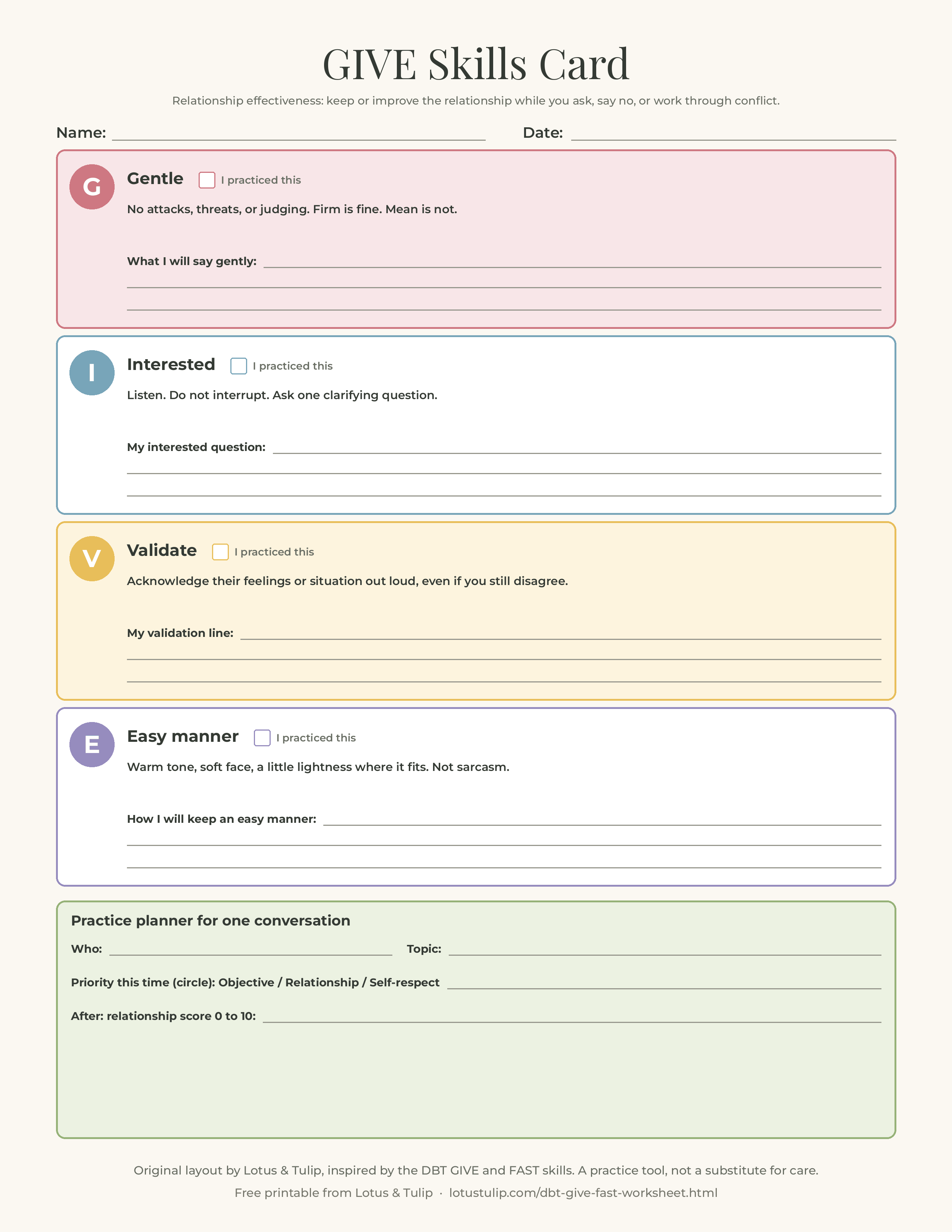
Download the free GIVE and FAST worksheets (PDF, 3 pages, US Letter)
Prefer single images? Page 1: GIVE Skills Card (PNG) · Page 2: FAST Skills Card (PNG) · Page 3: Conversation Planner (PNG)
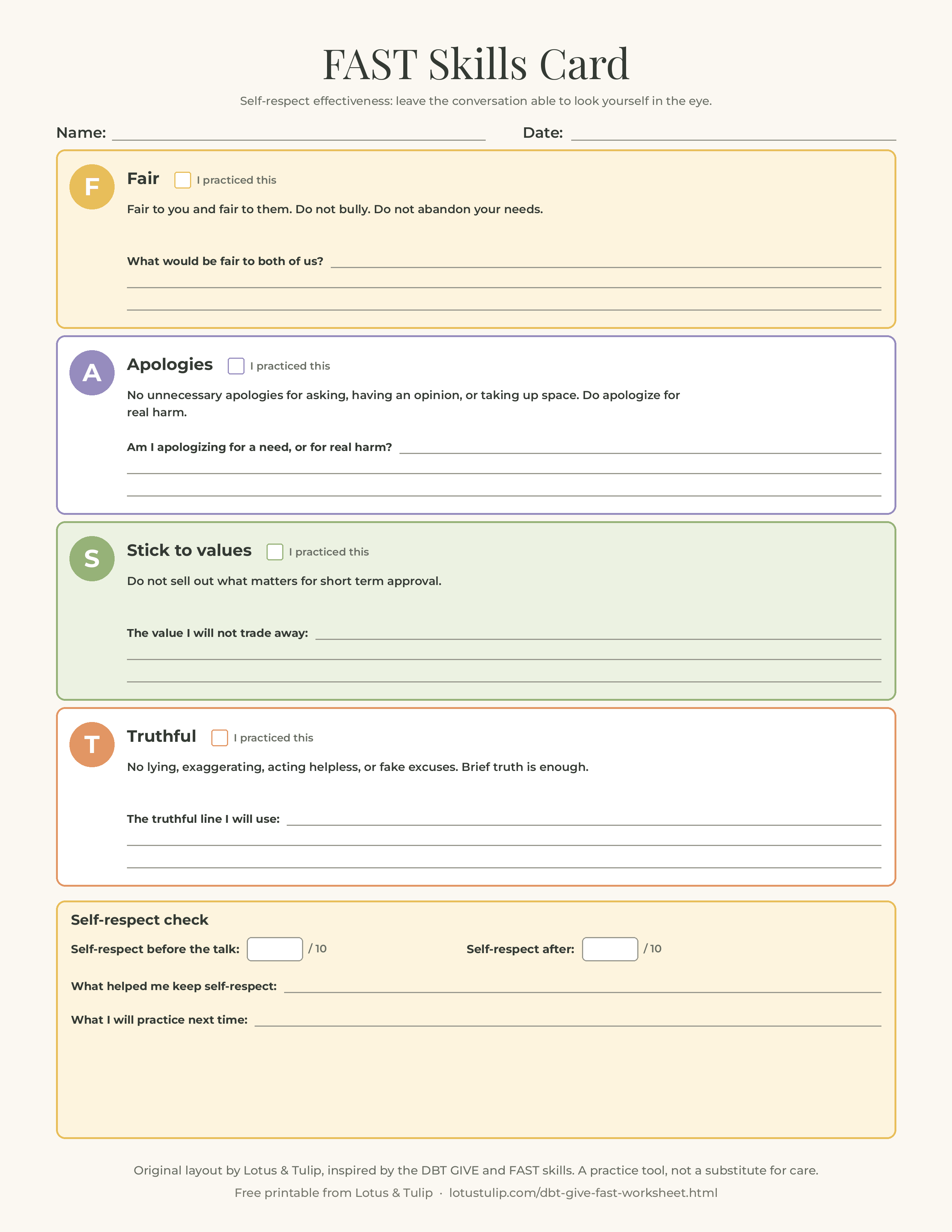
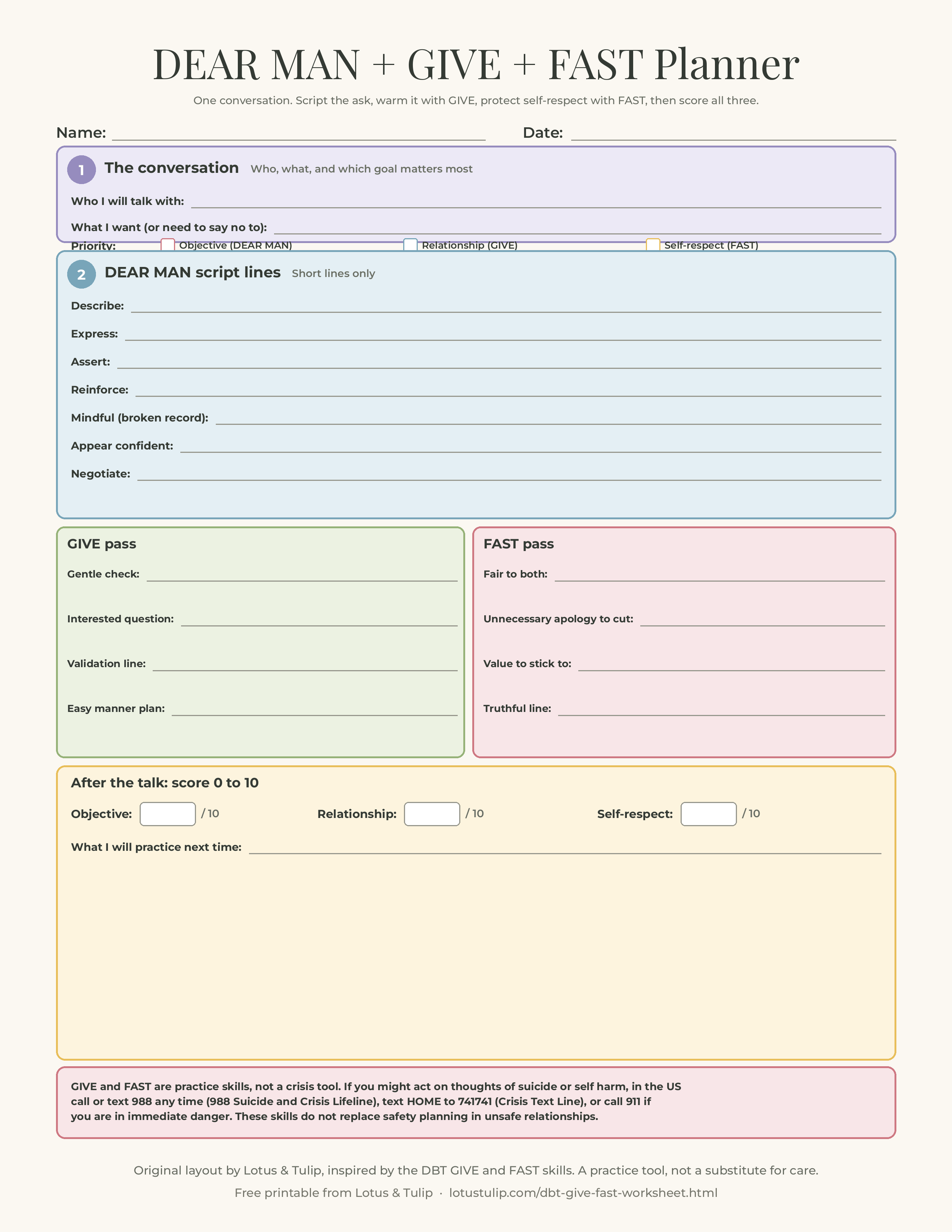
Free to print for your own use and for use with your own clients or groups. This is an original layout by Lotus & Tulip, inspired by the DBT GIVE and FAST skills, not a copy of any Linehan handout or worksheet. Please link to this page rather than re-uploading the file.
Related resources
- DBT validation worksheet: the six levels of validation and self-validation, a full guide to the V in GIVE.
- DEAR MAN worksheet: the objective effectiveness skill these pages pair with.
- Healthy boundaries worksheet: limits that support self-respect before and after hard talks.
- I statements worksheet: cleaner Express lines inside DEAR MAN.
- Wise mind worksheet: choosing which effectiveness goal matters most.
- Check the Facts worksheet: clearing emotion driven stories before you speak.
- Conflict resolution worksheet: a broader repair frame for kids and teens.
- Distress tolerance worksheets: when intensity is too high to talk well yet.
Sources
- Linehan, M. M. (2015). DBT Skills Training Manual, second edition. Guilford Press.
- Linehan, M. M. (2015). DBT Skills Training Handouts and Worksheets, second edition. Guilford Press. Interpersonal Effectiveness Handouts for GIVE (Gentle, Interested, Validate, Easy manner) and FAST (Fair, Apologies, Stick to values, Truthful), alongside DEAR MAN.
- Linehan, M. M., Korslund, K. E., Harned, M. S., and colleagues (2015). Dialectical behavior therapy for high suicide risk in individuals with borderline personality disorder: a randomized clinical trial and component analysis. JAMA Psychiatry, 72(5), 475 to 482.
- Neacsiu, A. D., Rizvi, S. L., and Linehan, M. M. (2010). Dialectical behavior therapy skills use as a mediator and outcome of treatment for borderline personality disorder. Behaviour Research and Therapy, 48(9), 832 to 839.
- Rathus, J. H., and Miller, A. L. work on Dialectical Behavior Therapy for Adolescents (DBT-A), adapting interpersonal effectiveness skills for teens and families.
- 988 Suicide and Crisis Lifeline, 988lifeline.org. Crisis Text Line, crisistextline.org.
GIVE and FAST: FAQ
What do GIVE and FAST stand for in DBT?
GIVE is the relationship effectiveness skill: Gentle, Interested, Validate, Easy manner. FAST is the self-respect effectiveness skill: Fair, no unnecessary Apologies, Stick to values, Truthful. Both come from Linehan's DBT interpersonal effectiveness handouts (2015).
When should I use GIVE vs FAST vs DEAR MAN?
Use DEAR MAN when the main goal is getting what you want or saying no clearly. Lead with GIVE when keeping or repairing the relationship is the priority. Lead with FAST when keeping self-respect is the priority. Most conversations use all three, with one chosen as the priority.
How do GIVE and FAST work with DEAR MAN?
DEAR MAN is the script for the ask or the no. GIVE shapes tone and connection. FAST protects fairness, values, and honesty. A common prep method is to draft DEAR MAN, then run a GIVE pass and a FAST pass before the real conversation.
Is validation the same as agreeing?
No. Validation means acknowledging that the other person's feelings or situation make sense from their point of view. You can validate and still say no, keep a boundary, or hold your request.
Do GIVE and FAST work?
DBT skills training as a package has randomized trial support, and greater skills use has been shown to mediate better outcomes. GIVE and FAST have not been tested alone as standalone treatments. Treat them as well specified component skills inside DBT interpersonal effectiveness.
Can teens use GIVE and FAST?
Yes. Use short scripts, peer and phone examples, and clear teaching that truth beats fake excuses. DBT-A adaptations (Rathus and Miller) support interpersonal effectiveness work with adolescents and families.
Can I print the free GIVE and FAST worksheets for clients?
Yes. The free PDF is an original Lotus & Tulip layout you can print for your own use and for your own clients, students, or groups. Please link to this page instead of re-uploading the file.