
Kids and teens · Updated 2026-11-06
Flexible Thinking Worksheet: Cognitive Flexibility Practice with a Free Printable
Ready-made printable: Executive Function Group Curriculum Holiday 20% off: about $11.04, was $14 (EUR 12) · instant digital download
Buy on EtsyTry it free first: download session 1 free (group at a glance, lesson plan and student page, PDF, 69 KB). Run it with your group, then get all 8 sessions. No email needed.

Flexible thinking (often called cognitive flexibility) is the skill of shifting between ideas, updating a plan when facts change, and seeing more than one workable option. It shows up when a child can try a new seating chart without melting down, when a teen can rewrite an essay outline after feedback, and when an adult can drop Plan A after traffic closes the road and still get to the appointment. It is one of the three core executive function skills in Adele Diamond's widely cited framework, alongside working memory and inhibitory control. Done well, flexible thinking keeps values intact while the strategy can change. Done poorly, it gets confused with "always agree," people pleasing, or abandoning what matters.
School counselors, therapists, and teachers often meet flexible thinking as its opposite: rigid, black and white, or all or nothing thinking. A student insists there is only one correct way to line up. A teen says friendship is ruined forever after one awkward lunch. An adult cannot revise a schedule when a coworker calls out. Those moments are not moral failures. They are stuck strategy moments where the mind treats the first plan as the only plan. A flexible thinking worksheet gives a short, concrete practice sequence: notice the stuck thought, name what changed, list other options, pick a next try, and review what helped.
This Lotus and Tulip page frames flexible thinking as a skill practice aid for kids, teens, school counselors, and clinicians who work with executive function, social problem solving, and CBT style cognitive work. Credit Diamond's executive function reviews honestly. Treat CBT package evidence as a neighbor, not as proof that this printable alone remits diagnoses. This page and printable are an original educational layout. We are not affiliated with any trademarked social cognition curriculum, any textbook publisher, or any specific treatment package, and this is not a copy of any copyrighted worksheet.
This guide covers what flexible thinking is and is not, how it links to executive function with honest caveats, rigid and black and white thinking as a common school and therapy presentation, when to use the skill versus when safety comes first, a nine step how to, fictional kid and teen and adult examples, a comparison table with growth mindset, problem solving, cognitive restructuring, size of the problem, and circle of control, tips for kids, teens, school counselors, and therapists, common mistakes, an honest research section, seven FAQs, and a free three page US Letter printable.
This guide is educational. It is not therapy, not medical advice, and not a diagnosis. If thoughts of ending your life, plans to harm yourself or someone else, or a medical emergency show up, stop the worksheet and get help now: in the US, call or text 988, text HOME to 741741, or call 911. Our safety plan worksheet is a better first tool in that moment. For nearby tools, see the cognitive distortions worksheet, the size of the problem worksheet, the growth mindset worksheet, the problem solving worksheet for kids, the circle of control worksheet, the cognitive restructuring worksheet, and the emotional regulation worksheets for kids.
Jump to the free flexible thinking worksheet (PDF) · How to practice flexible thinking, step by step · Worked examples · Comparisons
What flexible thinking is (and what it is not)
Flexible thinking means you can hold more than one idea at a time, switch strategies when the first one fails, and update conclusions when new facts arrive. Cognitive flexibility is the research term used most often in executive function literature. In everyday school and clinic language, adults say "flexible thinking," "try another way," or "Plan B thinking." The skill is about adapting the how while protecting the why. Values, safety rules, and core commitments can stay firm while the route, timing, or wording changes.
Core idea: the first plan is a draft, not a law. A mind that can generate a second and third option under mild stress usually handles classroom transitions, peer disagreements, and schedule changes with less shame and less escalation. Flexible thinking is not the same as being wishy washy. A flexible thinker can still say no to unfair requests, keep a boundary, and stick with hard practice. What changes is the ability to notice when the current approach is stuck and to choose a different workable move.
Flexible thinking often sits next to other skills. Working memory holds the goal and the options in mind. Inhibitory control pauses the first impulse long enough to consider another option. Emotion regulation keeps intensity low enough that options can be heard. Problem solving turns options into a chosen next step. Growth mindset frames mistakes as information rather than as proof of fixed failure. Cognitive restructuring examines a hot thought that may be locking the person into one harsh conclusion. Size of the problem and circle of control help match the size of the reaction and the focus of effort to the situation.
A flexible thinking worksheet on paper is a practice aid. It can help a student slow a stuck thought between sessions, help a counselor keep a short sequence visible in a twelve minute meeting, or help a parent coach a child through a canceled plan without a power struggle. It is not a substitute for training, supervision, or a living counseling relationship.
Not "always agree." Agreeing with every peer request or adult demand is compliance or people pleasing, not flexibility. Flexible thinking can include: "I will not join that joke. I can still sit with you at lunch." The boundary stays. The social strategy can still adapt.
Not abandoning values. Changing how you study for a test after a low quiz is flexible. Dropping honesty, kindness, or safety to win approval is not. Teach the difference out loud: "We keep our values. We change our plan."
Not the opposite of structure. Many students with rigid thinking need more structure, not less. Visual schedules, clear transitions, and previewed changes often make flexibility possible. Chaos does not teach flexibility. Predictable practice with small, survivable changes does.
Flexible thinking and executive function
Adele Diamond's reviews describe executive functions as top down control processes that help us manage attention, thoughts, and actions toward goals. In that frame, three core EFs are often listed: working memory (holding and updating information), inhibitory control (stopping or delaying a response), and cognitive flexibility (shifting set, switching perspectives, adapting when rules change). Cognitive flexibility depends on the other two: you need enough working memory to hold options, and enough inhibition to pause the first stuck response.
Honest caveats. Executive function models differ by lab and measure. Classroom checklists are not the same as lab task switching batteries. A worksheet that practices "stuck thought to other options" is a skill drill, not a full EF assessment and not a medical diagnosis of ADHD or any other condition. Many students who look rigid are tired, hungry, overwhelmed, or unsupported in transitions. Always check basics and context before labeling a child as inflexible.
In school and counseling practice, flexible thinking drills often target everyday moments: schedule changes, losing a game, peer conflict, assignment feedback, and "my way or no way" moments. Pair the worksheet with co regulation when intensity is high. A flooded student cannot brainstorm three options. Calm the body first, then practice the thinking skill. See the emotional regulation worksheets for kids when feelings block options.
Rigid, black and white, and all or nothing thinking
Rigid thinking shows up as insistence on one correct way, difficulty shifting after a rule change, or catastrophic conclusions from one event. Black and white thinking (also called all or nothing thinking) is a common cognitive distortion where outcomes are sorted into total success or total failure. In school, that might sound like: "If I am not first, I am last." In friendship: "If you sit with someone else once, you are not my friend." In therapy: "If I slipped once, the whole plan is ruined."
These patterns often travel with anxiety, perfectionism, autism related preference for sameness, ADHD related difficulty shifting set under load, trauma related threat scanning, or simply under practiced coping with change. Do not diagnose from a worksheet. Do notice the stuck thought and practice options. Cross link gently to the cognitive distortions worksheet when a label reduces shame rather than adding it. Pair with the size of the problem worksheet when the reaction size does not match the event, and with the growth mindset worksheet when "not yet" language helps. Use the problem solving worksheet for kids when the next step needs a fuller plan, the circle of control worksheet when effort is leaking into what cannot be controlled, the cognitive restructuring worksheet when a hot thought needs evidence work, and the emotional regulation worksheets for kids when the body is too loud for brainstorming.
When describing expected versus unexpected behavior in school settings, keep language generic and descriptive. Name what helps the group (safe hands, taking turns, trying a Plan B) without using trademarked social curriculum branding. Lotus and Tulip is not affiliated with any trademarked social thinking product line.
When to use flexible thinking (and when not to)
Good early uses: schedule or seating changes, losing a game, assignment feedback, peer disagreements with more than one fair option, "only one way" moments that are low to medium intensity, and homework between counseling sessions when a student already understands Plan A versus Plan B language.
Prefer another tool first when:
- Acute safety risk or medical emergency: stabilize and get help (988, HOME to 741741, 911). Prefer a safety plan.
- Flooded emotion where the person cannot name even one other option: shift to co regulation, grounding, or calm down skills first.
- When the stuck thought is a harsh self judgment that needs evidence work: prefer cognitive restructuring or a thought record style page.
- When the job is matching reaction size: use size of the problem first.
- When effort is aimed at what cannot be controlled: use the circle of control first.
How to practice flexible thinking, step by step
- Check safety and fit. If acute crisis, medical emergency, or the person cannot engage safely, pause. Use crisis pathways first: 988, HOME to 741741, or 911 when needed. Prefer a safety plan in that moment.
- Name the stuck moment. One concrete scene: who, where, when. Prefer "Tuesday gym class when teams changed" over "my whole life is unfair."
- Write the stuck thought. One sentence in the person's words. Examples: "There is only one right way." "If the plan changes, everything is ruined." "I have to win or I am a failure."
- Name the feeling and intensity. Word plus 0 to 10 or 0 to 100. Mad 8/10 is clearer than "bad."
- What changed or what is new? Fact, not drama. The teacher moved seats. The friend was late. The quiz score was lower than hoped. Traffic closed the road.
- List at least three other options. Silly options are allowed at first. Quantity before quality. Include one kind option and one tiny option.
- Pick a next try. One option that is safe, values aligned, and small enough to start today. Say when and where.
- Try it and notice what happened. What worked? What still felt hard? Re rate the feeling if useful.
- Review next time. What stuck thought returned? Which Plan B helped? Adjust. Use the free practice log for short reps between sessions. Bridge to problem solving or cognitive restructuring when needed.
Practice on ordinary stuck moments first. Skill grows with concrete scenes and honest options, not with one perfect debate about flexibility.
Worked fictional examples
Kid example (fictional): Maya, age 8, always sits by the window. On Wednesday the teacher rotates seats. Stuck thought: "If I cannot sit by the window, school is ruined." Feeling: mad 8/10, worried 6/10. What changed: seating chart rotated. Other options: ask for a turn next month, notice one good thing about the new seat, use a calm corner for two minutes then rejoin, draw the window at recess. Next try: two calm breaths, sit in the new seat for the first lesson, tell the teacher one thing that helps. After: mad 4/10. Written on the free fill in page.
Teen example (fictional): Leo, age 14, planned to present with a partner. The partner is sick. Stuck thought: "Without my partner I will fail and everyone will laugh." Feeling: anxiety 75/100. What changed: partner absent. Other options: ask to present alone with notes, ask for a one day delay, pair with a third classmate for this period only, present a shorter version today. Next try Leo owns: ask the teacher for a one day delay and outline three slides tonight. After anxiety: 45/100. Mini card kept in binder.
Adult example (fictional): Priya, age 36, planned a grocery run then a 7 p.m. call. Road closed. Stuck thought: "If I miss the grocery run, the whole evening is ruined." Feeling: frustration 70/100. What changed: detour. Other options: shop tomorrow morning, order staples for delivery, do the call first then a shorter shop, ask a household member to grab milk. Next try: do the call on time, order milk and bread for delivery, shop tomorrow. Frustration after: 30/100.
School counselor note (fictional): In a ten minute meeting, a counselor helps a student fill stuck thought, what changed, three options, and one next try. No lecture. Same spirit as fuller flexible thinking practice, compressed for school time. Optional practice, never forced disclosure.
Flexible thinking vs growth mindset, problem solving, cognitive restructuring, size of the problem, and circle of control
| Flexible thinking | Growth mindset | Problem solving | Cognitive restructuring | Size of the problem / circle of control | |
|---|---|---|---|---|---|
| Main job | Shift strategies and see more than one option when plans change | Frame ability as improvable with effort and strategy | Define a problem, generate solutions, pick and try one | Examine a hot thought with evidence for and against | Match reaction size; focus effort on what can be influenced |
| Best early use | Stuck on one way after a change or disappointment | When "I can't" language blocks trying | When a clear problem needs a plan | When a harsh or absolute thought locks mood | When reaction size or control focus is off |
| Output | Stuck thought, other options, next try | Yet language, strategy focus, practice plan | Chosen solution and follow up | Balanced thought and re rated emotion | Sized reaction and control map |
| Cross link | This page | Growth mindset | Problem solving | Cognitive restructuring | Size of the problem · Circle of control |
These tools cooperate. Flexible thinking generates options when the mind locks on one path. Growth mindset supports the belief that another try is worth it. Problem solving organizes options into a plan. Cognitive restructuring loosens absolute thoughts that block options. Size of the problem and circle of control keep reaction and effort proportional. Teach one tool clearly before stacking four on day one. Related neighbors: the cognitive distortions worksheet and the emotional regulation worksheets for kids.
Kids, teens, school counselor, and therapist tips
Kids. Prefer short scenes ("what happened at recess") and plain words ("Plan B" or "another way" instead of "cognitive flexibility"). Draw options. Allow one silly option to loosen black and white thinking. Keep practice optional and playful. Preview changes when you can.
Teens. Prefer concrete school or peer scenes. Let them reject jargon. "Stuck thought to other options" often lands better than "flexible thinking worksheet." Keep next tries tiny and within their real control. Pair with CBT worksheets for teens when a harsh thought needs evidence work.
School counselors. Short meetings favor a compressed sequence: stuck thought, what changed, three options, one next try. Groups can practice with low stakes "what would you tell a friend" prompts and schedule change role plays. Follow district crisis protocol if risk appears. Optional practice, never forced disclosure. Keep descriptions of helpful versus unhelpful group behavior generic and non branded.
Therapist tips:
- Stay in the client's language. Reflect their verbs. Do not overwrite their stuck thought with your favorite reframe.
- Co regulate before brainstorming. Options appear after intensity drops.
- Keep scenes concrete. Abstract lectures on flexibility rarely change Tuesday's seating chart meltdown.
- Protect values while changing strategy. Say the difference out loud.
- Quantity first. Three options beat one perfect option that never arrives.
- Bridge to neighbors when needed. Use restructuring, size of the problem, circle of control, or problem solving when the formulation calls for it.
- Measure function. Ask what changed: faster recovery after a plan change, more options named, less shame after trying Plan B.
Common mistakes
- Calling people pleasing "flexibility." Agreeing with everything is not the skill.
- Abandoning values and calling it adapting.
- Practicing only when flooded. Skill grows in calm, then transfers to harder moments.
- Demanding flexibility without preview or structure. Many rigid moments need clearer routines first.
- Using trademarked social curriculum phrases as branding when generic descriptive language would teach the same idea without affiliation claims.
- Skipping what changed, so the talk stays abstract.
- Stopping at options without a next try and a review.
- Using it in acute crisis instead of safety first.
- Treating the worksheet as therapy. Paper supports practice. It does not replace a clinician when problems are severe or lasting.
What the research says (honestly)
Flexible thinking drills are a skill practice aid, not a standalone RCT treatment. Do not claim this free printable remits diagnoses or replaces evidence based care for ADHD, autism, anxiety, or other conditions.
Executive function reviews. Adele Diamond's reviews of executive functions summarize working memory, inhibitory control, and cognitive flexibility as core EFs that support goal directed behavior, with development across childhood and sensitivity to stress, practice, and context. Treat that as a conceptual map for why "try another way" skills matter in school and counseling, not as proof that filling a flexible thinking worksheet alone improves EF batteries or grades.
CBT package evidence as neighbor. Hofmann, Asnaani, Vonk, Sawyer, and Fang (2012), in Cognitive Therapy and Research, reviewed meta analyses on the efficacy of CBT across many conditions. Cognitive work that loosens rigid, absolute thoughts often appears inside CBT packages. That is package level encouragement for CBT informed practice nearby, not evidence that this printable alone is a complete therapy.
School SEL caveats. Social and emotional learning programs vary widely in quality, dosage, and outcomes. A short flexible thinking worksheet used in counseling or classroom practice is not the same as a multi year SEL curriculum evaluation. Avoid overclaiming school wide effects from one printable.
Honest caveat. Use flexible thinking practice inside a coherent plan with co regulation, clear routines, and neighboring tools when needed. For severe mood problems, trauma, psychosis, or acute risk, use disorder appropriate care and crisis pathways. No study tests this three page Lotus and Tulip printable alone.
Free flexible thinking worksheet (PDF)
The free flexible thinking printable has three pages in US Letter size:
- Page 1: Flexible Thinking Steps card. Eight step sequence from stuck moment through review, plus safety reminders.
- Page 2: My Flexible Thinking Worksheet. Fill in stuck thought, feeling, what changed, other options, next try, and what happened after.
- Page 3: Practice Log + teen/kid mini card. Seven day rows plus a cut out reminder for stuck thought, other options, and next try.
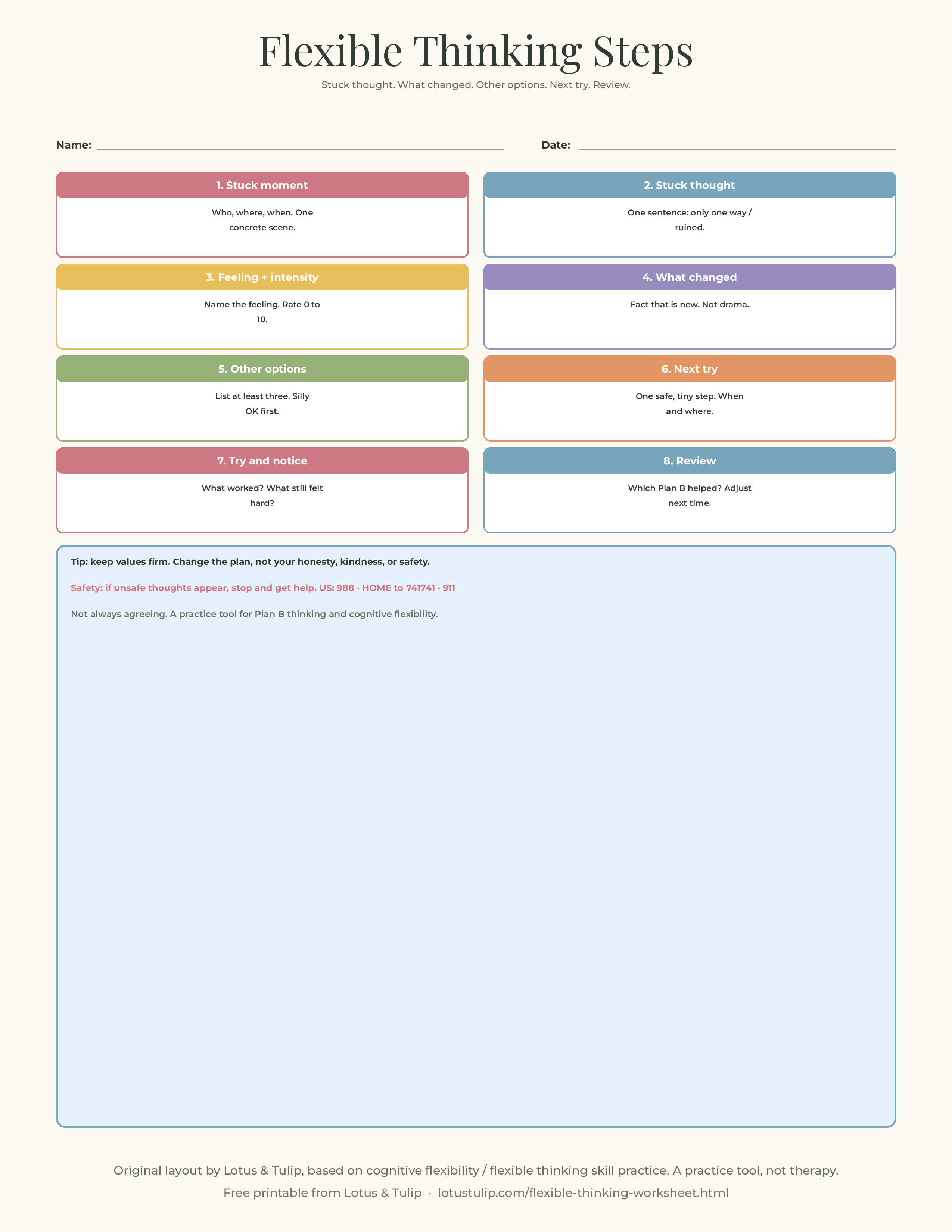
Download the free flexible thinking worksheet (PDF, 3 pages, US Letter)
Prefer single images? Page 1: Flexible Thinking Steps (PNG) · Page 2: My Flexible Thinking fill in (PNG) · Page 3: Practice Log (PNG)
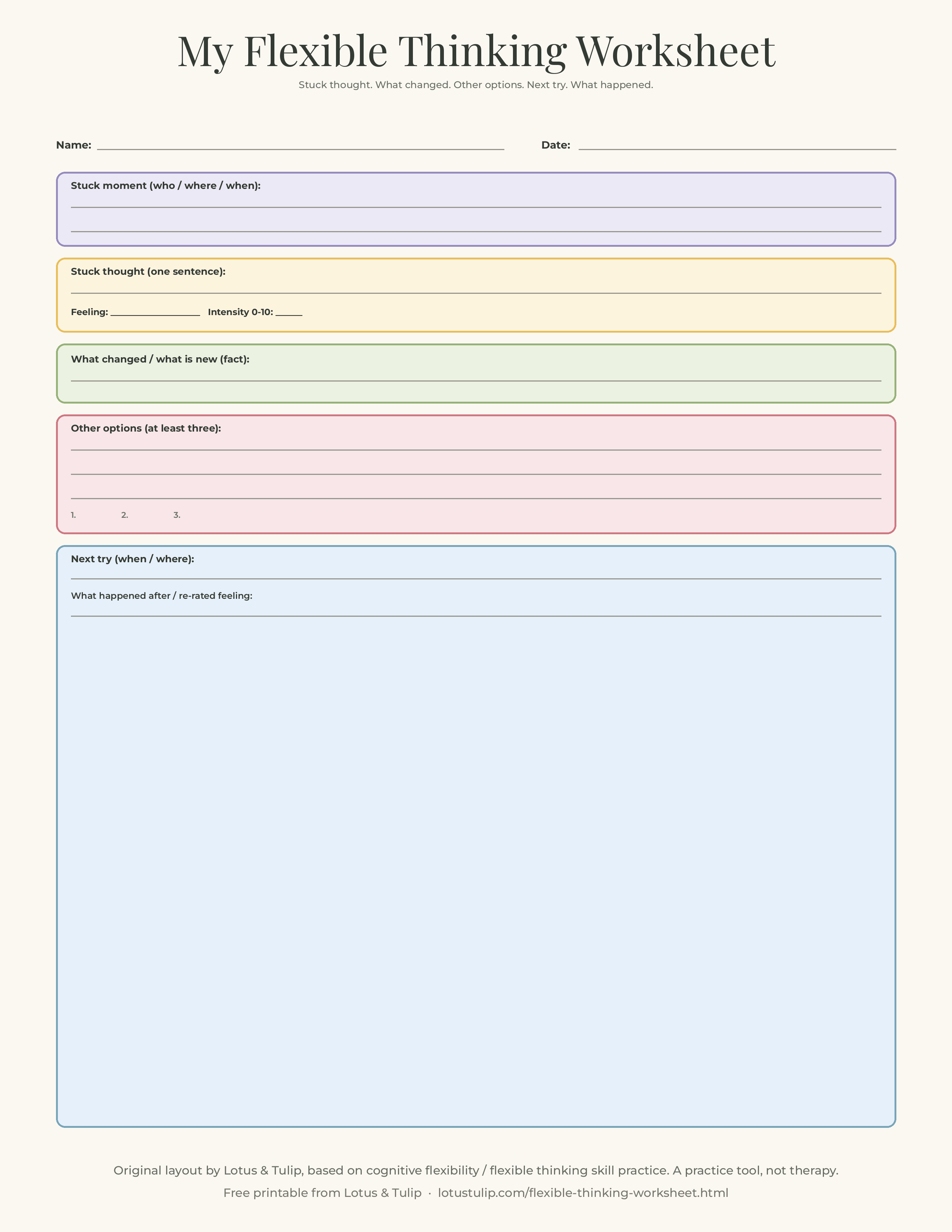
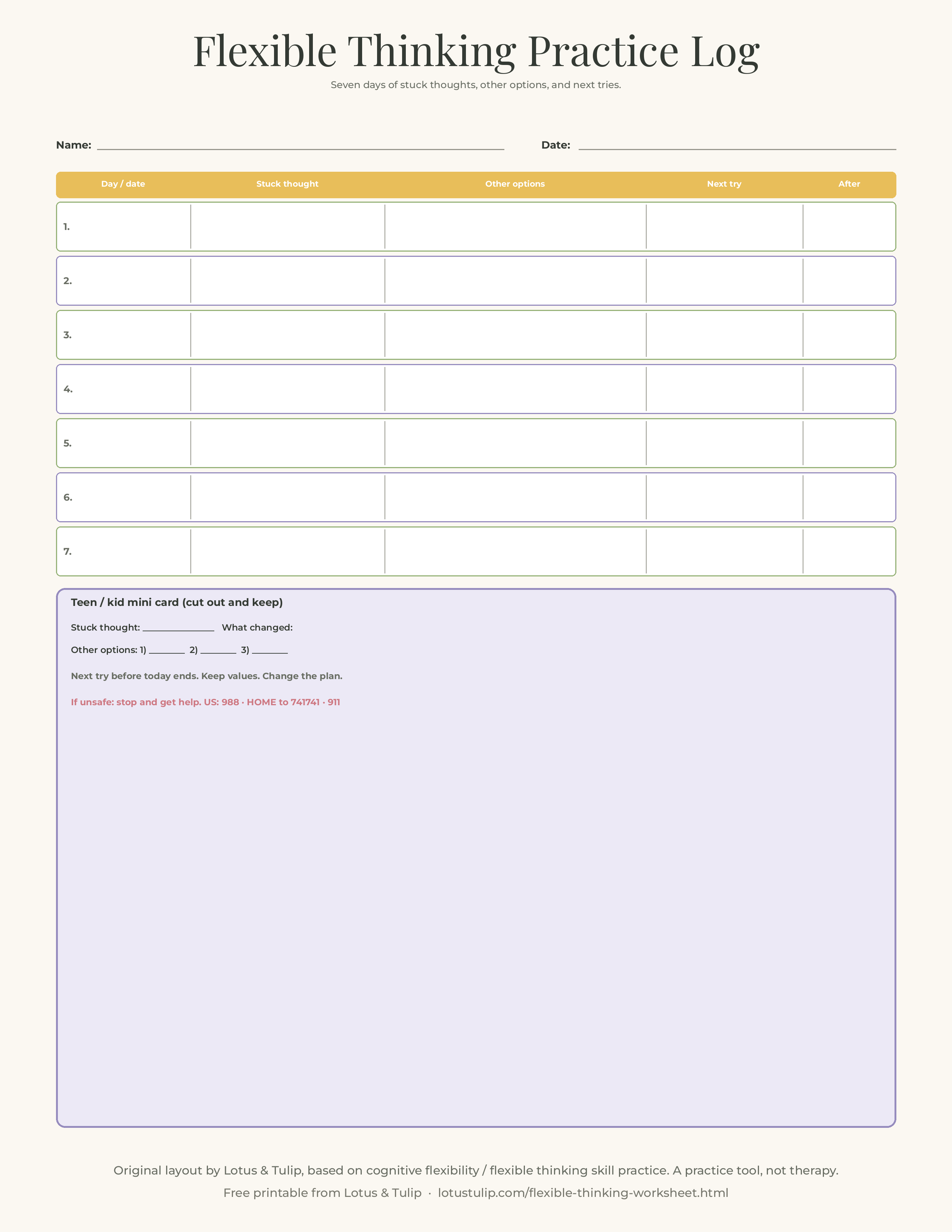
Free to print for your own use and for use with your own clients, students, or groups. This is an original layout by Lotus & Tulip, based on cognitive flexibility / flexible thinking skill practice associated with executive function teaching (including Diamond's EF framework) and neighboring CBT style cognitive work. It is not affiliated with those authors, any trademarked social cognition curriculum, or any specific treatment package, and is not a substitute for therapy. Please link to this page rather than re-uploading the file.
Related resources
- Cognitive distortions worksheet: thinking trap labels used gently.
- Size of the problem worksheet: match reaction size to the event.
- Growth mindset worksheet: yet language and strategy focus.
- Problem solving worksheet for kids: define, brainstorm, choose, try.
- Circle of control worksheet: what I can and cannot control.
- Cognitive restructuring worksheet: evidence for and against hot thoughts.
- Emotional regulation worksheets for kids: feelings signals and calm plans.
- Executive functioning worksheets for kids: EF skill practice pages.
- Impulse control worksheets for kids: pause and think skills.
- Social skills worksheets for kids: skill steps for peer moments.
- Safety plan worksheet: when the moment is about staying alive.
Sources
- Diamond, A. Executive function reviews describing working memory, inhibitory control, and cognitive flexibility as core EFs. Credit the lineage; models and measures vary by source. Not a claim that this printable improves EF test scores.
- Hofmann, S. G., Asnaani, A., Vonk, I. J. J., Sawyer, A. T., and Fang, A. (2012). The efficacy of cognitive behavioral therapy: A review of meta-analyses. Cognitive Therapy and Research, 36(5), 427 to 440. Package level CBT review across conditions; neighbor evidence, not proof for flexible thinking worksheets alone or for this printable.
- Honest caveat: flexible thinking / cognitive flexibility drills are a skill practice aid. EF reviews and CBT package reviews are not the same as technique only RCTs of this three page Lotus and Tulip printable. School SEL program results vary and do not validate one free worksheet.
Flexible thinking worksheet: FAQ
What is flexible thinking or cognitive flexibility?
Flexible thinking (cognitive flexibility) is the skill of shifting between ideas, updating a plan when facts change, and seeing more than one workable option. In executive function teaching it sits beside working memory and inhibitory control. It is not the same as always agreeing or abandoning values.
Is flexible thinking the same as growth mindset or problem solving?
No. Growth mindset frames ability as improvable. Problem solving organizes a full plan from problem to chosen solution. Flexible thinking focuses on unlocking stuck "only one way" moments by generating other options and a next try. They work well as neighbors.
How is this different from cognitive restructuring?
Cognitive restructuring examines a hot thought with evidence for and against and builds a balanced alternative. Flexible thinking generates strategy options when a plan or rule changes. If the lock is a harsh absolute thought, restructuring may fit first. If the lock is "only one way," flexible thinking may fit first.
Can kids and school counselors use it?
Yes, often with plain "Plan B" or "another way" language. Keep steps tiny, optional, and school safe. Follow crisis protocol when risk appears. Preview changes when you can.
Does a flexible thinking worksheet work on its own?
A worksheet is a practice aid, not a standalone treatment. Diamond style EF reviews and CBT package reviews speak to broader frameworks, not to this free page alone. Use it inside counseling, school support, or therapy, and get licensed care for persistent or severe problems.
When should I not use flexible thinking practice?
Do not use it as the first move in acute safety risk, medical emergency, or when the person is too flooded to name even one other option. Stabilize and get help first when needed: 988, HOME to 741741, or 911. Use a safety plan when staying alive is the job.
Is this affiliated with trademarked social thinking curricula?
No. This is an original Lotus and Tulip educational layout. When we describe helpful versus unhelpful group behavior, we use generic descriptive language. We are not affiliated with any trademarked social cognition product line.