
Therapist worksheets · Impostor feelings, self-doubt and CBT · Updated 2026-11-13
Impostor syndrome worksheet: what impostor feelings are, what the research shows, and how to stop the cycle (free printable)
Thoughts and beliefs: CBT Worksheets for Therapists, 20 pages including thought records and core beliefs Holiday 20% off: about $11.04, was $14 (EUR 12) · fillable PDF, instant digital download
Buy on EtsyTry it free first: download a fillable sample (thought record and evidence for and against, PDF, 105 KB). Type into it on screen, then get the full pack. No email needed.
When it comes with low mood: Depression and Behavioral Activation Worksheets for Therapists Holiday 20% off: about $9.20, was $12 (EUR 10) · instant digital download
Buy on EtsyA full caseload: Therapist Worksheets Mega Bundle (8 packs incl. DBT, CBT, ACT, anxiety, grief and ADHD) Holiday 20% off: about $35.88, was $45 (EUR 39) · fillable PDFs for all 8 packs plus 160 printable pages, instant digital download
Buy on EtsyYou got the job, the grade or the promotion, and the first feeling was not pride. It was a quiet alarm: they made a mistake, and sooner or later someone will notice. So you prepare twice as hard as anyone else, or you put it off until the night before, and when it goes well anyway you decide you got lucky. Then the next task arrives and the whole thing starts again.
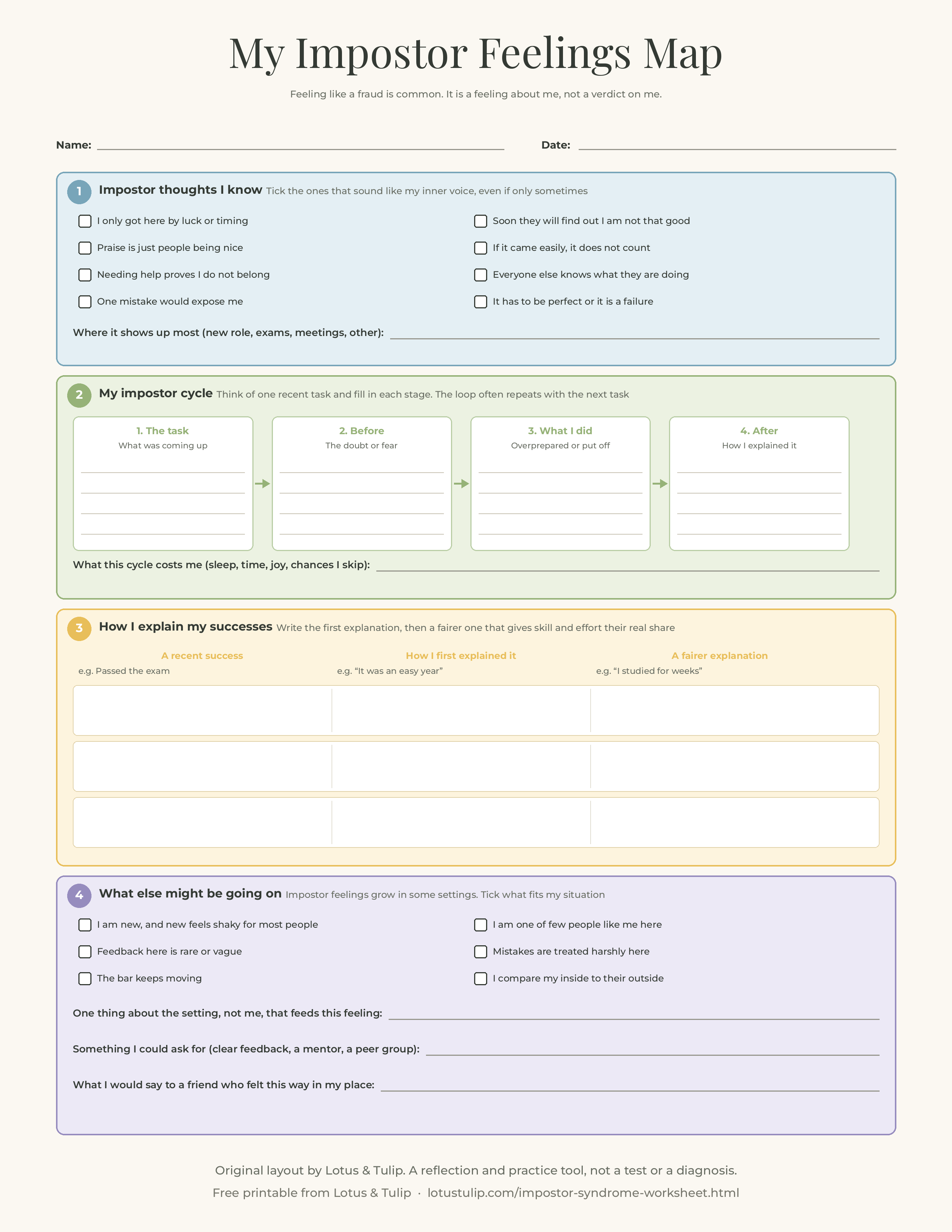
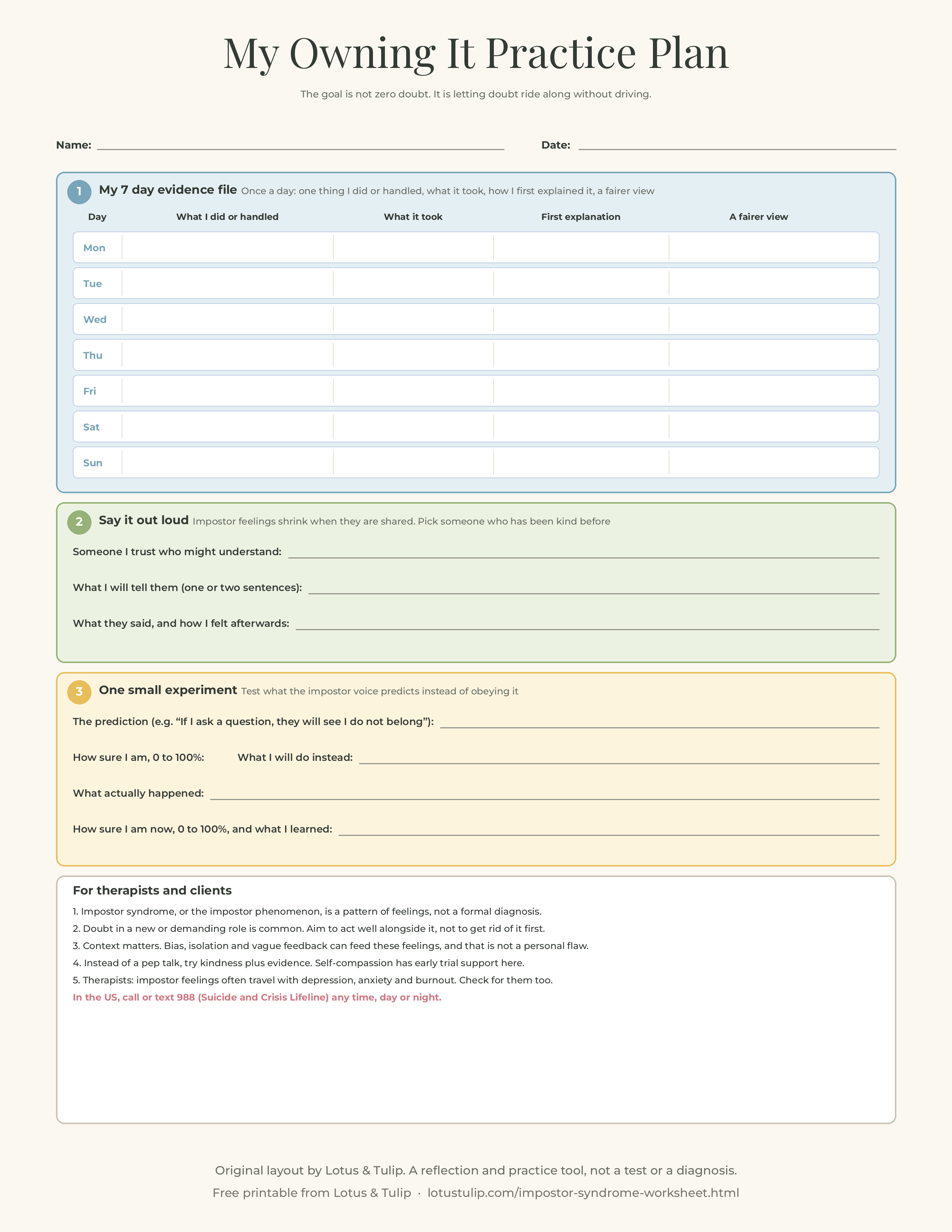
That loop has a name. This guide is for adults and the therapists who work with them. It explains what impostor syndrome (also spelled imposter syndrome) is and is not, where the idea comes from, what the research does and does not show, nine practical steps, common mistakes and examples. It ends with a free 2 page printable: My Impostor Feelings Map, which maps your impostor thoughts, your own impostor cycle, how you explain your successes and what in your setting feeds the feeling, and My Owning It Practice Plan, with a 7 day evidence file, a plan for saying it out loud and one small experiment.
Download the free impostor syndrome worksheet (PDF, 2 pages, US Letter)
Direct download, no email or sign up. See the pages first.
What impostor syndrome is, and what it is not
It is a feeling of being a fraud despite real evidence of ability. Psychologists Pauline Rose Clance and Suzanne Imes described the "impostor phenomenon" in 1978, based on their work in therapy, groups and college classes with over 150 high achieving women. Despite degrees, honors and praise, these women believed they were not really bright and had fooled everyone who thought otherwise. They put their success down to luck, misgrading, other people's faulty judgment or a mistake in the selection process, and feared being found out.
It is not a diagnosis. Impostor syndrome is not a disorder in the DSM-5-TR, and there are no formal diagnostic criteria. Clance and Imes used the word "phenomenon", and many researchers still prefer it, because "syndrome" makes a common experience sound like an illness. It is best understood as a pattern of thoughts and feelings that many capable people have, more strongly in some settings than others.
It is not the same as low confidence in a new skill. Feeling unsure the first week of a job you have never done is reasonable. The impostor pattern is when the doubt survives the evidence: success after success, and the belief that you do not deserve to be there stays the same.
The impostor cycle
Clance described a cycle that keeps the feeling going. A task comes up, such as an exam, a project or a presentation, and brings strong doubt or fear. The person then either overprepares, working far more than needed, or procrastinates and prepares in a last minute rush. The task goes well. But the success gets credited to the huge effort or to luck, not to ability, so it does not count as proof. The doubt is still there for the next task, and the cycle repeats.
Clance also noted related patterns: fear of evaluation, terror of failure and looking foolish, trouble taking in praise, and comparing your own weaknesses with other people's strengths. Page 1 of the worksheet lets you map your own version of the cycle with one real task.
How researchers measure it
The most used measure is the Clance Impostor Phenomenon Scale (CIPS; Clance, 1985). It has 20 statements rated from 1 (not at all true) to 5 (very true), giving a total of 20 to 100. Clance's own guide reads 40 or less as few impostor characteristics, 41 to 60 as moderate, 61 to 80 as frequent and above 80 as intense. Factor analyses have described three themes in the items, often labeled fake, discount and luck.
Our free worksheet is not the CIPS and not a screening test. It uses our own wording to help you reflect, and it does not produce a score.
What the research shows
It is common, but nobody knows exactly how common. Bravata and colleagues (2020) published the first systematic review, covering 62 studies and 14,161 participants. Reported prevalence ranged from 9% to 82%, mostly depending on which scale and cutoff a study used, so be wary of any single headline figure. More than half the studies were of students. Rates were particularly high in some ethnic minority groups.
It is not only a women's issue. Although the original description came from work with women, the same review found impostor feelings common in both men and women and across ages, from adolescents to late career professionals. Most of the included studies that compared the two found no difference, though a few found higher scores among women. One experiment by Badawy and colleagues (2018) with 268 undergraduates suggested the pattern may play out differently: men with strong impostor feelings reported more anxiety and put in less effort after negative feedback, while women with strong impostor feelings did not show that drop.
It often travels with other problems. In the Bravata review, impostor feelings were frequently linked with depression and anxiety, and with lower job performance and job satisfaction and with burnout, including among clinicians. These are mostly cross sectional associations, so they do not show which comes first.
The setting matters. Feenstra and colleagues (2020) argued that research has focused too much on the individual. Being one of few people like you in a room, facing stereotypes, or working somewhere with little feedback or harsh treatment of mistakes can create impostor feelings from the outside in. That is why page 1 has a section on the setting, not just on you.
Treatment research is young. When Bravata and colleagues searched the literature up to May 2018, they found no published studies evaluating treatments. Since then a few randomized trials have appeared. Liu, Wei and Russell (2023) randomly assigned 227 college students to a brief online self-compassion program (four modules of about 45 minutes) or no intervention, and the program reduced impostor feelings and maladaptive perfectionism. Fainstad and colleagues (2022) randomly assigned 101 women resident physicians to six months of online group coaching or usual training, and impostor scores fell in the coaching group compared with controls, along with emotional exhaustion. These are promising but small, specific samples, mostly with short follow up.
The honest caveat. There is no trial of this worksheet. The steps below borrow from cognitive behavioral therapy (examining how you explain success and testing predictions), self-compassion work, and the long standing clinical advice from Clance and Imes to share the feeling with others, and they work best alongside a therapist.
How to use an impostor syndrome worksheet, step by step
- Name the pattern without judging it. Start with the idea that this is a common feeling many capable people have, not a secret flaw. Saying "this is my impostor voice" creates a little distance from it.
- Tick your impostor thoughts. On page 1, mark the lines that sound like your inner voice, such as "I only got here by luck" or "Needing help proves I do not belong", and note where they show up most.
- Map one real cycle. Pick a recent task. Write what it was, the doubt you felt before, what you did (overprepared or put it off) and how you explained the result afterwards. Then note what the cycle costs you.
- Look at how you explain success. For three recent wins, write your first explanation, then a fairer one that gives skill, effort, help and luck each their honest share. The aim is accuracy, not bragging.
- Check the setting. Tick what fits your situation, such as being new, being one of few people like you, or getting vague feedback. Name one thing about the setting that feeds the feeling and one thing you could ask for.
- Keep a 7 day evidence file. On page 2, once a day, write one thing you did or handled, what it took, how you first explained it and a fairer view. Small things count: a hard email, a good question, a problem solved.
- Say it out loud. Choose someone you trust and tell them, in a sentence or two, that you sometimes feel like a fraud. Many people discover the other person feels the same way, which is part of why groups can help.
- Run one small experiment. Write down what the impostor voice predicts, for example "If I ask a question, they will see I do not belong", and how sure you are from 0 to 100%. Do the thing anyway, then record what actually happened and how sure you are now.
- Answer the voice with kindness and evidence. When doubt shows up, try what you would say to a friend in the same spot, plus one fact from your evidence file. Review the pages weekly with your therapist or on your own.
For more on testing predictions, see the behavioral experiment worksheet, and for the deeper "I am not good enough" belief, the core beliefs worksheet.
Common mistakes
- Waiting for the doubt to go away first. Many people hold off on applying, speaking up or sharing work until they feel ready. The feeling often fades after action, not before it.
- Using praise as a cure. Telling someone "but you are brilliant" rarely helps, because the impostor pattern discounts praise. Specific, factual feedback and their own evidence log work better than reassurance.
- Making it only an individual problem. If the workplace or school is isolating, biased or harsh about mistakes, that deserves attention too. Not every doubt is a distortion.
- Missing depression, anxiety or burnout. Impostor feelings often come with these. If low mood, exhaustion, panic or hopelessness are present, address them directly with appropriate care.
- Turning the worksheet into another performance. Filling it in perfectly is not the point. Rough notes are fine, and a missed day is not proof of anything.
Examples
- The new manager: Ticked "Soon they will find out I am not that good". Cycle: big team meeting, two nights of overpreparation, meeting went well, explained as "I just got lucky with the questions". Fairer explanation: "I know this project well and I prepared." Experiment: prepared for one hour only for the next meeting. Sureness that it would go badly fell from 80% to 35%.
- The graduate student: Ticked "Everyone else knows what they are doing" and "I am one of few people like me here". Told a peer in her program about the feeling and learned the peer felt the same. Asked her advisor for clearer written feedback. Linked page: the self compassion worksheet.
- The clinician: A newly licensed counselor felt like a fraud with every client who did not improve fast. Evidence file entries included "client said she felt heard" and "used the safety plan well". Worked on the rule "If I am not perfect, I am failing" with the cognitive distortions worksheet.
Free impostor syndrome worksheet
This free printable is an original Lotus & Tulip layout on US Letter, in our own wording. Page 1, My Impostor Feelings Map, has a checklist of impostor thoughts, a four stage map of your own impostor cycle, a table for how you explain your successes and a fairer explanation, and a section on what in your setting might feed the feeling. Page 2, My Owning It Practice Plan, has a 7 day evidence file, a plan for sharing the feeling with someone you trust, one small experiment with before and after ratings, and notes for therapists and clients, including the US 988 crisis line.
Download the free impostor syndrome worksheet (PDF, 2 pages, US Letter)
Prefer single images? Page 1: my impostor feelings map (PNG) · Page 2: my owning it practice plan (PNG)
Free to print for use with your own clients or for yourself. Please link to this page rather than re-uploading the file. A reflection tool, not a test, a diagnosis or a substitute for therapy. In the US, call or text 988 in a crisis.
Related resources
- Perfectionism worksheet for adults: rigid standards, the perfectionism cycle and a free good enough practice plan
- Self-esteem worksheets for adults: the harsh bottom line belief and a free fairer view practice plan
- Core beliefs worksheet: examining "I am not good enough" with evidence
- Behavioral experiment worksheet: testing predictions in real life
- Self compassion worksheet: a kinder and steadier way to meet self-doubt
- Perfectionism worksheet for teens: healthy striving vs impossible standards, for younger clients
- People pleasing worksheet: when your worth hangs on approval
FAQ
What is impostor syndrome?
It is a persistent feeling of being a fraud despite real evidence of ability, often with fear of being found out and a habit of crediting success to luck or extra effort. Clance and Imes first described it in 1978 as the impostor phenomenon.
Is impostor syndrome a mental health diagnosis?
No. It is not a disorder in the DSM-5-TR and has no formal diagnostic criteria. It is a common pattern of thoughts and feelings that researchers study with questionnaires such as the Clance Impostor Phenomenon Scale.
How common is impostor syndrome?
A 2020 systematic review of 62 studies found rates from 9% to 82%, mostly because studies used different scales and cutoffs. It was common in both men and women and across ages, and particularly high in some ethnic minority groups.
What is the impostor cycle?
Doubt before a task leads to overpreparing or procrastinating. The task goes well, but success is credited to effort or luck rather than ability, so the doubt returns with the next task. The worksheet helps you map and interrupt your own version.
How do you overcome impostor syndrome?
Research on treatment is still early. Small randomized trials suggest brief self-compassion training and group coaching can reduce impostor feelings. Practical steps include noticing the pattern, giving yourself fair credit, keeping an evidence file, sharing the feeling and testing predictions, and getting help for any depression, anxiety or burnout.
Is this impostor syndrome worksheet free?
Yes. It is free to print for use with your own clients or for yourself. Please link to this page rather than re-uploading the file.
Sources
- Badawy, R. L., Gazdag, B. A., Bentley, J. R., and Brouer, R. L. (2018). Are all impostors created equal? Exploring gender differences in the impostor phenomenon-performance link. Personality and Individual Differences, 131, 156 to 163.
- Bravata, D. M., Watts, S. A., Keefer, A. L., Madhusudhan, D. K., Taylor, K. T., Clark, D. M., Nelson, R. S., Cokley, K. O., and Hagg, H. K. (2020). Prevalence, predictors, and treatment of impostor syndrome: A systematic review. Journal of General Internal Medicine, 35(4), 1252 to 1275.
- Clance, P. R. (1985). The Impostor Phenomenon: Overcoming the Fear That Haunts Your Success. Peachtree Publishers.
- Clance, P. R., and Imes, S. A. (1978). The imposter phenomenon in high achieving women: Dynamics and therapeutic intervention. Psychotherapy: Theory, Research and Practice, 15(3), 241 to 247.
- Fainstad, T., Mann, A., Suresh, K., Shah, P., Dieujuste, N., Thurmon, K., and Jones, C. D. (2022). Effect of a novel online group-coaching program to reduce burnout in female resident physicians: A randomized clinical trial. JAMA Network Open, 5(5), e2210752.
- Feenstra, S., Begeny, C. T., Ryan, M. K., Rink, F. A., Stoker, J. I., and Jordan, J. (2020). Contextualizing the impostor "syndrome". Frontiers in Psychology, 11, 575024.
- Liu, S., Wei, M., and Russell, D. W. (2023). Effects of a brief self-compassion intervention for college students with impostor phenomenon. Journal of Counseling Psychology, 70(6), 711 to 724.