
Therapist worksheets · CBT · Updated 2026-11-05
Behavioral Experiment Worksheet: How to Test Hot Thoughts in CBT, with a Free Printable
Ready-made printable: CBT Worksheets for Therapists Fillable PDF, 20 pages: thought record, exposure ladder, activity logs, coping cards and 0 to 10 rating scales
Holiday 20% off: about $11.04, was $14 (EUR 12) · instant digital download
Try it free first: download a fillable sample (thought record and evidence for and against, PDF, 105 KB). Type into it on screen, then get the full pack. No email needed.

A behavioral experiment is a planned real world test of a hot thought or prediction. You write what you believe will happen, design a small experiment that could confirm or disconfirm that belief, drop (or notice) the safety behaviors that usually protect the belief, then compare the outcome with the prediction and update what you learned. In Beck style Cognitive Behavioral Therapy, that sequence is one of the strongest ways to change a belief that talk alone has not shifted.
This guide covers what a CBT behavioral experiment is, how it differs from an exposure hierarchy, a thought record, opposite action, and ABC disputing, how to run one step by step, adult and teen examples, a worked fictional example, common mistakes, tips for therapists, and what the research honestly shows. You also get a free three page US Letter printable: a Behavioral Experiment Planner, an Experiment Record, and a teen friendly mini planner with a belief scale.
This guide is educational. It is not therapy and not a diagnosis. If thoughts of ending your life show up while you plan or run an experiment, put the worksheet down and get help now: in the US, call or text 988, text HOME to 741741, or call 911 in an emergency. Our safety plan worksheet is a better first tool in that moment.
Jump to the free behavioral experiment worksheet (PDF) · How to do a behavioral experiment, step by step · Worked example · Teens and adults
What a behavioral experiment is (and is not)
In cognitive therapy, a belief is treated as a hypothesis, not as a verdict. Aaron T. Beck described designing a task that could test an assumption in session or between sessions: if the assumption is true, X should happen; if it is false, something else should happen. Therapist and client then evaluate the results against the original prediction. That idea is the root of the modern behavioral experiment.
A good experiment has five parts:
- A hot thought or prediction stated as a testable claim. "If I speak up in the meeting, everyone will think I am stupid" is better than "I am anxious about meetings."
- A belief rating before the test (0 to 100%). Numbers make learning visible.
- An experiment plan. Who, what, where, when, and for how long. Small enough to try this week.
- Safety behaviors named and dropped (or tracked). Reassurance seeking, over preparing, scanning faces, sitting near the door, and phone checking often "save" the belief from being tested.
- Outcome vs prediction, belief rating after, and a short learning statement. Then, often, a next experiment.
A behavioral experiment is not the same as "facing your fear until it goes away." Exposure can be part of an experiment, and many anxiety protocols use both. The experiment's main job is to gather information about a prediction. The exposure hierarchy's main job is to approach feared situations in a planned order while learning that anxiety peaks and falls, and that feared outcomes are less likely or less catastrophic than expected. They overlap. They are not copies of each other.
US searchers often type "behavioral experiment worksheet." UK and Commonwealth clinicians often write "behavioural experiment." Same method. This page uses the US spelling in titles and links, and names the UK spelling so both searches find the same guide.
Where the method comes from
Beck's early manuals already treated assumptions as things to test in the world, not only on paper. Later cognitive therapy for panic, social anxiety, OCD, health anxiety, and depression made behavioral experiments a central session tool, not a homework afterthought.
The practical handbook many clinicians keep nearby is the Oxford Guide to Behavioural Experiments in Cognitive Therapy, edited by James Bennett-Levy, Gillian Butler, Melanie Fennell, Ann Hackmann, Martina Mueller, and David Westbrook (Oxford University Press, 2004). It gathers theory and more than 200 worked examples across anxiety, depression, OCD, PTSD, eating problems, and other areas. David M. Clark's cognitive models (for example panic and social anxiety) lean heavily on experiments that drop safety behaviors and check catastrophic predictions. Judith S. Beck's therapist manuals teach the same collaborative empiricism: design the test with the client, predict, act, review.
This free printable is an original Lotus and Tulip layout for planning and recording those tests. It is not affiliated with Oxford University Press, the Beck Institute, or the Oxford Cognitive Therapy Centre, and it is not a substitute for therapy.
Behavioral experiment vs exposure hierarchy vs thought record vs opposite action vs ABC
People searching "how to do a behavioral experiment" often land next to related tools. Use this table to choose.
| Behavioral experiment | Exposure hierarchy (fear ladder) | Beck style thought record | Opposite action / ABC | |
|---|---|---|---|---|
| Main job | Test a specific prediction or hot thought in the real world | Approach feared situations in order while learning about anxiety and outcomes | Gather evidence for and against an automatic thought on paper | Opposite action: act against an emotion urge when the emotion does not fit. ABC/ABCDE: dispute rigid musts and awfulizing |
| Typical question | "What do I predict will happen if I do X without my usual safety move? What actually happened?" | "What is next on my ladder, and can I stay long enough to learn?" | "What is the evidence for and against this thought? What is a balanced view?" | "Is this emotion justified? What would the opposite action be?" or "Even if the worst is true, why must it not happen?" |
| Best early use | When a belief keeps winning the argument on paper, or when safety behaviors are protecting the belief | When avoidance is broad and you need a graded plan (phobia, OCD, social fear) | When the client can catch thoughts and is ready to weigh evidence | Opposite action for unjustified emotion urges; ABCDE when the stuck point is a demand |
| Safety behaviors | Usually named and dropped as part of the test | Often reduced over the ladder; ERP drops rituals | Not the focus, though they may appear in the situation column | Not the focus |
| Cross link | This page | Exposure hierarchy worksheet | CBT thought record | Opposite action · ABC model |
In practice they stack. A thought record may surface a prediction worth testing. An experiment may sit on one rung of a fear ladder. Opposite action may look like an experiment when the hot thought is "If I do not snap back, I will be a pushover." Use the tool that answers the question you have today.
How to do a behavioral experiment, step by step
- Pick one hot thought or prediction. Middling intensity works best for learning. "If I send this draft without one more polish, my manager will think I am careless" is better than "I am a failure at work."
- Write it as a testable claim. Include what you think will happen, to whom, and how you would know. Avoid vague doom. Prefer "two coworkers will look bored and check their phones" over "it will be a disaster."
- Rate belief 0 to 100% before the experiment. Also rate emotion 0 to 10 if that helps.
- Design a small experiment that could disconfirm the belief. Ask: if this thought were wrong, what would I expect to see? Build the test so both outcomes are possible. Keep it specific in time and place.
- List safety behaviors to drop or notice. Over rehearsing, reading faces, apologizing in advance, sitting by the exit, texting a friend for reassurance. Decide which ones you will leave out for this test.
- Plan the logistics and a minimum commitment. When, where, how long, and what "done" looks like. Add a backup if the first plan falls through.
- Run the experiment and observe like a scientist. Notice what happened, not only how you felt. Feelings matter; they are not the only data.
- Record outcome vs prediction. What did you predict? What actually happened? Rate belief again 0 to 100%. Write one learning sentence in your own words.
- Choose a next experiment if needed. Beliefs rarely move from 90% to 10% in one try. A slightly harder or cleaner test often follows. Track a few rounds on the Experiment Record page.
Collaborative empiricism still holds: design the test with the person, treat the belief as a hypothesis, and review the results together without arguing them into a new belief.
A worked adult example (fictional)
Jordan, 29, believes: "If I speak for two minutes in standup without notes, people will think I am unprepared and my lead will follow up with a critical Slack." Belief before: 80%. Anxiety 7/10.
- Experiment: Tomorrow at 10:05 a.m., speak for about two minutes in standup from three bullet points only. No extra notes, no pre apology in chat, no scanning every face for disapproval.
- What would disconfirm: Lead asks a normal clarifying question or says thanks; no critical Slack by end of day; at least one peer continues the thread without looking away in a way that clearly signals contempt.
- Safety behaviors to drop: Writing a full script, asking a friend "was that okay?" right after, and rereading the Slack channel for tone.
- What happened: Jordan spoke for about 90 seconds. Lead asked one logistics question. A peer added a related update. No critical Slack that day. Anxiety peaked at 8, then fell to 4 by lunch.
- Belief after: 45%. Learning: "I can share a short update without a script. Discomfort is not the same as proof that people think I am unprepared."
- Next experiment: Same standup, two days later, without the friend check in afterward.
Notice that the experiment did not require Jordan to believe a forced positive thought first. The world supplied new data. A thought record can still help before or after if the hot thought needs clarifying.
Adult and teen examples
Adults (work, health, relationships):
- Prediction: "If I leave the email in drafts overnight, I will forget something important and look incompetent." Experiment: send by 4 p.m. with a two minute proofread only; no third rewrite.
- Prediction: "If I do not check my heart rate after a coffee, I will miss a warning and something bad will happen." Experiment: sit with the sensation for 10 minutes without checking, then note what actually occurred. (For health anxiety, this belongs inside a clinician guided plan.)
- Prediction: "If I ask for a deadline change once, my client will fire me." Experiment: send one clear request with options; track the actual reply.
Teens (school, friends, social media):
- Prediction: "If I join the lunch table without a funny opener, everyone will go quiet and think I am weird." Experiment: sit down, say hi, ask one normal question; no rehearsed joke.
- Prediction: "If I post without checking the photo ten times, people will laugh at me." Experiment: post once after one check; do not delete for 24 hours; note real comments vs feared ones.
- Prediction: "If I raise my hand when I am unsure, the teacher will think I am dumb." Experiment: ask one clarifying question in a class where the teacher is usually fair; rate belief after.
Keep teen experiments short, concrete, and private. Do not post a filled worksheet on a classroom wall. Follow school or clinic safety rules if risk shows up.
Tips for therapists and school counselors
- Co design the experiment. Compliance rises when the client owns the prediction and the plan.
- Make disconfirmation possible. If every outcome can be twisted into "see, I was right," redesign the test.
- Name safety behaviors out loud. Many clients do not realize that scanning, over preparing, or reassurance seeking are part of the problem.
- Start smaller than your instinct. A clean small win teaches the method. A heroic first try that gets aborted teaches avoidance.
- Separate anxiety from the verdict. High anxiety during a successful test is still a successful test.
- Write the learning in the client's words. "Maybe people are less focused on me than I thought" sticks better than a therapist slogan.
- In schools, keep it skills based and private. Use classroom friendly predictions (raising a hand, joining a group) and follow district policy if risk appears.
- Bridge tools deliberately. Use a thought record to sharpen the prediction, an exposure hierarchy when many situations are avoided, and a mood tracker to see whether experiments move weekly ratings.
Common mistakes with behavioral experiments
- Testing a vague belief. "Things will go badly" cannot be confirmed or disconfirmed. Sharpen it.
- Keeping all the safety behaviors. Then the belief never really meets the world.
- Using the experiment as a pep talk. The point is data, not cheerleading.
- Declaring failure because anxiety was high. Anxiety is often expected. Look at the predicted outcome.
- One and done. Stubborn beliefs need a series of tests.
- Running a high stakes first experiment. Save big career or relationship risks for later, once the method is trusted.
- Using experiments in active crisis. If someone is unsafe, protect first. Use crisis supports, then return to skills work.
- Treating a worksheet as treatment. Persistent depression, anxiety, OCD, trauma symptoms, or health anxiety deserve care from a licensed clinician. A printable alone is practice homework inside a broader plan.
What the research says (honestly)
Behavioral experiments are a core method inside CBT packages. They are rarely tested as a standalone worksheet in randomized trials. Be careful with claims.
Clinical method. Bennett-Levy and colleagues (2004) collected theory and extensive clinical examples of behavioural experiments across many problem areas. The volume is a practice guide, not a single RCT of one form. Beck style cognitive therapy and Clark style cognitive models treat real world hypothesis testing, especially with safety behaviors removed, as a central change mechanism.
CBT overall. Hofmann, Asnaani, Vonk, Sawyer, and Fang (2012) reviewed a representative sample of 106 meta analyses of CBT in Cognitive Therapy and Research. They reported the strongest support for CBT of anxiety disorders, somatoform disorders, bulimia, anger control problems, and general stress. They also noted that more randomized controlled evidence was still needed in several areas, and that meta analytic work on specific subgroups such as ethnic minorities and low income samples was largely missing outside of child and older adult literatures. In plain terms: CBT packages that often include behavioral experiments have a strong evidence base on average, and the map is uneven.
Honest caveat. No trial has tested this free three page Lotus and Tulip printable on its own. Use it as a planning and recording aid inside therapy or a structured program. If symptoms are severe, frequent, or tied to safety concerns, get professional care rather than relying on a worksheet.
Free behavioral experiment worksheet (PDF)
The free behavioral experiment worksheet has three pages in US Letter size:
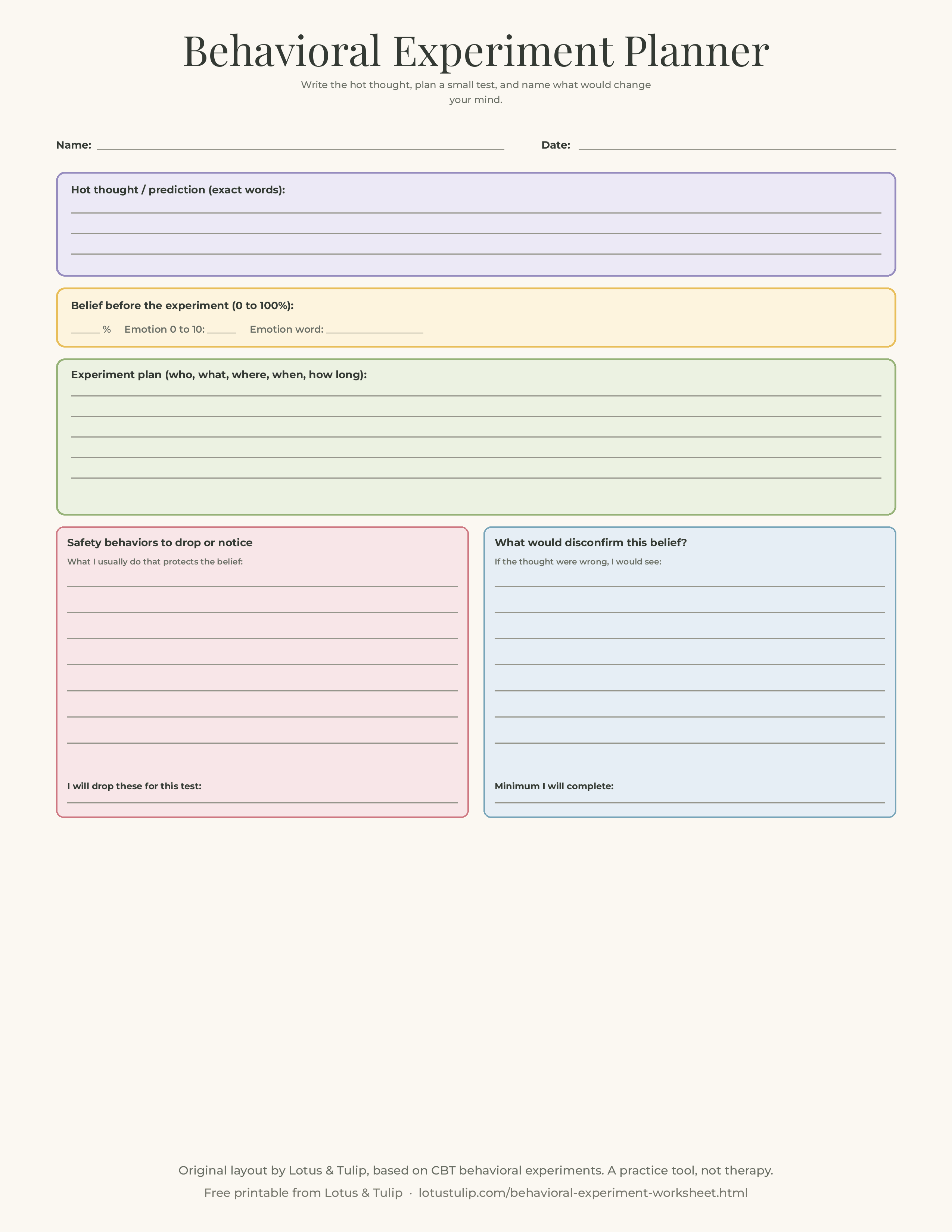
- Page 1: Behavioral Experiment Planner. Hot thought or prediction, belief % before, experiment plan, safety behaviors to drop, and what would disconfirm the belief.
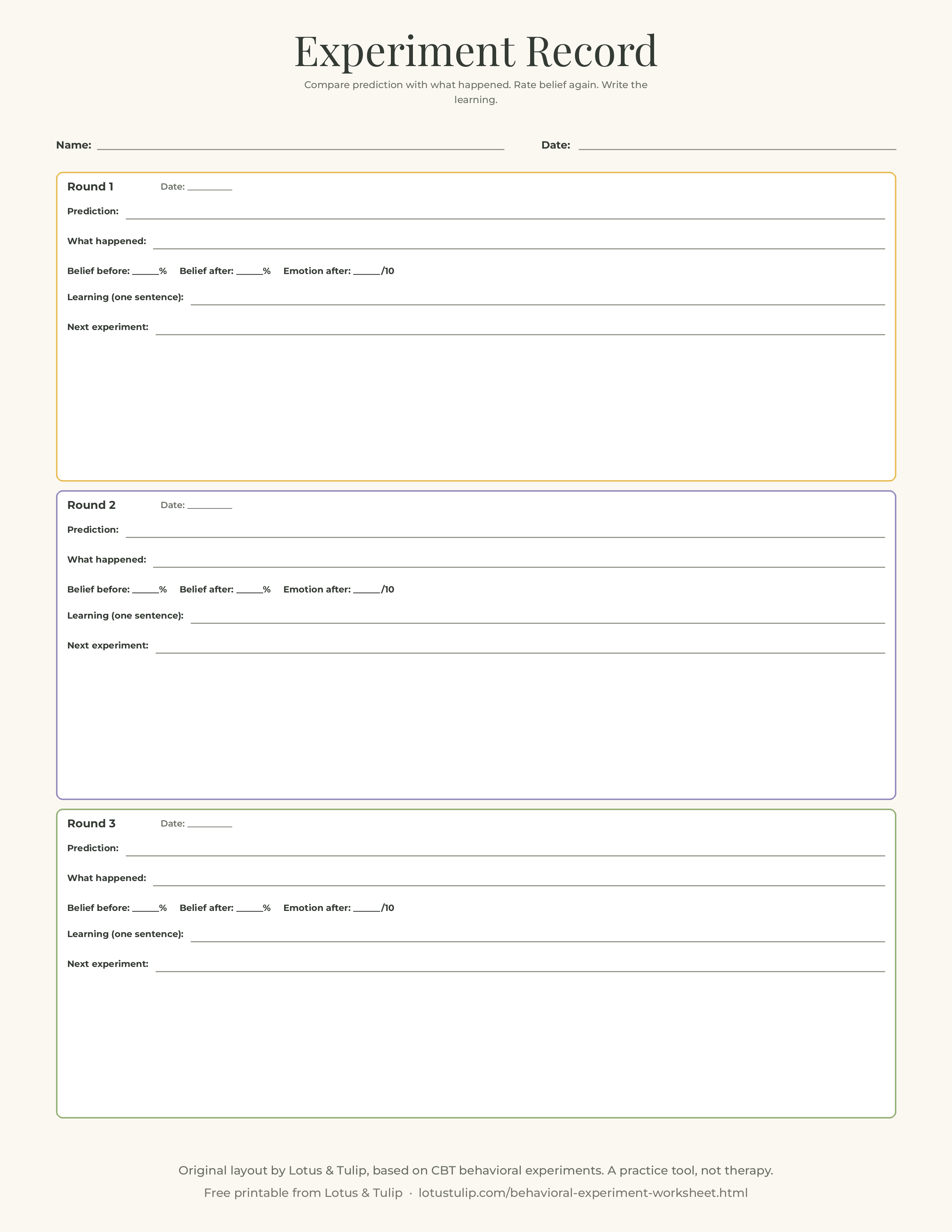
- Page 2: Experiment Record. Prediction vs what happened, belief % after, learning, emotion ratings, and a next experiment line. Room for several rounds.
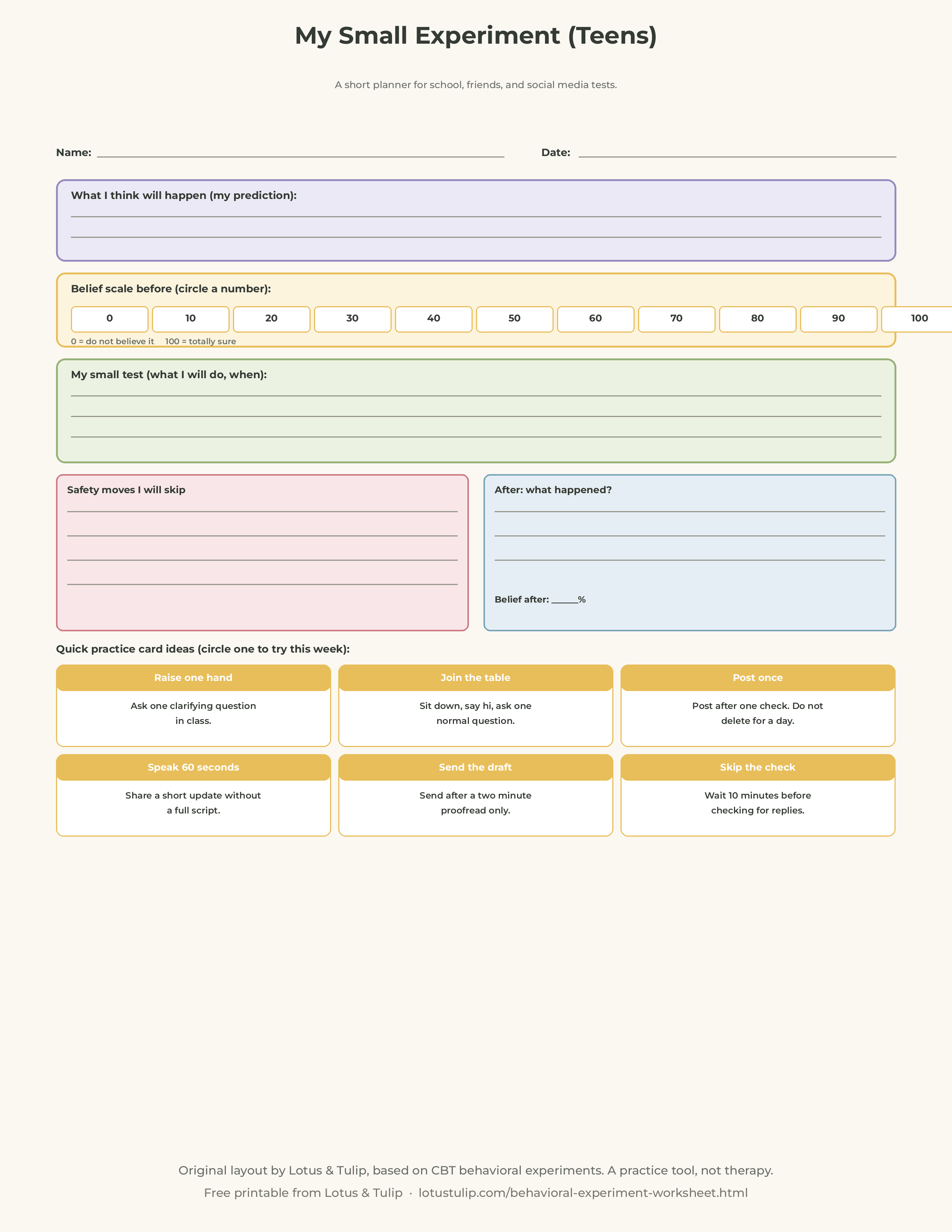
- Page 3: Teen friendly mini planner and belief scale. Short prompts, a 0 to 100 belief scale, and quick practice cards for small social or school tests.
Download the free behavioral experiment worksheet (PDF, 3 pages, US Letter)
Prefer single images? Page 1: Behavioral Experiment Planner (PNG) · Page 2: Experiment Record (PNG) · Page 3: Teen mini planner (PNG)
Free anxiety starter pack: The free anxiety worksheets starter pack includes probability and catastrophe, which compares a feared prediction with what actually happened, plus the anxiety cycle, a worry log, a fear ladder, grounding and a support and safety page from our paid anxiety set.
Free to print for your own use and for use with your own clients, students, or groups. This is an original layout by Lotus & Tulip, based on the behavioral experiment method taught in Beck style CBT and described in clinical guides such as Bennett-Levy and colleagues (2004). It is not affiliated with Oxford University Press, the Beck Institute, or the Oxford Cognitive Therapy Centre, and is not a substitute for therapy. Please link to this page rather than re-uploading the file.
Related resources
- Social anxiety worksheet for adults: test social predictions with a practice ladder and experiment log, free printable.
- Health anxiety worksheet: test what happens when you drop body checking and reassurance, with an agreed medical plan, free printable.
- Exposure hierarchy worksheet: build a fear ladder when avoidance is broad.
- CBT thought record: gather evidence on paper before or after a real world test.
- CBT triangle worksheet: map thoughts, feelings, and behaviors in one situation.
- ABC model worksheet: Ellis ABC and ABCDE when the stuck point is a must.
- Opposite action worksheet: act against an emotion urge when the emotion does not fit.
- Cognitive distortions worksheet: name thinking traps inside the hot thought.
- Core beliefs worksheet: when the same prediction keeps returning under many situations.
- Behavioral activation worksheet: when the problem is low activity and mood, not only a hot prediction.
Sources
- Bennett-Levy, J., Butler, G., Fennell, M., Hackmann, A., Mueller, M., and Westbrook, D. (Eds.). (2004). Oxford Guide to Behavioural Experiments in Cognitive Therapy. Oxford University Press. Clinical handbook with theory and extensive examples of behavioural experiments.
- Beck, A. T., Rush, A. J., Shaw, B. F., and Emery, G. (1979). Cognitive Therapy of Depression. Guilford Press. Early statement of testing assumptions with tasks and experiments.
- Beck, J. S. Cognitive Behavior Therapy: Basics and Beyond. Guilford Press. Therapist manual covering collaborative empiricism and between session tests.
- Clark, D. M., and related cognitive models of panic and social anxiety: clinical approaches that make behavioural experiments and dropping safety behaviors central (see also the Oxford Guide chapters on those problems).
- Hofmann, S. G., Asnaani, A., Vonk, I. J. J., Sawyer, A. T., and Fang, A. (2012). The efficacy of cognitive behavioral therapy: A review of meta-analyses. Cognitive Therapy and Research, 36, 427 to 440. Review of 106 meta analyses; strongest support noted for anxiety disorders, somatoform disorders, bulimia, anger control, and general stress; authors note limits in RCT coverage and subgroup research.
- Honest caveat: no study tests this three page Lotus and Tulip printable alone. The research above concerns CBT methods and packages, and clinical teaching of behavioural experiments.
Behavioral experiment worksheet: FAQ
What is a behavioral experiment in CBT?
A behavioral experiment is a planned real world test of a hot thought or prediction. You rate how much you believe the prediction, design a small experiment that could confirm or disconfirm it, often drop safety behaviors, then compare what happened with what you predicted and write what you learned. It is a core Beck style CBT method for changing beliefs with evidence from experience.
How do you do a behavioral experiment?
Write a specific prediction, rate belief 0 to 100%, plan a small test, name safety behaviors to drop, run the test, record outcome vs prediction, rate belief again, and write a learning sentence. The free printable on this page walks through a planner and an experiment record. See the nine step section above for the full sequence.
What is the difference between a behavioral experiment and exposure?
Exposure hierarchies rank feared situations and help people approach them while learning about anxiety and outcomes. A behavioral experiment focuses on testing a specific prediction, often by dropping safety behaviors. They overlap a lot in anxiety work. Use a fear ladder when avoidance is broad; use an experiment when one hot thought needs a clear test. See our exposure hierarchy worksheet for ladders.
Is a behavioral experiment the same as a thought record?
No. A thought record gathers evidence for and against an automatic thought on paper and writes a balanced alternative. A behavioral experiment gathers evidence in the real world by acting. Many people use a thought record to sharpen the prediction, then run an experiment.
Can teens use a behavioral experiment worksheet?
Yes. Keep predictions concrete (lunch table, raising a hand, posting once), keep experiments short, and protect privacy. The free printable includes a teen friendly mini planner and belief scale. Follow school or clinic safety rules if a worksheet reveals risk.
What are safety behaviors in a behavioral experiment?
Safety behaviors are things people do to prevent the feared outcome or reduce anxiety in the moment: over preparing, checking, reassurance seeking, sitting by the exit, scanning faces, or only speaking with a script. They often stop the belief from being truly tested. Good experiments name them and drop or reduce them during the test.
Does a behavioral experiment worksheet work on its own?
A worksheet is a planning and recording aid, not a standalone therapy. CBT packages that include behavioral experiments have strong meta analytic support for many problems, with uneven coverage across conditions and populations. Use the pages as homework inside a broader plan, and seek a licensed clinician for persistent or severe symptoms.