
Kids and teens · Updated 2026-11-06
Perfectionism Worksheet for Teens (with Free Printable)
Ready-made printable: CBT Worksheets for Teens Holiday 20% off: about $11.04, was $14 (EUR 12) · instant digital download
Buy on Etsy
Perfectionism in teens is not the same as having high standards. High standards can fuel practice, craft, and pride in a hard-won B-plus that still teaches something. Perfectionism turns performance into a verdict on the whole self: one missed shot, one awkward post, one quiz below 100 percent, and worth collapses. Healthy striving says "I want to do this well." Perfectionism says "I am only okay if this is flawless." That difference matters for school counselors, therapists, parents, and teens who feel exhausted by standards that never feel finished.
This Lotus and Tulip page is a teen-focused perfectionism worksheet guide with an original free three page US Letter printable. It targets searches families and helpers actually use: perfectionism worksheet for teens, overcoming perfectionism for teens, and healthy striving vs perfectionism. It is distinct from our goal setting worksheet for students (SMART goals), self esteem activities for teens, growth mindset worksheet, cognitive distortions worksheet, cognitive restructuring worksheet, and flexible thinking worksheet. Those neighbors help. This page centers on the perfectionism loop: shoulds, fear of being imperfect, kinder standards, and small experiments.
We credit research lineages honestly: Hewitt and Flett on self-oriented, other-oriented, and socially prescribed perfectionism; Frost and colleagues on Multidimensional Perfectionism Scale dimensions; Shafran, Cooper, Fairburn, Egan, and Wade on clinical perfectionism where self-worth hangs on performance; Flett and Hewitt on youth; and Curran and Hill on cohort rises in perfectionism among young people. We are not affiliated with those authors, any scale publisher, any textbook, or any treatment package. This printable is an original educational layout, not a copy of any copyrighted worksheet and not a standalone RCT treatment.
This guide is educational. It is not therapy, not medical advice, and not a diagnosis. If thoughts of ending your life, plans to harm yourself or someone else, or a medical emergency show up, stop the worksheet and get help now: in the US, call or text 988, text HOME to 741741, or call 911. Our safety plan worksheet is a better first tool in that moment. Nearby tools: cognitive distortions worksheet, cognitive restructuring worksheet, flexible thinking worksheet, self esteem activities for teens, growth mindset worksheet, self compassion worksheet, behavioral experiment worksheet, goal setting worksheet for students, circle of control worksheet, exposure hierarchy worksheet, and social anxiety worksheets for teens.
Jump to the free perfectionism worksheet (PDF) · How to use the perfectionism worksheet, step by step · Worked examples · Comparisons
What perfectionism is (vs high standards and healthy striving)
Healthy striving means you care about quality, practice, and growth while keeping your worth wider than one outcome. You can feel disappointed by a grade and still be a person of value. You can revise an essay without deciding the first draft proved you are a fraud. Perfectionism, especially the clinical form described in CBT writing, ties self-evaluation tightly to pursuing and meeting personally demanding standards in at least one domain, even when that pursuit hurts sleep, friendships, mood, or health.
Core idea: the problem is not caring. The problem is when caring becomes a rigid rule that your worth equals your performance. A teen with healthy standards can say "I want a strong tryout" and still recover after a miss. A teen in a perfectionism loop may postpone starting, over-edit for hours, avoid submitting, or spiral after any feedback that is not total praise.
Common companions of unhelpful perfectionism include all-or-nothing thinking ("if it is not perfect, it is worthless"), "should" statements ("I should never make mistakes"), discounting positives, and fear of how others will judge a visible flaw. Those patterns sit next to our cognitive distortions and cognitive restructuring pages. Flexible thinking helps when the mind locks on one correct way. Self compassion and self esteem activities help when worth has shrunk to a scoreboard. Growth mindset language helps when "not yet" is more useful than "I am finished as a person."
Not laziness. Procrastination often looks like avoidance of imperfect starts. Many perfectionistic teens work very hard. The issue is the cost and the self-attack, not a lack of effort.
Not the same as OCD. Perfectionism can appear in OCD and related problems, and ERP style ladders may fit some fears of mistakes. Do not diagnose from a worksheet. If rituals, intrusive thoughts, or compulsion cycles dominate, prefer clinician care and tools like the exposure hierarchy worksheet inside a proper plan.
Not "just be less ambitious." The goal of this page is kinder, workable standards and experiments that keep values and growth, not a lecture to stop caring.
Three directions of perfectionism (Hewitt and Flett) with clear non-affiliation
Paul L. Hewitt and Gordon L. Flett described perfectionism as multidimensional rather than one global trait. In their widely used Multidimensional Perfectionism Scale lineage (Hewitt and Flett, 1991), three trait directions are often taught in plain language:
- Self-oriented perfectionism: I require myself to be perfect. "I must get everything right."
- Other-oriented perfectionism: I require others to be perfect. "My teammates / siblings / friends should never mess up."
- Socially prescribed perfectionism: I believe others require me to be perfect. "Everyone expects me to be flawless."
These are research constructs and assessment lineages with their own manuals and permissions. This free page does not reproduce scale items and is not an administration of the MPS. We are not affiliated with Hewitt, Flett, or any scale publisher. For helpers, the practical value is noticing where the pressure seems to come from: inside the teen's rules, demands aimed at others, or a felt sense that the world will reject anything less than perfect. Socially prescribed perfectionism often links tightly to anxiety, shame, and fear of evaluation in youth writing by Flett, Hewitt, and colleagues. Treat that as a clinical clue for formulation, not as a worksheet diagnosis.
Frost Multidimensional Perfectionism Scale dimensions (brief)
Randy Frost and colleagues (Frost, Marten, Lahart, and Rosenblate, 1990) also offered a multidimensional map. Commonly discussed dimensions include concern over mistakes, doubts about actions, personal standards, parental expectations, parental criticism, and organization. Concern over mistakes and doubts about actions often sit closest to distress. Personal standards can look "adaptive" until they pair with harsh self-evaluation. Organization is not the same as perfectionism by itself. Again: this page does not reproduce Frost scale items. Credit the lineage. Do not treat a free fill-in as a formal FMPS score.
Clinical perfectionism and the CBT model (Shafran lineage)
Shafran, Cooper, and Fairburn (2002) proposed a focused definition of clinical perfectionism: self-evaluation that depends too heavily on the determined pursuit (and achievement) of personally demanding, self-imposed standards in at least one important domain, despite adverse consequences. Later CBT writing associated with Shafran, Egan, and Wade elaborates maintenance: biased evaluation of performance, dichotomous (all-or-nothing) thinking, self-criticism after perceived failure, raising the bar when standards are briefly met, and counterproductive checking, comparing, reassurance seeking, and avoidance.
Performance becomes self-worth. That is the hinge helpers can name out loud: "When this paper is not perfect, what does your mind say about you as a person?" Separating performance from personhood is a core practice target. CBT packages for clinical perfectionism have preliminary RCT support in small samples (for example early trials of CBT for clinical perfectionism). That is package-level encouragement, not evidence that this free three page printable remits diagnoses on its own.
We are not affiliated with Shafran, Egan, Wade, Cooper, Fairburn, Psychology Tools, Guilford, or any treatment manual publisher. Use clinician judgment and licensed care when problems are severe or lasting.
Signs of perfectionism in teens (educational, not diagnostic)
These patterns are educational flags for conversation, not a checklist that diagnoses a disorder:
- School: endless rewriting, fear of starting, melting down over a B, hiding unfinished work, asking for reassurance that something is "good enough" without accepting any answer.
- Sports and arts: practicing past injury risk, quitting after one bad game, equating a tryout miss with being talentless forever.
- Appearance: harsh mirror talk, delay leaving the house until looks feel flawless, comparing body or style to edited feeds.
- Social media: deleting posts that get fewer likes than hoped, drafting captions for hours, fear of being seen imperfectly in Stories.
- Relationships: high demands on friends, or fear that one awkward moment ends belonging. See social anxiety worksheets for teens when evaluation fear is social.
- Body and mood: sleep loss, irritability, stomach aches before grades, self-attack language ("I am stupid," "I am disgusting").
Context matters. High achievement culture, critical climates, bullying, trauma, ADHD related task initiation struggles, autism related preference for precision, and anxiety disorders can all look like "perfectionism" on the surface. Do not slap a label and walk away. Ask what the standard protects (belonging, safety from shame, control) and what it costs.
When to use this worksheet (and when not to)
Good early uses: a teen who can name a should or a fear of being imperfect, mild to moderate distress, homework between counseling sessions, school counseling check-ins, and building a kinder standard plus a small experiment.
Prefer another tool first when:
- Acute safety risk or medical emergency: stabilize and get help (988, HOME to 741741, 911). Prefer a safety plan.
- Eating, shape, or weight perfectionism with medical risk: escalate to appropriate clinical care. A generic worksheet is not enough.
- Flooded panic or total shutdown: co regulate first. Then return to thought and experiment work.
- When the hot thought needs evidence work first: use cognitive restructuring.
- When the lock is "only one way": use flexible thinking.
- When graded exposure to feared mistakes fits better: consider an exposure hierarchy inside a clinical plan.
How to use the perfectionism worksheet for teens, step by step
- Check safety and fit. If acute crisis, medical emergency, or the teen cannot engage safely, pause. Use crisis pathways first: 988, HOME to 741741, or 911 when needed. Prefer a safety plan in that moment.
- Name one domain. School, sport, appearance, social media, friendship, music, or another concrete area. One domain per worksheet pass beats "my whole life."
- Write the should or rule. One sentence in the teen's words. Examples: "I should never get below an A." "I must look perfect in every photo." "If I make a mistake in class, everyone will think I am stupid."
- Name the fear if imperfect. What does the mind predict will happen to worth, belonging, or future if the standard slips? Rate feeling intensity 0 to 10.
- Spot the trap gently. All-or-nothing? Should statement? Mind reading? Cross link to cognitive distortions without shaming.
- Draft a kinder, workable standard. Keep values (effort, honesty, growth) while dropping the impossible rule. Example: "I will study with a plan and turn work in on time even if it is not flawless."
- Design a tiny experiment. One safe, values-aligned try that tests the fear. Submit with one fewer rewrite. Post without deleting for 24 hours. Ask one clarifying question in class. See behavioral experiment worksheet for a fuller template.
- Try it and record what happened. What did the fear predict? What actually occurred? Re rate the feeling. Notice any urge to raise the bar again.
- Review and bridge. Keep what helped. Adjust the kinder standard. Bridge to self compassion, self esteem activities, growth mindset, goal setting, or circle of control when needed. Use the free practice log for short reps.
Practice on ordinary school and social moments first. Skill grows with concrete scenes and honest experiments, not with one perfect debate about perfectionism.
Worked fictional examples
Teen example, school (fictional): Jordan, age 15, rewrites a history essay five times and still will not submit. Should: "It has to be perfect or I am a failure." Fear if imperfect: "The teacher will think I am lazy and my grade will ruin college." Feeling: anxiety 8/10, shame 7/10. Trap: all-or-nothing plus fortune telling. Kinder standard: "I will submit a clear, complete draft after two focused edits." Experiment: stop after two edits, submit by 4 p.m., notice the grade and the teacher's actual comments. After: anxiety 4/10. The comments asked for one clearer thesis sentence, not a character verdict. Written on the free fill-in page.
Teen example, social media (fictional): Sam, age 16, drafts a post for forty minutes and deletes it when likes are slow. Should: "My posts should always look polished and popular." Fear: "If engagement is low, people will think I am irrelevant." Feeling: shame 75/100. Kinder standard: "I can share something real and leave it up for a day." Experiment: post one unfiltered photo from practice, leave it 24 hours, log actual comments vs feared comments. After shame: 40/100. Two friends replied kindly. No catastrophe.
Teen example, sports (fictional): Avery, age 14, wants to quit after missing two free throws in a game. Should: "I must never miss in front of people." Fear: "Coach and teammates will write me off." Feeling: anger 6/10, humiliation 8/10. Kinder standard: "I practice free throws and treat misses as data." Experiment: ask coach for five minutes of feedback, shoot twenty free throws at next practice, track makes without self-insults. Bridge to growth mindset language.
School counselor note (fictional): In a twelve minute meeting, a counselor helps a student fill domain, should, fear, kinder standard, and one experiment. No lecture. Optional practice, never forced disclosure. Follow district crisis protocol if risk appears.
Perfectionism practice vs growth mindset, self esteem, cognitive restructuring, flexible thinking, and goal setting
| Perfectionism worksheet | Growth mindset | Self esteem activities | Cognitive restructuring / flexible thinking | Goal setting (SMART) | |
|---|---|---|---|---|---|
| Main job | Untie worth from flawless performance; build kinder standards and experiments | Frame ability as improvable with effort and strategy | Build a fairer overall sense of worth with strengths and evidence | Examine hot thoughts or unlock "only one way" stuckness | Turn aims into specific, timed plans |
| Best early use | When standards are rigid and self-attack follows any slip | When "I can't" blocks trying | When worth feels globally fragile | When a harsh thought or rigid plan locks mood | When aims are vague or overwhelming |
| Output | Should, fear, kinder standard, experiment, review | Yet language and strategy focus | Strengths, values, proud moments | Balanced thought or Plan B options | SMART goal and next steps |
| Cross link | This page | Growth mindset | Self esteem for teens | Restructuring · Flexible thinking | Goal setting |
These tools cooperate. Perfectionism work names the worth-performance knot. Growth mindset supports another try. Self esteem widens worth. Restructuring and flexible thinking loosen absolute rules. Goal setting turns kinder standards into workable plans without recreating impossible bars. Self compassion softens the inner critic. Behavioral experiments and exposure hierarchies test fears in the world. Circle of control keeps effort aimed at what can be influenced. Teach one tool clearly before stacking four on day one.
School counselor, therapist, and parent tips
Teens. Prefer concrete scenes over lectures about "perfectionism as a construct." Let them reject jargon. "Shoulds and kinder standards" often lands better than a long theory talk. Keep experiments tiny and within their real control. Pair with CBT worksheets for teens when thoughts need evidence work.
School counselors. Short meetings favor a compressed sequence: domain, should, fear, kinder standard, one experiment. Groups can practice with low-stakes "what would you tell a friend" prompts. Follow district crisis protocol if risk appears. Optional practice, never forced disclosure. Avoid shaming high achievers; target the cost of the rule, not the ambition.
Therapist tips:
- Stay in the client's language. Reflect their shoulds. Do not overwrite with your favorite reframe.
- Separate person from performance out loud, repeatedly, without toxic positivity.
- Watch the raised bar. When a standard is met, ask whether the mind quietly made it "not enough."
- Use experiments and hierarchies carefully. Imperfect exposures should be planned, consented, and sized.
- Bridge to neighbors. Self compassion for the critic, restructuring for hot thoughts, flexible thinking for rigid how-tos, circle of control for effort leaks.
- Measure function. Ask what changed: faster starts, fewer all-nighters, kinder self talk after feedback, more submissions.
Parents. Notice outcome-only praise ("you are so smart / so talented") that freezes identity. Prefer process and values ("you stuck with a hard draft," "you were honest about needing help"). Model repair after your own mistakes. Do not turn the kinder standard into a new demand for perfect recovery from perfectionism.
Common mistakes
- Telling teens to "just lower standards" without building a kinder, values-based replacement.
- Praising only outcomes, which feeds the worth-performance knot.
- Using the worksheet as a diagnosis or as proof of a personality flaw.
- Skipping the experiment and staying in intellectual debate.
- Designing experiments that are too big or that violate safety, consent, or school rules.
- Ignoring sleep, hunger, ADHD supports, or bullying while blaming "perfectionism" alone.
- Using it in acute crisis instead of safety first.
- Treating the worksheet as therapy. Paper supports practice. It does not replace a clinician when problems are severe or lasting.
What the research says (honestly)
Perfectionism worksheets are a skill practice aid, not a standalone RCT treatment. Do not claim this free printable remits anxiety, depression, OCD, eating disorders, or any diagnosis.
Hewitt and Flett (1991). Their Multidimensional Perfectionism Scale work conceptualizes self-oriented, other-oriented, and socially prescribed perfectionism and links dimensions to psychopathology in clinical and nonclinical samples. Credit the lineage. This page does not administer the scale.
Frost et al. (1990). The Frost Multidimensional Perfectionism Scale dimensions (including concern over mistakes, doubts about actions, personal standards, parental expectations, parental criticism, and organization) shaped decades of research. Concern over mistakes often tracks distress closely. Treat that as a map for conversation themes, not as a free printable score.
Shafran, Cooper, and Fairburn (2002) and later Shafran / Egan / Wade CBT writing. Clinical perfectionism is defined around self-worth depending on pursuing demanding standards despite adverse consequences, maintained by biased evaluation, dichotomous thinking, self-criticism, and counterproductive performance behaviors. Small RCTs of CBT for clinical perfectionism show promise at the package level. That is not the same as technique-only proof for this three page Lotus and Tulip sheet.
Flett and Hewitt youth work. Reviews and studies on perfectionism in children and adolescents highlight socially prescribed pressures, school and peer contexts, and links with distress. Exact effect sizes vary by sample and measure. Go to primary papers when you need numbers for a grant or paper.
Curran and Hill (2019). In Psychological Bulletin, Curran and Hill reported a cross-temporal meta-analysis of birth cohort differences (1989 to 2016) among American, Canadian, and British college students completing the Hewitt and Flett MPS. They found linear increases in self-oriented, other-oriented, and socially prescribed perfectionism across cohorts (with socially prescribed showing a notably large rise in popular summaries of the work). Treat that as evidence that mean scores rose in those student samples over time, not as proof that every teen today is more perfectionistic, and not as validation of this printable.
Honest caveat. Use perfectionism practice inside a coherent plan with co regulation, sleep and school supports, and neighboring CBT tools when needed. For severe mood problems, trauma, psychosis, medical eating risk, or acute risk, use disorder-appropriate care and crisis pathways. No study tests this three page Lotus and Tulip printable alone.
Free perfectionism worksheet for teens (PDF)
The free perfectionism printable has three pages in US Letter size:
- Page 1: Perfectionism vs Healthy Striving Steps card. Eight step sequence from domain and should through kinder standard, experiment, and review, plus safety reminders.
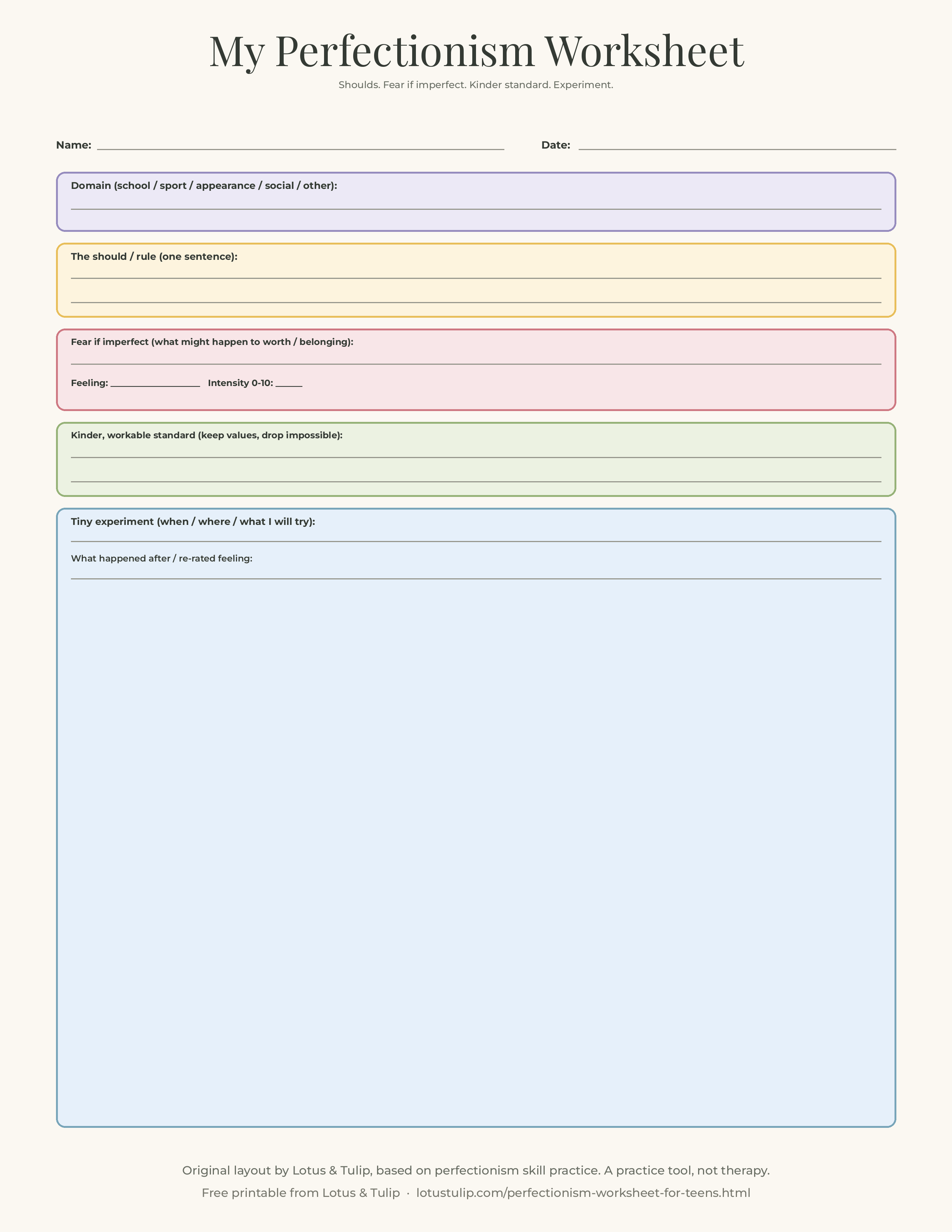
- Page 2: My Perfectionism Worksheet. Fill in shoulds, fear if imperfect, kinder standard, and experiment.
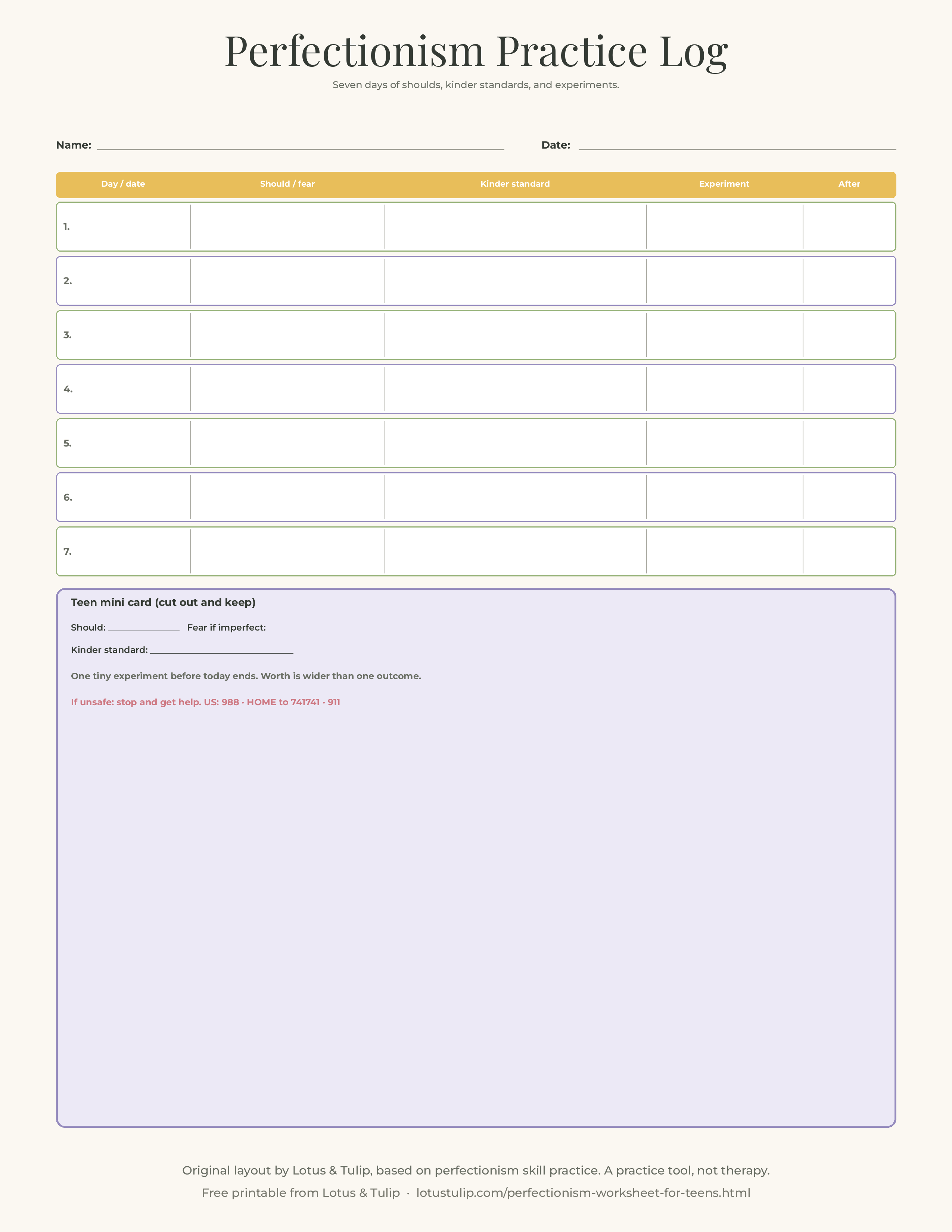
- Page 3: Practice Log + teen mini card. Seven day rows plus a cut out reminder for should, kinder standard, and next experiment.
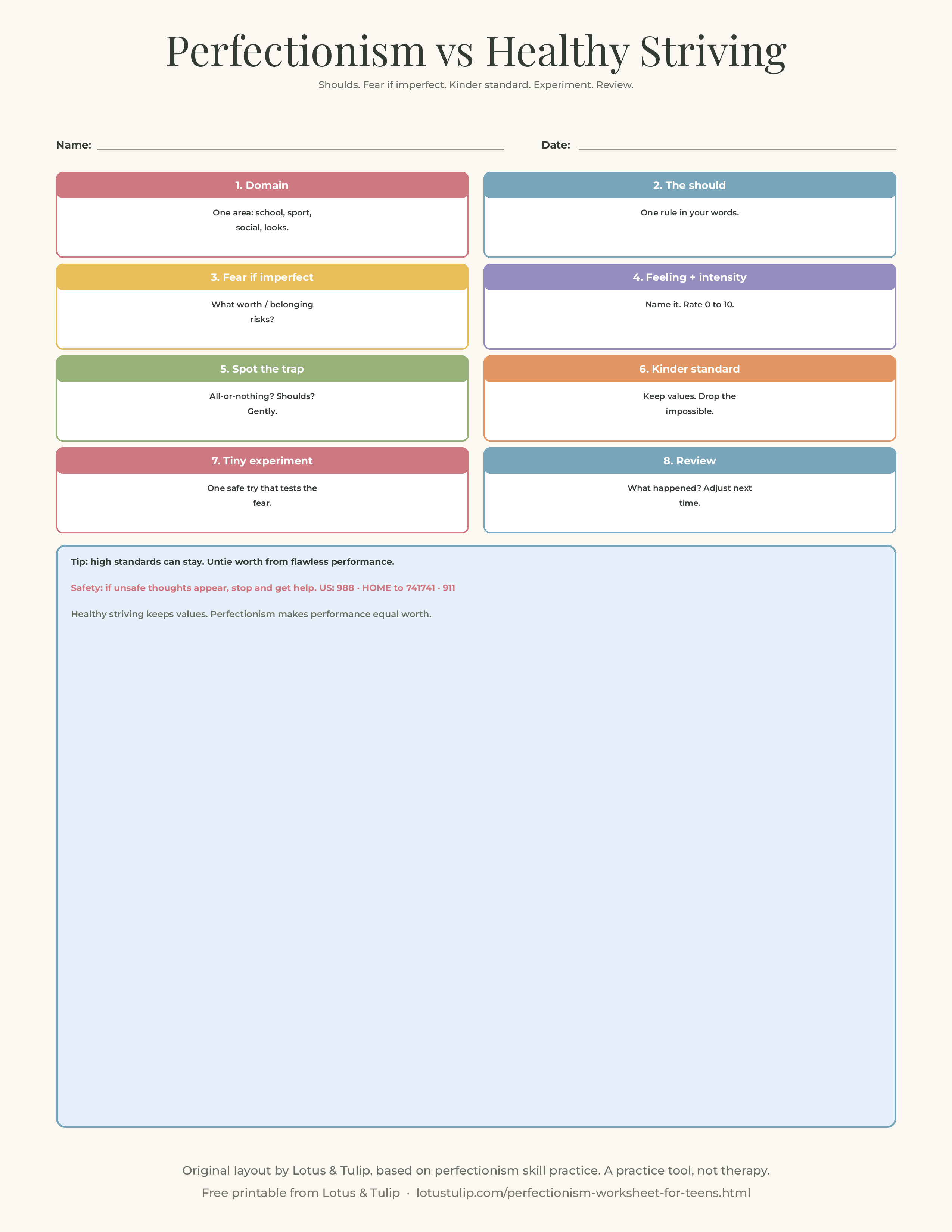
Download the free perfectionism worksheet for teens (PDF, 3 pages, US Letter)
Prefer single images? Page 1: Perfectionism vs Healthy Striving Steps (PNG) · Page 2: My Perfectionism fill in (PNG) · Page 3: Practice Log (PNG)
Free to print for your own use and for use with your own clients, students, or groups. This is an original layout by Lotus & Tulip, based on perfectionism skill practice associated with multidimensional perfectionism research (including Hewitt and Flett; Frost et al.) and clinical perfectionism CBT models (including Shafran and colleagues). It is not affiliated with those authors, any scale publisher, or any specific treatment package, and is not a substitute for therapy. Please link to this page rather than re-uploading the file.
Related resources
- Perfectionism worksheet for adults: the adult and therapist version, with a free perfectionism map and good enough practice plan
- Impostor syndrome worksheet: the adult version of "they will find out I am not that good", with a free printable
- Cognitive distortions worksheet: all-or-nothing and shoulds named gently.
- Cognitive restructuring worksheet: evidence for and against hot thoughts.
- Flexible thinking worksheet: Plan B when the mind locks on one way.
- Self esteem activities for teens: strengths, values, kinder self regard.
- Growth mindset worksheet: yet language and strategy focus.
- Self compassion worksheet: kindness toward struggle without fake praise.
- Behavioral experiment worksheet: test predictions in the world.
- Goal setting worksheet for students: SMART plans without impossible bars.
- Circle of control worksheet: what I can and cannot control.
- Exposure hierarchy worksheet: graded practice with feared situations.
- Social anxiety worksheets for teens: fear of evaluation in social scenes.
- Safety plan worksheet: when the moment is about staying alive.
Sources
- Hewitt, P. L., and Flett, G. L. (1991). Perfectionism in the self and social contexts: Conceptualization, assessment, and association with psychopathology. Journal of Personality and Social Psychology, 60, 456 to 470. Self-oriented, other-oriented, and socially prescribed perfectionism. Not a claim that this printable administers or replaces the MPS.
- Frost, R. O., Marten, P., Lahart, C., and Rosenblate, R. (1990). The dimensions of perfectionism. Cognitive Therapy and Research, 14, 449 to 468. FMPS dimensions including concern over mistakes and doubts about actions. Credit only; no scale items reproduced here.
- Shafran, R., Cooper, Z., and Fairburn, C. G. (2002). Clinical perfectionism: A cognitive-behavioural analysis. Behaviour Research and Therapy, 40, 773 to 791. Clinical perfectionism as self-worth tied to demanding standards despite adverse consequences. Later Shafran / Egan / Wade CBT writing elaborates maintenance and treatment. Package-level CBT evidence is not proof for this free page alone.
- Curran, T., and Hill, A. P. (2019). Perfectionism is increasing over time: A meta-analysis of birth cohort differences from 1989 to 2016. Psychological Bulletin, 145(4), 410 to 429. Cohort rises on Hewitt and Flett MPS scores in college student samples; not a validation of this printable.
- Honest caveat: perfectionism drills are a skill practice aid. Multidimensional measures and clinical perfectionism CBT packages are not the same as technique-only RCTs of this three page Lotus and Tulip printable.
Perfectionism worksheet for teens: FAQ
What is the difference between high standards and perfectionism?
High standards can support practice and pride while worth stays wider than one outcome. Perfectionism ties self-worth tightly to flawless performance, often with harsh self-criticism, all-or-nothing thinking, and costly avoidance or overwork when standards slip.
What are self-oriented, other-oriented, and socially prescribed perfectionism?
In the Hewitt and Flett lineage, self-oriented means requiring yourself to be perfect, other-oriented means requiring others to be perfect, and socially prescribed means believing others require you to be perfect. This page explains those ideas educationally and does not administer their scale.
Is this the same as a growth mindset or SMART goals worksheet?
No. Growth mindset frames ability as improvable. SMART goal setting organizes aims into specific plans. This perfectionism worksheet targets the worth-performance knot: shoulds, fear if imperfect, kinder standards, and experiments. They work well as neighbors.
Can school counselors use it with teens?
Yes, often in short meetings with one domain and one experiment. Keep practice optional and school safe. Follow crisis protocol when risk appears. Do not use the page as a diagnosis.
Does a perfectionism worksheet work on its own?
A worksheet is a practice aid, not a standalone treatment. Hewitt and Flett, Frost, Shafran-lineage CBT, and Curran and Hill speak to broader research, not to this free page alone. Use it inside counseling or therapy, and get licensed care for persistent or severe problems.
When should I not use this worksheet?
Do not use it as the first move in acute safety risk, medical emergency, medical eating risk, or when the teen is too flooded to engage. Stabilize and get help first when needed: 988, HOME to 741741, or 911. Use a safety plan when staying alive is the job.
Is this affiliated with Hewitt, Flett, Frost, or Shafran treatment manuals?
No. This is an original Lotus and Tulip educational layout. We credit research lineages with clear non-affiliation and do not reproduce copyrighted scale items or manual worksheets.