
School counselors · Updated 2026-11-11
School Counselor Evaluation Crosswalk: How to Map a Teacher Evaluation Form to Your Real Job (ASCA Appraisal, Ohio, Pennsylvania, North Carolina and Texas Models, Filled Example, Free Printable)
Ready-made printable: Complete Small Group Counseling Bundle Holiday 20% off: about $29.44, was $37 (EUR 32) · instant digital download
Buy on Etsy
Many school counselors are evaluated on a form written for classroom teachers. The domains talk about "instruction," "classroom environment" and "content knowledge," the observation expects a lesson, and the end-of-year conversation can drift toward things a counselor does not do while the work that fills most of the year (individual student planning, short-term counseling, referrals, consultation, the advisory council, the achievement gap plan) has no obvious box. Other counselors work in states that publish a counselor-specific model, and still need to explain how their evidence fits it. Both groups need the same tool: a crosswalk.
A crosswalk is a simple table. On the left, each domain, standard or component of the instrument you are actually evaluated on. On the right, the counseling work that shows it, the ASCA appraisal items it matches, and the evidence you will bring. ASCA's own School Counselor Performance Appraisal names this exact skill in its last item: a school counselor "explains how school counseling activities fit within categories of a performance appraisal instrument."
This guide shows how to build one. It uses ASCA's documents and four state sources we downloaded and read today: Ohio's School Counselor Evaluation System, Pennsylvania's school counselor and classroom teacher observation frameworks, North Carolina's school counselor and teaching standards, and the Texas Education Agency's guidance on counselor evaluation. It covers what ASCA says, what each state model contains and how it compares with that state's teacher instrument, a generic map from the familiar four domain teacher form to counseling evidence, how to handle the observation without breaking confidentiality, a ten step method, a full worked example for one fictional elementary school, scenarios, mistakes, and a plain list of what we could not verify.
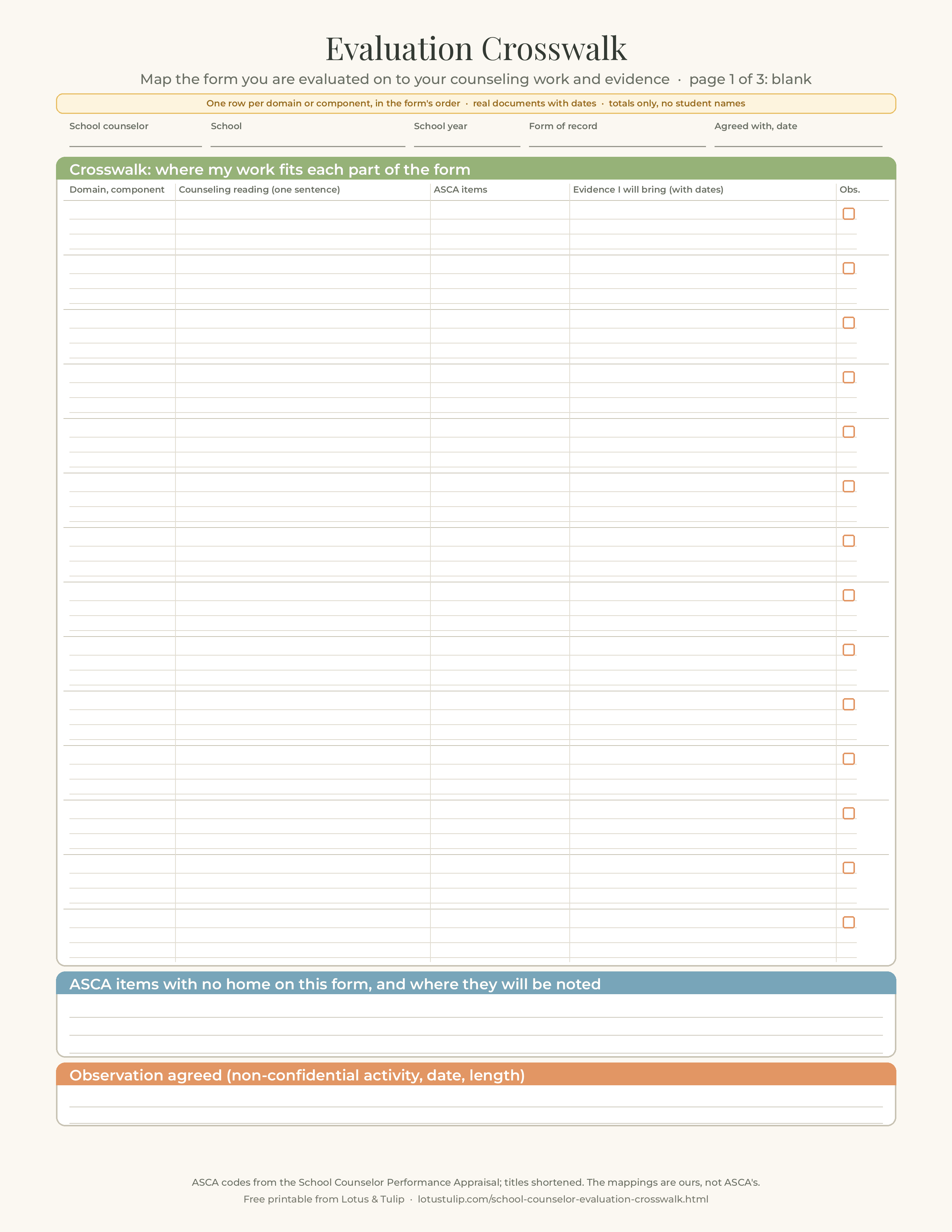
At the end is a free three page printable: a blank crosswalk worksheet, the same worksheet filled in for a fictional school, and a page with a state model quick reference and an observation planner.
Jump to the free crosswalk worksheet, filled example and observation planner
This guide is general information, not legal or employment advice. Your official evaluation is governed by your state's law, your district's policy and, in many districts, a bargaining agreement. A crosswalk does not change the form of record. It helps you and your evaluator read it the same way.
Download the free crosswalk worksheet, example and observation planner (PDF, 3 pages)
Or download single pages: Page 1: blank crosswalk worksheet (PNG) · Page 2: filled example (PNG) · Page 3: state models and observation planner (PNG)
Free to print and use in your own school. Please link to this page rather than re-uploading the file. This is a planning tool, not an ASCA or state publication; the item titles on it are shortened and the mappings are ours. Use the official documents for exact wording.
The short answer
- What it is: a table that lists every domain, standard or component of the evaluation instrument you are evaluated on, and beside each one the counseling work that shows it, the matching ASCA School Counselor Performance Appraisal items, the evidence you will bring, and where an observation could fit.
- Why ASCA expects it: the last item of ASCA's appraisal, "Uses appropriate school counselor performance appraisal process," lists the indicator "Explains how school counseling activities fit within categories of a performance appraisal instrument." ASCA's position statement on annual performance appraisal (reviewed 2026) says appraisals "should accurately reflect the unique professional training and practices of school counselors."
- Who needs it most: counselors evaluated on a teacher form. The Texas Education Agency says it plainly: "It is important to avoid evaluating school counselors according to criteria developed for classroom teachers or other educational professionals."
- State models: some states publish their own. Ohio's School Counselor Evaluation System has six standards plus a student outcomes area, rated Ineffective, Developing, Skilled or Accomplished. Pennsylvania's school counselor framework keeps the four domain, 22 component structure of its classroom teacher framework and rewrites the components for counseling. North Carolina's five school counselor standards (approved December 4, 2008) run parallel to its five teaching standards. Texas law asks the commissioner to develop a counselor job description and evaluation form, and TEA points districts to ASCA's appraisal and two Texas association models.
- When: build it before the evaluation year starts, bring it to the annual administrator conference, use it to plan the observation, and bring it again to the end-of-year meeting.
- The rule that keeps it honest: never stretch a box to cover work you did not do, and never pretend a teacher component fits when it does not. Write "no home on this form" and say where the evidence will go instead.
What a crosswalk is, and what it is not
A crosswalk is a translation table between two documents that describe the same work in different words. Curriculum teams use crosswalks between old and new standards; counselors use them between an evaluation instrument and their own program. It is not a new evaluation form, a request to be rated on something else, or an argument. It is a document you write so your evaluator can find your evidence in the categories they have to rate.
It helps to be clear about three things a crosswalk does not do:
- It does not change the form of record. If your district evaluates you on a teacher instrument, that instrument still produces your official rating. The crosswalk sits beside it.
- It does not replace ASCA's appraisal. ASCA's School Counselor Performance Appraisal is a full instrument with 30 rated items and an artifact list for each. A crosswalk can use those items as the middle column, but it is not a rating.
- It does not make a poor fit fair. If a domain genuinely does not apply to your role, a crosswalk shows that clearly, which is useful. Changing the instrument is a separate, longer conversation for your district (see the section on going wider).
What ASCA says about evaluation instruments
We downloaded ASCA's School Counselor Performance Appraisal and its position statement "The School Counselor and Annual Performance Appraisal" from schoolcounselor.org today. The relevant lines:
- The appraisal's scale: "0=Unsatisfactory, 1=Developing, 2=Proficient, 3=Distinguished." It has 30 rated items: 7 mindsets (M 1 to M 7), 9 Professional Foundation items (B-PF 1 to 9), 6 Direct and Indirect Student Services items (B-SS 1 to 6) and 8 Planning and Assessment items (B-PA 1 to 8). Our performance appraisal guide lists every item and its artifacts.
- The crosswalk item: B-PA 8, "Uses appropriate school counselor performance appraisal process," with three indicators: "a. Explains and advocates for appropriate school counselor performance appraisal process based on school counselor standards and implementation of the school counseling program," "b. Explains how school counseling activities fit within categories of a performance appraisal instrument," and "c. Utilizes components of the ASCA National Model® to document data-informed, student-focused activities that demonstrate evidence of meeting standards of performance appraisal instruments."
- The position: "The annual performance appraisal of school counselors should accurately reflect the unique professional training and practices of school counselors working within a pre-K-12 school counseling program. These appraisals should be aligned to the role and responsibilities of the school counselors as articulated by ASCA School Counselor Professional Standards & Competencies, the ASCA Ethical Standards for School Counselors, the school counseling program assessment and the school counselor performance appraisal from the ASCA National Model®." The position statement header reads "Adopted 1978; reaffirmed 1984; revised 1986, 1993, 2003, 2009, 2015; reviewed 1999, 2021, 2026."
- Why administrators may need help: "Because many administrators have not received training on how to evaluate school counselor performance, school counselors educate administrators about the appropriate role of the school counselor, ultimately to improve the school counseling program."
- The counselor's role, in part: the school counselor "Presents evidence of the school counseling program's impact including access, life-readiness and academic achievement data" and "Collaborates with other school counselors, school administrators, district leadership, union representatives (as appropriate), departments of education, etc. to advocate for the alignment between the school counselor appraisal tool and appropriate school counseling roles."
- The summary line: "The annual performance appraisal of the school counselor, including the appraisal forms and tools used in the process, should reflect the current standards, competencies and the performance appraisal instruments of the school counseling profession."
Two honest notes. First, ASCA's documents do not publish a crosswalk to any teacher framework or state model, and they do not tell you how to map items; the mappings in this guide are ours. Second, the position statement's rationale cites "ASCA School Counselor Professional Standards & Competencies (2019b)" in one sentence while its reference list cites the 2025 versions. It does not change the advice, but if you quote it, quote the position and the role bullets, which are current.
Three situations, three kinds of crosswalk
| Your situation | Left column of the crosswalk | What the crosswalk is for |
|---|---|---|
| Your district evaluates counselors on its teacher instrument | Each domain and component of the teacher form | Showing where counseling evidence fits, which components need a counseling reading, and which ASCA items have no home |
| Your state or district uses a counselor-specific model (for example Ohio's OSCES or Pennsylvania's school counselor framework) | Each standard or component of that model | Linking the model to the ASCA National Model artifacts you already produce, so evidence collection is one job, not two |
| Your district has agreed to use ASCA's appraisal | ASCA's 30 items | Usually no crosswalk is needed; use the appraisal's own artifact lists (our appraisal guide has an evidence planner) |
The rest of this guide focuses on the first two. If you are not sure which applies to you, ask your administrator or human resources for the name of the instrument used for your position and the policy that sets it. In Ohio, for example, the State Board says districts may design their own counselor rubric only if they show it aligns with the state standards and framework.
The four domain teacher form: where counseling evidence fits
Many district teacher instruments share the same four domain shape: planning and preparation, the classroom environment, instruction, and professional responsibilities. Pennsylvania's classroom teacher framework, for example, uses exactly those four domains and cites Charlotte Danielson's Framework for Teaching among its references. If your form looks like this, the map below is a starting point. The ASCA items in the third column are the appraisal items whose artifacts usually make the best evidence; they are our suggestions, not ASCA's.
| Teacher form domain | The counseling reading | ASCA appraisal items | Evidence that usually works |
|---|---|---|---|
| Planning and preparation (knowledge of content and students, outcomes, coherent design, assessment design) | Knowing your students through data, planning the program from that data, writing measurable outcomes for lessons, groups and the gap plan | B-PF 1, B-PF 5, B-PA 1, B-PA 2, B-PA 3 | Data priorities, annual student outcome goals, achievement gap plan, annual calendar, Student Standards delivery plan, lesson plans and small-group plans with pre and post items |
| Classroom environment (respect and rapport, culture for learning, procedures, behavior, physical space) | The climate of your lessons and groups, your referral and request procedures, group agreements, an accessible and welcoming counseling space, materials in families' languages | M 1, M 2, B-PF 6, B-SS 3, B-SS 4 | Group agreements, referral and self-referral procedures, translated family letters, a referral resource list, a short note on how students reach you |
| Instruction (communication, questioning and discussion, engagement, assessment during instruction, flexibility) | Classroom lessons and instructional small groups; appraisal and advisement | B-SS 1, B-SS 2 | An observed classroom lesson with its lesson plan, student pages and pre and post results; career and planning lessons; small-group session plans |
| Professional responsibilities (reflection, records, communicating with families, professional community, growth, professionalism) | Ethics and confidential records, the professional standards self-assessment and PD plan, consultation and collaboration, the administrator conference, the advisory council, results reported to the school | B-PF 3, B-PF 4, B-SS 5, B-SS 6, B-PA 4, B-PA 6, B-PA 7 | Professional standards self-assessment and PD plan, administrator conference template, advisory council agendas and minutes, results shared in totals, family workshop materials, consultation log without names |
What usually has no home on a teacher form
When counselors build this table, the same ASCA items tend to be left over. Expect to list some of these as "no home on this form" and agree with your evaluator where they will be noted (usually the comments, a goal or a professional responsibilities component):
- B-PA 5, use of time. No teacher component asks how much of your time goes to direct and indirect student services. If your use-of-time data shows non-counseling duties, this is the most important item to get into the conversation.
- B-SS 3, short-term counseling, and B-SS 4, referrals. Individual counseling cannot be observed and has no teacher equivalent. Evidence is aggregate: numbers served, small-group plans and results, a referral list, never case notes.
- B-PF 8, advocacy, and B-PF 9, systemic change. Teacher forms rarely ask for evidence of changing a school practice. A gap plan that changed a schedule or a policy is your evidence.
- B-PA 7, the advisory council, and B-PA 6, the administrator agreement. They can sit under professional responsibilities, but most teacher forms will not prompt your evaluator to look for them.
Components that need a counseling reading
Some teacher components fit only if both of you agree how to read them. Write the reading into the crosswalk so it is settled before the observation, not argued after it:
- "Knowledge of content." For a counselor, the content is the ASCA Student Standards, developmental and counseling theory, and the systems students move through (course and grade transitions, postsecondary options, referral pathways).
- "Managing classroom procedures." In a counseling role this is the referral and request system, how students are seen, how passes and schedules work, and how a lesson runs when you are a guest in a teacher's room.
- "Designing student assessment." Pre and post items for lessons and groups, and the outcome data in the gap plan. Grades are not part of your role.
- "Communicating with families." Family letters, workshops, consent for groups, translated materials and responsiveness; not report cards.
- "Maintaining accurate records." Program records (calendars, plans, data reports, use of time) that you can show, and confidential counseling records that you do not show. Say so in the crosswalk.
Ohio: the School Counselor Evaluation System (OSCES)
Ohio is the clearest example of a state with a separate, counselor-specific evaluation system written into law. We read the State Board of Education's School Counselor Standards and Evaluation page (dated December 18, 2023), the two page Evaluation Framework for School Counselors (adopted April 12, 2016, citing ORC 3319.113 and ORC 3319.61), and the 48 page OSCES model (dated May 2016).
The six standards and the seventh area
| OSCES area | Ohio's summary (quoted) | ASCA appraisal items that supply evidence (our map) |
|---|---|---|
| Standard 1: Comprehensive School Counseling Program Plan | "School counselors collaboratively envision a plan for a comprehensive school counseling program that is developmental, preventative and responsive, and in alignment with the school's goals and mission." | B-PA 1, B-PA 6, B-PF 7, M 4 |
| Standard 2: Direct Services for Academic, Career and Social/Emotional Development | "School counselors develop a curriculum, offer individual student planning and deliver responsive services in order to assist students in developing and applying knowledge, skills and mindsets for academic, career and social/emotional development." | B-SS 1, B-SS 2, B-SS 3, B-PF 5 |
| Standard 3: Indirect Services: Partnerships and Referrals | "School counselors collaborate and consult with school personnel, parents/guardians, community partners and agencies/organizations to coordinate support for all students." | B-SS 4, B-SS 5, B-SS 6, M 5 |
| Standard 4: Evaluation and Data | "School counselors collaboratively engage in a cycle of continuous improvement using data to identify needs, plan and implement programs, evaluate impact and adjust accordingly." | B-PA 2, B-PA 3, B-PA 4, B-PA 5 |
| Standard 5: Leadership and Advocacy | "School counselors lead school efforts and advocate for policies and practices that support an equitable, safe, inclusive and positive learning environment for all students." | B-PF 7, B-PF 8, B-PF 9, M 6 |
| Standard 6: Professional Responsibility, Knowledge and Growth | "School counselors adhere to the ethical standards of the profession, engage in ongoing professional learning and refine their work through reflection." | B-PF 3, B-PF 4, B-PA 8 |
| Metric(s) of Student Outcomes | The counselor "provides data demonstrating that students' skills, knowledge or behaviors have positively changed as a result of the school counselor's actions." | B-PA 3 and B-PA 4 (gap plan and data reports) |
How OSCES rates and observes
- Four levels: Ineffective, Developing, Skilled and Accomplished, for each of the seven areas and for the final summative rating. The rubric "is intended to be scored holistically."
- No weighting: the model says OSCES "does not include a weighting factor for the seven areas found on the evaluation rubric because all seven areas are critical to determine school counselor performance."
- Student outcome metrics are chosen locally and agreed at the start: "The school counselor and evaluator should collaboratively pre-determine metrics they will use for this portion of the evaluation rubric at the beginning of the evaluation cycle." The model's examples are core course passage rates, career awareness rates and behavior referral rates.
- Observations: "The annual evaluation process will consist of two formal observations of thirty minutes each and informal observations." The model adds that formal observations "last for a minimum of 30 minutes each."
- Confidentiality: "A school counselor must follow the ethics of maintaining confidentiality in counseling relationships and this must be taken into consideration when engaging in observations of the school counselor." The model lists non-confidential activities that "may include, but are not limited to, guidance activities in a classroom, instructional small group activities, parent education functions, staff development, child study team meetings and data meetings."
- Less frequent evaluation for strong ratings: a counselor rated Accomplished may be evaluated once every three school years and one rated Skilled once every two, "so long as the metric of student outcomes, for the most recent school year for which data is available, is skilled or higher." In the off years "the board shall conduct at least one observation and one conference."
- Growth and improvement plans: Accomplished counselors develop a professional growth plan, Skilled ones develop it "collaboratively with their evaluator," Developing ones develop it with the evaluator, and Ineffective ones "will develop an improvement plan with their evaluator." The self-assessment is optional: "The school counselor is not required to conduct a self-assessment before plan development."
- Forms and local rubrics: the State Board page says "There are no required forms," and a district may design its own counselor rubric if it shows alignment with the standards and framework through the Ohio Evaluation System.
- Evaluator training: evaluators must complete the one-day OSCES training, according to the State Board page.
How OSCES compares with Ohio's teacher rubric
Ohio's teacher instrument (the OTES 2.0 Teacher Performance Evaluation Rubric; the copy we downloaded is footed "FINAL February 2026") uses the same four rating labels but a different structure: three organizational areas (Instructional Planning, Instruction and Assessment, Professionalism) and six domains (Focus for Learning, Knowledge of Students, Lesson Delivery, Classroom Environment, Assessment of Student Learning, Professional Responsibilities). An Ohio counselor evaluated under OSCES does not need a crosswalk to OTES. The crosswalk you need runs from OSCES to your ASCA artifacts, as in the table above.
One small inconsistency, in case you quote it: the OSCES model says the rubric writers considered "West Virginia, Florida, North Carolina, New Jersey and Missouri," while the State Board page lists "West Virginia, Florida, New Jersey and Missouri." It does not affect how the rubric is used.
Pennsylvania: the school counselor framework next to the teacher framework
Pennsylvania is a useful example because its counselor instrument is visibly built on the teacher one. We read the "Framework for Observation & Practice for Non-Teaching Professionals: School Counselor" and the "Framework for Evaluation: Classroom Teacher," both marked "Revised June 2021," from the state's Standards Aligned System site. Both have four domains and 22 components, rated Distinguished, Proficient, Needs Improvement or Failing. The counselor version keeps the shape and rewrites the content:
| Component | Classroom teacher framework | School counselor framework |
|---|---|---|
| Domain 1: Planning and Preparation (both) | ||
| 1A | Knowledge of Content and Pedagogy | Demonstrating Knowledge of Counseling Theory, Best Practice, and Techniques |
| 1B | Demonstrating Knowledge of Students | Demonstrating Knowledge of Child and Adolescent Development |
| 1C | Setting Instructional Outcomes | Setting Instructional Outcomes and Goals for Comprehensive School Counseling Services |
| 1D | Demonstrating Knowledge of Resources | Demonstrating Knowledge of Resources |
| 1E | Designing Coherent Instruction | Designing Coherent Service Delivery |
| 1F | Designing Student Assessment | Use of Assessments and Data to Provide Supports and Interventions |
| Domain 2: Classroom Environment (teacher) / Educational Environment (counselor) | ||
| 2A | Creating an Environment of Respect and Rapport | Creating an Environment of Respect and Rapport |
| 2B | Establishing a Culture for Learning | Establishing a Culture for Learning |
| 2C | Managing Classroom Procedures | Managing Procedures |
| 2D | Managing Student Behavior Expectations | Managing Student Behavior |
| 2E | Organizing Physical and Digital Space | Organizing the Environment |
| Domain 3: Instruction (teacher) / Delivery of Service (counselor) | ||
| 3A | Communicating with Students | Communicating Clearly and Accurately |
| 3B | Questioning and Discussion Techniques | Using Questioning and Discussion Strategies |
| 3C | Engaging Students in Learning Activities and Assignments | Engaging Students in Learning and Development |
| 3D | Using Assessment in Instruction | Using Assessment in Service Delivery |
| 3E | Demonstrating Flexibility and Responsiveness | Demonstrating Flexibility and Responsiveness |
| Domain 4: Professional Responsibilities (both; see the note below) | ||
| 4A | Reflecting on Teaching | Reflecting on Professional Practice |
| 4B | Maintaining Accurate Records | Maintaining Accurate and Confidential Records |
| 4C | Communicating with Families | Communicating with Stakeholders |
| 4D | Participating in a Professional Community | Participating in a Professional Community |
| 4E | Growing and Developing Professionally | Growing and Developing Professionally |
| 4F | Showing Professionalism | Showing Professionalism |
Three details worth knowing. The counselor framework refers to the ASCA National Model by name, and its first discussion prompt asks the counselor to "Describe your familiarity with the ASCA National Standards and how they affect your practice." Its introduction says "not all components are necessarily applicable to every situation" and "The evaluator and the NTP jointly converse to explore the relationship of each component to the educator's specific role and responsibilities," which is an open invitation to bring a crosswalk. And the counselor document's table of contents names Domain 4 "Professional Development" while the domain page itself says "Professional Responsibilities"; use the domain page wording.
If you work in Pennsylvania on the counselor framework, your crosswalk runs from the 22 counselor components to your ASCA artifacts. 1C and 1F map naturally to B-PA 2 and B-PA 3 (data and the gap plan), 1E to B-PA 1 and the annual calendar, Domain 3 to B-SS 1 and B-SS 2, 4B to B-PF 3, and 4C to B-SS 5 and B-SS 6. We did not review Pennsylvania's rules on how domain ratings combine into a final rating or how student performance measures are weighted for counselors; check your district's current guidance.
North Carolina: parallel standards for counselors and teachers
North Carolina publishes separate professional standards for school counselors that deliberately mirror its teaching standards. We read the "North Carolina Professional School Counseling Standards" ("As approved by the State Board of Education on December 4, 2008") and the "North Carolina Professional Teaching Standards" (the copy we downloaded from DPI reads "As Approved by the State Board of Education May 3, 1998" and "Revised May 2, 2013").
| # | Teaching standard | School counseling standard | ASCA items that supply evidence (our map) |
|---|---|---|---|
| 1 | Teachers Demonstrate Leadership | School Counselors Demonstrate Leadership, Advocacy, and Collaboration | B-PF 7, B-PF 8, B-SS 6, B-PA 6 |
| 2 | Teachers Establish a Respectful Environment for a Diverse Population of Students | School Counselors Promote A Respectful Environment for A Diverse Population of Students | M 1, M 2, B-PF 6 |
| 3 | Teachers Know the Content They Teach | School Counselors Understand and Facilitate the Implementation of A Comprehensive School Counseling Program | B-PF 1, B-PF 5, B-PA 1, B-PA 5 |
| 4 | Teachers Facilitate Learning for Their Students | School Counselors Promote Learning for All Students | B-SS 1 to B-SS 4, B-PA 2, B-PA 3 |
| 5 | Teachers Reflect on Their Practice | School Counselors Actively Reflect on Their Practice | B-PF 4, B-PA 4, B-PA 8 |
NC DPI's Professional Standards and Evaluation page says the North Carolina standards "are aligned with the American School Counselor Association's ASCA National Model" and that "the official school counselor evaluation is housed in NC Home Base under Educator Effectiveness." The same page currently carries a notice that "some resources from this page have been temporarily removed until an accessible copy can be posted." The evaluation rubric, process guide and summary rating form are listed there but were not available to us today, so we have not described North Carolina's rating levels or process. The standards document we read is a copy posted by a North Carolina district, because DPI's own copy was among the removed resources.
Texas: law, TEA guidance and two association models
Texas does not, as far as we could verify, have a single state-built counselor rubric like Ohio's. What it has:
- The statute. Texas Education Code section 21.356, "Evaluation of School Counselors": "The commissioner shall develop and periodically update a job description and an evaluation form for use by school districts in evaluating school counselors. The commissioner shall consult with state guidance counselor associations in the development and modification of the job description and the evaluation form." (We read this text through a public statute site that cites the Texas Legislature's page; the official page did not render for us.)
- TEA's guidance. TEA's "School Counseling: Job Description & Evaluation" page says "It is important to avoid evaluating school counselors according to criteria developed for classroom teachers or other educational professionals," and that "Districts must reference TEC, §33.006 School Counselor: General Duties, to establish a school counselor job description and evaluation tool." It adds that counselors "are expected to spend at least 80% of their time implementing a comprehensive school counseling program according to TEC, §33.005, unless otherwise prescribed in local school board policy."
- The tools TEA links to: ASCA's School Counselor Performance Appraisal; the Texas School Counselor Evaluation and Support System (T-SCESS), which the Lone Star State School Counselor Association describes as "aligned to the ASCA National Model" and using "the same language, components, and supplemental evidence documents as the National Model"; and the Texas Evaluation Model for Professional School Counselors, 3rd Edition (TEMPSC), published by the Texas Counseling Association, which describes it as "Structured to reflect other appraisal tools currently used in Texas schools for other professional educators."
We did not review the contents of TEMPSC or the T-SCESS rubric; TEMPSC is offered as a free download through the association's online store, and the T-SCESS rubric is on the association's site. If your Texas district uses either, your crosswalk runs from that instrument to your ASCA artifacts. If it uses a teacher instrument, the TEA line above is the sentence to bring to the conversation, together with your use-of-time data against the 80 percent expectation.
Other states
We verified only the four states above for this guide. Many other states and districts publish school counselor standards, evaluation rubrics or guidance, and some districts adapt teacher frameworks for specialists. Before you build a crosswalk, find out three things for your position: the name of the instrument, who adopted it (state, district or bargaining agreement), and whether a counselor-specific version exists that your district could use. Your state school counselor association and state department of education are the places to start.
The observation: what can be observed without breaking confidentiality
The observation is where teacher instruments fit counselors least, and where a little planning helps most. ASCA's ethical standards protect counseling relationships, and Ohio's model states the principle plainly: observations must take confidentiality into account, which "does not mean observations of the school counselor should not occur, it means the evaluator and school counselor should work together to identify observation times where non-confidential activities are scheduled so no breach in confidentiality occurs."
| Activity | Usually observable? | What the observer should see |
|---|---|---|
| Classroom lesson | Yes | A lesson plan with a standard and outcome, clear directions, discussion, an engagement strategy, a pre and post check or exit question |
| Instructional small group (skills based) | Sometimes | Only with the group's agreement and in line with your parent letter and consent; many counselors prefer to offer a classroom lesson instead |
| Family workshop or parent education night | Yes | Planning, communication with families, materials in families' languages |
| Staff training or a data presentation to staff | Yes | Results in totals, a clear ask, professional communication |
| Advisory council meeting | Yes | Agenda, data in totals, member input, minutes |
| Student support or data team meeting | Sometimes | Only where the evaluator is already a member and student information is handled under school policy |
| Individual counseling | No | Nothing; offer aggregate evidence instead (numbers served, referral process, outcomes in totals) |
If your form requires observation of "instruction," offer a classroom lesson you would teach anyway, with the lesson plan and the pre and post items on the same page. If it requires "environment," offer to walk your evaluator through your referral procedure and your counseling space. Write the plan into the crosswalk so the observation is agreed in August, not improvised in March.
How to write each crosswalk row
Each row answers four questions. Keep it to one line each; the crosswalk should fit on one or two pages.
- What does the instrument say? The domain or component code and a shortened title. Quote the official wording in a footnote if a reading is disputed.
- What is the counseling reading? One plain sentence: what this looks like in your role. "Managing procedures: my referral and request system and how lessons run when I teach in a teacher's room."
- Which ASCA items match? Usually one to three appraisal codes. They tell your evaluator, and you, which ASCA artifacts to reach for.
- What evidence will you bring, and can it be observed? Name real documents with dates. Mark the one or two rows you will offer for observation.
Weak and strong rows
| Weak | Strong |
|---|---|
| "Instruction: I do lessons." | "Instruction (3a to 3c): classroom lessons, grades K to 5. B-SS 1. Evidence: grade 4 lesson plan, student pages, pre and post results (October). Offer for observation: 4B lesson, October 4." |
| "Records: N/A, counseling notes are confidential." | "Records (4b): program records I can show (calendars, use-of-time weeks, plans, data reports); counseling records kept separately and not shown. B-PF 3, B-PA 5." |
| "Knowledge of content: counseling." | "Knowledge of students and content (1a): school data by grade and group, ASCA Student Standards, developmental theory. B-PF 1, B-PA 2. Evidence: data priorities, delivery plan." |
| "Everything else: see my binder." | "No home on this form: B-PA 5 use of time (76.1 percent last year), B-PF 9 systemic change. Agreed: noted under 4d and in the year's goals." |
How to build a school counselor evaluation crosswalk, step by step
- Find out which instrument is the form of record. Ask for the exact name and version of the instrument used for your position, and the policy or agreement that sets it.
- Check for a counselor-specific model. Look up your state department of education and state school counselor association. If a counselor model exists (as in Ohio or Pennsylvania), use it as the left column.
- Download ASCA's appraisal and the professional standards. Get the School Counselor Performance Appraisal and the Professional Standards & Competencies from ASCA's Templates and Resources page, so the middle column uses current item titles.
- List every domain and component. Copy the instrument's structure into the left column, in its order, with codes. Do not skip components that seem not to fit.
- Write the counseling reading for each. One plain sentence per row. Mark any component that needs agreement on how to read it.
- Add the ASCA items and the evidence. One to three appraisal codes per row, and named documents with dates. Use aggregate data only.
- List what has no home. Write the ASCA items the instrument does not reach (often use of time, short-term counseling, systemic change) and propose where they will be noted.
- Plan the observation. Choose one or two non-confidential activities that fit the instrument's observation domains, with dates.
- Agree it at the administrator conference. Bring the crosswalk to the annual administrator conference or the evaluation goal meeting, agree the readings, the observation and any student outcome metric, and note the agreement.
- Use it all year, then file it. File evidence against the rows as the year goes, bring the crosswalk to the mid-year check and the end-of-year meeting, and keep a copy as an artifact for B-PA 8.
A worked example: Maple Hollow Elementary, 2028 to 2029 (fictional)
Maple Hollow Elementary is a fictional public elementary school with kindergarten to grade 5, 426 students and one school counselor, J. Rivera. The principal, A. Brooks, is the administrator in charge of the school counseling program. Readers of our other guides have followed the school's 2028 to 2029 school year: the annual administrator conference on Thursday, August 24, 2028, the professional standards self-assessment on Wednesday, September 6, the Plan It, Pack It grade 4 lesson taught October 3 to 5, the first-semester advisory council on Tuesday, October 17, the Reading Strong achievement gap plan, the Cool and Ready grade 5 small group, the second-semester advisory council on Thursday, April 26, 2029, and the end-of-year appraisal meeting on Wednesday, June 13, 2029.
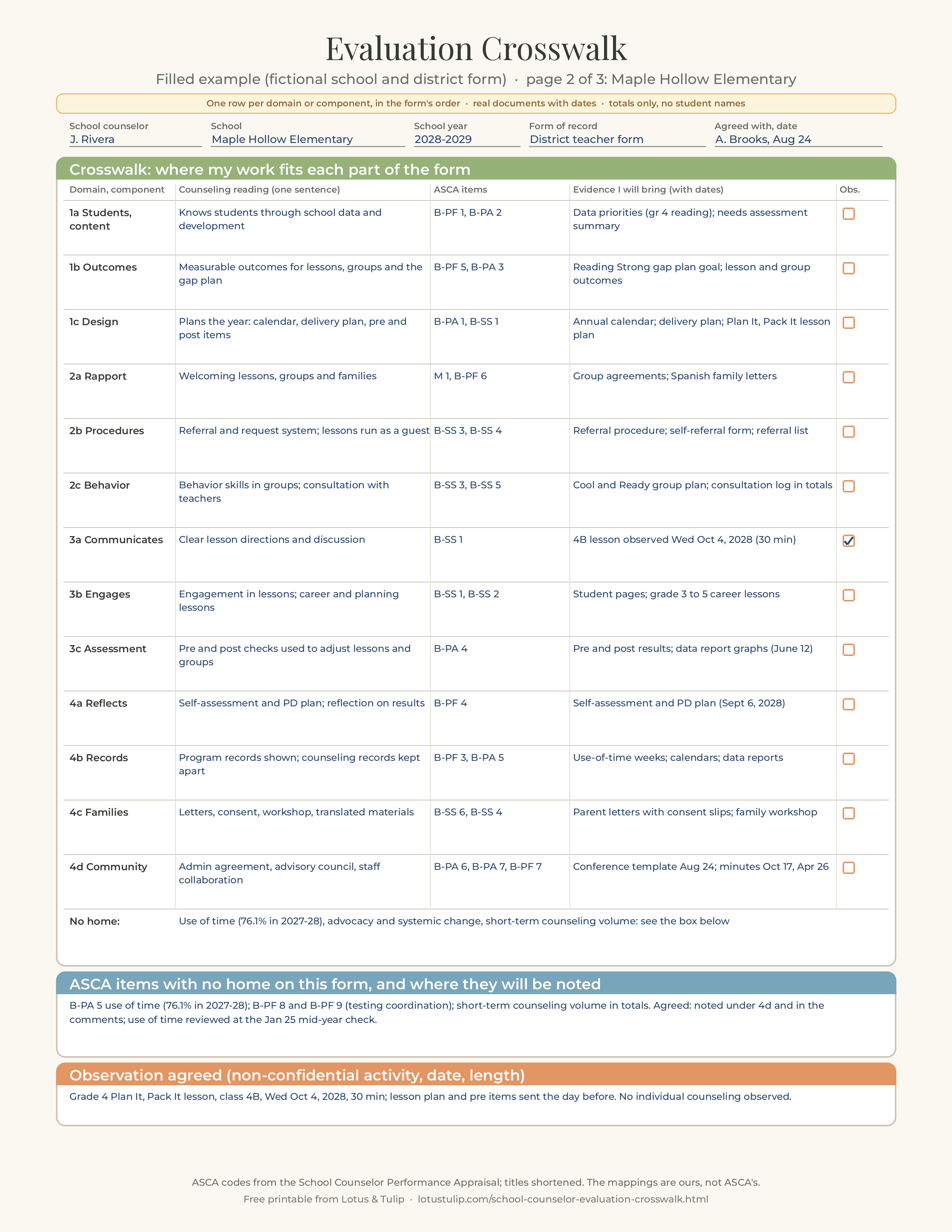
The fictional district evaluates counselors on its teacher evaluation form, which has four domains and thirteen components (we invented this form for the example; it is not any real district's instrument). Brooks agreed at the August conference that the district form stays the form of record and that ASCA's appraisal is the evidence guide. Rivera wrote the crosswalk the Monday before the conference and brought it with her, as evidence for the appraisal item B-PA 8.
The district form (fictional)
- Domain 1, Planning and Preparation: 1a Knowledge of students and content; 1b Sets learning outcomes; 1c Designs coherent instruction and assessment.
- Domain 2, Classroom Environment: 2a Respect and rapport; 2b Routines and procedures; 2c Student behavior.
- Domain 3, Instruction: 3a Communicates clearly; 3b Engages students; 3c Uses assessment during instruction.
- Domain 4, Professional Responsibilities: 4a Reflects on practice; 4b Keeps accurate records; 4c Communicates with families; 4d Professional community and growth.
Rivera's crosswalk, written Monday, August 21, 2028
| Component | Counseling reading | ASCA items | Evidence |
|---|---|---|---|
| 1a | Knows students through school data and development | B-PF 1, B-PA 2 | Data priorities (grade 4 reading), needs assessment summary |
| 1b | Writes measurable outcomes for lessons, groups and the gap plan | B-PF 5, B-PA 3 | Reading Strong gap plan goal; lesson and group outcomes |
| 1c | Plans the year: calendar, delivery plan, pre and post items | B-PA 1, B-SS 1 | Annual calendar, Student Standards delivery plan, Plan It, Pack It lesson plan |
| 2a | Welcoming lessons, groups and families | M 1, B-PF 6 | Group agreements; Spanish family letters |
| 2b | Referral and request system; how lessons run as a guest | B-SS 3, B-SS 4 | Referral procedure, self-referral form, referral list |
| 2c | Behavior skills taught in groups; consultation with teachers | B-SS 3, B-SS 5 | Cool and Ready group plan; consultation log in totals |
| 3a | Clear lesson directions and discussion | B-SS 1 | Observed 4B lesson, Wednesday, October 4 |
| 3b | Engagement in lessons; career and planning lessons | B-SS 1, B-SS 2 | Student pages, grade 3 to 5 career lessons |
| 3c | Pre and post checks used to adjust lessons and groups | B-PA 4 | Pre and post results, data report graphs (June 12) |
| 4a | Self-assessment and PD plan; reflection on results | B-PF 4 | Self-assessment and PD plan (September 6) |
| 4b | Program records shown; counseling records kept separately | B-PF 3, B-PA 5 | Use-of-time calculator weeks, calendars, data reports |
| 4c | Family letters, consent, workshop, translated materials | B-SS 6, B-SS 4 | Parent letters with consent slips; family attendance workshop |
| 4d | Administrator agreement, advisory council, staff collaboration | B-PA 6, B-PA 7, B-PF 7 | Conference template (August 24); council agendas and minutes (October 17, April 26) |
No home on the form: B-PA 5 (use of time, 76.1 percent in 2027 to 2028), B-PF 8 and B-PF 9 (advocacy and systemic change around testing coordination), and the volume of short-term counseling. Agreed: noted under 4d and in the comments, and the use-of-time figure discussed at the mid-year check.
Observation: Brooks observed the 4B Plan It, Pack It lesson on Wednesday, October 4, 2028 for 30 minutes, with the lesson plan and pre items in hand. Individual counseling was not observed; Rivera brought counts in totals instead.
Thursday, January 25, 2029: the mid-year check
The crosswalk was the agenda. Rivera showed evidence filed against 10 of the 13 rows. Rows 3c and 4c were waiting for spring data and the family workshop, and row 2c had the Cool and Ready plan but no results yet. Brooks asked to see the use-of-time weeks, and they agreed to discuss moving part of testing coordination, the same goal as in Rivera's ASCA appraisal.
Wednesday, June 13, 2029: the end-of-year meeting
Brooks completed the district form with the crosswalk open beside it. The components that had been hardest to rate in earlier years (1c, 2b and 4b) now had named evidence. In the comments, Brooks noted the crosswalk as the way counseling evidence had been located and recorded the use-of-time goal for 2029 to 2030 (two calculator weeks). On ASCA's appraisal, which they used as the evidence guide, B-PA 8 was rated 2, Proficient, by both of them. Rivera added one more goal: share the crosswalk with the other elementary counselors in the district, so the counselors could propose a shared version.
What made this work
- The crosswalk was written before the year began and agreed at the conference, not handed over in June.
- Every row named a real document with a date.
- The things the form could not see were written down, not left out.
- The observation was a lesson Rivera was teaching anyway.
Using the crosswalk with your administrator
Proposing it: "Our evaluation form was written for classroom teachers. I have put together a one page table showing where my counseling work fits each domain, with the evidence I will bring. Could we agree on it now, so we both read the form the same way this year?"
Agreeing a reading: "For 'managing classroom procedures,' I would suggest my referral and request system and how my lessons run when I teach in a teacher's room. Does that work for you?"
Planning the observation: "I cannot be observed in individual counseling, but I am teaching a grade 4 lesson on October 4. Could that be the formal observation? I will send the lesson plan the day before."
The item with no home: "Use of time does not appear anywhere on this form, but it is the biggest factor in what I can deliver. Could we note it under professional responsibilities, and look at my calculator weeks together in January?"
Asking for a counselor instrument, gently: "Some states and districts use a counselor-specific evaluation model or ASCA's appraisal. Would the district be open to the counselors drafting a proposal for next year?" Ask this outside your own evaluation meeting.
Going wider: when the instrument itself should change
ASCA's position statement describes this as collaboration "to advocate for the alignment between the school counselor appraisal tool and appropriate school counseling roles," with "other school counselors, school administrators, district leadership, union representatives (as appropriate), departments of education, etc." In practice that means a team project, not a personal one: the district's counselors agree a shared crosswalk, collect a year of evidence with it, and bring a proposal (adopt ASCA's appraisal, a state counselor model or a counselor version of the district form) through whatever process your district uses to change evaluation instruments. In states like Ohio, where a counselor system already exists in law, the conversation is about implementing it well rather than replacing a teacher form.
A checklist before you hand it over
- The instrument name and version at the top match the form of record.
- Every domain and component is listed, in order, including ones that do not fit.
- Each row has a one sentence counseling reading.
- Each row has one to three ASCA appraisal codes with current titles.
- Each row names real evidence with dates, in totals, with no student names.
- Confidential counseling records are named as kept separately, not shown.
- The ASCA items with no home are listed, with where they will be noted.
- One or two non-confidential observation options are named, with dates.
- Any student outcome metric (required in Ohio's OSCES) is agreed at the start.
- Your administrator has seen it before the first observation.
- You have a copy filed as an artifact for B-PA 8.
- Nothing in it claims work you did not do.
Six real world scenarios
"My principal says the form is the form, and we are not changing it." You are not asking to change it. Offer the crosswalk as a reading guide for the existing form, and ask only that the observation be a lesson or workshop.
"My state has a counselor model, but my district still uses the teacher form." Find out whether the state model is required, recommended or optional, and who decides. In Ohio, the framework is set by the State Board under state law and districts adopt a conforming policy; elsewhere a state model may be optional. Bring the state model to your counseling team before raising it with the district.
"Half the components are about classroom management." Write the counseling reading honestly (how your lessons run as a guest, your referral system, behavior skills taught in groups). If one genuinely does not apply, write "not applicable to this role; proposed evidence instead" and agree it in writing.
"I am the only counselor for 800 students and barely teach lessons." Then your instruction evidence is thin and your use-of-time data is your most important document. Put it in the "no home" row and make it the conversation. The crosswalk should show your real job, not an ideal one.
"I work across two buildings with two evaluators." Write one crosswalk, agree which evaluator rates which observation, and share the same evidence list with both.
"My evaluator wants to sit in on a counseling group." That decision depends on the group, your consent process and your ethical judgment. Offer a classroom lesson or a family workshop instead, and explain why using the confidentiality principle in ASCA's ethics or your state model.
Common mistakes
- Waiting until the end-of-year meeting. A crosswalk handed over in June is an argument. Handed over in August, it is an agreement.
- Leaving out components that do not fit. Your evaluator still has to rate them. Show your reading or your "not applicable" proposal.
- Stretching the truth. Mapping a lunch duty to "professional community" helps no one. Only real counseling work goes in.
- Listing a binder instead of documents. Name the document and the date in each row.
- Sharing student details as evidence. Results in totals only; counseling records stay confidential.
- Forgetting the "no home" items. Use of time and short-term counseling are often the heart of the job and the least visible on a teacher form.
- Treating a state counselor model like a teacher form. If your state has a counselor model, crosswalk from that model, not from the teacher rubric.
- Quoting outdated documents. Check the date and version of your instrument and ASCA's appraisal each year.
- Making it a complaint. Keep the tone practical: here is where my work fits, here is the evidence.
- Not filing it. The crosswalk is itself evidence for B-PA 8.
What we could not verify
- ASCA publishes no crosswalk to teacher frameworks or state models, and no guidance on how to map items. All mappings here are ours.
- North Carolina's school counselor evaluation rubric, process guide and summary rating form are listed but temporarily removed from DPI's page, so we did not describe North Carolina's rating levels or process. Our copy of the NC counseling standards is from a district website.
- We did not review the contents of TEMPSC (3rd edition) or the T-SCESS rubric. We read Texas Education Code 21.356 through a public statute site, not the Legislature's own page, which did not render for us.
- We did not verify how Pennsylvania combines domain ratings or weights student measures for school counselors in a final rating.
- We did not verify which Ohio districts use the state OSCES rubric as published and which use an aligned local rubric.
- We did not review any state not named in this guide. The fictional district form in the example is invented and is not modeled on a specific district.
- Nothing here is legal advice; evaluation rules change, so check the current versions of your state and district documents.
Free printable: crosswalk worksheet, filled example and observation planner
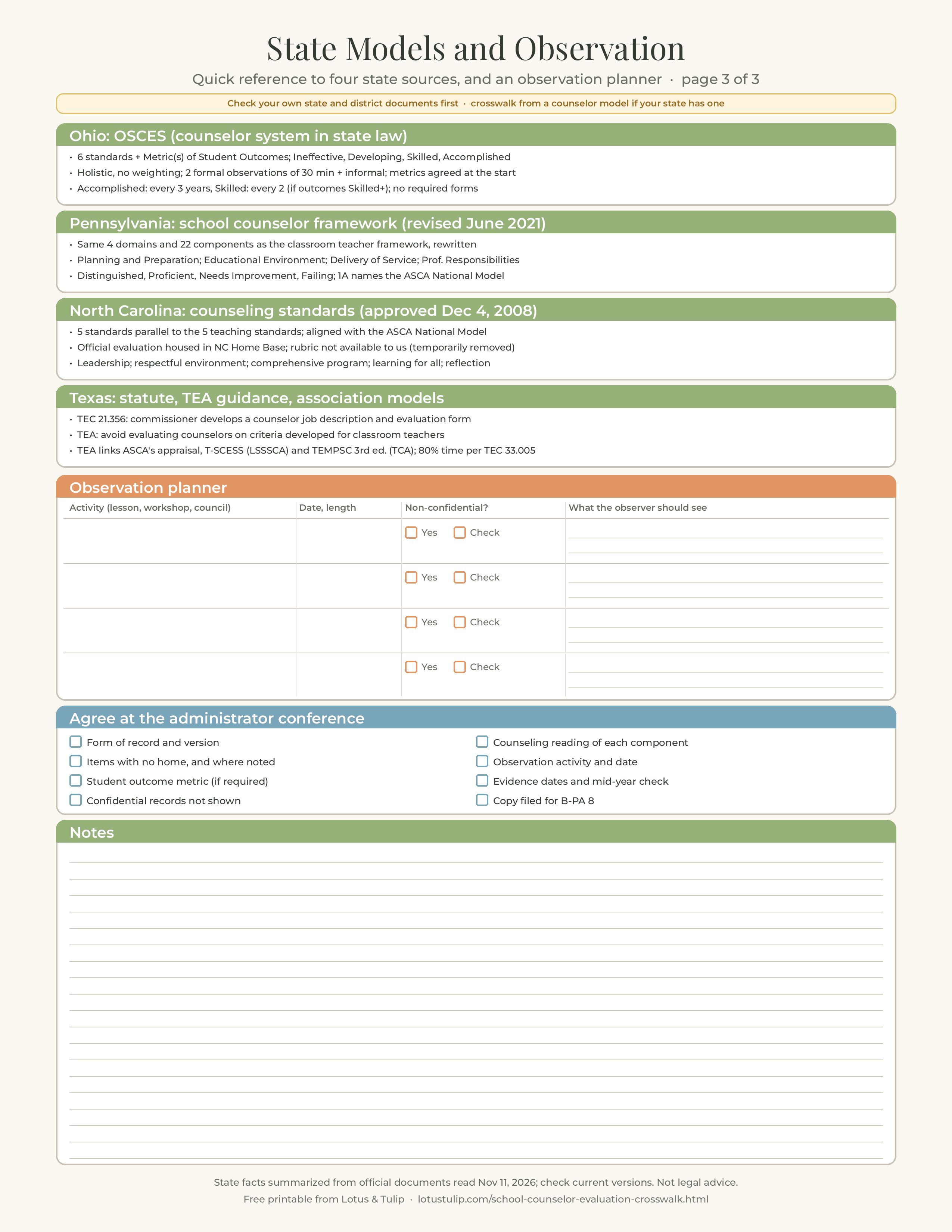
The free printable has three US Letter pages. Page 1 is a blank crosswalk worksheet: counselor, school, school year, the instrument of record and who it was agreed with at the top, then fourteen rows with columns for the domain or component, the counseling reading, the ASCA appraisal items, the evidence you will bring and an observation mark, followed by boxes for the ASCA items with no home on the form and the agreed observation. Page 2 is the same worksheet filled in for the fictional Maple Hollow Elementary crosswalk described above. Page 3 is a quick reference to the four state models we verified (Ohio, Pennsylvania, North Carolina and Texas), an observation planner with a confidentiality check, and a list of what to agree at the conference.
Download the free crosswalk worksheet, example and observation planner (PDF, 3 pages)
Use it alongside your official evaluation instrument and ASCA's School Counselor Performance Appraisal. The mappings are ours; the state facts are summarized from the documents listed below as of November 11, 2026. Keep student names off any copy you share.
Related resources
- School counselor performance appraisal: the ASCA 0 to 3 scale and artifacts for every item
- ASCA professional standards and competencies self-assessment and PD plan
- School counselor annual administrator conference: what to bring, sample agenda and talking points
- School counselor use-of-time calculator
- ASCA school counseling program assessment: all 25 benchmarks
- Classroom lesson plan and data report
- School counselor advisory council agenda and minutes
- Closing the gap action plan: the ASCA achievement gap plan and data report
- All school counselor small group curriculums
Sources (all checked November 11, 2026): American School Counselor Association, School Counselor Performance Appraisal (14 page PDF served from the "docx" link) and "The School Counselor and Annual Performance Appraisal" position statement (reviewed 2026), schoolcounselor.org; Ohio State Board of Education, "School Counselor Standards and Evaluation" (December 18, 2023), "Evaluation Framework for School Counselors" (adopted April 12, 2016), "Ohio School Counselor Evaluation System Model" (May 2016) and "Ohio Teacher Evaluation System Teacher Performance Evaluation Rubric" (footer "FINAL February 2026"); Pennsylvania Department of Education, "Framework for Observation & Practice for Non-Teaching Professionals: School Counselor" and "Framework for Evaluation: Classroom Teacher" (both revised June 2021), pdesas.org; North Carolina DPI, Professional Standards and Evaluation page, "North Carolina Professional School Counseling Standards" (approved December 4, 2008; district posted copy) and "North Carolina Professional Teaching Standards" (revised May 2, 2013); Texas Education Agency, "School Counseling: Job Description & Evaluation"; Texas Education Code 21.356 (via texas.public.law); Lone Star State School Counselor Association, T-SCESS page; Texas Counseling Association, Texas Model and TEMPSC page. The mappings, readings, worked example, fictional district form and printable are original to Lotus & Tulip and are not ASCA or state publications.
FAQ
What is a school counselor evaluation crosswalk?
A table that lists each domain, standard or component of the evaluation instrument a school counselor is evaluated on and, beside each, the counseling work that shows it, the matching ASCA School Counselor Performance Appraisal items and the evidence the counselor will bring. ASCA's appraisal names the skill in item B-PA 8: "Explains how school counseling activities fit within categories of a performance appraisal instrument."
Can school counselors be evaluated on a teacher evaluation form?
In many districts they are, because the instrument is set by district policy, state law or a bargaining agreement. ASCA's position statement says counselor appraisals "should accurately reflect the unique professional training and practices of school counselors," and the Texas Education Agency says "It is important to avoid evaluating school counselors according to criteria developed for classroom teachers or other educational professionals." A crosswalk helps when the teacher form is the form of record.
Which states have a school counselor evaluation model?
Of the states we verified: Ohio has the Ohio School Counselor Evaluation System (six standards plus a student outcomes area, rated Ineffective to Accomplished); Pennsylvania has a school counselor version of its observation and practice framework (four domains, 22 components); North Carolina has professional school counseling standards and an evaluation housed in NC Home Base; and Texas law asks the commissioner to develop a counselor job description and evaluation form, with TEA linking to ASCA's appraisal, T-SCESS and TEMPSC. Check your own state's department of education for others.
How do teacher evaluation domains map to school counseling?
On a four domain teacher form, planning and preparation usually maps to data, outcome goals and the gap plan (ASCA B-PF 1, B-PF 5, B-PA 1 to 3); environment to the climate of lessons and groups and the referral system (M 1, M 2, B-PF 6, B-SS 3, B-SS 4); instruction to classroom lessons and appraisal and advisement (B-SS 1, B-SS 2); and professional responsibilities to ethics, the self-assessment, collaboration, the administrator conference and the advisory council. These mappings are ours, not ASCA's.
What can an evaluator observe a school counselor doing?
Non-confidential activities. Ohio's model lists "guidance activities in a classroom, instructional small group activities, parent education functions, staff development, child study team meetings and data meetings." Individual counseling should not be observed; bring aggregate evidence instead. Agree the observation with your evaluator at the start of the year.
How many observations does Ohio's school counselor evaluation require?
Ohio's framework says the annual evaluation "will consist of two formal observations of thirty minutes each and informal observations," and the State Board adds demonstration of student outcome metrics. Counselors rated Accomplished or Skilled may be evaluated less often (every three or two years) if their student outcomes metric is Skilled or higher, with at least one observation and one conference in the off years.