
School counselors · Updated 2026-11-11
Classroom Lesson Plan for School Counselors: How to Write the ASCA Lesson Plan and Data Report (Filled Example, Free Planner)
Ready-made printable: Complete Small Group Counseling Bundle Holiday 20% off: about $29.44, was $37 (EUR 32) · instant digital download
Buy on Etsy
Most school counselors can teach a strong classroom lesson in their sleep. Twenty five fourth graders, a hook, a short teach, a practice activity, a closing question, out the door in thirty minutes. Writing that lesson up the way ASCA wants it is a different skill. The fifth edition template asks you to name one behavior standard, write objectives that start with "Students will," attach one or two pre and post items to each objective, describe four steps, report participation, graph the results and answer two reflection questions. If you are applying for RAMP, a reviewer checks all of that against eleven rubric items, and the plan has to be on ASCA's own template, unaltered.
A naming note first. Many counselors still search for a "classroom lesson plan template" or a "classroom results report." Those are fourth edition habits. In the fourth edition of the ASCA National Model, a classroom lesson lived in a Lesson Plan template (with a data collection plan inside it) and its results went on a separate "Classroom and Small-Group Results Report." The fifth edition (2025) replaced both with one document, the Lesson Plan and Data Report, and made one big change along the way: it no longer asks for achievement data. This guide uses the old search terms where they help, but everything below follows the fifth edition template, ASCA's completed fifth edition example and the fifth edition RAMP rubric, because those are what count now.
This guide is for elementary, middle and high school counselors in the United States who teach Tier 1 classroom lessons. It covers what the lesson plan is and where it fits; what changed from the fourth edition; every field on the fifth edition template, in order; the 11 items in Section 5 of the fifth edition RAMP rubric and the other sections that touch your lessons; choosing the lesson to document; one behavior standard, one or two objectives and one or two items per objective; the four steps; single lessons and units; pre and post scoring for a whole grade level; graphs; the two reflection questions, including the 250 word inclusion reflection that RAMP scores; what ASCA's own example shows, including a few details worth not copying; a realistic calendar; a ten step process; a fully worked fictional example; six scenarios; common mistakes; and a free three page printable: a blank planner, the same planner filled in for a fictional elementary school, and a data report worksheet with a scoring table, a graph checklist and a RAMP Section 5 checklist.
Jump to the free lesson plan planner, filled example and data report worksheet
This is educational information for school counselors in the US, not legal advice or official ASCA guidance. Your district, your state's school counseling framework and your evaluation system may set their own expectations. The ASCA documents quoted here were downloaded from schoolcounselor.org and checked on November 11, 2026: the fifth edition Lesson Plan and Data Report template (Word template, footer "ASCA National Model Fifth Edition 8/25 v2"), ASCA's completed fifth edition examples (including the lesson plan example for a fictional K to 9 school, marked "8/25 v2"), the "RAMP Scoring Rubric, Fifth Edition" (revision notes through February 2026), "The ASCA National Model: A Framework for School Counseling Programs, Fifth Edition," "Changes in the ASCA National Model Fifth Edition," the fifth edition "RAMP Application Timeline," "RAMP in the Fifth Edition," ASCA's "Graph Development Tips" (Rev. 9/25), the ASCA Student Standards: Mindsets & Behaviors for Student Success (2021), the ASCA Ethical Standards for School Counselors (2022), and, for comparison, the fourth edition Lesson Plan and Classroom and Small-Group Results Report templates and the fourth edition RAMP rubric. Anything we could not confirm in those documents is marked as such below.
The short answer
- Purpose, in ASCA's words: the lesson plan "provides details of specific lessons that enhance life-readiness skills for each and every student and defines: 1. What will be delivered to each and every student in a grade level (for Tier 1 lessons) 2. To whom it will be delivered 3. How it will be delivered 4. How students' attainment of the lesson's learning objective will be assessed."
- One standard. "Lessons are connected to only one ASCA Student Standard," and the template asks for one behavior standard. RAMP item 5.3 says the same.
- One or two objectives, one or two items each. Objectives begin "Students will," and each aligns with the standard. Each objective gets one or two pre and post items.
- Why this lesson: check no more than one Life-Readiness category (learning strategies, self-management skills or social skills) and any Academic Success category that applies (improve academic performance, meet benchmarks, improve test scores, meet promotion or graduation requirements).
- Four steps: introduce the lesson and objective, teach content, practice content, summarize. RAMP item 5.6 checks that each step supports the objective.
- No achievement data. ASCA's changes document: the lesson plan "No longer collects achievement data. A single lesson is not likely to have a significant impact on achievement data." It collects participation and ASCA Student Standards data only.
- Data report: students at the beginning and end (with an explanation if the number changed), a bar graph of pre and post results, and two reflection questions: what strategies facilitated inclusion and supported diverse learners, and what could be improved.
- For RAMP: Section 5 of the fifth edition rubric, 11 of 82 points. Submit "One stand-alone Lesson Plan and Data Report or one Lesson Plan and Data Report from a unit (PDF)." The "optional" data organizer is "Required for RAMP."
What the lesson plan is, and where it fits
The fifth edition framework describes four things school counselors do in the Manage component. The first is to plan how each and every student will learn the ASCA Student Standards, using three tools: "identifying specific standards in the ASCA Student Standards delivery plan that will be delivered in Tier 1 and 2 settings," "planning how the standards will be delivered using lesson plans and small-group sessions plan" and "using these standards to provide focus for individual sessions with students." So the three documents work as a set. The delivery plan lists every lesson and group for the year, one row each; the lesson plan details one lesson from that list; the small-group plan details one Tier 2 group.
The framework's tier table describes Tier 1 as "Proactive developmental strategies for each and every student and programs for families and staff," delivered through "classroom, grade-level and schoolwide programming." Its definition of instruction, the first of the direct student services, is to "Enhance student access, life-readiness and academic success through delivery of the ASCA Student Standards," in classroom, small group or individual settings, aligned with MTSS Tier 1 and 2 strategies. The framework's list of appropriate activities includes "Presenting school counseling lessons based on the ASCA Student Standards to address students' developmental needs and needs identified through data," and sets it against an inappropriate one: "Covering classes when teachers are absent or to create teacher planning time." That distinction matters when someone asks you to "just take the class for a period."
ASCA's example adds five implementation notes that frame the whole template:
- "Lessons are based on student data and developmental needs."
- "Lessons are delivered to all students at a grade level in classroom, large-group, small-group or individual settings (Tier 1)."
- "Some lessons may be based on specific requests from staff for unique circumstances/situations (Tier 2)."
- "Lessons are connected to only one ASCA Student Standard."
- "Directions are in red text below."
Note 2 surprises some counselors. In the fifth edition, a Tier 1 "lesson" does not have to happen in a classroom. Junior postsecondary planning conferences with every junior, or senior credit checks with every senior, count as Tier 1 lessons in small group or individual settings, because every student in the grade receives them. The template's setting checkboxes give exactly those two examples. What makes it Tier 1 is that each and every student in the grade gets it.
The plan uses two of the three categories of school counseling data from the framework's Assess component: participation data, which "Answers the question, 'Who participated in what activities?'", and ASCA Student Standards data, the "Attainment of the ASCA Student Standards." The third category, achievement data, is left to the small-group plan and the achievement gap plan, which starts from the school's data priorities.
Fourth edition vs fifth edition: what changed
If you trained under the fourth edition (2019), your classroom lesson documentation probably involved three things: a row on the "Classroom and Group Mindsets & Behaviors Action Plan" (now the delivery plan), a Lesson Plan for each lesson (with an evidence base checkbox, a data collection plan and follow up plans) and a "Classroom and Small-Group Results Report." ASCA's "Changes in the ASCA National Model Fifth Edition" sums up the change in one row: "Lesson Plans (included classroom and small group)" became the "Lesson Plan and Data Report," which "Includes rationale for the lesson" and "Collects two types of data: a. Participation b. ASCA Student Standards."
| Topic | Fourth edition | Fifth edition |
|---|---|---|
| Documents | Lesson Plan for each lesson, plus a separate Classroom and Small-Group Results Report | One Lesson Plan and Data Report |
| What RAMP asked for | "Three classroom lesson plans from your school counseling program, whether independent lessons or part of a unit" (Section 7) and their results (Section 8) | "One stand-alone Lesson Plan and Data Report or one Lesson Plan and Data Report from a unit" (Section 5) |
| Standards | "Identify 1-2 student standards" on the template ("Best practice = select one"); mindsets or behaviors (M&B#); RAMP 7.A1: one standard per lesson plan | One behavior standard from the ASCA Student Standards (RAMP 5.3) |
| Rationale | Target audience; evidence base checkboxes (best practice, action research, research-informed, evidence-based) | Reason checkboxes: no more than one Life-Readiness category and any Academic Success category that applies (RAMP 5.2) |
| Steps | Introduce lesson topic, communicate the lesson objective, teach content, practice content, summarize/close | Introduce lesson and objective, teach content, practice content, summarize, plus a materials box |
| Follow up | Plans for students who missed the lesson and for students who did not show mastery (RAMP 7.B2) | No follow up section on the template |
| Participation | Anticipated number of students and planned length of lessons | Students at beginning and end, with an explanation of any change; no length field |
| Outcome data | Achievement, attendance or discipline: baseline, final and percent change | None. Attendance and discipline boxes "when applicable" remain on the organizer |
| Reflections | How the instruction facilitated attainment of the standards; how the lesson could be improved; RAMP 7.G and 8.F/8.G reflections of up to 250 words | What strategies facilitated inclusion and supported diverse learners; what components could be improved; RAMP 5.11 scores the inclusion reflection (250 word limit) |
| RAMP points | Section 7 (classroom OR small-group lesson plans), 4 points, plus Section 8, Classroom Instruction Results Report, 7 points, required for every applicant | Section 5, Lesson Plan and Data Report, 11 points |
Two changes matter most in practice. First, you document one lesson instead of three. That makes the one you choose more important: pick a lesson you can measure well. Second, achievement data is gone. In the fourth edition, a classroom lesson's results report could compare, in ASCA's own sample wording, "reading levels of students before and after delivery of lesson." ASCA now says plainly that a single lesson is unlikely to move achievement data, and the fifth edition keeps achievement data for the small-group plan and the achievement gap plan, where several sessions with the same students make change more plausible. The lesson still has an academic rationale (the Academic Success boxes), but it does not report academic results.
On timing: ASCA's "RAMP in the Fifth Edition" says October 2026 was the final year to submit a fourth edition application, and October 2027 submissions are "Fifth edition only." If your data collection year is 2026 to 2027 or later, use the fifth edition template.
The fifth edition template, field by field
The blank template we downloaded (footer "ASCA National Model Fifth Edition 8/25 v2") is a Word template that prints to about five pages. It does not print the purpose, implementation notes or red directions; those appear in ASCA's completed example, which runs to seven pages. Here is every field, in order.
1. Lesson details
School Name, School Counselor Name, School Year, Lesson Title/Topic and Participants. RAMP item 5.1 checks "Lesson title/topic, participants and setting identified." Write participants the way the delivery plan asks for them, as a grade level ("All grade 4 students," or ASCA's example, "All eighth-grade students"), not a teacher's name. A title that says what the lesson teaches ("Understanding Bullying: Stopping Mean Behaviors" in ASCA's example) does the job; a cute title alone does not.
2. Setting
"Setting," "Lesson(s) will be delivered in:" with four checkboxes:
- "Classroom (Tier 1 whole-class instruction or Tier 2 specific classroom)"
- "Large Group (grade-level or multi-class instruction)"
- "Small groups (single session delivered to a group of students, ex., junior planning conferences)"
- "Individual (one-on-one student instruction) ex. senior credit checks"
Check the one that fits. "Small groups" here is not a Tier 2 counseling group; it means a single session delivered to a group, as part of reaching every student in a grade. If your lesson is a Tier 2 request for one class ("Tier 2 specific classroom"), it can still be documented on this template, but see the section on choosing a lesson for RAMP below.
3. Reason for this lesson
"Reason for this lesson: Select from each," with two columns and two rules printed beside them: Life-Readiness, "select no more than one category," and Academic Success, "select any category that applies."
- Life-Readiness: Learning Strategies, Self-Management Skills, Social Skills. These are the three subcategories of behavior standards in the ASCA Student Standards.
- Academic Success: Improve academic performance, Meet benchmarks, Improve test scores, Meet promotion/graduation requirements.
RAMP item 5.2 reads: "One Life-Readiness category and at least one Academic Success category are identified as the reason for the lesson(s)." So check exactly one Life-Readiness box and at least one Academic Success box. The rubric's revision notes say this item changed in September 2025 from an "open-ended response" to "category selection." The Life-Readiness box you check should be the subcategory your behavior standard comes from: a B-LS standard means Learning Strategies, a B-SMS standard means Self-Management Skills, a B-SS standard means Social Skills. ASCA's example checks Social Skills for a B-SS 2 lesson and Improve academic performance for the academic reason.
Notice that the Academic Success boxes on the lesson plan are worded as goals (improve, meet), while the small-group plan's boxes are worded as problems (failing grades, low test scores). That fits the tiers: a Tier 1 lesson supports every student's academic success; a Tier 2 group responds to students with an identified academic need.
4. Single lesson or unit
Two checkboxes: "Single Lesson" and "Unit of Lessons: Lesson ___ of ___." If you submit one lesson from a unit, write its number ("Lesson 2 of 3"). The RAMP rubric adds the rule that matters: "If a lesson plan from a unit is submitted, the data report should reflect the results for the entire unit."
5. ASCA Student Standards, objectives and assessment items
A table headed "ASCA Student Standards, Objectives and Assessment Items for Lesson" with three columns. In the blank template there is one standard cell and two objective rows, each with two numbered item lines. ASCA's example prints the red directions:
- Behavior Standard from ASCA Student Standards: "Identify one behavior standard from the ASCA Student Standards."
- Learning Objectives: "1. Include one or two objectives that align with the selected behavior standard from the ASCA Student Standards. 2. Begin each objective with 'Students will…'"
- Pre-/Post Assessment Statements: "Write one-two assessment items per learning objective. Administer pre-/post-assessments aligned with the learning objectives for: 1. each lesson or 2. the beginning of the first and end of the last lesson of the unit."
RAMP items 5.3 to 5.5 score this table: one behavior standard for the lesson plan, each objective aligned with that standard, and each objective aligned with at least one assessment item. So the most a lesson can carry is one standard, two objectives and four items, which is also exactly how many lines the data organizer has.
6. Materials
A free text "Materials" box. ASCA's example lists "Slide deck presentation, computer, projector" and "Chart paper and marker." It is not a numbered RAMP item, but it helps a reviewer picture the lesson and helps you repeat it next year. Include the pre and post assessment itself (paper forms, a digital form, response cards).
7. The steps
The steps page opens with two reminders: "1. Administer pre-assessment. 2. Record pre-assessment data. Optional data organizer can be used for this information." Then "Describe how you will:" with four boxes:
- Introduce lesson and objective
- Teach content
- Practice content
- Summarize
The plan section ends with the words "END OF PLAN." RAMP item 5.6 checks that the "Description of each step supports the attainment of the learning objective(s)." That one item covers all four boxes, so a vague summarize step can cost the same point as a vague teach step.
8. Lesson Data Report
- Participation Data Results: "Number of students at beginning of plan," "Number of students at end of plan" and "If number of students changes from beginning to ending of plan, provide an explanation for the change."
- Graphs: "If needed, use optional data organizer on the final page to organize the data." Then "ASCA Students Standards Data Results" (ASCA's spelling on the template), a "Behavior Standard Addressed" box, and a space to "Insert graph for data from the ASCA Student Standards pre- and post-assessment results for this plan."
- Two reflection questions: "What strategies facilitated inclusion and supported diverse learners?" and "What components of the lesson could be improved?"
There is no box for achievement data, percent change or contributing factors in the data report. That is by design.
9. Optional Data Organizer (Required for RAMP)
The last page pairs baseline and final boxes:
- "Baseline Participation Data: Number of students expected to participate in the lesson" and "Final Participation Data: Number of students who actually participated in the lesson."
- "Baseline ASCA Student Standards Data: ASCA Student Standard Pre-Assessment Results" and "Final ASCA Student Standards Data: ASCA Student Standard Post-Assessment Results," four numbered lines each. ASCA's example adds: "Calculate the average student response or percent correct for each item."
- "Baseline Attendance Data (when applicable)" and "Final Attendance Data (when applicable)," and the same pair for discipline. ASCA's example writes "NA" in all four.
The word "optional" refers to ordinary use. For RAMP, the organizer is where reviewers find the data for items 5.7, 5.9 and 5.10, so fill in every box, and write NA where a box does not apply.
RAMP Section 5: all 11 items in one place
The fifth edition RAMP Scoring Rubric describes Section 5 like this: "This section requires one lesson plan delivered by the school counseling program. The lesson shows evidence of the development of life-readiness skills for each and every student. The lesson plan includes what will be delivered, to whom it will be delivered, how it will be delivered and how students' attainment of the lesson's learning objective(s) will be assessed. Data results and graphs are required." The upload is "One stand-alone Lesson Plan and Data Report or one Lesson Plan and Data Report from a unit (PDF)."
| Item | What the rubric says | What it means in practice |
|---|---|---|
| 5.1 | Lesson title/topic, participants and setting identified | Title, a grade level in participants, one setting box checked. |
| 5.2 | One Life-Readiness category and at least one Academic Success category are identified as the reason for the lesson(s). | Exactly one box in the first column, one or more in the second. |
| 5.3 | Limit of one behavior standard from the ASCA Student Standards identified for the lesson plan. | One "B" code, never a mindset standard and never two standards. |
| 5.4 | Each learning objective aligns with the selected behavior standard from the ASCA Student Standards. | Both objectives teach the skill the standard names. |
| 5.5 | Each learning objective aligns with at least one assessment item. | Every objective has an item that measures it. |
| 5.6 | Description of each step supports the attainment of the learning objective(s). | All four steps lead to the objectives, including the summary. |
| 5.7 | Number of students at beginning of plan and the number of students at end of the plan are included. Explanation provided if number of students changes from beginning to end of plan. | Both numbers, plus one plain sentence if they differ. |
| 5.8 | Uploaded template includes life-readiness graph(s) that accurately reflects the ASCA Student Standards data. | Pre and post bar graph(s) that match the organizer. |
| 5.9 | Data calculates average student responses for Likert items or percent correct for knowledge-based items. | Averages for Likert, percents for knowledge, never raw totals. |
| 5.10 | Results provided for each assessment item in plan. | One pre and one post result for every item in the table. |
| 5.11 | Describe at least one strategy utilized in the submitted classroom lesson that facilitated inclusion and/or supported diverse learners. (250-word limit) | The first reflection, specific and under 250 words. |
The rubric groups these under headings that mirror the template: Lesson Plan Details (5.1, 5.2); Standards, Objectives and Assessment Items (5.3 to 5.5); Steps (5.6); and, under Lesson Data Report, Access (5.7), Graph(s) (5.8), the Optional Data Organizer (Required for RAMP) under Life-Readiness (5.9, 5.10) and Reflection (5.11). The second reflection, "What components of the lesson could be improved?", is on the template but is not a numbered RAMP item. Answer it anyway; it is part of the template, and an empty box on an uploaded template is never a good look.
Three general rules from the front of the rubric apply too. "Only completed fifth edition ASCA templates in their original form may be used," and "Using the wrong templates or altering templates may lead to rubric not being met." Everything except the delivery plan and use-of-time calculators is uploaded "as a PDF." And "No identifiable student information should be included. Applications with student photos and names risk deletion." The rubric also says the application "should cover one complete school year prior to the submission date," and the current rubric names a deadline of "Oct. 1, 2027, at 11:59 p.m. ET." We did not find a published passing score for the fifth edition application in ASCA's documents.
For context, the seven sections total 82 points: Section 1, ASCA Student Standards delivery plan, 9; Section 2, achievement gap plan and data report, 26; Section 3, advisory council, 11; Section 4, annual administrator conference, 6; Section 5, lesson plan and data report, 11; Section 6, small-group plan and data report, 16; and Section 7, reflections and signature page, 3. Section 5 has fewer moving parts than Sections 2 and 6, which makes it one of the most reliable places to earn every point.
Other rubric items that touch your lessons
- Delivery plan (Section 1): 1.1 "Specific Tier 1 lessons identified for each grade level in the school"; 1.2 "Each Tier 1 lesson (classroom, large group, small group or individual setting) is connected to one behavior standard"; 1.3 "Each Tier 1 lesson specifies grade level(s) in the participant column"; 1.8 asks that each title "conveys purpose/focus"; and 1.9 asks for "a start month for each Tier 1 lesson." Your Section 5 lesson should appear on the delivery plan with the same title, standard and grade.
- Advisory council (Section 3): 3.9 says the second-semester agenda includes, at a minimum, a "Lesson Plan and Data Report update," and 3.11 asks for a summary of discussion and feedback on at least two of three updates, one of which is the lesson plan update. If you teach your lesson in the fall, you will have finished data for the spring meeting. Our advisory council guide has sample agendas.
- Program reflections (Section 7): not specific to the lesson, but the lesson is often the clearest example you have of how your program reaches every student.
Choosing the lesson to document
You will teach dozens of lessons a year. For RAMP you submit one. For your own program, you might fully document three or four a year, one per grade band, and keep the rest as simpler plans. Either way, choosing well saves time.
Start from data, the way ASCA describes it
The ASCA Student Standards document lists ten implementation steps that map almost exactly onto this template:
- "Identify need in achievement data."
- "Consider contributing-factors data."
- "Select student standard."
- "Write learning objectives aligned with the student standard."
- "Create pre-/post-assessment."
- "Select or develop strategies."
- "Administer pre-assessment."
- "Deliver strategies."
- "Administer post-assessment."
- "Reflect on areas for improvement."
Steps 1 and 2 are your reason boxes, step 3 is the standard, steps 4 and 5 are the table, step 6 is the four steps, steps 7 to 9 are the data report, and step 10 is the reflections. The implementation note "Lessons are based on student data and developmental needs" asks for both: a reason in the school's data (a grade with missing work, a spike in peer conflict referrals, a benchmark gap) and a reason in development (what students that age are ready to learn).
A good RAMP lesson has five features
- It is Tier 1. Section 5 asks for evidence of "the development of life-readiness skills for each and every student," and ASCA's RAMP timeline says "choose one lesson, whether one independent Tier 1 lesson or one Tier 1 lesson from a unit of three lessons." Teach it to every student in a grade. A Tier 2 lesson for one class at a teacher's request can be documented on the same template for your own program, but we would not submit it for RAMP.
- It has one clear skill. One behavior standard and one or two objectives you can measure in a few minutes. "Organizing homework with a planner" is a skill; "Social emotional learning" is a topic.
- It can be measured with three or four items. If you cannot write a knowledge item with a clear right answer, or a Likert statement a student could honestly rate, pick another lesson.
- It is on the delivery plan. Same title, same standard, same grade, start month filled in.
- It finishes early enough. ASCA's timeline puts lesson delivery from October to March and data reports "completed and analyzed, graphs created" by April to May. A fall lesson gives you time to graph, reflect and share at the spring advisory council meeting.
Single lesson or a lesson from a unit?
Both are allowed. A single stand-alone lesson is simpler: pre at the start, post at the end, one class period of data. A lesson from a unit usually teaches more, but the rubric says "the data report should reflect the results for the entire unit," and the template's direction is to give the pre-assessment at "the beginning of the first" lesson and the post-assessment at "the end of the last lesson of the unit." ASCA's timeline mentions "a unit of three lessons"; we did not find a rule in the rubric or template that a unit must have exactly three lessons, or guidance on whether the other lessons in the unit must also be written on templates.
Our practical advice: if the skill can be taught and practiced in one period, submit a single lesson. If you submit a lesson from a unit, write the submitted lesson's objectives so they are the unit's objectives (the post-assessment at the end of the unit then measures exactly what the plan says), mark "Lesson 2 of 3" or similar, and say in the participation explanation which students completed both the first and the last lesson.
Which grade?
Pick the grade where your data story is clearest and where you can give a pre and post to every student without losing half your week. A grade of 70 to 120 students is easy to score by hand in an evening; a grade of 450 needs a digital form. Avoid a grade that is about to take state tests during your lesson window, and avoid lessons that depend on a single teacher's schedule.
The standard, the objectives and the items
Picking one behavior standard
The ASCA Student Standards have 36 standards: six mindset standards and 30 behavior standards in three groups of ten (Learning Strategies B-LS 1 to 10, Self-Management Skills B-SMS 1 to 10 and Social Skills B-SS 1 to 10). The template asks for a behavior standard. The Student Standards explain why: behaviors "are visible, outward signs that a student is engaged as well as putting forth effort to learn," which is what a lesson can teach and a pre and post can measure. Copy the code and the exact wording from the 2021 document; ASCA's changes document confirms the fifth edition uses the 2021 version with "No change."
Once you have the standard, our pre and post survey item bank has two Likert items and one or two knowledge items with answer keys for each of the 36 standards, plus the scoring formulas ASCA's data organizer uses.
Standards that fit common Tier 1 lessons (codes and wording from the ASCA Student Standards):
| Lesson topic | Standard | Life-Readiness box |
|---|---|---|
| Homework, planners, organization | B-LS 3 "Time-management, organizational and study skills" | Learning Strategies |
| Goal setting, academic planning | B-LS 7 "Long- and short-term academic, career and social/emotional goals" | Learning Strategies |
| Career exploration, course selection | B-LS 9 "Decision-making informed by gathering evidence, getting others' perspectives and recognizing personal bias" | Learning Strategies |
| Online research, digital citizenship for learning | B-LS 5 "Media and technology skills to enhance learning" | Learning Strategies |
| Calm tools, test worry, stress | B-SMS 7 "Effective coping skills" | Self-Management Skills |
| Self-control, impulse control | B-SMS 2 "Self-discipline and self-control" | Self-Management Skills |
| Growth mindset, persistence | B-SMS 5 "Perseverance to achieve long- and short-term goals" | Self-Management Skills |
| Body safety, online safety | B-SMS 9 "Personal safety skills" | Self-Management Skills |
| Transitions to middle or high school | B-SMS 10 "Ability to manage transitions and adapt to change" | Self-Management Skills |
| Friendship, conflict, respectful disagreement | B-SS 2 "Positive, respectful and supportive relationships with students who are similar to and different from them" | Social Skills |
| Listening, I statements, communication | B-SS 1 "Effective oral and written communication skills and listening skills" | Social Skills |
| Empathy | B-SS 4 "Empathy" | Social Skills |
| Bullying prevention, upstanders | B-SS 8 "Advocacy skills for self and others and ability to assert self, when necessary" | Social Skills |
| Group work, cooperation | B-SS 6 "Effective collaboration and cooperation skills" | Social Skills |
The Student Standards also say "All 36 standards can be applied to any of the three school counseling domains of academic, career and social/emotional development," and that "The school counselor selects a domain and standard based on the needs of the school, classroom, small group or individual." So B-LS 7 can anchor an academic goal lesson in grade 3 or a career goal lesson in grade 11. Pick the standard that names the skill your objectives teach, not the one that sounds closest to the lesson's title.
Writing the learning objectives
The Student Standards describe objectives as the way school counselors "operationalize the standards": "School counselors write or select measurable learning objectives that align with specific standards." On the template, each objective begins "Students will," and you may have one or two. A good objective names something students can say, list, show or do by the end of the lesson:
- Measurable: "Students will write tonight's assignments in a planner with the subject, the task and the due date."
- Measurable: "Students will name two ways to respond when they see mean behavior online."
- Not measurable: "Students will understand organization." "Students will learn about bullying." "Students will appreciate differences."
Two objectives are useful when the skill has a knowing part and a doing part (name the signals; use the tool), or two connected moves (write it down; check before you leave). If both objectives are really the same thing, use one. ASCA notes that "Sample grade-level learning objectives are available at schoolcounselor.org/studentstandards," a spreadsheet you can download and choose from.
Writing pre and post items
One or two items per objective, so a lesson has two to four items. That fits the Student Standards' own advice: "No more than three to five questions or prompts are needed for any one measure. Forcing that limitation maintains the concentrated focus of both the intervention and the measure." There are two kinds of item, and ASCA scores them differently:
- Likert items are statements students rate, for example from 1 (strongly disagree) to 4 (strongly agree): "I write down my homework before I leave school." You report the average.
- Knowledge items have a right answer: "Name two things to check before you leave school for the day." You report the percent of students who answered correctly. Write the answer key before the lesson, including what counts as correct for open answers (for example, two items from an accepted list).
The Student Standards suggest a simple way to draft items: "Brainstorming statements that begin with stems such as I believe…, I know… and I can… guide question development." "I believe" stems measure attitudes, "I know" stems lead to knowledge items, and "I can" stems measure skills. They also warn against measuring the wrong thing: "school counselors go beyond asking if participants enjoyed the activity or if they believed it was beneficial." "I liked today's lesson" is not an item.
Our pre and post assessment guide goes deeper on wording, scales and reading levels. For a whole grade, four rules matter most:
- Each item measures one objective, and the table shows which.
- Wording, order and scale are identical before and after.
- Students do not see the answers between pre and post (do not put the knowledge answer on the slide during the hook).
- Read items aloud in the early grades, and give students who need it the same accommodations they get in class.
Mix item types if it helps: two Likert and two knowledge items is a common pattern. But plan for two graphs if you do (see Graphs below).
Number items once, everywhere
The template numbers items 1 and 2 under each objective, and the organizer has lines 1 to 4. Number every item once (1, 2, 3, 4 across both objectives) and use those numbers in the table, the organizer and the graph labels. It makes item 5.10, "Results provided for each assessment item in plan," easy for a reviewer to confirm.
Writing the four steps
RAMP 5.6 asks whether each step supports the objectives. The test a reviewer applies is simple: if a substitute taught only what is written in these four boxes, would students be able to do what the objectives say? Write each step as what you will do and what students will do, in a few sentences.
| Step | What it should contain | Weak version | Stronger version |
|---|---|---|---|
| 1. Introduce lesson and objective | A short hook, the objective in student words, the pre-assessment | "Introduce the topic." | "Pre-assessment (4 items, read aloud, 5 minutes). Hook: a backpack with a crumpled worksheet and no pencil. 'Today you will learn to write homework so future you can read it, and to check your bag before you leave.'" |
| 2. Teach content | The actual content: steps, facts, examples, a model | "Slides about organization." | "Model the three-part planner entry (subject, task, due date) with two real assignments from the teacher. Show a weak and a strong entry and ask what is missing. Teach the four-item end of day checklist." |
| 3. Practice content | Every student does the skill, with feedback | "Students do an activity." | "Each student writes today's two real assignments in their planner; partners check each other against the three parts. Then a two minute 'pack up' drill with the checklist card." |
| 4. Summarize | Students restate the skill, say when they will use it, post-assessment | "Wrap up." | "Students tell a partner the three parts and when they will use the checklist today. Post-assessment (same 4 items). Checklist cards taped inside desks." |
The fourth edition had a separate "Communicate the Lesson Objective" step; the fifth edition folds it into the first box. Keep it there anyway. Saying the objective out loud is how students (and reviewers) know what the lesson is for. The fourth edition also asked for follow up plans for students who missed the lesson or did not show mastery. The fifth edition template has no box for that, but the plan still needs to exist; put a sentence in your own records, and mention it in the improvement reflection if it matters.
Pre and post: rules and math
When to give it
For a single lesson, give the pre-assessment at the start of the lesson and the post-assessment at the end, with the same items in the same order. For a unit, the template's direction is "the beginning of the first and end of the last lesson of the unit." If you teach the same lesson in several classrooms, give it the same way in each room: same instructions, same reading aloud, same time allowed.
How to score it
- Likert item: add every student's rating for that item and divide by the number of students who answered. Seventy one students whose ratings add up to 163 gives 163 / 71 = 2.30, shown as 2.3.
- Knowledge item: students who answered correctly divided by students assessed, times 100. Twenty seven of 71 correct is 38.0 percent.
RAMP 5.9 checks exactly this: "Data calculates average student responses for Likert items or percent correct for knowledge-based items." Report one decimal for Likert averages and one decimal or whole percents for knowledge items, and be consistent across the organizer and the graphs. Label each organizer line with its type or a percent sign, so a reviewer can tell 3.2 (a Likert average) from 32 (a percent).
Scoring a whole grade without losing a weekend
- Put all four items on a half page, with student number or class code, not names, if your district allows anonymous or coded collection.
- Use a digital form for large grades: one form, a "pre" or "post" choice, and a class code. The spreadsheet does the averages.
- For paper, tally per class on one sheet (ratings 1, 2, 3, 4 for each Likert item; correct or not for each knowledge item), then add the classes together.
- Keep the raw forms in your own files under your district's records rules, and report only totals.
Absent students and late arrivals
ASCA's template asks you to explain any change in participation between the beginning and end of the plan, but it does not say how to treat students who were absent for the lesson, arrived late or missed the post, and we did not find guidance on that in the rubric or example. We recommend reporting pre and post results for the same students, the ones who completed both, and saying so in one sentence ("Three students were absent on their class's lesson day; results are for the 71 students who completed both the pre and post"). That way a change in the numbers reflects learning, not a change in who was counted. If your district allows families to opt students out of surveys, count those students in participation but not in the results, and say so. Make up the lesson for absent students if you can; that is good practice, even though the fifth edition template no longer asks for it.
Keep the data private
The plan reports totals only. Never put student names, initials, photos or tiny subgroups that identify a student in the template. The ASCA Ethical Standards ask school counselors to "Use data-collection tools adhering to standards of confidentiality" (A.3.c). Our progress notes guide covers FERPA and records.
Graphs
ASCA's example prints the graph rules on the data report page. For pre and post results: "1. Match data reported in the results section. 2. Data represented side by side. 3. Graph aggregate data, not individual student data." Then: "All graphs are bar charts and include: 1. Primary title: ASCA Student Standards Data Results 2. Subtitle with specific details about the students or data represented on graph 3. Y-axis label: describes data being graphed; if Likert scale is used, defines the scale 4. X-axis label: defines what is being compared 5. Data points included for each bar on graph."
ASCA's Graph Development Tips (Rev. 9/25) give step by step directions for Excel ("CLUSTERED COLUMN"), Google Sheets ("COLUMN CHART"), PowerPoint and Canva, and note that the "Primary Title and ASCA Student Standards are provided on the ASCA National Model fifth edition templates." The fourth edition rubric said that if both item types are used, "create one graph for Likert-scale results and one graph for knowledge-based results." ASCA's fifth edition lesson example does the same: a Likert graph with the Y-axis "Average Likert Scale Response" on a 0 to 4 scale, and a knowledge graph with "Percent Correct" on a 0 to 100 scale. Keep them separate; on one shared axis the Likert bars would be unreadable.
A quick checklist for 5.8:
- Bar charts, pre and post side by side, with a legend.
- A subtitle naming the lesson and the students ("Plan It, Pack It, all grade 4, 71 students who completed pre and post").
- Item wording (or a short version) under each pair of bars, in the same order as the organizer.
- A Y-axis label that defines the Likert scale ("Average response, 1 = strongly disagree, 4 = strongly agree"), or "Percent of students who answered correctly."
- A data label on every bar, including zeros.
- Numbers that match the organizer exactly, including rounding.
Our school counseling data graphs guide covers subtitles, axis labels and Excel, Google Sheets, PowerPoint and Canva steps in more detail, with a free graph planner and check sheet.
The two reflection questions
"What strategies facilitated inclusion and supported diverse learners?"
This is the one RAMP scores. Item 5.11: "Describe at least one strategy utilized in the submitted classroom lesson that facilitated inclusion and/or supported diverse learners. (250-word limit)." Three words in that item do the work: "at least one," "utilized" and "submitted." Describe something you actually did in this lesson, not your general philosophy, and keep it under 250 words.
The Ethical Standards set the bar: school counselors "Provide culturally responsive instruction and appraisal and advisement to students" (A.1.d), and the Student Standards describe behavior standards as delivered through "culturally sustaining instruction, appraisal and advisement, and counseling." Concrete strategies that make a strong answer:
- Items and directions read aloud, with picture supports for early readers.
- Materials in the languages families and students use, or a bilingual staff member co-teaching part of the lesson.
- Accommodations from IEPs and 504 plans applied to the pre and post as well as the lesson, planned with the special education teacher.
- Examples and scenarios that reflect students' real lives and the communities in the school, chosen with teacher input.
- Several ways to show the skill: say it, write it, act it out, point to it.
- Structured partner roles so students who rarely speak in whole class discussion still practice.
- A pass option and no requirement to share personal experiences in front of the class.
A strong answer names the strategy, says why it was needed in this group (in totals, no names), and says what happened. "Twelve of the 74 grade 4 students are learning English. I gave the pre and post orally in English and Spanish, and the planner model used the class's real assignments so the vocabulary was familiar" is far stronger than "I differentiated instruction."
"What components of the lesson could be improved?"
Not a numbered RAMP item, but it is where your data turns into a decision. Look at the item with the smallest gain and ask why: was the teach step too fast, was the item worded unclearly, did the practice skip that part? Then write one or two specific changes: timing, examples, order, practice, materials, follow up with teachers. If your results raise a Tier 2 need (a group of students who still could not do the skill), say what happens next for them.
What ASCA's own example shows (and a few details not to copy)
ASCA's fifth edition example is a single classroom lesson, "Understanding Bullying: Stopping Mean Behaviors," for "All eighth-grade students" at a fictional Everett Naismith K to 9 School in 2025 to 2026. It is the clearest picture of what a finished plan looks like.
- Setting and reason: Classroom; Social Skills; Improve academic performance; Single Lesson.
- Standard and objectives: one standard, written as "B-SS 2: Create positive and supportive relationships with other students," and two objectives: "Students will be able to state personal needs/wants respectfully when needed" and "Students will be able to state personal opinions/thoughts respectfully during disagreements."
- Items: one per objective. A Likert statement, "I see how my wants and the wants of others interact," and a knowledge question, "How can you remain respectful when disagreeing?" The second line under each objective is left blank, which is fine, because the rule is one or two items.
- Steps: introduce by defining "mean" behaviors and asking for examples "without names"; teach with discussion questions and a slide deck review; practice by brainstorming in small groups, choosing one idea and role playing it, with each strategy added to a class chart; summarize by reviewing the list and leaving it in the classroom.
- Data: 78 students at the beginning and the end; the Likert item from 2.1 to 3.2 and the knowledge item from 32 to 82 percent correct; two bar graphs, one for each item type; attendance and discipline "NA."
- Reflections: "I used differentiated instruction and teaching methods with visuals, audio and technology. I encouraged students to share their personal experiences and traditions to foster cultural appreciation." And: "I plan to update my 'hook' to get the students connected to the lesson. I also updated my slide deck with more diverse images. I found that students need more time to share and reflect on their experiences and will build in extra time for the next presentation."
A few details we would not copy into a RAMP application, because each makes a rubric item harder for a reviewer to confirm:
- Standard wording. The 2021 ASCA Student Standards word B-SS 2 as "Positive, respectful and supportive relationships with students who are similar to and different from them." The example's wording is a paraphrase. Copy the code and the exact text from the current standards.
- An item that measures awareness, not the objective. The first objective is about stating needs and wants respectfully; its item asks whether students "see how" wants interact. It is related, but a reviewer checking 5.5 has to work to connect them. An item such as "I can tell a classmate what I need in a respectful way" lines up directly.
- Unlabeled organizer numbers. The organizer lists "2.1" and "32" with no type or percent sign. Label them (2.1 average; 32 percent correct).
- A generic inclusion reflection. The example's reflection is two sentences of general practice. RAMP 5.11 asks for "at least one strategy utilized in the submitted classroom lesson"; a more specific answer is safer.
- Personal disclosure in class. One of the example's discussion questions is "Who has been cyberbullied?" Asked aloud, that invites students to disclose in front of peers. Ask instead how common cyberbullying is, or use an anonymous show of hands or a scenario.
The example's Likert graph also has a small typo in the axis label ("Strongrly Disagree"). None of this makes it a bad example; it is a sample, not a scored application. It simply shows how easy it is for wording and numbers to drift between the table, the organizer and the graphs.
When to write it: a realistic calendar
ASCA's fifth edition RAMP Application Timeline lays out the data collection year. The lesson lines read: September to October, "Lesson plan finalized (choose one lesson, whether one independent Tier 1 lesson or one Tier 1 lesson from a unit of three lessons)"; October to December, January and February to March, "Lesson plan delivery"; February to March, "Data reports (lesson, small group, achievement gap plan)"; and April to May, "Data reports (completed and analyzed, graphs created)," alongside the second semester advisory council meeting. In a typical school year that becomes:
| When | What to do |
|---|---|
| August to September | Finish the delivery plan with Tier 1 lessons for every grade, each with one behavior standard and a start month. |
| September to October | Choose the lesson you will document. Draft it on paper (the free planner below), then type it into ASCA's template. Write the items and the answer key. Ask teachers for the dates. |
| The week before | Print or set up the pre and post, plan accommodations with special education and English learner staff, prepare materials. |
| Lesson day (each class) | Pre-assessment, the four steps, post-assessment. Note absences and anything that changed. |
| Within a week | Score pre and post, fill in participation and the organizer, build the graph(s), make up the lesson for absent students if you can. |
| Within two weeks | Write both reflections while the lesson is fresh. Check the inclusion reflection is under 250 words. |
| Second semester advisory council | Share the lesson plan and data report update in totals; record feedback in the minutes. |
| Before submission | Check every number against the organizer, save the template as a PDF, scan for names and identifying details. |
How to write an ASCA lesson plan and data report, step by step
- Choose a Tier 1 lesson from data. Pick one lesson that every student in a grade will receive, that teaches one clear skill, that is on your delivery plan and that you can measure with two to four items.
- Fill in the lesson details and setting. Enter school, counselor, year, a title that says what the lesson teaches and the participants as a grade level, then check one setting and single lesson or unit.
- Check the reason boxes. Check exactly one Life-Readiness category that matches your standard's subcategory and at least one Academic Success category.
- Choose one behavior standard. Copy the code and exact wording of one behavior standard from the 2021 ASCA Student Standards.
- Write one or two learning objectives. Begin each with "Students will," make it observable by the end of the lesson and align it with the standard.
- Write one or two pre and post items per objective. Decide whether each is a Likert or a knowledge item, fix the scale and the answer key now, and number the items 1 to 4.
- Describe the four steps and materials. Write how you will introduce the lesson and objective, teach, have every student practice and summarize, so each step clearly leads to the objectives, and list the materials.
- Teach the lesson and give the assessments. Give the pre-assessment at the start and the post-assessment at the end (or at the start of the first and end of the last lesson of a unit), the same way in every classroom, and note absences.
- Complete the data organizer and graph. Enter expected and actual participation, the average or percent correct for every item, NA for attendance and discipline if they do not apply, and build bar graphs that match the organizer exactly.
- Write the reflections and check against Section 5. Describe at least one inclusion strategy you used in under 250 words, say what you will improve, confirm items 5.1 to 5.11, remove any identifying information and save ASCA's template as a PDF.
A worked example (fictional): "Plan It, Pack It" at Maple Hollow Elementary
Maple Hollow Elementary is a fictional public elementary school with kindergarten to grade 5 and three classroom teachers per grade. J. Rivera is the only school counselor. Our other school counselor guides follow the same school, including the delivery plan, the 2028 to 2029 achievement gap plan for grade 4 reading and the Cool and Ready small group for grade 5. The school plans to apply for RAMP in October 2029, so 2028 to 2029 is the data collection year. Every name, number and date below is invented for illustration.
Choosing the lesson
In September 2028 the three grade 4 teachers raised the same concern at a grade level meeting: homework was not coming back. The gradebook for the first four weeks showed 29 of the 74 grade 4 students with two or more missing homework assignments. On the fall student survey, 41 of 74 said they "sometimes" or "often" forget what their homework is. Grade 4 is also the first year at Maple Hollow when students carry a paper planner.
Last year's delivery plan had a four lesson organization unit in grade 4. Teachers said it took too much class time, so for 2028 to 2029 J. Rivera replaced it with one stand-alone lesson in October plus two weeks of teacher follow up. She chose this lesson as the Section 5 submission because it is Tier 1 (every grade 4 student), it teaches one skill, and both objectives are easy to measure in a few minutes. On the 2028 to 2029 delivery plan it is one Tier 1 row: B-LS 3, "Plan It, Pack It: homework planner and end of day checklist (single lesson)," participants "All grade 4," start month (4) Oct.
Lesson details, setting and reason
- School Name: Maple Hollow Elementary. School Counselor: J. Rivera. School Year: 2028 to 2029.
- Lesson Title/Topic: Plan It, Pack It: writing homework in a planner and checking before you leave
- Participants: All grade 4 students (three classes, 4A, 4B and 4C)
- Setting: Classroom (Tier 1 whole-class instruction)
- Reason: Life-Readiness: Learning Strategies. Academic Success: Improve academic performance.
- Single Lesson, taught Tuesday, October 3 (4A), Wednesday, October 4 (4B) and Thursday, October 5, 2028 (4C), 40 minutes in each class.
Standard, objectives and items
| Behavior standard | Learning objective | Pre and post items |
|---|---|---|
| B-LS 3. Time-management, organizational and study skills | Students will write each assignment in a planner with the subject, the task and the due date. | 1. (L) I write down my homework in a planner before I leave school. 2. (K) Look at this planner entry: "Math: page 42." What is missing? |
| Students will use a four-item end of day checklist to pack what they need for homework. | 3. (L) Before I go home, I check that I have everything I need for my homework. 4. (K) Name two things to check before you leave school for the day. |
Likert items use 1 = strongly disagree to 4 = strongly agree. Answer key: item 2 is correct if the student names the due date (or "when it is due"); item 4 is correct with any two from the checklist or an equivalent (planner, homework folder, the books or worksheets the homework needs, device and charger, notes for family). All four items were read aloud in English and Spanish. Materials: pre and post half sheets, a backpack with a crumpled worksheet and no pencil, two real assignments from each teacher, student planners, a projected planner page, 74 laminated checklist cards, and a timer.
The four steps
- Introduce lesson and objective (8 minutes). Pre-assessment, four items read aloud. Hook: the backpack with a crumpled worksheet and no pencil; "What happens to this homework tonight?" Objective in student words: "Today you will write homework so that tonight-you can read it, and check your bag before you leave."
- Teach content (12 minutes). Model the three-part planner entry (subject, task, due date) with two real assignments from the class teacher. Show a weak entry ("Math: page 42") and a strong one ("Math: page 42, problems 1 to 10, due Thursday") and ask what changed. Teach the four-item end of day checklist: planner, folder, what the homework needs, what goes to family.
- Practice content (12 minutes). Each student writes the class's two real assignments in their own planner. Partners check each other's entries against the three parts and fix one thing. Then a two minute "pack up" drill: every student uses the checklist card to pack for a pretend homework night, and partners check.
- Summarize (8 minutes). Students tell a partner the three parts of a planner entry and when they will use the checklist today. Post-assessment, same four items. Checklist cards go inside desks, and teachers agree to a two minute planner check at the end of each day for two weeks.
Along the way
One student in 4A and two in 4C were absent on their class's lesson day. J. Rivera taught each of them a 15 minute make up the following week, but did not include them in the pre and post results. In 4C the lesson started ten minutes late after an assembly, so the pack up drill was cut to one minute.
The data report
Participation: 74 at the beginning, 71 at the end. "Three students were absent on their class's lesson day and received a make up lesson the next week; pre and post results are for the 71 students who completed both." In the organizer: expected 74, actually participated 71.
| Item | Type | Pre | Post |
|---|---|---|---|
| 1. I write down my homework in a planner before I leave school. | L | 2.3 | 3.2 |
| 2. Look at this planner entry: "Math: page 42." What is missing? | K | 38.0% (27 of 71) | 85.9% (61 of 71) |
| 3. Before I go home, I check that I have everything I need for my homework. | L | 2.1 | 3.1 |
| 4. Name two things to check before you leave school for the day. | K | 45.1% (32 of 71) | 90.1% (64 of 71) |
The Likert averages come from rating totals of 163 and 149 before the lesson and 227 and 220 after, each divided by 71 (163 / 71 = 2.30, 227 / 71 = 3.20, 149 / 71 = 2.10, 220 / 71 = 3.10). Attendance and discipline: NA.
Graphs: a Likert graph (primary title "ASCA Student Standards Data Results," subtitle "Plan It, Pack It, all grade 4, 71 students who completed pre and post, Oct 2028," Y-axis "Average response (1 = strongly disagree, 4 = strongly agree)," X-axis "Items 1 and 3, pre and post," bars 2.3 and 3.2, 2.1 and 3.1) and a knowledge graph (Y-axis "Percent of students who answered correctly," items 2 and 4, bars 38.0 and 85.9, 45.1 and 90.1), both with data labels and a pre and post legend.
She shared the update in totals at the second semester advisory council meeting on Thursday, April 26, 2029, and recorded two pieces of feedback in the minutes: a teacher member asked for the checklist card in Spanish for families, and a parent member asked for the three-part planner entry to go in the family newsletter.
Reflections
What strategies facilitated inclusion and supported diverse learners? "Twelve of the 74 grade 4 students are learning English, and six have IEPs or 504 plans with read aloud or extended time. I read every pre and post item aloud in English and Spanish, gave extended time on the same terms as in class, and planned the lesson with the English learner teacher. The planner model used each class's real assignments, so the vocabulary on the board was the vocabulary students would see that night. The checklist card used a picture beside each word. During practice, partners had set roles (writer and checker, then switch), so every student practiced both objectives, including students who rarely speak in whole class discussion." (111 words, well under the 250 word limit)
What components of the lesson could be improved? "Students learned the three-part entry quickly. The checklist practice was the weakest part, especially in 4C, where the lesson started late and the drill was cut short. Next year I will teach all three classes in the morning and keep the full two minute drill. The post-assessment measures what students say they will do on the day of the lesson, not a habit, so I will ask teachers for the number of students with two or more missing homework assignments in the four weeks after the lesson and share it with the grade level team. Ten students still could not find the missing due date on the post; their teachers will check planners with them daily for two more weeks, and students who are still missing work in November will be considered for a Tier 2 organization group in January."
RAMP item 5.11 asks for "at least one strategy utilized in the submitted classroom lesson that facilitated inclusion and/or supported diverse learners" in 250 words or fewer. Our RAMP reflections guide shows a longer version of this answer for the application and covers items 7.1, 7.2 and 3.5.
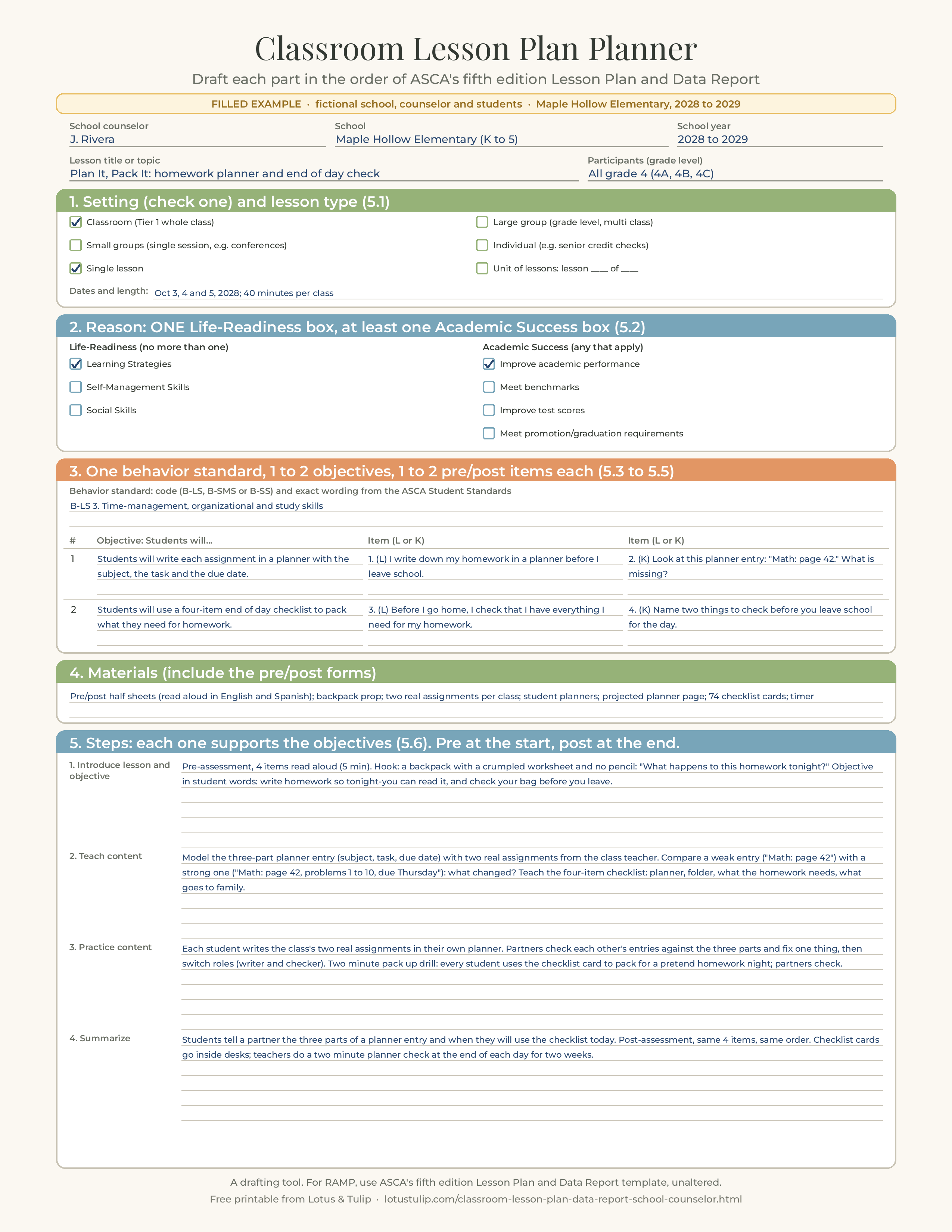
The free printable below shows this plan on page 2, in the same order as ASCA's template.
Six real world scenarios
- "My best lesson is part of a four lesson unit." You can submit one lesson from a unit. Give the pre at the start of the first lesson and the post at the end of the last, make the data report reflect the whole unit, and mark "Lesson ___ of ___." ASCA's timeline mentions units of three lessons; we did not find a rule that a unit must be exactly three.
- "I taught it to 420 ninth graders in 16 sections." Fine, and a digital form is your friend. Give it the same way in every section, report all students who completed both, and mention the sections in the subtitle of your graph. Large numbers are not a problem for the rubric.
- "A teacher asked for a lesson for one class after a conflict." That is a Tier 2 lesson ("Tier 2 specific classroom"), and the template can document it. For RAMP Section 5, submit a Tier 1 lesson instead, since the timeline and the section description both point to a lesson for each and every student in a grade.
- "My lesson is a junior planning conference with each student." That is a Tier 1 lesson in the individual setting, and the template's own example for that box is senior credit checks. Give a short pre before and a post after each conference, and count participation across all juniors.
- "Post scores went down on one item." Report it. RAMP asks for results for each item, not positive ones. Check whether the item was confusing (students often score a vague item lower once they understand the topic), say so in the improvement reflection, and fix the item next year.
- "Families opted some students out of surveys." Follow your district's rules and any state law. Some states, such as Texas, have consent rules that can affect surveys and counseling services; see our Texas SB 12 guide. Students who did not take the pre and post still received the lesson: count them in participation and explain why the results cover fewer students.
Common mistakes
- Two standards, or a mindset standard. RAMP 5.3 allows one behavior standard. Use a B-LS, B-SMS or B-SS code.
- Two Life-Readiness boxes checked. The template says "select no more than one," and 5.2 asks for one.
- A Life-Readiness box that does not match the standard. A B-SS standard with the Learning Strategies box checked makes a reviewer stop and wonder.
- Objectives that cannot be measured. "Students will learn about friendship" has no item that can measure it.
- Items that measure enjoyment. "I liked this lesson" is not ASCA Student Standards data.
- A vague summarize step. 5.6 covers every step. "Wrap up" is not a description.
- Raw totals in the organizer. Report the Likert average or the percent correct, not "227 points" or "61 students."
- A missing item. Every item in the table needs a pre and a post result (5.10).
- Different numbers in different places. The organizer, the graph and any text must show the same values, rounded the same way.
- An inclusion reflection that is general or too long. 5.11 wants at least one strategy you used in this lesson, in 250 words or fewer.
Free printable: lesson plan planner, filled example and data report worksheet
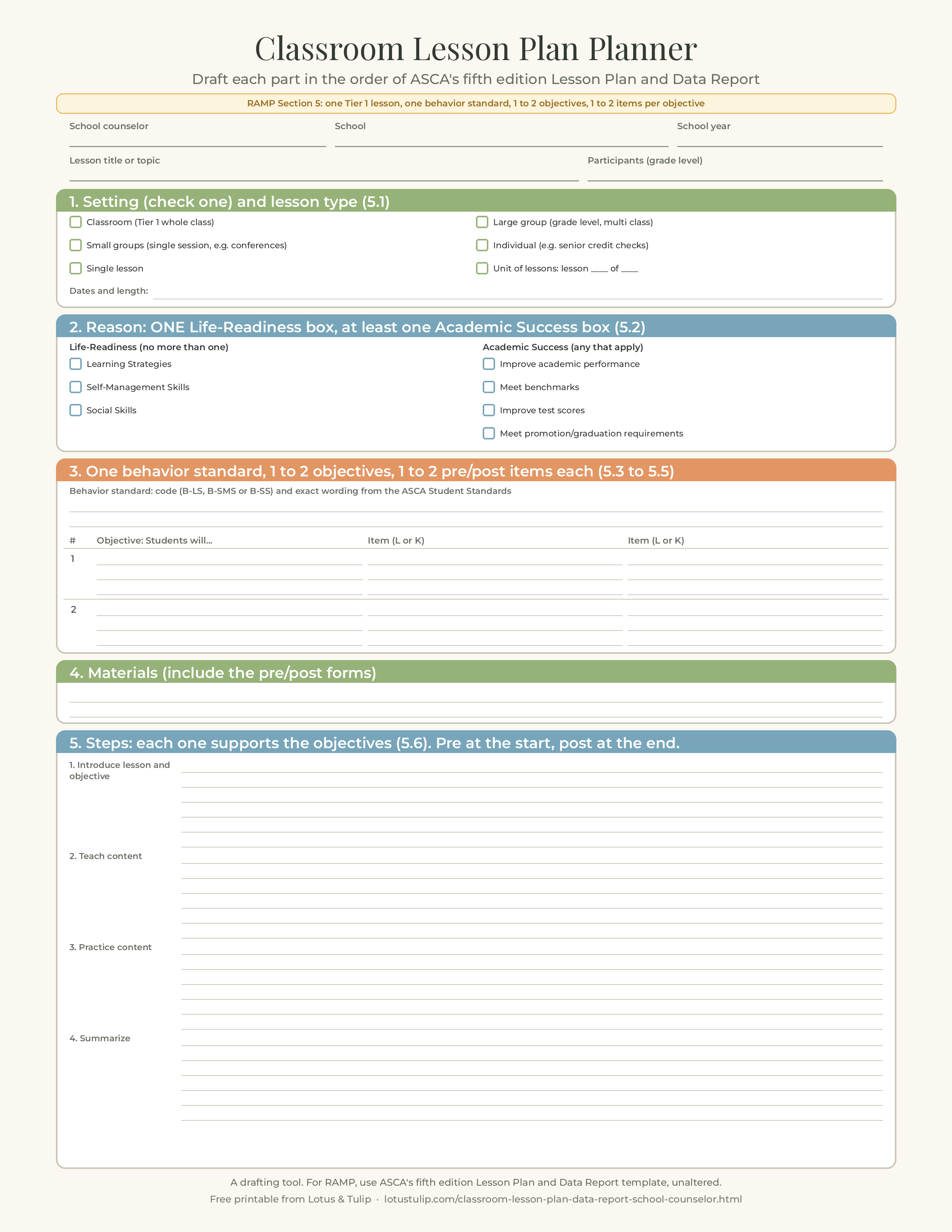
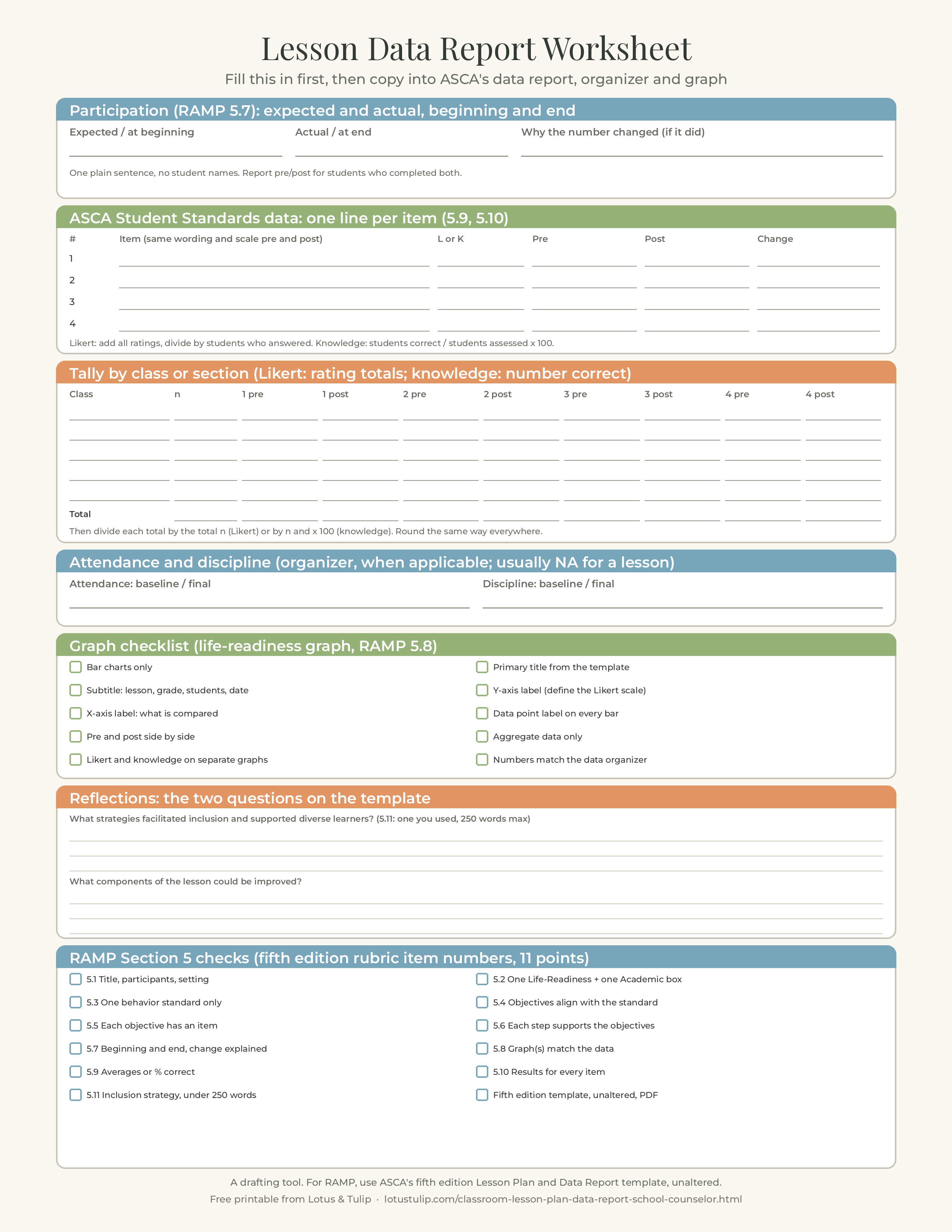
The free printable has three US Letter pages. Page 1 is a blank planner in the order of ASCA's fifth edition template: lesson details, participants and setting; the reason checkboxes (one Life-Readiness, any Academic Success); single lesson or unit; the behavior standard; two objective rows with two pre and post items each, marked L or K; materials; and the four steps. Page 2 is the same planner filled in for the fictional "Plan It, Pack It" lesson above. Page 3 is a data report worksheet: participation with an explanation line; a four line pre and post table with a scoring reminder; a per class tally box for scoring a whole grade; a graph checklist; the two reflection questions with a 250 word reminder; and a RAMP Section 5 checklist keyed to items 5.1 to 5.11.
The printable is a drafting and planning tool. It does not replace ASCA's fifth edition Lesson Plan and Data Report template, which the RAMP rubric says must be used in its original form.
Download the free planner, example and data report worksheet (PDF, 3 pages)
Or download single pages: Page 1: blank planner (PNG) · Page 2: filled fictional example (PNG) · Page 3: data report worksheet (PNG)
Free to print and use in your own school. Please link to this page rather than re-uploading the file. This is a planning tool. It does not replace ASCA's official templates, your district's data policies or legal advice. Keep student names off any copy you share or upload.
Related resources
- RAMP reflections: how to write items 7.1, 7.2 and 5.11 and the 3.5 alignment statement, with examples, word counts and a free reflections planner
- School counseling data graphs: how to graph pre and post, achievement and attendance results for ASCA data reports, with a free graph planner
- ASCA mindsets and behaviors pre and post survey questions: item bank for all 36 standards and free survey builder
- All school counselor small group curriculums
- ASCA Student Standards delivery plan: filled example and free planner
- Small-group action plan: the ASCA small-group plan and data report, filled example and free planner
- Closing the gap action plan: the ASCA achievement gap plan, filled example and free planner
- School counseling data priorities: the ASCA data priorities template, filled example and free worksheet
- Pre and post assessment: items, scoring and averages
- Small group counseling lesson plan template: one session, filled example and planning map
- School counselor advisory council agenda, minutes and a filled example
- Annual administrator conference: planner, filled example and notes log
- School counselor use-of-time calculator: filled example and free 5-day log
- School counselor needs assessment
Sources: American School Counselor Association, Lesson Plan and Data Report template, ASCA National Model Fifth Edition (Word template, 8/25 v2), from the ASCA Templates and Resources page; American School Counselor Association, All Fifth Edition Examples (Lesson Plan and Data Report example, 8/25 v2); American School Counselor Association, RAMP Scoring Rubric, Fifth Edition (August 2025, revised September 2025 and February 2026), general instructions and Sections 1, 3 and 5; American School Counselor Association (2025), The ASCA National Model: A Framework for School Counseling Programs, Fifth Edition (Manage component, MTSS tiers, direct student services, data categories and appropriate activities); American School Counselor Association, Changes in the ASCA National Model Fifth Edition (Define and Manage); American School Counselor Association, RAMP Application Timeline, Fifth Edition; American School Counselor Association, RAMP in the Fifth Edition; American School Counselor Association, Graph Development Tips, Fifth Edition (Rev. 9/25); American School Counselor Association (2021), ASCA Student Standards: Mindsets & Behaviors for Student Success; American School Counselor Association (2022), ASCA Ethical Standards for School Counselors, A.1.d and A.3.c; American School Counselor Association, Lesson Plan template and Classroom and Small-Group Results Report template, fourth edition, and RAMP Rubric, Fourth Edition, Sections 7 and 8, for comparison. All checked November 11, 2026.
FAQ
What is the ASCA Lesson Plan and Data Report?
It is the fifth edition ASCA National Model template for documenting one school counseling lesson: what will be delivered, to whom, how, and how students' attainment of the learning objectives will be assessed, followed by participation data, pre and post results, a bar graph and two reflections. It replaced the fourth edition Lesson Plan and the Classroom and Small-Group Results Report.
How many ASCA standards can a classroom lesson have?
One. ASCA's example says "Lessons are connected to only one ASCA Student Standard," the template asks for one behavior standard, and item 5.3 of the fifth edition RAMP rubric limits the plan to one behavior standard. A lesson can have one or two learning objectives aligned with that standard, and one or two pre and post items per objective.
Does the lesson plan need achievement data?
No. ASCA's changes document says the fifth edition Lesson Plan and Data Report "No longer collects achievement data. A single lesson is not likely to have a significant impact on achievement data." It collects participation data and ASCA Student Standards data. You still check at least one Academic Success category as part of the reason for the lesson.
Can I submit one lesson from a unit for RAMP?
Yes. Section 5 asks for "One stand-alone Lesson Plan and Data Report or one Lesson Plan and Data Report from a unit," and if you submit a lesson from a unit, "the data report should reflect the results for the entire unit." The template's direction is to give the pre-assessment at the beginning of the first lesson and the post-assessment at the end of the last lesson of the unit.
What does RAMP item 5.11 ask for?
It asks you to "Describe at least one strategy utilized in the submitted classroom lesson that facilitated inclusion and/or supported diverse learners," with a 250 word limit. It matches the template question "What strategies facilitated inclusion and supported diverse learners?" Describe something you actually did in that lesson, such as reading items aloud in two languages or applying IEP accommodations to the pre and post.
How many points is the lesson plan worth in RAMP?
Section 5, Lesson Plan and Data Report, is worth 11 of the 82 points in the fifth edition RAMP rubric, across items 5.1 to 5.11. We did not find a published passing score for the fifth edition application. In the fourth edition the same work was split between Section 7 (lesson plans, 4 points) and Section 8 (classroom instruction results report, 7 points), and every applicant had to report results for three classroom lessons or a unit of three.