
School counselors · Updated 2026-11-10
School Counselor Annual Administrator Conference: What It Is, What to Bring, a Sample Agenda, Talking Points, and a Filled Example (Free Planner)
Ready-made printable: Complete Small Group Counseling Bundle Holiday 20% off: about $29.44, was $37 (EUR 32) · instant digital download
Buy on Etsy
Every school year starts with a hundred small conversations about what the school counselor will do. A teacher asks if you can cover a class "just this once." The office asks you to run the state testing schedule again. A new assistant principal assumes you handle 504 paperwork. None of those conversations is wrong on its own, but if they are the only ones you have, the year gets decided for you, one favor at a time.
The annual administrator conference is the one conversation that is supposed to decide the year on purpose. It is a planned, documented meeting between you and your principal (or the administrator who supervises the school counseling program) near the start of the school year. You walk through your goals, how you plan to spend your time, your caseload, your advisory council, your professional development and the practical details of how the counseling office runs. Your administrator responds, you agree what you can, and both of you sign. If you plan to apply for RAMP, the Recognized ASCA Model Program designation, it is also worth six points in the fifth edition rubric, and the paperwork has to be right.
This guide is for elementary, middle and high school counselors in the United States. It covers what the conference is and what it is not; what ASCA's fifth edition template, implementation notes, phased implementation plan, RAMP rubric and RAMP timeline actually say, quoted where the wording matters; how the name and content changed from the third edition "annual agreement" to the fourth edition "annual administrative conference" to the fifth edition "annual administrator conference"; when to hold it and who should be there; exactly what to bring; the template section by section; use of time, including how to average your calculator weeks; ratio and caseload; a sample 45 minute agenda; sample talking points for the hard parts; minutes; follow up; a ten step process; a worked fictional example; six scenarios; common mistakes; and a free three page printable: a blank prep planner, the same planner filled in for a fictional elementary school, and a conference notes and follow up log.
Jump to the free conference planner, filled example and notes log
This is educational information for school counselors in the US, not legal or employment advice. Your contract, your district's job description and evaluation system, and your state's school counseling framework may set their own expectations. The ASCA documents quoted here were downloaded and checked on November 10, 2026: the fifth edition Annual Administrator Conference template and ASCA's completed example (both marked 8/25), the "Changes in the ASCA National Model Fifth Edition" document, the fifth edition Phased Implementation Plan, the "RAMP Scoring Rubric, Fifth Edition" (revision notes through February 2026), the fourth edition RAMP rubric for comparison, the fifth edition "RAMP Application Timeline," "RAMP in the Fifth Edition," the Apply for RAMP and Templates and Tools web pages, the fifth edition Use-of-Time 5-Day Calculator example, the ASCA Student Standards Delivery Plan and Achievement Gap Plan examples, "Appropriate and Inappropriate Activities for School Counselors," the ASCA Ethical Standards for School Counselors (2022), and ASCA's School Counselor Roles and Ratios page and February 13, 2026 ratio release. The third and fourth edition templates were checked from copies posted by School Administrators of Iowa, not from ASCA's current Templates and Tools page, which offers fifth edition templates.
The short answer
- It is a formal, documented meeting with your administrator about the school counseling program. ASCA's fifth edition template says it "guides the formal discussion between school counselors and the principal and/or the administrator in charge of the school counseling program."
- Hold it early. ASCA's implementation notes say "within the first two months of the school year," and the RAMP rubric requires the conference to be held and the template signed in that window. ASCA's RAMP timeline suggests August to September.
- One template per counselor. "Each school counselor completes a separate template," even in a department of five.
- Bring the plans the conversation is about. The fifth edition template asks you to share and discuss the ASCA Student Standards Delivery Plan and the Achievement Gap Plan, and to copy in your achievement gap goal or goals.
- Use of time is central. You report last year's use of time as the average of two use-of-time 5-day calculators and your planned use of time for this year, against ASCA's recommendation of 80 percent or more in direct and indirect student services.
- The rest is practical: ratio and caseload (ASCA recommends 1 to 250), advisory council dates and proposed members, professional development and costs, committees, presentations, budget, office hours, and who else supports the program.
- Write down what your administrator said. The template ends with minutes "indicating administrator response" on the gap goals, the delivery plan, use of time and the department's structure and activities.
- Names changed over the editions. Third edition: annual agreement. Fourth edition (2019): annual administrative conference. Fifth edition (2025): annual administrator conference. Some ASCA pages still use "administrative."
What the annual administrator conference is, and what it is not
The fifth edition template states its purpose in one sentence worth reading slowly: school counselors "explain the goals, activities and benefits of the school counseling program, increasing an administrator's understanding and support of the school counseling program." The RAMP rubric repeats it almost word for word, describing "evidence of a formal discussion between school counselors and the principal and/or the administrator in charge of the school counseling program about the goals, activities and benefits of the school counseling program in the building."
So the conference has two jobs. The first is planning: you and your administrator agree, in writing, what the counseling program is trying to achieve this year and how your time will be spent to get there. The second is advocacy: the administrator leaves with a clearer picture of what a school counselor does, why some duties pull you away from students, and what the program needs. A president's letter published in ASCA's November 2025 newsletter put it plainly, describing the template as a tool that "ensures your goals and role are clearly defined with your principal."
It helps to be clear about what the conference is not:
- It is not your performance evaluation. Your district's evaluation system, often tied to state law, is separate. Many counselors find the conference makes the evaluation easier, because the goals and duties were agreed in writing in September, but the signature on the conference template does not rate your work. ASCA's 2026 position statement on appraisal asks counselors to reference the conference during the annual appraisal; see our school counselor performance appraisal guide. If you are evaluated on a teacher form, the conference is also the moment to agree a crosswalk; see our school counselor evaluation crosswalk guide.
- It is not a contract. The third edition called it an "annual agreement," which made some counselors and principals treat it like a binding promise. It is a planning record. Things change during a year, and the sensible response is a follow up conversation, not an argument about what was signed.
- It is not a presentation. If you talk for 40 minutes and your principal nods, you have presented, not conferred. The minutes section exists because the administrator's response is the point.
- It is not only for RAMP schools. ASCA's Back to School resources page lists "Hold your annual administrative conference" first on its quick-start checklist for every counselor, and the phased implementation plan treats it as an annual task for any program using the National Model.
- It is not the place to discuss individual students. You will talk about groups of students in numbers. Keep names out of the documents, especially if they will be uploaded for RAMP, where the rubric warns that "No identifiable student information should be included."
What ASCA actually says (fifth edition)
The template's implementation notes
ASCA's completed example of the fifth edition Annual Administrator Conference template opens with four implementation notes. They are short enough to quote in full:
- "Hold the annual administrator conference within the first two months of the school year."
- "Document notes from the annual administrator conference, indicating administrator response to conversation around achievement gap goal(s) and the connection to the school's goals, ASCA Student Standards delivery plan, use of time and the structure and activities of the school counseling department."
- "Each school counselor completes a separate template."
- "Use NA for any item that does not apply."
The blank template, downloaded from ASCA's Templates and Tools page as a Word template file, has these sections in order: school counselor, school and school year; the documents to share and discuss (ASCA Student Standards Delivery Plan and Achievement Gap Plan); the achievement gap goal or goals "from achievement gap plan"; previous school year use of time ("Average of two use-of-time 5-day calculators from previous year") and planned use of time for the current year, each across five categories; full or part time, ratio and caseload, with the note that "The American School Counselor Association's recommended ratio is one school counselor per 250 students (1:250)"; advisory council first and second semester meeting dates and proposed members by name and position; professional development dates, topics and costs "based on my professional needs and/or professional standards from the ASCA School Counselor Professional Standards & Competencies checklist"; groups and committees with your role and time frame; presentations you make to local, state or national events; materials and supplies and an annual budget; office hours, your hours and career center hours; the people assigned to support roles (department assistant, attendance clerk, data manager or registrar, college and career center assistant, other staff and volunteers); signatures, the first day of school and the date of the conference ("Must be within the first two months of school"); and finally "Minutes from Administrator Conference."
The phased implementation plan
ASCA's fifth edition Phased Implementation Plan places the conference in Phase 3, "Inform and Advocate," where counselors develop the "Annual administrator conference template" and then "Implement: Annual administrator conference" alongside advisory council meetings and minutes. In Phase 4, the ongoing program, the annual administrator conference is on the list of items to "Complete annually." In other words, ASCA expects you to have your delivery plan, calendars, lesson plans and small group plans (Phase 1) and your data priorities and achievement gap plan (Phase 2) before the conference is most useful. If you are new to the model, it is fine to hold a conference with drafts; just say so in the minutes.
The RAMP rubric, Section 4
In the fifth edition RAMP Scoring Rubric, Section 4 is "Annual Administrator Conference," worth 6 points. You upload a "Completed Annual Administrator Conference Template for each school counselor (PDF)," two completed Use-of-Time 5-Day Calculators "from the school year prior to the data collection year for each member of the school counseling department employed during both school years (Excel format)," and, if staffing changed in that prior year, a statement explaining why there are fewer calculators. The six scored items are:
| Item | What it requires (quoted or closely paraphrased from the rubric) |
|---|---|
| 4.1 | "All sections of each Annual Administrator Conference Template completed for each member of the school counseling department or explanation of not applicable (N/A) responses." |
| 4.2 | "Conference held and template signed by the school counselor and administrator in charge of the school counseling program within the first two months of the school year." |
| 4.3 | A Use-of-Time 5-Day Calculator for one week (five consecutive days) from the first and second semester for each counselor, from the school year prior to the data collection year. |
| 4.4 | "Previous school year use of time reported on each Annual Administrator Conference Template is the average of the individual school counselor's two Use-of-Time 5-Day Calculators submitted." |
| 4.5 | Classifications of activities in the calculators align with the National Model definitions of direct and indirect services, program planning and school support, or non-school-counseling tasks. |
| 4.6 | "Each entry has only one classification." |
Three general rubric rules matter here too. First, "Only completed fifth edition ASCA templates in their original form may be used in the fifth edition RAMP application. These templates should not be altered." That means any planner you use to prepare, including the free one on this page, is for your own preparation; the upload must be ASCA's template. Second, the calculator goes up as an Excel file and the conference template as a PDF. Third, privacy: no identifiable student information anywhere in the application.
Item 4.4 trips people up more than any other. The "previous school year" numbers on your template are not an estimate or a typical week. They must be the average of the two calculator weeks you upload. If week one shows 58 percent direct services and week two shows 62 percent, the template says 60 percent. The notes log in the free printable has a small helper table for this.
One thing we could not confirm: the Apply for RAMP page still describes fourth edition scoring (54 or more out of 60 points earns RAMP), and we did not find a published fifth edition passing score on that page as of November 10, 2026. The fifth edition rubric's seven sections add up to 82 points (9, 26, 11, 6, 11, 16 and 3). Check with ASCA before you plan around a threshold.
When to hold it, according to the RAMP timeline
ASCA's fifth edition "RAMP Application Timeline" lists, for August to September of the data collection year: "Advisory council meeting dates/agendas," "Annual Administrator Conference (one per school counselor, each with two use-of-time calculators from the previous school year)" and "ASCA Student Standards Delivery Plan finalized for school year." School data priorities and the achievement gap plan come before that, in July to August. That order is sensible even if you never apply for RAMP: decide what the data says, write the plans, then sit down with your administrator.
Which edition applies when
ASCA's "RAMP in the Fifth Edition" document says October 2026 was the final year for fourth edition RAMP submissions and the first year for fifth edition submissions; from October 2027, only the fifth edition is accepted. Because the calculators come from the year before the data collection year, fifth edition submissions in October 2026 could use the fourth edition calculator, but "Beginning with October 2027 RAMP submissions, all applications must include the fifth edition version of the use-of-time calculator." The fifth edition rubric itself uses an example: an application submitted in October 2027 covers the 2026 to 2027 data collection year, with calculators from 2025 to 2026, and is due "no later than Oct. 1, 2027, at 11:59 p.m. ET." If your school is collecting data in 2026 to 2027 for an October 2027 application, the conference you held this fall should already have been on the fifth edition template.
Annual agreement, annual administrative conference, annual administrator conference: what changed
If you trained a few years ago, you may know this meeting by a different name, and older district handbooks and blog posts still use them. Here is how the three versions compare, based on the third and fourth edition templates posted by School Administrators of Iowa and ASCA's fifth edition template and "Changes in the ASCA National Model Fifth Edition" document.
| Third edition: Annual Agreement | Fourth edition (2019): Annual Administrative Conference | Fifth edition (2025): Annual Administrator Conference | |
|---|---|---|---|
| Goals | Up to three program goal statements on achievement, attendance and/or behavior, plus the program mission statement | School data priorities, then two school counseling program annual goals | Achievement gap goal(s) copied from the achievement gap plan |
| Plans discussed | Lists annual calendar, curriculum, small group and closing-the-gap action plans, and results reports | Attach classroom and group Mindsets & Behaviors action plan, closing-the-gap action plan and annual calendar | Share and discuss the ASCA Student Standards Delivery Plan and the Achievement Gap Plan |
| Use of time | Planned percent for core curriculum, individual student planning, responsive services, indirect services, and program planning and school support | Previous year and current year percents in four categories: direct, indirect, program planning and school support, non-school-counseling duties | Previous year (average of two calculators) and planned percents in five categories: direct, indirect, program planning, fair-share school support, non-school-counseling duties |
| Ratio and caseload | Caseload definition (alpha, grade level, all students, other) and a checklist of responsibilities; no ratio line | Ratio (1:250 recommended) and how the caseload is defined | Full or part time, ratio, and caseload (all students, alpha, grade level or other) |
| Other sections | Advisory council dates, professional development, professional collaboration (meetings), budget, office hours, other staff and volunteers | Advisory council dates and members, PD, committees, budget, office hours, other staff and volunteers | Same, plus presentations you will make; minutes section with the administrator's response |
| Signature | School counselor and principal | School counselor and administrative signature | Counselor, principal and, if different, the administrator in charge; ASCA says the principal's signature is not required if a different administrator supervises the program |
The "Changes" document summarizes the fifth edition differences in two bullets: the "ASCA Student Standards delivery plan and achievement gap plan are included in discussion," and the template is "Signed by the administrator in charge of the school counseling program. Does not require the principal signature if a different administrator supervises the school counseling program." The renamed plans come from other fifth edition changes: the old annual student outcome goal and closing-the-gap goal were combined into a single goal in the achievement gap plan, and the classroom and group Mindsets & Behaviors action plan was combined with the annual calendar into the ASCA Student Standards delivery plan.
The scoring also changed. The fourth edition rubric gave the section 5 points and scored, among other things, separate minutes describing "discussions and decisions regarding at least two topics" and two 250 word reflections on use of time. The fifth edition gives 6 points, moves the minutes into the template itself and adds items on calculator averages and classifications. If a colleague hands you last year's binder, check which edition each document is on before you copy anything.
One naming quirk: ASCA's own pages are not fully consistent. The template, the rubric and the phased plan say "annual administrator conference." The Back to School page and that November 2025 newsletter letter say "annual administrative conference," and the use-of-time calculator's overview tab says to "Share use-of-time analysis with administration during the annual administrative conference." They mean the same meeting.
When to hold it, and who should be in the room
Timing
The hard limit is the first two months of the school year, counted from your first day of school. The template asks for both dates, so a reviewer can check. If school starts on a Monday in mid August, your conference and signatures need to be done by mid October. In practice, most counselors aim for the last week of August or the first two weeks of September, for three reasons:
- Duty schedules are being made. Once lunch, bus and testing rosters go out, changing them is far harder.
- Advisory council dates go on the school calendar early, and the fall meeting often falls in October or November.
- The administrator still has time to think about the year. By October, the agenda is usually whatever happened yesterday.
Avoid the first three days back for staff, the first week with students and any day with a scheduled event. Ask for 45 minutes and a time when your administrator is not on duty. A calendar invitation with a one line agenda ("our annual counseling program conference: goals, use of time, council dates") signals that this is a planned meeting, not a hallway chat.
Who attends
The template is a conversation between "school counselors and the principal and/or the administrator in charge of the school counseling program." In a small school that is simply you and the principal. In larger schools:
- If an assistant principal supervises counseling, meet with that person. The fifth edition allows their signature in place of the principal's. Still invite the principal or send a copy, because duty and budget decisions often sit with them.
- If you are a department, you can meet together, but each counselor completes and signs a separate template. Many departments do a joint meeting for shared items (the delivery plan, council dates, office hours) followed by short individual conversations about each counselor's caseload and use of time.
- If you work in two buildings, hold a conference in each, with each building's administrator, and be explicit about how your days are split.
- District school counseling supervisors are not required, but some districts ask to be copied. Check your district's practice.
What to bring: the complete checklist
Bring paper copies for your administrator. A tidy packet says "this is a program," and it gives them something to write on.
- A one page summary. Your gap goal, your use of time last year and planned, your three asks, and the council dates. Many administrators will read only this page, so make it count.
- The ASCA Student Standards delivery plan for the year. In the fifth edition, this spreadsheet lists each Tier 1 lesson and Tier 2 group with one behavior standard, participants and the start month. ASCA's example describes Tier 2 small groups as "four-eight sessions and three-12 students."
- Your achievement gap plan or plans, or at least the goal statement and the strategies. The fifth edition template asks you to copy the goal in.
- Your school counseling data priorities, showing how they connect to the school improvement plan. Principals respond to goals they already own.
- Last year's two use-of-time 5-day calculators and the averages you calculated, plus a plain language summary of what you learned.
- Last year's results: a few totals from lesson and small group data reports. Participation, a pre and post change, and one achievement or attendance number if you have it.
- Your draft annual calendar, in any format. The fifth edition no longer provides a calendar template.
- Advisory council dates and a proposed member list by role.
- A professional development plan with costs, linked to your self assessment on the ASCA School Counselor Professional Standards and Competencies (see our self-assessment and PD plan guide).
- ASCA's "Appropriate and Inappropriate Activities for School Counselors" one page, if duties will come up. More on that below.
- Your ratio and caseload, with current enrollment.
- The ASCA template itself, filled in as far as you can, ready for notes and signatures.
Leave out anything with student names. If you want to show the attendance team's list or a referral spreadsheet, show it on your laptop and keep it out of the packet.
The template, section by section, with tips
1. School counselor, school, school year
Straightforward, but in a department make sure each template has one name. Reviewers check that there is one per counselor.
2. Documents shared: delivery plan and achievement gap plan
Do not just hand them over. Pick two or three things worth discussing. For the delivery plan: which grade levels get which Tier 1 lessons and when, and which Tier 2 groups are planned. (Our ASCA Student Standards delivery plan guide covers building it, row by row.) That is where you need classroom time and group times from your administrator, so name them. For the gap plan: the students it targets (in numbers), the goal, and the one or two things you need from the administrator to make it work, such as a family liaison's time or access to attendance reports.
3. Achievement gap goal(s)
Copy the goal statement exactly as it appears in your achievement gap plan. ASCA's achievement gap plan example builds the goal from an end date, two or more descriptors of a specific group of students ("At least one descriptor must be an achievement metric"), the achievement metric to increase or decrease, and precise baseline and projected numbers. Its example reads: "By the end of the 2025-2026 school year, seventh-grade students who have an F in math in the first quarter and scored in the lowest quartile on the Math FAST progress monitoring assessment #3 during the 2024-2025 school year will decrease the number of F's from 14 to seven." If your goal does not yet have numbers, say so and agree a date to finish it. Our closing the gap action plan guide covers each part of the goal, the contributing factors and the data report, with a filled example.
The minutes should show the administrator's response to the goal and its "connection to the school's goals." The easiest way to get that response is to ask directly: "This goal comes from goal 2 of the school improvement plan. Does it fit the way you see that goal?"
4. Use of time, previous year and planned
This is the heart of the conference for most counselors, so it has its own section below. On the template, you enter five percents for last year (the average of your two calculator weeks) and five for this year. The template groups direct and indirect student services under "Recommended 80% or more" and program planning and fair-share school support under "20% or less," with non-school-counseling duties on their own.
5. Ratio and caseload
Full or part time, your ratio as "one school counselor" to a number of students, and how your caseload is assigned: all students, alpha (last names from one letter to another), grade level, or other. In a department, the caseload choice is a conversation in itself. Alpha caseloads keep families with one counselor across grades; grade level caseloads make classroom lessons and transitions simpler. Either can work if the department agrees and the administrator knows why.
6. Advisory council
Two dates and the proposed members by name and position. The template says the council "will meet to provide feedback and input on the school counseling program." Getting the dates agreed now is one of the most useful outcomes of the conference, because your administrator should attend. RAMP asks for a council that approximates eight to 20 members. Our advisory council agenda guide covers membership and both meetings in detail.
7. Professional development
Dates, topics and costs, linked to the ASCA professional standards checklist. ASCA's example lists a state school counselor association conference at $350 and an ASCA U specialist course. Use this section to ask for release time and funding in the same breath as you explain why: "My self assessment showed I need to get better at analyzing achievement data, which is what the gap plan needs."
8. Committees and professional work
Groups you serve on, your role and the time frame. This section quietly shows your administrator how much of your week goes to meetings. In ASCA's example, one counselor lists five commitments, from a weekly building consultation team to chairing a state association committee. If the list is long, it is worth discussing which ones serve students and which could move to someone else.
9. Presentations
New compared with the fourth edition template: presentations you plan to make "to local, state or national events," with audience, title and date. Staff trainings count. ASCA's example includes a suicide prevention and intervention protocol presentation at a beginning of the year staff meeting that "fulfills state requirement to cover these annually." Listing these helps your administrator see the counseling program as a resource for staff, and it gets your staff meeting time on the calendar.
10. Budget, materials and supplies
List what you need and an annual figure. Be specific and modest: curriculum materials, copies for pre and post surveys, group supplies, memberships, a family night. If there is no budget, write NA and use the minutes to note what the administrator suggested instead (PTA, a grant, shared supplies).
11. Office hours and staff roles
When the counseling office is open, your hours (if you use flexible scheduling) and career center hours; then who serves as department assistant, attendance clerk, data manager or registrar, college and career center assistant, other staff and volunteers. These lines answer a question many principals never ask: who does the clerical and data entry work so the counselor does not have to? If the honest answer is "the counselor," that is worth discussing, because "Serving as a data entry clerk" and "Keeping/filing clerical records" are on ASCA's inappropriate activities list.
12. Signatures and dates
Printed names and signatures for the counselor, the principal and, if different, the administrator in charge; the first day of school; and the date of the conference. ASCA's example notes the signature is "in blue or black ink." Sign on the day if you can. A template signed weeks later, outside the two month window, means RAMP item 4.2 is not met.
13. Minutes
The last page: notes "indicating administrator response" on the gap goals and their connection to school goals, the delivery plan, use of time and the department's structure and activities. ASCA's example is a good model of honest minutes. The principal is excited that the gap goal connects to a school improvement goal, says he is "not familiar with all the standards," and is "fairly adamant" that non-school-counseling duties will not be removed this year because he has already allocated his resources. The department suggests meeting again in late winter, and the principal asks for a mid year meeting on progress. That is a realistic conference, recorded without spin.
Use of time: the numbers that start the most important conversation
For a full walkthrough of logging the two weeks, coding each block and calculating the percentages, with a free 5-day paper log, see our school counselor use-of-time calculator guide.
The five categories
The fifth edition Use-of-Time 5-Day Calculator, an Excel workbook, has one row for every 15 minutes of the day and five category columns. ASCA's example labels them:
- Direct student services: "Instruction, Appraisal & Advisement, Counseling." Classroom lessons, small groups, individual counseling, academic and career advisement.
- Indirect student services: "Referrals, Consultation, Collaboration." Parent and teacher conferences, referrals to community providers, team problem solving about a student.
- Program planning: "Defining, Managing, Assessing Activities." Writing plans, analyzing data, preparing the advisory council. In ASCA's example, "data collection small group" is coded here.
- School support: "Fair-Share Responsibility Activities." The duties every staff member shares. ASCA's example codes a car duty here.
- Non-school-counseling tasks: work that is not part of a school counselor's role. ASCA's example codes a kindergarten lunch duty here.
The calculator's notes say to complete it "for one week (five consecutive days) in first semester and second semester," to choose a week that "is free of predictable disruptions (e.g., special schedules, school holidays...)," to mark only one category per block ("Do not mark more than one category"), and to leave a duty-free lunch or break unchecked. It also says to "Share use-of-time analysis with administration during the annual administrative conference" and to "Make decisions about specific time allocation in collaboration with administrator." That last line matters: ASCA frames the plan as a joint decision, not a demand.
ASCA's recommendation, printed on both the calculator and the template, is 80 percent or more of your time in direct and indirect student services and 20 percent or less in program planning, school support and fair-share activities. Non-school-counseling duties have no target on the template, but ASCA's direction is clearly toward none: ASCA's own completed conference example shows a department planning 0 percent.
Averaging the two weeks
For each category, add the week one percent and the week two percent and divide by two. Example: direct 48 and 54 gives 51; indirect 12 and 14 gives 13; program planning 15 and 13 gives 14; fair-share 9 and 11 gives 10; non-school-counseling 16 and 8 gives 12. The averages add up to 100, as they should. If yours come to 99 or 101 because of rounding, that is normal; just be consistent with what the calculators show. For RAMP, these averages are what go on the template, and item 4.4 checks that they match.
Reading your own numbers before the meeting
Before the conference, look at the calculator weeks and ask three questions:
- Where did the non-school-counseling time come from? Name the specific duties and minutes. "Lunch duty five days a week, 45 minutes" is a conversation. "Too many duties" is a complaint.
- Was anything misclassified? Data collection is program planning in ASCA's example, not direct service. Be honest; inflating direct services helps no one, and RAMP reviewers check classifications (item 4.5).
- What would you do with the time? If lunch duty dropped from five days to two, which group could you run? Have the answer ready.
Talking about duties without starting a fight
ASCA's "Appropriate and Inappropriate Activities for School Counselors" sets similar tasks side by side, which makes it a useful conversation piece rather than a list of complaints. Examples from the current version:
| Appropriate | Inappropriate |
|---|---|
| Interpreting cognitive, aptitude and achievement tests | Coordinating school/district cognitive, aptitude and achievement testing programs |
| Providing counseling to students who are frequently tardy or absent | Signing excuses for students who are tardy or absent |
| Providing counseling to students who have disciplinary problems | Disciplining students or assigning discipline consequences |
| Analyzing schoolwide and school counseling program data | Serving as a data entry clerk |
| Advocating for students at individual education plan and 504 meetings, student study teams and school attendance review boards, as necessary | Coordinating schoolwide individual education plans, 504 plans, student study teams, response to intervention plans, MTSS and school attendance review boards |
| Consulting with teachers about building classroom connections, effective classroom management and the role of the ASCA Student Standards in student success | Covering classes when teachers are absent or to create teacher planning time |
The ASCA Ethical Standards for School Counselors (2022) back this up. Standard B.2.c asks counselors to "Advocate for a school counseling program free of non-school-counseling assignments identified by 'The ASCA National Model: A Framework for School Counseling Programs.'" Standard B.2.a asks you to "Develop and maintain professional relationships and systems of communication with faculty, staff and administrators to support students." Both matter. A 2017 ASCA School Counselor magazine article on duties called the earlier version of this standard "a tool and not a weapon," noted that building principals are, with few exceptions, the counselor's direct supervisors, and said "The onus is on the school counselor to help the principal know what the role should (appropriate duties) and should not (inappropriate duties) entail."
In practice, that means three things. Ask for one or two changes, not ten. Tie every ask to a student result your administrator already cares about. And offer a trade or a phase in, because duties are a staffing problem for the principal, not a philosophical one. ASCA's own example ends with a principal who says no for this year and a department that schedules a late winter follow up. That is not failure; it is the first step of a longer plan, written down.
Ratio and caseload: context, not a complaint
ASCA has recommended a ratio of 250 students per school counselor since 1965, according to its School Counselor Roles and Ratios page. The same page reports a national average of 372 to 1 for the 2024 to 2025 school year, the most recent data, and says only Colorado (247), Hawaii (243), New Hampshire (186) and Vermont (172) were within the recommendation. ASCA's February 13, 2026 release noted that, in the 35 states that report elementary and middle school counselors separately from high school counselors, the estimated ranges were 195 to 224 students per counselor in high schools and 571 to 694 in elementary and middle schools. These figures come from ASCA's analysis of National Center for Education Statistics Common Core of Data.
At the conference, the ratio is context for the plan. If you serve 426 students alone, a plan that promises a Tier 1 lesson in every classroom every week and eight Tier 2 groups each semester is not realistic, and your administrator should see that trade off in writing. You can say it plainly: "At 426 students, I can do monthly lessons in K to 2 and twice a month in 3 to 5, and four groups a semester. If you want more groups, something else has to move." Leave staffing requests for budget season unless your administrator raises them, but note them in the minutes if they do.
A sample agenda for a 45 minute conference
| Minutes | Item | What you want from it |
|---|---|---|
| 3 | Purpose and what you will both sign | A shared frame: this is the program plan for the year, written down |
| 7 | School goals and the achievement gap goal | The administrator's response to the goal and how it connects to the school improvement plan |
| 7 | ASCA Student Standards delivery plan | Agreement on lesson schedules and group times; questions about the standards answered |
| 10 | Use of time: last year's average, this year's plan | A decision, a partial decision or a scheduled follow up on one or two specific duties |
| 4 | Ratio, caseload and department structure | Caseload assignment confirmed; any concerns noted |
| 4 | Advisory council dates and members | Both dates on the school calendar; the administrator's attendance confirmed |
| 5 | PD, committees, presentations, budget, office hours, staff roles | Release time and costs approved or noted; staff meeting time for your presentation |
| 5 | Summary, signatures, follow up date | Signed template; a mid year check in on the calendar |
If you only get 20 minutes, keep the gap goal, use of time and council dates, and send the rest in writing with a note: "These sections are filled in as below; tell me if anything needs to change before we sign."
Sample talking points for the parts that matter most
These are starting points. Use your own voice and your school's language. The numbers come from the fictional example later in this guide.
Opening
"Thanks for making the time. ASCA recommends that each counselor and their administrator do this once a year, in the first two months of school. It is our plan for the counseling program this year: the goal we are working on, how I plan to use my time, the council dates and a few practical things. At the end we both sign it, and I will write down your feedback so we have a record of what we agreed."
The gap goal
"Our school improvement plan has attendance in kindergarten and first grade as a priority. Last year 23 of 142 students in those grades missed 10 percent or more of school days. My achievement gap plan focuses on the students who are already at that level by October 1. The goal is that by the end of April at least 13 of them are below 10 percent for the year. What I need from you is the family liaison's time for calls in Spanish. Does this goal fit how you see the school's attendance work?"
The delivery plan
"This is every lesson and group I plan to deliver, each with one ASCA Student Standard. Tier 1 lessons go to every student in a grade; Tier 2 groups are for students with an identified need, four to eight sessions with three to 12 students. The part I need your help with is time: a 30 minute slot in each classroom once a month, and protected time for groups on Tuesday and Wednesday after lunch."
Use of time
"These are my two calculator weeks from last year, averaged. About 64 percent of my time went to direct and indirect services for students; ASCA recommends 80 percent or more. Most of the gap was lunch duty five days a week and coordinating state testing. I am not asking to drop every duty. I am asking for two changes: lunch duty from five days to two, which frees the time for two Tier 2 groups, and testing coordination moving to someone else while I keep the test anxiety lessons. If both happened, my plan would be about 76 percent. Which of these is possible this year?"
When the answer is no
"I understand the schedule is set for this year. Could we write down that we will look at this again in January, and could I track the minutes so we have real numbers then?" Then write that in the minutes. A documented no with a follow up date is far more useful than an undocumented maybe.
Ratio and caseload
"I am one counselor for 426 students. ASCA recommends 250. I have planned around that: monthly lessons in K to 2 and twice monthly in 3 to 5, and four groups a semester. If priorities change during the year, I will come back to you so we can decide together what moves."
The advisory council
"I would like to set the council dates now so they are on the school calendar: October 19 and May 9, both at 3:30 in the library. Can you attend both? Your being there makes a real difference to how parents and community members see the program."
Professional development and budget
"My self assessment on the ASCA professional standards showed I need to strengthen how I use achievement data. The state conference in late October has sessions on that. It costs $350 and three days of release. I have also asked for $400 for group supplies and copies."
Closing
"Let me read back what we agreed, and the one thing we are going to revisit. Can we put a 20 minute check in on the calendar for January? I will send you a copy of the signed template today."
Data to bring, and how to show it
Your administrator can see student records as part of their job, so mentioning a student in conversation is not the issue. But the conference documents become part of a program record, may be uploaded for RAMP and are often shared with district staff. Keep the documents in totals:
- Participation: for example, "Last year I delivered 96 classroom lessons and ran 7 groups with 41 students; 38 attended at least 6 of 8 sessions."
- ASCA Student Standards data: "In the four groups with pre and post surveys, the average score rose from 13.5 to 18.3 out of 24."
- Achievement and contributing factors: "Of the 21 students in the attendance plan, 14 were below 10 percent by May." In the fifth edition, achievement data replaced "outcome" data and includes "measurement of any factors contributing to achievement," such as attendance rates, discipline rates, systemic barriers, and student and education partner perspectives.
Precise numbers ("14 of 21") are better than percents alone. Keep small numbers out of documents if they could identify a student to someone who knows the school. And say what the data does not show: a pre and post gain in one group is encouraging, not proof.
How to write the minutes
ASCA wants the administrator's response, not a list of what you presented. Write the minutes the same day, ideally in the meeting, and share them with your administrator before you file them.
Write this, not this
| Weak minutes | Useful minutes |
|---|---|
| "Reviewed the achievement gap plan." | "A. Brooks agreed the attendance goal fits SIP goal 2 and offered the family liaison two afternoons a week in October and November for calls." |
| "Discussed use of time." | "Lunch duty reduced from five days to two starting 09/13/2027. Testing coordination stays with the counselor this year; the assistant principal will co-build the spring schedule. Revisit at the January check in." |
| "Principal supportive." | "Asked how Tier 2 groups are chosen; I explained referrals and data. Asked to see group participation counts each quarter." |
| "Council dates set." | "Council 10/19/2027 and 05/09/2028 added to the school calendar. Principal will attend both." |
Four to eight short paragraphs is plenty. Use the administrator's own words where you can, and include disagreements. Minutes that show a real conversation are more credible than minutes where everything was approved.
After the conference
- Send a copy the same day with a two line email: thanks, the signed template attached, and the date of the follow up.
- Put every agreed date on the calendar: council meetings, your staff presentation, the January check in, the PD days.
- Change the duty schedule if that was agreed, and confirm it in writing with whoever makes the roster.
- Start tracking anything you agreed to revisit. If a duty is coming back up in January, keep a simple log of the minutes and what you could not do because of it.
- Hold the mid year check in. In ASCA's example, the principal asked for one himself. Twenty minutes in January or February: what is working, what changed, what you will report at the spring council meeting.
- Keep the file. Next year's conference starts from this year's minutes, and the next RAMP application may need this year's calculators.
Situations that change the conversation
A new principal
Treat the conference as an introduction to the whole program. Bring last year's signed template and minutes, so the new administrator sees what was agreed before. Expect more questions and fewer decisions, and say so in the minutes. Offer ASCA's one page appropriate and inappropriate activities sheet as background, not as a demand.
Your first year in the building
You will not have last year's calculators for this building. If you were a counselor elsewhere last year, you may have your own; if not, write NA for the previous year with a short explanation, and plan two calculator weeks this year so next year's conference has real numbers. For RAMP, the rubric asks for a statement when staff changes mean fewer calculators.
A large department
One template per counselor, one shared delivery plan and council. Agree caseloads and department roles first, then hold the conference. The administrator's response to department structure belongs in each counselor's minutes.
Part time or split between schools
Mark part time and state your days in each building. The RAMP rubric says school counselors working part time "should still complete the calculator and provide a note to explain the less than five day documentation." Your conference in each school should cover only that school's share of your time.
High school
The categories are the same, but the duties differ: master schedule building, testing, transcripts and data entry often land on counselors. "Building the master schedule" and "Computing GPAs" are on ASCA's inappropriate list, while "Appraisal & advisement for academic planning" and "Analyzing GPAs in relationship to achievement" are appropriate. Bring numbers on how many hours scheduling took last spring.
Elementary
Elementary counselors often carry lunch and recess duties and serve large caseloads; ASCA's estimates suggest elementary and middle school ratios are far higher than high school ratios. Protected time for classroom lessons and groups is usually the most valuable thing to ask for.
How to prepare and hold an annual administrator conference, step by step
- Check your dates. Write down the first day of school and the date two months later. Book a 45 minute meeting with your administrator in the first three to four weeks.
- Finish or draft your plans. School counseling data priorities, the achievement gap plan with its goal statement, and the ASCA Student Standards delivery plan for the year.
- Average last year's calculators. Take your two use-of-time 5-day calculator weeks from the previous year and average each of the five categories. Check that each entry has one classification.
- Plan this year's use of time. Decide realistic percents for each category, aiming toward 80 percent or more in direct and indirect services, and name the specific duties that would need to change.
- Pick two or three asks. Each one tied to a student result in your plans: a duty change, protected group time, a colleague's help with the gap plan.
- Fill in the ASCA template. Every section, with NA where something does not apply: ratio and caseload, council dates and members, PD and costs, committees, presentations, budget, office hours and staff roles.
- Make a one page summary. Goal, use of time, asks, council dates. Print the packet without student names.
- Hold the conference and listen. Walk through the agenda, ask a direct question on each key topic, and write down the administrator's response in their words.
- Sign and record. Both signatures and the conference date on the template the same day; minutes typed into the template and shared with your administrator.
- Follow up. Send a copy, put every date on the calendar, act on what was agreed, and hold the mid year check in.
A worked example (fictional): the annual administrator conference at Maple Hollow Elementary
Maple Hollow Elementary is a fictional public elementary school with kindergarten to grade 5 and three classroom teachers per grade. J. Rivera is the only school counselor. Our other school counselor guides follow the same school through the 2027 to 2028 school year, including the needs assessment, the "Calm and Brave" worry group, the attendance group and the advisory council. This example shows the conference where that year was planned. Every name, number and date is invented for illustration.
Before the conference
School started on Monday, August 16, 2027, so the two month deadline fell in mid October. J. Rivera booked 45 minutes with the principal, A. Brooks, for Thursday, August 26, at 3:30 p.m., after dismissal and car line.
Over the summer she had drafted the school counseling data priorities from the school improvement plan: attendance in kindergarten and grade 1, where 23 of 142 students had missed 10 percent or more of school days in 2026 to 2027, and math in grades 3 to 5, where 61 of 214 students had scored below the spring benchmark. The achievement gap plan focused on attendance. Because the exact students would only be known later, the goal was written around a date: "By the end of April 2028, at least 13 of the kindergarten and grade 1 students who have missed 10 percent or more of school days by October 1, 2027 will be below 10 percent for the year to date." Math would be supported through Tier 1 lessons and a test anxiety group rather than a second gap plan. (A note for fifth edition RAMP applicants: item 2.5 requires the data priority in the achievement gap plan to be achievement data, so attendance belongs in the contributing factors, not the goal. Our data priorities guide shows how Maple Hollow rebuilt its data priorities that way for 2028 to 2029.)
Her delivery plan listed monthly Tier 1 lessons in every K to 2 class and twice monthly lessons in grades 3 to 5, plus Tier 2 groups: Calm and Brave (worry) for grades 3 and 4, a friendship group, an attendance group for grades 4 and 5 in the winter, and a test anxiety group in the spring.
Her two calculator weeks from the previous year, one in October and one in March, averaged to 51 percent direct student services, 13 percent indirect, 14 percent program planning, 10 percent fair-share school support and 12 percent non-school-counseling duties. Direct plus indirect was 64 percent, well under ASCA's 80 percent. Nearly all the non-school-counseling time came from two duties: kindergarten lunch duty five days a week (45 minutes a day) and coordinating the spring state testing schedule.
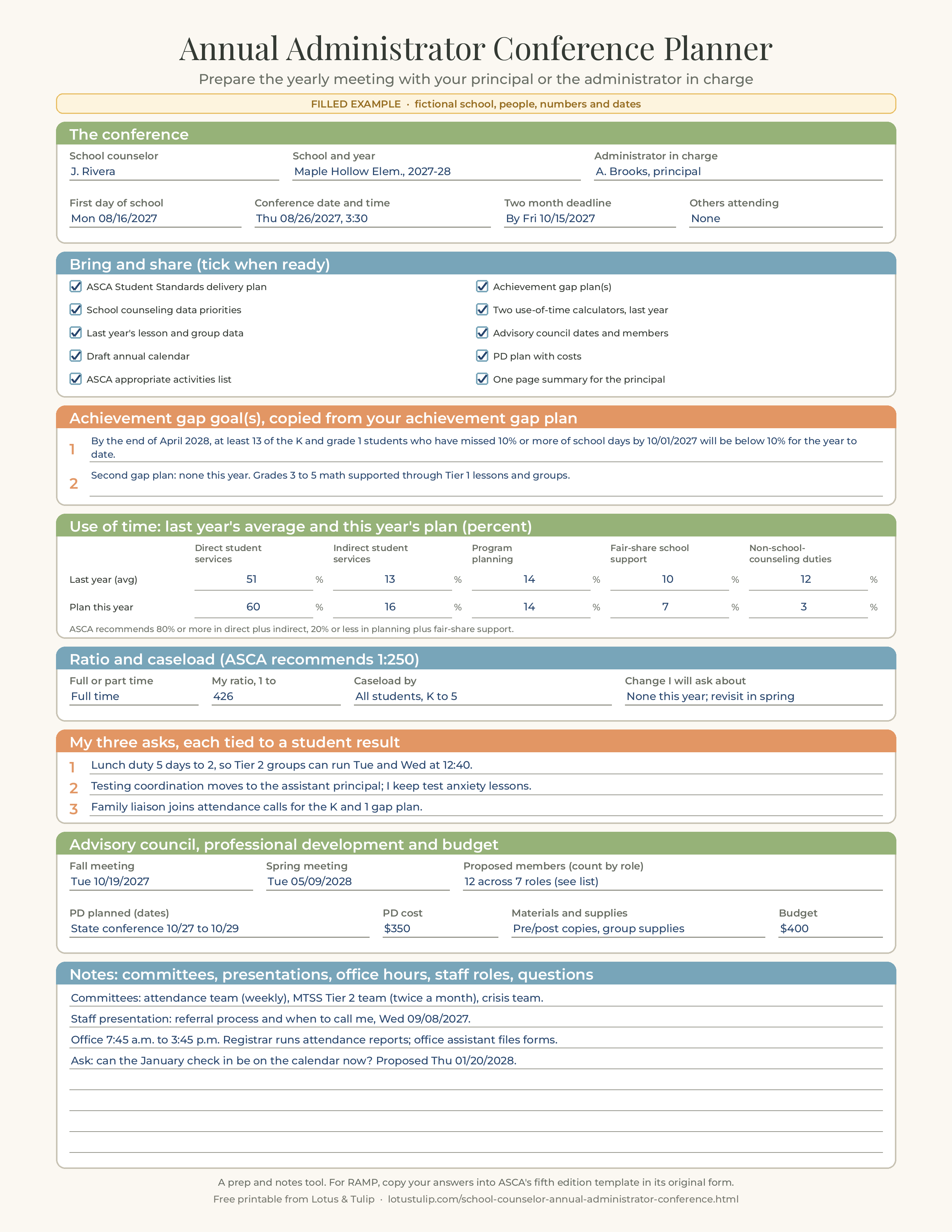
She chose three asks, each tied to a result: lunch duty from five days to two so Tier 2 groups could run on Tuesday and Wednesday at 12:40; testing coordination moving to the assistant principal while she kept the test anxiety lessons; and the family liaison joining attendance calls for the gap plan. Page 2 of the free printable shows the planner she filled in.
Her planned use of time, assuming the first two asks were granted, was 60 percent direct, 16 percent indirect, 14 percent program planning, 7 percent fair-share support and 3 percent non-school-counseling duties: 76 percent in direct and indirect services. Not yet 80, and she said so on the summary page.
The conference: Thursday, August 26, 2027
Gap goal (8 minutes). A. Brooks agreed the attendance goal fit school improvement goal 2, asked whether 13 students was ambitious enough, and accepted the answer that many students in the October group would already have missed a lot of school. The principal offered the family liaison two afternoons a week in October and November for calls in Spanish.
Delivery plan (7 minutes). A. Brooks asked what "B-SMS 7" meant on the spreadsheet. J. Rivera explained that it is the ASCA Student Standard behavior for effective coping skills, used for the worry group. The principal asked for a one page list of the standards used this year, which became an action item. Lesson slots would be set with the grade level leads at the September staff meeting.
Use of time (12 minutes). A. Brooks agreed to reduce lunch duty from five days to two starting Monday, September 13, 2027, by adding instructional aides to the rotation. Testing coordination would stay with the counselor this year, because the assistant principal was new, but the assistant principal would build the spring schedule with her. They agreed to revisit testing at a January check in.
Ratio and caseload (3 minutes). Full time, 426 students, all students K to 5. A. Brooks said a second counselor was not in this year's budget. J. Rivera said the lesson and group plan had been built around 426 students, and that anything new would need something else to move.
Advisory council (4 minutes). Dates set for Tuesday, October 19, 2027, and Tuesday, May 9, 2028, at 3:30 p.m. The principal will attend both. Twelve proposed members across administrators, the counselor, teachers, parents, community members, the school nurse and one grade 5 student for a spring item.
PD, committees, presentations, budget, office and staff (6 minutes). State conference October 27 to 29, $350, approved with release time. Committees: the attendance team weekly, the MTSS Tier 2 team twice a month and the crisis team. Staff presentation on the referral process at the staff meeting on Wednesday, September 8. $400 for group supplies and copies. Office open 7:45 a.m. to 3:45 p.m. The registrar runs attendance reports; the office assistant files signed forms.
Signatures (5 minutes). Both signed the ASCA template at the end of the meeting, ten days after the first day of school. The January check in went on the calendar for Thursday, January 20, 2028.
The minutes she wrote
"A. Brooks agreed the K and 1 attendance goal supports SIP goal 2 and asked whether the target of 13 students is ambitious enough; we agreed to keep it and review progress at the January check in. The principal offered the family liaison two afternoons a week in October and November for family calls in Spanish."
"When we reviewed the ASCA Student Standards delivery plan, A. Brooks asked what the behavior standard codes mean and asked for a one page list of the standards used this year. I will send it by 09/03/2027."
"On use of time, the principal agreed to reduce kindergarten lunch duty from five days to two starting 09/13/2027 so Tier 2 groups can meet Tuesday and Wednesday at 12:40. Testing coordination stays with me for 2027 to 2028 because the assistant principal is new; the assistant principal will co-build the spring testing schedule. We will revisit testing coordination at the 01/20/2028 check in."
"A. Brooks confirmed my caseload (all 426 students) and said a second counselor is not in the budget this year. The principal will attend both advisory council meetings, approved the state conference and $400 for group supplies, and asked to see group participation counts each quarter."
What happened next
With lunch duty cut to two days, the Calm and Brave group and the friendship group ran on Tuesdays and Wednesdays in the fall. At the January check in, J. Rivera brought a short log showing 19 hours spent on testing logistics so far that year. A. Brooks agreed that testing coordination would move to the assistant principal for the 2028 to 2029 school year, and that decision went into the next year's conference minutes. At the spring council meeting, the attendance gap plan's progress was reported in totals.
Six real world scenarios
- "Just sign it, I trust you." A busy principal wants to skip the meeting. Ask for 20 minutes instead of 45 and cover only the gap goal, use of time and council dates. If they still decline, send the filled template with a short note and ask for written comments. Record what happened honestly; a signature with no conversation gives you no useful minutes, and the RAMP rubric expects a conference to have been held.
- The assistant principal supervises you, the principal controls duties. Hold the conference with the assistant principal, who signs as administrator in charge, and ask that the principal join for the use of time item or receive a copy with the specific duty request highlighted.
- You missed the two month window. Hold the conference anyway, as soon as possible, and record the real date. Do not backdate. For a RAMP application based on that year, item 4.2 will not be met; for the program itself, a late conference is still far better than none.
- Your administrator wants you to keep testing coordination and add 504 coordination. Show the use of time effect in minutes per week, name which planned groups would not happen, and ask which matters more. Offer a middle path, such as attending 504 meetings for students on your caseload when needed while someone else coordinates the process. Write down the decision either way.
- A department disagrees about caseloads. Settle it before the conference. The administrator should hear one department proposal, not a debate, and each counselor's template should match.
- The goal changes in November. A new district priority arrives mid year. Hold a short follow up meeting, note the change and the reason in writing, and update the plan. The signed template stays as the record of what was planned in the fall; the follow up note shows how the program responded.
Common mistakes
- Treating it as a formality. A signature without a real conversation wastes the one meeting a year built for deciding your role.
- Holding it too late. After the first two months, duty rosters are fixed and the window has closed.
- One template for the department. ASCA asks for one per counselor.
- Guessing last year's use of time. The previous year numbers should be the average of two calculator weeks.
- Double counting activities. Each 15 minute block gets one category; in ASCA's example, data collection is program planning, not direct service.
- Asking for everything at once. Ten asks often get none. Two specific asks tied to student results often get one.
- Minutes that list topics. "Reviewed use of time" says nothing. Write what the administrator said and decided.
- Using the wrong template. Fourth edition documents in a fifth edition application, or a homemade version, can mean rubric items are not met. Use ASCA's fifth edition template in its original form.
- Student names in the packet. Keep documents in totals, especially anything that might be uploaded or shared.
- No follow up. The conference only works if the dates go on the calendar and the "revisit in January" actually happens.
Free printable: annual administrator conference planner, filled example and notes log
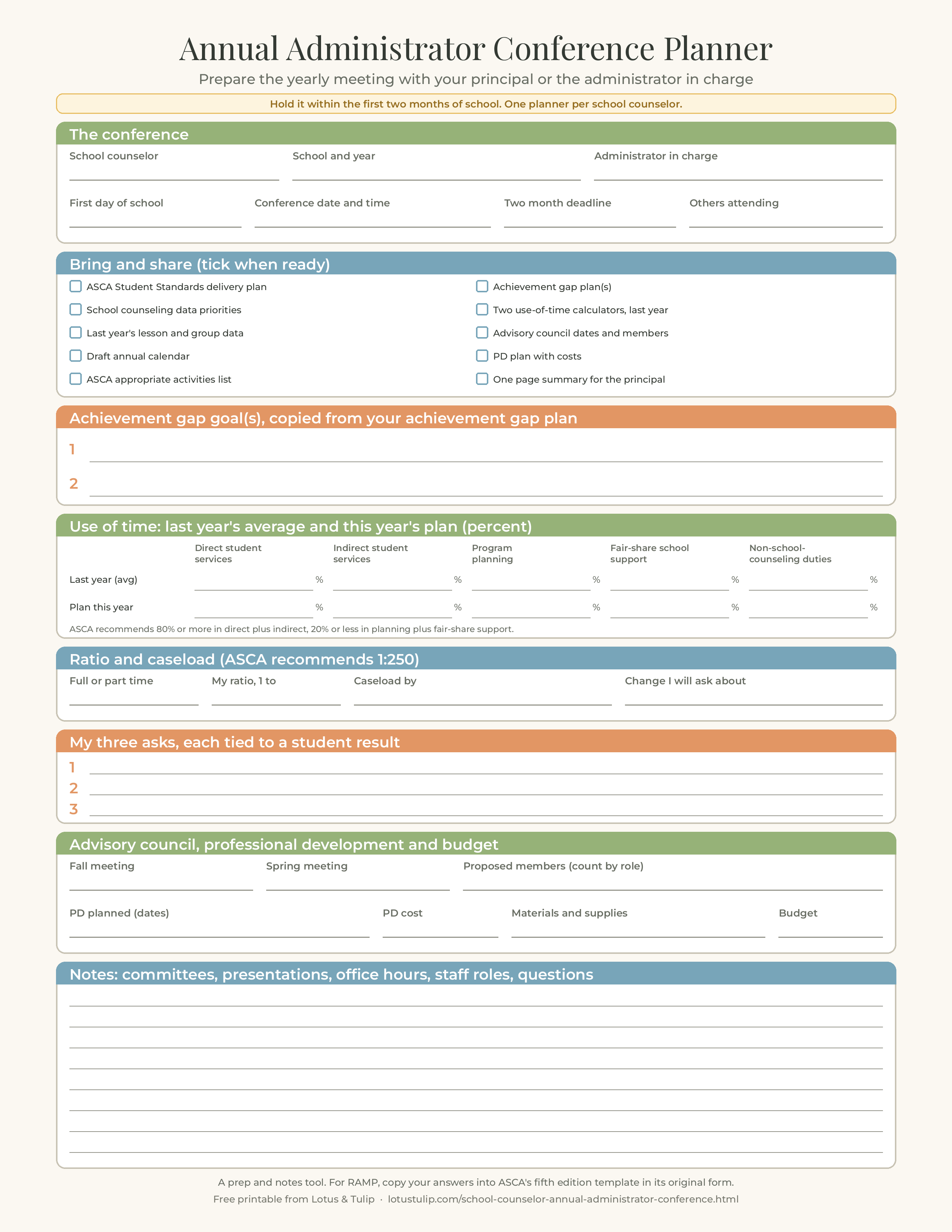
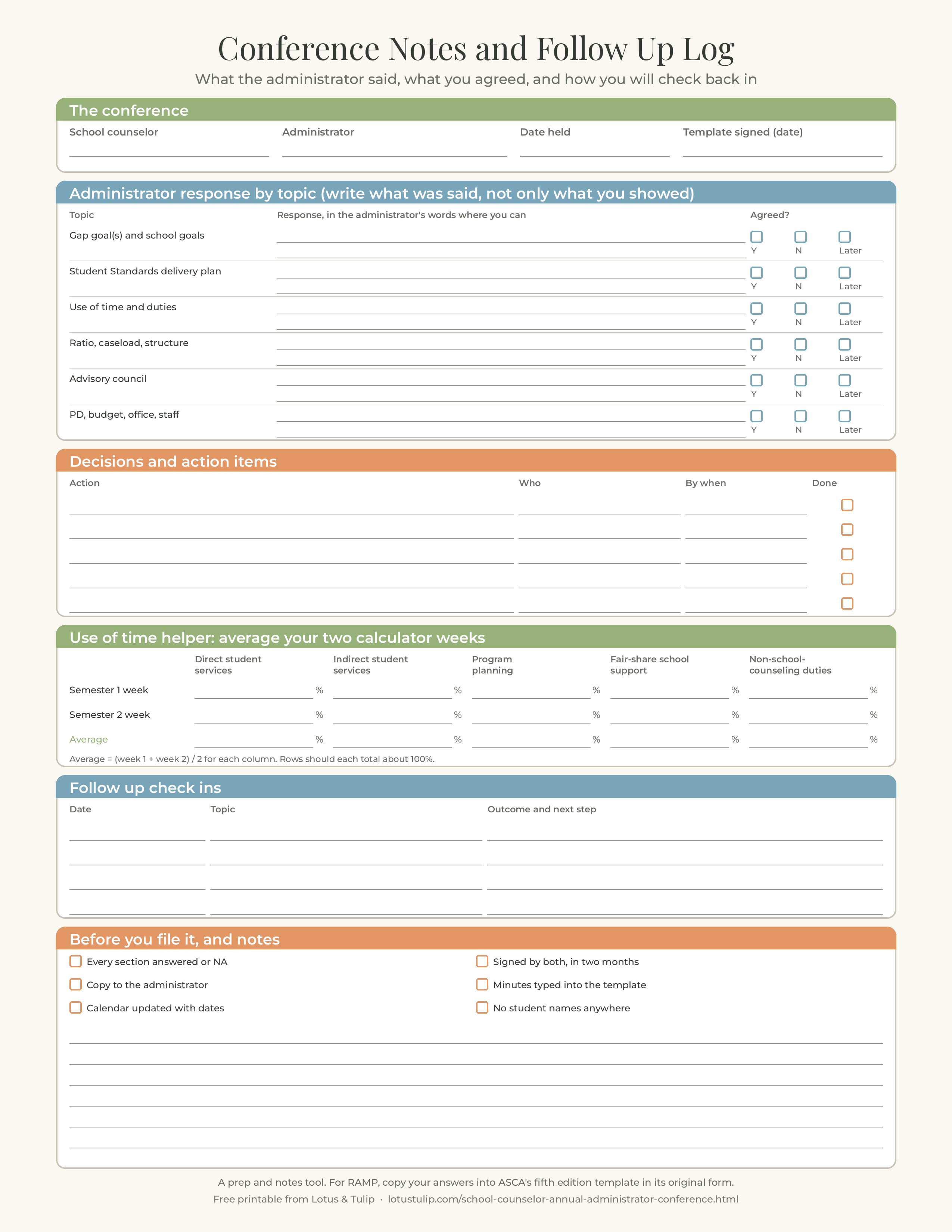
The free printable has three US Letter pages. Page 1 is a blank prep planner: the conference (school counselor, school and year, administrator in charge, first day of school, conference date and time, the two month deadline and others attending); a ten item "bring and share" checklist (delivery plan, achievement gap plans, data priorities, two use-of-time calculators from last year, last year's lesson and group data, advisory council dates and members, a draft annual calendar, a PD plan with costs, ASCA's appropriate activities list and a one page summary); space for one or two achievement gap goals copied from your plan; a use of time table with last year's average and this year's plan in the five fifth edition categories and ASCA's 80 and 20 percent recommendations; ratio and caseload; "my three asks, each tied to a student result"; advisory council dates and proposed members, PD, materials and budget; and notes for committees, presentations, office hours, staff roles and questions. Page 2 is the same planner filled in for the fictional Maple Hollow Elementary conference on Thursday, August 26, 2027, described above. Page 3 is a conference notes and follow up log: the administrator's response by topic (gap goals and school goals, delivery plan, use of time and duties, ratio and structure, advisory council, PD and office) with agreed, not agreed or later boxes; decisions and action items with who and by when; a use of time helper to average your two calculator weeks; a follow up check in table; and a six item "before you file it" checklist with space for notes.
The printable is a preparation and note taking tool. It does not replace ASCA's fifth edition Annual Administrator Conference template, which the RAMP rubric says must be used in its original form, or the Use-of-Time 5-Day Calculator. Prepare on paper, then copy your answers and minutes into ASCA's template.
Download the free planner, example and notes log (PDF, 3 pages)
Or download single pages: Page 1: blank prep planner (PNG) · Page 2: filled fictional example (PNG) · Page 3: notes and follow up log (PNG)
Free to print and use in your own school. Please link to this page rather than re-uploading the file. This is a planning tool. It does not replace ASCA's official templates, your district's evaluation system or policies, or legal advice.
The conference is Section 4 of the fifth edition RAMP application, and item 4.2 ties it to the first two months of the school year. The RAMP application checklist shows how that date shapes the rest of the data collection year.
Related resources
- School counselor evaluation crosswalk: map a teacher evaluation form or your state model to ASCA appraisal items, with a free worksheet
- ASCA professional standards and competencies self-assessment: how to rate yourself, pick 2 or 3 growth areas and write a PD plan, with a free printable
- School counselor performance appraisal: how to use the ASCA appraisal with your principal, with a free evidence planner
- RAMP application checklist: every fifth edition rubric item, upload and deadline, with a free checklist and data year planner
- School counseling data priorities: the ASCA data priorities template, filled example and free worksheet
- Closing the gap action plan: ASCA achievement gap plan and data report, filled example and free planner
- School counselor use-of-time calculator: 5-day log, percentages and a filled example
- All school counselor small group curriculums
- ASCA Student Standards delivery plan: map a year of lessons and groups, with a free planner
- School counselor advisory council agenda, minutes and a filled example
- School counselor needs assessment for small groups
- Small group counseling for attendance: 8 session plan, activities and data log
- Small group counseling progress notes and attendance tracker
- Small group counseling pre and post assessment
- Small group counseling lesson plan template and planning map
- Full year elementary small group counseling: plan the year
- Small group counseling referral form and referral log
Sources: American School Counselor Association, Annual Administrator Conference template and completed example, ASCA National Model Fifth Edition (8/25), from the ASCA Templates and Tools page; American School Counselor Association, Changes in the ASCA National Model Fifth Edition (Manage: Annual Administrator Conference, Achievement Gap Plan, ASCA Student Standards Delivery Plan, Use of Time, Use of Data); American School Counselor Association, ASCA National Model Fifth Edition Phased Implementation Plan (Phases 3 and 4); American School Counselor Association, RAMP Scoring Rubric, Fifth Edition (August 2025, revised September 2025 and February 2026), general instructions and Section 4 items 4.1 to 4.6, and RAMP Rubric, Fourth Edition, Section 4, for comparison; American School Counselor Association, RAMP Application Timeline, Fifth Edition, RAMP in the Fifth Edition, and the Apply for RAMP web page; American School Counselor Association, Use-of-Time 5-Day Calculator example, ASCA Student Standards Delivery Plan example and Achievement Gap Plan and Data Report example, fifth edition; American School Counselor Association, Back to School Resources page (quick-start checklist) and November 2025 newsletter president's letter; American School Counselor Association, Appropriate and Inappropriate Activities for School Counselors; American School Counselor Association (2022), ASCA Ethical Standards for School Counselors, standards B.2.a and B.2.c; ASCA School Counselor magazine, September/October 2017, "Appropriate vs. Inappropriate Duties"; American School Counselor Association, School Counselor Roles and Ratios web page and news release of February 13, 2026 (2024 to 2025 data from the NCES Common Core of Data); School Administrators of Iowa, School Counselor Resources for Administrators (copies of the third edition Annual Agreement and fourth edition Annual Administrative Conference templates). All checked November 10, 2026.
FAQ
What is the annual administrator conference for school counselors?
It is a formal, documented meeting near the start of the school year between each school counselor and the principal or the administrator in charge of the school counseling program. Using ASCA's template, the counselor explains the program's goals, activities and benefits, including the achievement gap goal, the ASCA Student Standards delivery plan and planned use of time, and records the administrator's response. Both sign the template.
When should the annual administrator conference be held?
Within the first two months of the school year. ASCA's template and implementation notes say so, and the fifth edition RAMP rubric requires the conference to be held and the template signed in that window. ASCA's RAMP timeline suggests August to September, after the data priorities and achievement gap plan are drafted.
Is the annual administrative conference the same as the annual agreement?
Yes, it is the same meeting under different names. The third edition of the ASCA National Model used an Annual Agreement template, the fourth edition (2019) used the Annual Administrative Conference, and the fifth edition (2025) calls it the Annual Administrator Conference. The content changed with each edition, so use the template for the edition you are working in.
What should a school counselor bring to the annual administrator conference?
The ASCA Student Standards delivery plan, the achievement gap plan and goal, the school counseling data priorities, last year's two use-of-time 5-day calculators with their averages, a few totals from last year's lesson and group data, advisory council dates and proposed members, a professional development plan with costs, your ratio and caseload, the ASCA template filled in as far as possible, and a one page summary. Leave student names out of every document.
How do I calculate previous year use of time for the template?
Take your two use-of-time 5-day calculator weeks from the previous school year, one from each semester, and average each of the five categories: direct student services, indirect student services, program planning, fair-share school support and non-school-counseling duties. For RAMP, item 4.4 checks that the numbers on the template are that average.
Does the principal have to sign the annual administrator conference template?
In the fifth edition, the template must be signed by the school counselor and the administrator in charge of the school counseling program. ASCA's Changes document says it "Does not require the principal signature if a different administrator supervises the school counseling program." The template still has a line for the principal, and many counselors ask the principal to sign or receive a copy anyway.