
School counselors · Updated 2026-11-10
School Counselor Advisory Council Agenda: Who Sits on It, Fall and Spring Meetings, What Data to Share, Minutes, and a Filled Example (Free Printable)
Ready-made printable: Complete Small Group Counseling Bundle Holiday 20% off: about $29.44, was $37 (EUR 32) · instant digital download
Buy on Etsy
Most school counselors hear about the advisory council for the first time in graduate school or in a RAMP training. It sounds simple enough: invite some parents, teachers and community members, meet twice a year, show them your program. Then the first meeting comes around. You are not sure who to invite, how many people are enough, what you can actually show without breaking confidentiality, what goes on the agenda, who takes the minutes, or what to do with the feedback once the room has emptied. Many councils end up as a polite slide presentation with cookies, which is a missed chance and, if you plan to apply for RAMP, a lost set of points.
A good advisory council is one of the cheapest and most useful things a school counseling program can have. It is a small group of people who know your school from different angles, who hear what your program is trying to do, look at the data with you, tell you what they see that you cannot, and then help you explain the program to everyone else. Done well, two one hour meetings a year give you better plans, earlier warnings, allies when budgets are cut, and an honest record of how your program listens to the people it serves.
This guide is for elementary, middle and high school counselors in the United States. It covers what an advisory council is and what it is not; what the ASCA National Model, fifth edition (2025), ASCA's fifth edition advisory council templates and the fifth edition RAMP rubric actually require, quoted where the wording matters; how the fifth edition changed the agenda items; who should sit on the council and how many members you need; how often to meet and when; sample fall and spring agendas you can adapt; what data to share and how to keep student information out of the room; how to take minutes that show feedback, not just a presentation; how to use what members tell you; a ten step process; a fully worked fictional example; six scenarios; common mistakes; and a free three page printable: a blank agenda planner, the same planner filled in for a fictional fall meeting, and a minutes and action items sheet.
Jump to the free advisory council agenda, filled fall example and minutes sheet
This is educational information for school counselors in the US, not legal advice. Districts and states have their own rules on committees, volunteers, records and public meetings. Check your district's policies and ask your supervisor before you set up a council or share data with one. The documents quoted here were checked on November 10, 2026 against "The ASCA National Model: A Framework for School Counseling Programs, Fifth Edition" (2025), ASCA's "Changes in the ASCA National Model Fifth Edition," the ASCA "Phased Implementation Plan," the fifth edition School Counseling Advisory Council First-Semester and Second-Semester templates and ASCA's completed examples, the "RAMP Scoring Rubric, Fifth Edition" (revised February 2026), the ASCA "RAMP Application Timeline" and "RAMP in the Fifth Edition" documents, the ASCA Apply for RAMP page, the ASCA Ethical Standards for School Counselors (2022), and the FERPA regulations at 34 CFR 99.3 and 99.31 (current eCFR text).
The short answer
- An advisory council is a feedback group, not a governing board. ASCA's templates describe it as "a representative group of education partners selected to provide feedback about issues relevant to the school counseling program."
- Meet at least twice a year, fall and spring. The fifth edition National Model tells counselors to "hold fall and spring advisory council meetings," and ASCA's RAMP timeline puts the first meeting in October to December and the second in April to May.
- Aim for 8 to 20 members. The RAMP rubric asks that the council "approximates" the recommended eight to 20 members.
- Cover the main roles. At a minimum for RAMP: parents or guardians, teachers, school counselors, administrators, community members and students (if appropriate), each member listed in a single role.
- Keep it about the school counseling program. RAMP item 3.1 requires a council "solely focused" on the school counseling program, so a school site council or PTA meeting with a counseling slot does not count.
- Fall agenda: how the program aligns with the school or district vision and mission, your school counseling data priorities, your achievement gap plan and your ASCA Student Standards delivery plan.
- Spring agenda: updates on the achievement gap plan and data report, the lesson plan and data report, and the small group plan and data report.
- Minutes must show feedback, not just your talk. RAMP wants a summary of what you presented on every item and a summary of members' discussion and feedback on at least two of the main items. Agendas and minutes are also artifacts for four items of ASCA's School Counselor Performance Appraisal; see our performance appraisal guide.
- Share data in totals only. Council members are not entitled to student records. Remove names and codes, combine small numbers, and never discuss an individual student.
- Use the feedback and say so. Write down what you will change, who will do it and by when, and open the next meeting by reporting back.
What a school counseling advisory council is, and what it is not
ASCA's fifth edition advisory council templates open with a one sentence purpose: "The advisory council is a representative group of education partners selected to provide feedback about issues relevant to the school counseling program." The same paragraph adds that "each advisory council meeting has a specific agenda that includes essential items to be discussed" and that "other items related to the school counseling program can be added." Three words in that definition do a lot of work.
Representative. The council should reflect the school community: the grades you serve, the languages families speak, the neighborhoods students come from, the families who are hardest to reach. A council made up of the PTA president, the principal and two teachers who already love the counseling program is easy to run and tells you very little.
Education partners. The fifth edition uses "education partners" where earlier editions said "stakeholders." The ASCA National Model, fifth edition, explains that "education partners may include families, staff, administrators, decision-makers, and any other school or community organizations/individuals."
Feedback. The council advises. It does not approve your budget, choose students for groups, review cases or evaluate you. You stay responsible for the program; the council helps you see it more clearly and explain it more widely. The National Model frames the purpose as twofold: to "educate education partners about the program's impact" and to "advocate for the support and role of the school counselor," and it describes the result as giving "a voice to education partners through dialogue about how the school counseling program addresses success for each and every student."
It helps to be clear about what the council is not, because the line blurs in real schools.
| Group | Purpose | Talks about individual students? | Counts as your advisory council? |
|---|---|---|---|
| School counseling advisory council | Feedback on the school counseling program's plans and results; advocacy | No, never | Yes |
| School site council, school improvement team or campus leadership team | Whole school plan, budget or governance, depending on the state | Usually no | No; RAMP requires a council solely focused on the counseling program |
| PTA or PTO | Family engagement, fundraising, events | No | No, though PTA members can be invited as council members |
| MTSS, student support or problem solving team | Plans for groups of students or individual students, with staff who have a legitimate educational interest | Yes, under FERPA and district rules | No, and its student level discussions should never move to the council |
| Attendance team or crisis team | Specific operational work | Yes | No |
A council can sometimes share members with these groups, and it can hear summaries of their work in totals. What it cannot become is a second place where individual students are discussed by people who have no right to that information.
What ASCA and RAMP actually say (fifth edition)
The fifth edition of the ASCA National Model was published in 2025. The ASCA document "Changes in the ASCA National Model Fifth Edition" lists the advisory council under the Manage component, with the change described as "Advisory Council First Semester Second Semester" and the note "Updated language and improved alignment between agenda and minutes." In practice, that means two templates, one for each semester, and minutes headings that follow the agenda items one for one.
The National Model
In the Manage component, under the purpose "Educate about and advocate for the school counseling program," the fifth edition says to "Hold fall and spring advisory council meetings to educate education partners about the program's impact and advocate for the support and role of the school counselor." The same row asks counselors to hold the annual administrator conference and to "Communicate school counseling program information to students and families, and share the program's impact with decision-makers and other education partners." The advisory council sits alongside those two tasks, which is a useful way to think about it: the administrator conference is where you agree the plan with your principal, the council is where you test it with the wider community, and your communication to families is where you share it.
ASCA's "Phased Implementation Plan" for the fifth edition puts the council in Phase 3, "Inform and Advocate." The Manage step is to develop "Advisory council membership, dates, agenda, presentations," and the Deliver step is to implement "Advisory council meetings and minutes." Phase 4 lists "School counseling advisory council" among the items to complete annually. If you are new to the National Model, that tells you the expected order: get your data priorities, achievement gap plan and Student Standards delivery plan in shape first, because those are what the council will review.
The fifth edition templates
ASCA's Templates and Tools page offers a "School Counseling Advisory Council First-Semester Agenda" and a "School Counseling Advisory Council Second-Semester Agenda" as Word templates. Each one contains three parts:
- The agenda: school, meeting date and time, the school or district vision statement, the mission statement, a box to "Describe how the school counseling program aligns with the school/district vision and mission statements," and the numbered agenda items with a column for the "School Counselor Facilitating Discussion," then the next meeting date and time.
- The planning tool: a members table by role (administrators, school counselors, teachers, parents or guardians, community members, students "if appropriate," and other roles) with name, contact information and term, followed by membership terms, the chairperson and the minutes recorder.
- The minutes: members present by name and position, then, for each agenda item, a "Summary of..." box "presented by the school counselor" and a "Discussion and Feedback on..." box, each with a column headed "Action Needed & Person Responsible (if applicable)," then closing and the next meeting date and time.
The first-semester agenda lists, after "Welcome & Introduction": "School Counseling Program Alignment with School or District Mission/Vision," "School Counseling Data Priorities Overview," "Achievement Gap Plan Overview," "ASCA Student Standards Delivery Plan Overview," two optional items, and "Closing." The second-semester agenda lists "Achievement Gap Plan and Data Report Update," "Lesson Plan and Data Report Update" (see our lesson plan and data report guide), "Small Group Plan and Data Report Update," two optional items and "Closing."
The implementation notes on ASCA's completed examples add practical advice: "Determine appropriate education partners for representation on the advisory council including an administrator, a parent/guardian, a teacher, a community/business member and the school counselor(s)," "Consider how the advisory council can reflect the school community," and "Consider including a student if developmentally appropriate." ASCA's high school example uses one optional slot in the fall for an overview of the fifth edition changes and, in the spring, adds student testimony about a small group, presented with the student.
The RAMP rubric, Section 3
The fifth edition RAMP Scoring Rubric gives the advisory council its own section, "Section 3, Advisory Council," worth 11 points. It "requires evidence of a school counseling specific advisory council that is a representative group of education partners selected to provide feedback about issues relevant to the school counseling program." You upload the completed first-semester template and the completed second-semester template. The items are:
| Item | What the rubric looks for |
|---|---|
| 3.1 | "Advisory council solely focused on the applicant's school counseling program." |
| 3.2 | A list of all members with their role indicated, at a minimum "parents/guardians, teachers, school counselors, administrators, community members and students (if applicable but identity protected in application)." "Each member has a single role." |
| 3.3 | The council "approximates" the recommended eight to 20 members. |
| 3.4 | School or district vision and mission statements provided (N/A only if your school or district has none). |
| 3.5 | A description of how the program aligns with the vision and mission (100 word limit), or with school or district goals if there is no vision or mission. |
| 3.6 | First-semester agenda including, at a minimum, program alignment with the mission and vision, the School Counseling Data Priorities overview, the Achievement Gap Plan overview and the ASCA Student Standards Delivery Plan overview. |
| 3.7 | First-semester minutes include "a summary of information provided by school counselor for each agenda item." |
| 3.8 | First-semester minutes include a summary of discussion and feedback on at least two of: the data priorities, the Student Standards delivery plan and the achievement gap plan. |
| 3.9 | Second-semester agenda including, at a minimum, the Achievement Gap Plan and Data Report update, the Lesson Plan and Data Report update and the Small-Group Plan and Data Report update. |
| 3.10 | Second-semester minutes include a summary of information provided by the counselor for each agenda item. |
| 3.11 | Second-semester minutes include a summary of discussion and feedback on at least two of the three update items. |
The council also appears in Section 7: item 7.3 requires a completed signature page "with signatures from school counselors, advisory council members, principal and school board representative." So your members will be asked to sign at the end of the data year, which is one more reason to keep them engaged through the spring.
Two general rules in the rubric matter for the council. First, "Only completed fifth edition ASCA templates in their original form may be used in the fifth edition RAMP application. These templates should not be altered." Your own planning sheets, slides and notes are fine for running the meeting, but what you upload must be ASCA's template, completed. Second, under "FERPA Adherence," ASCA "reminds schools to protect student identity throughout the RAMP application" and warns that "applications with student photos and names risk deletion." That applies to your council materials too: if a student member is listed, the rubric says their identity must be protected in the application.
When fifth edition rules apply
ASCA's Apply for RAMP page says that for October 2026 applications, "Schools may use the fourth edition or the fifth edition scoring rubric," and from "October 2027 and beyond: Schools must use the fifth edition scoring rubric." The rubric itself gives the fifth edition portal deadline as "no later than Oct. 1, 2027, at 11:59 p.m. ET," and explains that an application submitted in October 2027 uses the 2026 to 2027 school year as its data collection year. If you are planning council meetings now, in the 2026 to 2027 school year, and you intend to apply in October 2027, your fall and spring meetings this year are the ones that count, and they must use the fifth edition templates.
What changed from the fourth edition
Many counselors learned the advisory council with fourth edition language, and older sample agendas online still use it. The fourth edition RAMP rubric gave the council 6 points, asked for a "School Data Summary," "Annual Student Outcome Goal Plan(s)," the "Classroom and Group Mindsets & Behaviors Action Plan" and "Closing-the-Gap Action Plan(s)" in the fall, and results reports in the spring, and it included two written reflections about the council. ASCA's changes document maps the old terms to the new ones:
| Fourth edition | Fifth edition | Where it shows up at the council |
|---|---|---|
| School Data Summary | School Counseling Data Priorities | Fall: data priorities overview |
| Annual Student Outcome Goal and Closing-the-Gap Goal | Achievement Gap Plan Goal ("combined into a single goal in the achievement gap plan and data report") | Fall: achievement gap plan overview; spring: update |
| Closing-the-Gap Action Plan/Results Report | Achievement Gap Plan and Data Report | Fall and spring |
| Classroom and Group Mindsets & Behaviors Action Plan | ASCA Student Standards Delivery Plan (also replaces the annual calendar template) | Fall: delivery plan overview |
| Lesson plans (classroom and small group) | Lesson Plan and Data Report; Small Group Plan and Data Report | Spring: two separate updates |
| Mindsets & Behaviors data; outcome data | ASCA Student Standards data; achievement data | The data you show in both meetings |
| School counseling vision and mission statements | No separate statements; counselors articulate how the program "aligns with the school or district vision and mission statements" | Fall: alignment item |
The practical difference is that the fifth edition council meetings line up exactly with the other fifth edition documents. If your data priorities, achievement gap plan, Student Standards delivery plan, lesson plan and small group plan are done, your agendas almost write themselves. If they are not, the council is a good deadline for finishing them.
Who should sit on a school counseling advisory council
Start with the roles ASCA names, then fill the gaps your school actually has. The fifth edition planning tool lists administrators, school counselors, teachers, parents or guardians, community members, students (if appropriate) and other roles, each with a name, contact information and term.
| Role | Why they matter | Good people to ask |
|---|---|---|
| Administrator | Connects the program to the school improvement plan and to decisions about time and budget | The principal or the administrator in charge of the counseling program; an assistant principal who handles attendance or discipline |
| School counselors | Present the plans and data; at schools with several counselors, each can lead an item | Every counselor in the building, or a rotating representative in a large department |
| Teachers | See students every day and know what class time costs | One per grade band or department; a special education teacher; an English learner teacher; a newer teacher and a veteran |
| Parents or guardians | Know what families actually experience and what gets in the way | Parents from different grades, neighborhoods and languages; not only PTA officers; a parent of a student with an IEP or 504 plan; a grandparent raising a grandchild |
| Community members | Bring resources, referral paths and an outside view | A family resource center, a youth program, a public librarian, a faith or cultural organization, a local employer for a high school, a pediatric or community health partner |
| Students (if appropriate) | Say whether the program feels the way you think it does | Student council members, a peer helper, a student who has been through a group and wants to speak about it; in elementary, often for one agenda item only |
| Other roles | Fill the gaps in what you know | The school nurse, the school psychologist or social worker, a family liaison, an attendance clerk, a district counseling coordinator, a school board member as a guest |
Two RAMP details are easy to miss. Each member gets a single role, so a teacher who is also a parent at the school is listed as one or the other. And students, if you include them, must have their identity protected in the application: use a role or initials, as ASCA's fourth edition rubric suggested, rather than a full name.
How many members
The RAMP rubric's eight to 20 recommendation is a good working range for any school. Below eight, you rarely have enough different views and a single absence empties the room. Above 20, it becomes a presentation instead of a discussion. Most elementary councils work well at ten to fourteen; large high schools with several counselors and community partners may need closer to twenty. Invite a few more than you need, because someone will always be sick on the day.
Terms, chair and minutes recorder
The planning tool has lines for membership terms, the chairperson and the minutes recorder. Decide them on purpose:
- Terms. One or two school years, renewable, with about half the members rotating each year, keeps memory in the room while bringing in new voices. Write the term next to each name.
- Chair. A council chaired by a parent or community member, not the counselor, signals that the meeting is a real conversation. The chair welcomes people, keeps time and makes sure quieter members speak. The counselor still presents the program.
- Minutes recorder. Not the person presenting. A teacher, a counseling intern or a second counselor can take minutes so that you can listen. Agree in advance that the recorder captures members' comments, not only your slides.
Finding members who reflect the school
Personal invitations work better than a newsletter notice. Ask teachers to suggest a family from their class who would bring a different view, ask your family liaison who is not usually heard, and ask community partners you already refer to. Tell people exactly what you are asking for: two meetings of about an hour, one in the fall and one in the spring, plus reading a short summary beforehand and, if you apply for RAMP, signing a page at the end of the year. Offer an evening or after school time, a video option, childcare if your school can provide it, and an interpreter. ASCA's ethical standards ask counselors to "Advocate for the use of vetted, bilingual/multilingual translators to represent languages used by families in the school community" (B.2.j) and to "ensure students and stakeholders have access to materials in their preferred languages when possible" (B.2.p). A council in which a third of the families speak Spanish but every member is English speaking is not representative, however well it runs.
How often the advisory council meets, and when
The National Model says fall and spring. The RAMP rubric scores one first-semester meeting and one second-semester meeting. Twice a year is the minimum; some councils add a short midyear check, especially in the first year or when a plan is not working. More meetings are not better if they turn into presentations without decisions.
ASCA's fifth edition "RAMP Application Timeline" suggests a sequence for the data collection year: data priorities and the achievement gap plan in July to August; "Advisory council meeting dates/agendas" in August to September, alongside the annual administrator conference and the Student Standards delivery plan; the "Advisory council first semester meeting" in October to December; and the "Advisory council second semester meeting" in April to May, while data reports are completed and graphs created, followed by the signature page.
That timeline gives practical guidance on timing:
- Fall: late enough that your plans exist and your first data are in (attendance for the first month, the needs assessment, fall referrals), early enough that feedback can still change what you do. Mid October to mid November is often ideal. Check your calendar for holidays and conference weeks before you send the invitation.
- Spring: late enough to report results from fall and winter groups and lessons, early enough to use feedback for next year's plan. Late April to mid May works for most schools, before state testing ends and end of year events take over.
- Same time, both meetings. Setting the spring date at the end of the fall meeting, as the ASCA template prompts with "Next Meeting Date/Time," protects it on everyone's calendar.
- One hour. ASCA's high school examples run from 3:30 to 4:30 p.m. Sixty minutes, with materials sent a week ahead, is enough if you present less and ask more.
A sample fall advisory council agenda (first semester)
This agenda follows the fifth edition template order and RAMP item 3.6, with times for a one hour meeting and a question for each item so members know what you want from them. Replace the questions with your own.
| # | Item | Minutes | What you show | What you ask |
|---|---|---|---|---|
| 1 | Welcome and introductions | 5 | Member list by role; purpose of the council; privacy norms | "What do you hope this council does this year?" |
| 2 | School counseling program alignment with school or district mission and vision | 5 | The school or district vision and mission; your alignment statement (100 words or less) | "Does this match what you see the counseling program doing?" |
| 3 | School counseling data priorities overview | 10 | The school's goals and the data points behind them, as precise numbers; which priorities the counseling program will address and why | "Is anything missing from this picture? What would families or teachers add?" |
| 4 | Achievement gap plan overview | 15 | The goal, the students it targets (as a number), contributing factors, the behavior standards you chose, and your direct and indirect strategies | "What gets in the way for these students? What could help that we have not listed?" |
| 5 | ASCA Student Standards delivery plan overview | 15 | Tier 1 lessons by grade and month; Tier 2 groups planned; family programs linked to Tier 1 lessons | "Is the timing right? Are there topics or grades we are missing?" |
| 6 | Optional item | (within the hour) | For example, the fall needs assessment summary, a new family event, or an overview of fifth edition changes | A specific question |
| 7 | Closing and next meeting date | 10 | Action items read back; how you will report back | "Who can help with which action?" |
The minutes for this meeting need two things for RAMP: a summary of what you presented on each item (3.7) and a summary of members' discussion and feedback on at least two of the data priorities, Student Standards delivery plan and achievement gap plan items (3.8). That is why the questions matter. If you present for fifty minutes and ask "any questions?" at the end, there is nothing to put in the feedback boxes.
A sample spring advisory council agenda (second semester)
The spring meeting is about results. It follows the fifth edition second-semester template and RAMP item 3.9.
| # | Item | Minutes | What you show | What you ask |
|---|---|---|---|---|
| 1 | Welcome, introductions and what we did with your fall feedback | 10 | Two or three fall suggestions and what changed because of them | "Did we understand you correctly?" |
| 2 | Achievement gap plan and data report update | 15 | Number of students at the start and now; Student Standards pre and post results; achievement or contributing factor data, baseline and current, as graphs of totals | "What do you think explains the students who did not improve?" |
| 3 | Lesson plan and data report update | 10 | The lesson, who received it, participation, pre and post results | "Should we keep, change or expand this lesson next year?" |
| 4 | Small group plan and data report update | 15 | The group's focus, number expected and number who participated, pre and post results, achievement data, in totals | "What would make families more likely to say yes to groups?" |
| 5 | Optional item | (within the hour) | For example, a student speaking about a group with permission, next year's priorities, or the signature page | A specific question |
| 6 | Closing, next year's first meeting date | 10 | Action items; membership terms ending; thanks | "Who would like to continue next year?" |
RAMP item 3.11 asks for a summary of discussion and feedback on at least two of the three update items. Spring feedback is often the most valuable of the year, because members can now react to real results.
Good optional items
- The needs assessment summary, in the fall, so members see where groups came from.
- A family program you are planning, with a question about timing and barriers.
- A student or family speaking about their experience, prepared in advance, with written permission, and never about another student.
- Your use of time data and non-counseling duties, if the council is ready to advocate on them. The National Model recommends that counselors "spend at least 80% of their time in direct and indirect services to students and 20% or less in program planning and school support."
- Next year's priorities, in the spring, so the council helps shape the plan rather than react to it.
- A walk through the counseling office, a calm corner or a new resource, for a first meeting.
What data to share with the advisory council
The council exists to look at your program's data with you, so you will share data at both meetings. The fifth edition organizes program results into three types, and ASCA's changes document lists them as "Participation data," "ASCA Student Standards data (formerly Mindsets & Behaviors data)" and "Achievement data (formerly outcome data)." It also defines contributing-factors data, which "include: 1. Attendance rates 2. Discipline rates 3. Systemic barriers 4. Student perspectives 5. Education partner perspectives." Your council members are themselves a source of that last category.
| Data type | Fall meeting | Spring meeting | Example in totals |
|---|---|---|---|
| Achievement and contributing factors | Baseline for each data priority | Baseline and current or final | "23 students in kindergarten and grade 1 missed 10 percent or more of school days last year" |
| Participation | Who the plans will reach | Expected versus actual | "Five students expected, five took part, 38 of 40 possible attendances" |
| ASCA Student Standards | The standards you chose and why | Pre and post results by item | "Average on 'I can name a calm tool to use before a test' rose from 2.3 to 3.4 out of 4" |
| Perceptions | Needs assessment summary | Student and family feedback on the program | "16 of 18 teachers returned the survey; worry and stress was the most named need in grades 3 and 4" |
The RAMP rubric's data rules are a good standard for the council as well. It asks for a "Precise number of students (not percentages)" in achievement data points (2.3), it wants pre and post graphs that "accurately depict aggregate data, not individual student data" (2.17 and 2.20), and every graph needs a subtitle, labeled axes and a data point on each bar (2.18 and 2.21). A council of parents and community members will understand "23 of 142 students" faster than "16.2 percent," and a clearly labeled graph faster than a table of averages.
How to present data to people who are not educators
- One idea per slide or page. The data point, a one sentence meaning, and the question you want answered.
- Numbers of students, then percentages. "13 of 21 students (62 percent)."
- Before and after side by side, with the same scale, and the time windows stated.
- Say what the data cannot tell you. A five student group with a self report survey is a small, uncontrolled comparison. Saying so builds trust; overclaiming loses it.
- Explain acronyms once, or avoid them. "MTSS," "Tier 2" and "chronic absence" all need a plain sentence.
- Send a one page summary a week ahead in the languages members read, and bring printed copies. People who have read the numbers come ready to talk about them.
The program assessment belongs on the council's agenda too. ASCA's Professional Standards & Competencies list "program assessment" among the things school counselors explain and discuss with the advisory council (B-PA 7d), and "Fall and spring advisory council meetings" is itself one of the 25 benchmarks. Our school counseling program assessment guide covers how to bring the review to the council and to the administrator conference.
Confidentiality: keeping students out of the room
This is where advisory councils most often go wrong, usually with good intentions. A parent asks, "How is the group my neighbor's son is in going?" A teacher gives an example about a student by first name. A slide shows a table of five students' pre and post scores with initials. None of that belongs at a council meeting.
Parents and community members on your council are generally not school officials with a legitimate educational interest in individual student records, so FERPA's school official exception (34 CFR 99.31(a)(1)) is not a basis for sharing student level information with them. Under the FERPA regulations, personally identifiable information includes not only names and student numbers but also "other information that, alone or in combination, is linked or linkable to a specific student that would allow a reasonable person in the school community, who does not have personal knowledge of the relevant circumstances, to identify the student with reasonable certainty" (34 CFR 99.3). De-identified information may be released without consent only "after the removal of all personally identifiable information provided that the educational agency or institution or other party has made a reasonable determination that a student's identity is not personally identifiable, whether through single or multiple releases, and taking into account other reasonably available information" (34 CFR 99.31(b)(1)).
That last phrase is the one to remember. Council members are, by design, people who know your school well. "Five grade 4 students in the worry group" may already be identifiable to a parent whose child is in grade 4. ASCA's ethical standards point the same way: counselors "Protect the confidentiality of students' records and release of personal data in accordance with prescribed federal and state laws and district and school policies" (A.2.j) and "Advocate for the ethical use of student data and records and inform administration of inappropriate or harmful practices" (A.13.b).
Practical rules that work:
- Totals only. No names, initials, student codes, photos or student work with names on it in any council material.
- Combine small numbers. Report groups across grades ("grades 3 and 4") and avoid splitting results by gender, race or program when a cell would be very small. Many districts set a minimum cell size for public reports; ask whether yours has one and use it.
- Report the group, not the students. "Four of five students' totals rose" can be fine; "the one student whose total went down" is not, if anyone in the room could guess who.
- No case talk, ever. Set a norm at the first meeting: "We talk about programs and patterns, not individual students. If you have a concern about a child, talk to me after the meeting." Write it on the agenda.
- Stories with permission only. A student or parent speaking about their own experience is powerful, but prepare it, get written permission under your district's process, and never let it touch other students.
- Collect paper handouts that contain more detail than the public summary, and do not email slides with student level data.
- Treat the minutes as public. Write them as though they could be read by any family in the school, because they may be. If your council was formally created by the board, ask your district whether any state open meeting or public records rules apply to its agendas and minutes.
The RAMP rubric gives the same message from another direction: ASCA "reminds schools to protect student identity throughout the RAMP application," and that includes the minutes you upload.
How to take advisory council minutes
The fifth edition minutes template follows the agenda item by item. For each one there is a box for the summary of what the counselor presented and a box for discussion and feedback, with an action column alongside. RAMP checks that the presentation summary exists for every item (3.7 and 3.10) and that feedback is recorded for at least two of the main items (3.8 and 3.11). Good minutes are short, specific and written in plain language.
Write this, not this
| Not this | Write this |
|---|---|
| "Counselor presented the data priorities. Members agreed." | "J. Rivera presented two data priorities from the school improvement plan: kindergarten and grade 1 attendance (23 of 142 students missed 10 percent or more of days in 2026 to 2027) and math in grades 3 to 5 (61 of 214 students below the spring benchmark). The counseling program will address attendance directly and math through test worry lessons." |
| "Good discussion about attendance." | "Two parent members said morning routines and younger siblings make on time arrival hard; one asked whether the school bus schedule had changed. The family resource center coordinator offered alarm clocks and a family workshop. The principal will check the bus schedule." |
| "A parent raised a concern about a student." | Nothing in the minutes. Talk privately after the meeting and follow your usual process. |
| "Group results were great." | "Five students took part in the eight session worry group (38 of 40 possible attendances). The group's average on the pre and post survey rose from 13.0 to 18.6 out of 24. J. Rivera noted this is a small, self report comparison." |
| "Follow up as needed." | "Action: add a family session on morning routines in January. Person responsible: J. Rivera with the family resource center. By: 01/20/2028." |
A simple process
- Give the recorder a copy of the agenda with space under each item, or use page 3 of the free printable.
- The recorder writes the presenter's main points in one to three sentences, then members' comments, attributed by role ("a parent member," "the grade 3 teacher") rather than by name if your council prefers.
- At the end, the chair reads back the action items, the person responsible and the date.
- Within a few days, the recorder sends a draft to you and the chair; you check that every agenda item has a summary and that feedback is captured.
- Copy the final text into ASCA's template without altering it, file it with the sign in sheet and your slides, and send the final minutes to members and your principal.
Members present on the template are listed by name and position. Keep a sign in sheet, paper or the attendee list from your video platform, as backup.
Using the feedback, and showing that you did
The most common complaint from council members is that nothing seemed to happen after the meeting. The fix is simple and costs nothing: close each meeting with a short list of actions, owners and dates, and open the next meeting by reporting what you did with what members said. ASCA's minutes template already has the column, "Action Needed & Person Responsible (if applicable)." Use it.
Not every suggestion should be acted on. Some are outside your role, some conflict with district policy, and some are good ideas for next year. Saying "we looked at this and here is why we did not do it" still counts as listening. Sort feedback into three piles after each meeting: do now, plan for next year, and explain why not. Then put one sentence about each in the next agenda.
The council can also act. Members can speak at a school board meeting about counselor ratios, help recruit families to a workshop, connect you to a community resource or tell other parents what groups are and are not. The National Model's purpose for the council includes advocating "for the support and role of the school counselor." Ask for that directly when you need it, with a specific, small request.
Virtual and hybrid meetings, and making it easy to come
- Offer a video link for every meeting, even if most people come in person. Working parents and community partners are far more likely to attend.
- Book the interpreter first, then send the invitation in the languages your families read, with the time, the place, the link and what you will ask.
- Send the one page summary a week ahead and keep slides to what you will actually discuss.
- Record attendance from the sign in sheet and the video platform's participant list. Do not record the meeting itself without telling members and checking your district's rules.
- Use the chat for questions, and have the chair read them aloud so remote members are heard.
- Keep the same norms online: no student names in the chat, no screenshots of data slides.
How to set up and run a school counseling advisory council, step by step
- Finish the documents the council will review. Your school counseling data priorities, achievement gap plan and ASCA Student Standards delivery plan, at least in draft, plus the needs assessment summary if you have one.
- Agree the plan with your principal. Use the annual administrator conference to confirm the council, the dates, what data you will share and who will attend from administration.
- Build a representative member list. Eight to 20 people across administrators, counselors, teachers, parents or guardians, community members and students if appropriate, each in a single role, with terms, a chair and a minutes recorder.
- Set both dates now. Fall between October and December and spring between April and May, avoiding holidays and testing weeks, with a video option and an interpreter booked.
- Write the agenda on the ASCA template. Fill in the vision, mission and alignment statement, the required items for that semester, a presenter for each, and any optional items.
- Prepare data in totals only. Precise numbers of students, labeled graphs, small numbers combined, no names, initials or codes, and a sentence on the limits of each result.
- Send materials a week ahead. The agenda, a one page summary in members' languages and the questions you will ask.
- Run the meeting for discussion. Set the privacy norm, present briefly, ask a specific question on each item, and let the chair keep time and draw in quieter members.
- Write and file the minutes. A summary of what you presented and members' feedback for every item, actions with owners and dates, members present, and a sign in sheet, copied into ASCA's template without altering it.
- Act on the feedback and report back. Sort suggestions into do now, next year and why not, complete the actions, and open the next meeting by telling members what changed.
A worked example (fictional): the advisory council at Maple Hollow Elementary
Maple Hollow Elementary is a fictional public elementary school with kindergarten to grade 5 and three classroom teachers per grade. J. Rivera is the school counselor. The needs assessment guide, the referral form guide, the permission slip guide, the pre and post assessment guide, the lesson plan template guide, the progress notes guide and the termination guide follow the same school through the 2027 to 2028 school year, including the "Calm and Brave" worry group for grades 3 and 4. This example shows the advisory council that heard about that work. Every name, number and date is invented for illustration.
Planning in August and September
At the annual administrator conference in late August, J. Rivera and the principal, A. Brooks, agreed two council dates: Tuesday, October 19, 2027, and Tuesday, May 9, 2028, both from 3:30 to 4:30 p.m. in the library, with a video link. They checked the dates against the school calendar: no holidays, no conference weeks, no testing.
The school improvement plan named two goals that became the counseling program's data priorities: attendance in kindergarten and grade 1, where 23 of 142 students had missed 10 percent or more of school days in 2026 to 2027, and math in grades 3 to 5, where 61 of 214 students had scored below the spring benchmark. The counseling program would address attendance through an achievement gap plan and support math indirectly through calm tools before tests.
The achievement gap plan focused on the 21 kindergarten and grade 1 students who, by October 1, 2027, had already missed 10 percent or more of school days. The goal: by the end of April 2028, at least 13 of those students would be below 10 percent for the year to date. Direct strategies were short arrival check ins and a classroom lesson on morning routines; indirect strategies were family phone calls with the family liaison, work with the attendance team and referrals to community resources. (A note for RAMP applicants: under item 2.5 of the fifth edition RAMP rubric, the achievement gap goal must be achievement data, such as grades or benchmark results, with attendance tracked as a contributing factor. Our closing the gap action plan guide shows how Maple Hollow rebuilt its plan that way for 2028 to 2029.)
The members
She invited twelve people and asked the PTA's family engagement chair, R. Delgado, to chair the council.
| Role | Members (fictional) | Term |
|---|---|---|
| Administrator | A. Brooks, principal | Ongoing |
| School counselor | J. Rivera | Ongoing |
| Teachers | L. Marsh (kindergarten); T. Nguyen (grade 1), minutes recorder; Ms. Okafor (grade 3) | Two years |
| Parents or guardians | R. Delgado (chair); M. Herrera (Spanish speaking parent of a kindergartner); K. Johnson (grandparent raising a grade 4 student) | Two years |
| Community members | S. Mensah, family resource center coordinator; D. Ortiz, children's librarian at the public library | Two years |
| Student | A grade 5 student council member, for one spring item only, with a parent's written permission (listed by role only) | Spring 2028 |
| Other role | P. Greene, school nurse | Two years |
That is twelve members, inside the eight to 20 range, each with a single role. Ms. Okafor is also a parent in the district, but she is listed as a teacher.
The fall meeting: Tuesday, October 19, 2027
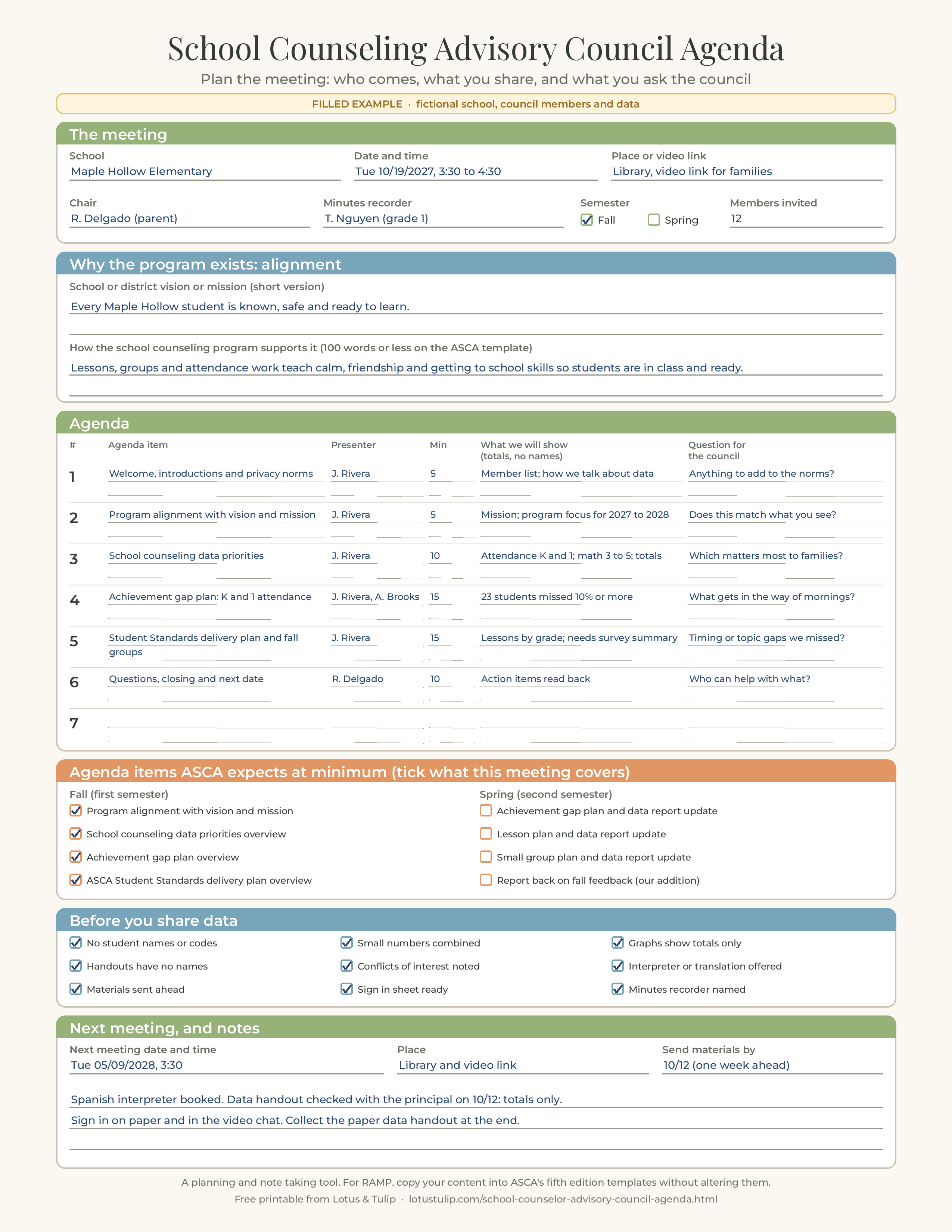
The agenda went out on October 12, in English and Spanish, with a one page summary of the data priorities and the achievement gap plan in totals. A Spanish interpreter was booked. Page 2 of the free printable shows the agenda planner J. Rivera filled in. Ten of twelve members attended: eight in the library and two by video. The student member was not invited to the fall meeting.
1. Welcome and privacy norms (5 minutes). R. Delgado welcomed members. J. Rivera explained the council's purpose in ASCA's words and the norm: "We talk about programs and patterns, not individual students."
2. Alignment (5 minutes). The school's vision: "Every Maple Hollow student is known, safe and ready to learn." Her alignment statement: lessons, groups and attendance work teach calm, friendship and getting to school skills so students are in class and ready to learn.
3. Data priorities (10 minutes). The two goals, as numbers of students. A parent member asked how many of the 23 had been in kindergarten; J. Rivera answered with the split by grade, 14 and 9, which was large enough to share.
4. Achievement gap plan (15 minutes). The 21 students, the goal of 13, the contributing factors she knew about from the attendance team (illness, transportation, family schedules) and the strategies. This item drew the most feedback. M. Herrera said through the interpreter that attendance calls from the office came only in English, so some families did not know a call was about attendance. K. Johnson said the September bus schedule change meant the first pickup on her route was now before 7:00. P. Greene said many absences were for mild illness and that families were unsure when a child was too sick for school. S. Mensah offered alarm clocks and a morning routines workshop at the family resource center.
5. ASCA Student Standards delivery plan (15 minutes). Tier 1 lessons by grade and month, the fall worry group for grades 3 and 4 and the friendship group for grades 1 and 2, and the needs assessment summary that led to them. Ms. Okafor asked that the grade 3 calm tools lessons happen before the winter benchmark week of December 6, not after. R. Delgado asked for a family version of the calm tools page in English and Spanish. D. Ortiz offered to put books about worry and feelings on a display at the library during the group.
6. Closing (10 minutes). The chair read back the actions and confirmed the spring date.
| # | Action | Who | By when |
|---|---|---|---|
| 1 | Check the bus route timing with transportation | A. Brooks | 10/29/2027 |
| 2 | Attendance calls in Spanish through the family liaison | A. Brooks, family liaison | Starting 11/01/2027 |
| 3 | One page "Sick or ready for school?" guide for families, in English and Spanish | P. Greene | 11/19/2027 |
| 4 | Grade 3 calm tools lessons scheduled before December 6, with a family calm tools page | J. Rivera, Ms. Okafor | 11/30/2027 |
| 5 | Morning routines family workshop at the resource center | S. Mensah, J. Rivera | 01/20/2028 |
T. Nguyen's draft minutes reached J. Rivera and the chair on Friday, October 22. J. Rivera checked that each agenda item had a summary of what she presented and that feedback was recorded for the data priorities, the achievement gap plan and the delivery plan, then copied the text into the ASCA first-semester template, unaltered, and filed it with the sign in sheet and her slides.
Between meetings
The bus route was adjusted by ten minutes from November. Attendance calls in Spanish started on November 1. The nurse's guide went home on November 19. The grade 3 calm tools lessons ran in November in all three classes, with the family page sent home the same week. The worry group ran from October 7 to December 2. The morning routines workshop was held on Thursday, January 20, 2028; eleven families came.
The spring meeting: Tuesday, May 9, 2028
Eleven of twelve members attended, including the grade 5 student member for item 5. The meeting opened with a report back on the five fall actions, with dates.
Achievement gap plan update. Of the 21 students in the plan, 20 were still enrolled at the end of April; one had moved. Of those 20, 12 were below 10 percent absence for the year to date as of April 28, 2028, one short of the goal of 13. J. Rivera showed the baseline and current numbers side by side and the Student Standards pre and post results from the arrival check ins, as group averages. Members' feedback: the workshop helped the families who came, but the families who most needed it could not come on a weekday evening; S. Mensah suggested a Saturday repeat with the library. A. Brooks noted that next year's plan would start in September, not October.
Lesson plan and data report update. The grade 3 calm tools lesson reached 70 of 72 students. The average on "I can name a calm tool to use before a test" rose from 2.3 to 3.4 out of 4, and correct answers on "Which of these is a calm body tool?" rose from 48 percent to 91 percent. Ms. Okafor said several students used the tools during the winter benchmark. Feedback: repeat the lesson before spring testing next year, and add a short version for grade 4.
Small group plan and data report update. The Calm and Brave worry group, grades 3 and 4 combined: five students expected and five took part, with 38 of 40 possible attendances. The group's average on the pre and post survey rose from 13.0 to 18.6 out of 24; the teacher rating average rose from 7.4 to 10.4 out of 16; absences fell from 11 to 7 days and nurse visits from 14 to 7, comparing the eight school weeks before the group with the eight weeks of the group. One survey item, about knowing an adult at school to go to for help, fell slightly as a group average, and J. Rivera explained that next year's last session would include naming trusted adults. She said plainly that this was a small, self report comparison. No student level results were shown.
Optional item: a student's view of groups. The grade 5 student member, prepared in advance and with a parent's written permission, said that some students think being in a group means you are in trouble. She did not talk about any group or any other student. Feedback from teachers: explain groups in classroom lessons each fall. Action: J. Rivera would add a one slide "What is a counseling group?" to her first classroom lesson in every grade.
Closing. Members signed the RAMP signature page for the counselors who were applying. Three members said they would continue; R. Delgado agreed to chair again. The next meeting was set for Tuesday, October 17, 2028.
The spring minutes recorded feedback on all three update items, comfortably above the RAMP minimum of two. More importantly, three concrete changes for next year came from people other than the counselor.
Six real world scenarios
1. "Can we just use the school site council?" A principal suggests adding a counseling item to the existing school site council to save time. It is a reasonable request, and site council members may be good candidates for your council, but RAMP item 3.1 requires a council "solely focused on the applicant's school counseling program," and a fifteen minute slot inside another agenda rarely produces real feedback. Offer a compromise: invite two site council members to join a separate one hour counseling council, scheduled right before or after their meeting.
2. Nobody from the families you most need comes. Your parent members are all PTA officers. Ask teachers and the family liaison for personal introductions, offer a video option and an interpreter, hold the meeting at a time families can attend, and say exactly how short the commitment is. Consider a short family listening session at a community location, and bring a summary of what you heard to the council as an optional item.
3. A member raises a specific student. A parent member says, "My neighbor's daughter is in your friendship group and she says..." Stop it kindly and at once: "I can't talk about any student here, but I would be glad to talk with you after the meeting." Do not record it in the minutes. Remind members of the norm at the start of the next meeting.
4. A member objects to what the program teaches. A community member says schools should not be teaching feelings or mental health. Listen and record the feedback. Explain the ASCA Student Standards behind your lessons, your district's consent and opt out process for groups, and what families can see. A council that only includes people who agree with you is not representative, and a respectful disagreement in the minutes shows the council is real.
5. Your results did not improve. Your achievement gap plan missed its goal. Show it anyway, with the numbers. Ask the council what they think got in the way and what they would change. RAMP asks for actual final data, which "may be different from projected final data," and a council that helps you understand a miss is worth more than one that applauds a success.
6. You are a high school counseling department of five. Each counselor can present one item, but keep the council to the program, not five separate caseloads. Include two or three students with clear roles, a family member from each grade if possible, and community partners such as a college access program, a workforce partner and a youth mental health agency. Divide the spring updates among counselors and keep to the hour.
Common mistakes
- Presenting for the whole hour. If the minutes have nothing in the feedback boxes, the meeting did not do its job, and RAMP items 3.8 and 3.11 will not be met.
- Inviting only friends of the program. Easy meetings, little learning.
- Too few members. Below eight, one or two absences leave you with a conversation, not a council.
- Using a site council, PTA or MTSS team instead. It will not meet RAMP 3.1, and an MTSS team discusses individual students, which the council must never do.
- Showing student level data. Initials, codes or a five row table of scores can identify students to people who know the school.
- Old terminology. A fifth edition application needs fifth edition agenda items: data priorities, achievement gap plan, Student Standards delivery plan, and the lesson plan and small group data reports.
- Altering ASCA's templates. RAMP requires fifth edition templates "in their original form." Plan on your own sheets if you like, then copy into the template.
- Minutes written by the presenter. You cannot listen and write at the same time. Name a recorder.
- No actions, owners or dates. Feedback that does not turn into an action is forgotten by spring.
- Forgetting the spring signatures. RAMP item 7.3 needs advisory council members' signatures. Collect them at the spring meeting while everyone is in the room.
Free printable: school counseling advisory council agenda, filled fall example and minutes sheet
The free printable has three US Letter pages. Page 1 is a blank advisory council agenda planner: the meeting (school, date and time, place or video link, chair, minutes recorder, fall or spring, members invited); why the program exists (a short version of the school or district vision or mission, and how the counseling program supports it); an agenda table with seven rows for the item, presenter, minutes, what you will show in totals and the question you will ask the council; the agenda items ASCA expects at minimum for the fall and spring meetings as tick boxes, plus a line for reporting back on fall feedback; a nine item "before you share data" check (no student names or codes, small numbers combined, graphs show totals only, handouts have no names, conflicts of interest noted, interpreter or translation offered, materials sent ahead, sign in sheet ready, minutes recorder named); and the next meeting date, place and the date to send materials. Page 2 is the same planner filled in for the fictional Maple Hollow Elementary fall meeting on Tuesday, October 19, 2027, described above. Page 3 is a blank minutes and action items sheet: members present by role, with invited and present counts and a reminder of ASCA's 8 to 20 member recommendation; minutes item by item (agenda item, summary of what the counselor presented, discussion and feedback from members, action needed and person responsible); an action items list with who, by when and done; a six item check before you file and send the minutes; and space for the feedback you will use and how you will report back.
The printable is a planning and note taking tool. If you are applying for RAMP, copy your agenda and minutes into ASCA's fifth edition first-semester and second-semester templates, which must be used "in their original form," and keep this sheet with your own records.
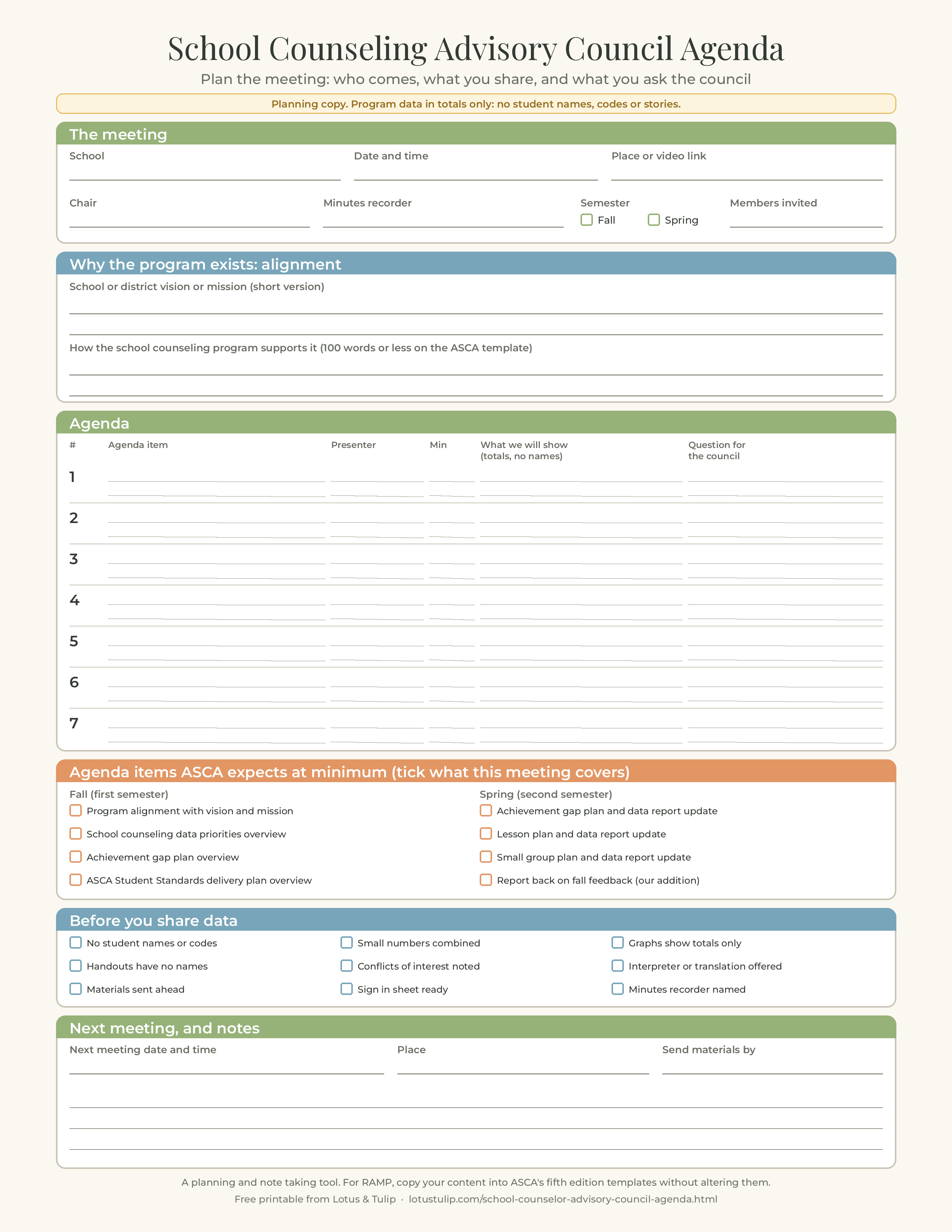
Download the free agenda, example and minutes sheet (PDF, 3 pages)
Or download single pages: Page 1: blank agenda planner (PNG) · Page 2: filled fictional fall example (PNG) · Page 3: minutes and action items sheet (PNG)
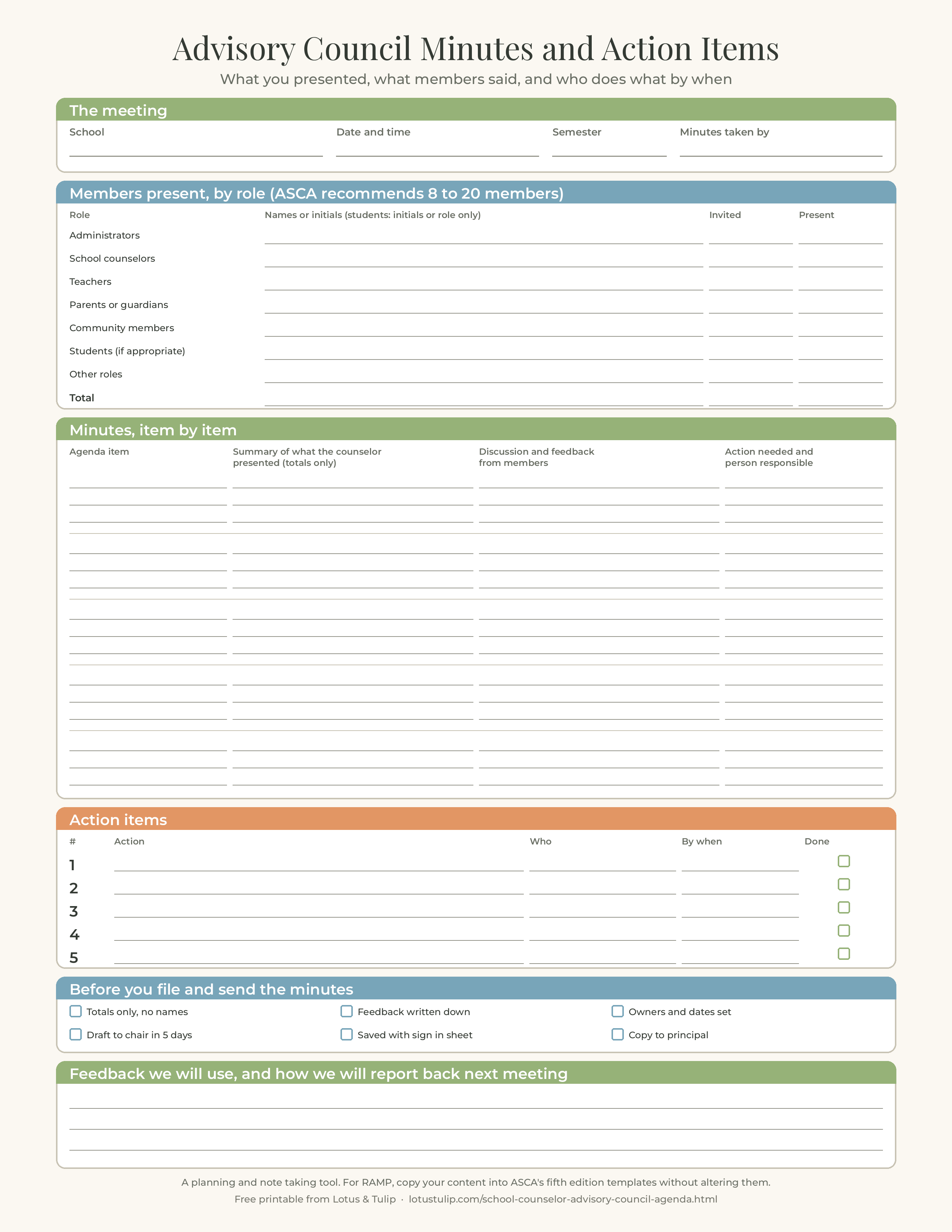
Free to print and use in your own school. Please link to this page rather than re-uploading the file. This is a planning tool. It does not replace ASCA's official templates, your district's policies on committees, volunteers, records and public meetings, or legal advice.
Related resources
- School counselor performance appraisal: how council agendas and minutes count as evidence, with a free planner
- School counseling program assessment: all 25 ASCA fifth edition benchmarks, filled example and free worksheet
- School counseling data priorities: what to present at the fall meeting, filled example and free worksheet
- ASCA classroom lesson plan and data report: RAMP Section 5, filled example and free planner
- Closing the gap action plan: ASCA achievement gap plan and data report, filled example and free planner
- School counselor use-of-time calculator: 5-day log, percentages and a filled example
- All school counselor small group curriculums
- ASCA Student Standards delivery plan: map a year of lessons and groups, with a free planner
- School counselor annual administrator conference: what to bring, sample agenda, talking points and a free planner
- Small group counseling for attendance: 8 session plan, activities and data log
- School counselor needs assessment for small groups
- Small group counseling pre and post assessment
- Small group counseling progress notes and attendance tracker
- Small group counseling lesson plan template and planning map
- Small group counseling termination activities and follow up log
- Small group counseling referral form and referral log
- Small group counseling permission slip and parent letter
- Full year elementary small group counseling: plan the year
- Small group counseling curriculum for anxiety: an 8 session plan
Sources: American School Counselor Association (2025), The ASCA National Model: A Framework for School Counseling Programs, Fifth Edition (Manage component: "Hold fall and spring advisory council meetings"; education partners; use of time recommendation); American School Counselor Association, Changes in the ASCA National Model Fifth Edition (advisory council first and second semester; data types; fourth to fifth edition terms); American School Counselor Association, ASCA National Model Fifth Edition Phased Implementation Plan (Phase 3, Inform and Advocate); American School Counselor Association, School Counseling Advisory Council First-Semester and Second-Semester templates and completed examples, fifth edition; American School Counselor Association, RAMP Scoring Rubric, Fifth Edition (revised February 2026), Section 3 (items 3.1 to 3.11), Section 2 (items 2.3, 2.17, 2.18, 2.20, 2.21 and 2.25) and Section 7 (item 7.3), and the fourth edition rubric, Section 5, for comparison; American School Counselor Association, RAMP Application Timeline, Fifth Edition, RAMP in the Fifth Edition, and the Apply for RAMP web page; American School Counselor Association (2022), ASCA Ethical Standards for School Counselors, standards A.2.j, A.13.b, B.2.j and B.2.p; Family Educational Rights and Privacy Act regulations, 34 CFR 99.3 (personally identifiable information) and 99.31(a)(1) and (b)(1), current eCFR text checked November 10, 2026.
FAQ
How often should a school counseling advisory council meet?
At least twice a year. The ASCA National Model, fifth edition, says to hold fall and spring advisory council meetings, and the RAMP rubric scores one first-semester and one second-semester meeting. ASCA's RAMP timeline suggests the first meeting between October and December and the second between April and May.
Who should be on a school counselor advisory council?
At a minimum for RAMP: parents or guardians, teachers, school counselors, administrators, community members and students if appropriate, with each member in a single role. Add people who fill gaps in what you know, such as the school nurse, a family liaison or a special education teacher, and make sure members reflect the languages and neighborhoods of your school.
How many members does an advisory council need?
The RAMP rubric recommends eight to 20 members and asks that the council approximate that range. Ten to fourteen works well for most elementary schools; large high schools may need more.
What goes on the first semester advisory council agenda?
For the fifth edition: how the school counseling program aligns with the school or district vision and mission, the school counseling data priorities overview, the achievement gap plan overview and the ASCA Student Standards delivery plan overview, plus a welcome, optional items and a closing with the next meeting date. The second semester agenda covers updates on the achievement gap plan and data report, the lesson plan and data report, and the small group plan and data report.
Can I share student data with the advisory council?
Share program data in totals only, with no names, initials or codes, and combine small numbers so no student can be identified by people who know the school. Under FERPA, information that is "linked or linkable to a specific student" by "a reasonable person in the school community" counts as personally identifiable, and council members are generally not school officials with a legitimate educational interest in individual records. Never discuss an individual student at a council meeting.
Is a school counseling advisory council required?
No federal law requires one. It is part of the ASCA National Model and is required for RAMP, where it is worth 11 points in the fifth edition rubric. Some states' school counseling frameworks and some districts also call for one, so check your state's model and your district's expectations.