
School counselors · Updated 2026-11-10
School Counselor Use-of-Time Calculator: How to Log a 5-Day Week, Code Every Block, and Calculate Your Percentages (Filled Example, Free Log)
Ready-made printable: Complete Small Group Counseling Bundle Holiday 20% off: about $29.44, was $37 (EUR 32) · instant digital download
Buy on Etsy
Ask a school counselor how the week went and you will often hear "busy." Ask what share of that week went to students, and most of us have to guess. The use-of-time calculator replaces the guess with a number. For one ordinary week in the fall and one in the spring, you write down what you did in every 15 minute block of your contract day and mark one category for each block. The spreadsheet counts the blocks and gives you five percentages: direct student services, indirect student services, program planning, school support and non-school-counseling tasks.
Those five numbers do a lot of work. They are the "previous school year" line on the annual administrator conference template, they are four of the six items in Section 4 of the RAMP application, and they are the most concrete way to show an administrator where a counselor's time goes, including the lunch duty, the testing schedule and the class you covered when there was no substitute. ASCA's recommendation is printed right on the calculator: 80 percent or more of your time in direct and indirect student services, and 20 percent or less in program planning and school support.
This guide is for elementary, middle and high school counselors in the United States. It covers what the fifth edition ASCA Use-of-Time 5-Day Calculator is and what changed from the fourth edition; the five categories and what goes in each, with ASCA's own coded examples; how to choose your two weeks; how to log a day in 15 minute blocks; exactly how the spreadsheet calculates the daily and weekly percentages, and why that matters; how to average two weeks for the conference; the 80 percent recommendation and how to read your result; appropriate and inappropriate duties; how the numbers feed the annual administrator conference and RAMP Section 4; part time, four day week and multi school situations; a ten step process; a fully worked fictional example; six scenarios; common mistakes; and a free three page printable: a blank 5-day paper log with a tally box, the same log filled in for a fictional elementary counselor's fall week, and a two-week summary sheet for averaging, duty analysis and planning next year.
Jump to the free 5-day log, filled example and summary sheet
This is educational information for school counselors in the US, not legal or employment advice. Your district contract, your state's school counseling framework and your evaluation system may set their own expectations for duties and time. The ASCA documents quoted here were downloaded from schoolcounselor.org and checked on November 10, 2026: the fifth edition Use-of-Time 5-Day Calculator template (Excel, marked "Updated Aug 25") and its alternate version, ASCA's completed fifth edition examples (including the annual administrator conference example), the fifth edition Annual Administrator Conference template, "The ASCA National Model: A Framework for School Counseling Programs, Fifth Edition" (the free 16 page framework document, 2025), "Changes in the ASCA National Model Fifth Edition," "RAMP in the Fifth Edition," the "RAMP Scoring Rubric, Fifth Edition" (revision notes through February 2026), the fifth edition "RAMP Application Timeline," the "RAMP Application and Use-of-Time 5-Day Calculator Timeline," the fourth edition calculator for comparison, ASCA's position statement "The School Counselor and School Counseling Programs" and ASCA's ratios page. Anything we could not confirm in those documents is marked as such below.
The short answer
- It is a time study, not a timesheet. ASCA's template states its purpose: "This template provides a snapshot of how school counselors spend their time in each of the components of the ASCA National Model."
- Two weeks a year, five consecutive days each. "Complete the use-of-time calculator for one week (five consecutive days) in first semester and second semester of the academic year."
- Every 15 minutes, one activity and one category. The spreadsheet has a row for each 15 minute block from 7 a.m. to 5 p.m. If you did two things in a block, record "the activity where you spent the majority of time," and "Do not mark more than one category."
- Five categories: direct student services, indirect student services, program planning, school support (fair share) and non-school-counseling tasks. A duty-free lunch or break gets no category at all.
- The math is simple. Percent of time in a category = blocks marked in that category divided by all marked blocks. The spreadsheet does it for each day and for the whole week.
- The recommendation: "80% of time or more is spent in direct and indirect student services" and "20% of time or less is set aside for program planning, school support and fair-share activities."
- Where the numbers go: the average of your two weeks becomes the "previous school year" use of time on the annual administrator conference template, next to your planned use of time for the current year.
- For RAMP, you upload both calculators as Excel files, from the school year before the data collection year, in ASCA's original, unaltered template.
What the use-of-time calculator is, and what it is for
The Use-of-Time 5-Day Calculator is one of the fifth edition ASCA National Model templates, an Excel workbook you download free from ASCA's Templates and Tools page. It belongs to the Manage component of the model. The free framework document lists "plan and monitor time" as one of the four things school counselors manage, with three parts: "Use weekly calendars to prioritize, plan and publicize day-to-day work," "Publicize an annual calendar, which includes all major school counseling activities," and "Monitor use of time. ASCA recommends school counselors spend at least 80% of their time in direct and indirect services to students and 20% or less in program planning and school support."
The calculator is the "monitor" part. A weekly calendar shows what you planned. The calculator shows what actually happened, in a format that adds up to 100 percent and can be compared across years and across counselors.
ASCA's implementation notes give the calculator three jobs, in this order:
- Measure. Complete it for one week in each semester, choosing "a week that involves a variety of activities and is free of predictable disruptions (e.g., special schedules, school holidays, planned absence for a medical absence)," and code activities "per the ASCA definition for direct services, indirect services, program planning, school support (fair share), and non-school counseling duties."
- Share. "Share use-of-time analysis with administration during the annual administrative conference." (The template still uses the older word "administrative"; the conference itself is now called the annual administrator conference.) The same calculator is listed as an artifact in ASCA's School Counselor Performance Appraisal under advocacy and use of time; see our performance appraisal guide.
- Decide together. "Make decisions about specific time allocation in collaboration with administrator."
That last note is worth reading twice. ASCA does not frame the calculator as evidence for a grievance. It frames it as the starting point for a joint decision about how the counselor's time is spent. The tone of your conference follows from that.
What is in ASCA's workbook
The fifth edition template (the Overview tab is marked "Updated Aug 25") has eight tabs:
| Tab | What it holds |
|---|---|
| Overview | Purpose, five implementation notes, the two recommendations and nine directions |
| Example | One completed day for a fictional counselor ("Jordan Counselor"), coded and totaled |
| Mon, Tues, Wed, Thurs, Fri | One sheet per day: counselor name, date, contract start and end time, then 40 rows of 15 minute blocks (7 to 7:15 a.m. through 4:46 to 5:00 p.m.), an activity column, five category columns, a TOTALS row and a "% per category" row |
| Charts | The week: the five daily totals added together, the weekly percent for each category, and a chart |
The five category columns carry both a heading and a short definition, and those definitions are the closest thing to a coding key that the template itself provides:
| Column | ASCA's label in the calculator |
|---|---|
| Direct Student Services | Instruction, Appraisal & Advisement, Counseling |
| Indirect Student Services | Referrals, Consultation, Collaboration |
| Program Planning | Defining, Managing, Assessing Activities |
| School Support | Fair-Share Responsibility Activities |
| Non-School-Counseling Tasks | Non-School-Counseling Tasks |
The two versions: checkboxes and the "alternate" X version
ASCA posts two versions of the fifth edition calculator. The main version uses checkboxes in the category columns. The alternate version asks you to type an X instead; its Overview tab says, "If you see 'FALSE' repeatedly in the Use of Time document, use this alternate version." In our copy, the main version's category cells are true or false checkbox cells, which is why some versions of Excel, and some other spreadsheet programs, show the word FALSE in every empty box instead of a checkbox. The formulas count either "true" (main version) or "x" (alternate version), so do not mix the two: an X typed into the checkbox version is not counted.
ASCA's Templates and Tools page offers both versions without saying one is preferred for RAMP. We found no ASCA statement either way, so if you are applying, use whichever version works in your copy of Excel, do not alter it, and keep the file in Excel format.
What changed from the fourth edition calculator
"Changes in the ASCA National Model Fifth Edition" lists three changes to the calculator: "All direct services combined into one column," "All indirect services combined into one column," and "Uses checkboxes instead of requiring an X." The fourth edition calculator had seven category columns: Instruction, Appraisal and Advisement, and Counseling as three separate direct service columns; one indirect column for referrals, consultation and collaboration; program planning and fair-share school support under a shared "Program Planning and School Support" heading; and non-school-counseling tasks. Its directions said, "You must record an X."
Which version applies when matters for RAMP. ASCA's "RAMP in the Fifth Edition" document says that because the calculator comes from the year before the data collection year, "fifth edition submissions in October 2026 will allow the fourth edition version of the calculator. Beginning with October 2027 RAMP submissions, all applications must include the fifth edition version of the use-of-time calculator." In practice: if you are logging weeks now, in the 2026 to 2027 school year or later, use the fifth edition calculator.
The five categories, and what goes in each
RAMP item 4.5 checks that "Classifications of activities in the Use-of Time 5-Day Calculators align with the ASCA National Model definitions of direct and indirect services, program planning and school support, or non-school-counseling tasks." So the definitions are the rules. Here is what ASCA's free documents say for each category, followed by the examples ASCA itself codes on the calculator's Example tab.
1. Direct student services
The fifth edition framework defines direct student services as "in-person or direct interactions between school counselors and students," and ASCA's position statement on school counseling programs adds that direct services "are face-to-face or virtual interactions." There are three kinds:
- Instruction: "Enhance student access, life-readiness and academic success through delivery of the ASCA Student Standards," in classroom, small group or individual settings. Classroom lessons, large group lessons and the instructional part of small groups.
- Appraisal and advisement: "Analyze and assess students' abilities, interests, skills and achievement from test and inventory results," then "Make recommendations based on appraisal of test and inventory results to help students make decisions for their future." Academic planning conferences, career inventories with a student, going over test results with a student.
- Counseling: "Provide students with short-term assistance and support based on counseling theories and techniques during times of transition, heightened stress, critical change or other situations impeding academic, career and social/emotional development," in small group or individual settings. Individual counseling, small group counseling, responding to a student in crisis.
The test is simple: are you with a student or students, in person or virtually, doing one of those three things? If yes, it is direct.
2. Indirect student services
"Indirect student services are provided on behalf of students through the school counselor's interactions with others." Again there are three kinds:
- Referrals: "Connect students and families with more intensive resources for life-readiness and academic success."
- Consultation: "Provide information, perspectives, strategies and recommendations to individuals who can support a student's needs," and "Seek information on what students might need to address an issue."
- Collaboration: "Work with education partners (faculty/staff, parents/guardians, community services/agencies) on an identified goal for student success, sharing responsibility for identified tasks among cooperating individuals."
Parent conferences, teacher consultations, calls to community providers, and team meetings where you are working on a specific student's needs all fit here. The key words are "on behalf of students." A meeting about the bus schedule is not indirect service just because it happens at a school.
3. Program planning
The calculator labels this column "Defining, Managing, Assessing Activities," which points back to three of the four components of the National Model: Define (standards), Manage (planning tools) and Assess (program and counselor assessment). ASCA's position statement "The School Counselor and School Counseling Programs" (revised 2023) lists what belongs in the 20 percent or less for program planning and school support:
- "Reviewing school data"
- "Developing achievement gap goals"
- "Creating lesson plans, small group plans achievement gap plans"
- "Reporting results of lessons, small groups and achievement gap plans to the school community"
- "Discussing the priorities of the school counseling program in the annual administrator conference"
Preparing lessons, scoring your own pre and post assessments, analyzing attendance data for your gap plan, building the delivery plan, preparing the advisory council agenda and writing results reports are all program planning. On ASCA's Example tab, "data collection small group" is coded here too, which is a useful signal: collecting your group's data is part of running your program, but the time you spend on it is not direct service.
4. School support (fair share)
The calculator's label is "Fair-Share Responsibility Activities." ASCA's free framework document and position statement do not define "fair share" in a sentence; the position statement says only that "Fair-share responsibilities should not preclude implementing, managing and accessing a school counseling program." The plain reading is the routine duties that every staff member in the building shares: arrival or dismissal supervision on a rotation, a turn at a schoolwide event, general school email. ASCA's Example tab codes "Car duty" and "Email check - school/district matters" as school support.
The word "share" does the work here. If every teacher takes one week of bus duty a month, your week of bus duty is fair share. If you are on bus duty every day because the counselor "has a flexible schedule" and nobody else is, it is hard to call that a fair share, and you should think carefully about whether it is really a non-school-counseling task. ASCA's free documents do not draw that line for you, so make the call honestly, apply it the same way in both weeks, and be ready to explain it.
5. Non-school-counseling tasks
These are tasks that are not part of the school counselor's role in the National Model. The fifth edition framework includes a chart of "Appropriate and Inappropriate Activities for School Counselors" that pairs similar tasks, which "can be helpful when explaining how school counselors spend their time." The inappropriate column is the best guide to what goes here. On ASCA's Example tab, "K lunch duty" is coded as a non-school-counseling task, while "Car duty" is coded as school support. ASCA does not explain the difference on the template. A reasonable reading is that the car duty is a shared staff rotation and the lunch supervision is not, but that is our interpretation, not ASCA's wording.
ASCA's own example day, coded
The calculator's Example tab shows one day for a counselor whose contract runs 7 a.m. to 3 p.m. It is worth studying, because it is the only place where ASCA codes real activities for you:
| Activity on ASCA's Example tab | Blocks | ASCA's category |
|---|---|---|
| Conduct parent conference gr 6 (LS) | 2 | Indirect |
| Data collection small group | 3 | Program planning |
| Teach 5th grade career lesson (two classes) | 6 | Direct |
| Goal check with student (TR) 2nd gr | 2 | Direct |
| K lunch duty | 3 | Non-school-counseling |
| Personal lunch | 2 | No category (left blank) |
| Teach 8th grade career lesson | 3 | Direct |
| Counseling with student (AC) 7th gr, family issue | 2 | Direct |
| 3rd, 4th and 5th gr study skills small groups | 3 | Direct |
| Attend parent/teacher conference gr 3 (DW) | 3 | Indirect |
| Email check, school/district matters | 1 | School support |
| Email responses, teachers' concerns/questions | 1 | Indirect |
| Car duty | 1 | School support |
The template's totals for that day are 16 direct, 6 indirect, 3 program planning, 2 school support and 3 non-school-counseling blocks: 30 marked blocks. That gives 53.3 percent direct, 20.0 percent indirect, 10.0 percent program planning, 6.7 percent school support and 10.0 percent non-school-counseling. Direct plus indirect is 73.3 percent. In other words, ASCA's own example day is below its own 80 percent recommendation, mostly because of the 45 minutes of lunch duty. That is a realistic day, not a failure, and it is a good reminder that the calculator is for honest measurement.
Notice three details. Students are identified by initials only. Email is split by purpose: school and district business is school support, while answering teachers' questions about students is indirect. And the two blocks of personal lunch are left blank, so they are not counted in any category or in the total.
A coding guide for common activities
The table below combines ASCA's examples with our reading of ASCA's definitions and its appropriate and inappropriate activities chart. Where ASCA's free documents do not settle a question, we say so. If your district or state framework has its own coding guide, follow it, and apply it the same way in both weeks.
| Activity | Suggested code | Basis |
|---|---|---|
| Classroom or large group lesson | Direct | ASCA example; "Instruction" |
| Small group session with students | Direct | ASCA example |
| Individual counseling, short term | Direct | ASCA example; "Counseling" |
| Responding to a student in crisis | Direct | "Counseling" definition (heightened stress, critical change) |
| Academic or postsecondary planning meeting with a student | Direct | "Appraisal and advisement" |
| Explaining a student's test or inventory results to the student | Direct | "Appraisal and advisement"; "Interpreting cognitive, aptitude and achievement tests" is appropriate |
| Goal check in with a student | Direct | ASCA example |
| Parent or parent and teacher conference about a student | Indirect | ASCA example |
| Consulting a teacher about a student or classroom | Indirect | "Consultation"; ASCA example (email responses to teacher concerns) |
| Referral call to a community provider | Indirect | "Referrals" |
| Student study team, IEP or 504 meeting where you advocate for a student | Indirect | "Advocating for students at individual education plan and 504 meetings, student study teams and school attendance review boards, as necessary" is appropriate |
| Consulting the principal to identify and resolve student issues | Indirect | Listed as appropriate; fits "Consultation" |
| Writing a lesson plan, small group plan or gap plan | Program planning | Position statement list |
| Reviewing school or program data; scoring your pre and post | Program planning | Position statement list; ASCA example (data collection) |
| Preparing for and holding the advisory council or administrator conference | Program planning | Position statement list (conference); "Managing" activities |
| Arrival, dismissal or car duty on a shared staff rotation | School support | ASCA example (car duty) |
| General school and district email | School support | ASCA example |
| Staff meeting | Not settled by ASCA | ASCA's free documents do not code it; treating it as fair share (every staff member attends) is one reasonable choice. Be consistent. |
| Coordinating the school's testing program or schedule | Non-school-counseling | Inappropriate: "Coordinating school/district cognitive, aptitude and achievement testing programs" |
| Covering a class for an absent teacher | Non-school-counseling | Inappropriate: "Covering classes when teachers are absent or to create teacher planning time" |
| Supervising classrooms, common areas, in-school suspension or time-out rooms | Non-school-counseling | Inappropriate list |
| Building the master schedule | Non-school-counseling | Inappropriate list |
| Coordinating schoolwide IEPs, 504 plans, student study teams, RTI, MTSS or attendance review boards | Non-school-counseling | Inappropriate list (coordinating, as opposed to advocating) |
| Data entry, filing clerical records, maintaining student records, computing GPAs | Non-school-counseling | Inappropriate list |
| Disciplining students or assigning consequences | Non-school-counseling | Inappropriate list |
| Signing excuses for tardy or absent students | Non-school-counseling | Inappropriate list |
| Duty-free lunch or break | Leave blank | Calculator directions |
Two judgment calls come up constantly. First, a recurring lunch supervision: ASCA codes its own example as non-school-counseling, so if yours is the same kind of duty, code it the same way. Second, professional development days: ASCA's free documents do not tell you how to code a workshop, but the implementation note about choosing a week "free of predictable disruptions" means you should simply not pick a PD week.
Choosing your two weeks
The notes ask for "one week (five consecutive days) in first semester and second semester." RAMP item 4.3 repeats it: "Provide a Use-of-Time 5-day Calculator for one week (five consecutive days) from the first and second semester for each school counselor."
A good calculator week has three qualities:
- It is typical. ASCA asks for "a week that involves a variety of activities." Lessons, groups, individual students, consultation and the usual duties should all show up.
- It is undisturbed. No holiday, no special schedule, no testing week, no field day, no planned leave. ASCA's examples of disruptions are "special schedules, school holidays, planned absence for a medical absence."
- It is chosen in advance. Pick the week before it starts and put it on your calendar. Choosing a week after the fact, because it happened to look good, defeats the purpose and is the kind of thing a careful administrator will notice.
A week in October and a week in February or March often works well. Early fall and the last weeks of the year are usually full of one time events. Avoid the week of your state testing window and any week that includes a federal or school holiday.
What if something unexpected happens, such as a crisis on Wednesday? Log it. ASCA asks you to avoid predictable disruptions, not to edit out the unpredictable ones. A crisis response with students is direct service, and leaving it out would make the week less honest, not more.
How to log a day in 15 minute blocks
ASCA's directions are short:
- "Enter your activity for the corresponding contracted work time and day of the week. Provide enough details so how your time is spent is clear."
- "If you did more than one activity in a 15-minute timeframe, record the activity where you spent the majority of time."
- "In the columns next to each activity, check the category that aligns with your activity. Do not mark more than one category."
- "If you take a duty-free lunch break or any other duty-free break, do not check any category for this time."
- "Do not use any other mark in the columns."
- The spreadsheet counts your activities each day and calculates the percent in each category.
- It also calculates your percent of time for the week, on the Charts tab.
- The Example tab shows a completed day.
- "Because there are formulas in the spreadsheets, do not alter any part of the Use-of-Time Calculator in any way."
Here is how that works in practice.
Log as you go, not on Friday afternoon
Memory is a poor time study. Keep a paper log on your desk (the free printable below has one) and jot a few words and a code at natural breaks: after each lesson, at lunch, after dismissal. Copy it into ASCA's spreadsheet at the end of each day, while you still remember what the 1:15 block was.
Write activities a reviewer can understand
"Provide enough details so how your time is spent is clear." Compare "meeting" with "consult with gr 3 teacher about student (DW) reading plan." The second one shows why it is indirect service. Use initials or no identifier at all; never full student names. ASCA's RAMP rubric reminds applicants that "No identifiable student information should be included."
Only your contracted time
The directions say to enter activities for your "contracted work time." If your contract runs 7:30 a.m. to 3:30 p.m., the rows before 7:30 and after 3:30 stay empty. The template only has rows from 7 a.m. to 5 p.m., and you must not add rows. ASCA's free documents do not address evening events such as a family night outside the contract day; we found no guidance on whether or how to include them, so leave them out of the calculator and mention them in your conference notes if they matter.
Majority rules within a block
If a 15 minute block had eight minutes of a parent call and seven minutes of school email, it is a parent call (indirect). Do not try to split blocks. Over five days, the small rounding in each direction tends to even out.
Duty-free lunch is blank, not "other"
A real duty-free lunch is not counted at all, so it does not lower any percentage. A "working lunch" with a lunch bunch group is direct service. Lunch supervision is a duty and gets the code that fits the duty.
How the percentages are calculated (and why it matters)
The formulas in ASCA's workbook are short, and knowing them helps you check your own numbers.
Each day
Each day sheet counts the marked boxes in each category column across the 40 time blocks, then divides each category count by the total of all five counts. ASCA labels the result "% per category." So for a day:
Percent in a category = blocks in that category / all marked blocks
Blank blocks, such as a duty-free lunch or time outside your contract, are not in the denominator. That is why the daily percents always add up to 100 percent, whatever your contract length.
The week
The Charts tab adds the five daily counts for each category (Mon + Tues + Wed + Thurs + Fri) and divides each sum by the total of all five sums. So the weekly percent is:
Weekly percent in a category = blocks in that category over five days / all marked blocks over five days
This is a pooled calculation, not an average of the five daily percents. The difference is small when every day has the same number of marked blocks, but it is not zero when they differ. Suppose Monday was a full day of 32 marked blocks with 20 direct (62.5 percent), and on Tuesday you were in the building only until noon, with 16 marked blocks and 4 direct (25 percent). The average of the two daily percents is 43.8 percent. The pooled figure, which is what the spreadsheet uses, is 24 of 48 blocks, or 50.0 percent. If you calculate by hand from a paper log, add up the blocks, then divide.
The two weeks: average for the conference
For the annual administrator conference, ASCA's template asks for the "Average of two use-of-time 5-day calculators from previous year." RAMP item 4.4 checks the same thing: "Previous school year use of time reported on each Annual Administrator Conference Template is the average of the individual school counselor's two Use-of-Time 5-Day Calculators submitted."
So for each category, add the week one percent and the week two percent, and divide by two. Use the weekly percents from each calculator's Charts tab. If your two weeks had slightly different numbers of marked blocks, the result can differ by a tenth of a point or so from pooling all ten days, and the average of the two calculators is what item 4.4 describes.
Rounding
ASCA's completed conference example uses whole percents. When you round five numbers, they may add up to 99 or 101. That is normal arithmetic, not an error. Round each to the nearest whole number and leave it, or, if you want the total to be exactly 100, adjust the category closest to a half and note it. Never adjust in a way that moves a number across a meaningful line such as 80 percent.
Direct plus indirect
The figure everyone asks about is direct plus indirect. Add the two percents. That is the number to compare with ASCA's "80% or more." Program planning plus school support is the number to compare with "20% or less." Non-school-counseling tasks have their own column on the conference template, under neither heading.
The 80 percent recommendation: what it says and how to read your result
The recommendation appears in four places we checked: the calculator ("Recommendation: 80% of time or more is spent in direct and indirect student services" and "Recommendation: 20% of time or less is set aside for program planning, school support and fair-share activities"); the fifth edition framework ("A minimum of 80% of a school counselor's time should be spent in direct and indirect student services" and "No more than 20% of a school counselor's time should be spent in program planning and school support activities"); the annual administrator conference template, which labels the direct and indirect columns "Recommended 80% or more" and the program planning and fair-share columns "20% or less"; and ASCA's position statement on school counseling programs.
A few things the recommendation does and does not say:
- It is a recommendation, not a RAMP criterion. None of the six Section 4 items in the fifth edition RAMP rubric requires 80 percent. The items check that the calculators exist, cover the right weeks, are averaged correctly, are coded correctly and have one code per entry. We found no rubric item that scores the percentages themselves.
- It does not split direct and indirect. ASCA gives no separate target for direct alone. Both kinds of service count toward the 80 percent.
- There is no stated target for non-school-counseling tasks on the conference template, but the 80/20 split leaves no room for them, and ASCA's position statement says duties outside the counselor's role "should be limited and performed by other school staff." ASCA's own completed conference example shows a department planning 0 percent.
- Program planning is necessary. Zero percent program planning is not a good sign. Someone has to analyze the data, write the plans and report results. ASCA puts that work inside the 20 percent, not outside the program.
Reading your result
Below 80 percent is common, and ASCA's own examples show it: the Example tab day is 73.3 percent direct and indirect, and the completed annual administrator conference example reports a previous year of 59 percent direct, 12 percent indirect, 16 percent program planning, 8 percent fair-share school support and 5 percent non-school-counseling duties, which is 71 percent direct and indirect. Its planned use for the current year is 60, 15, 20, 5 and 0: 75 percent direct and indirect, still under 80, with program planning and fair share together at 25 percent. ASCA chose to publish that as its example. The point is a credible plan to move in the right direction, not a perfect number on day one.
When you look at your two weeks, ask four questions:
- Where did the non-school-counseling time come from? List each duty, how many days a week, and the minutes. "Lunch duty, 45 minutes, five days" is a conversation; "too many duties" is a complaint.
- Is the fair share really fair? Compare your duty rotation with a classroom teacher's.
- Is the program planning time doing its job? If it is very high, is some of it really clerical work (filing, data entry) that should be coded as non-school-counseling? If it is very low, when do the plans and reports get written?
- Was anything miscoded? Data collection is program planning in ASCA's example, not direct service. Honest coding protects you; RAMP reviewers check classifications under item 4.5.
Your two weeks also answer two benchmarks on ASCA's School Counseling Program Assessment: "Use of time is monitored at least twice a year" and the 80 percent recommendation. Our program assessment guide shows how to record a result below 80 percent honestly in the comments and turn it into a plan for the administrator conference.
Appropriate and inappropriate activities: the chart to bring with you
The fifth edition framework includes ASCA's "Appropriate and Inappropriate Activities for School Counselors" chart, which "provides a comparison between two similar types of activities and can be helpful when explaining how school counselors spend their time." The power of the chart is that it pairs tasks instead of simply forbidding them. Here is the full list from the fifth edition framework:
| Appropriate activities | Inappropriate activities |
|---|---|
| Appraisal & advisement for academic planning | Building the master schedule |
| Academic advising for new students | Coordinating paperwork and data entry of all new students |
| Presenting school counseling lessons based on the ASCA Student Standards to address students' developmental needs and needs identified through data | Covering classes when teachers are absent or to create teacher planning time |
| Consulting with teachers about building classroom connections, effective classroom management and the role of the ASCA Student Standards in student success | Supervising classrooms, common areas, in-school suspension or time-out rooms |
| Interpreting cognitive, aptitude and achievement tests | Coordinating school/district cognitive, aptitude and achievement testing programs |
| Analyzing schoolwide and school counseling program data | Serving as a data entry clerk |
| Analyzing GPAs in relationship to achievement | Computing GPAs |
| Interpreting student records | Maintaining student records |
| Protecting student records and information per state and federal regulations | Keeping/filing clerical records |
| Providing short-term individual and small-group counseling services to students | Providing long-term counseling in schools |
| Providing counseling to students who are frequently tardy or absent | Signing excuses for students who are tardy or absent |
| Providing counseling to students who have disciplinary problems | Disciplining students or assigning discipline consequences |
| Consulting with the school principal to identify and resolve student issues, needs and problems | Assisting with duties in the principal's office |
| Advocating for students at individual education plan and 504 meetings, student study teams and school attendance review boards, as necessary | Coordinating schoolwide individual education plans, 504 plans, student study teams, response to intervention plans, MTSS and school attendance review boards |
Use it as a translation tool. When your log shows two hours of testing coordination, the chart lets you say, "Interpreting test results with students is my job and I want more time for it; coordinating the testing program is on ASCA's list of tasks that belong with someone else." That is a professional standard, not a personal preference.
The chart also helps with the opposite problem. "Providing long-term counseling in schools" is on the inappropriate side. If your direct service number is high because you see the same few students weekly all year for therapy-like sessions, the chart points toward a referral plan rather than celebration.
How the results feed the annual administrator conference
The fifth edition Annual Administrator Conference template has a use-of-time section with two rows of five boxes:
- "Previous school year: Average of two use-of-time 5-day calculators from previous year." Direct student services, indirect student services, program planning activities, fair-share school support activities, non-school-counseling duties.
- "Planned Use-of-Time for Current Year: Indicate your planned time allocations for this school year." The same five categories.
Above the columns, the template prints "Recommended 80% or more" over direct and indirect, and "20% or less" over program planning and fair-share school support. The minutes section asks you to document the administrator's response to the conversation about "use of time," among other topics. ASCA's position statement lists "Discussing the priorities of the school counseling program in the annual administrator conference" as program planning, so log the conference itself as program planning if it falls in a calculator week.
The conference happens early. RAMP item 4.2 requires the conference to be held and the template signed "within the first two months of the school year," and ASCA's "RAMP Application and Use-of-Time 5-Day Calculator Timeline" says the calculator data "is used in the completion of the Annual Administrative Conference form, which is signed in the first two months of the school year." That is why the previous year's two weeks matter: they are your evidence at the start of the next year.
The same template prints ASCA's ratio recommendation, "one school counselor per 250 students (1:250)," next to your own ratio and caseload. ASCA's ratios page reports a national average of 372 students per school counselor for the 2024 to 2025 school year. A high ratio does not change how you code the calculator, but it explains a lot of what the calculator shows, and the two belong in the same conversation.
Turning numbers into a plan
The planned row is where the conversation lives. A plan that says "80 percent direct and indirect" with nothing changed is not a plan. Build the planned numbers from specific changes:
- List every non-school-counseling and heavy fair-share duty from your two weeks, with minutes per week.
- For each one, say what you would do with the time: "Lunch duty from five days to two frees 135 minutes a week, which is two Tier 2 groups at 12:40 on Tuesday and Wednesday."
- Recalculate. If 135 minutes (9 blocks) of a 160 block week moved from non-school-counseling to direct, direct rises by about 5.6 points.
- Bring the trade, not just the number. Administrators respond to students served, not to percentages.
Our annual administrator conference guide covers the template section by section, with a 45 minute agenda, talking points and sample minutes.
How the calculator fits RAMP Section 4
In the fifth edition RAMP rubric, Section 4, Annual Administrator Conference, is worth 6 points. Four of its six items are about the calculator:
| Item | What it says | What it means in practice |
|---|---|---|
| 4.3 | "Provide a Use-of-Time 5-day Calculator for one week (five consecutive days) from the first and second semester for each school counselor from the school year prior to the data collection year." | Two calculators per counselor, one per semester, from the right year |
| 4.4 | "Previous school year use of time reported on each Annual Administrator Conference Template is the average of the individual school counselor's two Use-of-Time 5-Day Calculators submitted." | Your conference numbers must match the average of the two files |
| 4.5 | "Classifications of activities in the Use-of Time 5-Day Calculators align with the ASCA National Model definitions of direct and indirect services, program planning and school support, or non-school-counseling tasks." | Reviewers read your activities and check the codes |
| 4.6 | "Each entry has only one classification." | One mark per block, never two |
The other two items are about the conference template: 4.1, all sections completed (or marked N/A), and 4.2, held and signed within the first two months. The section asks you to upload the conference template for each school counselor as a PDF and "Two completed Use-of-Time 5-Day Calculators from the school year prior to the data collection year for each member of the school counseling department employed during both school years (Excel format)." The rubric's general instructions add: "Upload the ASCA Student Standards Delivery Plan Template and Use-of-Time 5-Day Calculator Template as Excel documents and all others as a PDF," and "Only completed fifth edition ASCA templates in their original form may be used in the fifth edition RAMP application. These templates should not be altered."
The fifth edition rubric totals 82 points across seven sections. ASCA does not publish a fifth edition passing score in the rubric or the other RAMP documents we checked, so we cannot tell you how many points you need overall.
Which year's weeks count
This is the most common RAMP calculator mix-up, so here it is plainly. The rubric says the application "should cover one complete school year prior to the submission date, except for the use-of-time 5-day calculator, which is needed from the year before the data collection year. For example, an application submitted in October 2027 includes data collection year during the 2026-2027 school year and use-of-time 5-day calculators from the 2025-2026 school year." The fifth edition rubric we downloaded gives the submission deadline for that cycle as "no later than Oct. 1, 2027, at 11:59 p.m. ET."
ASCA's calculator timeline lays it out year by year:
| Apply in October | Data collection year | Annual administrator conference | Calculator weeks from |
|---|---|---|---|
| 2027 | 2026 to 2027 | First two months of 2026 to 2027 | 2025 to 2026 |
| 2028 | 2027 to 2028 | First two months of 2027 to 2028 | 2026 to 2027 |
| 2029* | 2028 to 2029 | First two months of 2028 to 2029 | 2027 to 2028 |
*ASCA's timeline chart ends at 2028; the 2029 row follows the same pattern and is our extension.
So the weeks you log this year are the ones you would upload two Octobers from now. If you might ever apply, do the calculator every year, on ASCA's current template, and save the Excel files where you can find them.
Part time counselors, four day weeks and staff changes
The rubric's "Special Note About the Use-of-Time 5-Day Calculator" covers the exceptions:
- "All school counselors five-day-a-week schools are required to submit documentation for the five-day week period."
- "School counselors at schools operating only four days per week throughout the year should also submit a statement."
- "School counselors working part-time should still complete the calculator and provide a note to explain the less than five day documentation."
- "When there are school counseling staff changes during the school year prior to the data-collection year, provide a statement explaining this change that resulted in fewer use-of-time 5-day calculators."
Because the percentages use only marked blocks, a part time counselor's numbers are directly comparable with a full time colleague's.
Is a 5-day sample enough?
Two weeks out of about 36 is a small sample, and some counselors worry that it is not representative. A few honest answers:
- It is what ASCA asks for. The calculator is designed as a snapshot ("This template provides a snapshot"), not a census.
- Two semesters catch seasonal patterns. A fall week and a spring week will look different, especially in high schools with registration and testing seasons.
- Choosing typical weeks in advance protects the result from both cherry picking and bad luck.
- You can do more. Nothing stops you from logging an extra week for your own analysis, for example a testing week, to show the administrator what that season costs. Keep the two official weeks typical, and label any extra week clearly as extra.
Departments, multiple schools and high school seasons
Departments
Each counselor completes their own calculator and their own conference template; ASCA's conference template instructions say "Each school counselor completes a separate template." Agree on coding rules as a department before the weeks begin, especially for staff meetings, duties and data work, so that the numbers are comparable. If one counselor carries the testing coordination for the whole department, that will show up in one person's calculator, and the conversation is about the department's structure, not that person's choices.
Counselors split between schools
ASCA's free documents do not say how to handle a counselor who works at two schools within one week. The part time note suggests the principle: complete the calculator for the time you work in the building and explain the arrangement. Ask ASCA before you rely on any particular approach for an application.
High school seasons
High school counselors often have a registration season and a testing season that swallow whole weeks. Pick calculator weeks outside both. If coordinating testing is part of your job, log it honestly as non-school-counseling in your typical weeks and bring the extra testing week as separate evidence. Individual academic advising with a student, including course selection conversations, is direct service under appraisal and advisement; entering course requests into the system for the whole grade is data entry.
How to complete the ASCA use-of-time calculator, step by step
- Download ASCA's current fifth edition calculator. Get it from ASCA's Templates and Tools page, read the Overview and Example tabs, and check whether the checkboxes work; if every box shows FALSE, use ASCA's alternate X version instead.
- Agree on coding rules before you start. Read ASCA's five definitions, the Example tab and the appropriate and inappropriate activities chart, and decide (with your department, if you have one) how you will code staff meetings, duties and data work.
- Choose your two weeks in advance. One typical week in each semester, five consecutive days, with no holidays, special schedules, testing or planned leave, and put both on your calendar.
- Enter your name, the date and your contract hours on each day sheet. Leave the rows outside your contract day empty.
- Log as you go. Keep a paper log and write a short, clear activity and one code for each 15 minute block, using initials or no identifier for students.
- Apply the majority rule and leave breaks blank. One activity and one category per block; no category for a duty-free lunch or break.
- Copy each day into ASCA's sheet the same day. Mark exactly one box per block and do not change formulas, rows or labels.
- Check the week on the Charts tab. Confirm the five weekly percents add up to 100 and that direct plus indirect matches what you expected from your log.
- Average the two weeks. For each category, add the two weekly percents and divide by two, round to whole numbers, and enter them as the previous year on the annual administrator conference template.
- Turn the result into a plan. List every non-school-counseling and fair-share duty with minutes, decide what each change would buy for students, set your planned percents, and save both Excel files for RAMP.
A worked example (fictional): use of time at Maple Hollow Elementary
Maple Hollow Elementary is a fictional public elementary school with kindergarten to grade 5 and 426 students. J. Rivera is the only school counselor. Our other school counselor guides follow the same school through the 2027 to 2028 school year, including the annual administrator conference, the delivery plan, the needs assessment and the attendance group. This example shows the two calculator weeks of that year and how they feed the next conference. Every name, number and date is invented for illustration.
Where she started
At her conference on Thursday, August 26, 2027, J. Rivera reported the average of her two weeks from 2026 to 2027: 51 percent direct, 13 percent indirect, 14 percent program planning, 10 percent fair-share school support and 12 percent non-school-counseling duties. Direct plus indirect was 64 percent. Most of the non-school-counseling time came from kindergarten lunch duty five days a week and coordinating the spring testing schedule.
The principal, A. Brooks, agreed to cut lunch duty from five days to two starting Monday, September 13, 2027. Testing coordination stayed with the counselor for one more year because the assistant principal was new. Her planned use of time for 2027 to 2028 was 60, 16, 14, 7 and 3: 76 percent direct and indirect.
Choosing the weeks
In early September she put two weeks on her calendar: Monday, October 4 to Friday, October 8, 2027, and Monday, February 7 to Friday, February 11, 2028. Neither week had a holiday, an assembly schedule, a testing window or planned leave. She wrote down her coding rules first: arrival and dismissal posts as school support (every staff member at Maple Hollow has a daily post), lunch duty as non-school-counseling (following ASCA's example), general school email as school support, emails about students as indirect, and scoring her own pre and post assessments as program planning.
The fall week: October 4 to 8, 2027
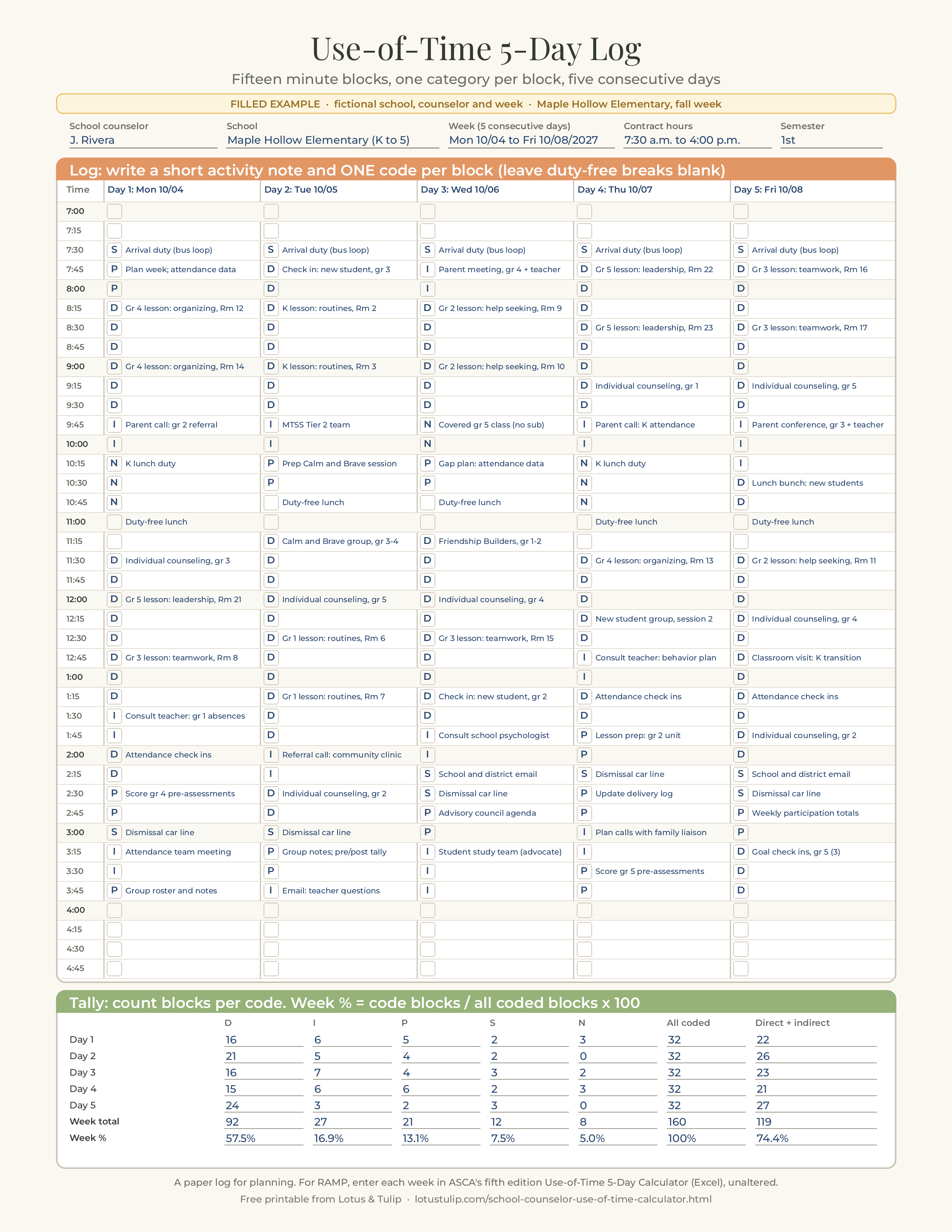
Her contract runs 7:30 a.m. to 4:00 p.m.: 34 blocks a day. With a 30 minute duty-free lunch left blank, each day had 32 marked blocks, so the week had 160. Page 2 of the free printable shows the whole week, block by block. Her daily totals:
| Day | Direct | Indirect | Program planning | School support | Non-school-counseling | Marked |
|---|---|---|---|---|---|---|
| Mon 10/04 | 16 | 6 | 5 | 2 | 3 | 32 |
| Tue 10/05 | 21 | 5 | 4 | 2 | 0 | 32 |
| Wed 10/06 | 16 | 7 | 4 | 3 | 2 | 32 |
| Thu 10/07 | 15 | 6 | 6 | 2 | 3 | 32 |
| Fri 10/08 | 24 | 3 | 2 | 3 | 0 | 32 |
| Week | 92 | 27 | 21 | 12 | 8 | 160 |
| Week % | 57.5 | 16.9 | 13.1 | 7.5 | 5.0 | 100 |
Direct plus indirect: 74.4 percent. The eight non-school-counseling blocks were lunch duty on Monday and Thursday (three blocks each) and 30 minutes on Wednesday covering a grade 5 class when no substitute came. Direct service included classroom lessons in all six grades, the Calm and Brave worry group, the Friendship Builders group, a new student group and lunch bunch, individual counseling and attendance check ins. Indirect included parent conferences, the MTSS Tier 2 team, the weekly attendance team, a referral call to a community clinic and a student study team where she advocated for a student.
The spring week: February 7 to 11, 2028
The spring week had one surprise: on Wednesday, February 9, a student crisis ran through her lunch, so she logged those two blocks as direct service and that day had 34 marked blocks. The week had 162. The "Here and Ready" attendance group met on Tuesday. Testing coordination, still hers this year, took six blocks for building the spring testing schedule.
| Direct | Indirect | Program planning | School support | Non-school-counseling | Marked | |
|---|---|---|---|---|---|---|
| Blocks | 98 | 28 | 14 | 10 | 12 | 162 |
| Week % | 60.5 | 17.3 | 8.6 | 6.2 | 7.4 | 100 |
Direct plus indirect: 77.8 percent. The twelve non-school-counseling blocks were six of lunch duty and six of testing schedule work.
The average for the next conference
| Direct | Indirect | Program planning | Fair-share support | Non-school-counseling | Direct + indirect | |
|---|---|---|---|---|---|---|
| Fall week | 57.5 | 16.9 | 13.1 | 7.5 | 5.0 | 74.4 |
| Spring week | 60.5 | 17.3 | 8.6 | 6.2 | 7.4 | 77.8 |
| Average | 59.0 | 17.1 | 10.9 | 6.8 | 6.2 | 76.1 |
| Rounded for the template | 59 | 17 | 11 | 7 | 6 | 76 |
| Her 2027 to 2028 plan | 60 | 16 | 14 | 7 | 3 | 76 |
The averages use the unrounded weekly percents (for example, direct is (57.5 + 60.49) / 2 = 59.0). Rounded, they add up to exactly 100. Compared with the year before, direct plus indirect rose from 64 to 76 percent, almost exactly as planned. Non-school-counseling time fell from 12 to 6 percent, but not to the planned 3, because the testing work stayed and one class coverage happened in the fall week.
How she read it
Three things stood out on her summary sheet. First, the lunch duty change worked: it freed about 135 minutes a week, and the Tuesday and Wednesday groups it was meant to make room for ran in both weeks. Second, testing coordination was the largest remaining non-school-counseling task, at 90 minutes in the spring week alone. Third, program planning dropped from 13.1 to 8.6 percent in the spring, which looked good on paper but meant her group data reports were being written after hours. She noted that she wanted program planning closer to 12 percent, not lower.
How the numbers were used
At the Thursday, January 20, 2028 check in, A. Brooks agreed that the assistant principal would take over testing coordination for 2028 to 2029. At the next annual administrator conference, planned for Thursday, August 24, 2028 (ten days after the first day of school on Monday, August 14, 2028), J. Rivera will enter 59, 17, 11, 7 and 6 as the previous year, and a planned use of time of 62 percent direct, 18 percent indirect, 12 percent program planning, 6 percent fair-share support and 2 percent non-school-counseling: 80 percent direct and indirect, built on two specific changes (testing coordination moves, and class coverage goes to the substitute pool first). If Maple Hollow applies for RAMP in October 2029, the data collection year will be 2028 to 2029, and these two calculators from 2027 to 2028 are the ones she will upload.
Six real world scenarios
1. "Every box in the calculator says FALSE." That is the checkbox version opening in a program that does not display its checkboxes. Download ASCA's alternate version, which uses an X instead, and enter your week there. Do not type X into the checkbox version; the formulas there count only checked boxes.
2. "My calculator week turned into a crisis week." If the crisis was unpredictable, keep the week and log it honestly; crisis response with students is direct service. If the school then moved to a special schedule for several days, that is a predictable disruption going forward, and choosing a different week is reasonable. Write down why you changed it.
3. "I am a half time counselor." Complete the calculator for the days and hours you work in the building and, for RAMP, attach a note explaining the less than five day documentation, as the rubric asks. Your percentages are still comparable, because blank blocks are not counted.
4. "My principal says lunch duty is non-negotiable." Then measure it honestly, put the minutes on the summary sheet, and ask for something smaller: two days instead of five, or a rotation with other staff so it becomes a genuinely shared duty. ASCA's own completed conference example shows a principal saying duties will not change this year. The minutes record that, and the conversation continues at the next check in.
5. "I spend hours on 504 plans." Separate the two parts in your log. Advocating for a student at a 504 meeting is appropriate and fits indirect service. Coordinating the schoolwide 504 process (scheduling, paperwork and case management for the whole school) is on ASCA's inappropriate list. The split itself is useful evidence at the conference.
6. "We are a department of four and our numbers are very different." First check that you coded the same activities the same way. If the difference is real, it usually reflects structure: one counselor has the testing, another the registration, a third the duties. That is a department conversation with the administrator, and the conference template's caseload and department sections are the place to have it.
Common mistakes
- Logging from memory at the end of the week. Reconstruct a Wednesday on Friday and you will guess. Log as you go.
- Two codes in one block. "Do not mark more than one category," and RAMP item 4.6 checks it.
- Counting a duty-free lunch. Leave it blank. Coding it as anything distorts the real percentages.
- Coding data collection or scoring as direct service. ASCA's example codes data collection as program planning.
- Averaging daily percents by hand. The spreadsheet pools the blocks for the week. If you calculate on paper, add the blocks first, then divide.
- Using the wrong year's weeks for RAMP. The calculators come from the year before the data collection year.
- Altering the template. Adding rows, changing times or editing formulas breaks the "original form" rule. Use the paper log for anything that does not fit.
- Conference numbers that do not match the files. Item 4.4 checks that the previous year line is the average of the two calculators.
- Vague activity descriptions. "Meeting" or "office" tells a reviewer nothing. Write what it was and for whom.
- Student names in the activity column. Use initials or no identifier. ASCA warns that applications with student names risk deletion.
Free printable: 5-day use-of-time log, filled example and summary sheet
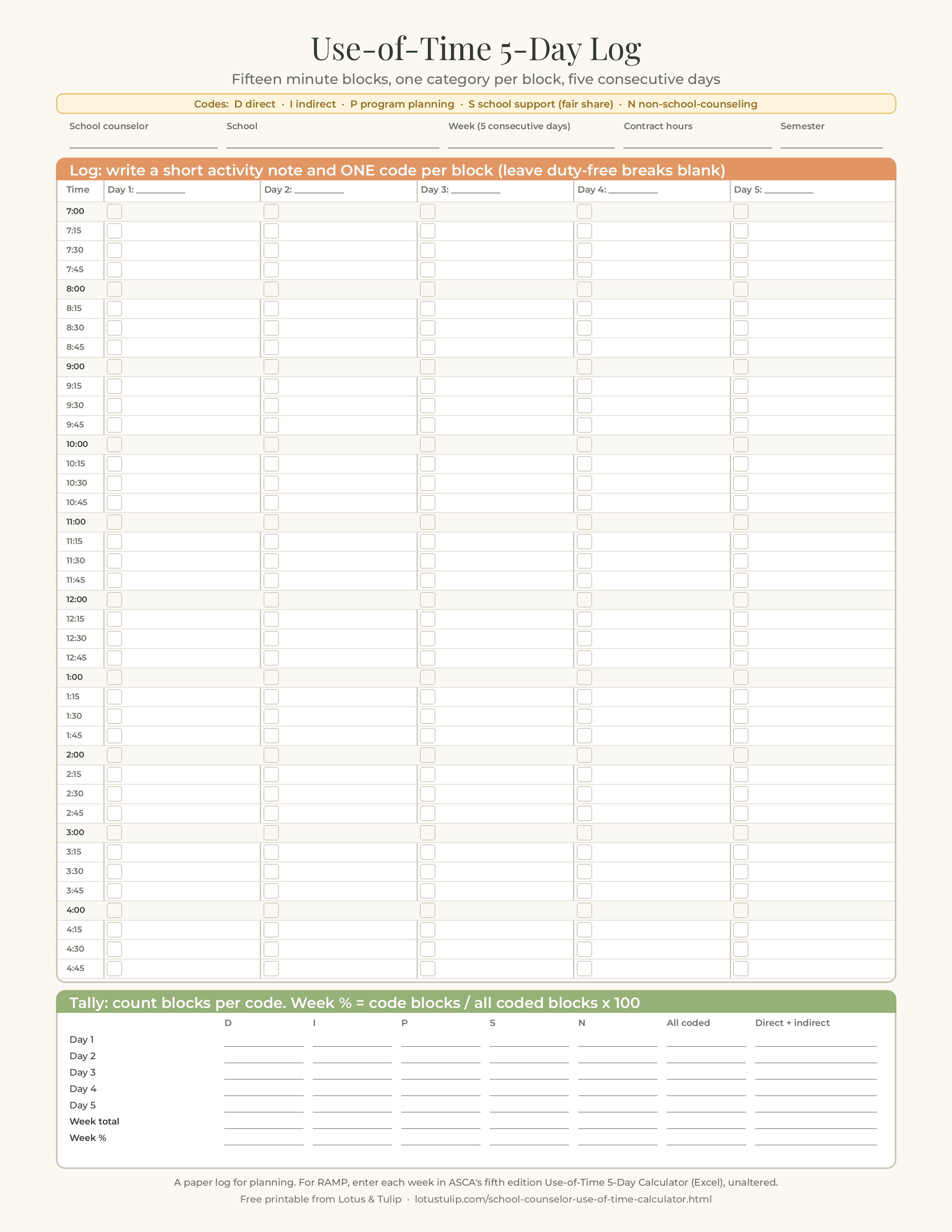
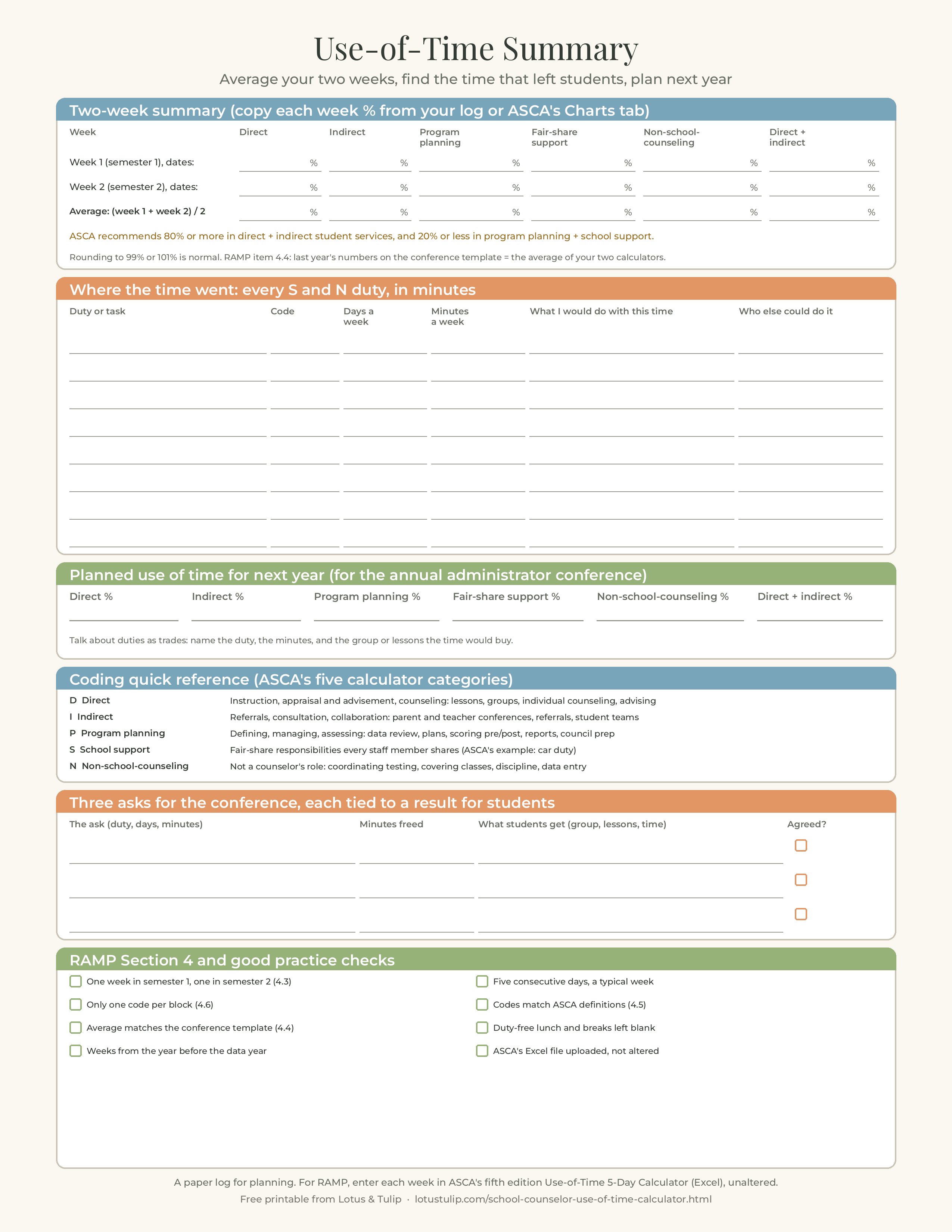
The free printable has three US Letter pages. Page 1 is a blank 5-day log: a details line (counselor, school, week, contract hours, semester); a grid of 40 fifteen minute blocks from 7:00 a.m. to 5:00 p.m., matching the rows in ASCA's calculator, for five days, each block with a small box for one code and space for a short activity note; and a tally box where you count each code by day, total the week, and work out each week percent and direct plus indirect. The codes are D direct, I indirect, P program planning, S school support (fair share) and N non-school-counseling. Page 2 is the same log filled in for the fictional Maple Hollow Elementary fall week, October 4 to 8, 2027, described above, with every block coded and the tally completed (57.5, 16.9, 13.1, 7.5 and 5.0 percent). Page 3 is a two-week summary sheet: a table to copy each week's percents and calculate the average for the conference template, a "where the time went" table for every school support and non-school-counseling duty in minutes, your planned use of time for next year, a coding quick reference, three asks for the conference each tied to a result for students, and a checklist keyed to RAMP items 4.3 to 4.6.
The printable is a paper log and planning tool. It does not replace ASCA's fifth edition Use-of-Time 5-Day Calculator, which the RAMP rubric says must be used in its original form and uploaded in Excel format. Log on paper, then enter each day in ASCA's spreadsheet.
Download the free log, example and summary (PDF, 3 pages)
Or download single pages: Page 1: blank 5-day log (PNG) · Page 2: filled fictional example (PNG) · Page 3: two-week summary sheet (PNG)
Free to print and use in your own school. Please link to this page rather than re-uploading the file. This is a planning tool. It does not replace ASCA's official templates, your district's contract or policies, or legal advice. The coding reference on page 3 is shortened; use ASCA's definitions and your district's guidance for edge cases.
The two calculators are uploaded in Section 4 of the fifth edition RAMP application, from the school year before the data collection year. The RAMP application checklist lists which year applies to each October deadline.
Related resources
- School counselor performance appraisal: the 0 to 3 scale and the artifacts ASCA lists, including use of time
- School counseling program assessment: all 25 ASCA fifth edition benchmarks, filled example and free worksheet
- RAMP application checklist: every fifth edition rubric item, upload and deadline, with a free checklist and data year planner
- Closing the gap action plan: ASCA achievement gap plan and data report, filled example and free planner
- All school counselor small group curriculums
- School counselor annual administrator conference: what to bring, sample agenda and a free planner
- ASCA Student Standards delivery plan: filled example and free planner
- School counselor advisory council agenda, minutes and a filled example
- School counselor needs assessment for small groups
- Small group counseling for attendance: 8 session plan, activities and data log
- Small group counseling progress notes and attendance tracker
- Full year elementary small group counseling: plan the year
Sources: American School Counselor Association, Use-of-Time 5-Day Calculator template, ASCA National Model Fifth Edition (Excel, Overview tab "Updated Aug 25"; Overview, Example, Mon to Fri and Charts tabs and formulas), and the alternate X version, from the ASCA Templates and Tools page; American School Counselor Association, All Fifth Edition Examples (completed use-of-time calculator and annual administrator conference examples); American School Counselor Association, Annual Administrator Conference template, fifth edition; American School Counselor Association (2025), The ASCA National Model: A Framework for School Counseling Programs, Fifth Edition (Deliver: direct and indirect student services; Manage: plan and monitor time; Appropriate and Inappropriate Activities for School Counselors); American School Counselor Association, Changes in the ASCA National Model Fifth Edition; American School Counselor Association, RAMP in the Fifth Edition; American School Counselor Association, RAMP Scoring Rubric, Fifth Edition (August 2025, revised September 2025 and February 2026), general instructions, special note about the calculator, and Section 4; American School Counselor Association, RAMP Application Timeline, Fifth Edition; American School Counselor Association, RAMP Application and Use-of-Time 5-Day Calculator Timeline; American School Counselor Association, Use-of-Time 5-Day Calculator, fourth edition, for comparison; American School Counselor Association, position statement "The School Counselor and School Counseling Programs" (adopted 1988, revised 2023), from ASCA's position statements collection; American School Counselor Association, School Counselor Roles and Ratios page (250:1 recommendation; 372:1 national average for 2024 to 2025). All checked November 10, 2026.
FAQ
What is the ASCA use-of-time calculator?
It is a fifth edition ASCA National Model template, an Excel workbook, in which a school counselor records each 15 minute block of the contract day for five consecutive days and marks one of five categories: direct student services, indirect student services, program planning, school support (fair share) or non-school-counseling tasks. The spreadsheet calculates the percent of time in each category for each day and for the week. It is completed for one week in each semester.
How do you calculate use of time percentages?
For each category, divide the number of 15 minute blocks marked in that category by the total number of marked blocks. Duty-free breaks are left blank and not counted. ASCA's spreadsheet does this for each day and, on the Charts tab, for the whole week by adding the five days' blocks together. For the annual administrator conference, average the two weeks: add the two weekly percents for each category and divide by two.
What percentage of time should school counselors spend in direct and indirect services?
ASCA recommends at least 80 percent of a school counselor's time in direct and indirect student services and 20 percent or less in program planning and school support. The recommendation appears on the calculator, in the fifth edition National Model framework and on the annual administrator conference template. The fifth edition RAMP rubric items for the calculator check completeness, averaging and coding, not whether you reached 80 percent.
Is lunch duty a non-school-counseling task?
On ASCA's own Example tab in the fifth edition calculator, "K lunch duty" is coded as a non-school-counseling task, while "Car duty" is coded as school support (fair share). ASCA's free documents do not explain the difference. A common reading is that fair share means duties every staff member takes on a shared rotation. Whatever you decide, apply it the same way in both weeks.
Which year's use-of-time calculators do I need for RAMP?
The calculators come from the school year before the data collection year. ASCA's fifth edition rubric example: an application submitted in October 2027 has a 2026 to 2027 data collection year and calculators from 2025 to 2026. Two calculators per counselor, one from each semester, uploaded in Excel format on ASCA's unaltered fifth edition template. From October 2027 submissions, the fifth edition calculator is required.
What if the calculator shows FALSE in every box?
The main fifth edition calculator uses checkboxes, which some versions of Excel and other spreadsheet programs display as FALSE. ASCA provides an alternate version for this case, which counts an X typed in the category column. Use one version for the whole week, and do not type an X into the checkbox version, because its formulas count only checked boxes.