
School counselors · Updated 2026-11-11
School Counseling Program Assessment: How to Complete the ASCA Fifth Edition Program Assessment (All 25 Benchmarks, Filled Example, Free Printable)
Ready-made printable: Complete Small Group Counseling Bundle Holiday 20% off: about $29.44, was $37 (EUR 32) · instant digital download
Buy on Etsy
The ASCA School Counseling Program Assessment is the shortest document in the fifth edition template set, and the easiest one to rush. It is a Word form with a list of benchmarks, a Yes box next to each, and a Comments column. There is no score, no rating scale and no instruction sheet. Most counselors tick it in ten minutes, file it, and never look at it again.
That is a waste, because ASCA puts this form at the very start of everything else. It is the first thing to complete in Phase 1 of ASCA's Phased Implementation Plan, the first item to update every year in Phase 4, and, according to ASCA's Apply for RAMP page, the first step toward RAMP: "The first step to applying for RAMP® is to use the program assessment tool to determine whether your program is ready to seek the RAMP® designation." Done honestly, with evidence written in the Comments column, it tells you which templates you have not really finished, which parts of your program exist only on paper, and what to fix before you commit to a data collection year.
This guide goes through all 25 benchmarks on the current fifth edition form (footer dated 9/25), grouped the way ASCA groups them under Deliver, Manage and Assess. For each one it explains what a defensible Yes looks like and which document proves it, which detailed template guide on this site covers it, and how it connects to the fifth edition RAMP rubric. It also covers where the form fits in the Define, Manage, Deliver and Assess components, the two companion assessments ASCA publishes with it, when and how often to complete it, how to turn every "not yet" into an action plan you can bring to your administrator conference and advisory council, a fully worked fictional example, six scenarios, common mistakes, and what ASCA's documents do not say.
At the end is a free three page printable: a program assessment worksheet with all 25 benchmarks and an evidence column, the same worksheet filled in for a fictional elementary school, and an action plan and annual cycle sheet.
Jump to the free program assessment worksheet, filled example and action plan
This is educational information for school counselors, not official ASCA guidance. ASCA National Model and RAMP are registered trademarks of the American School Counselor Association, and Lotus & Tulip is not affiliated with or endorsed by ASCA. Everything on this page was checked against ASCA's own public documents and pages, downloaded from schoolcounselor.org on November 11, 2026: the School Counseling Program Assessment (Word form, footer "ASCA National Model® Fifth Edition" and "9/25"), the "All Assessments" download (the program assessment, the ASCA School Counselor Professional Standards & Competencies Assessment and the School Counselor Performance Appraisal), "The ASCA National Model®: A Framework for School Counseling Programs, Fifth Edition" (the free 16 page overview), the ASCA National Model Fifth Edition Phased Implementation Plan, the Templates and Resources page, the RAMP Scoring Rubric, Fifth Edition, the Recognized ASCA Model Program, Apply for RAMP and RAMP FAQs pages, the fifth edition RAMP Application Timeline, the fifth edition templates download and the fifth edition examples download. Benchmark wording on this page is quoted or closely paraphrased from ASCA's form; the numbering (D1 to D7, M1 to M13, A1 to A5) is ours, because the form's own list numbering does not display consistently. Anything we could not confirm is marked as such.
The short answer
- What it is: ASCA's checklist for "progress toward full implementation of a comprehensive school counseling program," used "to identify program strengths and areas for improvement." Each benchmark has a Yes box and a Comments box.
- How many benchmarks: 25 on the current form. Deliver has 7 (four direct student services, three indirect), Manage has 13 (in four groups: planning for each and every student, achievement gaps, time, and educating and advocating), and Assess has 5.
- No Define section: the form has headed sections for Deliver, Manage and Assess only. Define (the Student, Professional and Ethical Standards) shows up inside other benchmarks rather than as its own section.
- No score: the form has no rating scale, no points and no total, and we found no ASCA cut-off for how many Yes answers make a program "ready."
- Not part of the RAMP score: none of the seven sections of the fifth edition RAMP rubric asks you to upload the program assessment, and none of the 82 points is for it. ASCA's RAMP pages present it as the readiness check you do before you apply.
- When: complete it in Phase 1, when you start building an ASCA National Model program, and update it every year (it is the first item under "Update" in Phase 4 of ASCA's Phased Implementation Plan).
- What to do with it: the ASCA Professional Standards & Competencies expect school counselors to "apply the results of a school counseling program assessment to inform the design and implementation of the school counseling program" (B-PF 7e), and to "explain and discuss" the program assessment with the advisory council (B-PA 7d).
What ASCA says the program assessment is for
The form opens with one paragraph, which is the only instruction on it: "The school counseling program assessment is used to analyze progress toward full implementation of a comprehensive school counseling program and to identify program strengths and areas for improvement. Each section of the program assessment includes benchmarks for program implementation within each component of the ASCA National Model®."
The free fifth edition overview, "The ASCA National Model®: A Framework for School Counseling Programs," adds a little more in its Assess chapter. It describes the purpose as "Assess the school counseling program for alignment with the ASCA National Model®," and says the School Counseling Program Assessment "guides the regular assessment of design and delivery of a school counseling program and its impact on access, life-readiness and academic success." Under "How the School Counseling Program Promotes Success for Each and Every Student" it says research shows that programs aligned with the ASCA National Model improve student achievement, attendance and discipline, and that counselors implementing these programs have increased job satisfaction and a better understanding of their role.
Two words in those passages matter for how you complete the form. The first is regular: this is not a one-time audit. The second is alignment: the form checks whether the structure of an ASCA National Model program is in place and working, not whether students improved. Student outcomes are measured in your data reports, and the program assessment only asks whether those reports were completed and shared.
Where it sits: Define, Manage, Deliver and Assess
The fifth edition ASCA National Model has four components, shown in ASCA's diamond graphic: Define (Student Standards and Professional Standards), Manage (program focus and program planning), Deliver (direct and indirect student services) and Assess (program assessment, and school counselor assessment and appraisal). The program assessment belongs to the Assess component, alongside two other documents ASCA publishes in its "All Assessments" download:
| Assess document | Purpose in ASCA's words | Format |
|---|---|---|
| School Counseling Program Assessment | "Assess the school counseling program for alignment with the ASCA National Model®" | Word form, Yes box and comments for each benchmark |
| ASCA School Counselor Professional Standards & Competencies Assessment | "Self-assess your own mindsets and behaviors and formulate an appropriate professional development plan" | 7 page PDF checklist of the mindsets and behavior competencies |
| School Counselor Performance Appraisal | "Gain feedback on your performance as a school counselor" | 14 page PDF, each item rated 0=Unsatisfactory, 1=Developing, 2=Proficient, 3=Distinguished |
The difference is the unit being assessed. The program assessment looks at the program. The other two look at the school counselor. ASCA's Templates and Resources page puts all three under one heading: "School counselors regularly assess their own skills and their program to determine its effectiveness in enhancing access, life-readiness and academic success for each and every student."
Why there is no Define section
If you were expecting a Define, Manage, Deliver and Assess checklist in that order, the current form will surprise you. It has red section bars for Deliver, Manage and Assess, in that order, and nothing headed Define. We did not find an ASCA explanation for this. Define is still present, just not as its own section:
- the ASCA Student Standards appear in four Manage benchmarks (the delivery plan, lesson plans, small-group plans and individual sessions);
- the ASCA School Counselor Professional Standards & Competencies appear in Assess, where the self-assessment must be completed (our self-assessment guide explains the 147 item form and how to write the PD plan);
- the ASCA Ethical Standards for School Counselors are not named in any benchmark. If you want your review to cover them, add your own line, and say in the comments that it is your addition and not part of ASCA's form.
The National Model overview describes Define as "three sets of standards, which guide school counselors through developing, implementing and assessing a school counseling program." A sensible way to handle Define on your own review is to read all three documents before you start, as Phase 1 of the Phased Implementation Plan tells you to, and then complete the form.
What the form looks like
The current form is a Word document (.docx) with ASCA's logo and the title "School Counseling Program Assessment" across the top of each page, and the footer "ASCA National Model® Fifth Edition" with a page number and "9/25." Each benchmark is a gray box with a checkbox under "Yes" and a box under "Comments" (under Indirect Student Services the column heading reads "Comment"). Several benchmarks link straight to the template you would use as evidence: lesson plans, small-group plans, the ASCA Student Standards delivery plan, the ASCA Student Standards, data priorities, the achievement gap plan, use of time, the annual administrator conference, the advisory council templates, the Professional Standards & Competencies assessment and the performance appraisal.
A few things the form does not have, which you should know before you rely on it:
- no "No," "In progress" or "Not applicable" box: you either tick Yes or leave it blank and explain in Comments;
- no field for the school name, the counselors, the date or the school year;
- no signature line;
- no rating scale, point values, total or threshold;
- no instructions on who completes it, when, or what counts as evidence.
So write the school, the school year, the date and who took part at the top yourself. Without a date, a Yes from three years ago looks exactly like a Yes from last week.
The form appears in more than one place on ASCA's site, all pointing to the same file: the Templates and Resources page (under Assessments, and inside the "All Assessments" zip, which also contains the Professional Standards & Competencies Assessment and the Performance Appraisal), and the RAMP, Apply for RAMP and RAMP FAQs pages, which call it the "program assessment tool." There is no filled example of the program assessment in ASCA's "All Fifth Edition Template Examples" download; the examples cover templates 1 to 9 and the alternate use-of-time calculator only.
All 25 benchmarks, and what a defensible Yes looks like
For each benchmark below you get ASCA's wording (quoted or closely paraphrased from the form), what we suggest you should be able to show before you tick Yes, and where it connects to the fifth edition RAMP rubric. The evidence suggestions and the rule of thumb are ours, not ASCA's. Our rule of thumb is simple: tick Yes only if you can point to a document, a calendar entry or a log that proves it, and write where that evidence is in the Comments box. If a benchmark has two bullet points joined by "and," you need both.
Deliver: direct student services (D1 to D4)
The National Model overview defines direct student services as "in-person or direct interactions between school counselors and students," in three forms: instruction, appraisal and advisement, and counseling.
D1. Instruction is provided in classroom, large group, small group and/or individual settings and outlined using lesson plans. A Yes needs both halves: you deliver lessons based on the ASCA Student Standards, and those lessons are written up on lesson plans. Evidence: your lesson plan folder, and lessons on your weekly calendars. A stack of slide decks without plans is a half Yes, which on this form means not yet. Guide: the ASCA Lesson Plan and Data Report. RAMP: Section 5 scores one lesson plan and data report (11 points), and Section 1 needs Tier 1 lessons for every grade on the delivery plan.
D2. Appraisal and advisement is provided in classrooms, large groups, small groups and/or with individual students. ASCA defines appraisal as analyzing and assessing "students' abilities, interests, skills and achievement from test and inventory results," and advisement as making "recommendations based on appraisal of test and inventory results to help students make decisions for their future." In a high school this is course planning and postsecondary planning; in an elementary school it might be an interest inventory, a transition conversation or helping students understand their reading goals. Evidence: the inventories you used, the dates, and who took part. Note that coordinating the testing program is listed by ASCA as an inappropriate activity; interpreting test results is appropriate.
D3. Small groups are provided to students for short-term assistance with life-readiness and academic success and outlined using small-group plans. Again two halves: short-term groups exist, and each has a small-group plan. Evidence: your group list for the year with a plan for each group. Guide: the ASCA Small-Group Plan and Data Report. RAMP: Section 1 item 1.6 needs at least two Tier 2 small groups on the delivery plan, and Section 6 scores one full small-group plan (four or more sessions, three to 12 students, 16 points).
D4. Individual counseling is provided to students for short-term assistance with life-readiness and academic success. The word that matters is short-term. ASCA's overview lists "providing long-term counseling in schools" as an inappropriate activity and "providing short-term individual and small-group counseling services" as appropriate. A Yes means you see students individually for brief support and refer out for ongoing therapy. Evidence: your individual session log (counts, not names) and your referral process.
Deliver: indirect student services (D5 to D7)
Indirect services are "provided on behalf of students through the school counselor's interactions with others": referrals, consultation and collaboration.
D5. Referrals are provided to students and families. ASCA's definition is connecting "students and families with more intensive resources for life-readiness and academic success." Evidence: a current community resource list and a referral log. Guide for the school side of referrals into groups: small group referral form.
D6. Consultation occurs between the school counselor(s) and education partners. Consultation means giving and seeking information, perspectives and strategies with teachers, administrators and families. Evidence: consultation entries on your calendars or use-of-time weeks.
D7. Collaborations occur to support identified goals for student success and are reflected on weekly calendars. This one fails more often than it looks. ASCA defines collaboration as working with education partners "on an identified goal for student success, sharing responsibility for identified tasks." A monthly meeting where you share data with the grade 4 team and each person leaves with a task is collaboration. A Yes also needs it to show on your weekly calendars, which is the part people forget. RAMP: item 2.13 needs at least two indirect strategies in the achievement gap plan that meet ASCA's definition of collaboration, consultation or referral.
Manage: planning how each and every student will learn (M1 to M4)
The group heading on the form is "The school counselor(s) plan how each and every student will learn strategies and skills for student success."
M1. The ASCA Student Standards delivery plan identifies specific standards delivered in Tier 1 and 2 settings. Evidence: this year's delivery plan, with a behavior standard named for every Tier 1 lesson and every Tier 2 group session. Guide: ASCA Student Standards delivery plan. RAMP: Section 1, items 1.1 to 1.9 (9 points).
M2. Lesson plans are completed and include standards for behaviors each and every student will learn in Tier 1 or Tier 2 settings, and access, life-readiness and contributing factors results. This is the stricter twin of D1. D1 asks whether lessons are outlined using lesson plans; M2 asks whether those plans are complete, with a behavior standard and results. Note the wording: lesson plans report access, life-readiness and contributing factors results, not achievement results, which matches the fifth edition lesson plan template. Guide: lesson plan and data report; for writing the items behind the life-readiness results, see pre and post survey questions for all 36 standards.
M3. Small-group plans are completed and include standards for behaviors students will learn in Tier 2 settings, and access, life-readiness and achievement results. Here the results include achievement, which is the main difference from M2. A group plan with pre and post items but no achievement measure (grades, benchmark scores, promotion, test scores) is a not yet. RAMP: Section 6 items 6.3, 6.11 and 6.14 to 6.16 are all about achievement data.
M4. ASCA Student Standards are used to provide focus for individual sessions with students. The overview says counselors use "these standards to provide focus for individual sessions with students." Evidence: your individual session notes name a standard (B-SMS 7 for coping, for example) or your log has a standards column. If your notes never mention a standard, this is a not yet, and it is one of the easiest to fix.
Manage: identifying and addressing achievement gaps (M5 and M6)
M5. School counseling data priorities align with the school improvement plan. Evidence: a completed School Counseling Program Data Priorities template listing the achievement goals from the school improvement plan with a data point for each. Guide: school counseling data priorities. RAMP: items 2.1 to 2.4.
M6. Achievement gap plan(s) address the needs of students who are not reaching achievement goals or benchmarks. Evidence: a completed Achievement Gap Plan and Data Report whose goal matches a data point you checked on the data priorities template. Guide: the ASCA achievement gap plan. RAMP: Section 2 (26 points, the largest section).
Manage: planning and monitoring time (M7 to M10)
M7. Weekly calendars are used to prioritize, plan and publicize day-to-day work. Three verbs: prioritize, plan and publicize. A private calendar nobody else can see covers the first two only. Evidence: weekly calendars shared with your administrator or staff, or posted.
M8. The annual calendar, including all major school counseling activities, is publicized to students, families and education partners. A Yes needs the calendar to be public: on the website, in a family newsletter, on a board. A calendar that lives in your planning folder is a not yet.
M9. Use of time is monitored at least twice a year. Evidence: two completed use-of-time 5-day calculators, one each semester. Guide: use-of-time 5-day calculator. RAMP: item 4.3 needs one five consecutive day week from the first and second semester of the school year before the data collection year.
M10. ASCA recommends school counselors spend at least 80% of their time in direct and indirect services to students and 20% or less in program planning and school support. This is phrased as a statement rather than a task, so decide what your Yes means and write it down. We read it as: the average of your two use-of-time weeks shows 80 percent or more in direct plus indirect student services. If you are at 76 percent, say so in the comments with the numbers; a truthful not yet with a plan is more useful than a hopeful tick. Note that the fifth edition RAMP rubric scores whether your reported use of time is the accurate average of two calculators (item 4.4) and correctly coded (4.5, 4.6); we found no rubric item that requires 80 percent.
Manage: educating about and advocating for the program (M11 to M13)
M11. The annual administrator conference is held with the administrator in charge of the school counseling program to educate about the program's impact and advocate for its organization, goals, plans and use of time. Evidence: a completed and signed Annual Administrator Conference template for each school counselor. Guide: annual administrator conference. RAMP: Section 4, where item 4.2 asks for the conference to be held and signed early in the year.
M12. Fall and spring advisory council meetings educate about and advocate for the school counseling program with education partners. Both meetings, not one. Evidence: agendas and minutes for both semesters on ASCA's first-semester and second-semester templates. Guide: advisory council agenda and minutes. RAMP: Section 3 (11 points).
M13. School counseling program information is communicated to students and families, and the program's impact is shared with decision-makers and other education partners. Two audiences and two kinds of message: information to students and families, impact to decision-makers. A family newsletter covers the first half. The second half needs results going to someone who decides things: the principal, the district, the school board.
Assess (A1 to A5)
A1. Achievement Gap, Lesson Plan and Small Group data reports completed. Evidence: the data report sections of all three template types, with numbers filled in, for this year.
A2. Achievement Gap, Lesson Plan and Small Group data reports shared with education partners. The natural place is the second-semester advisory council, whose RAMP agenda (item 3.9) must include updates on all three. Evidence: the spring agenda and minutes, or a results summary sent to staff and families.
A3. School Counseling Program Assessment is completed. Yes, the form asks whether you completed the form. Treat it as the date stamp for this review and write the date, the school year and who took part in the comments.
A4. ASCA School Counselor Professional Standards & Competencies assessment is completed. Each school counselor completes the self-assessment. ASCA says counselors use it to "self-assess their own mindsets and behaviors" and to "formulate an appropriate professional development plan." Evidence: the completed checklist and the resulting professional development goals.
A5. School Counseling Performance Appraisal is conducted annually. ASCA's appraisal rates each counselor 0 to 3 on professional beliefs and responsibilities, with artifacts. Many districts evaluate counselors on a teacher evaluation form. If yours does, this is honestly a not yet, and the comment should say what form is used. Whether a district form aligned to ASCA's standards counts, ASCA's documents do not say. Our school counselor performance appraisal guide walks through all 30 rated items, the artifacts ASCA lists for each, and how to use the appraisal alongside a district form. If the district form stays the form of record, our evaluation crosswalk guide shows how to map it to ASCA's items.
When to complete it, and how often
ASCA's Phased Implementation Plan for the fifth edition gives the clearest answer. It has four phases, and the program assessment appears twice:
- Phase 1, Start Here: read the National Model, the ASCA Student Standards and the ASCA Ethical Standards, then "Complete: School counseling program assessment, School counselor standards & competencies checklist, Use-of-time 5-day calculator," then develop the delivery plan, annual calendar, weekly calendars, lesson plans and small group plans.
- Phase 4, Your ASCA National Model® Program: "Update: School counseling program assessment, Lesson plans, Small group plans, Annual calendar," and "Complete annually" the data priorities, achievement gap plan(s) and data report, use-of-time 5-day calculator, annual administrator conference, weekly calendars, advisory council, lesson plan library, lesson plan data report(s) and small group data report(s).
So ASCA expects one at the start and an update every year after that. ASCA does not name a month. In practice there are two good moments, and many programs use both:
- End of the school year (May or June). Every benchmark can be judged on a full year of evidence, and the not yet items become next year's plan while there is still summer planning time.
- Midyear (January). A quick recheck of the Manage benchmarks shows whether the fall plans actually happened, while there is still a semester to fix them.
If you are thinking about RAMP, add a third: complete it before you choose a data collection year. ASCA's RAMP FAQs say: "Download the program assessment tool to see if your school counseling program is data-informed and includes all components of the ASCA National Model®," and the Apply for RAMP page says that although "a specific number of years implementing the ASCA National Model® framework is not required," schools are encouraged to review the tool "to determine whether your school counseling program is aligned with the ASCA National Model®, thus giving you confidence to readiness in applying." The RAMP pages also say schools need "at least one entire academic year to collect the data and information needed," so a review in the spring tells you whether the coming school year can be your data year.
Who completes it
ASCA's form does not say. It uses "school counselor(s)" throughout, which suggests one review per program. Our suggestion: in a school with several counselors, complete one form together, with each benchmark's evidence assigned to a named person, and have each counselor complete the Professional Standards & Competencies self-assessment separately. In a district where counselors serve several schools, complete one form per school, because the calendars, data priorities and advisory councils differ by school. Share the finished form with the administrator in charge of the school counseling program; ASCA does not require a signature, but a shared copy makes the conversation at the annual administrator conference much easier.
How to complete the ASCA program assessment, step by step
- Download the current form. Get the School Counseling Program Assessment from ASCA's Templates and Resources page and check the footer date (the current version reads 9/25). Write the school, school year, date and names at the top.
- Read the Define documents first. Skim the ASCA National Model overview, the ASCA Student Standards and the Ethical Standards, so you are judging your program against ASCA's definitions of instruction, counseling, consultation and collaboration, not your own.
- Gather the evidence before you tick anything. Put this year's delivery plan, lesson plans, small-group plans, data priorities, gap plan, weekly and annual calendars, both use-of-time calculators, the administrator conference template, both advisory council agendas and minutes, and your data reports in one folder.
- Work through Deliver. For each of the seven benchmarks, tick Yes only if you can point to the evidence, and write where it is in the comments. For two part benchmarks (D1, D3), check both parts.
- Work through Manage. Use the same rule for all thirteen. For M10, copy your two-week use-of-time average into the comments and state the direct plus indirect percent.
- Work through Assess. Confirm all three data report types exist and were shared, then record the dates of the Professional Standards & Competencies self-assessment and the last performance appraisal.
- Write a comment for every blank box. Say what exists, what is missing and why, in one or two sentences. "Spring council not held: date clashed with testing" is useful next August; a blank box is not.
- Count and sort, but do not score. Count the Yes answers for your own tracking, then sort the not yet items into three groups: fix this summer, fix during the year, and needs the administrator's help.
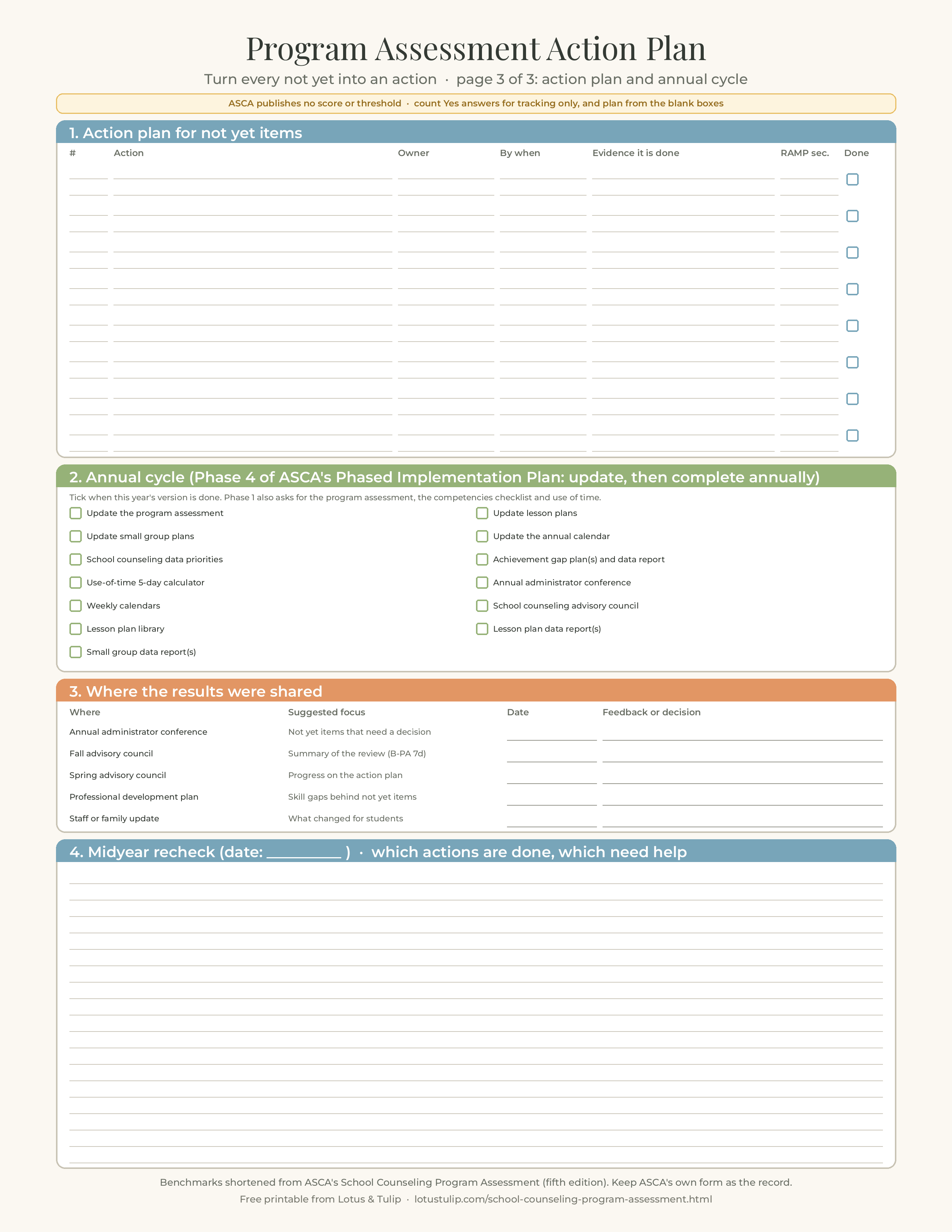
- Turn not yet items into an action plan. For each one, write the action, the owner, the date and the evidence that will prove it is done. Bring the list to the annual administrator conference and the fall advisory council.
- Recheck in January and redo it in June. Mark which actions are done at midyear, then complete a fresh form at the end of the year and compare the two.
How it feeds your annual results and RAMP
The program assessment does not produce results data itself, and it is not submitted for RAMP. It connects to both in a different way: almost every benchmark is a check on a template that does produce results or does get scored.
The results side
In the fifth edition, a program's results come from three data reports, which are exactly the documents named in A1 and A2: the Achievement Gap Plan and Data Report, the Lesson Plan and Data Report, and the Small-Group Plan and Data Report. The National Model overview describes three kinds of results, each with its own data: access (participation data, "Who participated in what activities?"), life-readiness (ASCA Student Standards data, measured through pre and post assessments) and academic success (achievement data such as grades, benchmark assessments, promotion rates, graduation rates and test scores). M2 and M3 check that your lesson and small-group plans actually report those results. If those benchmarks are not yet, you will not have annual results to share with the spring advisory council or the principal.
(The fourth edition called these documents results reports: the Classroom Instruction Results Report, the Small-Group Results Report and the Closing the Gap Results Report. If your district still uses the old names, they map to the three fifth edition data reports. We did not review the fourth edition version of the program assessment for this guide.)
The RAMP side
The fifth edition RAMP Scoring Rubric has seven sections worth 82 points, and none of them is the program assessment. But most benchmarks map directly to a section, which makes the form a useful early warning:
| Benchmarks | Fifth edition RAMP rubric section | What a not yet would put at risk |
|---|---|---|
| M1, D1, D3 | Section 1, ASCA Student Standards Delivery Plan (9 points) | Tier 1 lessons for each grade (1.1), at least two Tier 2 groups (1.6) |
| M5, M6, D7, A1 | Section 2, Achievement Gap Plan and Data Report (26 points) | Data priorities (2.1 to 2.6), indirect strategies such as collaboration (2.13), the data report (2.14 to 2.26) |
| M12, A2 | Section 3, Advisory Council (11 points) | Fall agenda and minutes (3.6 to 3.8), spring updates on all three data reports (3.9 to 3.11) |
| M9, M10, M11 | Section 4, Annual Administrator Conference (6 points) | Conference held and signed (4.2), two use-of-time weeks from the prior year (4.3), the accurate average (4.4) |
| D1, M2, A1 | Section 5, Lesson Plan and Data Report (11 points) | One standard, objectives and items, data report and graphs (5.1 to 5.11) |
| D3, M3, A1 | Section 6, Small-Group Plan and Data Report (16 points) | Achievement data for the group (6.3, 6.11, 6.14 to 6.16) |
| A2, M13 | Section 7, Reflections and Signature Page (3 points) | Reflections on student benefit and next steps are easier when results have been shared |
Your not yet benchmarks are also the natural source for RAMP item 7.2, "actions you will take to sustain or improve your school counseling program over the next one-four years." Our RAMP reflections guide shows how to turn them into two checkable actions within the 250 word limit.
The mapping is ours, built by reading the form and the rubric side by side. The benchmarks with no direct rubric item, such as individual counseling (D4), individual sessions focused by standards (M4), weekly and annual calendars (M7, M8) and the professional assessments (A4, A5), still matter: they are part of a full ASCA National Model program, and the performance appraisal and the Professional Standards & Competencies expect them. For the full rubric item by item, see the RAMP application checklist.
How many Yes answers do you need before applying? ASCA does not say, and we would not invent a number. A practical reading: if any benchmark that maps to a scored rubric section is a not yet, plan to fix it before or early in your data collection year, because the rubric will score the document that benchmark describes.
Using the results: the conference, the council and your own growth
The Professional Standards & Competencies and the Performance Appraisal both say what to do with a finished program assessment:
- Use it to redesign the program. Competency B-PF 7e: "Apply the results of a school counseling program assessment to inform the design and implementation of the school counseling program." The Performance Appraisal has the same item under leadership: "Applies the results of a school counseling program assessment to inform the design and implementation of the school counseling program."
- Discuss it with the advisory council. Competency B-PA 7d: "Explain and discuss school data, school counseling data priorities, school counseling plans (e.g., achievement gap, ASCA Student Standards delivery plan, lesson plans and small-group plans) and program assessment." The appraisal lists the same behavior under establishing and convening an advisory council.
- Bring it to the annual administrator conference. ASCA's form does not mention the conference and the conference template does not mention the program assessment. But the conference is where you agree on "organization, goals, plans and use of time," and several not yet items (M8, M10, A5) usually need the administrator's decision. A one page list of those items, each with the help you need, is an efficient agenda.
- Link it to your professional development plan. If a not yet comes from a skill gap (writing knowledge items, building graphs, running a council), it belongs in the professional development plan you write after the Professional Standards & Competencies self-assessment.
Keep the review at program level. The program assessment is not a performance evaluation, and it should not be used as one. Write comments about documents and systems, not about colleagues.
A filled example: Maple Hollow Elementary, June 2028 (fictional)
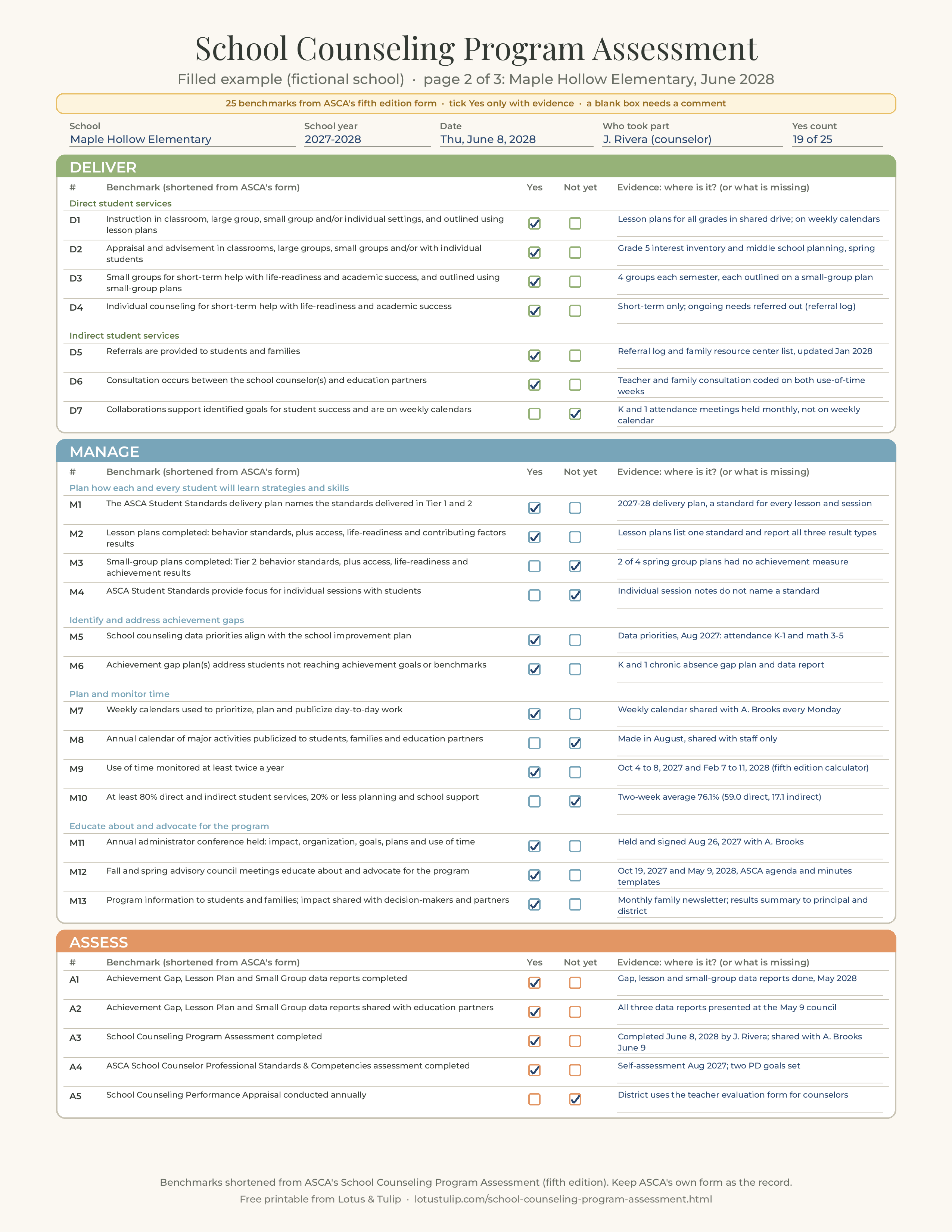
Maple Hollow Elementary is a fictional public elementary school with kindergarten to grade 5, 426 students and one school counselor, J. Rivera. The principal, A. Brooks, is the administrator in charge of the school counseling program. Readers of our other guides have followed the school through the 2027 to 2028 school year: an administrator conference on Thursday, August 26, 2027, advisory council meetings on Tuesday, October 19, 2027 and Tuesday, May 9, 2028, use-of-time weeks from October 4 to 8, 2027 and February 7 to 11, 2028, and an achievement gap plan on chronic absence in kindergarten and grade 1. Rivera is considering RAMP with 2028 to 2029 as the data collection year, so she completes the program assessment on Thursday, June 8, 2028, before planning the summer.
She ticks 19 of 25. That count is for her own tracking; it is not an ASCA score. The six not yet items, with her comments:
| Benchmark | Rivera's comment | Action for 2028 to 2029 |
|---|---|---|
| D7 Collaborations on weekly calendars | Monthly attendance meetings with the K and 1 teachers happened but were never on my weekly calendar. | Block every collaboration meeting on the weekly calendar from August; the grade 4 reading team meetings start in December. |
| M3 Small-group plans with achievement results | 2 of 4 spring group plans had pre and post items but no achievement measure. | Name an achievement measure (report card mark or benchmark score) on every small-group plan before session one. |
| M4 Standards focus individual sessions | Individual notes do not name a standard. | Add a standard field to the individual session log; use the delivery plan's standards list. |
| M8 Annual calendar publicized | Calendar made in August but only shared with staff. | Post on the school website and in the September family newsletter. |
| M10 80% direct and indirect | Two-week average 76.1% (59.0 direct, 17.1 indirect) after lunch duty was cut to two days. | Ask at the August 24, 2028 conference to move testing coordination; plan 80% or more. |
| A5 Performance appraisal annually | District evaluates counselors on the teacher evaluation form. | Ask A. Brooks whether ASCA's appraisal can be used alongside it; not in my control. |
Some of her Yes comments, to show what an evidence comment looks like: D1 "Lesson plans for all grades in the shared drive; lessons on weekly calendars." M9 "Oct 4 to 8, 2027 and Feb 7 to 11, 2028, fifth edition calculator." M11 "Held and signed Aug 26, 2027 with A. Brooks." M12 "Oct 19, 2027 and May 9, 2028, agendas and minutes on ASCA templates." A2 "All three data reports presented at the May 9 council." A3 "Completed June 8, 2028 by J. Rivera; shared with A. Brooks June 9."
Then she sorts the six. M4, M8 and D7 are hers to fix in August. M3 is fixed as each group is planned. M10 and A5 need the principal, so they go on the agenda for the 2028 to 2029 administrator conference, which our data priorities example puts on Thursday, August 24, 2028, and the program assessment summary goes on the agenda for the fall advisory council on Tuesday, October 17, 2028. She sets a midyear recheck for Tuesday, January 16, 2029.
Notice what the review does for RAMP. M3 maps to Section 6 of the rubric, where achievement data is worth several points, and D7 maps to item 2.13. Both are fixed before the data collection year starts, which is exactly what ASCA's "first step" advice is for. M10, by contrast, does not stop her applying: the rubric scores an accurate average, not a percentage.
This example is illustrative. The school, the people and the numbers are invented and are not ASCA examples.
Six real world scenarios
"I am new and nothing exists yet." Most boxes will be blank, and that is the point of Phase 1. Write a comment for each anyway ("no delivery plan yet; draft by October"), then follow Phase 1 in order: complete the three assessments, then build the delivery plan, calendars, lesson plans and small-group plans. Redo the form in June and the difference is your first year's story for the administrator.
"We are a team of four counselors." Complete one form for the program, assign each benchmark's evidence to one person, and put initials in the comments. Use-of-time (M9, M10) and the administrator conference (M11) are per counselor, so note each counselor's numbers separately; the RAMP rubric expects a conference template for each school counselor.
"I serve two schools." Complete a separate form for each school. The data priorities, achievement gap plan, advisory council and calendars belong to a school, so one combined form would blur exactly the gaps you are trying to find.
"My district gives me non-counseling duties I cannot drop." Record M10 truthfully, with the numbers and the duties in the comments. The form is a planning tool, and the comment gives your administrator a precise, documented starting point. Our use-of-time guide shows how to log and code the duties.
"I am a high school counselor and appraisal and advisement is most of my job." D2 will be an easy Yes, but check the balance: ASCA counts appraisal and advisement as direct services, and the same week may also include master schedule building or GPA calculation, which ASCA lists as inappropriate. Make sure your use-of-time coding separates the two.
"It is January and I just found this form." Do it now anyway, because a midyear review still gives you a semester to act. Mark which benchmarks are Yes so far this year, and focus on the ones you can still complete by June: the spring advisory council, data reports and sharing (M12, A1, A2), and the second use-of-time week (M9).
Common mistakes
- Ticking Yes without evidence. If you cannot open the document, it is a not yet.
- Ticking half of a two part benchmark. D1, D3, M2, M3, M7 and M13 each ask for two or more things.
- Leaving the comments empty. The comment is the useful part of the form; the tick is just a summary.
- Not dating the form. ASCA's form has no date field. Add one, plus the school year.
- Using an old copy. Check the footer for "ASCA National Model® Fifth Edition" and the version date. Fourth edition materials use different template names.
- Treating the count as a score. ASCA publishes no scale or threshold. 19 of 25 is a tracking number, not a grade.
- Confusing M2 and M3. Lesson plans report access, life-readiness and contributing factors results; small-group plans report access, life-readiness and achievement results.
- Counting a meeting as collaboration when nobody shared tasks. ASCA's collaboration definition needs an identified goal and shared responsibility.
- Doing it once. ASCA's Phase 4 says update it every year.
- Using it to evaluate a colleague. It assesses the program. The performance appraisal is the separate tool for the counselor.
What ASCA's documents do not tell you
We looked for each of these in the form, the National Model overview, the Phased Implementation Plan, the three assessments, the RAMP pages, the fifth edition rubric, the RAMP timeline and the template and example downloads, and did not find them:
- a scoring method, rating scale or number of Yes answers that makes a program "ready";
- a month or deadline for completing the program assessment (Phase 4 says update it, without a date);
- whether one form is completed per school, per counselor or per program, or who signs it;
- a filled example of the program assessment;
- why the form has no Define section, and how the Ethical Standards should be reviewed;
- whether a district performance evaluation counts for A5;
- how the fifth edition form differs from the fourth edition version (we did not review the fourth edition form).
If any of these matter for your situation, ASCA's Apply for RAMP page lists a contact for questions about whether a school meets the criteria, and ASCA offers RAMP office hours. ASCA can also update the form at any time, so check the footer date each year.
Free printable: program assessment worksheet, filled example and action plan
The free printable has three US Letter pages. Page 1 is a program assessment worksheet with all 25 benchmarks from ASCA's fifth edition form, shortened to fit and grouped under Deliver, Manage and Assess, each with a Yes box, a Not yet box and a line for where the evidence is. It adds the fields ASCA's form leaves out: school, school year, date and who took part, plus a Yes count. Page 2 is the same worksheet filled in for the fictional Maple Hollow Elementary review on June 8, 2028, described above. Page 3 is an action plan for every not yet item (action, owner, by when, evidence of done, and the RAMP section it touches), an annual cycle checklist built from Phase 4 of ASCA's Phased Implementation Plan, and a box for where the results were shared: the administrator conference, the fall and spring advisory councils and your professional development plan.
Benchmark wording on the printable is shortened. Use ASCA's own form as the record, and use this as a working copy and a planning sheet.
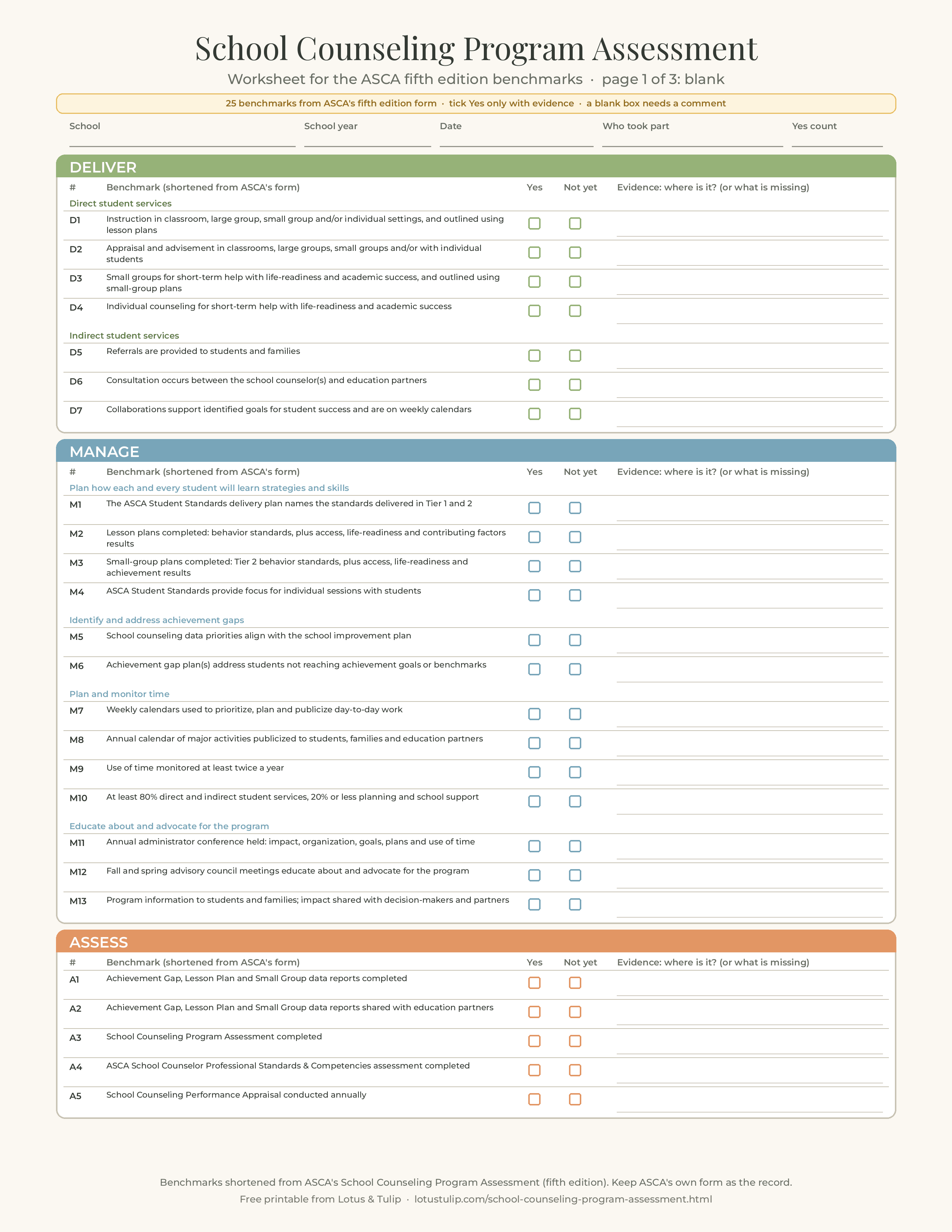
Download the free program assessment worksheet (PDF, 3 pages)
Or download single pages: Page 1: blank worksheet (PNG) · Page 2: filled example (PNG) · Page 3: action plan and annual cycle (PNG)
Free to print and use in your own school. Please link to this page rather than re-uploading the file. This is a planning tool, not an ASCA publication, and it does not replace ASCA's School Counseling Program Assessment. Keep student names off any copy you share.
Related resources
- School counselor evaluation crosswalk: map a teacher evaluation form or your state model to ASCA appraisal items, with a free worksheet
- ASCA professional standards and competencies self-assessment: how to rate yourself, pick 2 or 3 growth areas and write a PD plan, with a free printable
- School counselor performance appraisal: all 30 ASCA items, the 0 to 3 scale and artifacts, with a free evidence planner
- RAMP reflections: how to write items 7.1, 7.2 and 5.11 and the 3.5 alignment statement, with examples, word counts and a free reflections planner
- RAMP application checklist: every fifth edition rubric item, upload and deadline
- ASCA Student Standards delivery plan (M1)
- Classroom lesson plan: the ASCA lesson plan and data report (D1, M2)
- Small-group action plan: the ASCA small-group plan and data report (D3, M3)
- School counseling data priorities (M5)
- Closing the gap action plan: the ASCA achievement gap plan (M6)
- School counselor use-of-time 5-day calculator (M9, M10)
- School counselor annual administrator conference (M11)
- School counselor advisory council agenda and minutes (M12, A2)
- ASCA mindsets and behaviors pre and post survey questions
- School counselor needs assessment
- All school counselor small group curriculums
Sources: American School Counselor Association, School Counseling Program Assessment (fifth edition, footer 9/25); ASCA, All Assessments download (School Counseling Program Assessment, ASCA School Counselor Professional Standards & Competencies Assessment, School Counselor Performance Appraisal); ASCA, "The ASCA National Model®: A Framework for School Counseling Programs, Fifth Edition"; ASCA, ASCA National Model Fifth Edition Phased Implementation Plan; ASCA, Templates and Resources page; ASCA, RAMP Scoring Rubric, Fifth Edition; ASCA, Recognized ASCA Model Program (RAMP), Apply for RAMP, RAMP FAQs and Templates and Tools pages, schoolcounselor.org/RAMP; ASCA, RAMP Application Timeline, ASCA National Model Fifth Edition; ASCA, fifth edition templates and template examples downloads. All checked November 11, 2026. The benchmark numbering, evidence suggestions, RAMP mapping, worked example and printable are original to Lotus & Tulip and are not ASCA publications.
FAQ
What is the ASCA school counseling program assessment?
A short form from the American School Counselor Association used "to analyze progress toward full implementation of a comprehensive school counseling program and to identify program strengths and areas for improvement." The current fifth edition version has 25 benchmarks under Deliver, Manage and Assess, each with a Yes box and a Comments box.
How is the program assessment scored?
It is not. The form has no rating scale, points or total, and we found no ASCA threshold for how many Yes answers a program needs. Count your Yes answers for your own tracking if you like, but the comments and the action plan you build from the blank boxes are the useful part.
Do I submit the program assessment with my RAMP application?
No. None of the seven sections of the fifth edition RAMP Scoring Rubric asks for it, and none of the 82 points is for it. ASCA's Apply for RAMP page calls it the first step, used "to determine whether your program is ready to seek the RAMP® designation."
How often should a school counseling program assessment be completed?
ASCA's Phased Implementation Plan lists it to complete in Phase 1 and to update every year in Phase 4. ASCA does not name a month. The end of the school year works well, with a short midyear recheck in January.
Why does the program assessment have no Define section?
The current form has headed sections for Deliver, Manage and Assess only, and we did not find an ASCA explanation. Define is still present inside other benchmarks: the Student Standards in four Manage benchmarks and the Professional Standards & Competencies self-assessment under Assess. The Ethical Standards are not named in any benchmark.
What is the difference between the program assessment and the performance appraisal?
The program assessment reviews the program's alignment with the ASCA National Model. The School Counselor Performance Appraisal evaluates the individual counselor, rating each item from 0 (Unsatisfactory) to 3 (Distinguished). The Professional Standards & Competencies Assessment is the counselor's own self-assessment, used to plan professional development.