
School counselors · Updated 2026-11-10
Closing the Gap Action Plan for School Counselors: How to Write the ASCA Achievement Gap Plan and Data Report (Filled Example, Free Planner)
Ready-made printable: Complete Small Group Counseling Bundle Holiday 20% off: about $29.44, was $37 (EUR 32) · instant digital download
Buy on Etsy
Most school counselors first meet the closing-the-gap action plan as a RAMP requirement, and many of us meet it again every August as a blank Word template and a vague memory of last year's goal statement. It deserves better. Done well, it is the one plan in the ASCA National Model that starts from a real group of students who are not where they need to be academically, asks why, and commits you to a few specific things you will do about it. At the end of the year it gives you a number you can show your principal, your advisory council and your school board: how many of those students moved, and by how much.
There is a naming problem to clear up first. In the fourth edition of the ASCA National Model the template was called the "Closing-the-Gap Action Plan and Results Report." In the fifth edition (2025) it became the Achievement Gap Plan and Data Report, and ASCA folded the old annual student outcome goal and the closing-the-gap goal into a single achievement gap goal. The searches still say "closing the gap," so this guide uses both names, but everything below follows the fifth edition template, the fifth edition example and the fifth edition RAMP rubric, because those are what count now.
This guide is for elementary, middle and high school counselors in the United States. It covers what the plan is and what changed from the fourth edition; the School Counseling Program Data Priorities template that has to come first; how to write a goal that meets every part of RAMP item 2.7; the one rule that trips up the most plans (the goal must be achievement data, and attendance and discipline are not); contributing-factors data and how to gather student and partner perspectives; choosing behavior standards, learning objectives and pre and post items; direct and indirect strategies that meet ASCA's definitions; the data report, the optional data organizer that RAMP requires, the graphs and the percent change math; the systemic focus and plan improvement questions; the 26 RAMP Section 2 items; a ten step process; a fully worked fictional example; six scenarios; common mistakes; and a free three page printable: a blank plan planner, the same planner filled in for a fictional elementary school, and a data report worksheet with a percent change calculator, a graph checklist and a RAMP checklist.
Jump to the free achievement gap plan planner, filled example and data report worksheet
This is educational information for school counselors in the US, not legal advice or official ASCA guidance. Your district, your state's school counseling framework and your evaluation system may set their own expectations. The ASCA documents quoted here were downloaded from schoolcounselor.org and checked on November 10, 2026: the fifth edition Achievement Gap Plan and Data Report template (Word template, footer "ASCA National Model Fifth Edition 8/25"), ASCA's completed fifth edition examples (including the achievement gap plan example for a fictional middle school and the School Counseling Program Data Priorities example), the fifth edition School Counseling Program Data Priorities template, "The ASCA National Model: A Framework for School Counseling Programs, Fifth Edition" (the free framework document), "Changes in the ASCA National Model Fifth Edition," "RAMP in the Fifth Edition," the "RAMP Scoring Rubric, Fifth Edition" (revision notes through February 2026), the fifth edition "RAMP Application Timeline," the fifth edition Phased Implementation Plan, ASCA's "Graph Development Tips" (Rev. 9/25), the ASCA Student Standards: Mindsets & Behaviors for Student Success, the ASCA Ethical Standards for School Counselors (2022), and, for comparison, the fourth edition Closing-the-Gap Action Plan and Results Report template and the fourth edition RAMP rubric. Anything we could not confirm in those documents is marked as such below.
The short answer
- Purpose, in ASCA's words: "This template serves as a guide to address the needs of students who are not reaching achievement goals or benchmarks."
- It starts from your data priorities. The first implementation note on the template: "Choose one data priority from the School Counseling Data Priority Template and complete this plan." You complete the School Counseling Program Data Priorities template first.
- One goal, four parts. An end date; two or more descriptors that identify "a specific and manageable group of students," at least one of them an achievement metric; the achievement metric to decrease or increase; and precise baseline and projected final numbers. The goal statement "consolidates all factors from 1-4" and, for RAMP, contains "no additional information."
- Achievement data only for the goal. RAMP item 2.5 says the data priority "Must be achievement data as defined by ASCA": grades, standards-based grades, benchmark assessments, promotion rates, graduation rates or test scores. Attendance and discipline go in the contributing-factors section, not in the goal.
- Contributing factors next: attendance and discipline data (or "NA"), perspectives from students, families, teachers, counselors and administrators, and systemic barriers. RAMP wants at least two, and one must be the student perspective.
- Then standards, objectives and items: behavior standards from the ASCA Student Standards, one or two learning objectives per standard beginning "Students will," and one or two pre and post items per objective.
- Then strategies: at least two direct student services (instruction, appraisal and advisement, or counseling) and at least two indirect student services (referral, consultation or collaboration).
- Then the data report: participation at the beginning and end, pre and post results, baseline and final achievement data, percent change, bar graphs, and two reflection boxes: systemic focus and plan improvement. In the fifth edition RAMP application this is Section 2, worth 26 of 82 points, the largest section.
What the achievement gap plan is (and what it replaced)
The fifth edition framework describes four things school counselors do in the Manage component: plan for each and every student to learn the ASCA Student Standards, "identify and address achievement gaps," plan and monitor their time, and educate and advocate for the program. The achievement gap row reads: "School counselors identify school counseling data priorities that align with the school improvement plan and create achievement gap plans to address the needs of students who are not reaching achievement goals or benchmarks." What that does for students, according to the same table, is focus "attention on achievement gaps for students not meeting achievement benchmarks" and connect "the gaps to contributing factors, such as attendance, discipline and policies/procedures (e.g., patterns in course enrollment or discipline policies)."
In plain terms: the delivery plan covers what every student learns; the achievement gap plan covers one specific group of students who are behind on a measurable academic outcome, and what the counseling program will do, directly and through other adults, to help them catch up.
The fourth edition versions
Counselors who trained on the fourth edition had two similar plans. The Annual Student Outcome Goal Plan set a program goal, and the Closing-the-Gap Action Plan and Results Report addressed a specific gap. The fourth edition closing-the-gap template had a goal box, up to two Mindsets & Behaviors standards, four pre and post statements, at least two direct and two indirect interventions, a systemic focus box, and a results section with participation, Mindsets & Behaviors and outcome data and a percent change. In the fourth edition RAMP rubric it was Section 10, worth 9 points, and item 10.A allowed a goal that "addresses a gap demonstrated in student achievement, attendance or discipline data."
What changed in the fifth edition
ASCA's "Changes in the ASCA National Model Fifth Edition" document lists three relevant changes:
- One goal instead of two. "Annual student outcome goal and closing-the-gap goal combined into a single goal in the achievement gap plan and data report."
- Three types of data. The Achievement Gap Plan and Data Report "Monitors three types of data: 1. Participation 2. ASCA Student Standards 3. Achievement. Contributing-factors data, including attendance and discipline, are measured when appropriate for the plan."
- New first step. The old School Data Summary became the School Counseling Data Priorities template, and the old "supplemental data" was "Renamed to make clearer" as contributing-factors data: attendance rates, discipline rates, systemic barriers, student perspectives and education partner perspectives.
The practical effect is bigger than the list suggests. In the fifth edition RAMP rubric, Section 2 is worth 26 points, almost a third of the 82 total, and it scores the data priorities template, the goal, the contributing factors, the standards and items, the strategies, the participation numbers, two kinds of graphs, the data organizer and the percent change item by item.
| Topic | Fourth edition: Closing-the-Gap Action Plan and Results Report | Fifth edition: Achievement Gap Plan and Data Report |
|---|---|---|
| Where the goal comes from | School data summary; a gap in achievement, attendance or discipline data | A data priority copied from the School Counseling Program Data Priorities template; must be achievement data |
| Goal | Closing-the-gap goal (plus a separate annual student outcome goal plan) | One achievement gap goal built from end date, descriptors, metric and baseline to projected numbers |
| Attendance and discipline | Could be the outcome the goal targets | Contributing-factors data, tracked "when appropriate," with optional baseline and final boxes |
| Why students are struggling | Not a separate section | Contributing-factors section: attendance, discipline, five perspectives, systemic barriers |
| Standards | Up to two Mindsets & Behaviors standards | Behavior standards from the ASCA Student Standards, with learning objectives |
| Assessment | Four Mindsets & Behaviors pre and post statements | One or two pre and post items per learning objective |
| Strategies | At least two direct and two indirect interventions | Up to four direct (with type and setting) and four indirect (with type); RAMP needs at least two of each |
| Results | Participation, Mindsets & Behaviors and outcome data, percent change, reflection | Participation, Student Standards and achievement data, optional contributing-factors results, graphs, systemic focus, plan improvement, data organizer |
| RAMP weight | Section 10, 9 points | Section 2, 26 points (with the data priorities template) |
Step zero: the School Counseling Program Data Priorities template
You cannot start the achievement gap plan from a blank page, and ASCA does not want you to. (Our data priorities guide covers this template in depth, with a filled example and a free worksheet; the essentials are below.) The data priorities template states its purpose: "This template will establish annual school counseling program priorities and inform your achievement gap goal(s). The template guides school counselors' review of school data to identify achievement issues." Its implementation notes are short:
- "Identify achievement goals/priorities found in the school improvement plan, strategic plan or district and state initiatives."
- "Create data points for each achievement goal/priority identified."
- "Indicate which data point(s) the school counseling program will address."
The template has three columns. Column A lists "all student achievement goals/priorities in school plan(s)," and the red directions add that "District and state goals/priorities may be included if there are no goals specific to the school" and "Do not list school climate/SEL priorities in this document." Column B gives at least one measurable data point for each goal, including "the precise number of students (not percentages) in the data point." Column C is a checkbox: "Will Address." The last line points to the next step: "Develop an achievement gap plan for each data point the school counseling program will address."
ASCA's completed example lists three school goals ("Close the student achievement gap in math," "90% of students will meet or exceed grade level proficiency," "Accelerate higher levels of student performance") with a data point under each, such as "18 repeat ninth graders failed English I in 2024-2025" and "15 current fifth-grade students did not meet projected growth on the reading assessment in 2024-2025." Only the first, the math data point, is checked. That data point is then copied word for word into the top of ASCA's achievement gap plan example.
RAMP scores this template in Section 2 too:
| Item | Data priorities requirement (fifth edition RAMP rubric) |
|---|---|
| 2.1 | School, district or state achievement goals/priorities provided. |
| 2.2 | At least one measurable achievement data point is included for each achievement goal/priority listed. |
| 2.3 | Precise number of students (not percentages) included in the data point. |
| 2.4 | Achievement goals/priority(ies) that will be addressed by the school counseling program are identified by checkbox. |
How to write a good data point
A data point is a sentence that names a number of students, a grade or group, and a measurable academic result from a named source and time. Compare:
- Too vague: "Many students are struggling in reading."
- A percentage: "38 percent of third graders are below benchmark." (Fails item 2.3.)
- A climate goal: "Increase the number of students who feel they belong." (The template says not to list climate or SEL priorities here.)
- Good: "15 current fourth-grade students scored well below benchmark on the spring 2028 reading screener and earned a 1 in reading on the first trimester report card."
Write a data point for every goal in the school plan, even the ones you will not address, then check only the one or two the counseling program can realistically move. ASCA's fifth edition RAMP Application Timeline says one or two achievement gap plans "may be submitted."
How to write the achievement gap goal
The template walks you through five numbered boxes under the heading "Achievement Gap Goal." The red directions in ASCA's example are worth quoting exactly, because the RAMP rubric scores the result against them.
- End date. "What is the end date of the intervention?" ASCA's example: "End of 2025-2026 school year."
- Descriptors. "Describe students with two or more descriptors that identify a specific and manageable group of students to focus on. At least one descriptor must be an achievement metric." The template has room for three. ASCA's example: "Seventh-grade students," "Have an F in math in the first quarter," and "Scored in the lowest quartile on the Math FAST progress monitoring assessment #3 during the 2024-2025 school year."
- Achievement metric to decrease/increase. "Name the achievement metric to be decreased or increased." Example: "Decrease the number of F's in math."
- Baseline to projected final data. "Identify the precise numbers for baseline achievement data and projected final achievement data." Example: "From 14 F's to seven F's."
- Achievement goal. "Write a statement that consolidates all factors from 1-4." Example: "By the end of the 2025-2026 school year, seventh-grade students who have an F in math in the first quarter and scored in the lowest quartile on the Math FAST progress monitoring assessment #3 during the 2024-2025 school year will decrease the number of F's from 14 to seven."
RAMP item 2.7 turns those boxes into a checklist. The goal in box 5 "includes the following components and no additional information":
- "End date specified."
- "Two or more student descriptors provided that identify a specific group of students to focus on. At least one descriptor must be an achievement metric."
- "Exact achievement metric to be decreased/increased is named and matches the stated metric."
- "Precise numbers for baseline and projected final achievement data are identified."
A goal formula that passes 2.7
By [end date], [descriptor 1] who [descriptor 2] (and [descriptor 3]) will [decrease or increase] [the exact metric from box 3] from [baseline number] to [projected number].
Three details matter more than they look:
- "No additional information." The goal is not the place for strategies ("through small group counseling"), standards, reasons or hopes ("so that students feel more confident"). Those belong in the sections below. ASCA's example goal has nothing in it but the four components.
- The metric must match word for word in spirit. If box 3 says "Decrease the number of F's in math," the goal says "decrease the number of F's," not "improve math grades" or "raise GPAs."
- Precise numbers, not percents. "From 14 F's to seven F's," not "by 50 percent." The percent comes later, in the data report, as a result.
Choosing a manageable group
"Specific and manageable" is ASCA's phrase, and it is good advice. Two or three descriptors narrow a large group (all seventh graders) to the students for whom counseling strategies are most likely to make a difference (seventh graders failing math who were also in the lowest quartile last spring). ASCA's own example has 14 students, and its data priorities example lists groups of 14, 18 and 15. ASCA does not set a minimum or maximum number of students for an achievement gap plan in the template or the rubric; the Small-Group Plan section of the rubric says three to 12 students for a small group, which is a separate requirement. If your list is 60 names long, add a descriptor. If it is four, consider whether one of the descriptors is too narrow or whether the issue is better handled in individual planning.
Setting the projected number
Neither the template nor the rubric says how ambitious the projection should be; RAMP checks that a precise number is there. ASCA's example projects halving the count (14 to seven). A projection is more defensible when you can explain it: last year's rate of change for similar students, the size of the group, how long the strategies run and how many grading periods are left. A plan that starts in December has less time to move a grade than one that starts in September.
The rule that trips up the most plans: achievement data only
RAMP item 2.5 is short: the school counseling program data priority "Must be achievement data as defined by ASCA." Item 2.6 adds that it "Must align with a data point selected to be addressed on School Counseling Program Data Priorities Template."
The fifth edition framework defines achievement data as "The impact of the school counseling program on student data including: Traditional grades, Standards-based grades, Benchmark assessments, Promotion rates, Graduation rates, Test scores." The same table says achievement data "includes measurement of any factors that contribute to achievement, including but not limited to Attendance rates, Discipline rates, Systemic barriers, Student perspectives, Education partner perspectives," and the framework's results table lists the six academic measures under "Academic Success" and puts attendance, discipline, school climate and systemic barriers among the "factors that contribute to achievement gaps."
Read together with ASCA's own example, which puts attendance and discipline on the second page under "What Contributing-Factors Data May Impact the Strategies to Reach this Goal?", the safe reading for RAMP is this: the goal and its metric come from the six academic measures, and attendance and discipline are contributing factors you track alongside. That is a real change from the fourth edition, where a closing-the-gap goal could target attendance or discipline directly. ASCA's free documents do not include an example of a fifth edition goal built on attendance, and we did not find a statement from ASCA that one would meet item 2.5, so we would not risk it on a RAMP application.
| Use as the goal metric (achievement data) | Track as contributing factors |
|---|---|
| Number of F's or D's in a course on a report card | Absences, chronic absence, tardies |
| Number of 1s ("beginning") on a standards-based report card | Office referrals, suspensions |
| Number of students below benchmark on a screener or benchmark assessment | Student perspectives (interviews, surveys) |
| Number of students not promoted or retained | Family, teacher, counselor and administrator perspectives |
| Number of seniors not on track to graduate, or credits short | Systemic barriers (schedules, policies, access) |
| Number of students below proficient on a state test | School climate data |
If your school's real priority is chronic absence, you do not have to abandon it. Pick the academic result absence is hurting (for example, the number of 1s in reading among chronically absent second graders), make attendance a descriptor or a contributing factor, and report attendance in the optional baseline and final attendance boxes. The worked example below does exactly that.
Contributing-factors data: why these students, and why now
The second page of the template is headed "What Contributing-Factors Data May Impact the Strategies to Reach this Goal?" It has six parts:
- Attendance data ("Use 'NA' if no data applies."). The template's sample text: "Nine out of 20 students identified in the goal have five or more absences in the first quarter." ASCA's completed example: "The 14 students had 126 cumulative absences in the 2024-2025 school year."
- Discipline data ("Use 'NA' if no data applies."). Template sample: "Seven out of 20 students identified in the goal have more than three office referrals." Example: "Two of the 14 have had a referral during the 2024-2025 school year."
- Student/partner perspectives. "Talk with students and partners who are involved with the specific students identified in the goal to gain their insight about possible factors contributing to the achievement issue. Summarize insights for any that apply." Rows for students, family, teachers, school counselors, administrator and other insights.
- Systemic barriers ("Use 'NA' if no data applies.").
- Which contributing factors will you address? ("Use 'NA' if not applicable."). ASCA's example: "Attendance data."
RAMP item 2.8 asks for a "Summary provided for at least two contributing factors, one of which must be the student perspective." So the student row is never optional for RAMP.
Gathering student perspectives without making it a survey project
The goal group is usually small enough to talk to everyone. A five minute conversation with each student, using the same four or five open questions, gives you more useful information than a long survey. For example:
- "What is [math or reading] like for you right now?"
- "When it gets hard, what do you usually do?"
- "What helps you most in class? What gets in the way?"
- "Is there anything outside school that makes [homework, getting to school, studying] harder?"
- "If one thing changed, what would help most?"
Record themes, not quotes with names, and summarize them in counts where you can ("11 of 15 said they skip words they do not know"). The ASCA Ethical Standards (2022) ask counselors to "Use data-collection tools adhering to standards of confidentiality" (A.3.c), and the RAMP rubric reminds applicants that "No identifiable student information should be included."
Partner perspectives
Fifteen minutes at a grade level or department meeting covers teachers. Families are best reached at conferences or by phone with an interpreter when needed; ask what they see at home and what would help. The administrator row is often where systemic issues surface: schedules, course placement rules, intervention time, transportation. ASCA's example records the administrator's view that "teachers need additional support to better engage students in the learning process."
Systemic barriers
The framework describes the counselor's role in "providing leadership, advocacy and collaboration with education partners to promote systemic change," and says counselors "collaborate to identify and address systemic barriers that may be a result of school policies, practices and traditions." On the plan, a systemic barrier is something about how the school works, not something about the students. Examples: intervention scheduled when a late bus arrives; reports to families only in English; honors placement based on a single test; homework that assumes internet access at home; tutoring only before school when some students cannot get there early. ASCA's example names "the lack of classroom strategies to assist students who are not engaged or are struggling with the work." If you genuinely find none, "NA" is allowed, but most honest conversations turn something up.
Behavior standards, learning objectives and pre and post items
The third page, "ASCA Student Standards, Objectives and Assessments," has three columns. The direction above them: "Consider the goal, contributing factors (if applicable) and student/partner perspectives when selecting behavior standards."
- Behavior Standard(s) from ASCA Student Standards: "Identify behavior standard(s) that will address the achievement goal." The template has rows for two standards.
- Learning Objective(s): "Include one or two objectives per standard that align with the selected behavior standard(s) from the ASCA Student Standards" and "Begin each objective with 'Students will…'"
- Pre-/Post-Assessment Statements: "One or two per learning objective." "The attainment of each learning objective is measured by a pre-/post-assessment statement." "Administer pre-assessment before any strategies are delivered." "Likert-scale or knowledge-based items are recommended."
If you need items for a different standard than the ones in the example below, our pre and post survey item bank has Likert and knowledge items with answer keys for all 30 behavior standards, and explains how to score them for the data organizer (RAMP items 2.22 and 2.23).
RAMP items 2.9 to 2.11 check the chain: standards "are informed by the goal, contributing factors and student/education partner perspectives" (2.9); "Learning objectives align with the selected behavior standard(s)" (2.10); and "Each learning objective aligns with at least one pre-/post-assessment item" (2.11).
Picking standards from what you heard
The ASCA Student Standards have 30 behavior standards in three groups: learning strategies (B-LS 1 to 10), self-management skills (B-SMS 1 to 10) and social skills (B-SS 1 to 10). The template asks for behavior standards, not mindset standards. The useful habit is to let the contributing factors pick them:
| If students and partners said... | Behavior standards to consider |
|---|---|
| "I don't turn things in," "I lose my papers," "I don't know what's due" | B-LS 3. Time-management, organizational and study skills |
| "I give up when it's hard," "I don't see the point" | B-SMS 5. Perseverance to achieve long- and short-term goals; B-LS 4. Self-motivation and self-direction for learning |
| "I don't know how to get help," "I'm embarrassed to ask" | B-SS 8. Advocacy skills for self and others and ability to assert self, when necessary; B-SS 3. Positive relationships with adults to support success |
| "I don't have a goal," "I don't know where I stand" | B-LS 7. Long- and short-term academic, career and social/emotional goals |
| Teachers: off task, not participating, not taking responsibility | B-SMS 1. Responsibility for self and actions; B-SMS 2. Self-discipline and self-control |
| Students name barriers: work, siblings, no quiet place, missing school | B-SMS 6. Ability to identify and overcome barriers; B-SMS 8. Balance of school, home and community activities |
| Test anxiety, panic, worry about grades | B-SMS 7. Effective coping skills |
ASCA's example chose B-SMS 1 (responsibility for self and actions) and B-SMS 6 (ability to identify and overcome barriers), which match what students, teachers and the counselor reported: students had "stopped trying," did not know how to get help, and were off task.
Writing objectives and items that measure something
Each objective is something a student will do or know, and each pre and post item checks it. ASCA's example pairs:
- "Students will write an academic goal and plan with observable action steps to achieve it." with "I have a specific goal with a plan to achieve it." (Likert)
- "Students will utilize tools and resources to improve attendance." with "List three tools you can use to improve your attendance." (knowledge)
- "Students will identify personal barriers to learning." with "Describe what makes it hard for you to learn in math." (knowledge)
- "Students will maintain on-task behaviors in the classroom." with "I recognize when I am off-task and correct it." (Likert)
Notice that the attendance objective sits inside an academic plan, as a contributing factor the counselor chose to address. For your own items: keep Likert statements in the first person and about one thing; decide your scale in advance (ASCA's graph uses 1 = Strongly Disagree to 4 = Strongly Agree); write knowledge items with an answer key and a clear scoring rule (for example, "correct if the student names two of: reread, sound it out, use the picture, ask a reader"); and give the same items, in the same order and the same way, before and after. Our pre and post assessment guide covers scales, scoring and averaging in more detail.
Strategies: direct and indirect student services
The last page of the plan lists strategies. Above the direct services table: "Identify multiple strategies that will be delivered directly to students. Consider the learning objectives and contributing factors (if applicable) when selecting strategies." Each of the four rows has a type checkbox (Instruction, Appraisal & Advisement, Counseling; "Choose one per strategy"), a setting checkbox (Small Group or Individual) and a description. Above the indirect table: "Identify one or more strategies with education partners," with Referral, Consultation or Collaboration checkboxes and a description. The plan ends with "Reminder: Administer pre-assessment before delivering strategies" and "END OF PLAN."
RAMP needs at least two of each. Item 2.12: "Identify and describe at least two strategies for direct student services that meet the ASCA definition of instruction, appraisal & advisement and/or counseling to support students in the goal." Item 2.13: "Identify and describe at least two strategies with education partners that meet the ASCA definition of collaboration, consultation with or referral to education partners to support students in the goal." So the template's "one or more" indirect strategies is not enough for RAMP.
ASCA's definitions, so each strategy is checked correctly
| Type | ASCA fifth edition definition (framework) | Example in an achievement gap plan |
|---|---|---|
| Instruction (direct) | "Enhance student access, life-readiness and academic success through delivery of the ASCA Student Standards." | A six session small group teaching goal setting and what to do when work gets hard |
| Appraisal & advisement (direct) | Appraisal: "Analyze and assess students' abilities, interests, skills and achievement from test and inventory results." Advisement: "Make recommendations based on appraisal of test and inventory results to help students make decisions for their future." | Individual data conferences after each benchmark: show the student their results, set the next goal |
| Counseling (direct) | "Provide students with short-term assistance and support based on counseling theories and techniques during times of transition, heightened stress, critical change or other situations impeding academic, career and social/emotional development." | Short-term individual counseling for students whose avoidance is driven by worry |
| Referral (indirect) | "Connect students and families with more intensive resources for life-readiness and academic success." | Referral to tutoring, the attendance team, a community program or school-based mental health |
| Consultation (indirect) | "Provide information, perspectives, strategies and recommendations to individuals who can support a student's needs." Also: "Seek information on what students might need..." | Family conferences with strategies to support at home; consulting the attendance team |
| Collaboration (indirect) | "Work with education partners (faculty/staff, parents/guardians, community services/agencies) on an identified goal for student success, sharing responsibility for identified tasks among cooperating individuals." | Monthly data meetings with teachers and the interventionist, with shared tasks |
ASCA's example uses an instruction small group and individual appraisal and advisement with progress monitoring data as direct strategies, and parent conferences (consultation), monthly meetings with math teachers (collaboration) and consulting the attendance intervention team (consultation) as indirect strategies.
A note on small groups
A small group is often the backbone of the direct strategies, which is fine. Two RAMP details to plan around: the Small-Group Plan and Data Report section (Section 6) says "The small group submitted in this section cannot be the same small group included in the Achievement Gap Plan, if one was included," and Section 6 requires a group "with a minimum of four sessions for three-12 students." If your gap group is your best group, choose a different one for Section 6. Our small-group plan and data report guide walks through all 16 Section 6 items with a filled example.
The Achievement Gap Data Report
After "END OF PLAN" comes the data report. Its parts, in template order:
- Participation Data Results: "Number of students at beginning of plan," "Number of students at end of plan," and "If number of students changes from beginning to ending of plan, provide an explanation for the change." ASCA's example: 14 and 13, "One student withdrew to another state."
- ASCA Student Standards Data Results: the behavior standards addressed and a graph of the pre and post results.
- Achievement Data Results: a graph of baseline and final achievement data.
- Contributing-Factors Results Graphs (if applicable): "When appropriate, insert graph(s) of baseline and final data such as attendance and discipline."
- Systemic Focus and Plan Improvement reflections.
- Optional Data Organizer (Required for RAMP): baseline and final participation, pre and post results for each item, baseline and final achievement data, percent change, and baseline and final attendance and discipline data when applicable.
The data organizer, box by box
The organizer is labeled optional, but the template itself says "(Required for RAMP®)," and RAMP items 2.15 and 2.19 say the graphs must match it. Fill it in first, then build the graphs from it.
- Participation: "Number of students expected to participate" (baseline) and "Number of students who actually participated" (final).
- Student Standards data: "Calculate the average student response for each Likert-scale item or percent correct for each knowledge-based item," for each pre item and each post item. RAMP 2.22 and 2.23: averages or percent correct, and "Results provided for each assessment item in plan."
- Achievement data: baseline "matches baseline achievement data in goal statement" (2.24) and final is the "actual final achievement data (may be different from projected final data)" (2.25).
- Percent change: "Percent change from baseline to final data reported" (2.26).
- Attendance and discipline: baseline and final, "when applicable."
When a student leaves: adjust the baseline
ASCA's example shows how to handle a student who withdraws. The goal said 14 F's. One student moved away, so the organizer reports "13* F grades in math on first-quarter report card" with the note "*Adjusted baseline due to one student withdrawing," and the attendance baseline is adjusted the same way (126 absences in the plan, "114*" in the organizer). Comparing the same students at the start and the end keeps the percent change honest.
How to calculate percent change
ASCA's documents ask for the percent change but do not print a formula. The standard calculation, which reproduces ASCA's example, is:
Percent change = (final - baseline) / baseline x 100
A negative result is a decrease. For a metric you want to decrease (F's, 1s, students below benchmark), report it as a decrease. ASCA's example went from an adjusted baseline of 13 F's to 8 F's: (8 - 13) / 13 x 100 = -38.46, which ASCA reports as "38.4%." (Rounded to one decimal place it would be 38.5 percent; either way, say clearly that it is a decrease.) For a metric you want to increase, such as students at or above benchmark, the same formula gives a positive number.
Two cautions. First, the percent change compares counts for the same students, so a small group can produce large percentages; report the raw numbers next to it ("from 13 to 8 F's, a 38.4 percent decrease"). Second, compare like with like: the same assessment, the same kind of grading period, and the same students. If you compare absences, use windows of the same length.
Graphs
ASCA's example and its "Graph Development Tips" (Rev. 9/25, with directions for Excel, Google Sheets, PowerPoint and Canva) set out what the graphs must show. From the example: "All graphs are bar charts and include: 1. Primary title... 2. Subtitle with specific details about the students or data represented on graph 3. Y-axis label... 4. X-axis label... 5. Data points included for each bar on graph." Pre and post results must "Match data reported in the results section," be "represented side by side," and show "aggregate data, not individual student data."
| Graph | RAMP items | Must include |
|---|---|---|
| ASCA Student Standards (life-readiness) graph | 2.15 to 2.18 | Matches the organizer; standards addressed listed and match the plan; pre and post side by side, aggregate; subtitle; y-axis label (define the Likert scale if used); x-axis label; a data point on every bar |
| Achievement (academic success) graph | 2.19 to 2.21 | Matches the organizer; baseline and final side by side, aggregate; subtitle; y-axis label; x-axis label that "defines what is being compared and when data is collected"; a data point on every bar |
| Contributing factors graph | Not separately scored in Section 2 | Template: "When appropriate," baseline and final data such as attendance and discipline |
ASCA's example uses two Student Standards graphs, one for the Likert items (average response on a 1 to 4 scale) and one for the knowledge items (percent correct), because the two scales cannot share an axis. That is a good habit even though the fifth edition rubric does not spell it out; the fourth edition rubric did ask for separate Likert and knowledge graphs.
A small proofreading note: ASCA's own example has a few typos (for example "Strongrly Disagree" on a graph axis and "Eighth F grades" where it means eight). Do not copy them, and proofread your own labels; a graph label that does not match the organizer is the easiest point to lose.
Systemic focus and plan improvement
The template asks two sets of questions. Systemic focus: "What did you learn about any systemic barriers (new or previously identified)?" considering the specific impact on these students, the barriers that became more evident, and "What might change in your school if this issue were successfully resolved"; and "What strategies can you use to address the barrier(s), such as leadership, advocacy, collaboration?" considering how counselors have addressed the barrier and the impact of that work. Plan improvement: "How can you improve your achievement gap plan? Consider timing, number and type of strategies, culturally sustaining practice, student access and identified barriers."
ASCA's example answers are specific: the counselor will identify students "before the end of the first grading period so the interventions can start sooner," involve teachers earlier in scheduling groups, and advocate for planners, supplies and access to tutoring. Write yours the same way: what you learned, what you did about it, and what you will change, with names of practices and dates, not adjectives.
RAMP Section 2: all 26 items in one place
The fifth edition RAMP rubric titles Section 2 "Achievement Gap Plan and Data Report" (26 points) and describes it as establishing "the annual school counseling program priorities," informing "your achievement gap goal(s)" and addressing "the needs of students who are not reaching achievement goals or benchmarks." Two uploads: the "Completed School Counseling Program Data Priorities (PDF)" and the "Completed Achievement Gap Plan and Data Report (including completed optional data organizer and graphs) (PDF)." Items 2.1 to 2.4 cover the data priorities template (see the table above). The rest:
| Item | What it checks (paraphrased closely from the rubric) |
|---|---|
| 2.5 | The data priority must be achievement data as defined by ASCA. |
| 2.6 | It aligns with a data point checked on the data priorities template. |
| 2.7 | The goal includes end date, two or more descriptors (one an achievement metric), the exact metric, precise baseline and projected numbers, and nothing else. |
| 2.8 | At least two contributing factors summarized, one of them the student perspective. |
| 2.9 | Behavior standards informed by the goal, contributing factors and perspectives. |
| 2.10 | Learning objectives align with the standards. |
| 2.11 | Each objective aligns with at least one pre and post item. |
| 2.12 | At least two direct strategies meeting ASCA's definitions. |
| 2.13 | At least two indirect strategies meeting ASCA's definitions. |
| 2.14 | Number of students at beginning and end, with an explanation if it changed. |
| 2.15 | Life-readiness graph matches the organizer. |
| 2.16 | Behavior standards addressed are identified and match the plan. |
| 2.17 | Pre and post side by side, aggregate data. |
| 2.18 | Life-readiness graph has subtitle, y-axis label (scale defined), x-axis label, data points. |
| 2.19 | Academic success graph matches the organizer. |
| 2.20 | Baseline and final side by side, aggregate data. |
| 2.21 | Academic success graph has subtitle, y-axis label, x-axis label with what and when, data points. |
| 2.22 | Organizer gives average responses (Likert) or percent correct (knowledge). |
| 2.23 | Results for each assessment item in the plan. |
| 2.24 | Baseline achievement data matches the goal statement. |
| 2.25 | Actual final achievement data reported. |
| 2.26 | Percent change from baseline to final reported. |
Some general rules from the front of the rubric apply here too: "Only completed fifth edition ASCA templates in their original form may be used," "Using the wrong templates or altering templates may lead to rubric not being met," upload everything except the delivery plan and use-of-time calculator as PDF, and protect student identity: "No identifiable student information should be included." The rubric also asks applicants to "fact check and edit AI-generated output before submission."
What we could not find: ASCA's fifth edition rubric lists the points for each section (82 in total) but none of the documents we checked, including the RAMP pages on schoolcounselor.org, states a passing score for the fifth edition application or how many Section 2 points are needed. We also found no ASCA guidance on a minimum or maximum number of students in the goal group or on how ambitious the projected number should be. If you are applying, check the current RAMP pages and the portal for scoring details.
The part reviewers do not score, but your advisory council sees
The achievement gap plan shows up in two other RAMP sections. The first-semester advisory council agenda must include an "Achievement Gap Plan overview" (item 3.6), and the second-semester agenda an "Achievement Gap Plan and Data Report update" (3.9). And ASCA's "Changes" document says the fifth edition annual administrator conference includes the delivery plan and achievement gap plan "in discussion," with the goal copied onto the conference template. Our guides to the advisory council agenda and minutes and the annual administrator conference cover both.
When to write it: a realistic calendar
ASCA's fifth edition RAMP Application Timeline puts "School Data Priorities (one per school)" and "Achievement Gap Plan and Data Report (one or two may be submitted)" in July to August of the data collection year, with data reports in February to March and April to May, and "Review of all application materials" in June to October. The fifth edition Phased Implementation Plan puts data priorities and achievement gap plans in Phase 2, "Using Data," after the Phase 1 foundations.
In practice there is a tension: ASCA's own example uses first-quarter grades as a descriptor, which you cannot have in August. Many counselors resolve it like this: draft the data priorities and the shape of the plan in July or August from last spring's data, then finalize the student list, baseline numbers and goal as soon as the first grading period closes, give the pre-assessment, and start strategies. The later the start, the fewer grading periods left to move the metric, which is exactly what ASCA's example reflection says to fix.
| When | What |
|---|---|
| July to August | School improvement plan goals into the data priorities template; data points with precise numbers; check the one or two you will address; draft the plan |
| August to September | Share the plan at the annual administrator conference; copy the goal onto the conference template |
| First grading period ends | Finalize the student list, baseline and goal; interview students; gather partner perspectives |
| Before any strategy | Give the pre-assessment |
| First semester | Present the plan at the first advisory council meeting; start direct and indirect strategies |
| Each grading period | Check grades or benchmark data with teachers; adjust strategies |
| Spring | Update the advisory council; give the post-assessment after the last strategy |
| End date | Final achievement and contributing-factors data; organizer, graphs, percent change, reflections |
How to write an ASCA achievement gap plan, step by step
- Complete the School Counseling Program Data Priorities template. List every achievement goal in the school improvement plan (or district and state goals if the school has none), write a data point with a precise number of students for each, and check the one or two the counseling program will address.
- Copy the checked data point into the plan. Paste it into the data priority box at the top of ASCA's Achievement Gap Plan and Data Report template, unchanged, and confirm it is achievement data: grades, standards-based grades, benchmark assessments, promotion, graduation or test scores.
- Build the goal from its four parts. Write the end date, two or three descriptors (at least one an achievement metric), the exact metric to decrease or increase, and precise baseline and projected numbers, then combine them in box 5 with nothing else added.
- Gather contributing-factors data. Pull attendance and discipline data for the same students (or write NA), talk with every student in the group, collect family, teacher, counselor and administrator perspectives, and name any systemic barriers and the factors you will address.
- Choose behavior standards from what you heard. Pick one or two behavior standards from the ASCA Student Standards that match the contributing factors, and write one or two learning objectives per standard beginning "Students will."
- Write the pre and post items. One or two Likert or knowledge items per objective, with your scale and scoring key decided now, and give the pre-assessment before any strategy starts.
- Plan at least two direct and two indirect strategies. Check one type and one setting for each direct strategy and one type for each indirect strategy, and describe who, what and when so each meets ASCA's definition.
- Deliver and monitor. Run the strategies, check grades or benchmark data with teachers each grading period, keep participation records, and work on the systemic barrier with the people who control it.
- Collect final data and fill in the organizer. Give the post-assessment, record participation at the end with an explanation of any change, adjust the baseline if students left, enter final achievement and contributing-factors data, and calculate the percent change.
- Make the graphs and write the reflections. Build bar graphs that match the organizer, with subtitles, axis labels and data points, then answer the systemic focus and plan improvement questions, share the results with your advisory council and administrator, and save the plan as a PDF on ASCA's unaltered template.
A worked example (fictional): the achievement gap plan at Maple Hollow Elementary
Maple Hollow Elementary is a fictional K to 5 school with one school counselor, J. Rivera, and a principal, A. Brooks. Readers of our other guides have met them: in 2027 to 2028 Rivera ran an advisory council, an annual administrator conference and two use-of-time weeks. The numbers below are invented for teaching and are not from a real school.
The lesson from last year
In 2027 to 2028 Rivera's achievement gap plan targeted chronic absence among kindergarten and first grade students, and it helped. But when she read the fifth edition RAMP rubric in the summer of 2028 to prepare for an October 2029 application (data collection year 2028 to 2029), she stopped at item 2.5: the data priority "Must be achievement data as defined by ASCA." Absence is contributing-factors data. For 2028 to 2029 she kept attendance in the plan, but as a contributing factor, and built the goal on an academic result.
Data priorities (August 2028)
The school improvement plan had three academic goals: increase the number of students reading on grade level by the end of grade 3 and beyond, increase the number of students meeting their math growth targets, and increase the number of grade 5 students proficient on the state science test. Rivera wrote a data point for each with the data coach, using spring 2028 results. For reading she wrote: "15 current fourth-grade students scored well below benchmark on the spring 2028 reading screener in grade 3." She checked reading. After first trimester report cards came out on Friday, December 1, 2028, she added the report card descriptor and finalized the list on Tuesday, December 5.
The goal
- Data priority: 15 current fourth-grade students scored well below benchmark on the spring 2028 reading screener and earned a 1 (beginning) in reading on the first trimester 2028 to 2029 report card.
- 1. End date: End of the 2028 to 2029 school year.
- 2. Descriptors: Fourth-grade students; earned a 1 in reading on the first trimester report card; scored well below benchmark on the spring 2028 reading screener.
- 3. Metric: Decrease the number of 1s in reading on the trimester report card.
- 4. Baseline to projected final data: From 15 1s to seven 1s.
- 5. Goal: By the end of the 2028 to 2029 school year, fourth-grade students who earned a 1 in reading on the first trimester report card and scored well below benchmark on the spring 2028 reading screener will decrease the number of 1s in reading from 15 to seven.
Standards-based grades are on ASCA's list of achievement data, the metric in box 3 matches the goal, both numbers are precise, and nothing else is in the goal.
Contributing factors
- Attendance: The 15 students had 141 cumulative absences in 2027 to 2028; six of the 15 missed 10 percent or more of school days.
- Discipline: NA (none of the 15 had an office referral in 2027 to 2028 or in the first trimester).
- Students (five minute conversations with all 15): most said reading is "too hard" or "boring"; 11 of 15 said they skip words they do not know; 9 said they do not read at home; several said they did not want classmates to hear them read.
- Families (December conferences, with an interpreter): want to help but are not sure how; six families prefer Spanish and said reading progress reports come home only in English.
- Teachers: the students avoid independent reading, give up on longer passages, and five of them often miss the start of the morning reading intervention block.
- School counselor: low confidence and avoidance; no personal reading goals; worry about reading aloud for at least three students.
- Administrator: the intervention block starts at 7:50 a.m., and the Route 6 bus regularly arrives after 8:00; five of the 15 ride it.
- Systemic barriers: (1) reading intervention scheduled before a regularly late bus arrives; (2) reading progress reports and the take-home reading log only in English.
- Factors addressed: attendance data, including late arrival.
Standards, objectives and items
| Behavior standard | Learning objective | Pre and post item |
|---|---|---|
| B-LS 4. Self-motivation and self-direction for learning | 1. Students will set a weekly reading goal and track their progress toward it. | 1. "I set a goal for my reading each week." (Likert, 1 = Strongly Disagree to 4 = Strongly Agree) |
| 2. Students will name strategies to use when a word or sentence is hard. | 2. "List two things you can do when you get stuck on a word." (knowledge; correct if two of: reread, break the word into parts, read on and come back, use the picture, ask a reader) | |
| B-SMS 5. Perseverance to achieve long- and short-term goals | 1. Students will keep working on a reading task for a set time when it is hard. | 3. "I keep reading even when the words get hard." (Likert, 1 to 4) |
| 2. Students will plan one step that helps them get to school on time and ready to learn. | 4. "Name one thing you can do the night before so you get to school on time." (knowledge; any concrete step) |
The pre-assessment was given individually, read aloud, in the week of Monday, January 8, 2029, before any strategy started.
Strategies
- Direct 1, Instruction, Small Group: "Reading Strong," six weekly 30 minute sessions in two groups of seven and eight students, Thursdays January 11 to February 15, 2029, during the grade 4 enrichment block (not during reading instruction): weekly reading goals and a tracker, stuck-word strategies taught with the reading interventionist's list, a keep-going plan, and a getting-to-school-on-time plan.
- Direct 2, Appraisal and Advisement, Individual: a 10 minute data conference with each student after the winter screener (January) and after the second trimester report card (March): show the student their own results, name one strength, set the next goal.
- Direct 3, Counseling, Individual: short-term individual counseling (four sessions each) for three students whose worry about reading aloud was keeping them from trying.
- Indirect 1, Collaboration: a 20 minute data meeting with the three grade 4 teachers and the reading interventionist on Tuesday, December 12, 2028, then the first Tuesday of each month from February to May 2029, with shared tasks: teachers sign the weekly goal tracker, the interventionist shares progress monitoring scores, Rivera follows up with students who stall.
- Indirect 2, Consultation: January conferences with all 15 families, with the family liaison and a Spanish interpreter: how to use the reading log, and why 15 minutes of reading together in any language counts.
- Indirect 3, Referral: the six students with chronic absence to the school attendance team, and interested families to the public library's free after-school homework help.
On the systemic barriers, Rivera brought the Route 6 schedule and the five students' late arrivals (in totals, no names) to Principal Brooks. Transportation adjusted the route from Monday, February 5, 2029, and the school translated reading progress report comments and the reading log into Spanish starting with the second trimester report cards.
Along the way
One student moved to another district in February 2029. At the second trimester report card (Friday, March 16, 2029), the number of 1s among the 14 remaining students had fallen from 14 to nine, which Rivera shared, in totals, at the second-semester advisory council meeting on Thursday, April 26, 2029. The post-assessment was given in the week of Monday, May 21, 2029, and final report cards came out on Friday, June 8, 2029.
The data report
| Data organizer box | Baseline | Final |
|---|---|---|
| Participation | 15 students expected | 14 students (one moved to another district in February) |
| Item 1, "I set a goal for my reading each week." (Likert 1 to 4) | 1.8 | 3.1 |
| Item 2, stuck-word strategies (knowledge) | 29% (4 of 14) | 86% (12 of 14) |
| Item 3, "I keep reading even when the words get hard." (Likert 1 to 4) | 2.0 | 3.2 |
| Item 4, getting to school on time (knowledge) | 36% (5 of 14) | 79% (11 of 14) |
| Achievement: 1s in reading | 14* on the first trimester report card (*adjusted from 15; one student moved) | 6 on the third trimester report card |
| Percent change | (6 - 14) / 14 x 100 = -57.1, a 57.1 percent decrease (projected: 15 to seven; met) | |
| Attendance (when applicable) | 63* absences in the first trimester, 60 school days, for the 14 students | 34 absences in the third trimester, 60 school days (a 46.0 percent decrease) |
| Discipline (when applicable) | NA | NA |
Pre and post results are for the 14 students who completed both. Rivera made three bar graphs: "ASCA Student Standards Data Results" for the Likert items (subtitle "Fourth-grade students with a 1 in reading, 2028 to 2029"; y-axis "Average response (1 = Strongly Disagree, 4 = Strongly Agree)"; x-axis naming the two statements, pre and post side by side, a data label on each bar), the same for the knowledge items in percent correct, and "Achievement Data Results" (y-axis "Number of 1s in reading"; x-axis "First trimester report card (Dec 2028) and third trimester report card (June 2029)"; bars 14 and 6). She added an attendance graph under contributing factors.
Reflections
Systemic focus (summary): two school practices made the gap worse for these students: a bus that arrived after intervention began, and reading reports families could not read. Both changed during the year after the counselor brought data to the principal and transportation. The principal agreed to review all intervention times against bus arrival data each August and to translate report card comment banks for 2029 to 2030.
Plan improvement (summary): start in October using the spring screener and the first progress report instead of waiting for December report cards; schedule groups with the grade 4 team in August; send Spanish materials from the first week; add a mid-group check of the weekly trackers; and pick a different group for RAMP Section 6, since "Reading Strong" is part of this plan.
These two boxes are not numbered RAMP items, but they are the raw material for the Section 7 reflections: this plan becomes the first example in Maple Hollow's item 7.1 answer, and its improvements become an item 7.2 action in our RAMP reflections guide.
The free printable below has this example on page 2, set out in the same order as ASCA's template, and page 3 shows the data report arithmetic.
Six real world scenarios
- "Our school's top priority is chronic absence." Keep attendance, but not as the goal metric. Find the academic result absence is hurting (1s in reading, F's in a course, credits) for chronically absent students, use chronic absence as a descriptor or contributing factor, and report attendance in the optional baseline and final boxes.
- High school, ninth graders failing English I. ASCA's data priorities example lists "18 repeat ninth graders failed English I." Descriptors: ninth graders repeating English I who failed the first semester; metric: number of F's in English I; strategies: credit recovery advisement (appraisal and advisement), a study skills group (instruction), collaboration with English teachers, referral to tutoring. Check that the semester grade calendar gives you a final data point before your end date.
- The group shrinks. Students move, change schedules or exit services. Record the beginning and end numbers, explain the change (2.14), adjust the baseline to the students still in the plan, and say so with an asterisk, as ASCA's example does.
- You missed the goal. The final number is "actual final achievement data (may be different from projected final data)." A plan that projected 15 to seven and reached 15 to ten is still a 33.3 percent decrease and an honest result. Use the plan improvement box to explain what you would change. The rubric items check what you report, and item 2.25 expressly allows a final number that differs from the projection.
- Three counselors, one plan or three? The RAMP timeline says "one or two may be submitted" per application. A department can share one plan with shared strategies; if you write two, make sure each has its own data point checked on the data priorities template.
- Data you cannot get. If the district will not release individual screener results to counselors, work with the data coach or an administrator who can pull the counts, and use the counts on the plan. You need precise numbers for the group, not a spreadsheet of names in your files.
Common mistakes
- Making attendance or discipline the goal metric. Under the fifth edition rubric it must be achievement data (2.5).
- A goal with extra words. Strategies, standards and reasons in the goal statement break "no additional information" (2.7).
- A metric that does not match. Box 3 says F's, the goal says grades, the graph says GPA.
- Percentages instead of precise numbers in the data point or the baseline and projection (2.3, 2.7).
- Skipping the student perspective. RAMP requires it as one of at least two contributing factors (2.8).
- Standards picked before you talked to anyone. Item 2.9 asks that standards be informed by the goal, contributing factors and perspectives.
- Only one indirect strategy. The template says "one or more"; RAMP says at least two (2.13).
- Giving the pre-assessment late. The template's reminder is explicit: before delivering strategies.
- Graphs that do not match the organizer, or individual student bars instead of aggregate data, or missing subtitles, axis labels or data points (2.15 to 2.21). Our school counseling data graphs guide walks through all four gap plan graphs, including this plan's, with a free graph planner.
- Using the old template or retyping ASCA's. Fifth edition templates in their original form only; a fourth edition closing-the-gap template will not do.
Free printable: achievement gap plan planner, filled example and data report worksheet
Three US Letter pages to draft on paper before you type into ASCA's template. Page 1 is a blank planner in the same order as the fifth edition template: the data priority; the goal builder (end date, up to three descriptors, the metric, baseline to projected numbers, lines for the goal statement and a four point check); contributing factors (attendance, discipline, five perspective rows including the student row RAMP requires, systemic barriers and factors to address); a table for two behavior standards with two objectives and items each; and three direct and three indirect strategies with the types and settings to circle. Page 2 is the same planner filled in for the fictional Maple Hollow Elementary plan described above. Page 3 is a data report worksheet: participation at the beginning and end; a pre and post table with a scoring reminder; baseline, final and an adjusted baseline line; a percent change calculator with the formula; contributing-factors baseline and final; a graph checklist for the two kinds of graph; prompts for the systemic focus and plan improvement boxes; and a RAMP Section 2 checklist keyed to the item numbers.
The printable is a drafting and planning tool. It does not replace ASCA's fifth edition Achievement Gap Plan and Data Report template or the School Counseling Program Data Priorities template, which the RAMP rubric says must be used in their original form.
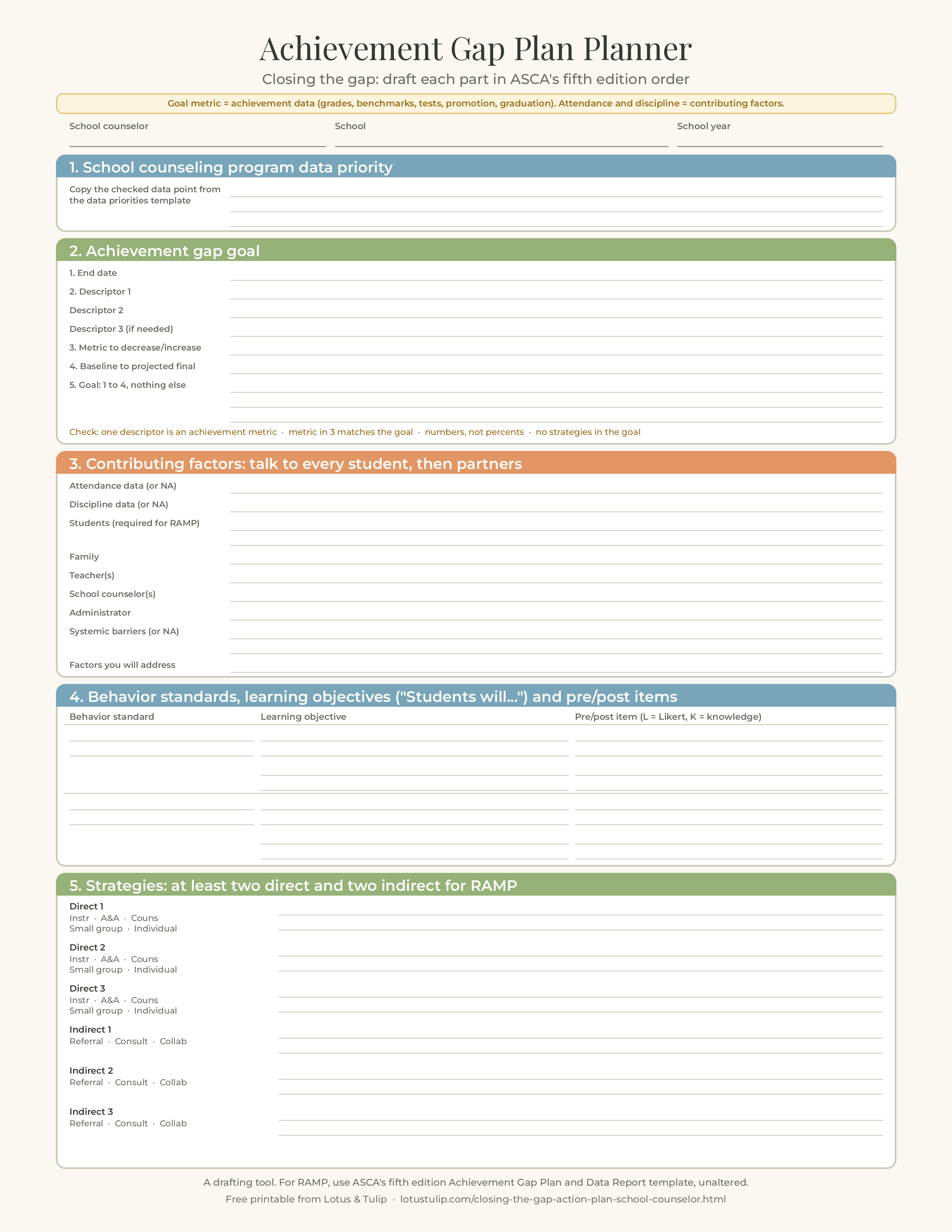
Download the free planner, example and data report worksheet (PDF, 3 pages)
Or download single pages: Page 1: blank planner (PNG) · Page 2: filled fictional example (PNG) · Page 3: data report worksheet (PNG)
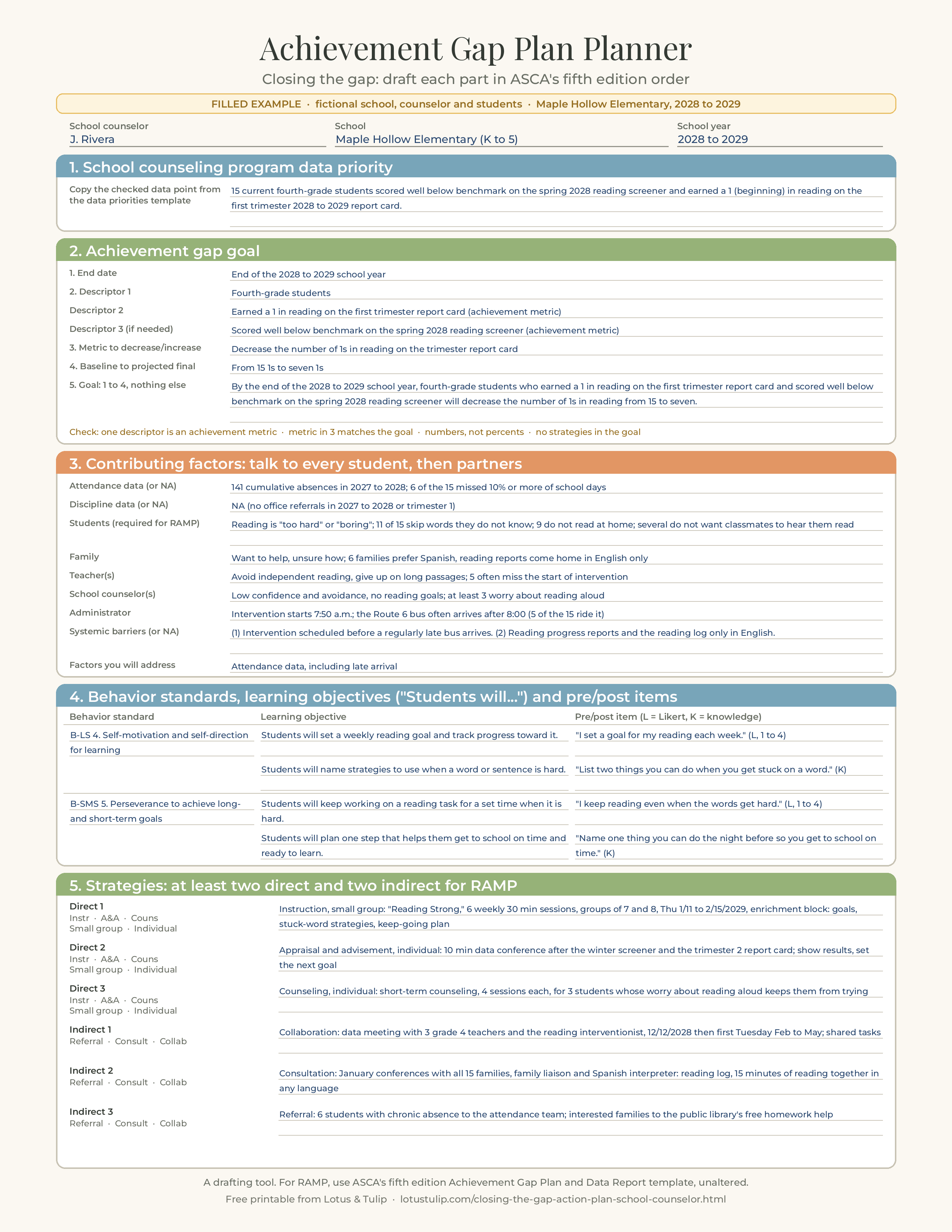
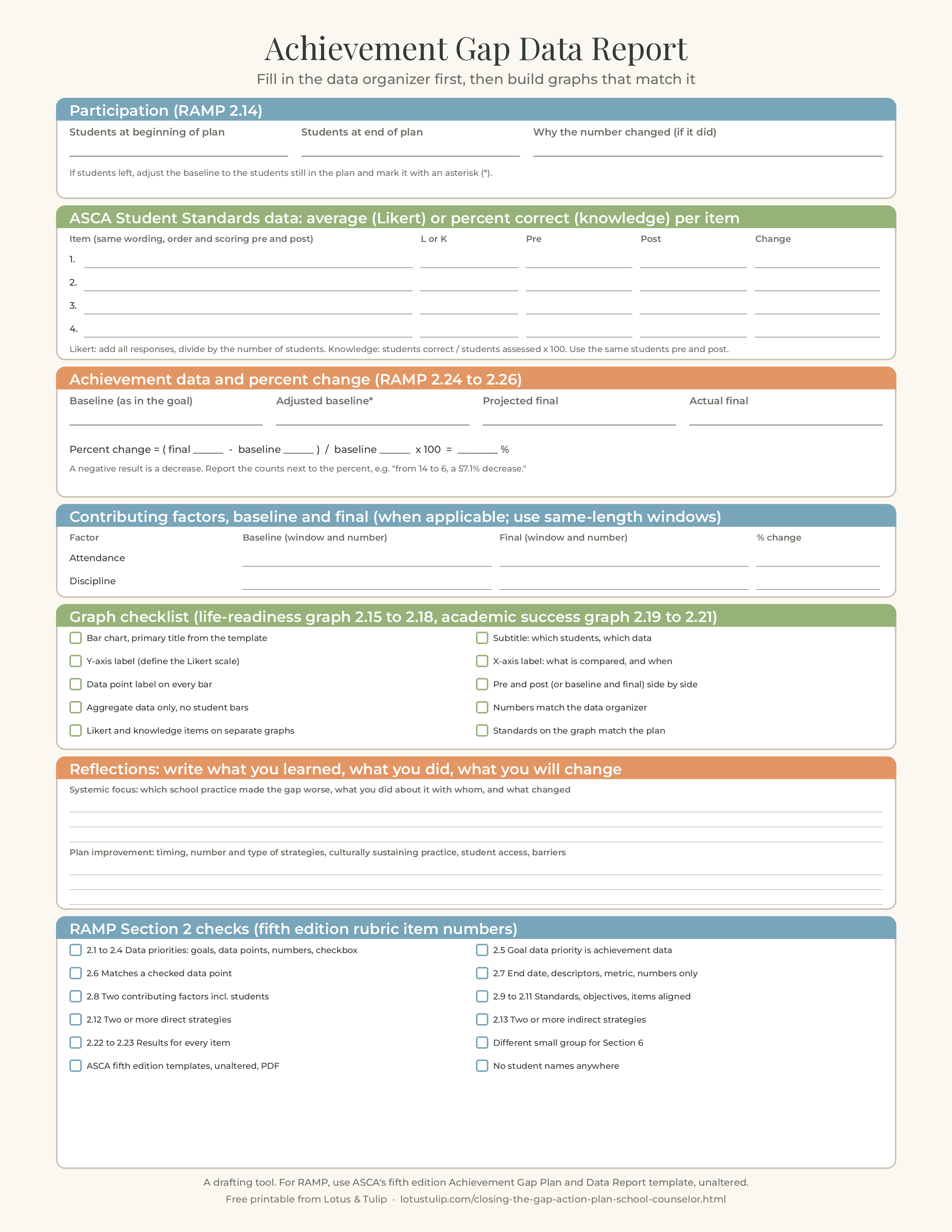
Free to print and use in your own school. Please link to this page rather than re-uploading the file. This is a planning tool. It does not replace ASCA's official templates, your district's data policies or legal advice. Keep student names off any copy you share or upload.
Related resources
- RAMP reflections: how to write items 7.1, 7.2 and 5.11 and the 3.5 alignment statement, with examples, word counts and a free reflections planner
- School counseling data graphs: how to graph pre and post, achievement and attendance results for ASCA data reports, with a free graph planner
- ASCA mindsets and behaviors pre and post survey questions: item bank for all 36 standards and free survey builder
- School counseling data priorities: the ASCA data priorities template, filled example and free worksheet
- ASCA small-group plan and data report: RAMP Section 6, filled example and free planner
- All school counselor small group curriculums
- School counselor use-of-time calculator: filled example and free 5-day log
- ASCA Student Standards delivery plan: filled example and free planner
- School counselor annual administrator conference: what to bring, sample agenda and a free planner
- School counselor advisory council agenda, minutes and a filled example
- Small group counseling pre and post assessment: items, scoring and averages
- School counselor needs assessment for small groups
- Small group counseling for attendance: 8 session plan, activities and data log
Sources: American School Counselor Association, Achievement Gap Plan and Data Report template, ASCA National Model Fifth Edition (Word template, 8/25), from the ASCA Templates and Tools page; American School Counselor Association, All Fifth Edition Examples (Achievement Gap Plan and Data Report example and School Counseling Program Data Priorities example, both marked 8/25); American School Counselor Association, School Counseling Program Data Priorities template, fifth edition; American School Counselor Association (2025), The ASCA National Model: A Framework for School Counseling Programs, Fifth Edition (Define, Manage, Deliver and Assess components; definitions of direct and indirect student services; school counseling data categories); American School Counselor Association, Changes in the ASCA National Model Fifth Edition (Manage); American School Counselor Association, RAMP in the Fifth Edition; American School Counselor Association, RAMP Scoring Rubric, Fifth Edition (August 2025, revised September 2025 and February 2026), general instructions and Sections 2, 3 and 6; American School Counselor Association, RAMP Application Timeline, Fifth Edition; American School Counselor Association, ASCA National Model Fifth Edition Phased Implementation Plan; American School Counselor Association, Graph Development Tips, Fifth Edition (Rev. 9/25); American School Counselor Association, ASCA Student Standards: Mindsets & Behaviors for Student Success; American School Counselor Association (2022), ASCA Ethical Standards for School Counselors, A.3; American School Counselor Association, Closing-the-Gap Action Plan and Results Report template, fourth edition, and RAMP Rubric, Fourth Edition, Section 10, for comparison; American School Counselor Association, RAMP web page. All checked November 10, 2026.
FAQ
What is a closing-the-gap action plan for school counselors?
It is the ASCA National Model plan a school counselor writes for a specific group of students who are not reaching an academic goal or benchmark: a measurable goal, the factors contributing to the gap, behavior standards with learning objectives and pre and post items, direct and indirect strategies, and a results report. In the fifth edition of the ASCA National Model (2025) it is called the Achievement Gap Plan and Data Report, and it replaced both the fourth edition Closing-the-Gap Action Plan and Results Report and the Annual Student Outcome Goal Plan.
How do you write an achievement gap goal?
Combine four parts and nothing else: an end date; two or more descriptors that identify a specific, manageable group of students, at least one of them an achievement metric; the exact achievement metric to decrease or increase; and precise baseline and projected final numbers. ASCA's example: by the end of the school year, seventh-grade students who have an F in math in the first quarter and scored in the lowest quartile on a progress monitoring assessment the year before will decrease the number of F's from 14 to seven.
Can an achievement gap goal be about attendance or discipline?
Not safely for a fifth edition RAMP application. RAMP item 2.5 says the data priority must be achievement data as defined by ASCA: traditional or standards-based grades, benchmark assessments, promotion rates, graduation rates or test scores. Attendance and discipline are contributing-factors data, which the template tracks in its own section and in optional baseline and final boxes. In the fourth edition, a closing-the-gap goal could target attendance or discipline directly.
How do you calculate percent change for the data report?
Subtract the baseline from the final number, divide by the baseline and multiply by 100. A negative result is a decrease. ASCA's example went from an adjusted baseline of 13 F's to 8 F's, which is a 38.4 percent decrease as ASCA reports it (38.46 before rounding). If students leave the group, adjust the baseline to the students still in the plan and mark it with an asterisk, as ASCA's example does.
How many points is the achievement gap plan worth in RAMP?
In the fifth edition RAMP Scoring Rubric, Section 2, Achievement Gap Plan and Data Report, is worth 26 of the 82 total points, the largest section. It covers the School Counseling Program Data Priorities template (items 2.1 to 2.4) and the plan, data report, graphs and data organizer (items 2.5 to 2.26). We did not find a published passing score for the fifth edition application in ASCA's documents.
Can the achievement gap small group be used for the RAMP small-group section?
No. Section 6 of the fifth edition RAMP rubric says the small group submitted there cannot be the same small group included in the Achievement Gap Plan, if one was included. Plan a different group of at least four sessions for three to 12 students for Section 6.