
School counselors · Updated 2026-11-11
ASCA Professional Standards & Competencies Self-Assessment: How to Rate Yourself, Pick 2 or 3 Growth Areas and Write a School Counselor PD Plan (Filled Example, Free Printable)
Ready-made printable: Complete Small Group Counseling Bundle Holiday 20% off: about $29.44, was $37 (EUR 32) · instant digital download
Buy on Etsy
Every school counselor who works toward the ASCA National Model meets the same short line sooner or later. It sits in the program assessment ("ASCA School Counselor Professional Standards & Competencies assessment is completed."), in Phase 1 of ASCA's implementation plan, and in the artifact list for the performance appraisal. The document behind it is a seven page checklist with 147 blank boxes and no instructions beyond three bullet lists. It is easy to open it, tick most of the boxes and close it again. That is a missed opportunity, because the same seven pages are the most direct way ASCA offers to answer a practical question: what should I get better at this year, and how will I show it?
This guide explains the ASCA School Counselor Professional Standards & Competencies (revised 2025) and the matching self-assessment, using only ASCA's own documents, downloaded today from schoolcounselor.org. It covers what the standards are and how they are organized, the seven mindsets and why ASCA gives them no competencies, all 23 behavior standards with the number of competencies under each and the gaps counselors most often find, exactly what the self-assessment form contains and what it leaves out, a simple way to rate yourself honestly, how to choose two or three growth areas, how to write a yearly professional development plan that someone else can check, a ten step method, a full worked example for one fictional elementary school, scenarios, mistakes and a plain list of what ASCA's documents do not say.
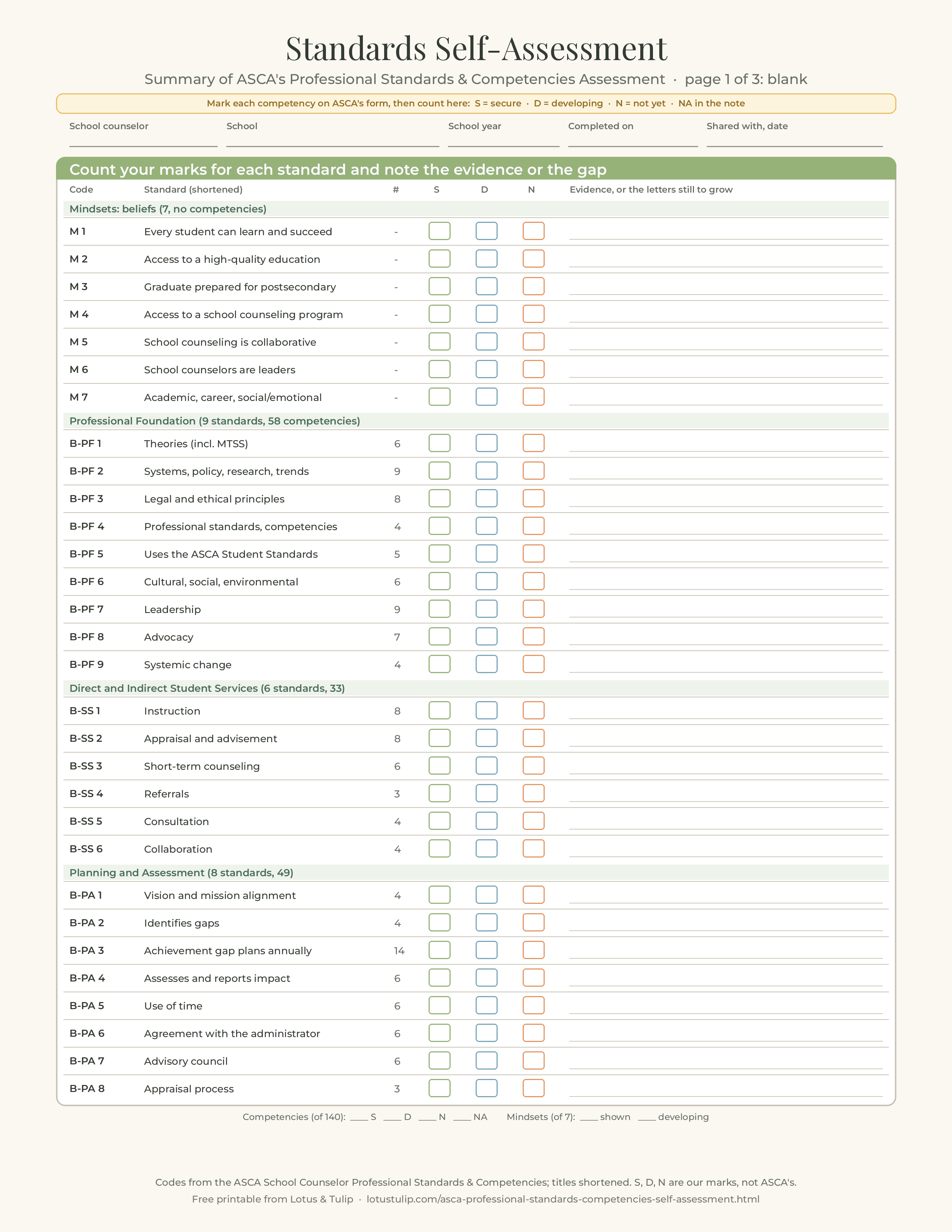
At the end is a free three page printable: a one page self-assessment summary for all 7 mindsets and 23 behavior standards (counts of secure, developing and not yet competencies, with a line for evidence), the same summary filled in for a fictional school, and a professional development plan page.
Jump to the free self-assessment summary, filled example and PD plan
The printable is a planning tool. It does not replace ASCA's Professional Standards & Competencies Assessment, which is where you mark each competency, and it does not replace any professional growth plan your district or state requires.
Download the free self-assessment summary, example and PD plan (PDF, 3 pages)
Or download single pages: Page 1: blank self-assessment summary (PNG) · Page 2: filled example (PNG) · Page 3: professional development plan (PNG)
Free to print and use in your own school. Please link to this page rather than re-uploading the file. This is a planning tool, not an ASCA publication; the standard titles on it are shortened, and the secure, developing and not yet marks are ours. Use ASCA's documents for the exact wording.
This is educational information for school counselors, not official ASCA guidance and not legal, licensing or human resources advice. ASCA National Model and RAMP are registered trademarks of the American School Counselor Association, and Lotus & Tulip is not affiliated with or endorsed by ASCA. Everything on this page was checked against ASCA's own public documents and pages, downloaded from schoolcounselor.org on November 11, 2026: the ASCA School Counselor Professional Standards & Competencies (8 page PDF, "Adopted 2007; revised 2012, 2019, 2025"), the ASCA School Counselor Professional Standards & Competencies Assessment (7 page fillable PDF), the Templates and Resources page, the School Counseling Program Assessment (fifth edition), the School Counselor Performance Appraisal, the ASCA National Model Fifth Edition Phased Implementation Plan, "Changes in the ASCA National Model Fifth Edition," the ASCA Ethical Standards for School Counselors (2022), ASCA's collected position statements and the RAMP Scoring Rubric, Fifth Edition. Competency wording is quoted from ASCA; counts are ours. Anything we could not confirm is marked as such.
The short answer
- What it is: the ASCA School Counselor Professional Standards & Competencies "outline the mindsets and behaviors school counselors need to meet the rigorous demands of the school counseling profession and the needs of pre-K-12 students." The current version is dated 2025.
- How it is organized: 7 mindset standards (M 1 to M 7, beliefs, with no competencies) and 23 behavior standards in three groups: Professional Foundation (B-PF 1 to 9), Direct and Indirect Student Services (B-SS 1 to 6) and Planning and Assessment (B-PA 1 to 8). By our count the behavior standards have 140 lettered competencies: 58, 33 and 49.
- The self-assessment: a separate 7 page PDF, the ASCA School Counselor Professional Standards & Competencies Assessment, prints every mindset and competency with a blank line in front of it. The digital version has 147 checkboxes (7 mindsets plus 140 competencies) and nothing else: no rating scale, no name or date field, no score and no plan page.
- What it is for: ASCA's own first bullet points for school counselors are "Self-assess their own mindsets and behaviors" and "Formulate an appropriate professional development plan." Competency B-PF 4 d asks you to "Develop a yearly professional development plan."
- How to do it well: mark every competency with more than a tick (we use secure, developing, not yet, not applicable), write the evidence or the gap for each standard, choose two or three growth areas tied to student data and your administrator's priorities, and write a plan with actions, support, evidence and check dates.
- When: ASCA lists it in Phase 1 of the Phased Implementation Plan (as the "School counselor standards & competencies checklist") and in the program assessment. B-PF 4 d implies a yearly cycle. ASCA does not name a month; late August or September, before your appraisal self rating, works well.
What the ASCA School Counselor Professional Standards & Competencies are
The standards document opens with one paragraph that sets out its purpose: "The ASCA School Counselor Professional Standards & Competencies outline the mindsets and behaviors school counselors need to meet the rigorous demands of the school counseling profession and the needs of pre-K-12 students. These standards and competencies help ensure new and experienced school counselors are equipped to establish, maintain and enhance a school counseling program addressing academic achievement, career planning and social/emotional development."
The title line reads "(Adopted 2007; revised 2012, 2019, 2025)." ASCA's citation guide on the last page asks for this reference: "American School Counselor Association (2025). ASCA School Counselor Professional Standards & Competencies. Alexandria, VA: Author." If your district binder, graduate syllabus or growth plan form still quotes the 2019 version, it is out of date. The "Changes in the ASCA National Model Fifth Edition" document lists the standards under Define as "Revised, 2025" with the note "Beliefs moved here from Manage section."
That note matters. In the fourth edition of the National Model, counselors wrote a beliefs statement in Manage. In the fifth edition the beliefs live in the Professional Standards & Competencies as the seven mindsets, and the behavior standards ask you to "Compose a personal beliefs statement about students, families, teachers, school counseling programs and the educational process consistent with the mindsets of the ASCA Professional Standards & Competencies" (B-PA 1 b).
Who ASCA says should use them
The first page lists three groups of users and what each does with the standards:
| User | ASCA's wording |
|---|---|
| School counselors | "Self-assess their own mindsets and behaviors" and "Formulate an appropriate professional development plan" |
| School administrators | "Guide the recruitment and selection of competent school counselors" and "Develop or inform meaningful school counselor performance appraisal" |
| School counselor education programs | "Establish benchmarks for ensuring school counseling students graduate with the knowledge, attitudes and skills needed to develop a school counseling program." |
So the same document is a self-check for you, a hiring and appraisal guide for your principal, and a graduation benchmark for your graduate program. That is why it is worth knowing well: the language your principal may use in your appraisal, and the language your interns are trained on, comes from here.
Standards versus competencies
ASCA draws a clear line between the two levels: "The standards are broader topics that describe the knowledge, attitudes and skills school counselors need to implement a school counseling program. The competencies are more specific and measurable indicators of the behavior standards." Later: "Each behavior standard has specific competencies that are measurable indicators of the broader standard. These competencies can be used to further define the behaviors necessary for the implementation of a school counseling program."
In practice, you self-assess at the competency level (the lettered lines) and plan at the standard level (B-SS 2, B-PA 5 and so on). A growth area like "B-SS 2, competencies b and d" is specific enough to act on and short enough to remember.
The three behavior groups
ASCA defines the three groups this way:
- Professional foundation: "the essential skills that are the basis of a school counselor's professional orientation"
- Direct and indirect student services: "interactions that are provided directly to students or indirectly for students in collaboration with education partners, such as families, staff, administrators, decision-makers, and any other school or community organizations/individuals."
- Planning and assessment: "activities necessary for the design, implementation and assessment of the school counseling program"
ASCA prints a dash between each group name and its definition; we show a colon instead.
Two documents: the standards and the self-assessment
ASCA publishes the content twice, and it helps to know which file you are holding.
| ASCA School Counselor Professional Standards & Competencies | ASCA School Counselor Professional Standards & Competencies Assessment | |
|---|---|---|
| Length | 8 pages, US Letter | 7 pages, US Letter |
| What it adds | An introduction, ASCA's definitions of standards, competencies, mindsets and the three behavior groups, a one page chart of all 30 standards, the citation guide | A blank line before every mindset and every competency; the digital file has a checkbox on each line |
| Where to find it | Linked across ASCA's site and cited in its position statements | Templates and Resources page, under Assessments, and inside the "All Assessments" download |
| Competency wording | The reference text | The same wording; our word by word comparison found only line break and hyphenation differences |
| Rating, name, date, plan | None | None |
The Assessment's first page repeats the three user groups, with one small difference in wording: "School/district administrators use this document to:" where the standards say "School administrators." Then it goes straight into the list, starting with "School counselors believe:" and the seven mindsets.
What the self-assessment form looks like, and what it leaves out
We opened every page of the Assessment as a PDF and as a form. Here is what is actually there:
- 147 lines with a blank in front. Seven for the mindsets (M 1 to M 7) and 140 for the lettered competencies under the 23 behavior standards, by our count.
- 147 checkboxes in the fillable PDF. Every form field is a checkbox with two states, on and off. There are no text fields at all.
- Standard headings without boxes. The 23 behavior standards (B-PF 1 and so on) are printed as headings; only their competencies have boxes.
- Section bands for Mindsets, Professional Foundation, Direct and Indirect Student Services and Planning and Assessment, with "cont." on the follow-on pages.
- A footer on each page reading "ASCA SCHOOL COUNSELOR PROFESSIONAL STANDARDS & COMPETENCIES ASSESSMENT" with the page number.
And here is what is not there, which is most of what you need to make the form useful:
- no instructions on what a tick means (that you can do it, that you did it this year, or that you believe it);
- no rating scale, no levels, no descriptors;
- no place for your name, school, school year or the date;
- no space for evidence or comments;
- no total, score or cut-off;
- no "not applicable" option (for example, B-SS 6 d is about supervising interns, which many counselors do not do in a given year);
- no professional development plan page, even though the first page says the document is used to "Formulate an appropriate professional development plan."
None of this is a flaw so much as a choice: ASCA gives you the content and leaves the method to you. The rest of this guide is one method that works, with a summary sheet and a plan page you can print.
A practical tip if you use the fillable version: a checkbox is either on or off, so the PDF alone cannot hold "developing." Mark the PDF only for competencies you rate secure, and keep the rest of your marks on paper or on our summary sheet. Save the file with the date in the name, because the PDF will not record it for you.
Where the self-assessment fits in the ASCA National Model
The Professional Standards & Competencies appear in several places across ASCA's materials. Seeing them together explains why this one checklist carries so much weight.
| Where | What ASCA says |
|---|---|
| Define (fifth edition) | The standards are one of the three sets of standards in Define. The changes document lists them as "Revised, 2025" and notes "Beliefs moved here from Manage section." |
| Assess | The Templates and Resources page lists three assessments and introduces them: "School counselors regularly assess their own skills and their program to determine its effectiveness in enhancing access, life-readiness and academic success for each and every student. The following three assessments are available for download." The self-assessment is the second of the three. The changes document lists it under Assess as "Language alignment" ("Updated to align with language from the fifth edition"). |
| Phased Implementation Plan | Phase 1, "START HERE," step 2 "Complete:" lists the "School counseling program assessment," the "School counselor standards & competencies checklist" and the "Use-of-time 5-day calculator." |
| School Counseling Program Assessment | One Assess benchmark reads: "ASCA School Counselor Professional Standards & Competencies assessment is completed." |
| School Counselor Performance Appraisal | Its 30 rated items follow the standards (M 1 to 7, B-PF 1 to 9, B-SS 1 to 6, B-PA 1 to 8) in the same order. The artifacts for the item on professional standards include a "Completed ASCA Professional Standards & Competencies self-assessment with written plans for own professional growth." |
| RAMP | No rubric item asks for the self-assessment. The integrity rules say "your school counselors must agree to abide by the ASCA Ethical Standards for School Counselors and ASCA Professional Standards & Competencies." |
ASCA's free overview of the fifth edition National Model (our copy of the download) describes this assessment in one sentence, "The ASCA School Counselor Professional Standards & Competencies Assessment is used to self-assess the school counselor's knowledge, attitudes and skills needed to implement a school counseling program," under the heading "Self-assess your own mindsets and behaviors and formulate an appropriate professional development plan," and adds: "Continued professional development promotes increased school counseling expertise, leading to improved student outcomes."
What ASCA's ethics and position statements add
Three other ASCA documents make the link between the standards, professional development and evaluation explicit:
- ASCA Ethical Standards for School Counselors (2022), B.3 Responsibilities to Self, e: school counselors "Engage in routine, content-applicable professional development to stay up to date on trends and needs of students and other stakeholders, and regularly attend training on current legal and ethical responsibilities."
- The same document, section C, for school counselor directors, administrators and supervisors: they support counselors by "Providing opportunities for professional development in current research related to school counseling practices, competencies and ethics" (C.d) and by "Using and/or advocating for a performance appraisal instrument aligned with the ASCA School Counselor Professional Standards & Competencies that assesses school counselors' knowledge, skills and attitudes" (C.g).
- "The School Counselor and Annual Performance Appraisal" (revised 2026): "Feedback and collaboration in the performance appraisal process should be based on the ASCA School Counselor Professional Standards & Competencies." The school counselor "Consults with school administrators regarding ASCA School Counselor Professional Standards & Competencies and advocates for its integration as a tool of the ASCA National Model® ... in the performance appraisal process."
- "The School Counselor and Credentialing and Licensure" (adopted 1990, revised 2026): "All state education certification or licensure agencies are encouraged to adopt the ASCA School Counselor Professional Standards & Competencies when developing policy and legislation regarding school counselor credentialing or licensing." And: "School counselors collaborate with district and state education personnel and local or state school counselor associations to provide ongoing professional development specifically for school counselors, aligned with the ASCA School Counselor Professional Standards & Competencies."
Note the word "encouraged." ASCA does not say every state has adopted the standards, and we did not check state rules for this guide. Your state's renewal requirements (hours, approved providers, any required growth plan form) come from your state, not from ASCA.
The seven mindsets, and how to self-assess a belief
The mindsets are introduced with "School counselors believe:" and read, in the 2025 standards:
| Code | ASCA's wording | What evidence of it in your work can look like |
|---|---|---|
| M 1 | "Each and every student can learn and succeed." | A gap plan or group aimed at the students furthest behind, not only the easiest to help |
| M 2 | "Each and every student deserves access to and opportunity for a high-quality education." | Action on a barrier to access: translation, transport, course or program placement |
| M 3 | "Each and every student should graduate from high school prepared for postsecondary opportunities." | Career and postsecondary lessons on the delivery plan, at every level, including elementary |
| M 4 | "Each and every student deserves access to a school counseling program." | A delivery plan that reaches every grade or every student, not only referred students |
| M 5 | "Effective school counseling is a collaborative process involving school counselors, students, families, teachers, administrators and other education partners." | Advisory council minutes, teacher consultation, family input into plans |
| M 6 | "School counselors are leaders in the school, district, state and nation." | A role on a leadership team where you contribute, a data presentation, an association role |
| M 7 | "School counseling programs promote and enhance student academic, career and social/emotional development." | Plans and results in all three domains, not only social/emotional |
ASCA explains why the mindsets stand alone: "Mindsets: The mindset standards include beliefs school counselors hold about student achievement and success. Although it may be possible to measure these beliefs, the mindsets are more readily recognized through the behaviors a school counselor demonstrates as a result of the implementation of a school counseling program. Therefore, the mindset standards do not have correlating competencies."
That sentence is the key to self-assessing them. Almost every counselor would tick all seven if the question were "do you believe this?" The useful question is the one ASCA points to: does my work this year show it? For each mindset, write one concrete piece of evidence. If you cannot think of one, mark it developing. Two mindsets are easy to leave without evidence: M 6 (leadership) and, in elementary schools, M 3 (postsecondary preparation).
One caution if you also use ASCA's free National Model overview: our copy of it lists four beliefs in older wording ("Each and every student can learn and can succeed," "Each and every student should receive a high-quality education," and so on). The 2025 standards have seven mindsets with the wording in the table above. Use the 2025 wording in your beliefs statement and self-assessment.
The performance appraisal turns each belief into a behavior. For example, M 4 in the standards ("Each and every student deserves access to a school counseling program") becomes, in the appraisal, "Demonstrates belief that each and every student should have access to the school counseling program." If you will be appraised on the ASCA form, that is one more reason to self-assess the mindsets by evidence, not by agreement.
Professional Foundation: 9 standards, 58 competencies
Professional Foundation is the largest group. It covers theory, systems, ethics, your own growth, the Student Standards, culture, leadership, advocacy and systemic change. The standard titles below are ASCA's; the summaries of the competencies are ours, so read ASCA's full wording when you mark them.
| Code | ASCA's standard | Competencies | What they cover (our summary) | A common gap to check |
|---|---|---|---|---|
| B-PF 1 | "Apply developmental, learning, counseling and education theories" | 6 (a to f) | Human development, learning theory, evidence-based counseling theories (ASCA names rational emotive behavior therapy, reality therapy, cognitive-behavioral therapy, Adlerian, solution-focused brief counseling, person-centered counseling and family systems), theory in all settings, career development theory, multitiered system of supports | e (career development theories), especially in elementary schools |
| B-PF 2 | "Apply knowledge of educational systems, legal issues, policies, research and trends in education" | 9 (a to i) | Governance of US education, current trends and legislation, policy development, the history of school counseling, how school counseling differs from other counseling fields, roles of other student service providers, a rationale for a program, research, technology | a (governance) and d (history), which few counselors revisit after graduate school |
| B-PF 3 | "Apply legal and ethical principles of the school counseling profession" | 8 (a to h) | The ASCA Ethical Standards, legal responsibilities with minors, limits of confidentiality, obligations to families and staff, consultation when questions arise, an ethical decision-making model, modeling ethical behavior, continual professional development on legal and ethical work | f (using a named decision-making model) and h (recent legal and ethical training) |
| B-PF 4 | "Apply school counseling professional standards and competencies" | 4 (a to d) | Staying current with research, conducting "self-appraisal and assessment related to school counseling professional standards and competencies," reflection, consultation and supervision, and "a yearly professional development plan" | d (no written yearly plan); completing this guide's steps covers b and d |
| B-PF 5 | "Use the ASCA Student Standards: Mindsets & Behaviors for Student Success to inform the implementation of a school counseling program" | 5 (a to e) | Selecting standards from data, using them to focus strategies, prioritizing them with school improvement goals, writing learning objectives, explaining how they "promote positive mental health development" | e (articulating the mental health link to staff and families) |
| B-PF 6 | "Apply knowledge of cultural, social and environmental influences to enhance student success and opportunities" | 6 (a to f) | Respect for differences, how background affects school performance, high expectations, cross-cultural communication, culturally sustaining curricula, personal limitations and biases | d (communicating with families in their language) and f (naming your own biases) |
| B-PF 7 | "Provide leadership through the development and implementation of a school counseling program" | 9 (a to i) | Sources of power and leadership, leadership qualities, a model of leadership, program structure aligned with the National Model, applying program assessment results, positive change, the counselor's role in the school crisis plan, leadership in school and community, the school improvement process | c (a named model of leadership) and g (a written crisis plan role) |
| B-PF 8 | "Advocate for a school counseling program" (in the detailed list: "Demonstrate advocacy for a school counseling program") | 7 (a to g) | Advocacy competencies, advocating for policy in students' interests, explaining program benefits, a rationale for appropriate activities and for "discontinuation of inappropriate activities," using data to reduce ratios and non-counseling tasks, professional organizations | e and f, when duties such as testing coordination take time from students |
| B-PF 9 | "Create systemic change through the implementation of a school counseling program" | 4 (a to d) | An environment supporting success, using data to see how policies help or impede students, using data to address systemic barriers, a plan to address "personal and/or institutional resistance to change" | d (a written plan for resistance), and c when data on course enrollment or access has never been pulled |
Two details are worth knowing. First, the title of B-PF 8 differs between the one page chart ("Advocate for a school counseling program") and the detailed list in both documents ("Demonstrate advocacy for a school counseling program"). The meaning is the same; use either. Second, B-PF 4 is the standard this whole exercise satisfies. Competency b asks you to "Conduct and analyze self-appraisal and assessment related to school counseling professional standards and competencies," c asks you to "Use personal reflection, consultation and supervision to promote professional growth and development," and d reads in full: "Develop a yearly professional development plan to ensure engagement in professional growth opportunities related to relevant professional standards and competencies and personal limitations."
Direct and Indirect Student Services: 6 standards, 33 competencies
| Code | ASCA's standard | Competencies | What they cover (our summary) | A common gap to check |
|---|---|---|---|---|
| B-SS 1 | "Design and implement instruction aligned to the ASCA Student Standards: Mindsets & Behaviors for Student Success in classroom, large-group, small-group and individual settings" | 8 (a to h) | Using achievement and contributing-factors data to pick issues, evidence-based curricula, cultural and social trends, lesson plans, pedagogical and classroom management skills, technology, working with staff on instruction, analyzing lesson data | e (classroom management) for counselors without teaching backgrounds, and h (analyzing lesson data) |
| B-SS 2 | "Provide appraisal & advisement in classroom, large-group, small-group and individual settings" | 8 (a to h) | Strategies for appraisal and advisement, assessments of "abilities, values and career interests," labor market trends, cross-referencing assessment results (ASCA names "MBTI, Holland Code, ASVAB, O*Net") with goals and "universal screeners with wellness and life-readiness," the link between school and work, postsecondary education, admissions and financial aid, workplace experiences | b, d and h at elementary level; c and g in schools without a career program |
| B-SS 3 | "Provide short-term counseling in small-group and individual settings" | 6 (a to f) | Using data to identify students, individual and small-group counseling during "times of transition, heightened stress, critical change," Student Standards as the focus, why short-term counseling is appropriate and "long-term therapy is inappropriate," adverse childhood experiences and trauma, crisis response | e (trauma techniques) and f (before, during and after crisis) |
| B-SS 4 | "Make referrals to appropriate school and community resources" | 3 (a to c) | A current referral list consistent with policy, communicating "the limits of school counseling and the continuum of mental health services," why diagnoses and long-term therapy are outside the scope | a (a list nobody has checked in two years) |
| B-SS 5 | "Consult to support student achievement and success" | 4 (a to d) | Gathering information from families, staff and community, sharing strategies, consulting with other professionals, "in-service training or workshops for families, administrators, other school staff, teachers or other education partners" | d (workshops), which many counselors never schedule |
| B-SS 6 | "Collaborate with families, teachers, administrators and other education partners for student achievement and success" | 4 (a to d) | Partnering to advocate for students, the potential for dual roles with families, involving the right people in a crisis, supervising school counseling interns | d, which is not applicable in a year without an intern |
B-SS 2 is the standard elementary counselors most often rate low, and it is worth reading slowly. Several competencies are written with secondary students in mind (admissions and financial aid, workplace experiences), but others fit any level: helping students "understand their abilities, values and career interests" (b) and "understand how academic performance relates to the world of work, family life and community service" (e). ASCA does not publish an elementary version of the standards, so decide for yourself what an age appropriate version looks like and write it in your notes.
Planning and Assessment: 8 standards, 49 competencies
| Code | ASCA's standard | Competencies | What they cover (our summary) | A common gap to check |
|---|---|---|---|---|
| B-PA 1 | "Articulate how the school counseling program aligns with the school and district vision and mission" | 4 (a to d) | Analyzing beliefs and philosophies, a personal beliefs statement consistent with the mindsets, analyzing the vision and mission, explaining the alignment to others | b (no written beliefs statement since the fifth edition moved beliefs into the standards) |
| B-PA 2 | "Identify achievement gaps and factors contributing to those gaps" | 4 (a to d) | Collecting and analyzing data for gaps, disaggregating achievement data, contributing-factors data ("attendance, discipline, systemic barriers, student perspectives and education partner perspectives"), goals to close gaps | c (contributing factors beyond attendance and discipline) |
| B-PA 3 | "Develop achievement gap plans based on student data annually" | 14 (a to n) | The full gap plan cycle: school improvement goals, data priorities, choosing students, intended impact, measurable goals that "include baseline and projected final data within the goal statement," contributing factors, perspectives, Student Standards, curricula, resources, communicating the plan, research concepts ("sampling, methodology and analysis"), monitoring and refining | m (research concepts) and n (refining mid-year) |
| B-PA 4 | "Assess and report program impact to the school community" | 6 (a to f) | Access, life-readiness and achievement data, reviewing gap plan impact, program effectiveness, deciding with administration how impact is shared, demonstrating value, presentation skills | d (agreeing how results are shared) and f (presenting) |
| B-PA 5 | "Use time appropriately according to national recommendations and student/school data" | 6 (a to f) | Direct versus indirect services, assessing use of time, the best use of time for student needs, scheduling and prioritizing, "annual and weekly calendars," and fair-share responsibilities, which ASCA defines as "the routine running of school responsibilities that all members of the school staff take equal turns doing to ensure the school's smooth operation" | b (no recent use-of-time data) and e (weekly calendars) |
| B-PA 6 | "Establish agreement about the school counseling program with the administrator in charge of the program" | 6 (a to f) | Completing National Model templates with colleagues, meeting the administrator, modeling the counselor's role, explaining gap goals, advocating for time, and "Finalize the Annual Administrator Conference Template" | f (the conference template never finalized) |
| B-PA 7 | "Establish and convene an advisory council for the school counseling program" | 6 (a to f) | Choosing members, agendas, explaining alignment, discussing data, priorities, plans "and program assessment," recording and distributing notes, using the council's feedback | e (minutes) and f (showing what changed because of feedback) |
| B-PA 8 | "Use appropriate school counselor performance appraisal process" | 3 (a to c) | Advocating for an appraisal "based on school counselor standards," explaining where counseling fits in an appraisal instrument, using National Model components as evidence | a and b when the district appraises counselors on a teacher form |
Planning and Assessment is where the National Model templates live, so it is also where your evidence is easiest to find: the data priorities, gap plan and data report, use-of-time calculator, annual and weekly calendars, administrator conference template and advisory council agendas and minutes each cover several competencies at once.
How to rate yourself honestly
ASCA gives you a blank line. To turn it into something you can plan from, use four marks. These are ours, not ASCA's, and you can rename them, but keep the meanings consistent from year to year so you can compare.
| Mark | Meaning | The test |
|---|---|---|
| S, secure | You do this well now, as part of this year's work | You can point to a document, data or a colleague who would confirm it from the last 12 months |
| D, developing | You do it sometimes, partly, or you know how but have not done it recently | Evidence exists but is old, partial or informal |
| N, not yet | You do not do this yet, or would not know where to start | No evidence at all |
| NA, not applicable this year | The competency does not arise in your role this year | Use sparingly and write why (for example, B-SS 6 d with no intern) |
For the mindsets, use S when your work this year clearly shows the belief and D when you hold it but have little to show.
Rules that keep the self-assessment honest
- Evidence, not confidence. The question is never "could I?" but "did I, and can I show it?" A competency you could do in theory, but have not done in two years, is developing.
- Explain and articulate count. Many competencies begin with "Explain," "Articulate" or "Delineate." These are tested when someone asks you. If you could not explain the distinction between direct and indirect student services (B-PA 5 a) to a new principal in two minutes, it is not yet secure.
- Read the whole line. Several competencies have more than one part. B-PA 5 e asks for "annual and weekly calendars"; an annual calendar alone is developing. B-PF 3 b asks about the legal responsibilities of the role "including the unique legal and ethical principles of working with minor students in a school setting."
- Do it in one sitting, with your files open. Open last year's data reports, calendars, minutes and the administrator conference template before you start. It takes far less time to mark a competency when the evidence is on the screen. A first honest pass through all 147 lines usually takes about an hour (our estimate; ASCA gives no time).
- Do not average or total. ASCA prints no score. A count of 114 secure tells you less than the three not yet marks under one standard.
- Keep it private until you choose to share it. The self-assessment is for you. ASCA does not say who should see it. Sharing the plan (not every mark) with your administrator is usually enough, and the appraisal artifact ASCA lists is the completed self-assessment "with written plans for own professional growth."
Then summarize by standard
Once every line is marked, count the marks under each of the 23 standards and write one line of evidence or the letters still to grow. This is what page 1 of the free printable is for. The summary turns 147 marks into 30 lines you can read in a minute, and it makes patterns visible: three developing marks under one standard is a growth area; one developing mark scattered under each of five standards usually is not.
How to choose two or three growth areas
ASCA says the document is used to "Formulate an appropriate professional development plan," and B-PF 4 d says the plan should cover "professional growth opportunities related to relevant professional standards and competencies and personal limitations." ASCA does not say how many areas to choose. We suggest two or three standards, each with two to four named competencies. Fewer is too narrow to matter; more is a wish list that will not survive October.
Use these questions, in order:
- Is anything a legal or ethical risk? A not yet under B-PF 3 (for example, the limits of confidentiality) or B-SS 3 f (crisis response) goes first, regardless of anything else.
- Which gaps touch students most this year? Look at your data priorities and achievement gap plan. A gap in B-PA 2 or B-SS 1 h matters more in a year when you are running a gap plan.
- What does your school need? If the school improvement plan names attendance or career readiness, growth in the matching competencies has a reason everyone understands.
- What did your last appraisal say? If your administrator rated an item low, that standard is a natural growth area, and your self-assessment can show you have already planned for it.
- Can you show progress by June? Choose areas where a specific action this year would produce evidence you can file.
- Are two areas really one? Some gaps share a cause. In the example below, B-PF 8 e and f (advocating against inappropriate duties) and B-PA 5 (use of time) are both about testing coordination, so they become one area.
Also write down two or three strengths. A plan made only of gaps reads like a deficit list. Naming what you do well, and how you will use it (mentoring a new counselor, presenting at a staff meeting), is also evidence for M 6 and B-PF 7.
How to write the professional development plan
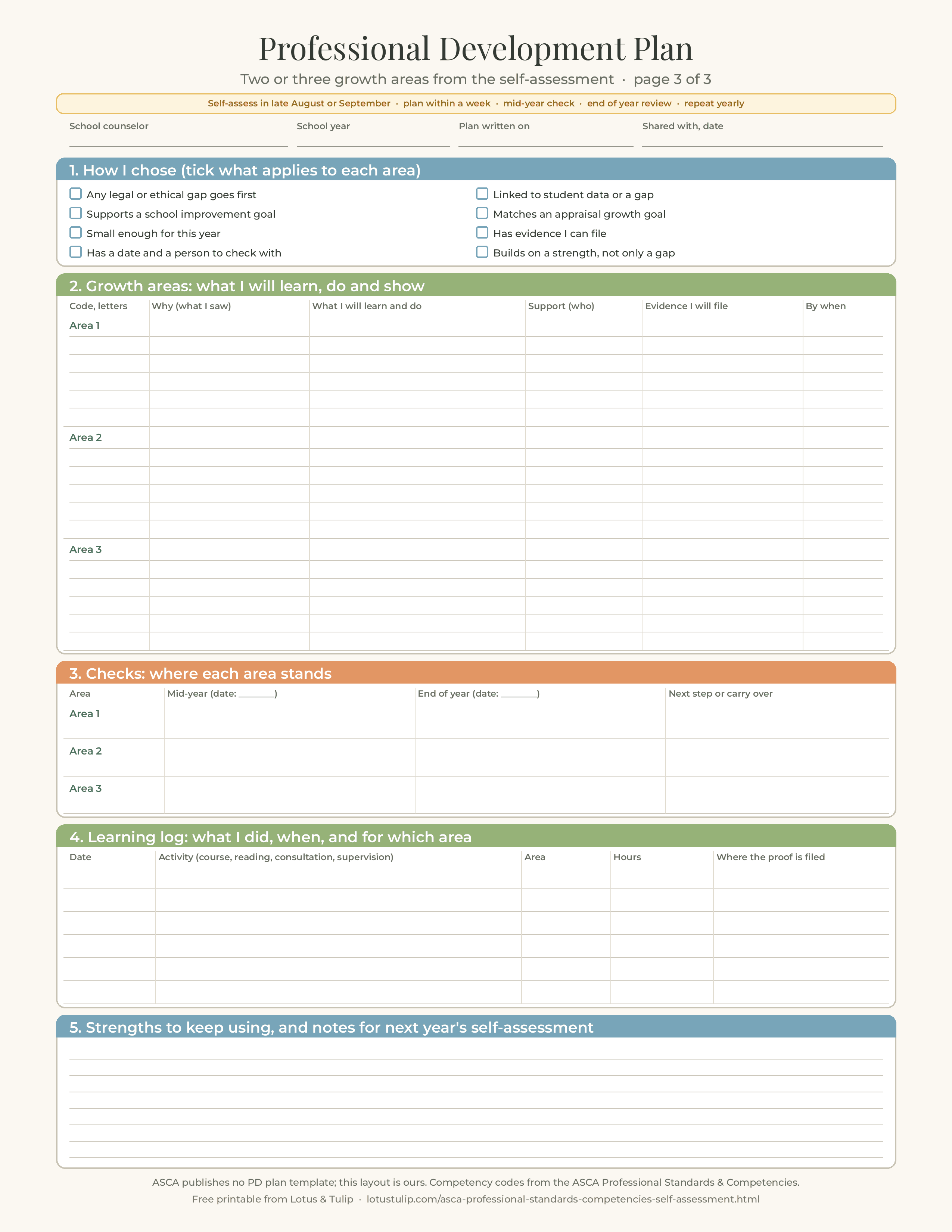
ASCA publishes no professional development plan template. B-PF 4 d asks for "a yearly professional development plan," and the appraisal's artifact list asks for "written plans for own professional growth." A plan that someone else can check has six parts for each growth area:
| Part | What to write | Example |
|---|---|---|
| Code and competencies | The standard and the letters you are working on | B-SS 2 b and d |
| Why | What you saw in the self-assessment, with a fact | No strengths or career interest inventory work at any grade in 2027-28 |
| What you will learn and do | One learning activity and one action with students or staff | Join the district's elementary counselor session on career development; teach one grade 5 inventory lesson with individual follow up |
| Support | Who will help, consult or supervise (B-PF 4 c names "personal reflection, consultation and supervision") | The feeder middle school counselor; principal for schedule time |
| Evidence | The artifact you will file | Lesson plan and data report; follow up log in totals |
| Dates | A finish date and a mid-year check date | Lesson by March 2029; check January 25, 2029 |
Weak and strong plan lines
| Weak | Strong | Why it is better |
|---|---|---|
| Improve my use of time. | B-PA 5 b, d, e: post a weekly calendar every Monday from September 18, 2028, and follow up on my August 24 request to move testing coordination to the district testing team, with a written answer by March 2029. | Names the competencies, two actions, a date and evidence |
| Learn more about career development. | B-SS 2 b, d: attend one district session on career development by November 2028; plan and teach one grade 5 strengths and career interest lesson with individual follow up by March 2029. | Learning plus action with students |
| Be more culturally responsive. | B-SS 4 a, b and B-PF 6 d: update the referral list by September 29, 2028, and have the counseling brochure translated into Spanish through the district by December 2028. | Observable, with a finish line |
| Attend PD as required. | Log each activity with the date, the area it serves and where the certificate is filed. | Connects hours to the plan, which is what B-PF 4 d asks |
Learning activities that count
ASCA does not limit what counts as professional development in these documents. B-PF 4 c names reflection, consultation and supervision; B-PF 8 g names "Participate in school counseling and education-related professional organizations"; the Ethical Standards (B.3.e) name "routine, content-applicable professional development" and regular training on legal and ethical responsibilities. Useful activities include a course or webinar, a professional reading with a written takeaway, a consultation with a more experienced counselor, structured supervision, observing a colleague, a session at a state or national conference and a practice run of a presentation. Choose the one most likely to change what you do, and pair it with an action.
Hours and renewal
Whether any of this counts toward license or certificate renewal depends on your state and district. ASCA's documents do not set hours. Keep a simple learning log (date, activity, area, hours, where the proof is filed); page 3 of the free printable has one, and it serves both purposes.
How to complete the professional standards self-assessment and PD plan, step by step
- Download the current documents. Get the ASCA School Counselor Professional Standards & Competencies (the 2025 revision) and the Professional Standards & Competencies Assessment from ASCA's Templates and Resources page. Check the title line says "revised 2012, 2019, 2025."
- Gather last year's evidence. Open your data priorities, gap plan and data reports, lesson and small-group plans, calendars, use-of-time calculator, administrator conference template, advisory council agendas and minutes, and any certificates.
- Decide your marks. Use secure, developing, not yet and not applicable (or your own names), and write the meanings at the top of your copy so next year's comparison is fair.
- Mark the mindsets by evidence. For each of M 1 to M 7, write one thing you did that shows the belief. If nothing comes to mind, mark it developing.
- Mark all 140 competencies. Read every line in full, mark it, and for anything developing or not yet, note what is missing in a few words.
- Summarize by standard. Count the marks under each of the 23 standards and write one line of evidence or the letters still to grow. Name two or three strengths.
- Choose two or three growth areas. Start with any legal or ethical gap, then choose the gaps that touch students most, match school goals or last year's appraisal, and can show progress by June. Combine gaps with one cause.
- Write the plan. For each area: the code and letters, why, what you will learn and do, who will support you, the evidence you will file, a finish date and a mid-year check date.
- Share the plan with your administrator. Bring it to the annual administrator conference or your appraisal goal meeting, and agree any time or resources it needs.
- Check, file and repeat. Hold the mid-year check, keep the learning log, review each area at the end of the year, file the self-assessment and plan as an appraisal artifact, and carry unfinished areas into next year's self-assessment.
A worked example: Maple Hollow Elementary, 2028 to 2029 (fictional)
Maple Hollow Elementary is a fictional public elementary school with kindergarten to grade 5, 426 students and one school counselor, J. Rivera. The principal, A. Brooks, is the administrator in charge of the school counseling program. Readers of our other guides have followed the school's 2028 to 2029 school year: the annual administrator conference on Thursday, August 24, 2028, the first-semester advisory council on Tuesday, October 17, 2028, the Reading Strong achievement gap plan for grade 4, the second-semester advisory council on Thursday, April 26, 2029, and the performance appraisal meeting on Wednesday, June 13, 2029.
At the August conference, Brooks agreed to use ASCA's performance appraisal alongside the district's teacher evaluation form, with Rivera's self rating due Thursday, September 14, 2028. Rivera decided to complete the Professional Standards & Competencies Assessment first, so the appraisal self rating and growth goals would rest on a full read of the standards rather than on 30 short item titles.
Wednesday, September 6, 2028: the self-assessment
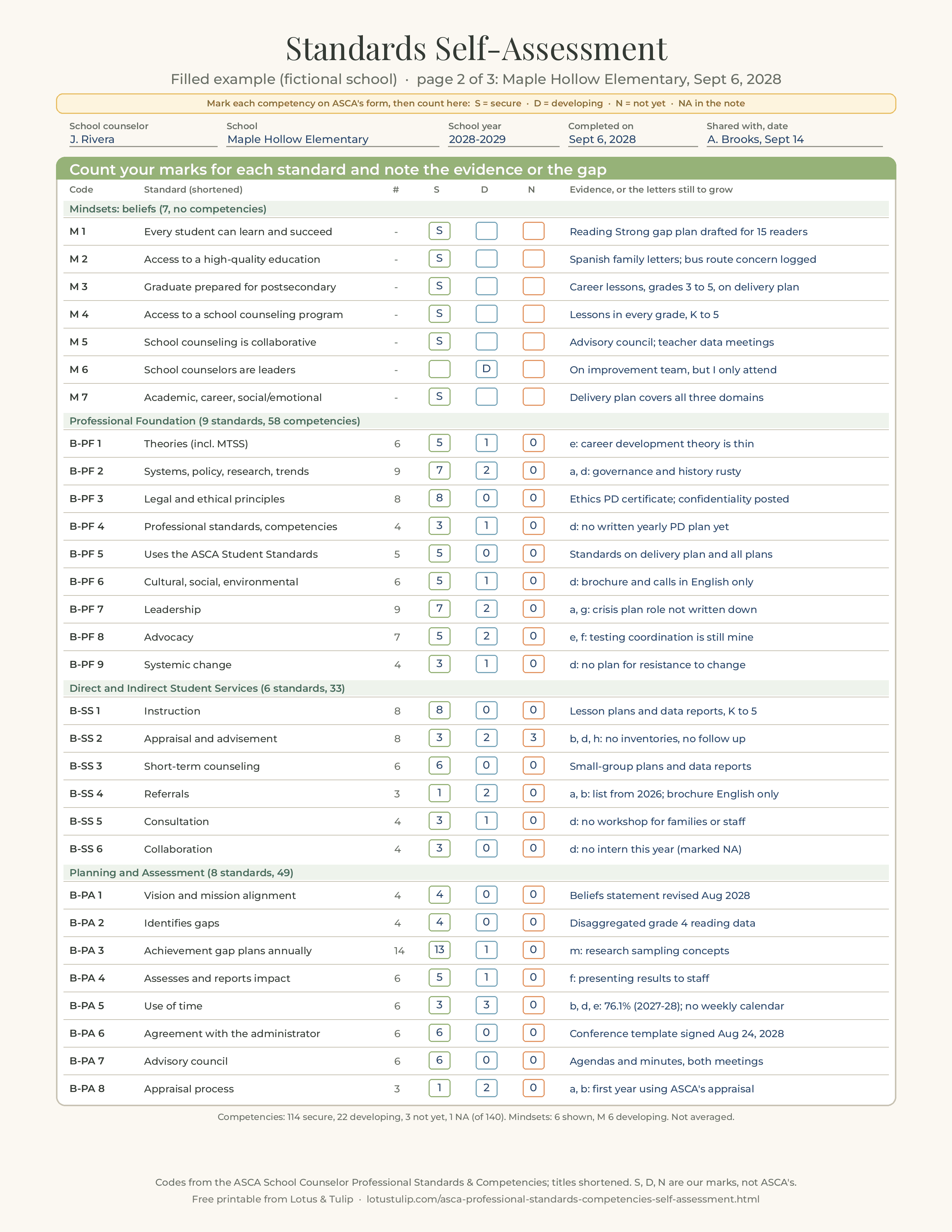
Rivera blocked 90 minutes after school, opened last year's files, and marked every line of ASCA's Assessment on paper with S, D, N or NA. She ticked only the secure lines in the fillable PDF and saved it as "PSC self-assessment 2028-09-06." Then she filled in the summary sheet (page 2 of the free printable). The results:
- Mindsets: six shown, one developing. M 6 (leaders): "On improvement team, but I only attend."
- Competencies: 114 secure, 22 developing, 3 not yet and 1 not applicable, of 140.
- The not yet marks: all three under B-SS 2 (b, d and h): no strengths or career interest inventories, no follow up on results, no workplace connections.
- Standards with two or more developing or not yet marks: B-PF 2 (a, d), B-PF 7 (a, g), B-PF 8 (e, f), B-SS 2 (c, g developing; b, d, h not yet), B-SS 4 (a, b), B-PA 5 (b, d, e) and B-PA 8 (a, b).
- Not applicable: B-SS 6 d (supervising interns), because the school had no intern this year.
| Group | Competencies | Secure | Developing | Not yet | NA |
|---|---|---|---|---|---|
| Professional Foundation | 58 | 48 | 10 | 0 | 0 |
| Direct and Indirect Student Services | 33 | 24 | 5 | 3 | 1 |
| Planning and Assessment | 49 | 42 | 7 | 0 | 0 |
| Total | 140 | 114 | 22 | 3 | 1 |
Her strengths were just as clear: every competency under B-PF 3, B-PF 5, B-SS 1, B-SS 3, B-PA 1, B-PA 2, B-PA 6 and B-PA 7 was secure, and B-PA 3 had 13 of 14. Those are the standards where the National Model templates do most of the work, and Maple Hollow had used them for two years.
Choosing three growth areas
Seven standards had more than one gap. Rivera went through the questions in order.
- Legal or ethical risk: none. B-PF 3 was all secure, and B-PF 7 g (the counselor's role in the crisis plan) was developing only because the role was not written down; she fixed that the same week by adding two lines to the school crisis plan with Brooks, so it did not need a growth area.
- Students: B-SS 2 was the only standard with not yet marks, and it touched every student in grades 3 to 5. It became area 1.
- School and appraisal: use of time had been raised at the August conference. Her 2027 to 2028 calculators averaged 76.1 percent direct and indirect student services, under ASCA's 80 percent recommendation, mainly because she coordinated state testing. B-PA 5 b, d and e and B-PF 8 e and f had the same cause, so they became one area, area 2.
- Families: the referral list dated from 2026, and the counseling brochure, which explains what counselors do and do not do, existed only in English, although many Maple Hollow families read Spanish and the advisory council already sends its agendas in both languages. B-SS 4 a and b and B-PF 6 d became area 3.
- Parked for next year: B-PF 2 a and d (governance and history; low impact on students this year), B-PA 3 m (research concepts), B-PA 8 a and b (covered by the appraisal process itself) and B-SS 2 h (workplace experiences, which she wanted to plan with the feeder middle school later).
She also named three strengths to use: the gap plan cycle (B-PA 3), advisory council practice (B-PA 7) and small-group counseling (B-SS 3), and offered to show a new counselor in the district how she runs the council.
The professional development plan
| Area | Why | What she will learn and do | Support | Evidence | Dates |
|---|---|---|---|---|---|
| 1. B-SS 2 b, d (and c, g at an elementary level) | No strengths or career interest inventory work at any grade; career lessons stop at awareness | Attend one district session on career development; choose a free, age appropriate interest inventory; plan and teach one grade 5 lesson with individual follow up | Feeder middle school counselor (what inventory grade 6 uses); Brooks for schedule time | Lesson plan and data report; follow up log in totals | Session by Nov 2028; lesson by Mar 2029; check Jan 25, 2029 |
| 2. B-PA 5 b, d, e and B-PF 8 e, f | Use of time 76.1 percent (2027-28 calculators); testing coordination; no weekly calendar | Post a weekly calendar every Monday from Sept 18, 2028; follow up the Aug 24 request to move testing coordination to the district testing team; bring use-of-time data to the request | Brooks; district testing office | Weekly calendars; written request and the district's answer | Answer by Mar 2029; check Jan 25, 2029 |
| 3. B-SS 4 a, b and B-PF 6 d | Referral list from 2026; brochure in English only | Update and verify every referral list entry; have the brochure translated through the district translation office and reviewed by a Spanish speaking parent on the advisory council | School nurse for the list; district translation office | Dated referral list; Spanish brochure | List by Sept 29, 2028; brochure by Dec 2028; check Jan 25, 2029 |
She brought the plan, not the 147 marks, to the September 14 meeting with Brooks, together with her appraisal self rating. Brooks agreed the three areas and became the support person for area 2. The same three areas appear as Rivera's September growth goals in our performance appraisal guide.
Thursday, January 25, 2029: the mid-year check
- Area 3: the referral list was updated and dated in September. The brochure had not been sent for translation.
- Area 2: weekly calendars had been posted most weeks since October. The testing coordination request was with the district, with no answer yet.
- Area 1: she had attended the district session in November, but the inventory lesson had not started. Brooks suggested moving it to the fall rather than squeezing it into testing season, and Rivera agreed to record that honestly.
June 2029: the end of year review
| Area | Status | Next step |
|---|---|---|
| 1. B-SS 2 | Learning done; lesson moved to fall 2029 by agreement | Carry over: deliver the grade 5 strengths inventory lesson with individual follow up in fall 2029 |
| 2. B-PA 5, B-PF 8 | Weekly calendars posted; district decision on testing still pending; no new use-of-time data, because the plan did not include a calculator week | Carry over with a measure: log one calculator week each semester in 2029 to 2030 and bring both to the August 2030 conference |
| 3. B-SS 4, B-PF 6 | Referral list done; brochure still English only | Fold the Spanish language goal into a new B-SS 5 d goal: one family workshop on attendance, in English and Spanish, in the first semester |
One area fully done, two partly done. Rivera's note for next year's self-assessment was short: "Every area needs a number I can check. Area 2 had actions but no measure, so in June I could not say whether my time had changed." That lesson is the most useful thing the plan produced, and it is why the 2029 to 2030 plan includes the two calculator weeks. The appraisal on June 13, 2029 rated B-PF 4 (professional standards and competencies) a 2, with "PS&C self-assessment and PD plan, Sept 2028" as the artifact.
The example is consistent with the other Maple Hollow guides: the 76.1 percent use-of-time figure appears in the RAMP reflections and the program assessment examples, and the annual administrator conference guide shows how the school ran the previous year's conference on August 26, 2027.
Using the self-assessment with your administrator and your appraisal
ASCA's documents connect the self-assessment to the appraisal in three ways: the standards say administrators use them to "Develop or inform meaningful school counselor performance appraisal," the appraisal follows the standards item by item, and the appraisal lists the completed self-assessment "with written plans for own professional growth" as an artifact. A simple yearly rhythm uses all three:
| When | What you do | What you file |
|---|---|---|
| Late August or September | Complete the self-assessment and summary; write the plan; share the plan at the administrator conference or appraisal goal meeting | Dated self-assessment, summary and plan |
| September | Do your appraisal self rating (if you use ASCA's appraisal), using the self-assessment as your first pass | Appraisal self rating |
| January | Mid-year check on each growth area | Notes on the plan page |
| May or June | End of year review of each area; appraisal meeting | Updated plan, learning log, certificates |
| Summer | Carry unfinished areas forward; note what to do differently | Notes for next year |
If your district uses a teacher evaluation instrument, the self-assessment is still useful: B-PA 8 b asks you to "Explain how school counseling activities fit within categories of a performance appraisal instrument." A plan that names ASCA competencies and the matching district domain makes that explanation easy. Our performance appraisal guide covers the appraisal itself in detail, and our evaluation crosswalk guide shows how to map a teacher form or state model to ASCA's items, row by row.
A short script for the conference: "I completed ASCA's professional standards self-assessment last week. These are the three areas I want to grow in this year, why, and what I will bring as evidence. Area 2 needs your help with the testing schedule. Could we check on all three in January?"
Other ways to use the standards
- New school counselors: expect more developing marks, especially in Planning and Assessment. Choose growth areas that build the program (B-PA 6, B-PA 3) before refinements.
- Counseling teams: each counselor self-assesses privately, then the team compares summaries to divide work by strength (one leads the council, another the gap plan) and to choose one shared growth area.
- Supervising an intern: B-SS 6 d asks you to "Supervise school counseling interns consistent with the principles of these Professional Standards & Competencies." Using the same standards with your intern is the simplest way to show that.
- District counseling leaders: the Ethical Standards ask directors and supervisors to provide professional development "related to school counseling practices, competencies and ethics." Anonymous counts of developing and not yet marks across a district show where shared training would help most. Ask counselors to share counts, not individual marks.
- Interviewing: administrators use the standards to "Guide the recruitment and selection of competent school counselors." A candidate who can name a recent growth area and what changed is answering the question the standards ask.
A checklist before you file the plan
- You used the 2025 version of the standards and the current Assessment.
- Every one of the 147 lines has a mark, and the meaning of the marks is written down.
- Each mindset has one piece of evidence or is marked developing.
- Every not applicable mark has a reason.
- The summary shows counts and one line of evidence or gap for each standard.
- You chose two or three growth areas, with competency letters.
- Any legal or ethical gap was dealt with first.
- Each area has a why, an action, support, evidence and dates.
- At least one area has a number you can check in June.
- You named two or three strengths and how you will use them.
- The plan has a mid-year check date.
- Your administrator has seen the plan.
- The files are dated and saved where next year's you can find them.
- No student names appear on anything you share.
Six real world scenarios
"I ticked almost every box." Go back and apply the evidence test to every line that begins with "Explain," "Articulate," "Use data" or "Create." A first pass of 140 out of 140 rarely survives the question "can I show it from this year?"
"I am a high school counselor and B-SS 2 is all secure." Your gaps are more likely in B-SS 3 e and f (trauma and crisis), B-PA 5 (time, scheduling and testing) or B-PA 7 (a council that meets twice). The method is the same.
"My district already requires a professional growth plan." Use the district form as the form of record and the self-assessment as the source of the goals. Write the ASCA codes next to each goal so the link is visible.
"I am the only counselor and have no one to consult." B-PF 4 c and B-SS 5 c both name consultation with other school counselors. A counselor in a neighboring district, a state association group or a former supervisor counts. Put the name in the support column.
"My principal wants to see all 147 marks." ASCA does not say who sees the self-assessment. Offer the summary and the plan; if your principal still asks for the full form, share it, but agree first that it is a growth document and not an evaluation.
"I did not finish any of my growth areas." Write down why, honestly, and what you will change. A plan with an honest June review is better evidence for B-PF 4 than a plan that was quietly forgotten. Check whether the areas were too big, had no dates, or had no support person.
Common mistakes
- Using the 2019 standards. The current version is the 2025 revision; the wording and some competencies changed.
- Ticking beliefs instead of showing them. ASCA says mindsets "are more readily recognized through the behaviors."
- Ticking without a meaning. Decide what a mark means before you start, or next year's comparison is meaningless.
- Treating the count as a score. ASCA prints no total. The pattern under each standard matters, not the sum.
- Choosing too many growth areas. Five areas in September are usually zero areas by March.
- Writing goals without competency letters. "B-PA 5" is a topic; "B-PA 5 b, d, e" is a plan.
- Plans with actions but no measure. As the Maple Hollow example shows, without a number you cannot tell in June whether anything changed.
- Learning without doing. A webinar alone rarely changes practice. Pair each learning activity with an action with students, staff or families.
- Never sharing the plan. Areas that need time or schedule changes need your administrator's agreement in September, not a surprise in June.
- Losing the file. The fillable PDF stores no date or name. Save it with the date in the file name, alongside the summary and plan.
What ASCA's documents do not tell you
We looked for each of these in the Professional Standards & Competencies, the Assessment, the Templates and Resources page, the program assessment, the performance appraisal, the Phased Implementation Plan, the fifth edition changes document, the Ethical Standards, the collected position statements and the RAMP rubric on November 11, 2026, and did not find them:
- a rating scale, levels or descriptors for the self-assessment, or what a tick means;
- how often to complete the self-assessment (B-PF 4 d asks for "a yearly professional development plan," and the program assessment asks only that the assessment "is completed");
- which month to complete it;
- who should see the completed self-assessment, and whether it should be shared with an administrator;
- a professional development plan template, format or required parts;
- how many growth areas to choose;
- any number of professional development hours;
- how to handle competencies that do not apply in a given year (there is no not applicable option);
- versions for elementary, middle or high school;
- which states have adopted the standards for licensure or renewal (the position statement says agencies "are encouraged to adopt" them).
Where this guide fills those gaps (the four marks, the summary by standard, two or three growth areas, the six part plan and the yearly rhythm), it is our practical advice, not ASCA's rule.
Free printable: self-assessment summary, filled example and PD plan
The free printable has three US Letter pages. Page 1 is a blank self-assessment summary: counselor, school, school year, the date completed and who it was shared with at the top, then all 7 mindsets and 23 behavior standards in ASCA's order (titles shortened, with the codes and the number of competencies under each), boxes for your counts of secure, developing and not yet competencies, and a line for the evidence or the letters still to grow. Page 2 is the same summary filled in for the fictional Maple Hollow Elementary self-assessment on September 6, 2028, described above. Page 3 is a professional development plan: a "how I chose" checklist, three growth areas (code and letters, why, what I will learn and do, support, evidence, by when), mid-year and end of year checks, a learning log with hours, and space for strengths and notes for next year.
Download the free self-assessment summary, example and PD plan (PDF, 3 pages)
Use it alongside ASCA's Professional Standards & Competencies Assessment, where you mark each competency. The summary counts are yours to fill in; the codes and competency counts come from ASCA's 2025 standards (our count). Keep student names off any copy you share.
Related resources
- School counselor evaluation crosswalk: map a teacher evaluation form or your state model to ASCA appraisal items, with a free worksheet
- School counselor performance appraisal: the ASCA 0 to 3 scale and artifacts for every item
- ASCA school counseling program assessment: all 25 benchmarks
- School counselor annual administrator conference: what to bring, sample agenda and talking points
- School counselor use-of-time calculator
- RAMP reflections: items 7.1, 7.2, 5.11 and 3.5 with examples
- RAMP application checklist: every fifth edition rubric item, upload and deadline
- School counselor advisory council agenda and minutes
- Closing the gap action plan: the ASCA achievement gap plan and data report
- School counseling data priorities
- All school counselor small group curriculums
Sources: American School Counselor Association (2025), ASCA School Counselor Professional Standards & Competencies (8 page PDF); ASCA, ASCA School Counselor Professional Standards & Competencies Assessment (7 page fillable PDF, in the Templates and Resources page and the All Assessments download); ASCA, Templates and Resources page; ASCA, School Counseling Program Assessment (fifth edition); ASCA, School Counselor Performance Appraisal; ASCA, ASCA National Model Fifth Edition Phased Implementation Plan; ASCA, "Changes in the ASCA National Model Fifth Edition"; ASCA, ASCA Ethical Standards for School Counselors (2022); ASCA, "The School Counselor and Annual Performance Appraisal" (revised 2026) and "The School Counselor and Credentialing and Licensure" (revised 2026), in ASCA's collected position statements; ASCA, RAMP Scoring Rubric, Fifth Edition; all checked November 11, 2026. ASCA, "The ASCA National Model: A Framework for School Counseling Programs, Fifth Edition" (our copy of the free download). The marks, summary method, selection questions, plan format, worked example and printable are original to Lotus & Tulip and are not ASCA publications.
FAQ
What are the ASCA School Counselor Professional Standards & Competencies?
A 2025 ASCA document that outlines "the mindsets and behaviors school counselors need to meet the rigorous demands of the school counseling profession and the needs of pre-K-12 students." It has 7 mindset standards (beliefs) and 23 behavior standards in Professional Foundation (B-PF 1 to 9), Direct and Indirect Student Services (B-SS 1 to 6) and Planning and Assessment (B-PA 1 to 8), with 140 lettered competencies by our count.
How do I complete the ASCA professional standards self-assessment?
Download the Professional Standards & Competencies Assessment from ASCA's Templates and Resources page, open last year's evidence, and mark all 7 mindsets and 140 competencies. ASCA gives only a blank line or checkbox, so decide your marks first (for example secure, developing, not yet, not applicable), mark each mindset by evidence of it in your work, then summarize by standard and choose two or three growth areas.
Does the ASCA self-assessment have a rating scale or score?
No. The 7 page form has a blank line before each item, and the fillable PDF has 147 on or off checkboxes. There is no scale, no descriptors, no total, no name or date field and no plan page. Any scale you use is your own; write its meaning down so you can compare from year to year.
How many growth areas should a school counselor PD plan have?
ASCA does not say. Two or three standards, each with two to four named competencies, is a practical size: enough to matter and small enough to finish. Start with any legal or ethical gap, then choose gaps that affect students most and can show progress by June.
What should a school counselor professional development plan include?
ASCA asks for "a yearly professional development plan" (B-PF 4 d) but publishes no template. For each growth area, write the standard and competency letters, why you chose it, what you will learn and do, who will support you, the evidence you will file and the dates, including a mid-year check. Keep a learning log of activities and hours.
Is the professional standards self-assessment required for RAMP?
No RAMP rubric item asks for it, but RAMP applicants must agree to abide by the ASCA Ethical Standards and the Professional Standards & Competencies. The program assessment includes the benchmark "ASCA School Counselor Professional Standards & Competencies assessment is completed," and ASCA's Phased Implementation Plan lists the checklist in Phase 1.