
Anxiety and worry · CBT skills for adults, teens and kids · Updated 2026-11-12
Worry time worksheet: how to use scheduled worry time and worry postponement (free printable)
For adult clients: Anxiety Worksheets for Therapists, 20 pages incl. a worry log, the anxiety cycle, uncertainty tolerance and a fear ladder Holiday 20% off: about $11.04, was $14 (EUR 12) · fillable PDF, instant digital download
Buy on EtsyTry it free first: download a fillable sample (worry log and fear ladder, PDF, 258 KB). Type into it on screen, then get the full pack. No email needed.
Grades 2 to 5: Calm and Brave Worry Group, an 8 session anxiety small group with breathing, thought checking and brave steps Holiday 20% off: about $11.04, was $14 (EUR 12) · instant digital download
Buy on EtsyCBT set: CBT Worksheets for Therapists, 20 pages incl. a 7 column thought record, evidence for and against and an exposure ladder Holiday 20% off: about $11.04, was $14 (EUR 12) · fillable PDF, instant digital download
Buy on EtsyTry it free first: download a fillable sample (thought record and evidence for and against, PDF, 105 KB). Type into it on screen, then get the full pack. No email needed.
Telling a worried person to "just stop worrying" rarely works. Asking them to worry later often does. Worry time, also called scheduled worry time, worry postponement or stimulus control of worry, is a simple CBT technique: you notice a worry, jot it down in a few words, and save it for a short appointment at a set time and place each day. Outside that window, you bring your attention back to what you are doing.
This guide is for therapists and counselors, school counselors, parents of kids and teens, and adults who worry too much. It covers what worry time is and why it can help, what the research actually shows (including a trial where it did not work), how to set it up step by step, what to do during the worry window, how to adapt it for children and teens, and common mistakes. It ends with a free 2 page printable: a My Worry Time plan and a Worry Time Log with a weekly tracker and an adult guide.
Download the free worry time worksheet (PDF, 2 pages, US Letter)
Direct download, no email or sign up. See the pages first.
What worry time is
Worry has a habit of showing up everywhere: in the shower, at your desk, in the car, in bed. Psychologist Thomas Borkovec and colleagues reasoned that because worry happens in so many places and at so many times, almost anything can become a cue for it. Their idea, first tested in 1983, was to shrink those cues: give worry one time and one place, and postpone it everywhere else.
In the original stimulus control instructions, as summarized by Rowland Folensbee and Thomas Borkovec, there are four parts:
- Learn to notice worrisome thoughts and tell them apart from useful, present moment thinking.
- Set a half hour worry period at the same time and in the same place every day.
- Outside the worry period, when you catch yourself worrying, postpone the worry to the worry period and turn your attention back to the present moment.
- During the worry period, worry on purpose about your concerns and problem solve the ones you can do something about.
Worry time is postponing, not suppressing. You are not told to push the thought away or never think it again. You are told "not now, at 5:30." That small difference matters, because trying hard not to think about something can make it come back more.
Why postponing a worry can help
- Fewer cues. When worry only happens in one chair at one time, the bed, the desk and the commute stop being reminders to worry.
- Practice in disengaging. Every postponed worry is a small rep of noticing a thought and choosing where to put your attention.
- A safer feeling of control. Many worriers believe worry is uncontrollable. Successfully postponing it, even for an hour, is direct evidence against that belief.
- Worries shrink with time. Many people find that by the worry window, several items on their list no longer feel urgent or have already resolved. Writing that down is useful data.
- Time to actually solve problems. The window is not only for worrying. It is a planned moment to sort worries into ones you can act on and ones you cannot control, and to make a next step for the first kind.
What the research says about worry time
Worry postponement has been studied for about 40 years, mostly in short trials with adults and older teens. The honest summary is: it helps on average, the effect is modest, and the format matters.
- Borkovec, Wilkinson, Folensbee and Lerman (1983, Behaviour Research and Therapy) reported two experiments in which self-labeled worriers received either no treatment or a 4 week trial of stimulus control instructions. Daily worry reports declined significantly in the treated groups compared with the controls.
- McGowan and Behar (2013, Behavior Modification) randomly assigned 53 people with high trait worry to 2 weeks of either stimulus control training (a daily 30 minute worry period restricted to one time and place) or a comparison condition called focused worry, where participants were told not to avoid worry when it came up. Stimulus control led to larger reductions in worry, anxiety, negative affect and insomnia, though not in depression or positive affect, and more people in that group showed clinically significant change in worry and anxiety. The authors call it preliminary support for using the technique as part of a larger treatment.
- Brosschot and van der Doef (2006, Psychology and Health) asked 171 high school students aged 16 and 17 to log their worry for 6 days. Half were told to postpone worry to a special 30 minute worry period each day. Afterwards, the postponers reported fewer physical complaints than controls, and the drop appeared to run through shorter worry duration.
- Versluis, Verkuil and Brosschot (2016, British Journal of Health Psychology) tested a simple online version with the general public: 996 people signed up, 361 finished, and the postponement group (n = 163) did not differ from the registration only group (n = 188) in worry or health complaints. Participants had high worry and reported that postponing was hard. Handing people instructions on a website, with no support, was not enough.
- Dippel, Brosschot and Verkuil (2024, International Journal of Cognitive Therapy) pooled 7 randomized trials with 999 participants, 250 of whom experienced their worry as a burden. Compared with simply registering worries, postponement had small effects on worry duration (d = 0.31) and worry frequency (d = 0.19). Practice periods ran from about a week to a month, and long term follow up studies are still missing.
What this means in practice: worry time is a reasonable, low cost tool, especially as one part of CBT for worry, but it is not a cure on its own. People seem to do better with a clear plan, a paper log and someone to review it with. There is very little research on worry time with younger children, so for kids it is a sensible adaptation of an adult technique rather than a tested treatment.
Worry time is for everyday worries, not for emergencies. If a worry is about someone being in danger right now, act on it now. If you or someone you support is thinking about suicide or self-harm, in the US call or text 988 (Suicide and Crisis Lifeline), text HOME to 741741 (Crisis Text Line), or call 911 in an emergency.
When worry time is a good fit, and when it is not
Worry time tends to fit when:
- Worry is frequent, spread through the day and hard to switch off, as in generalized anxiety or a stressful period.
- Worry is getting in the way of sleep, work, school or being present with people.
- The person is willing to try an experiment for 2 to 4 weeks and keep a short log.
Choose something else first, or add other support, when:
- Thoughts are intrusive and followed by rituals, as in OCD. Postponing can turn into another form of avoidance or reassurance. See our ERP worksheets for OCD and work with a clinician trained in exposure and response prevention.
- The main problem is panic attacks or trauma memories. Those need their own approach, such as our panic attack worksheet or trauma focused care.
- Low mood, hopelessness or thoughts of self-harm are present. Talk with a doctor or therapist and use the crisis lines above.
- A child's worry is about something unsafe happening at home or school. That is not a worry to postpone. It needs an adult to act.
How to set up worry time, step by step
- Explain the idea in one sentence. "You are allowed to worry, just not all day. We are going to give your worries an appointment." Make clear this is postponing, not banning thoughts.
- Pick a time. Choose the same time every day, often late afternoon or early evening. Avoid the last hour before bed, so worry time does not become bedtime worry.
- Pick a place. A specific chair or spot that you do not use for sleep, work or relaxing. Not the bed and not your work desk.
- Set the length. The research protocols used 30 minutes. Many people start with 15 to 20 minutes, and children usually need 10 to 15 minutes with an adult. Use a timer and stop when it rings.
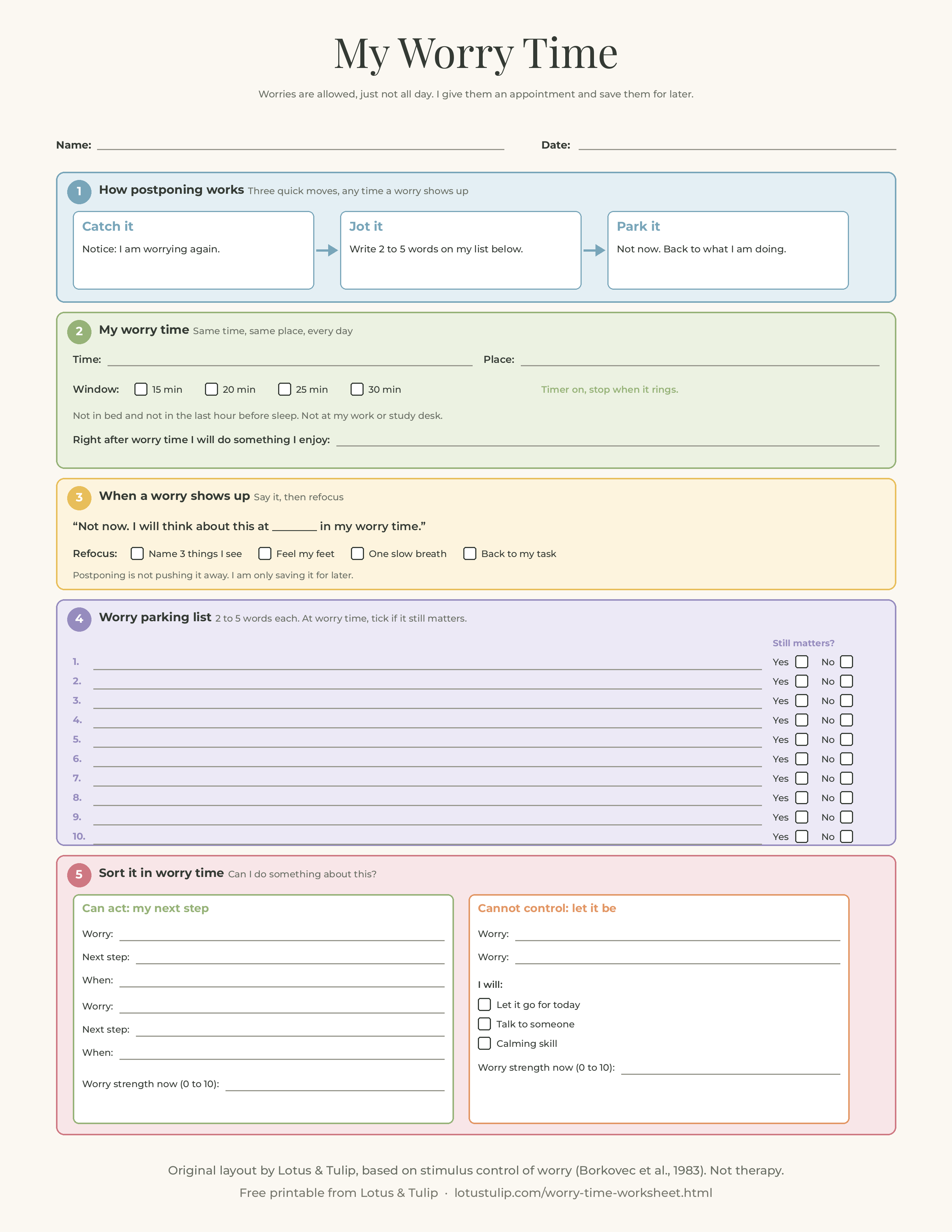
- Catch it, jot it, park it. During the day, when a worry shows up, write 2 to 5 words on a worry list, a sticky note or your phone. Say to yourself "Not now, at my worry time," then bring your attention back to what you are doing by noticing something you can see, hear or touch.
- Use the worry window on purpose. At the set time, sit in your spot and read the list. Cross off anything that no longer matters. Worry about the rest deliberately, and write freely if that helps.
- Sort each worry. Ask: "Can I do something about this?" If yes, write one small next step and when you will do it. If no, write "outside my control" and choose a coping response, such as letting it go for today, talking to someone or using a calming skill.
- Close the window. When the timer rings, stop, even mid worry. Do something pleasant or absorbing straight afterwards, such as a walk, a call, cooking or a game, so the window has a clear end.
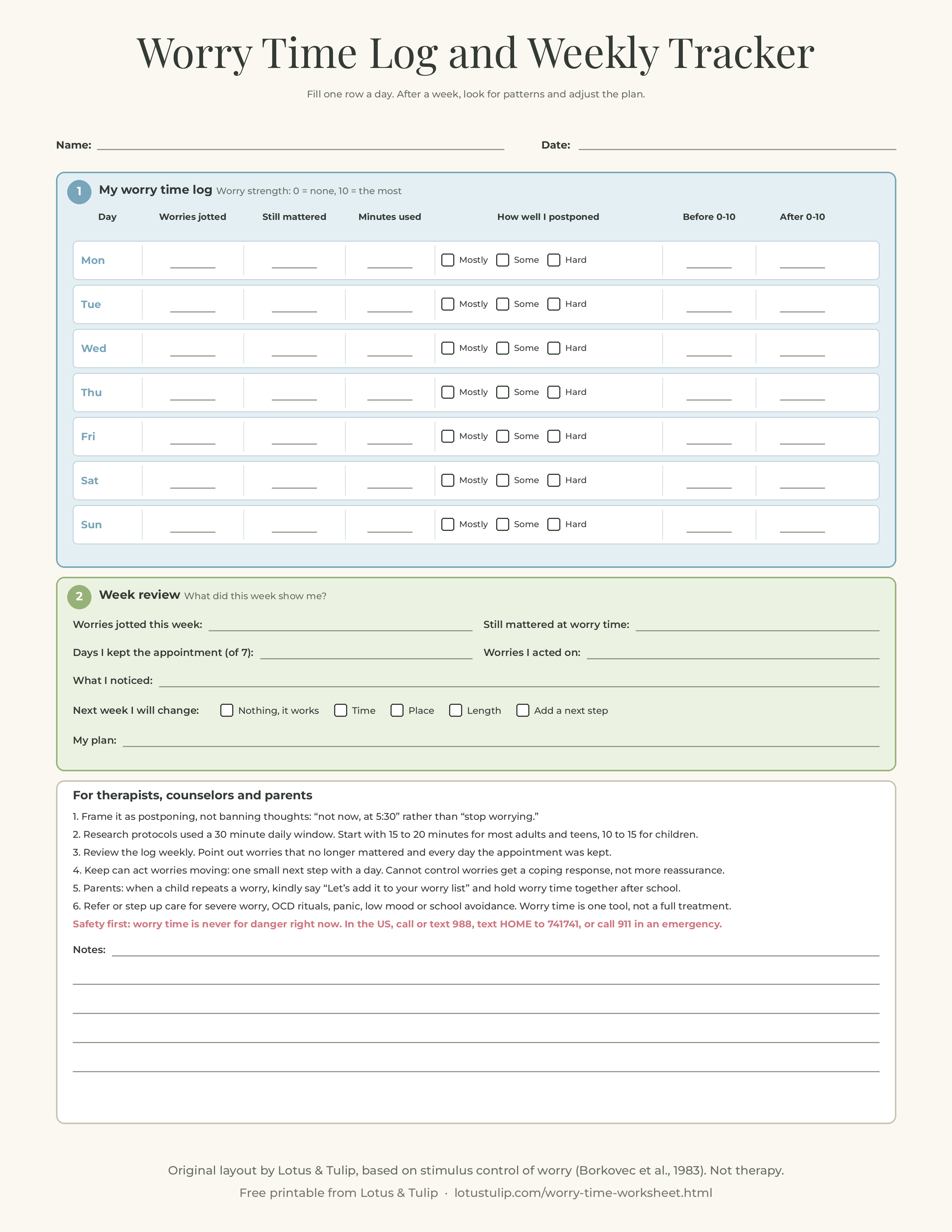
- Track it and review weekly. Each day, note how many worries you jotted, how many still mattered at worry time, and how well you postponed. After a week, review the log with your therapist, counselor or parent, and adjust the time, place or length.
What to do during the worry window
A good worry window has a beginning, a middle and an end:
- Beginning (2 minutes). Read your list. Put a line through worries that have resolved or no longer bother you. Notice how many there are. That number is worth tracking.
- Middle (10 to 20 minutes). For each remaining worry, decide: can act, or cannot control. For can act worries, write one concrete step ("email the teacher Thursday," "check the bill online tonight"). For cannot control worries, allow yourself to think about them fully for a few minutes, then let them go for today. A worry tree or circle of control worksheet can help with the sort.
- End (2 to 5 minutes). Rate how strong your worry feels now, from 0 to 10. Plan one pleasant thing for right after. Close the notebook.
Some therapists use the window for deliberate, even intensified worry, so that the person learns that thinking a worry through does not lead to disaster. Others focus more on problem solving. Both fit the original instructions, which included worrying on purpose and problem solving the concerns you can do something about.
Worry time for kids and teens
Parents and school counselors often adapt worry time for children. Because the research is mostly with adults and older teens, keep it simple, short and supported:
| Age | What worry time looks like | Adult role |
|---|---|---|
| Ages 5 to 8 | A worry box or jar. The child draws or says the worry, an adult writes 2 or 3 words on a slip, and it goes in the box. Worry time is 10 minutes after school with a parent. | Hold the slips, read them together, praise every postponed worry, end with a game or story. |
| Ages 9 to 12 | A worry list on page 1 of the printable, a fixed 10 to 15 minute time, sorting worries into "I can do something" and "not mine to control." | Help with one small step for can act worries. Do not answer the same worry over and over. |
| Teens | A notes app or the log, a 15 to 20 minute window, sorting and problem solving mostly on their own. | Check in weekly, not daily. Respect privacy. Watch for low mood or school avoidance. |
For more child friendly tools, see our worry worksheet for kids with worry box slips, and for school counselors, the Calm and Brave worry group.
Common mistakes
- Turning it into suppression. "Don't think about it" is not the instruction. "Save it for later" is.
- Worry time in bed. Bed should be for sleep. A worry window right before sleep can keep you up.
- No end. A window without a timer slides into an evening of rumination. Stop when the timer rings.
- Skipping the window. If you postpone worries but never hold the appointment, it becomes avoidance. Keep the appointment, even on calm days, even if it lasts 2 minutes.
- Only worrying, never acting. Can act worries need a next step written down, or they come back tomorrow.
- Giving reassurance all day. For parents: answering the same anxious question again and again teaches the child that worry needs an immediate answer. Kindly say "Let's put that on your worry list."
- Judging it after one day. Postponing is a skill. Give it 2 to 4 weeks with a log, then review.
Free worry time worksheet and log
This free printable is an original Lotus & Tulip layout on US Letter. Page 1, My Worry Time, is the plan: how postponing works in three moves (catch it, jot it, park it), my worry time with the time, place and a 15 to 30 minute window, a "Not now" script and refocus ideas, a 10 line worry parking list, and a sort grid for can act (with a next step) and cannot control (with a coping response). Page 2, Worry Time Log and Weekly Tracker, has a 7 day log (worries jotted, still mattered, minutes used, postpone rating, worry 0 to 10 before and after), a week review and a guide for therapists, counselors and parents, with crisis lines.
Download the free worry time worksheet (PDF, 2 pages, US Letter)
Prefer single images? Page 1: My Worry Time (PNG) · Page 2: Worry Time Log and Weekly Tracker (PNG)
Free to print for use with your own clients, students, children or yourself. Please link to this page rather than re-uploading the file. A self-help and teaching tool, not therapy or a diagnosis.
Related resources
- Overthinking worksheet for adults: sort a loop into replaying, what ifs or a stuck decision, with a free map and plan
- Stress management worksheet for adults: when worry is part of a wider stress load, with a free stress map and plan
- Intrusive thoughts worksheet: when the thought is a sudden unwanted image or urge rather than a worry, free printable
- Rumination worksheet: stop overthinking loops by switching from why to how (free printable)
- Worry tree worksheet: a step by step decision tool for the can act or cannot control sort
- Journaling prompts for anxiety: 39 prompts and a free worry journal page to use during your worry time
- Health anxiety worksheet: postpone illness worries and cut back checking and reassurance, free printable
- Worry worksheet for kids: worry detective, a worry box and brave steps
- Worry group curriculum for elementary students
- Anxiety worksheets for adults (free printable)
- Anxiety worksheets for kids (free printable)
- Free anxiety worksheets for therapists: 8 page starter pack
- Circle of control worksheet
FAQ
What is a worry time worksheet?
It is a short plan and log for scheduled worry time. You choose a daily time and place for a 15 to 30 minute worry window, jot worries down during the day instead of dwelling on them, then use the window to sort each worry into ones you can act on and ones you cannot control. The log tracks how well postponing is working.
Does scheduled worry time actually work?
On average, yes, but modestly. A 2024 meta-analysis of 7 randomized trials with 999 participants found small reductions in how long and how often people worried, compared with just recording worries. A small 2013 trial found larger drops in worry, anxiety and insomnia than a comparison condition. A plain online version without support did not work in one large trial, so a clear plan and review help.
How long should worry time be?
The research protocols used a 30 minute worry period. Many people start with 15 to 20 minutes, and children usually do best with 10 to 15 minutes alongside an adult. Use a timer and stop when it rings.
When is the best time for worry time?
The same time every day, often late afternoon or early evening, in the same place. Avoid the last hour before bed and avoid your bed or work desk as the spot, so those places stop being cues for worry.
Can kids use worry time?
Yes, with adaptations: a worry box or a short written list, a 10 to 15 minute time with a parent or counselor, and something fun right after. Most research is with adults and older teens, so treat it as a helpful adaptation and get professional help if worry is severe or a child avoids school, sleep or friends.
Is this worry time worksheet free?
Yes. It is free to print for use with your own clients, students, children or yourself. Please link to this page rather than re-uploading the file.
Sources
- Borkovec, T. D., Wilkinson, L., Folensbee, R., and Lerman, C. (1983). Stimulus control applications to the treatment of worry. Behaviour Research and Therapy, 21(3), 247 to 251. doi:10.1016/0005-7967(83)90206-1
- Brosschot, J. F., and van der Doef, M. (2006). Daily worrying and somatic health complaints: testing the effectiveness of a simple worry reduction intervention. Psychology and Health, 21(1), 19 to 31. doi:10.1080/14768320500105346
- Dippel, A., Brosschot, J. F., and Verkuil, B. (2024). Effects of worry postponement on daily worry: a meta-analysis. International Journal of Cognitive Therapy, 17(1), 160 to 178 (published online 2023). doi:10.1007/s41811-023-00193-x
- Folensbee, R., and Borkovec, T. D. Stimulus control of worry. Common Language for Psychotherapy (CLP) Procedures, commonlanguagepsychotherapy.org.
- McGowan, S. K., and Behar, E. (2013). A preliminary investigation of stimulus control training for worry: effects on anxiety and insomnia. Behavior Modification, 37(1), 90 to 112. doi:10.1177/0145445512455661
- Versluis, A., Verkuil, B., and Brosschot, J. F. (2016). Reducing worry and subjective health complaints: a randomized trial of an internet-delivered worry postponement intervention. British Journal of Health Psychology, 21(2), 318 to 335. doi:10.1111/bjhp.12170