
Kids and teens · Updated 2026-11-07
Time Management Activities for Teens (with Free Printable)
Ready-made printable: Executive Function Group Curriculum Holiday 20% off: about $11.04, was $14 (EUR 12) · instant digital download
Buy on EtsyTry it free first: download session 1 free (group at a glance, lesson plan and student page, PDF, 69 KB). Run it with your group, then get all 8 sessions. No email needed.

Time management activities for teens are short, practical rounds that help middle and high school students estimate how long work really takes, map a week or a day, prioritize with must / should / could, protect focus blocks, break big tasks into first tiny steps, pad transitions, review what slipped without shame, and name digital time drains. This guide is for school counselors, therapists, teachers and parents who work with teens about ages 12 to 18. It gives twelve activities you can run tomorrow: a time estimate calibration, a week load map, a must / should / could sort, a focus block design, a task break-down ladder, a transition buffer pad, a digital drain audit, a phone park experiment, an evening review loop, a two-home or two-job schedule puzzle, a sleep window check next to the plan, and a peer planning teach-back. Each comes with timing, setup, debrief and adaptations, plus a free three page printable.
This page is distinct from our study skills activities for teens, which go deep on retrieval, spacing and focus methods for learning content. It sits next to executive functioning worksheets for kids (building blocks for younger students), goal setting worksheet for students (longer-range goals), impulse control activities for teens (STOP / THINK urges), problem solving activities for teens, flexible thinking worksheet, stress management worksheets for teens, growth mindset activities for teens and self advocacy activities for students. Those pages go deep on neighboring skills. This one is about the time management loop itself: estimate, plan, prioritize, protect focus, break tasks, buffer, review, and adjust digital drains. It is not tutoring, not an ADHD cure, and not a study technique deep dive.
We credit the sources these activities lean on, without claiming any affiliation or endorsement: Claessens, van Eerde, Rutte and Roe (2007) time management literature review neighbors; Macan and colleagues' Time Management Behavior Scale (TMBS) neighbors on goal setting, mechanics and perceived control of time; Diamond's executive function framing (planning as a higher-order skill built on working memory, inhibition and flexibility); ASCA Student Standards B-LS 3 on time-management, organizational and study skills; CASEL self-management; and, where sleep timing matters for the plan, the American Academy of Sleep Medicine consensus (Paruthi and colleagues, 2016) that teenagers ages 13 to 18 generally need 8 to 10 hours of sleep per 24 hours. The printable is an original Lotus and Tulip layout, not a copy of any of their materials.
This guide is educational. It is not therapy and not a diagnosis. Time management practice does not cure ADHD, a learning disability, depression or anxiety, and it does not erase unfair workloads or missing supports. If a conversation turns up thoughts of ending a life, self harm, a plan to hurt someone, abuse or a medical emergency, stop the activity and get help now: in the US, call or text 988 (Suicide and Crisis Lifeline), text HOME to 741741 (Crisis Text Line), or call 911. Our safety plan worksheet is a better first tool in that moment.
Jump to the free time management printable (PDF) · Activities · How to use time management activities for teens, step by step · Worked examples · Comparisons
What time management is (and is not) for teens
For this page, time management means a repeatable loop: estimate how long a task will take, plan the day or week with real constraints (school, sleep, work, family, fun), prioritize what must happen today, protect at least one focus block, break oversized tasks into a first tiny step, leave buffer for transitions, review what slipped, and adjust digital drains. Popular advice often stops at "make a pretty planner." Useful teen practice starts with honest estimates and ends with a kind review.
It is not:
- A color-coded planner cult. Fancy layouts help some teens and overwhelm others. The skill is the loop, not the stationery.
- Tutoring for content. Knowing how to schedule study time is different from knowing algebra. Pair with study skills activities for teens when the gap is how to learn, not when to learn.
- A cure for ADHD. Planning scaffolds can help many teens, including some with ADHD, but they do not treat ADHD. Prefer evaluation, accommodations and clinical care when attention or executive function is the main barrier. Neighbor pages such as executive functioning worksheets for kids and our ADHD worksheets product are planning neighbors, not treatments.
- Long-range goal setting alone. SMART semester goals matter; this page is the day and week loop. Use goal setting worksheet for students when the need is longer horizons.
- Impulse control or urge surfing. Stopping a snap text is different from blocking 25 minutes for a lab report. See impulse control activities for teens for STOP / THINK work.
- A fix for an impossible load. If the schedule has no sleep window, no travel time and three simultaneous "musts," adults need to shrink the load. Time management does not magic extra hours.
Why teens need teen-shaped time management
Estimates are usually optimistic. Many teens (and adults) guess 20 minutes for a task that takes 45. Calibration practice, guessing then checking real minutes, builds the skill research neighbors call time management mechanics.
Schedules collide. Classes, jobs, sports, family care, two homes, and group chats all compete. A week map that includes sleep and transitions is more honest than a homework-only list.
Phones steal focus blocks. A plan that ignores notifications is a wish. Teens need concrete experiments: phone parked, one app closed, one 25 minute round.
Sleep is part of the plan. The American Academy of Sleep Medicine (Paruthi and colleagues, 2016) recommends 8 to 10 hours per 24 hours for ages 13 to 18. A "productive" late night that cuts sleep often costs the next day's focus. Mention sleep as a constraint, not as a lecture that replaces clinical sleep care.
Effects in research are real and mixed. Reviews find time management behaviors often link to more perceived control of time and less stress, while links to performance are less clear, and training does not automatically raise grades. That is a reason to teach useful habits without miracle claims.
Time management activities teens will actually do
Each activity lists time, group size, setup and debrief. Run one or two per session. Early activities build estimation and prioritization; middle ones build focus and buffers; later ones tackle digital drains, sleep windows and peer teach-back.
1. Time estimate calibration
Time: 15 minutes. Group: individual, then pairs. Setup: a short real task (read two pages, outline a paragraph, tidy a binder section) plus a timer.
Teens write a guess in minutes, do the task, write the real time, and compute the gap. Pair share: were you early, late or close? Debrief: optimism is common; the skill is updating the next guess. Teaching point: Macan-style "mechanics" include planning with realistic times, not wishful ones.
2. Week load map
Time: 20 minutes. Group: individual. Students sketch seven days with school blocks, sleep window, work or sports, family duties, and open slots. Mark one overloaded day in a different color (or with a star). Debrief: which day has no buffer? Teaching point: a plan that ignores sleep and travel is not a plan. Pair with stress management worksheets for teens when overload is mostly emotional load, not only clock load.
3. Must / should / could sort
Time: 15 minutes. Group: individual or small groups. Cards or sticky notes with real tasks. Sort into must (due or safety-critical today), should (important soon), could (nice if time). Cap musts at three when possible. Debrief: what got demoted, and why? Teaching point: priority is a choice about today, not a moral ranking of the teen's worth.
4. Focus block design
Time: 15 minutes. Group: individual. Design one protected block: when, where, length (often 20 to 30 minutes), task, phone location, and a reset if distracted. Run a micro version in session if possible. Debrief: what broke the block? Teaching point: focus is scheduled, not hoped for. This is not a full Pomodoro curriculum; keep it one honest block.
5. Task break-down ladder
Time: 15 minutes. Group: individual. Take one oversized task ("write history paper") and write five rungs ending in a first tiny step (10 minutes or less). Debrief: which rung can you start tonight? Teaching point: breaking tasks is planning, and it overlaps with problem solving activities for teens when the teen is stuck on how, not only when.
6. Transition buffer pad
Time: 10 minutes. Group: pairs. List today's switches (class to practice, school to job, home A to home B). Add 5 to 15 minutes of buffer to each. Debrief: where do you always run late? Teaching point: transitions are real work; schedules that stack back-to-back without padding fail by design.
7. Digital drain audit
Time: 15 minutes. Group: individual, optional share. List top three apps or sites that steal time after school. For each: usual minutes, what it costs (sleep, homework, calm), and one bound (time limit, app off during focus, charger outside bedroom). Debrief: which drain is automatic versus chosen fun? Teaching point: fun can stay; unmanaged drains crowd out musts.
8. Phone park experiment
Time: 20 minutes including a short practice. Group: whole group. Agree on a park spot (bag, box, other room). Run one 15 minute focus round on a real task. Debrief: urge to check, then what helped. Teaching point: this neighbors impulse control without replacing it; if urges dominate, add impulse control activities for teens.
9. Evening review loop
Time: 10 minutes. Group: individual. End-of-day prompts: What slipped? Why (estimate off, drain, overload, unclear task, energy)? One adjust for tomorrow. Keep tone kind and specific. Debrief: reviews without blame stick better. Teaching point: Claessens and colleagues note training can improve skills without automatically raising performance; review is how skills become habits.
10. Two-context schedule puzzle
Time: 20 minutes. Group: individual. For teens with two homes, a job, or caregiving duties, map both contexts and the handoff. Mark materials that must travel. Debrief: what always gets left behind? Teaching point: logistics are time management; shame is not a strategy. Link self advocacy when teens need to ask adults for clearer handoffs: self advocacy activities for students.
11. Sleep window next to the plan
Time: 10 minutes. Group: individual. Mark a target sleep window that aims toward 8 to 10 hours for ages 13 to 18 (AASM 2016 neighbor). Check whether tonight's plan leaves that window intact. If not, cut a could, not the sleep window, when possible. Debrief: which "could" is stealing sleep? Teaching point: mention the consensus range honestly; do not diagnose sleep disorders or replace medical care. See also sleep hygiene worksheet when sleep habits need their own page.
12. Peer planning teach-back
Time: 15 minutes. Group: pairs. Each teen teaches their partner one estimate miss, one must / should / could choice, and one focus block design. Debrief: teaching the loop deepens it. Teaching point: social accountability can help without turning into public shaming.
How to run these activities in a group or session
Set norms first. Pass is always allowed. Nobody is labeled "lazy" for a bad estimate. Celebrate calibration and protected focus, not only finished checklists. End each session with one carry over: one must list, one focus block, or one evening review.
Suggested six session sequence. Session 1: time estimate calibration and must / should / could sort. Session 2: week load map and transition buffer pad. Session 3: focus block design and phone park experiment. Session 4: task break-down ladder and digital drain audit. Session 5: two-context schedule puzzle and sleep window check. Session 6: evening review loop, peer teach-back, and review of the practice log.
Classroom or advisory version. In one period, run estimate calibration (10 minutes), must / should / could for tonight (10 minutes), and design one focus block (10 minutes). Send the printable home.
Adaptations
- Middle school (about 11 to 14): shorter blocks (15 to 20 minutes), more visual week maps, adult help with must caps, concrete phone park spots.
- High school (about 14 to 18): add job and activity calendars, two-context puzzles, sleep window honesty, and college or work application deadlines as musts when real.
- ADHD: externalize the plan (visible timers, written musts, body doubling when available), shorter focus rounds, and clear first tiny steps. Do not claim time management treats ADHD. Prefer evaluation and accommodations when attention or executive function is the main barrier. Neighbor: ADHD worksheets for therapists product pages for planning supports, used as skill aids only.
- Anxious teens: keep must lists short, allow written plans instead of public share, and separate "enough for today" from "catch up everything tonight." Link anxiety activities for teens when worry is broader than scheduling.
- Perfectionism: emphasize good-enough first steps and unfinished drafts as planned chunks. Pair with perfectionism worksheet for teens so planning does not become another impossible standard.
- Virtual groups: shared timers, chat based must lists, private messages for two-home logistics, camera-off focus rounds with a return check-in.
How to use time management activities for teens, step by step
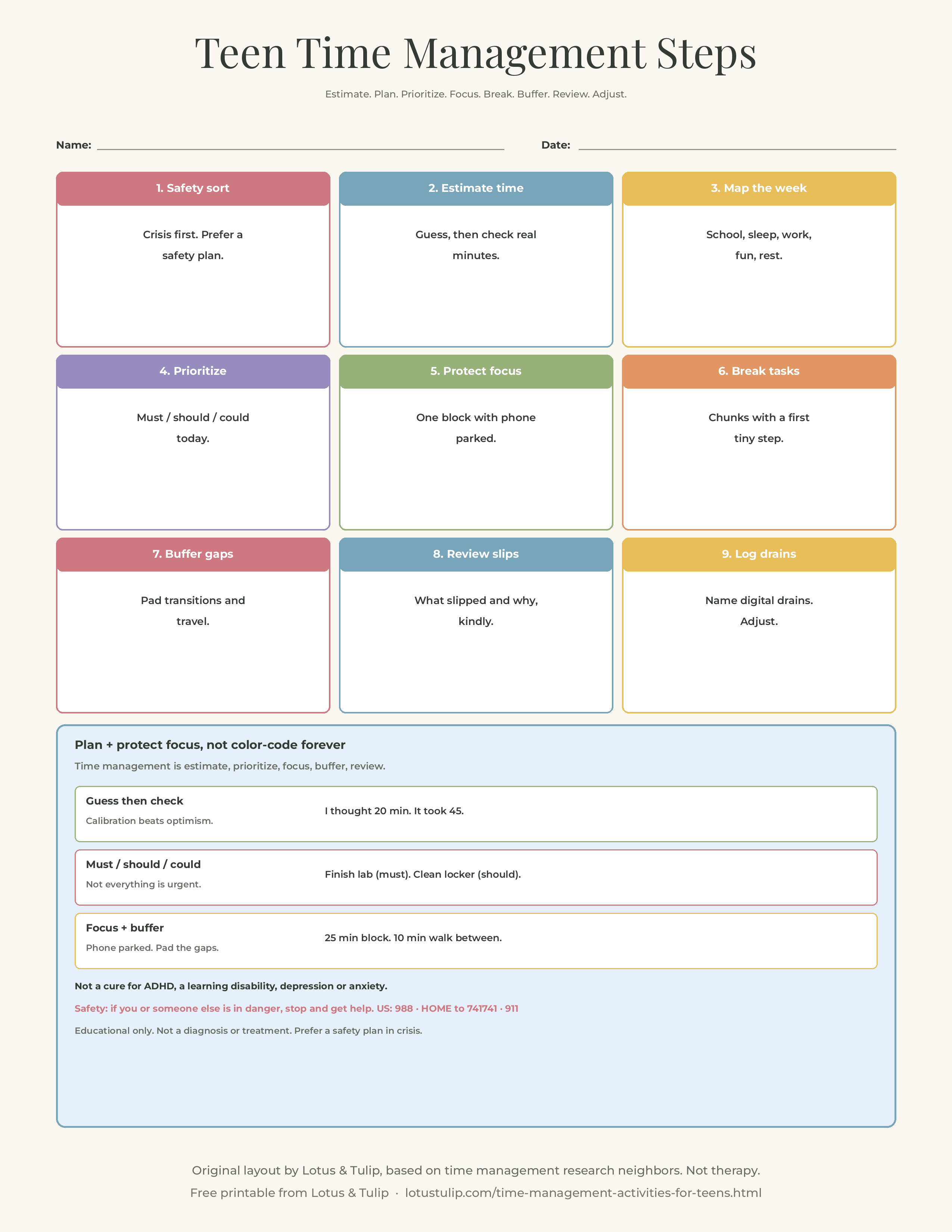
- Safety sort. Check that this is a planning question and not a crisis. Thoughts of ending a life, self harm, a plan to hurt someone, abuse or a medical emergency come first: 988, HOME to 741741, or 911 when needed, plus a safety plan.
- Estimate time honestly. Guess minutes for a real task, then check the real time and update the next guess.
- Map the week or day. Include school, sleep, work, family, fun and travel, not only homework.
- Prioritize with must / should / could. Cap musts when you can. Demote without shame.
- Protect a focus block. Choose when, where, length and a phone park. Do one block.
- Break big tasks. Write chunks and a first tiny step of 10 minutes or less.
- Buffer for transitions. Pad switches between places and roles.
- Review what slipped. Name why kindly (estimate, drain, overload, unclear task) and pick one adjust.
- Log digital drains and adjust. Bound the top drains. Repeat the loop tomorrow.
Practice on small school nights first. The same loop helps with bigger projects and two-context weeks later.
School counselor, therapist, teacher and parent tips
School counselors. Time management fits ASCA-aligned academic development work, especially B-LS 3 (time-management, organizational and study skills) and self-management neighbors. Keep groups practical: estimates, must lists, focus blocks. Measure small changes such as more on-time starts and fewer all-nighters, not perfect planners.
Therapists. Use calibration and evening review when teens freeze under overload. Watch for ADHD, anxiety or depression as the main driver and treat those directly. Planning language is a skill aid, not a stand-alone treatment.
Teachers. Publish due dates early, break multi-step projects into dated chunks, and allow revision windows. Model your own estimate misses out loud. A syllabus that stacks three major deadlines on one day teaches the opposite of buffer.
Parents and caregivers. Help with a shared week map, not a takeover. Ask "what is your must tonight?" and "when is your focus block?" Support evaluation if chronic lateness and unfinished work look like possible ADHD or a learning disability rather than only "attitude."
Worked fictional examples
The optimistic estimate (fictional). Priya, 14, always wrote "20 minutes" for science reading that took closer to 50. In calibration she logged three real gaps, then planned a 50 minute block with a 10 minute buffer. Carry over: the next quiz week had fewer late nights because the map matched reality.
The endless should list (fictional). Jordan, 16, listed twelve shoulds and zero musts, then froze. Must / should / could capped musts at three: submit the lab, reply to the coach, pack for the other home. Carry over: finishing three beats starting twelve.
The phone-killed focus block (fictional). Sam, 15, opened "study mode" with the phone on the desk face up. After the phone park experiment, the phone went in a bag across the room for one 25 minute block. Carry over: urge still showed up; the park made finishing possible.
The two-home materials miss (fictional). Alex, 13, left the binder at home A before a home B homework night. The two-context puzzle added a Sunday pack list and a photo of the locker. Carry over: logistics, not laziness.
Counselor small group note (fictional). In a six session eighth grade time management group, the counselor banned the word "lazy." Students practiced estimates and focus blocks. One student shared hopeless talk about never catching up that went beyond deadlines; the counselor followed up privately with school protocol and a safety check.
Time management activities for teens vs study skills teens, EF kids, goal setting, impulse teens, problem solving teens, stress teens and growth mindset teens
| Time management teens (this page) | Study skills teens | EF kids | Goal setting students | Impulse teens | Problem solving teens | Stress teens | Growth mindset teens | |
|---|---|---|---|---|---|---|---|---|
| Main job | Estimate, prioritize, focus blocks, buffer, review, digital drains | Retrieval, spacing, focus methods for learning | EF building blocks for younger kids | Longer-range SMART goals | STOP / THINK urges | Define, brainstorm, pick, try, review | Stress signals and coping | Fixed thought to strategy swap |
| Best early use | Missed deadlines, optimistic estimates, phone-killed evenings | When methods of studying are the gap | Younger EF practice | When goals need structure | When snap urges dominate | When the problem is unclear | When stress load is the theme | When labels and setbacks dominate |
| Output | Time management plan, practice log, mini card | Study skills plan | EF worksheets | Goal builder | Impulse plan | Problem solving plan | Stress toolkit | Growth mindset plan |
| Link | This page | Study skills teens | EF kids | Goal setting | Impulse teens | Problem solving teens | Stress teens | Growth mindset teens |
These tools work together. This page is the teen activity layer for the day and week time loop. When the main need is study methods, younger EF practice, long-range goals, urge control, problem solving steps, stress coping or growth mindset language, go to the matching page.
What helps vs common myths
What often helps: guess-then-check estimates, capped must lists, one protected focus block, visible first tiny steps, padded transitions, kind evening reviews, phone parks, and adults who shrink impossible loads.
Common myths: "Time management means a perfect planner." (The loop matters more than the layout.) "If they cared, they would just do it." (Skills, ADHD, sleep, anxiety and load all matter.) "More hours always equal more learning." (Focus quality and sleep often beat marathon cram nights.) "Apps will fix it." (Tools help only when the loop is practiced.)
Common mistakes
- Planning without estimating. Pretty lists with fantasy times fail.
- Unlimited musts. Everything urgent means nothing is prioritized.
- Focus with the phone face up. Hope is not a park plan.
- No buffers. Back-to-back blocks ignore real transitions.
- Shame reviews. Blame blocks learning; specific adjusts build skill.
- Skipping crisis checks. Overwhelm talk can hide self harm risk; know when to switch to a safety plan.
- Overselling research. Skills and perceived control often improve more clearly than grades; teach honestly.
When time management activities are not the right tool
- Crisis or safety concerns. Thoughts of ending a life, self harm, a plan to hurt someone or abuse come first. Use 988, HOME to 741741 or 911, a safety plan and your reporting protocol.
- Suspected ADHD or learning disability. Prefer school or clinical evaluation and accommodations. Planning scaffolds can sit alongside; they do not replace assessment or treatment.
- Depression or anxiety as the main driver. Treat those directly with appropriate care. Scheduling aids are not a cure. See neighboring depression and anxiety teen pages.
- When the load is impossible. If adults stacked an unsustainable schedule, shrink the load. Do not tell teens to time-manage their way through a broken setup alone.
What the research says (honestly)
Literature review neighbor. Claessens, van Eerde, Rutte and Roe (2007) reviewed 32 empirical time management studies (1982 to 2004) in Personnel Review. They reported that time management behaviors related positively to perceived control of time, job satisfaction and health, and negatively to stress, while the relationship with work and academic performance was not clear. Training often improved time management skills without automatically transferring to better performance. Treat that as a reason to teach the loop and measure habits, not to promise grade miracles.
Behavior scale neighbor. Macan, Shahani, Dipboye and Phillips (1990) developed the Time Management Behavior Scale with college students, with factors often discussed as goal setting and priorities, time management mechanics (lists, planning, scheduling), preference for organization, and perceived control of time. Later work (including Macan, 1994) treated perceived control as especially important. This page borrows the practical idea (goals, mechanics, control) as a teaching neighbor. Lotus and Tulip is not affiliated with the authors, and this printable is not the TMBS.
Executive function neighbor. Adele Diamond's reviews describe planning as a higher-order executive function built on working memory, inhibition and cognitive flexibility, with development continuing through adolescence. Time management activities for teens are practical planning practice, not a lab measure of EF and not a treatment claim.
School counseling and SEL neighbors. ASCA Student Standards include B-LS 3: time-management, organizational and study skills, under learning strategies for academic development. CASEL's self-management competency is a neighboring frame for managing time and tasks. Lotus and Tulip is not affiliated with ASCA or CASEL.
Sleep timing neighbor (when relevant). Paruthi and colleagues (2016), for the American Academy of Sleep Medicine, recommend that teenagers ages 13 to 18 sleep 8 to 10 hours per 24 hours on a regular basis. Plans that erase that window often trade tonight's output for tomorrow's attention. This is context for scheduling, not a sleep disorder diagnosis.
Honest limits. No study tests this three page printable or this exact activity set. Treat this as a practical skill practice aid built on well known research neighbors, not a standalone randomized curriculum and not a treatment for any condition. Do not invent effect sizes; do not claim it treats ADHD.
Free time management printable for teens (PDF)
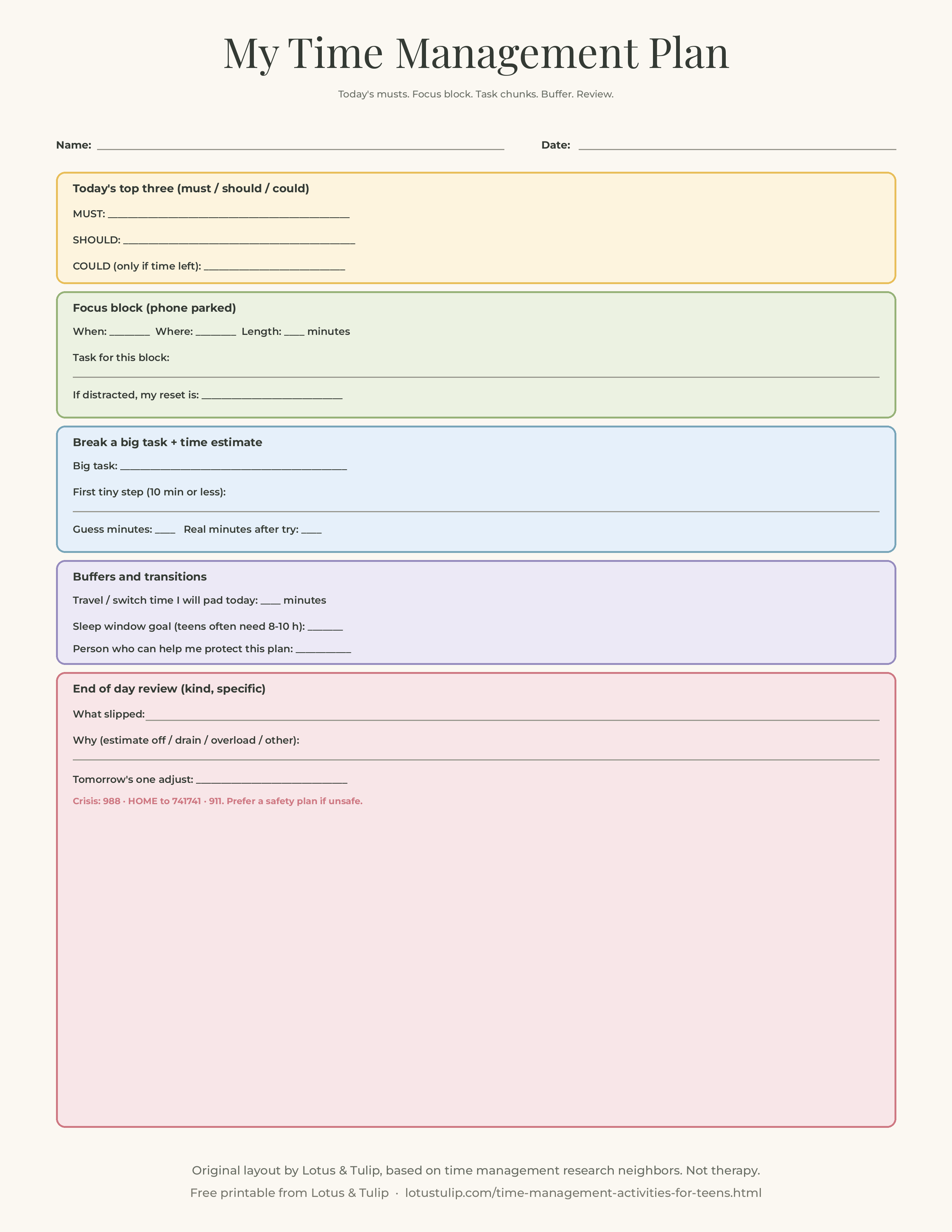
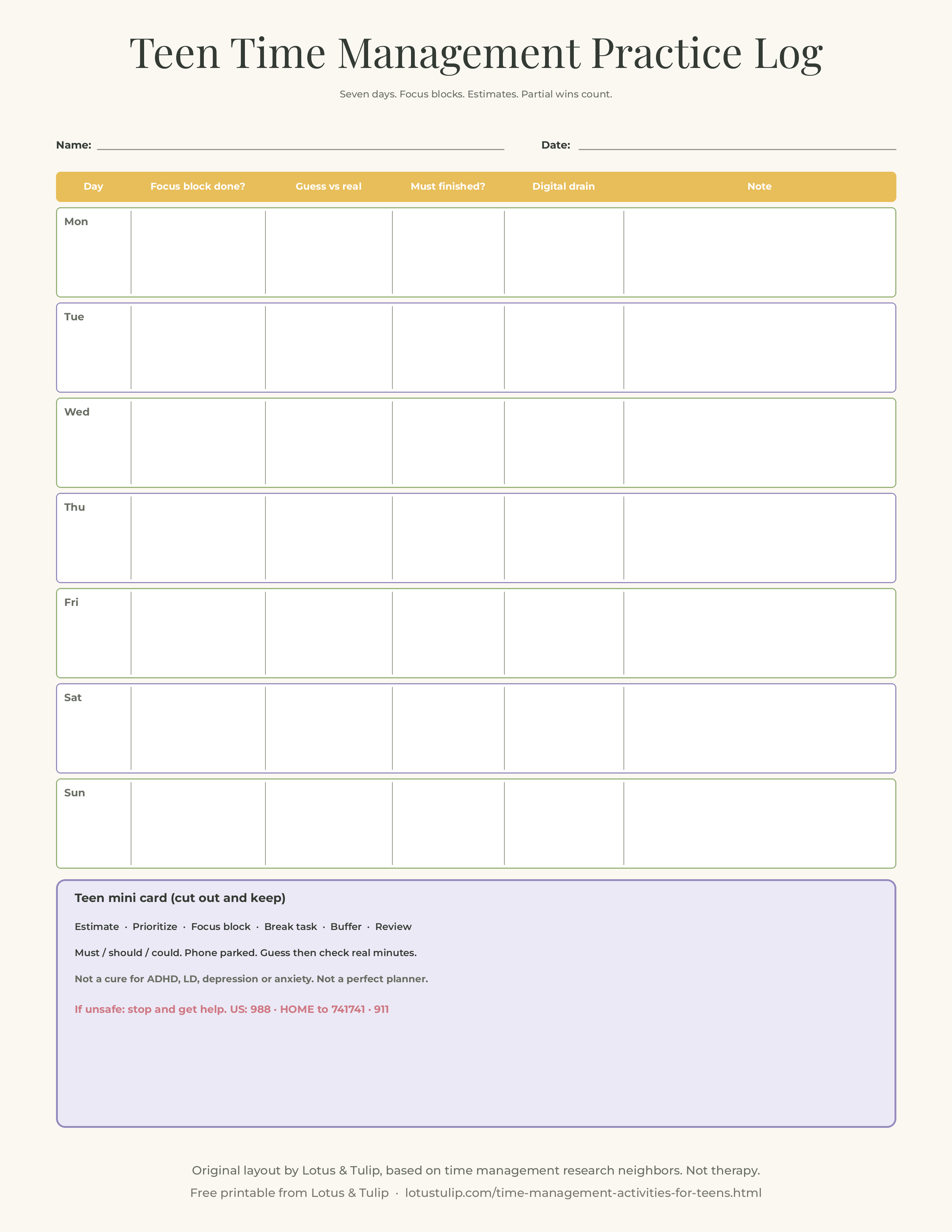
The free time management printable has three pages in US Letter size:
- Page 1: Teen Time Management Steps. Nine loop steps matching the HowTo above: safety sort, estimate time, map the week, prioritize, protect focus, break tasks, buffer gaps, review slips, log drains.
- Page 2: My Time Management Plan. Must / should / could, focus block, task break-down with guess versus real minutes, buffers and sleep window, end of day review.
- Page 3: Practice Log + teen mini card. Seven days of focus blocks, estimate checks, musts and digital drains, plus a cut out reminder card.
Download the free time management printable for teens (PDF, 3 pages, US Letter)
Prefer single images? Page 1: Teen Time Management Steps (PNG) · Page 2: My Time Management Plan (PNG) · Page 3: Practice Log (PNG)
Free ADHD starter pack: Working with a teen or adult who has ADHD? The free ADHD worksheets starter pack includes a time estimation log, break it down and getting unstuck, plus three more real pages from our paid ADHD set (8 pages, client use license, no email).
Free to print for your own use and for use with your own clients, students or groups. This is an original layout by Lotus & Tulip, drawing on widely cited time management and executive function research neighbors (Claessens et al.; Macan et al.; Diamond; ASCA / CASEL; AASM Paruthi et al. 2016 for sleep timing context). It is not affiliated with any author, agency, organization or curriculum named on this page, does not diagnose or treat any condition, and is not a substitute for therapy, evaluation or medical care. Please link to this page rather than re-uploading the file.
Related resources
- Time management worksheet for adults: the adult and therapist version with a free time map and weekly plan.
- Study skills activities for teens: retrieval, spacing and focus methods for learning.
- Executive functioning worksheets for kids: younger EF building blocks.
- Goal setting worksheet for students: longer-range goals next to the day loop.
- Impulse control activities for teens: STOP / THINK for urges.
- Problem solving activities for teens: when the stuck point is how, not only when.
- Flexible thinking worksheet: shifting rigid plans when life changes.
- Stress management worksheets for teens: when overload is mostly stress load.
- Growth mindset activities for teens: strategy after setbacks.
- Self advocacy activities for students: asking for clearer deadlines and supports.
- Safety plan worksheet: when the moment is about staying safe.
Sources
- Claessens, B. J. C., van Eerde, W., Rutte, C. G., and Roe, R. A. (2007). A review of the time management literature. Personnel Review, 36(2), 255 to 276.
- Macan, T. H., Shahani, C., Dipboye, R. L., and Phillips, A. P. (1990). College students' time management: correlations with academic performance and stress. Journal of Educational Psychology, 82(4), 760 to 768.
- Macan, T. H. (1994). Time management: test of a process model. Journal of Applied Psychology, 79(3), 381 to 391.
- Diamond, A. (2013). Executive functions. Annual Review of Psychology, 64, 135 to 168. (Planning as a higher-order EF neighbor.)
- American School Counselor Association. ASCA Student Standards: Mindsets and Behaviors for Student Success (B-LS 3 time-management, organizational and study skills).
- Collaborative for Academic, Social, and Emotional Learning (CASEL). Self-management competency (neighboring frame).
- Paruthi, S., et al. (2016). Recommended amount of sleep for pediatric populations: a consensus statement of the American Academy of Sleep Medicine. Journal of Clinical Sleep Medicine, 12(6), 785 to 786. (8 to 10 hours for ages 13 to 18.)
Time management activities for teens: FAQ
What are time management activities for teens?
They are short practice rounds that help teens estimate time, map a week or day, prioritize with must / should / could, protect focus blocks, break tasks, buffer transitions, review slips, and bound digital drains. They fit classrooms, small groups and individual sessions.
How is this different from study skills activities for teens?
Study skills activities focus on how to learn (retrieval, spacing, notes, teach-back). This page focuses on when and how to organize time around school and life. Many teens need both.
Does time management fix ADHD?
No. Planning scaffolds can help many teens, including some with ADHD, but they do not treat ADHD. Prefer evaluation, accommodations and clinical care when those are the main issue.
Will a fancy planner solve missed deadlines?
Not by itself. Useful practice is estimate, prioritize, protect focus, buffer and review. Stationery is optional.
How much sleep should teens plan for?
The American Academy of Sleep Medicine (Paruthi and colleagues, 2016) recommends 8 to 10 hours per 24 hours for ages 13 to 18. Use that as a scheduling constraint. It is not a diagnosis of a sleep disorder.
What should a school counselor measure?
Small behavior changes: more realistic estimates, capped must lists, completed focus blocks, fewer all-nighters. Do not expect automatic grade jumps from a short skill group alone.
When are time management activities not enough?
When there is crisis or self harm risk, a suspected untreated ADHD or learning disability, depression or anxiety as the main driver, or an impossible adult-made load. In a crisis in the US, call or text 988, text HOME to 741741, or call 911, and use a safety plan.