
Therapists and counselors · Updated 2026-11-07
Trauma Worksheets: Grounding, Window of Tolerance, and Free Printable
Ready-made printable: Trauma Worksheets for Therapists Fillable PDF, 20 pages: window of tolerance, trigger map, grounding toolkit, coping plan and 0 to 10 distress scales
Holiday 20% off: about $9.20, was $12 (EUR 10) · instant digital download
Try it free first: download a fillable sample (window of tolerance and grounding toolkit, PDF, 189 KB). Type into it on screen, then get the full pack. No email needed.

Trauma worksheets give therapists and counselors a gentle, structured way to support adults after traumatic experiences: psychoeducation, safety and stabilization checks, trigger tracking, window of tolerance mapping, grounding menus, coping cards and a calm between session plan. This guide is written for US clinicians working with adult trauma exposed clients in outpatient, community, private practice and telehealth settings. Adults can use the free printable too, ideally beside a trained clinician, because trauma work goes best when it is paced, chosen and supported.
You will get twelve worksheet backed practices with timing and debrief questions, a six session starter plan that is deliberately heavy on stabilization, adaptations for common clinical situations, honest notes on what the research does and does not show, three fictional examples, seven FAQs, a nine step HowTo and a free three page US Letter printable: Trauma Care Steps, My Stabilization Plan, and a Between Sessions Log with nine pocket cards.
This page is distinct from our single topic guides. The window of tolerance worksheet goes deep on one model. The 5 4 3 2 1 grounding worksheet covers one grounding skill. The safety plan worksheet is for suicidal crisis planning. The grief worksheets for adults, ERP worksheets for OCD and distress tolerance worksheets serve other goals. This page pulls the stabilization pieces together into one trauma informed workflow.
We draw on published trauma research and clinical guidelines without claiming any affiliation or endorsement: Judith Herman's three stage recovery model (1992); the window of tolerance idea introduced by Daniel Siegel (1999) and used in sensorimotor work by Ogden, Minton and Pain (2006); the American Psychological Association (2017), International Society for Traumatic Stress Studies (2018), NICE (2018) and VA/DoD (2023) PTSD guidelines; and the Kessler and colleagues (2017) World Mental Health survey report on trauma exposure. The printable is an original Lotus and Tulip layout.
This guide is educational. Worksheets do not treat PTSD or trauma by themselves and do not deliver any trauma focused protocol. They are skill practice aids inside clinical care. If you or someone you support is thinking about suicide, call or text 988 (Suicide and Crisis Lifeline; veterans press 1) or text HOME to 741741 (Crisis Text Line). For immediate danger, call 911. If someone is being hurt by a partner, the National Domestic Violence Hotline is 1-800-799-7233 or text START to 88788. For a written plan for a crisis moment, see our safety plan worksheet.
What trauma worksheets are (and are not)
Trauma worksheets are paper tools that help a client understand common reactions after trauma, notice their own patterns, practice regulation skills and plan for hard moments between sessions. In good trauma informed care they support the relationship, they do not replace it. Most of the value comes from the conversation the page starts: what the client noticed, what helped, what was too much, and what they want to try next.
What they are not.
- Not forced disclosure. A client never has to write what happened to complete these pages. The free set asks about present day reactions, signals and skills, not trauma details. Clients choose what to share and when.
- Not flooding. A worksheet that asks someone to describe the worst moment of their life alone at the kitchen table at midnight can push them far outside their window of tolerance. Processing work belongs in session, with a trained clinician, inside a chosen protocol.
- Not a cure printable. Strong evidence for PTSD treatment comes from trauma focused psychotherapies delivered by trained clinicians. A three page PDF is a support tool, not a course of therapy.
- Not a substitute for phased trauma care. Worksheets can help with stabilization and skills. They do not replace clinical judgment about when, whether and how to move into trauma focused work.
- Not for acute crisis alone. If someone is at imminent risk, in an unsafe relationship right now, or unable to keep themselves safe, crisis care and a safety plan come first.
Good trauma worksheets respect choice and control. They use plain language, avoid graphic examples, give permission to skip a prompt and remind the client they can stop at any time. A page that says "write only what feels okay today" is not soft, it is clinically wise. Many survivors had choice taken away during the traumatic event. Restoring choice on paper is a small piece of restoring it in life.
It also helps to separate stabilization pages from processing pages in your filing system. The free printable and the paid trauma pack are both stabilization sets. If you later use a manualized trauma focused therapy, use the materials that come with that protocol and the training you received for it.
Core ideas that shape good trauma worksheets
1. Safety first, then the past, then reconnection. Judith Herman's Trauma and Recovery (1992) described recovery in three stages: establishing safety, remembrance and mourning, and reconnection with ordinary life. Herman framed the first task as establishing the survivor's safety, starting with control of the body and moving outward to the environment. She also noted that recovery is not strictly linear. Worksheets in this guide live mostly in that first stage: body, sleep, routine, triggers, supports and coping.
2. The window of tolerance. Daniel Siegel introduced the window of tolerance in The Developing Mind (1999) to describe a zone of arousal in which a person can think, feel and function. Ogden, Minton and Pain (2006, Trauma and the Body) used the idea in sensorimotor psychotherapy, describing hyperarousal above the window and hypoarousal below it. The model is a clinical teaching tool, not a lab measure. Clients often find it validating because it explains why they can swing between panic and numbness, and it gives a shared language for pacing.
3. Evidence based PTSD treatments are trauma focused and clinician delivered. The American Psychological Association's 2017 Clinical Practice Guideline for the Treatment of PTSD strongly recommends cognitive behavioral therapy, cognitive processing therapy (CPT), cognitive therapy and prolonged exposure (PE) for adults, and conditionally recommends brief eclectic psychotherapy, EMDR and narrative exposure therapy. The International Society for Traumatic Stress Studies (2018) gives strong recommendations to CPT, cognitive therapy, EMDR, individual trauma focused CBT and PE for adults. NICE guideline NG116 (2018) recommends individual trauma focused CBT for adults with PTSD and EMDR for non combat related trauma after three months. The 2023 VA/DoD guideline recommends individual manualized trauma focused psychotherapies such as CPT, EMDR and PE. Prolonged exposure is associated with Edna Foa and colleagues, CPT with Patricia Resick and colleagues, and EMDR with Francine Shapiro. This page is not affiliated with any of these organizations or authors, and the worksheets here do not deliver those protocols.
4. Stabilization before processing can help some clients. Cloitre and colleagues (2010, American Journal of Psychiatry) randomized 104 women with PTSD related to childhood abuse to skills training in affective and interpersonal regulation (STAIR) followed by exposure, or to comparison sequences. The STAIR then exposure sequence did better on sustained remission than the comparisons and had fewer dropouts and less symptom worsening than supportive counseling followed by exposure. That supports skill building as a useful early phase for some clients. It does not mean every client needs months of stabilization before trauma focused work. Many guidelines caution against long delays, so your plan should match the person in front of you.
5. Trauma is common, PTSD is not inevitable. Kessler and colleagues (2017, European Journal of Psychotraumatology) reported that a weighted 70.4 percent of respondents in World Health Organization World Mental Health surveys across 24 countries had experienced at least one lifetime traumatic event. Interpersonal violence carried the highest PTSD risk. Many people exposed to trauma never develop PTSD. Worksheets should normalize reactions without labeling every reaction as disorder.
6. Polyvagal language is popular, use it carefully. Many clinicians use polyvagal theory, associated with Stephen Porges, as a metaphor for safety and threat states. It can be a helpful story for clients. It is also scientifically contested: Grossman (2023, Biological Psychology) argued that its five basic premises are untenable or highly implausible based on the physiology literature. If you use the language, present it as one model among several, not as settled neuroscience, and do not build worksheets that depend on its specific nerve claims.
When you explain these ideas to clients, keep the story kind and short. Your nervous system learned to protect you. Some of those protections now fire when there is no danger. We will practice noticing, steadying and choosing, at your pace. That message alone lowers shame for many people.
Twelve worksheet backed trauma practices
Use these in session and as optional homework. Times are approximate. Always screen for current danger, suicidality, self harm, substance use, dissociation and ongoing abuse before assigning between session work. Offer choice on every page and never push processing worksheets before safety is in place.
1. Psychoeducation map: common reactions after trauma
Time: 15 to 20 minutes. When: first or second session.
A one page map of body, feelings, thoughts and actions that often follow trauma: startle, sleep trouble, avoidance, irritability, numbness, guilt, shame, difficulty concentrating. The client circles what fits and crosses out what does not. Make clear it is not a diagnostic checklist. The goal is "these reactions make sense" rather than "here is your label."
Debrief: "Which reaction surprised you most to see on a list, and what does it mean that other people have it too?"
2. Safety and stabilization check
Time: 10 to 15 minutes. When: first session and whenever life changes.
Quick ratings for physical safety at home, safety from others, self harm or suicidal thoughts, substance use, sleep, eating, money and housing, and support. Anything rated unsafe goes to the top of the agenda. If interpersonal violence is current, shift to safety planning with the National Domestic Violence Hotline (1-800-799-7233 or text START to 88788) and local resources rather than introspective worksheets.
Debrief: "What would make next week feel even ten percent safer?"
3. Trigger log
Time: 5 minutes per entry. When: after the client has at least two grounding skills.
Columns: situation, what I noticed first (body, sound, smell, image), how strong (0 to 10), what I did, what helped. No trauma details are needed. Over a few weeks patterns emerge, such as evenings, crowds, certain tones of voice or anniversaries. Page three of the free printable includes a short log.
Debrief: "What was the earliest signal, before the reaction peaked?"
4. Body, mind and behavior snapshot
Time: 10 minutes. When: early, as a bridge to the window map.
Three boxes: what my body does when I feel threatened, what my mind says, what I tend to do. Then three boxes for when I feel steady. The contrast helps clients spot their own regulated state, which many have stopped noticing. Use simple drawings if words are hard.
Debrief: "What is one sign that tells you that you are back in a steadier place?"
5. Window of tolerance map
Time: 15 to 20 minutes. When: session two or three.
Draw the zone of steady arousal in the middle, hyperarousal above (racing heart, panic, anger, scanning) and hypoarousal below (numb, foggy, flat, far away). The client fills in their own signs and one or two skills for each zone. For a deeper single topic version, see our window of tolerance worksheet. Page two of the free printable has a compact window map.
Debrief: "Which edge of your window do you reach most often, top or bottom?"
6. 5 4 3 2 1 grounding
Time: 5 minutes to teach, 1 to 3 minutes to use. When: early, practiced in session before homework.
Name five things you see, four you can touch, three you hear, two you smell and one you taste. Practice when calm first, so the skill is available when distress rises. Offer variations for clients who dislike counting or for whom a sense is a trigger. Full guide and printable: 5 4 3 2 1 grounding worksheet.
Debrief: "Which sense brought you back fastest?"
7. Breathing and grounding menu
Time: 15 minutes. When: after trying a few skills in session.
A personal menu with three columns: skills for when I am too high (slow exhale breathing, cold water on hands, pressing feet into the floor, walking), skills for when I am too low (standing up, naming objects, strong mint, bright light, gentle movement), and skills for anywhere (holding a grounding object, orienting to the room, a safe word or phrase). Some trauma survivors find breath focus uncomfortable. Offer eyes open options and never insist on closing eyes.
Debrief: "Which skill would you use on a bus, at work or in bed?"
8. Urge and flooding plan
Time: 15 to 20 minutes. When: once triggers and window signs are mapped.
A step plan for when memories, images or urges arrive unbidden: notice and name ("this is a memory, not now"), orient to date and place, use one grounding skill, use one soothing skill, contact a support person if still high, use the safety plan if risk appears. Pair with urge surfing if urges to drink, use or self harm show up.
Debrief: "What is the first sentence you will say to yourself when a flashback starts?"
9. Coping card set
Time: 10 minutes. When: any time after a few skills are known.
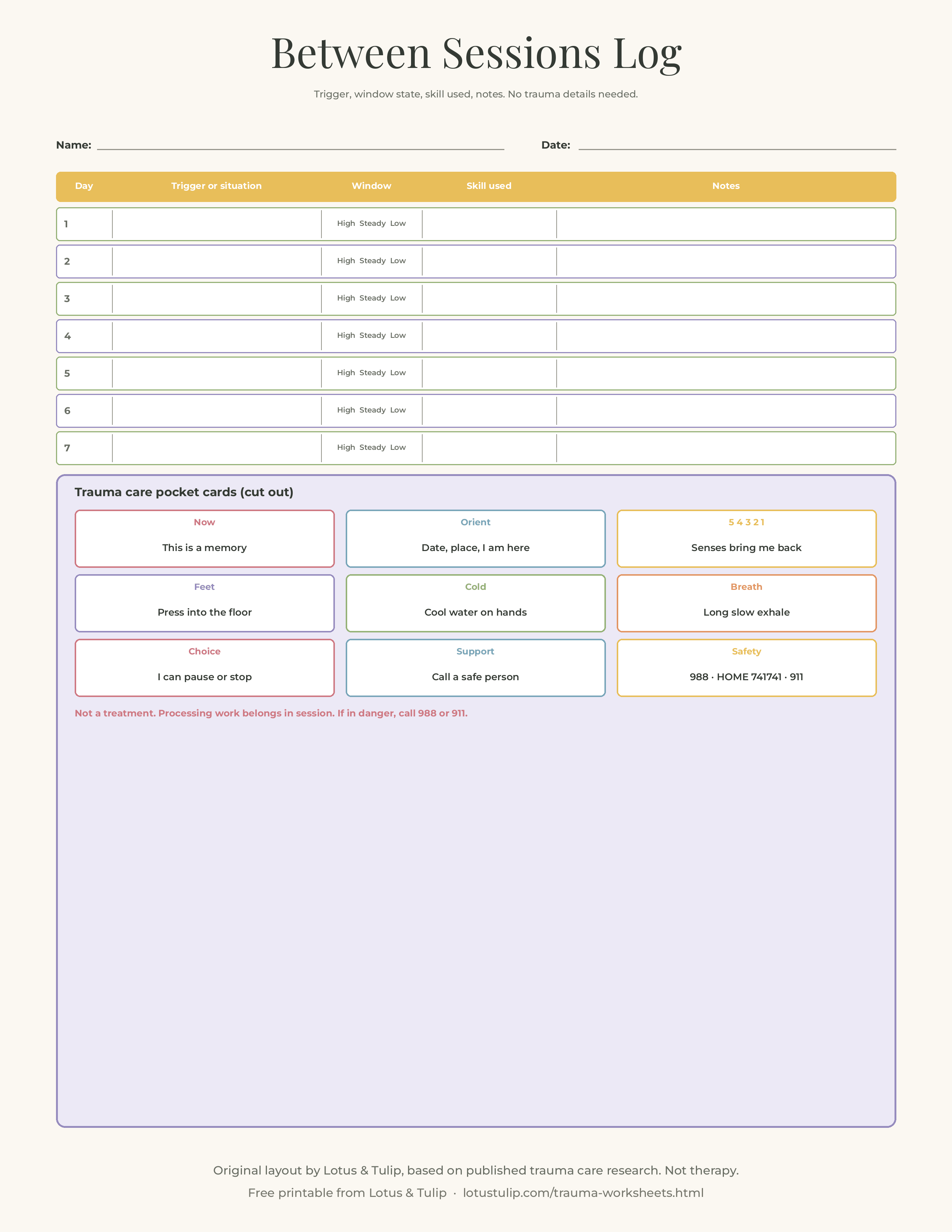
Small cards for wallet, phone case or nightstand: one skill per card, in the client's words. Page three of the free printable has nine pocket cards to cut out. Cards help when thinking goes offline under stress.
Debrief: "Where will these cards live so you can actually reach them?"
10. Values and meaning after trauma (gentle)
Time: 15 to 20 minutes. When: once stabilization is steady, never in the first session.
Prompts such as "what still matters to me," "a small way I could honor that this week," and "people or places that feel steady." Avoid pushing post traumatic growth language; some clients find it invalidating. The aim is reconnection with ordinary life, in Herman's sense, at the client's pace. ACT style values pages can help here.
Debrief: "What is one small action this week that fits who you want to be?"
11. Sleep and routine after nightmares
Time: 15 minutes. When: when sleep is disrupted, which is common after trauma.
A simple wind down plan, a steady rise time, a grounding routine for after nightmares (lights on, orient, cool water, a grounding card), and a short log of nights. If chronic insomnia persists, see our CBT-I worksheets, used carefully: nighttime may feel unsafe for trauma survivors, so stimulus control and schedule changes need titration and clinical judgment. Persistent nightmares deserve specific clinical attention rather than a worksheet alone.
Debrief: "What helps you know you are safe after you wake from a nightmare?"
12. Session review and between session plan
Time: 5 to 10 minutes. When: end of every session.
What we worked on, how activated I feel now (0 to 10), one skill to practice, what I will do if things get hard, and when I will next see my clinician. Make sure the client leaves inside their window. If not, spend the last minutes grounding rather than finishing the page.
Debrief: "On a scale of 0 to 10, where are you now, and what would bring that down one point before you leave?"
Across all twelve practices, titrate. Titration means small doses: touch a hard topic briefly, return to steady ground, then decide together whether to go a little further. Offer choice at every step: which page, how much, now or later, written or spoken. Choice is not a courtesy in trauma work, it is part of the intervention.
Also plan for literacy, vision, language and cultural needs. Large print, fewer columns and oral completion help. Some clients prefer drawing. Some cultures describe distress mainly through the body. Some clients do not use the word trauma at all; follow their language.
A six session starter plan (stabilization heavy)
Real trauma care varies widely in length and model. This table is a starter structure for the early phase of individual therapy, not a protocol. If you are trained in a trauma focused therapy and the client is ready, you may move into that work sooner. Safety always comes first.
| Session | Focus | Optional take home page |
|---|---|---|
| 1 | Engagement, consent, current safety, crisis resources, what the client wants from therapy | Safety and stabilization check (practice 2) |
| 2 | Psychoeducation on common reactions, body and mind snapshot, first grounding skill in session | Reactions map and snapshot (practices 1 and 4) |
| 3 | Window of tolerance map, 5 4 3 2 1 grounding practice, breathing and grounding menu | Window map and grounding menu (practices 5, 6 and 7) |
| 4 | Trigger log review, early signals, sleep and nightmare routine | Trigger log and sleep routine (practices 3 and 11) |
| 5 | Urge and flooding plan, coping cards, support people | Flooding plan and coping cards (practices 8 and 9) |
| 6 | Review progress, gentle values work, shared decision about next phase or referral | Values page and between session plan (practices 10 and 12) |
If six sessions are too few, stay longer with grounding and sleep. If the client is stable and wants trauma focused treatment, discuss options openly, including referral to a clinician trained in CPT, PE, EMDR or another recommended approach if that is outside your training. Document informed consent and the client's preferences.
Consider using a validated measure at intake and periodically, such as a PTSD symptom checklist your setting already uses, so progress is not judged by worksheet completion alone.
How to use trauma worksheets, step by step
- Screen for safety first. Ask about suicidal thoughts, self harm, current violence, substance use and severe dissociation. If risk is present, use crisis care and a safety plan before any worksheet.
- Explain choice and control. Tell the client they never have to write trauma details, can skip any prompt and can stop at any time.
- Start with psychoeducation. Normalize common reactions after trauma without labeling every reaction as disorder.
- Map the window of tolerance. Name the client's own signs of being too high, too low and steady.
- Teach and practice grounding in session. Try 5 4 3 2 1 and a breathing or movement option until one feels usable.
- Build a personal grounding menu and coping cards. Put skills in the client's words where they can reach them.
- Track triggers gently. Log situations, early signals and what helped, not trauma details.
- Plan for flooding, nightmares and hard days. Write steps for flashbacks, a post nightmare routine and when to call for support.
- Review every session and decide the next phase together. Check the client leaves inside their window, and revisit whether stabilization, trauma focused therapy or referral fits best.
Print the free three page set once and keep a blank stack in your office. Many clients like paper because it stays private and does not live on a phone. Encourage them to store pages somewhere that feels safe, and to decide who, if anyone, may see them.
Adaptations
- Complex trauma: Expect a longer stabilization phase, more attention to relationship and trust, and more time on emotion regulation and dissociation. Watch for shame spikes from worksheet language. Shorter pages and more in session completion often work better.
- Single incident trauma: Many adults with single incident trauma do well moving into trauma focused therapy after brief stabilization. Do not hold them in endless skills work if they are safe and ready.
- Sexual trauma (extra care): Avoid body focused prompts that ask clients to locate sensations without consent. Offer eyes open grounding, control over seating and door position, and plain non graphic language. Never require written details. RAINN's National Sexual Assault Hotline is 800-656-4673.
- Interpersonal and domestic violence: If abuse is ongoing, safety planning comes before introspective work. Assume written pages may be found by an abusive partner. Offer to keep pages in the office. National Domestic Violence Hotline: 1-800-799-7233 or text START to 88788.
- Combat and first responders: Respect culture and language; some clients prefer "operational stress" or "critical incidents." Hypervigilance may be valued at work and costly at home, so frame the window map as context dependent. Veterans can reach the Veterans Crisis Line by dialing 988 and pressing 1. NICE NG116 does not recommend EMDR specifically for combat related trauma, so keep referral decisions grounded in current guidance.
- Teens: This guide is written for adults. Teens need developmentally adapted materials, caregiver involvement where safe, and attention to mandated reporting. Refer to clinicians trained in adolescent trauma care, and see our teen pages for age appropriate skills.
- Telehealth: Confirm the client's location and privacy at the start of each session, agree on what happens if the connection drops during distress, and screen share or email the printable. End sessions with grounding on camera.
When to refer: refer when the client wants or needs a trauma focused protocol you are not trained to deliver, when dissociation is severe, when substance use dominates, when psychosis or mania is present, or when ongoing danger requires specialized advocacy. When not to use worksheets: during acute crisis, when writing itself triggers flooding, when the client feels pressured or graded by homework, or when literacy or privacy make paper unsafe. Talk instead.
Tips for therapists and counselors
- Practice every skill in session before assigning it. A skill first tried at 2 a.m. rarely works.
- Use the client's words for zones and triggers. "Wired" and "gone" may land better than hyperarousal and hypoarousal.
- Keep pages short. One or two prompts done well beat ten prompts abandoned.
- Normalize partial completion. A half page with one useful insight is a success.
- Close every session inside the window. Leave time for it on purpose.
- Track progress with a measure, not only with worksheets.
- Ask permission before body focused prompts and offer an alternative.
- Watch for dissociation during worksheet work: glazed eyes, slowed speech, losing track. Pause and ground.
- Coordinate with prescribers and other providers when the client consents.
- Look after yourself. Secondary traumatic stress is real for clinicians, and good supervision protects clients too.
Common mistakes
- Assigning a trauma narrative or detailed memory worksheet as homework.
- Skipping a safety check because the client seems calm.
- Teaching grounding only by talking about it, never practicing it together.
- Using breath focused or eyes closed skills with clients who find them triggering.
- Treating every reaction as pathology rather than a protective response.
- Keeping a safe, ready client in stabilization indefinitely without discussing trauma focused options.
- Overclaiming neuroscience, for example presenting polyvagal theory as settled fact.
Myths about trauma worksheets
- Myth: "You have to tell the whole story to heal." Reality: Some evidence based therapies involve processing memories, but they are done in session with a trained clinician. Stabilization worksheets need no details at all.
- Myth: "Worksheets are enough to treat PTSD." Reality: Guidelines recommend trauma focused psychotherapies delivered by clinicians. Worksheets support that care.
- Myth: "Everyone who goes through trauma gets PTSD." Reality: Trauma exposure is common; many people recover without developing PTSD.
- Myth: "Grounding is avoidance." Reality: Grounding helps clients stay present enough to function and, when they choose, to do harder work. Used rigidly to avoid all reminders forever, any skill can become avoidance, which is why review matters.
- Myth: "More stabilization is always safer." Reality: For many clients, timely trauma focused treatment is the safer long term path. Match the plan to the person.
Three fictional examples
Dana, 34, car crash survivor. Dana had startle, avoidance of highways and broken sleep. Two sessions of psychoeducation, a window map and 5 4 3 2 1 practice gave her a shared language for pacing. The trigger log showed her worst moments were merging lanes and the sound of brakes. With stabilization in place and her clear preference, her clinician discussed trauma focused options and she began a recommended protocol with a trained colleague. The worksheets were scaffolding, not the treatment.
Marcus, 47, retired firefighter. Marcus disliked the word trauma and found breathing exercises "pointless." His clinician used "critical incident stress," offered movement and cold water grounding instead of breath work, and built a short coping card set he kept in his truck. A sleep routine after nightmares helped him get back to sleep faster. He chose to continue with a clinician experienced with first responders.
Rosa, 29, worksheets set aside for safety. In session two, Rosa disclosed that her partner had threatened her the night before and checked her phone and bag daily. Her clinician put the worksheets away. They focused on immediate safety, discussed the National Domestic Violence Hotline (1-800-799-7233, or text START to 88788), agreed that no pages would go home, and completed a safety plan stored in the office. Stabilization pages waited until Rosa was safer.
In each example the clinician matched the page to the moment. Dana was ready to move forward, Marcus needed a different language and skill set, and Rosa needed safety before any worksheet at all.
How this page compares to nearby Lotus and Tulip guides
| Page | Best for | Not the same as trauma worksheets |
|---|---|---|
| Trauma worksheets for kids | Children 5 to 12, parents and school counselors | Child version: body alarm, calm and safe plan, reminders, no trauma story |
| Window of tolerance worksheet | Deep dive on one regulation model | One tool, not a full stabilization workflow |
| 5 4 3 2 1 grounding | A single sensory grounding skill | One skill, not trigger or sleep planning |
| Safety plan worksheet | Suicidal crisis planning | Use first when risk is present |
| Grief worksheets for adults | Bereavement support | Grief focus, overlaps after sudden loss |
| ERP worksheets for OCD | Exposure for OCD | Different target, not trauma exposure |
| Distress tolerance worksheets | DBT crisis survival skills | Broader, not trauma specific |
| Anxiety worksheets (product) | Worry and anxiety skills | Complement for anxious trauma survivors |
When not to use these worksheets
- Acute suicidal crisis or inability to keep self safe. Use crisis care and a safety plan first. Call or text 988, text HOME to 741741, or call 911 for immediate danger.
- Ongoing violence where pages could be found and increase risk. Prioritize safety planning and advocacy.
- Severe dissociation, psychosis or mania that needs specialist assessment.
- When writing itself pushes the client out of their window. Work verbally instead.
- As a do it yourself trauma processing tool without clinical support.
Free 3 page trauma worksheets printable (US Letter)
Download the free printable, print on US Letter and use in session or as optional homework.
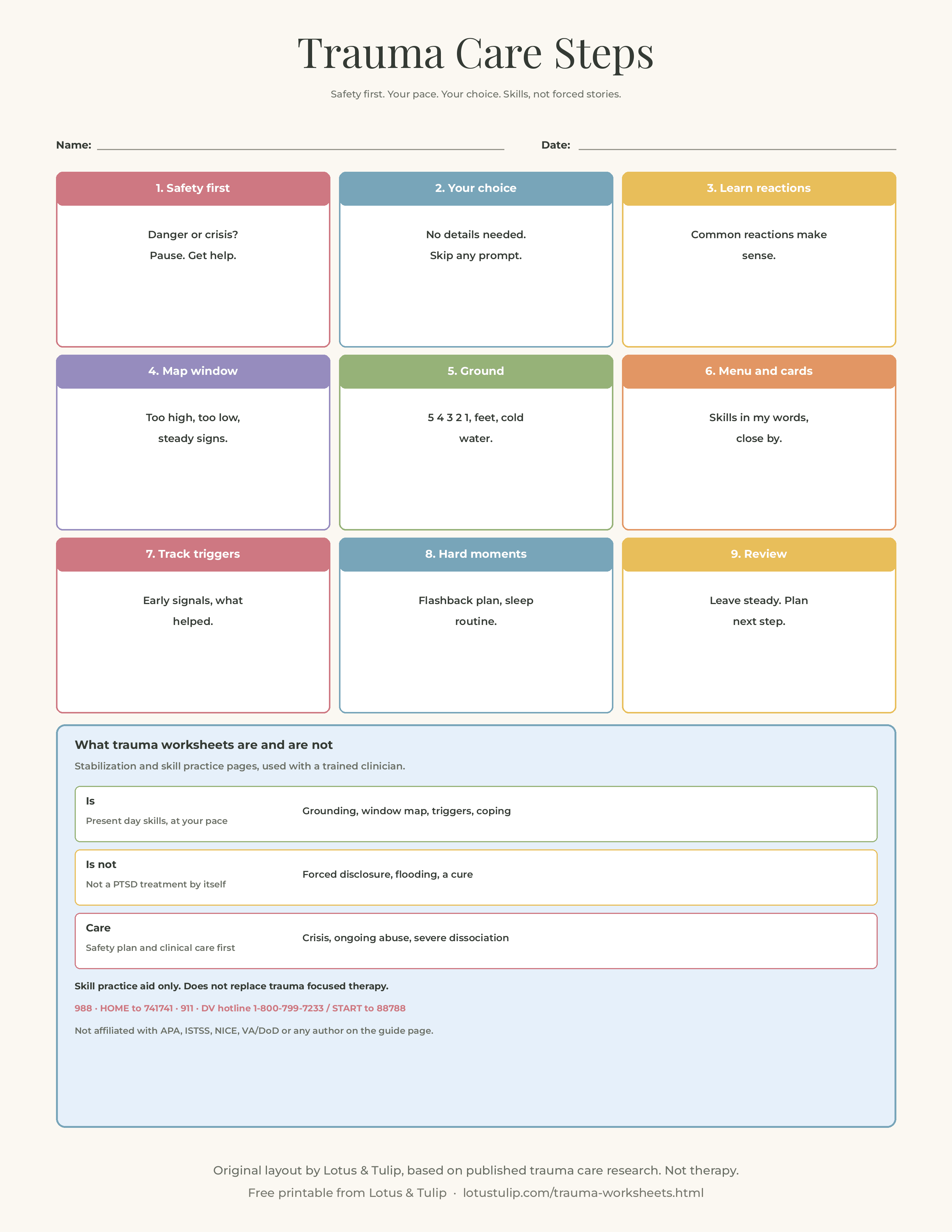
- Page 1: Trauma Care Steps. Nine steps that match the HowTo above, what trauma worksheets are and are not, and crisis resources.
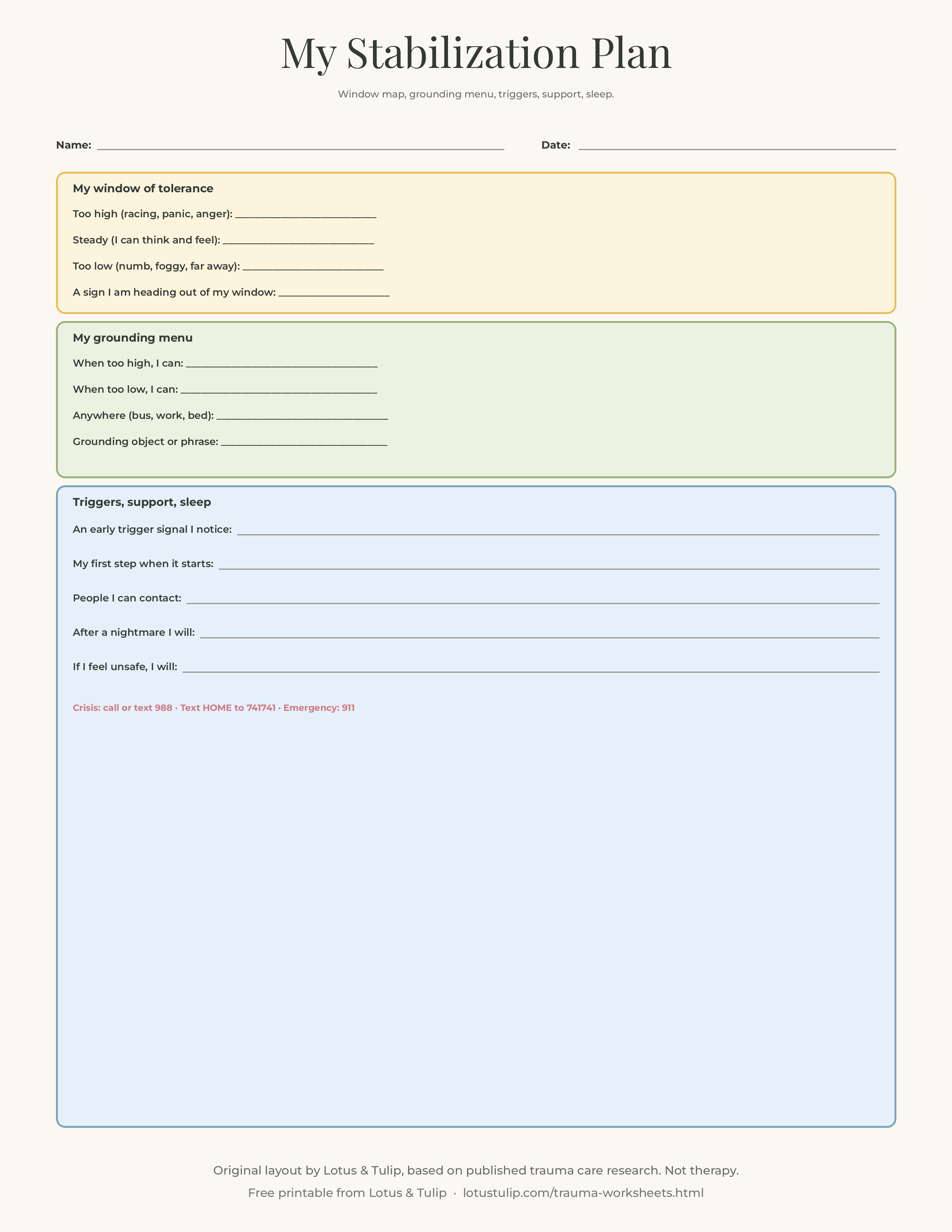
- Page 2: My Stabilization Plan. Window of tolerance map, grounding menu, trigger plan, support people and a sleep routine after nightmares.
- Page 3: Between Sessions Log. Triggers, window state, skill used and notes, plus nine pocket cards.
Download free PDF · Page 1 PNG · Page 2 PNG · Page 3 PNG
Free trauma starter pack: Want more real pages? The free trauma worksheets for therapists starter pack adds six pages from our paid trauma informed set: my window of tolerance, a trigger map, 5 senses grounding, a grounding toolkit, a coping plan for hard moments and a support and contacts page (8 pages, client use license, no email).
Research notes (verified, with caveats)
- Herman JL. Trauma and Recovery. Basic Books; 1992. Describes recovery in three stages: establishing safety, remembrance and mourning, and reconnection with ordinary life.
- Siegel DJ. The Developing Mind. Guilford Press; 1999. Introduced the window of tolerance concept.
- Ogden P, Minton K, Pain C. Trauma and the Body: A Sensorimotor Approach to Psychotherapy. Norton; 2006. Uses the window of tolerance with hyperarousal and hypoarousal zones.
- American Psychological Association. Clinical Practice Guideline for the Treatment of Posttraumatic Stress Disorder (PTSD) in Adults. 2017. Strong recommendations for CBT, CPT, cognitive therapy and PE; conditional for brief eclectic psychotherapy, EMDR and narrative exposure therapy.
- International Society for Traumatic Stress Studies. PTSD Prevention and Treatment Guidelines. 2018. Strong recommendations for CPT, cognitive therapy, EMDR, individual trauma focused CBT and PE in adults; psychoeducation and relaxation training alone listed as insufficient evidence to recommend as PTSD treatments.
- National Institute for Health and Care Excellence. Post-traumatic stress disorder (NG116). 2018. Recommends individual trauma focused CBT for adults; EMDR for non combat related trauma after three months.
- Department of Veterans Affairs and Department of Defense. Clinical Practice Guideline for the Management of PTSD and Acute Stress Disorder. 2023. Recommends individual manualized trauma focused psychotherapies such as CPT, EMDR and PE.
- Cloitre M, Stovall-McClough KC, Nooner K, et al. Treatment for PTSD related to childhood abuse: a randomized controlled trial. Am J Psychiatry. 2010. 104 women; STAIR followed by exposure outperformed comparison sequences on sustained remission.
- Kessler RC, Aguilar-Gaxiola S, Alonso J, et al. Trauma and PTSD in the WHO World Mental Health Surveys. Eur J Psychotraumatol. 2017;8(sup5):1353383. 24 countries; weighted 70.4 percent reported at least one lifetime trauma.
- Grossman P. Fundamental challenges and likely refutations of the five basic premises of the polyvagal theory. Biol Psychol. 2023;180:108589.
We do not invent effect sizes. Note an important caveat from ISTSS: psychoeducation and relaxation training on their own did not have enough evidence to be recommended as PTSD treatments. That is exactly why this page frames worksheets as stabilization and skill practice aids inside care, not as treatment. The free printable is not a standalone intervention and has not been tested in a randomized trial.
Guidelines differ in details and are updated over time, so check the current versions before citing them to clients or in documentation. When you share research with clients, say what it measured and what it did not.
Trauma worksheets: FAQ
What are trauma worksheets?
They are structured pages that support trauma informed therapy: psychoeducation on common reactions, safety checks, window of tolerance maps, grounding menus, trigger logs, coping cards, sleep routines after nightmares and between session plans. Therapists use them in session and as optional homework.
Do trauma worksheets treat PTSD by themselves?
No. Guidelines recommend trauma focused psychotherapies such as CPT, PE, cognitive therapy, trauma focused CBT and EMDR delivered by trained clinicians. Worksheets are practice aids inside that care, not a standalone treatment.
Do clients have to write about what happened?
No. The free printable and the stabilization pack avoid trauma narrative prompts. Clients can skip any question. Processing work, if chosen, happens in session with a trained clinician.
What is the window of tolerance?
It is a model introduced by Daniel Siegel describing a zone of arousal where a person can think and function, with hyperarousal above and hypoarousal below. Clinicians use it to pace trauma work and teach regulation skills.
Can I use the free printable without a therapist?
You can use grounding, the window map and coping cards for steadiness. Avoid writing detailed trauma memories on your own. If you feel unsafe or overwhelmed, reach out to a clinician. For crisis, call or text 988, text HOME to 741741 or call 911.
Is polyvagal theory proven?
It is a popular clinical model, but its physiological claims are contested in the research literature. Use it as a metaphor if helpful, not as settled science.
What if a client is in danger right now?
Set worksheets aside. Focus on immediate safety, a safety plan and resources: 988, text HOME to 741741, 911 for emergencies, and the National Domestic Violence Hotline at 1-800-799-7233 or text START to 88788.