
Kids and teens · Middle and high school SEL · Updated 2026-11-05
Peer Pressure Worksheets for Teens: Refusal Skills, Scripts and Activities (Free Printable)
Ready-made printable: Middle School Friendship Small Group Curriculum for Counselors Holiday 20% off: about $11.04, was $14 (EUR 12) · instant digital download
Buy on EtsyTry it free first: download session 1 free (group at a glance, lesson plan and student page, PDF, 71 KB). Run it with your group, then get all 8 sessions. No email needed.

Most teenagers already know that vaping, cheating on a test, or sending a private photo is a bad idea. Knowing is rarely the problem. The problem is the moment itself: four friends laughing, a phone buzzing, a dare, a quiet fear of being the one who ruins the fun. Peer pressure works because it hits right where teens care most, which is belonging.
This guide is for school counselors, middle and high school teachers, therapists who work with adolescents, and parents. It explains what peer pressure is (and what it is not), why the teen years make it stronger, what the research actually shows, six refusal moves with real scripts, a nine step plan for teaching refusal skills, activities for groups and classrooms, advice for parents, online pressure and photo safety, common mistakes, and a free three page printable: a Spot the Pressure worksheet, a My Refusal Plan page, and a Pressure Moments Log.
Jump to the free peer pressure worksheets (PDF) · See refusal scripts by situation
What peer pressure is, and what it is not
Peer pressure is the influence that people of a similar age have on what we think, say, and do. It can be loud ("Just try it, don't be boring") or completely silent (everyone at the table is laughing at a joke, so you laugh too). It is not always bad. Friends can pressure each other into studying, trying out for a team, or standing up for someone. Researchers often say peer influence rather than peer pressure for exactly this reason.
It also helps to separate peer pressure from two things it is often confused with:
- Bullying is repeated, intentional harm with a power imbalance. Pressure can turn into bullying when a group punishes a teen for saying no. If that happens, treat it as bullying. Our bullying worksheets for kids cover how to tell the difference.
- Coercion or exploitation by an adult, or by anyone demanding sexual images, is not peer pressure at all. It is a safety issue that needs a trusted adult right away. More on that in the online section below.
Four kinds of peer pressure teens can learn to name
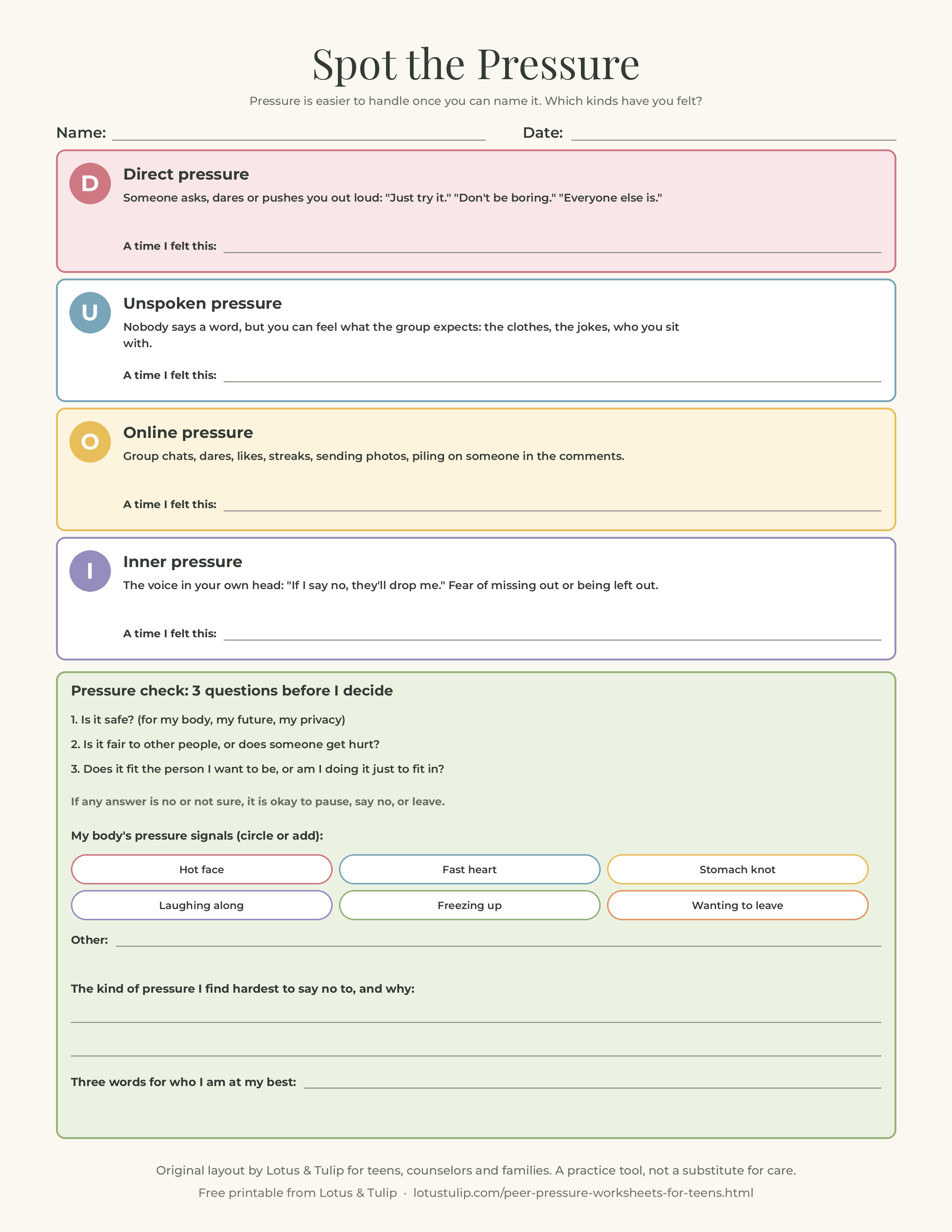
The free printable uses four labels that are easy for students to remember. Naming the kind of pressure is the first skill, because a pressure you can name is a pressure you can step back from.
- Direct pressure (D): someone asks, dares, or pushes out loud. "Everyone else is doing it." "Are you scared?"
- Unspoken pressure (U): nobody says a word, but the group's expectations are clear: the brand of shoes, the way people talk about a certain kid, who sits where.
- Online pressure (O): group chats, streaks, likes, dares filmed for social media, piling on in the comments, requests for photos.
- Inner pressure (I): the voice in your own head. "If I say no, they'll drop me." "I'll be the only one who didn't go." This is often the strongest kind, and it can exist even when nobody else is pushing at all.
Why peer pressure feels so strong in the teen years
Adults sometimes describe teens as reckless or irrational. The research tells a more useful story. Teens can reason about risk about as well as adults when they are calm and alone. What changes is how strongly the social and reward systems of the brain respond when peers are present.
- Peers change decisions in the moment. In a well known experiment, Margo Gardner and Laurence Steinberg (2005) had adolescents, college age youths, and adults play a video driving game either alone or with two friends in the room. The presence of friends increased risky driving among the adolescents and young adults much more than among adults.
- Peers make risk feel more rewarding. Jason Chein and colleagues (2011) repeated a similar driving task in a brain scanner. When teens knew friends were watching, they took more risks and showed greater activity in reward related brain regions, including the ventral striatum. Adults did not show the same effect. In other words, peers do not just distract teens; they make the risky choice feel better.
- Resistance to peer influence grows with age. Steinberg and Kathryn Monahan (2007) pooled data from thousands of participants aged 10 to 30 and found that self reported resistance to peer influence increased most clearly between about ages 14 and 18. Middle school and early high school are the years when teens need the most practice and support.
- Likes count, literally. Lauren Sherman and colleagues (2016) showed teenagers a simulated Instagram feed. Teens were more likely to "like" photos that appeared to have many likes already, including photos showing risky behavior, and seeing their own photos with many likes activated reward regions of the brain.
The takeaway for anyone working with teens: lectures about consequences, delivered when a teen is calm, do not prepare them for a hot, social, fast moment. Practice does. That is why the rest of this guide focuses on rehearsed words and plans.
The good news: peer influence works both ways
The same sensitivity that makes teens vulnerable also makes them easy to influence in good directions.
- Prosocial pressure is real. Jorien van Hoorn and colleagues (2016) found that young adolescents gave more to a group in a sharing game when peers showed approval for giving. Friends who value effort, kindness, or sport can pull each other up.
- A trusted older person nearby helps. Karol Silva, Chein, and Steinberg (2016) found that when a slightly older adult was present, young people in peer groups made more cautious decisions in a risk task. Adults do not have to hover. Being around, available, and known to care matters.
- "Everyone is doing it" is often wrong. Teens tend to overestimate how much their friends drink, smoke, or take risks. Mitchell Prinstein and Sharon Wang (2005) found that adolescents' perceptions of their friends' risk behavior were often higher than what the friends actually reported, and those perceptions were linked to the teens' own later behavior. National surveys such as Monitoring the Future consistently find that in any given month, most US middle and high school students do not drink alcohol, vape nicotine, or use cannabis. Sharing accurate norms is one of the simplest, most respectful tools you have.
Signs a teen may be struggling with peer pressure
Most peer pressure is invisible to adults. These signs do not prove anything on their own, but they are worth a gentle conversation:
- Saying "everyone" a lot: everyone has one, everyone is going, everyone thinks it is fine.
- Anxiety about events they used to enjoy, or stomachaches before parties and sleepovers.
- Secrecy about a particular group chat or app, or checking the phone with visible stress.
- Grades or attendance slipping alongside a new group of friends.
Six refusal moves teens can actually use
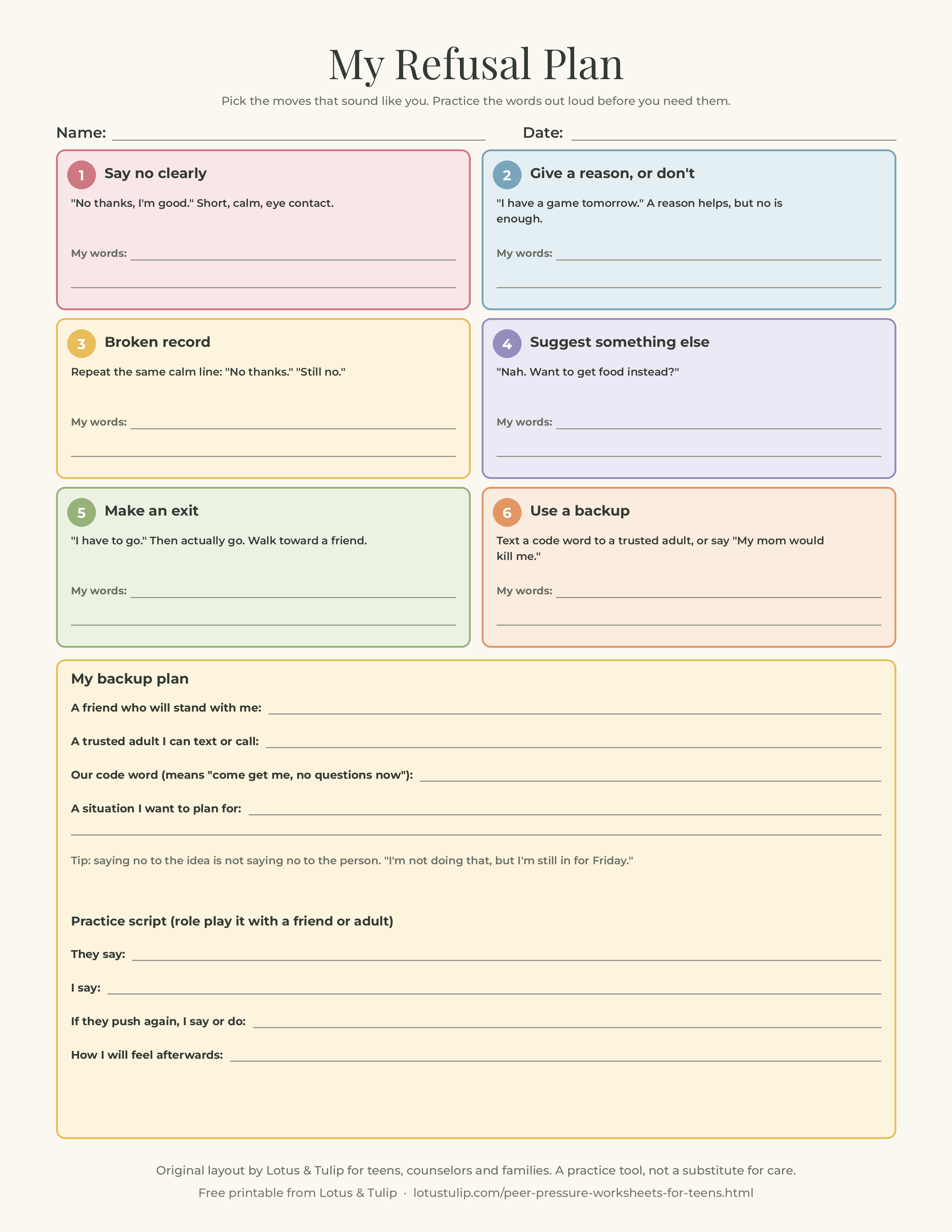
Refusal skills are short, concrete things to say and do when pressure shows up. The best ones feel natural to the teen, keep the friendship intact when possible, and get them out of the situation when not. These six moves appear on page 2 of the free printable. Encourage teens to pick two or three that fit their personality, not all six.
- Say no clearly. "No thanks, I'm good." Short, calm, with eye contact and a steady voice. A long explanation invites a debate.
- Give a reason, or don't. "I have a game tomorrow" or "That's not my thing" can soften a no. But teens need to hear from adults that no is a complete sentence. They do not owe anyone a justification.
- Broken record. Repeat the same calm line every time: "No thanks." "Still no." "I said no thanks." It is boring on purpose, and boring ends the push.
- Suggest something else. "Nah. Want to get food instead?" This keeps the social connection while changing the plan, and it often works because the group wanted to hang out, not necessarily to do the risky thing.
- Make an exit. "I have to go." Then actually go, toward another friend, a trusted adult, or home. Leaving is a skill, not a failure.
- Use a backup. Text a code word to a parent, or use them as the excuse: "My mom drug tests me" or "My dad would ground me for a year." Teens may roll their eyes at this one, but many use it. Letting a parent be the bad guy is a gift adults can give.
Two body skills make all six moves stronger: a calm, upright posture and a short pause before answering. A slow breath buys a second to check the three questions on page 1 of the printable: Is it safe? Is it fair to others? Does it fit the person I want to be?
For teens who already know DBT, these moves map neatly onto DEAR MAN (asking for what you want or saying no effectively) and the GIVE and FAST skills (keeping the relationship and your self respect). The "Stick to values" part of FAST is peer pressure resistance in three words.
Refusal scripts by situation
Teens freeze less when they have heard and said the words before. Use these as starting points and let students rewrite them in their own voice. A script that sounds like a teacher wrote it will not be used.
Vaping or smoking
"Nah, I'm good." "I tried it once and felt sick, not doing that again." "My coach checks. Not worth it." If they keep offering: "Still no. Anyone want to go to the court?"
Alcohol at a party
Holding a can of soda or a water bottle reduces offers without a single word. If asked: "I'm driving" or "I've got a thing early tomorrow." If the party starts to feel unsafe, a pre arranged code word texted to a parent means "come get me, we'll talk later, not now."
Riding with a driver who has been drinking or using
This is the one situation where adults should drill a simple rule: you never ride with an impaired driver, and you can always call home for a ride with no punishment that night. Script: "I'm going to get picked up. You should crash here too." Then call.
Cheating or sharing answers
"I can't, I'd lose my spot on the team if I got caught." "I'll help you study tonight, but I'm not sending my answers." The second script keeps the friendship and offers real help.
Group chat meanness
Pressure to pile on someone is one of the most common forms teens describe. Options: do not react, leave the chat, privately message the targeted person ("That wasn't okay, you alright?"), or say in the chat "Not funny, let's drop it." Screenshots can be saved and shown to a trusted adult if it continues.
Requests for photos or videos
"No." That is the whole script. Then block, save evidence if it continues, and tell a trusted adult. Nobody who cares about you will pressure you for images, and a teen who is threatened after sending one is a victim of a crime, not someone in trouble.
How to teach peer pressure refusal skills, step by step
- Start with belonging, not danger. Open by asking why fitting in matters so much at this age. Validate it: wanting to belong is normal and healthy. Teens listen better when the lesson starts by respecting what they care about.
- Name the four kinds of pressure. Teach direct, unspoken, online, and inner pressure with an example of each. Have students complete the top of page 1 of the free printable, writing a time they felt each kind.
- Correct the "everyone is doing it" myth. Run an anonymous poll asking what students think most of their peers do, then share accurate national or school survey data. The gap between perception and reality is often an eye opener.
- Teach the three question pressure check. Is it safe? Is it fair to others? Does it fit who I want to be? Practice applying it to quick scenarios until students can do it in a few seconds.
- Notice body signals. Ask students what pressure feels like in the body: hot face, fast heart, stomach knot, laughing along when it is not funny. Body signals are an early warning that a pressure moment has started.
- Teach and model the six refusal moves. Demonstrate each move, including tone of voice and posture. Show a weak version and a strong version so students can see the difference.
- Role play in low stakes scenarios first. Begin with mild pressure (borrowing a phone, skipping a club meeting) before moving to harder topics. Students write their own words on page 2 of the printable, then practice in pairs or triads with a coach.
- Build a backup plan. Each student names a friend who will stand with them, a trusted adult they can text, and a code word. Encourage students to share the code word idea with a parent or caregiver at home.
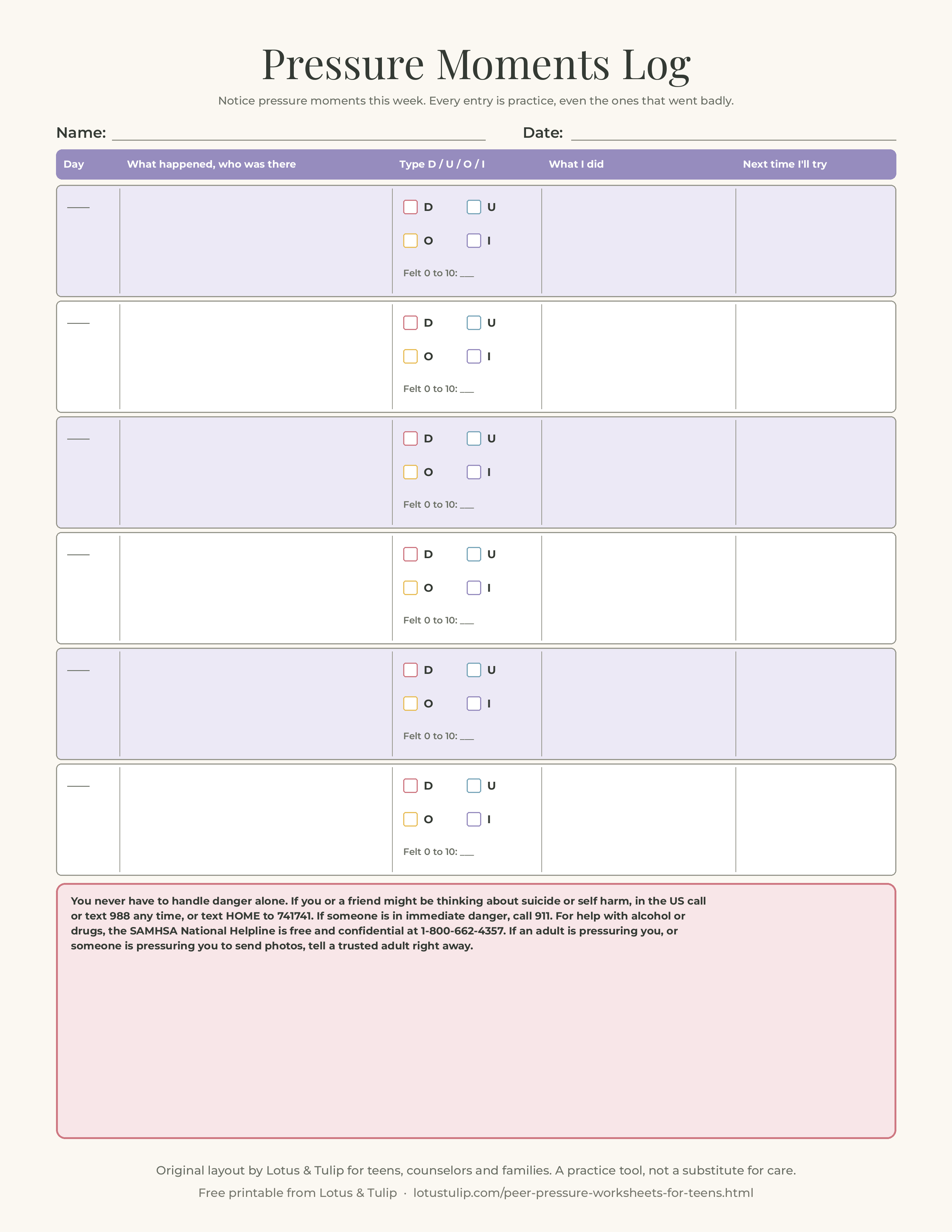
- Practice in real life and debrief. Over the next week, students note pressure moments on the Pressure Moments Log (page 3). In the next session, debrief what worked and what to try next time, without shaming entries that went badly.
Peer pressure activities for school counselors and classrooms
These activities work well in an advisory period, a health class, or a small counseling group. Most take 10 to 20 minutes.
- Pressure sort. Write 15 short scenarios on cards. Students sort them into direct, unspoken, online, or inner pressure, then into "positive influence" or "negative pressure." Some cards will spark real debate, which is the point.
- The norms poll. Ask students to estimate anonymously what percentage of students at their grade level vape, drink, or cheat. Compare their estimates with real survey data. Discuss why the gap exists (the loudest stories travel fastest).
- Script remix. Hand out the scripts from this article. Small groups rewrite them so they sound like real teens at their school. Vote on the most usable line for each situation.
- Freeze frame role play. Two students act out a pressure moment. The leader calls "freeze," and the audience suggests which refusal move to use next. Then the scene continues with the new move.
- Upstander practice. Pressure often targets someone else. Practice lines for backing up a friend who is saying no: "She said no, leave it." Having one ally makes it far easier to resist a group.
For counselors running a full eight session group, peer pressure fits naturally inside a middle school friendship, self esteem, or identity group. A simple sequence: belonging and values, naming pressure, norms, refusal moves, online pressure, role plays, helping friends, and a personal plan.
For parents and caregivers
Parents cannot follow teens into every room, but they can make saying no easier.
- Be the excuse. Tell your teen directly: "Blame me. Say I'll check, say I'll ground you, whatever works." Many teens find this the easiest refusal of all.
- Set up a code word or text. Agree on a word or emoji that means "call me with an emergency" or "come get me." Promise to pick them up with no lecture that night. You can talk the next day. Some families call this an X plan.
- Stay curious, not shocked. If a teen tells you about pressure and you explode, they will stop telling you. Ask "What did you do? How did it feel? What would you try next time?"
- Praise the no, even when it was messy. If your teen left a party early or refused a ride, notice it and thank them, even if the evening also included choices you are not happy about.
For more ideas on talking with kids calmly, see our parenting worksheets and resources.
Online peer pressure and photo safety
Online pressure follows teens home and never sleeps. Group chats, dares filmed for views, streaks, and like counts all add social weight to choices. Practical steps:
- Teach teens that they can mute, leave, or not respond. Not replying right away is a valid choice.
- Talk about how "everyone" online is a curated, loud minority. The kids who are not doing the dare are not posting about it.
- Make a family rule that any request for nude or sexual images gets shown to a trusted adult, with a promise that the teen will not be punished for telling.
- If a teen is threatened or blackmailed over an image (often called sextortion), do not pay and do not keep replying. Save the evidence, block the account, and report it to the CyberTipline run by the National Center for Missing and Exploited Children (report.cybertip.org or 1-800-843-5678). NCMEC's free Take It Down tool (takeitdown.ncmec.org) can help remove explicit images of minors from participating platforms.
Common mistakes adults make
- Only teaching "just say no." A slogan without practice, alternatives, and an exit plan gives teens nothing to do in the moment.
- Scare tactics. Exaggerated stories tend to lose credibility the moment a teen sees a peer who did the thing and seemed fine.
- Implying everyone does it. Lessons that say "most teens will be offered drugs at a party" can accidentally make risky behavior sound normal. Lead with accurate, positive norms.
- Scripts that sound like adults. If a line would get a teen laughed at, they will not use it. Let teens write the words.
- Punishing the call for help. If a teen calls for a ride from a bad situation and gets grounded, they will not call next time. Separate the rescue from any later conversation.
- One lesson and done. Refusal skills fade without practice. Revisit them before high risk times: the start of middle school, the first year of high school, prom, and summer.
What the research says (honestly)
The lab research on peer influence is strong and consistent: peers change adolescent decisions, especially in the moment, and resistance grows across the teen years. The research on prevention programs is more mixed, and it is worth being honest about that.
- Resistance skills alone are not enough. The original Drug Abuse Resistance Education (D.A.R.E.) program, built around police officers teaching students to say no, showed effects close to zero on later drug use in a meta-analysis by Steven West and Keri O'Neal (2004). D.A.R.E. has since revised its curriculum.
- Combined programs do better. Gilbert Botvin's LifeSkills Training combines drug resistance skills with general self management and social skills. Botvin and Kenneth Griffin (2004) summarize a series of trials showing reductions in tobacco, alcohol, and other drug use compared with control schools.
- Culturally grounded, student made content helps. The keepin' it REAL program, which teaches four strategies (Refuse, Explain, Avoid, Leave) using videos made with students, showed reductions in substance use in a large trial in Phoenix middle schools reported by Michael Hecht and colleagues (2003), although effects were modest and results across later studies have varied.
- Norms matter. Correcting misperceptions about what peers do is a common ingredient of effective programs, and Prinstein and Wang (2005) show why: perceived norms predict behavior.
- SEL frameworks include it. The CASEL framework for social and emotional learning lists resisting negative social pressure as part of the relationship skills competency, so peer pressure lessons fit naturally into SEL standards most US schools already use.
No study has tested a three page worksheet like the one below on its own, and no one should claim it prevents substance use by itself. It is a practice tool that supports the ingredients the research points to: naming pressure, correcting norms, rehearsing refusal, and having a backup plan with trusted people.
Safety notes and when to get more help
Peer pressure lessons sometimes bring up bigger things: a teen already using substances, being hurt by a partner, being pressured by an adult, or thinking about self harm. Follow your school's reporting procedures and mandated reporter duties where they apply. In the US:
- Call or text 988 (988 Suicide and Crisis Lifeline) any time, for anyone thinking about suicide or in emotional crisis, or someone worried about them.
- Text HOME to 741741 to reach the Crisis Text Line.
- Call 911 if someone is in immediate danger.
- The SAMHSA National Helpline at 1-800-662-4357 is free, confidential, and open 24 hours for questions about substance use and treatment referrals.
A teen who seems unable to say no in many areas of life, or who is struggling with anxiety, low mood, or substance use, may benefit from counseling. Peer pressure skills are a good start, not a replacement for care.
Free peer pressure worksheets for teens (PDF)
The free peer pressure worksheets have three pages in US Letter size, written for middle and high school students:
- Page 1: Spot the Pressure. Direct, unspoken, online, and inner pressure, each with an example and a "time I felt this" line, plus the three question pressure check, body signals to circle, and a short values prompt.
- Page 2: My Refusal Plan. Six refusal moves with example lines and space for the student's own words, a backup plan (a friend, a trusted adult, a code word), and a practice script for role plays.
- Page 3: Pressure Moments Log. Six entries to track what happened, the type of pressure, what the student did, how strong it felt, and what to try next time, with US crisis lines.
Download the free peer pressure worksheets (PDF, 3 pages, US Letter)
Prefer single images? Page 1: Spot the Pressure (PNG) · Page 2: My Refusal Plan (PNG) · Page 3: Pressure Moments Log (PNG)
Free to print for your own use and for use with your own students, clients, or groups. This is an original layout by Lotus & Tulip. Please link to this page rather than re-uploading the file.
Related resources
- Friendship worksheets for kids: joining in, repair, and healthy friendships.
- Social skills worksheets for kids: the building blocks behind confident refusals.
- Bullying worksheets for kids: when pressure turns into bullying, and how to be an upstander.
- DEAR MAN worksheet: the DBT skill for saying no effectively.
- GIVE and FAST worksheet: keeping friendships and self respect at the same time.
- Healthy boundaries worksheet: boundaries with scripts.
- Impulse control worksheets for kids: the pause before the choice.
- Stress management worksheets for teens and coping skills worksheets for teens: healthier ways to handle the feelings pressure brings.
Sources
- Gardner, M., and Steinberg, L. (2005). Peer influence on risk taking, risk preference, and risky decision making in adolescence and adulthood: an experimental study. Developmental Psychology, 41(4), 625 to 635.
- Chein, J., Albert, D., O'Brien, L., Uckert, K., and Steinberg, L. (2011). Peers increase adolescent risk taking by enhancing activity in the brain's reward circuitry. Developmental Science, 14(2), F1 to F10.
- Steinberg, L., and Monahan, K. C. (2007). Age differences in resistance to peer influence. Developmental Psychology, 43(6), 1531 to 1543.
- Sherman, L. E., Payton, A. A., Hernandez, L. M., Greenfield, P. M., and Dapretto, M. (2016). The power of the like in adolescence: effects of peer influence on neural and behavioral responses to social media. Psychological Science, 27(7), 1027 to 1035.
- Van Hoorn, J., van Dijk, E., Meuwese, R., Rieffe, C., and Crone, E. A. (2016). Peer influence on prosocial behavior in adolescence. Journal of Research on Adolescence, 26(1), 90 to 100.
- Silva, K., Chein, J., and Steinberg, L. (2016). Adolescents in peer groups make more prudent decisions when a slightly older adult is present. Psychological Science, 27(3), 322 to 330.
- Prinstein, M. J., and Wang, S. S. (2005). False consensus and adolescent peer contagion: examining discrepancies between perceptions and actual reported levels of friends' deviant and health risk behaviors. Journal of Abnormal Child Psychology, 33(3), 293 to 306.
- West, S. L., and O'Neal, K. K. (2004). Project D.A.R.E. outcome effectiveness revisited. American Journal of Public Health, 94(6), 1027 to 1029.
- Botvin, G. J., and Griffin, K. W. (2004). Life Skills Training: empirical findings and future directions. Journal of Primary Prevention, 25(2), 211 to 232.
- Hecht, M. L., Marsiglia, F. F., Elek, E., and colleagues (2003). Culturally grounded substance use prevention: an evaluation of the keepin' it R.E.A.L. curriculum. Prevention Science, 4(4), 233 to 248.
- CASEL. What is the CASEL framework? casel.org.
- Monitoring the Future survey, University of Michigan, monitoringthefuture.org.
- 988 Suicide and Crisis Lifeline, 988lifeline.org. Crisis Text Line, crisistextline.org. SAMHSA National Helpline, samhsa.gov. National Center for Missing and Exploited Children, missingkids.org.
Peer pressure worksheets for teens: FAQ
What are refusal skills?
Refusal skills are short, practiced ways to say no and get out of a situation when someone pressures you. Examples include saying no clearly, repeating the same line, suggesting something else, leaving, and using a parent or a code word as a backup.
At what age is peer pressure strongest?
Research by Steinberg and Monahan (2007) found that resistance to peer influence grows most clearly between about ages 14 and 18, so early and middle adolescence, roughly middle school and the first years of high school, are when teens benefit most from practice and support.
Is all peer pressure bad?
No. Peer influence can be positive, such as friends encouraging each other to study, try out for a team, or stand up for someone. Research shows teens are also more generous when peers approve of giving. The goal is to help teens tell the difference and choose friends who pull them in good directions.
How can I teach peer pressure to middle school students?
Start with why belonging matters, name four kinds of pressure (direct, unspoken, online, and inner), correct the "everyone is doing it" myth with real data, teach a quick pressure check and a few refusal moves, then role play from easy to harder scenarios and build a backup plan with a trusted adult.
What is a good code word plan for teens?
A family agrees on a word or emoji the teen can text that means "please call me with an emergency" or "come get me." The parent responds without questions in the moment and without punishment that night, so the teen can leave a bad situation safely and save face with friends.
Do peer pressure programs work?
Programs that only teach "just say no" have shown little effect, such as the original D.A.R.E. program. Programs that combine refusal skills with broader social and self management skills, accurate norms, and student made content, such as LifeSkills Training and keepin' it REAL, have shown reductions in substance use in trials, though effects vary.
Can I print the free peer pressure worksheets for my students?
Yes. The free PDF is an original Lotus & Tulip layout you can print for your own use and for your own students, clients, or groups. Please link to this page instead of re-uploading the file.