
Therapist worksheets · Intrusive thoughts, thought suppression and OCD · Updated 2026-11-13
Intrusive thoughts worksheet: why unwanted thoughts stick, what the research shows, and how to change your relationship with them step by step (free printable)
When it looks like OCD: OCD and ERP Worksheets for Therapists, 20 pages incl. an exposure ladder, obsession and compulsion tracking and response prevention Holiday 20% off: about $9.20, was $12 (EUR 10) · fillable PDF, instant digital download
Buy on EtsyThe appraisals behind it: CBT Worksheets for Therapists, 20 pages including thought records, core beliefs and an exposure ladder Holiday 20% off: about $11.04, was $14 (EUR 12) · fillable PDF, instant digital download
Buy on EtsyTry it free first: download a fillable sample (thought record and evidence for and against, PDF, 105 KB). Type into it on screen, then get the full pack. No email needed.
A full caseload: Therapist Worksheets Mega Bundle (8 packs incl. CBT, anxiety, DBT, ACT, grief and ADHD) Holiday 20% off: about $35.88, was $45 (EUR 39) · fillable PDFs for all 8 packs plus 160 printable pages, instant digital download
Buy on EtsyYou are holding a kitchen knife and a picture flashes into your mind of hurting someone you love. You are driving and the thought comes: "what if I swerved into that car?" You are in church, or in a meeting, and a shocking word or image pops up out of nowhere. Most people feel a jolt, think "that was weird" and move on. For some, the jolt turns into fear: "Why would I think that? What does it say about me?" They try hard to push the thought away, and it comes back louder.
This guide is for adults and the therapists who work with them. It explains what intrusive thoughts are, how common they are, why fighting them tends to backfire, when they may point to OCD, nine practical steps, common mistakes and examples. It ends with a free 2 page printable: My Intrusive Thoughts Map, which helps you see the thought, the meaning you give it and what you do next, and My Intrusive Thoughts Practice Plan, a plan for letting thoughts come and go while dropping the checking, neutralizing and avoidance that keep them sticky.
Download the free intrusive thoughts worksheet (PDF, 2 pages, US Letter)
Direct download, no email or sign up. See the pages first.
Safety first. This page and the worksheet are not a diagnosis. Unwanted thoughts you find repugnant are different from intentions, plans or urges you want to act on. If you have thoughts of harming yourself or someone else that you are considering acting on, call or text 988 (Suicide and Crisis Lifeline) or call 911 now.
What intrusive thoughts are, and what they are not
They are unwanted thoughts, images or urges that pop into the mind. They arrive without being invited, often feel out of character and can be about harm, accidents, sex, religion, contamination, doubt ("did I lock the door?") or saying something embarrassing. They are part of the normal stream of thinking that every brain produces.
They are not wishes or plans. The fact that a thought upsets you is usually a sign that it goes against what you value. A parent who is horrified by an image of dropping their baby is horrified precisely because they care. The thought itself is not evidence about your character or what you will do.
They are not the same as worry or rumination. Worry is a chain of "what if" thinking about real life problems, and rumination is going over and over something. Intrusive thoughts are usually short, sudden and feel foreign. They can, however, set off worry, rumination or checking, which is where the trouble starts.
How common are they?
Almost everyone has them. In a classic study, Stanley Rachman and Padmal de Silva (1978) found that about 80% of people without a psychiatric diagnosis (99 of 124) reported unwanted intrusive thoughts or impulses, and that their content was similar to the obsessions reported by patients with OCD. What differed was how often the thoughts came, how distressing they were and how hard they were to dismiss.
Christine Purdon and David Clark (1993) asked 293 students about 52 types of intrusive thought, image and impulse. Ninety-nine percent reported at least one, including thoughts about reckless driving, aggression toward friends and family, and unwanted sexual acts. Adam Radomsky and colleagues (2014) then tested whether this was just a feature of Western students: across 777 students at 15 sites in 13 countries on six continents, 93.6% reported at least one unwanted intrusive thought in the previous three months. Doubting intrusions were the most common and repugnant ones (such as sexual or blasphemous thoughts) the least common. All three studies used student or volunteer samples, so the exact figures are a rough guide, but the conclusion is consistent: having intrusive thoughts is normal.
Why they stick: meaning and control
It is the meaning, not the thought. Paul Salkovskis (1985) set out the cognitive behavioral account that most current treatment builds on. An intrusive thought becomes a problem when it is read as meaningful or dangerous: "having this thought means I might do it", "I am a bad person for thinking this" or "if I do not deal with it, something terrible will happen and it will be my fault". That appraisal brings anxiety, guilt or disgust, and a strong urge to do something about the thought.
Thought-action fusion. Roz Shafran, Dana Thordarson and Stanley Rachman (1996) described two common beliefs that make intrusive thoughts feel dangerous. Moral thought-action fusion is the belief that having an unacceptable thought is almost as bad as acting on it. Likelihood thought-action fusion is the belief that thinking about something bad makes it more likely to happen. Both are understandable, and both can be tested.
Pushing thoughts away tends to backfire. In Daniel Wegner and colleagues' (1987) "white bear" experiments, people who were asked not to think about a white bear went on to think about it more once the instruction was lifted. Jonathan Abramowitz, David Tolin and Gordon Street (2001) pooled the controlled studies and found a small to moderate rebound effect of thought suppression, varying with the type of thought and how it was measured. Lab studies used fairly neutral thoughts over minutes, so they cannot capture everything about real life, but they fit what many people report: the harder you try not to think something, the more it seems to show up.
Neutralizing, checking and avoidance keep the fear untested. Replacing the thought with a "good" one, praying it away, asking for reassurance, checking that nothing bad happened or avoiding knives, babies or driving all bring short relief. But each one teaches your brain that the thought was dangerous and that you only stayed safe because you neutralized it. Page 1 of the worksheet maps these responses so you can see them.
When intrusive thoughts may point to OCD
Intrusive thoughts are universal, but obsessive-compulsive disorder is not. In the National Comorbidity Survey Replication, a nationally representative survey of US adults, Ruscio and colleagues (2010) found that more than a quarter of respondents reported obsessions or compulsions at some point, while 2.3% met full criteria for OCD in their lifetime and 1.2% in the past year. Signs that it may be worth an assessment include thoughts that take up more than an hour a day, strong urges to perform rituals, mental reviewing or reassurance seeking, avoidance that limits your life, or distress that does not ease. Only a qualified clinician can diagnose OCD.
The treatment with the strongest evidence for OCD is cognitive behavioral therapy with exposure and response prevention (ERP), sometimes alongside medication. Our ERP worksheets for OCD guide explains how it works, and the free OCD and ERP worksheets include an exposure ladder and response prevention plan.
The honest caveat. There is no trial of this worksheet. It borrows the shared ingredients of cognitive behavioral approaches to unwanted thoughts: normalizing them, noticing the appraisal, testing thought-action fusion beliefs, and gradually dropping suppression, neutralizing and avoidance. If intrusive thoughts take over your days, or come with low mood or thoughts of self-harm, see a therapist or doctor.
How to use an intrusive thoughts worksheet, step by step
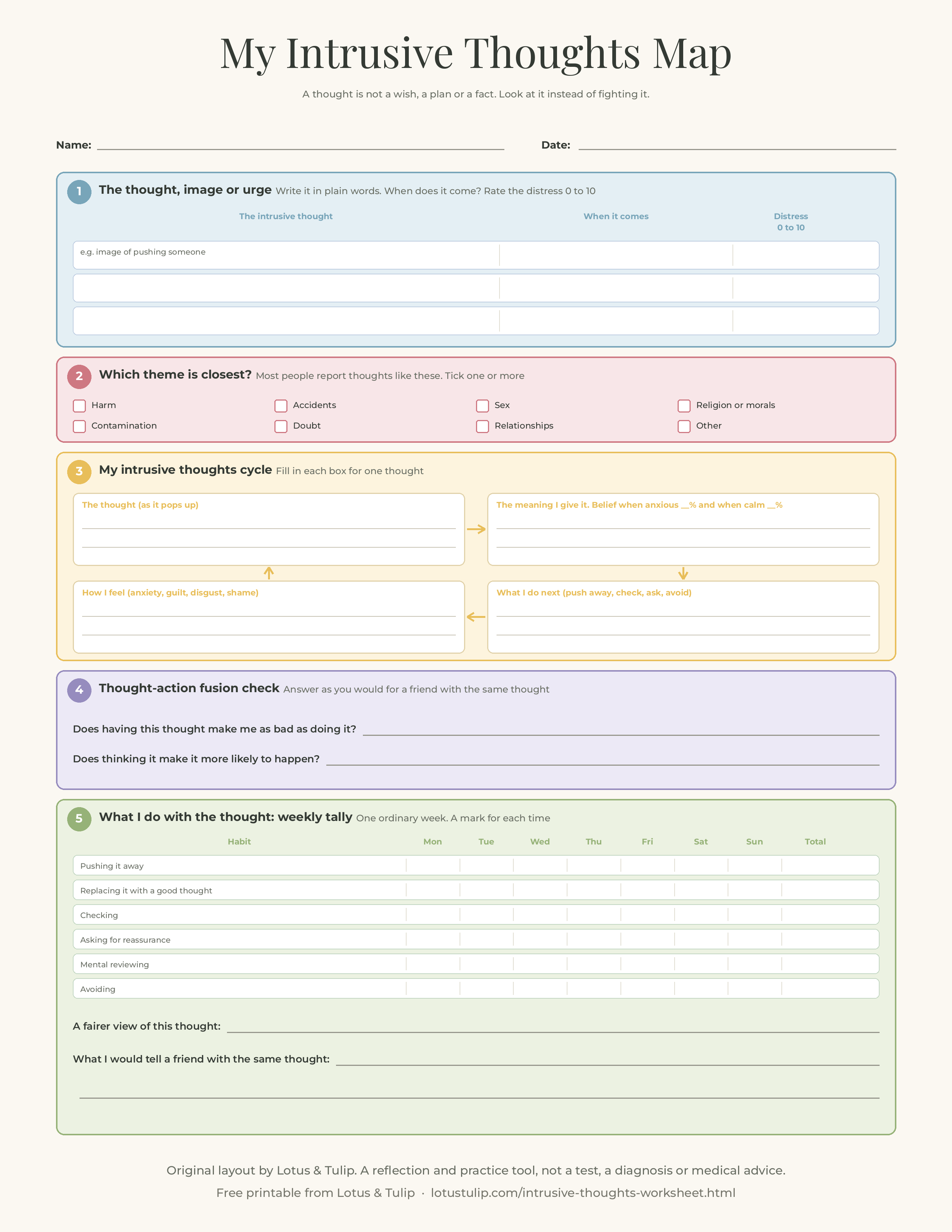
- Write the thought down exactly. On page 1, write the intrusive thought, image or urge in plain words, when it tends to come and how distressing it is from 0 to 10. Writing it down is often the first time it has been looked at instead of fled from.
- Name the type. Tick the closest theme: harm, accidents, sex, religion or morals, contamination, doubt, relationships or other. Seeing that your thought belongs to a well known category, reported by most people, can take some of the shock out of it.
- Spot the meaning you give it. Write what you fear the thought says about you or might cause, and how much you believe that from 0 to 100%. Then rate the belief again when you are calm. The cognitive distortions worksheet helps name the thinking traps involved.
- Check for thought-action fusion. Ask two questions: "Does having this thought make me as bad as doing it?" and "Does thinking it make it more likely to happen?" Write what you would say to a friend who asked you the same.
- List what you do next. For one ordinary week, tally pushing the thought away, replacing it, checking, seeking reassurance, mental reviewing and avoiding. These are the habits that keep the thought feeling dangerous.
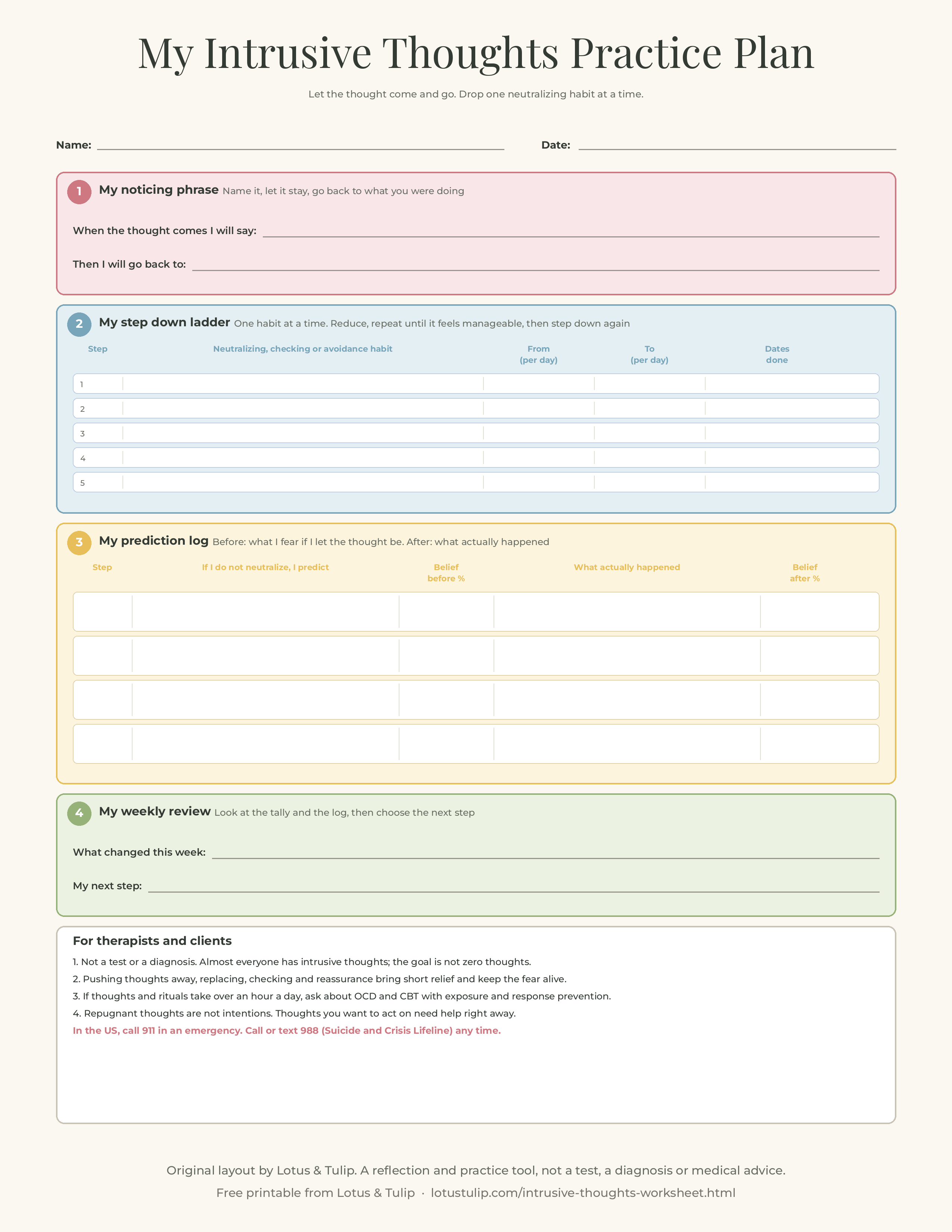
- Practice noticing without fighting. On page 2, choose a short phrase such as "there is the harm thought again" and let the thought stay for a few minutes without arguing, replacing or checking. The cognitive defusion worksheet has more ways to step back from thoughts.
- Drop one neutralizing habit at a time. Use the step down ladder to reduce one habit gradually, for example from asking for reassurance five times a day to two, then none. The urge surfing worksheet helps you ride the urge without acting on it.
- Test a prediction. Write what you fear will happen if you let the thought be and skip the ritual, and how strongly you believe it. Do it, then log what actually happened and your new belief. The behavioral experiment worksheet uses the same logic.
- Return to what matters and review weekly. After noticing the thought, go back to what you were doing, even if the anxiety is still there. Once a week, review your tallies and belief ratings and choose the next step. If thoughts take more than an hour a day, use the OCD resources above or see a therapist.
When the same worries loop for hours, the worry time worksheet helps postpone them, and the self compassion worksheet helps when shame about the thoughts is loud.
Common mistakes
- Trying to stop the thoughts completely. The goal is not zero intrusive thoughts, which nobody has, but thoughts that come and go without running your day.
- Arguing with the thought for hours. Rebuttals can turn into mental reassurance. Write the fairer view once, then return to what you were doing.
- Swapping one ritual for another. Stopping reassurance from your partner but searching online instead teaches the same lesson. Track all forms of neutralizing together.
- Avoiding the people and places the thought is about. Avoidance brings relief and keeps the fear untested. Step back into those situations gradually.
- Going it alone when it looks like OCD. If the thoughts and rituals take more than an hour a day or limit your life, CBT with ERP from a trained clinician has the best evidence.
Examples
- The new parent: Weeks after her baby was born, she had sudden images of dropping him down the stairs. She stopped carrying him on the stairs and asked her partner several times a day whether she was a good mother. Map: thought, image of dropping the baby, distress 9; meaning, "I might secretly want to", 60%; habits, avoidance and reassurance. After learning how common intrusive thoughts are, she practiced noticing the image ("there is the scary picture") and carried the baby on the stairs with her partner nearby, then alone. Two weeks later, belief 15%, reassurance down from six times a day to one.
- The driver: Had the thought "what if I hit someone and did not notice?" and circled back to check the road several times a week. Prediction: "If I do not check, I will find out I hurt someone, 70%." Plan: no circling back, one note in his phone instead. After a month of drives with no checking, belief 20%.
- The worshipper: Had blasphemous words pop into her head during prayer and repeated prayers until they felt "right", sometimes for an hour. With her therapist, she practiced letting the words be there without restarting, cutting repetitions step by step. Her therapist also assessed for OCD, and the worksheet became part of a fuller ERP plan.
Free intrusive thoughts worksheet
This free printable is an original Lotus & Tulip layout on US Letter, in our own wording, not the items of any clinical questionnaire. Page 1, My Intrusive Thoughts Map, has a table for the thought, when it comes and how distressing it is, a checklist of common themes, a four box map of the cycle (the thought, the meaning I give it, how I feel, what I do next) with belief ratings, a thought-action fusion check, a weekly tally of suppressing, replacing, checking, reassurance, mental reviewing and avoidance, and lines for a fairer view. Page 2, My Intrusive Thoughts Practice Plan, has a noticing phrase, a step down ladder for neutralizing habits, a prediction log, a weekly review and short notes for therapists and clients.
Download the free intrusive thoughts worksheet (PDF, 2 pages, US Letter)
Prefer single images? Page 1: my intrusive thoughts map (PNG) · Page 2: my intrusive thoughts practice plan (PNG)
Free to print for use with your own clients or for yourself. Please link to this page rather than re-uploading the file. A reflection and practice tool, not a test, a diagnosis or a substitute for therapy. In the US, call 911 in an emergency, or call or text 988 in a mental health crisis.
Related resources
- OCD worksheets for kids: when a child has unwanted thoughts and rituals, a free boss back plan for ages 5 to 12
- ERP worksheets for OCD: when intrusive thoughts come with rituals
- Cognitive defusion worksheet: step back from sticky thoughts
- Urge surfing worksheet: ride the urge to check or neutralize
- Health anxiety worksheet: when the intrusive thought is about illness
- Worry time worksheet: postpone looping worries to a daily slot
- Behavioral experiment worksheet: test an anxious prediction
- All therapist worksheets: CBT, DBT, ACT and more
FAQ
What is an intrusive thoughts worksheet?
An intrusive thoughts worksheet is a structured page that helps you write down an unwanted thought, image or urge, the meaning you give it, how much you believe that meaning and what you do next, such as pushing it away, checking or seeking reassurance, and then plan gradual steps to let the thought come and go. Therapists use them in cognitive behavioral work, and adults can use them on their own or alongside therapy.
Are intrusive thoughts normal?
Yes. In studies of people without a diagnosis, about 80% to 99% reported unwanted intrusive thoughts, and an international study of 777 students in 13 countries found 93.6% had at least one in the past three months. The content is often similar to clinical obsessions. What differs in OCD is how often the thoughts come, how distressing they are and what people do to get rid of them.
Why does trying not to think about something make it worse?
Experiments on thought suppression, starting with the white bear studies, found that trying to push a thought away often leads to it coming back more afterwards. A meta-analysis of controlled studies found a small to moderate rebound effect. Letting the thought be there, without fighting or neutralizing it, tends to help it fade.
Do intrusive thoughts mean I have OCD?
Not on their own. Almost everyone has intrusive thoughts, while about 2.3% of US adults meet criteria for OCD in their lifetime. An assessment is worth considering if the thoughts take up more than an hour a day, come with strong urges to perform rituals or seek reassurance, or limit your life. Only a qualified clinician can diagnose OCD.
Is this intrusive thoughts worksheet free?
Yes. It is free to print for use with your own clients or for yourself. Please link to this page rather than re-uploading the file.
Sources
- Abramowitz, J. S., Tolin, D. F., and Street, G. P. (2001). Paradoxical effects of thought suppression: A meta-analysis of controlled studies. Clinical Psychology Review, 21(5), 683 to 703.
- Purdon, C., and Clark, D. A. (1993). Obsessive intrusive thoughts in nonclinical subjects. Part I. Content and relation with depressive, anxious and obsessional symptoms. Behaviour Research and Therapy, 31(8), 713 to 720.
- Rachman, S., and de Silva, P. (1978). Abnormal and normal obsessions. Behaviour Research and Therapy, 16(4), 233 to 248.
- Radomsky, A. S., Alcolado, G. M., Abramowitz, J. S., and colleagues. (2014). Part 1. You can run but you can't hide: Intrusive thoughts on six continents. Journal of Obsessive-Compulsive and Related Disorders, 3(3), 269 to 279.
- Ruscio, A. M., Stein, D. J., Chiu, W. T., and Kessler, R. C. (2010). The epidemiology of obsessive-compulsive disorder in the National Comorbidity Survey Replication. Molecular Psychiatry, 15(1), 53 to 63.
- Salkovskis, P. M. (1985). Obsessional-compulsive problems: A cognitive-behavioural analysis. Behaviour Research and Therapy, 23(5), 571 to 583.
- Shafran, R., Thordarson, D. S., and Rachman, S. (1996). Thought-action fusion in obsessive compulsive disorder. Journal of Anxiety Disorders, 10(5), 379 to 391.
- Wegner, D. M., Schneider, D. J., Carter, S. R., and White, T. L. (1987). Paradoxical effects of thought suppression. Journal of Personality and Social Psychology, 53(1), 5 to 13.