
Therapist worksheets · DBT emotion regulation · Updated 2026-11-12
Cope ahead worksheet: the DBT skill for planning and rehearsing hard situations (free printable)
Full DBT set: DBT Worksheets for Therapists, 20 pages incl. a diary card, checking the facts, opposite action, a crisis survival plan and chain analysis Holiday 20% off: about $11.04, was $14 (EUR 12) · fillable PDF, instant digital download
Buy on EtsyTry it free first: download a fillable sample (weekly diary card and checking the facts, PDF, 234 KB). Type into it on screen, then get the full pack. No email needed.
For teens: DBT Worksheets for Teens, 20 pages incl. wise mind, check the facts, opposite action, a body reset and school and social media triggers Holiday 20% off: about $11.04, was $14 (EUR 12) · instant digital download
Buy on EtsyMega bundle: Therapist Worksheets Mega Bundle (8 packs incl. DBT, CBT, ACT, anxiety, grief and ADHD) Holiday 20% off: about $35.88, was $45 (EUR 39) · fillable PDFs for all 8 packs plus 160 printable pages, instant digital download
Buy on EtsySome hard moments arrive without warning. Many do not: the court date, the holiday dinner with a critical relative, the performance review, the first day back at school after time away, the anniversary of a death. Cope ahead is the DBT skill for those predictable situations. Instead of hoping skills will show up in the moment, the client picks the skills in advance, pictures the situation as if it is happening now, and rehearses coping well, including with the problems they fear most. This guide is for therapists, counselors, DBT skills group leaders and school mental health staff, and it is written so adults and older teens can use it too. It covers where cope ahead sits in DBT, the steps as the skills handouts teach them, why rehearsal in imagery may help, how to run it in session, how it changes for teens, examples and common mistakes. It ends with a free 2 page printable: a My Cope Ahead Plan and a Cope Ahead Rehearsal script and log.
Download the free cope ahead worksheet (PDF, 2 pages, US Letter)
Direct download, no email or sign up. See the pages first.
What cope ahead is in DBT
Dialectical behavior therapy, developed by Marsha Linehan, teaches skills in four modules: mindfulness, distress tolerance, emotion regulation and interpersonal effectiveness. Cope ahead belongs to emotion regulation, in the group of skills for reducing vulnerability to emotion mind, usually taught as ABC PLEASE: Accumulate positive emotions, Build mastery, Cope ahead, plus the PLEASE skills for physical care. In the second edition of the skills materials (Linehan, 2015), cope ahead appears on Emotion Regulation Handout 19, "Build Mastery and Cope Ahead", with Emotion Regulation Worksheets 12 and 13 for practice.
The idea is simple. Emotional situations that are likely to prompt problem behavior (yelling, leaving, self harm urges, drinking, shutting down) are much easier to handle when the person has already decided what to do and has practiced it. Cope ahead is preparation, not prediction: it does not try to stop the situation from happening, and it does not require the client to believe it will go well.
Cope ahead sits next to several other DBT skills. If the feared situation might not be a real problem at all, check the facts comes first. If the situation can be changed or avoided wisely, problem solving may be the better route. If the emotion is going to fit the facts but the urge would make things worse, the plan often includes opposite action, a DEAR MAN script or crisis survival skills such as TIPP. Cope ahead is the wrapper that gets those skills ready for one specific day.
The cope ahead steps
In our own words, the adult handout breaks cope ahead into five steps:
- Describe the situation that is likely to prompt problem behavior. Check the facts and be specific. Name the emotions and actions most likely to get in the way of using skills.
- Decide which coping or problem solving skills to use, and write out in detail how you will cope with the situation, the emotions and the action urges.
- Imagine the situation as vividly as possible, as if you are in it now, seeing it through your own eyes rather than watching yourself from the outside.
- Rehearse coping effectively in your mind: your actions, your thoughts, what you say and how you say it. Rehearse coping with new problems that come up, and with the catastrophe you fear most.
- Practice relaxation after rehearsing.
The adolescent version in Rathus and Miller's DBT Skills Manual for Adolescents (2015, Emotion Regulation Handout 15, "Building Mastery and Coping Ahead") uses four steps with the same core: describe the situation and check the facts, decide which skills to use and write them out, imagine the situation as if you are in it now, and rehearse coping, including troubleshooting problems that might arise. DBT STEPS-A, the school based curriculum (Mazza et al., 2016), teaches the same skill for classroom use.
Why rehearsing in imagery may help
There is no trial that we know of that tests cope ahead on its own against a control condition, so it is worth being precise about what the evidence does say.
- Skills training is an active part of DBT. In a randomized component analysis with 99 women with borderline personality disorder and recent suicidal or self injuring behavior, Linehan and colleagues (2015, JAMA Psychiatry) found that all three DBT conditions reduced suicide attempts similarly, but the conditions that included skills training produced greater improvements in nonsuicidal self injury and depression than DBT individual therapy without skills training. That supports the skills package as a whole, not cope ahead specifically.
- Imagery carries emotion. Holmes and Mathews (2010, Clinical Psychology Review) reviewed evidence that mental imagery evokes greater emotional responses than thinking about the same material in words, and that the size of the response depends on the perspective taken. That fits the handout's instruction to imagine being in the situation now. It is also why rehearsal can be uncomfortable, and why the relaxation step at the end matters.
- If then plans help people act on intentions. Cope ahead overlaps with what social psychologists call implementation intentions: plans that spell out "if situation Y happens, then I will do X". A meta-analysis by Gollwitzer and Sheeran (2006) of 94 independent tests with 8,461 participants found a medium to large effect of forming such plans on goal attainment (d = .65). The If then plan box on page 1 of the free printable uses this format.
- Cope ahead has a place in adolescent DBT research. Rathus and Miller (2015) note that among the emotion regulation skills they adapted from Linehan's revised adult manual, cope ahead is the one that had already been included in adolescent research trials.
In short: cope ahead is a well established part of a well supported treatment, built on ideas with good evidence of their own, but its specific effect has not been isolated. Use client data, such as the rehearsal log and the after review, to judge whether it is helping a given person.
Good situations for cope ahead
Cope ahead works best for a specific, predictable situation in the next week or two that the client cannot or should not avoid. Some typical examples:
- A family holiday, wedding or funeral with a relative who has been critical or hurtful
- A meeting with a manager, a performance review, a court date or a custody exchange
- A medical procedure, a dental visit or a hospital follow up
- An anniversary of a death, a breakup or a trauma
- A party where alcohol or drugs will be available and the client wants to stay sober
- For teens: a class presentation, a test, a school trip, seeing an ex friend at an event, asking a teacher for an extension, returning to school after an absence
It is a poor fit for vague, open ended worry ("something bad might happen at some point"), for situations that need problem solving rather than coping, and for acute crises. If a client is at risk of suicide or self harm, cope ahead can be part of the plan but does not replace a safety plan.
How to use the cope ahead worksheet, step by step
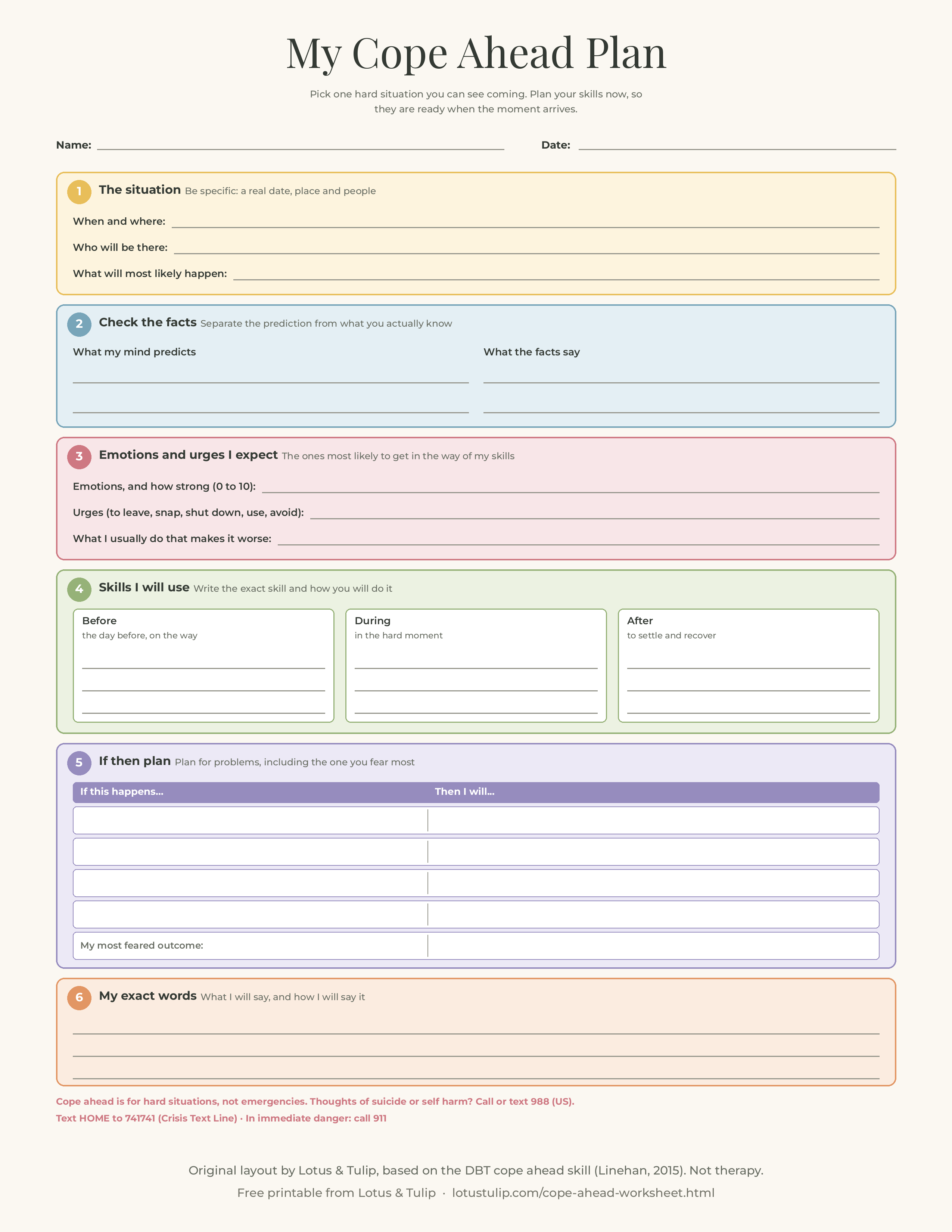
- Pick one real situation. Choose something specific in the next week or two, with a date, a place and the people involved. Write it in box 1 of page 1. Specific works far better than "family stuff".
- Check the facts. In box 2, separate what the client's mind predicts from what they actually know. If the feared problem turns out to be unlikely, the plan may get smaller; if it holds up, the plan is aimed at the right target.
- Name emotions and urges. In box 3, list the emotions with a 0 to 10 strength rating, the urges that could get in the way, and what the client usually does that makes things worse.
- Choose skills for before, during and after. In box 4, write exact skills, not labels: "paced breathing in the car park for two minutes" rather than "breathe". Include something for recovering afterward.
- Write if then plans. In box 5, list the likely problems and what the client will do if each one happens, and finish with the most feared outcome and a plan for that too.
- Write the exact words. In box 6, script what the client will say and how they will say it, for example one validating line and one clear request or limit.
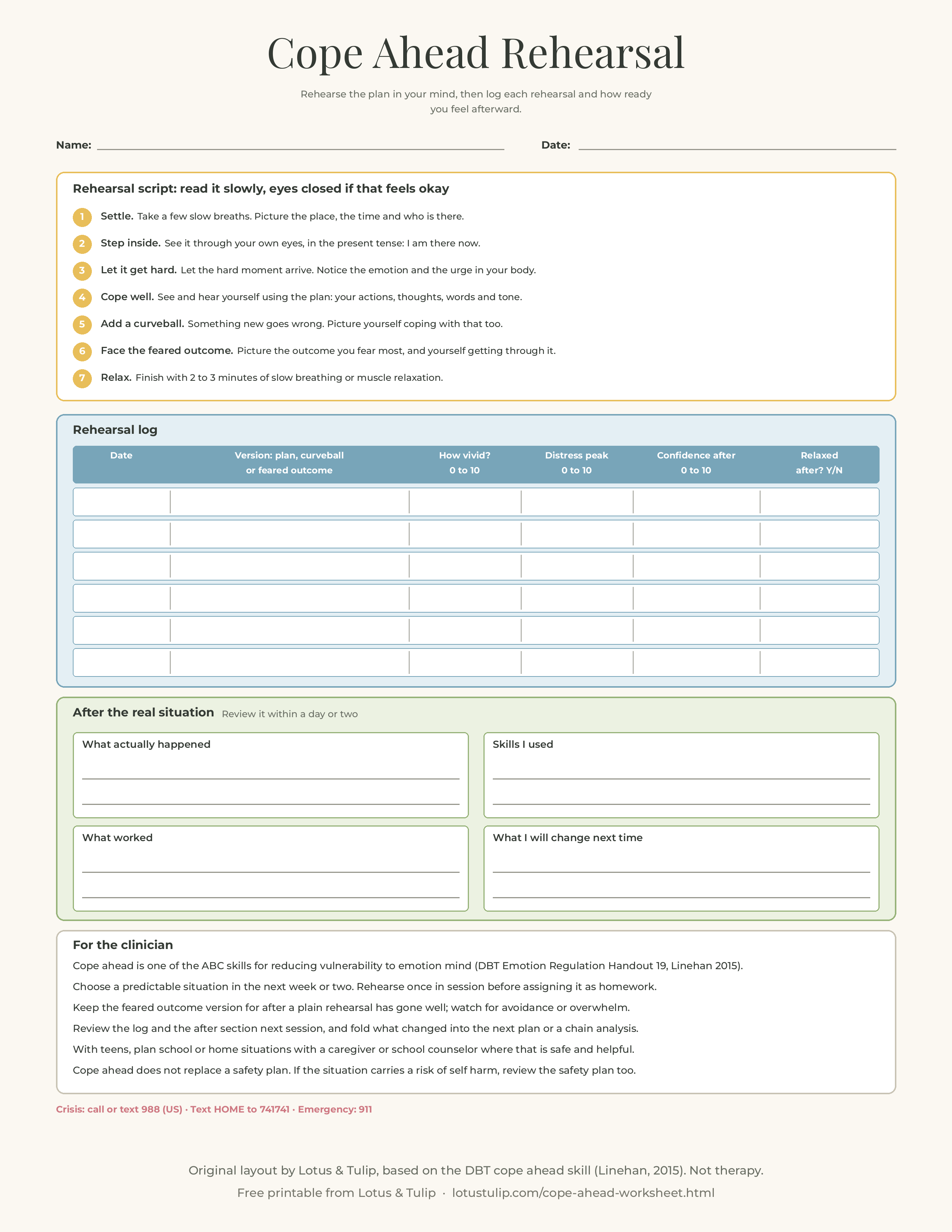
- Rehearse in session. Read the script on page 2 slowly: settle, step inside the scene in the present tense, let the hard moment arrive, cope well, add a curveball, face the feared outcome, then relax for two to three minutes.
- Log each rehearsal. After each practice, the client records the date, which version they rehearsed (the plan, a curveball or the feared outcome), how vivid it was, peak distress and confidence afterward, and whether they relaxed.
- Review after the real event. In the after section, record what actually happened, the skills used, what worked and what to change, then bring it to the next session.
Running it in session
It usually helps to complete page 1 together, then lead the first rehearsal out loud, with the client describing the scene in the first person and present tense ("I'm walking into the kitchen, my aunt looks up..."). Keep the first run to the plain plan, where the client copes well. Add a curveball on the second run. Save the feared outcome version for when a plain rehearsal has gone well, and watch for signs of overwhelm or avoidance, such as switching to an observer view, rushing or skipping the hard part. Role play out loud is a useful step up from imagery for interpersonal situations, especially when paired with a DEAR MAN script.
Assign rehearsal as homework once the client can do it in session. Short repeated rehearsals across the days before the event are easier to fit into a week than one long session the night before, and the log makes them visible. In the next session, review the log and the after section, and if the situation went badly, a behavior chain analysis can show where the plan broke down.
Using cope ahead with teens
Teens often have a steady supply of predictable hard situations: tests, presentations, team tryouts, group chats, family events and the first day back after an absence. The adolescent handout has four steps, without a separate relaxation step, and calls the rehearsal of problems troubleshooting. The free printable keeps both, so a teen can skip what they do not need. Practical tips:
- Use the teen's own words for emotions and urges, and accept brief answers.
- Make the before, during and after plan concrete and private enough to use at school, such as a pocket card or a note on the phone.
- Where it is safe and helpful, involve a caregiver or the school counselor in the plan, for example agreeing on a pass to step out of class.
- For social media situations, plan both the online moment and what the teen will do with the urge afterward.
Our DBT Worksheets for Teens include school and social media triggers, check the facts, opposite action and a body reset page that fit naturally into a cope ahead plan.
Three short examples
These are illustrative composites written for this guide, not real clients.
- A holiday dinner. An adult client expects her father to comment on her weight at Thanksgiving. Facts: he has done so at the last three family meals. Expected emotions: shame 7, anger 8, with the urge to leave in tears or snap back. Plan: before, a walk and a text to a friend; during, paced breathing and one prepared line ("I'm not discussing my body today, Dad. How's the garden?"); if he repeats it, she excuses herself for ten minutes; feared outcome: a shouting match in front of the kids, with the plan to leave early and calmly. She rehearses three times. Afterward she logs that he made the comment once, she used the line, and the rest of the meal was tense but fine.
- A performance review. A client with a history of shutting down under criticism rehearses a meeting with his manager. His plan includes writing two notes in advance, asking one clarifying question, and saying "I'd like to think about that and come back to you tomorrow" if he feels flooded. His curveball rehearsal adds a colleague joining the meeting.
- A class presentation. A 15 year old fears freezing in front of her class. Check the facts: she has frozen once, for a few seconds, and recovered. Plan: before, practice twice at home and eat breakfast; during, a paced breath at the first slide and a note card with her first sentence; if she blanks, she reads the card. Her feared outcome rehearsal is classmates laughing, and she pictures finishing anyway and telling her counselor afterward.
Common mistakes
- Choosing a vague situation. "School" or "my family" is too broad to rehearse. Pick one event with a date.
- Skipping check the facts. Rehearsing for a catastrophe that is very unlikely can build fear rather than skill.
- Listing skills by name only. "Use DEAR MAN" is not a plan. Write the actual words and actions.
- Watching instead of being there. The handout asks the client to imagine being in the situation now, not watching it. Observer style rehearsal tends to stay abstract.
- Only rehearsing the good version. The point is to practice coping when things go wrong, including the feared outcome, once the client is ready.
- Leaving out the recovery. End each rehearsal with relaxation, and plan what the client will do after the real event.
- Never reviewing it. The after section is where the next plan gets better.
Free cope ahead worksheet
This free printable is an original Lotus & Tulip layout on US Letter. Page 1, My Cope Ahead Plan, has six boxes: the situation (when and where, who will be there, what will most likely happen), check the facts (what my mind predicts and what the facts say), emotions and urges with 0 to 10 strength, skills for before, during and after, an if then plan with a row for the most feared outcome, and my exact words. Page 2, Cope Ahead Rehearsal, has a seven step imagery script, a six row rehearsal log (version, vividness, distress peak, confidence and relaxation), an after the real situation review and short clinician notes. Both pages show 988 and 911, and page 1 adds the Crisis Text Line.
Download the free cope ahead worksheet (PDF, 2 pages, US Letter)
Prefer single images? Page 1: my cope ahead plan (PNG) · Page 2: cope ahead rehearsal (PNG)
Free to print for use with your own clients or for personal use. Please link to this page rather than re-uploading the file. An original layout based on the cope ahead skill as described in published DBT skills materials (Linehan, 2015; Rathus and Miller, 2015). Not affiliated with or endorsed by the authors, the publisher or any organization named here. A practice tool, not a substitute for treatment or a safety plan.
Related resources
- DBT STOP skill worksheet: the in the moment skill to rehearse for the during column
- DBT PLEASE skills worksheet: the rest of ABC PLEASE, with a daily tracker
- Check the facts worksheet: the first step of a good cope ahead plan
- Opposite action worksheet: a common skill to rehearse inside the plan
- DEAR MAN worksheet: scripts for the exact words box
- DBT TIPP skills worksheet: fast body skills for the during column
- Wise mind worksheet: the state of mind to plan from
- Behavior chain analysis worksheet: for when a plan did not hold
- Safety plan worksheet: for crisis risk, alongside cope ahead
FAQ
What is cope ahead in DBT?
Cope ahead is a DBT emotion regulation skill, the C in ABC PLEASE. You describe a hard situation you expect, decide which skills you will use, imagine the situation vividly as if you are in it now, rehearse coping well (including with new problems and your most feared outcome), and then practice relaxation.
What is a cope ahead worksheet?
It is a page that walks a client through those steps on paper: the situation, the facts, expected emotions and urges, the skills to use, if then plans and the words to say, plus a place to log rehearsals and review how the real event went.
Which DBT handout covers cope ahead?
In Linehan's second edition skills materials (2015) it is Emotion Regulation Handout 19, "Build Mastery and Cope Ahead", with Worksheets 12 and 13. In Rathus and Miller's adolescent manual (2015) it is Emotion Regulation Handout 15, "Building Mastery and Coping Ahead".
What is the difference between cope ahead and check the facts?
Check the facts asks whether an emotion and its intensity fit the actual situation. Cope ahead prepares for a situation that is likely to be hard anyway. A good cope ahead plan usually starts by checking the facts about the situation.
Can teens use cope ahead?
Yes. Adolescent DBT teaches it as part of ABC PLEASE, with examples such as class presentations, school trips and family events. Keep the plan concrete, use the teen's own words, and involve a caregiver or school counselor where that is safe and helpful.
Is this cope ahead worksheet free?
Yes. It is free to print for use with your own clients or for personal use. Please link to this page rather than re-uploading the file.
Sources
- Linehan, M. M. (2015). DBT Skills Training Manual, second edition. Guilford Press.
- Linehan, M. M. (2015). DBT Skills Training Handouts and Worksheets, second edition. Guilford Press. Emotion Regulation Handout 19 and Worksheets 12 and 13.
- Rathus, J. H., and Miller, A. L. (2015). DBT Skills Manual for Adolescents. Guilford Press. Emotion Regulation Handout 15.
- Mazza, J. J., Dexter-Mazza, E. T., Miller, A. L., Rathus, J. H., and Murphy, H. E. (2016). DBT Skills in Schools: Skills Training for Emotional Problem Solving for Adolescents (DBT STEPS-A). Guilford Press.
- Linehan, M. M., Korslund, K. E., Harned, M. S., Gallop, R. J., Lungu, A., Neacsiu, A. D., McDavid, J., Comtois, K. A., and Murray-Gregory, A. M. (2015). Dialectical behavior therapy for high suicide risk in individuals with borderline personality disorder: a randomized clinical trial and component analysis. JAMA Psychiatry, 72(5), 475 to 482.
- Holmes, E. A., and Mathews, A. (2010). Mental imagery in emotion and emotional disorders. Clinical Psychology Review, 30(3), 349 to 362.
- Gollwitzer, P. M., and Sheeran, P. (2006). Implementation intentions and goal achievement: a meta-analysis of effects and processes. Advances in Experimental Social Psychology, 38, 69 to 119.