
Therapist worksheets · DBT behavior chain analysis · Updated 2026-11-05
Behavior Chain Analysis Worksheet: DBT Chain Analysis Explained, with Examples and a Free Printable
Ready-made printable: DBT Worksheets for Therapists Fillable PDF: type into the chain analysis, plus weekly diary card, pros and cons, crisis survival plan and 0 to 10 scales (20 pages)
Holiday 20% off: about $11.04, was $14 (EUR 12) · instant digital download
Try it free first: download a fillable sample (weekly diary card and checking the facts, PDF, 234 KB). Type into it on screen, then get the full pack. No email needed.

A behavior chain analysis is one of the most useful tools in dialectical behavior therapy (DBT). When a client or student has already done something they regret, a lecture rarely helps. What helps is slowing the moment down: what made them vulnerable that day, what happened just before the urge, what thoughts and feelings linked together, what the behavior was, and what followed. Marsha Linehan built chain analysis into DBT for exactly that purpose. It turns a blurry "I just snapped" into a map you can work with.
This guide is for therapists, counselors, and school-based clinicians who want a clear, honest walkthrough of DBT chain analysis (also called a behavior chain analysis worksheet). It covers what a chain analysis is and is not, each piece of the chain (vulnerability factors, prompting event, links, problem behavior, consequences), missing links and solution analysis, when to use it and when not to, adult and teen examples, a worked fictional case, common mistakes, what the research actually shows, and a free three page printable: a Behavior Chain Map, a Missing Links and Solution Analysis page, and a Practice Chain Log.
Jump to the free behavior chain analysis worksheet (PDF) · See a worked example · How to teach it, step by step
What a DBT behavior chain analysis is
In DBT, a chain analysis is a structured way to examine a specific instance of a target behavior. The "chain" metaphor matters. The problem behavior is rarely a single event. It sits in the middle of a sequence: conditions that made the person more vulnerable, an event that set things off, a series of links (thoughts, emotions, body sensations, urges, and actions), the behavior itself, and then short and long term consequences that often keep the pattern going.
Linehan's treatment manuals treat chain analysis as a core clinical tool, not a homework gimmick. In individual DBT, therapists use it after target behaviors such as self harm, substance use, aggression, or other behaviors that interfere with therapy or quality of life. Skills groups and school adaptations use simpler versions so clients and students can learn to notice their own patterns between sessions.
A few things a chain analysis is not:
- It is not a character judgment. The goal is understanding, not shame.
- It is not a full life history. It is about one episode, described in enough detail to see the links.
- It is not the same as a CBT thought record. Thought records focus on a situation, automatic thoughts, emotions, and alternative thoughts. A chain analysis includes thoughts, but also vulnerability, body sensations, actions, missing skills, and consequences across time.
- It is not a crisis tool. If someone is in acute danger or extreme arousal, stabilize first with distress tolerance skills such as STOP and TIPP. Do the chain when they can think.
The pieces of the chain, one by one
Most DBT chain analyses follow a similar structure. The free printable maps these onto one page so nothing gets skipped.
1. Vulnerability factors
Vulnerability factors are anything that made the person more likely to struggle that day or that week. Classic DBT teaching points to the same territory as the PLEASE skills: poor sleep, missed meals, illness, substance use, untreated pain, hormonal shifts, loneliness, recent conflict, and ongoing stress. Vulnerability does not excuse the behavior. It explains why a smaller prompt was enough to tip things over.
Useful questions:
- How did I sleep the night before?
- Had I eaten regularly?
- Was I sick, in pain, hungover, or coming down from caffeine or alcohol?
- What else was already hard that day (work, school, money, loneliness, a fight still simmering)?
For more on reducing day to day vulnerability, see our DBT PLEASE skills worksheet.
2. The prompting event
The prompting event is the specific thing that started this particular chain. It is usually external (a text, a look, a grade posted, a comment in a meeting) but can be internal (a memory, a sudden urge, noticing a body sensation). Clients often start with a vague prompt like "I got stressed." Push for a concrete moment: time, place, who was there, what was said or done.
A good prompting event description is short and factual. "My partner sent a three word text at 9:40 p.m. saying 'We need to talk'" is better than "my relationship is falling apart."
3. Links: thoughts, emotions, body, actions
Links are the steps between the prompt and the problem behavior. DBT asks for several kinds of links, not just thoughts:
- Thoughts and interpretations: "They're leaving me." "Everyone thinks I'm stupid." "If I don't do something now, I will explode."
- Emotions: shame, anger, fear, sadness, envy, guilt, with intensity ratings when possible (0 to 10).
- Body sensations: tight chest, hot face, stomach drop, shaking hands, numbness.
- Urges: urge to yell, to leave, to drink, to self harm, to send a long message.
- Actions and inactions: checking the phone five times, pacing, pouring a drink, opening a chat, saying nothing when a skillful ask was needed.
The links are where most of the clinical work lives. Two people can face the same prompt and build completely different chains. Naming each link creates places to intervene next time: check the facts on a thought, use opposite action on an emotion, leave the room before the urge peaks, text a support person.
Skills that often fit specific links include Check the Facts for interpretations, opposite action for emotion driven urges, Wise Mind for decisions made in emotion mind, and interpersonal skills such as DEAR MAN when the missing move was an effective ask or a clear no.
4. The problem behavior
State the target behavior in one clear sentence. "I sent six angry texts between 9:45 and 10:10" is usable. "I was a mess" is not. If more than one behavior happened, pick the primary target for this chain and note the others as links or later consequences. In full DBT, target hierarchies guide which behaviors get analyzed first (life threatening behaviors before therapy interfering behaviors, and so on). Outside of comprehensive DBT, choose the behavior that caused the most harm or the one the client most wants to change.
5. Consequences: short term and long term
Consequences keep chains alive. Short term consequences are what happened in the minutes and hours after the behavior: relief, attention, ending an argument, numbness, a temporary sense of control. Long term consequences are what showed up later: shame, damaged trust, lost sleep, a write up at work, a friendship that cooled, another urge the next day.
Be honest about both. If the behavior "worked" for five minutes, write that down. Pretending there were no short term payoffs makes the analysis feel fake, and clients stop using it. The point of writing the short term relief next to the long term cost is to make the trade visible.
6. Missing links
Missing links analysis asks: where did skillful behavior fail to appear? What did the person not know, not remember, not believe they deserved, or not have the energy to do? Common missing links include:
- Not noticing vulnerability early enough
- Not pausing after the prompt (no STOP)
- Not checking whether the interpretation was accurate
- Not using a distress tolerance skill when arousal spiked
- Not asking for help or leaving the situation
- Not repairing after a smaller misstep, so the chain kept growing
Missing links are not character flaws. They are skill gaps, memory gaps under stress, or moments when emotion mind crowded out wise mind.
7. Solution analysis and repair
Solution analysis turns the map into a plan. For each important missing link, ask: what skill or action would I use next time at that exact point? Then practice it. Repair means cleaning up consequences that can still be cleaned up: a sincere apology, returning what was taken, telling a trusted person what happened, adjusting a safety plan, scheduling a session sooner.
Repair is not the same as self punishment. DBT is clear that piling on shame after a target behavior usually feeds the next chain. Repair is concrete, proportionate, and aimed at values and relationships.
When to use a chain analysis (and when not to)
Use a chain analysis when:
- A specific target behavior has already happened and you want to understand it.
- The person can talk about the episode without becoming overwhelmed or unsafe.
- You have enough time (often 20 to 40 minutes for a thorough first chain).
- The goal is learning and planning, not assigning blame.
Do not use a chain analysis when:
- Someone is in acute crisis, actively suicidal with intent and means, or so aroused they cannot track a conversation. Use STOP, TIPP, grounding, and safety planning first. Our distress tolerance worksheets and TIPP skills worksheet are for that phase.
- The person is still intoxicated or unable to remember the episode.
- You only have two minutes. A rushed chain that skips links teaches people that the form is busywork.
- The behavior is ongoing abuse directed at the client. Focus on safety and support, not on analyzing the client's "links" as if they caused the harm.
A practical rule used by many DBT clinicians: if distress is above about 7 or 8 out of 10, regulate first, analyze later. Chain analysis done in emotion mind tends to become either a shame spiral or a justification speech.
How to fill out a behavior chain analysis worksheet
Here is a plain language way to walk through the free printable with an adult client or a teen. Adjust the language to the person in front of you.
- Name the episode. Pick one concrete incident. Write the date and a short label ("Tuesday texts after the meeting").
- List vulnerability factors. Sleep, food, health, substances, stress already on board. Circle or write the ones that applied.
- Describe the prompting event in facts. Who, what, when, where. No story yet.
- Add the links in order. Thought, feeling, body, urge, action, then the next thought. Keep going until you reach the problem behavior. Aim for at least four or five links, not one giant jump.
- State the problem behavior clearly. One sentence.
- Write short term consequences. What happened right away, including any relief or payoff.
- Write long term consequences. What showed up hours or days later.
- Find missing links. Where could a skill have gone? What did they not try, not remember, or not believe would work?
- Build solutions and repair. For two or three key points on the chain, write a specific next time plan. Then note any repair that is still possible and kind.
Adult example (brief)
Alex, 34, yelled at a coworker in a hallway after a project update. Vulnerability: two hours of sleep, skipped lunch, a cold starting. Prompt: the coworker said, in front of others, "We're still waiting on your piece." Links: thought "They're humiliating me on purpose," shame 8/10, heat face, urge to defend, sarcastic comment, then louder yelling. Problem behavior: raised voice and personal criticism for about a minute. Short term: coworker went quiet, Alex felt briefly powerful, then shaky. Long term: HR email, shame, avoidance of the team, two days of rumination. Missing links: no food, no pause after the comment, no Check the Facts, no ask for a private conversation. Solutions: eat before hard meetings, STOP and step to the bathroom, use DEAR MAN later that day, repair with a specific apology.
Teen example (brief)
Maya, 16, posted a mean story about a classmate after being left out of a group chat photo. Vulnerability: fight with a parent that morning, three hours of sleep, scrolled social media for an hour before school. Prompt: seeing the photo without her in it at lunch. Links: thought "They all hate me," sadness and anger 9/10, stomach knot, urge to get even, drafting the story, posting it. Problem behavior: posted the story. Short term: likes from two friends, brief sense of power. Long term: school call home, friend group colder, private shame, urge to delete and then post again. Missing links: no phone break, no STOP before posting, no Wise Mind check ("Will this help me keep the friends I want?"), no ask to a trusted adult. Solutions: leave phone in locker for ten minutes after a social sting, text one safe friend instead of posting, use GIVE or FAST values check, repair with a direct apology and taking the story down.
A worked fictional example, start to finish
Jordan, 28, has been in outpatient therapy for six months and is learning DBT skills. On Thursday night Jordan drank half a bottle of wine after promising themselves they would not drink this week. Here is a chain analysis of that episode. This is a fictional composite for teaching, not a real client.
- Vulnerability factors: slept about four hours after a late work deadline, skipped dinner, had two leftover beers in the fridge from a roommate, felt lonely after canceling plans, menstrual cramps.
- Prompting event: at 8:55 p.m., an ex posted a photo with a new partner. Jordan saw it while lying on the couch scrolling.
- Links:
- Thought: "I will always be alone. I was not enough."
- Emotion: shame 8/10, sadness 7/10.
- Body: chest tight, face hot, restless legs.
- Urge: drink to numb, text the ex.
- Action: opened the fridge, stood there for a minute.
- Thought: "One glass will take the edge off. I can stop."
- Emotion: relief at the decision, anxiety underneath.
- Action: poured a large glass, then another, then finished most of the bottle while watching short videos.
- Problem behavior: drank alcohol after a clear personal commitment not to drink this week (approximately half a bottle of wine between 9:05 and 10:20 p.m.).
- Short term consequences: numbness, stopped looking at the phone, fell asleep on the couch, did not text the ex.
- Long term consequences: woke at 3 a.m. with a headache and shame, canceled a morning run, was irritable at work, urge to drink again the next evening, told their therapist with heavy self criticism.
- Missing links: no meal after work, phone in bed with no plan, no STOP when the photo hit, no TIPP or self soothe instead of the fridge, no call or text to the support person on their plan, no radical acceptance that the ex has a new life.
- Solution analysis:
- Vulnerability: keep a ready meal at home on late work days; put alcohol out of the apartment during hard weeks (already discussed with roommate).
- After a social media sting: phone face down, STOP, splash cold water, rate urge 0 to 10.
- If urge to drink is above 6: leave the apartment for a ten minute walk or call Sam (support person), then reassess.
- Thought link: Check the Facts on "I will always be alone," then one opposite action step for sadness (text a friend to walk this weekend).
- Values: write the reasons for the no drink commitment on a card on the fridge.
- Repair: honest check in with therapist (already done), apology to self without punishment (rest, water, food, no spiral), message to Sam that Thursday nights are high risk and asking for a check in text at 9 p.m. next week. No drunk texting the ex, which is already a win worth naming.
Notice what the chain did. It did not pretend the wine "came out of nowhere." It showed several places where a skill could have gone, and it treated the short term numbness as real so the plan could compete with it.
How to teach a DBT behavior chain analysis, step by step
- Explain the purpose without shame. Say that a chain analysis is a map of one episode, used to find places to put skills next time. It is not a trial.
- Pick one clear target behavior. Help the client choose a specific incident. If they offer five, take the most recent or the most harmful and save the others for later.
- Regulate first if needed. If arousal is high, do STOP, paced breathing, or TIPP before opening the worksheet. A regulated nervous system makes better links.
- Start with vulnerability and the prompt. Fill the top of the Behavior Chain Map together. Keep the prompt factual.
- Slow down the links. Ask "and then what did you think / feel / notice in your body / do?" until the jump from prompt to behavior is gone. Write thoughts, emotions, body sensations, urges, and actions as separate links.
- Name the behavior and both sets of consequences. Include short term payoffs. Clients trust the process more when the relief is on the page.
- Run a missing links pass. For each major link, ask what skill or support was missing. Keep the tone curious.
- Build two or three concrete solutions. Solutions should be small enough to practice before the next similar situation. Role play one of them in session.
- Plan repair and homework. Decide what repair is needed, if any, and assign a short Practice Chain Log entry for the next near miss or target behavior. Review it next session and refine.
For teens and school settings, shorten the language, use the teen example above as a model, and expect more help writing the first chain. Many adolescents can fill page 3 of the printable (short log rows) more easily than a full map until they have done two or three guided ones.
Chain analysis for teens and schools
DBT for adolescents (Rathus and Miller) and school based programs such as DBT STEPS-A keep the chain idea but simplify the paperwork. A few adaptations help:
- Use everyday words: "what was already hard," "what set it off," "what happened step by step," "what I did," "what happened after," "what I will try next time."
- Expect phone based prompts: group chats, photos, streaks, and seen receipts are common prompting events.
- Invite a caregiver into the solution side when appropriate (rides, phone charging outside the bedroom, a code word), without turning the chain into a parental interrogation.
- Watch for shame. Teens often collapse into "I'm just bad." Redirect to links and skills.
Related teen pages on this site include coping skills worksheets for teens, GIVE and FAST, and relapse prevention worksheets when substance use or habit loops are part of the chain.
Common mistakes
- Jumping from prompt to behavior. "I got a text and then I yelled." That skips the links where skills belong.
- Writing only thoughts. Body and urges matter. Many people feel the urge in the body before they notice a thought.
- Skipping short term payoffs. If the behavior relieved something, say so. Otherwise the plan will not compete with reality.
- Using the chain as punishment. Long, shaming write ups after every slip teach people to hide behavior, not to analyze it.
- Doing it during a 9 out of 10 crisis. Regulate first. Analyze when thinking is possible.
- Vague solutions. "Be more mindful" is not a solution. "When I see an ex's post, phone down, cold water, text Sam" is.
- Ignoring repair or overdoing it. No repair leaves damage sitting. Excessive self punishment is another problem behavior on a new chain.
- Analyzing someone else's behavior as if it were yours. Chain analysis is for the client's own actions, not for diagnosing a partner or parent.
What the research says (honestly)
Chain analysis is a clinical method inside DBT. It has been described and taught for decades in Linehan's texts, and clinicians write about how to use it well. It has not, to our knowledge, been tested as a standalone intervention in large randomized trials that isolate "chain analysis only" from the rest of DBT. That honesty matters for how you talk about worksheets with clients and students.
- Linehan's manuals. The second edition DBT skills materials and the broader treatment manuals present chain analysis (and missing links analysis) as a standard way to assess target behaviors and generate solutions (Linehan, 1993; Linehan, 2015 skills manuals). The method is part of how DBT individual therapy is structured.
- Rizvi and colleagues on chain analysis as a clinical tool. Shireen Rizvi and coauthors have written specifically about behavior chain analysis in clinical practice, including how to conduct thorough chains, avoid common errors, and connect chains to treatment targets (see Rizvi and Ritschel, 2014, on the utility of chain analysis, and related clinical guidance in DBT training literature). Their work is practice focused: how to do the tool well, not a claim that a worksheet alone remediates borderline personality disorder or self harm.
- DBT as a package has strong evidence. Linehan and colleagues (2015) published a randomized clinical trial and component analysis in JAMA Psychiatry with individuals at high risk for suicide. Standard DBT and conditions that included skills training showed important benefits on several outcomes compared with a condition without skills group. That supports skills based DBT broadly. It does not isolate chain analysis as the active ingredient.
- Skills use mediates outcomes. Neacsiu, Rizvi, and Linehan (2010) found that greater DBT skills use mediated improvements in suicide attempts, depression, and anger control in a secondary analysis. Chain analysis is one way clinicians increase awareness and prompt skills use after a target behavior, but again, the study measured skills use overall.
- Adolescents. Trials of DBT for adolescents (for example Mehlum and colleagues, 2014) support adapted DBT for self harming teens. School curricula such as DBT STEPS-A teach related ideas in classroom form. Neither replaces individualized risk care.
Bottom line: use chain analysis because it is a clear, teachable way to find intervention points. Do not claim that a three page printable has been proven, on its own, to reduce suicide, self harm, or substance use. It is an educational practice tool that supports good clinical work.
Safety notes and when to get more help
Talking through a chain can bring up intense shame, memories of self harm, or new urges. That is expected and manageable in a safe setting, but it is not something to push through alone if danger is present.
- In the US, call or text 988 (988 Suicide and Crisis Lifeline) any time for suicidal thoughts or emotional crisis.
- Text HOME to 741741 to reach the Crisis Text Line.
- Call 911 if someone is in immediate danger.
If you are a clinician, pair chain analysis with your usual risk assessment and safety planning. If chains show escalating life threatening behavior, intensify care. A worksheet is not a safety plan.
For acceptance of facts that cannot be changed after a hard episode, see radical acceptance. For riding out urges without acting, return to distress tolerance.
Tips for therapists and group leaders
- Model a chain on a mild, non shameful example first (raising a voice at a TV remote) before tackling high stigma targets.
- Write as the client talks. Looking at a shared page reduces the feeling of being interrogated.
- Stop and regulate if the client's distress climbs while telling the story.
- End every chain with at least one practiced solution, not only insight.
- Track patterns across several chains. The same missing link (for example, no food, or checking the phone in bed) often repeats.
- Coordinate with skills group language so homework matches what the group teaches.
Free behavior chain analysis worksheet (PDF)
The free behavior chain analysis worksheet has three pages in US Letter size, written for teens and adults:
- Page 1: Behavior Chain Map. Space for vulnerability factors, the prompting event, link columns (thoughts, emotions, body, actions), the problem behavior, and short and long term consequences.
- Page 2: Missing Links and Solution Analysis. Prompts for skills that were missing, what to do at key points next time, and a repair plan that is concrete rather than punishing.
- Page 3: Practice Chain Log. Several short rows to log near misses or target behaviors between sessions, plus a US safety box with 988, the Crisis Text Line (text HOME to 741741), and 911.
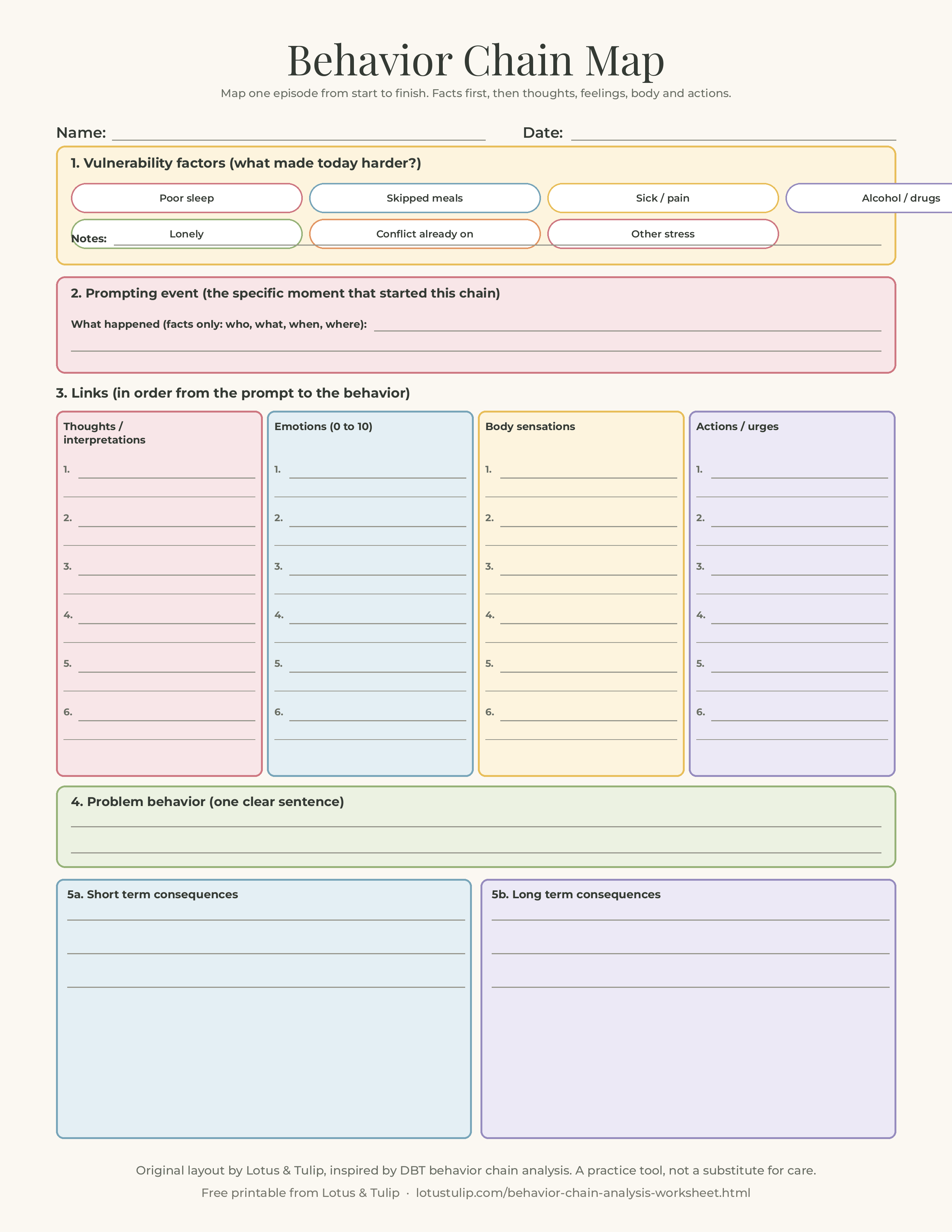
Download the free behavior chain analysis worksheet (PDF, 3 pages, US Letter)
Prefer single images? Page 1: Behavior Chain Map (PNG) · Page 2: Missing Links and Solution Analysis (PNG) · Page 3: Practice Chain Log (PNG)
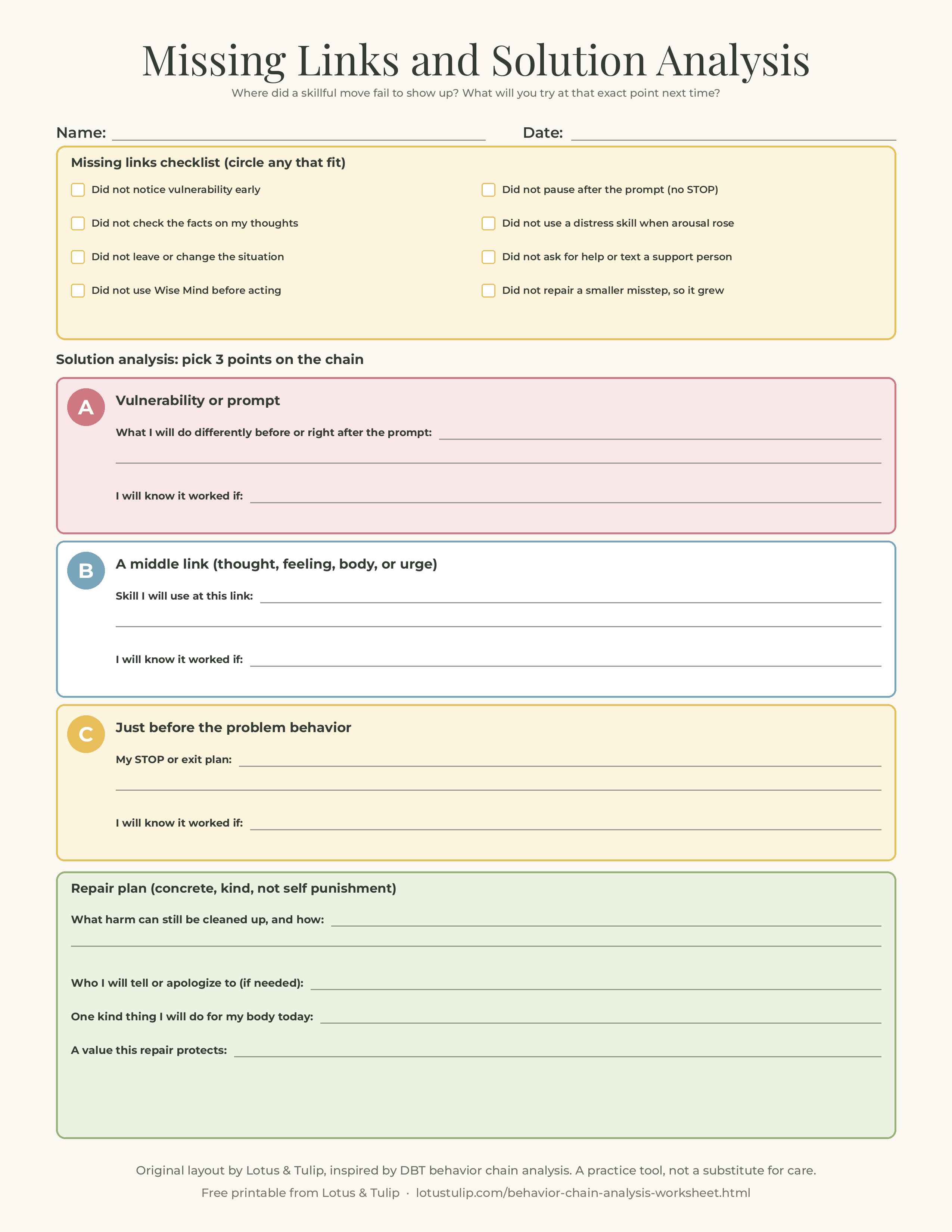
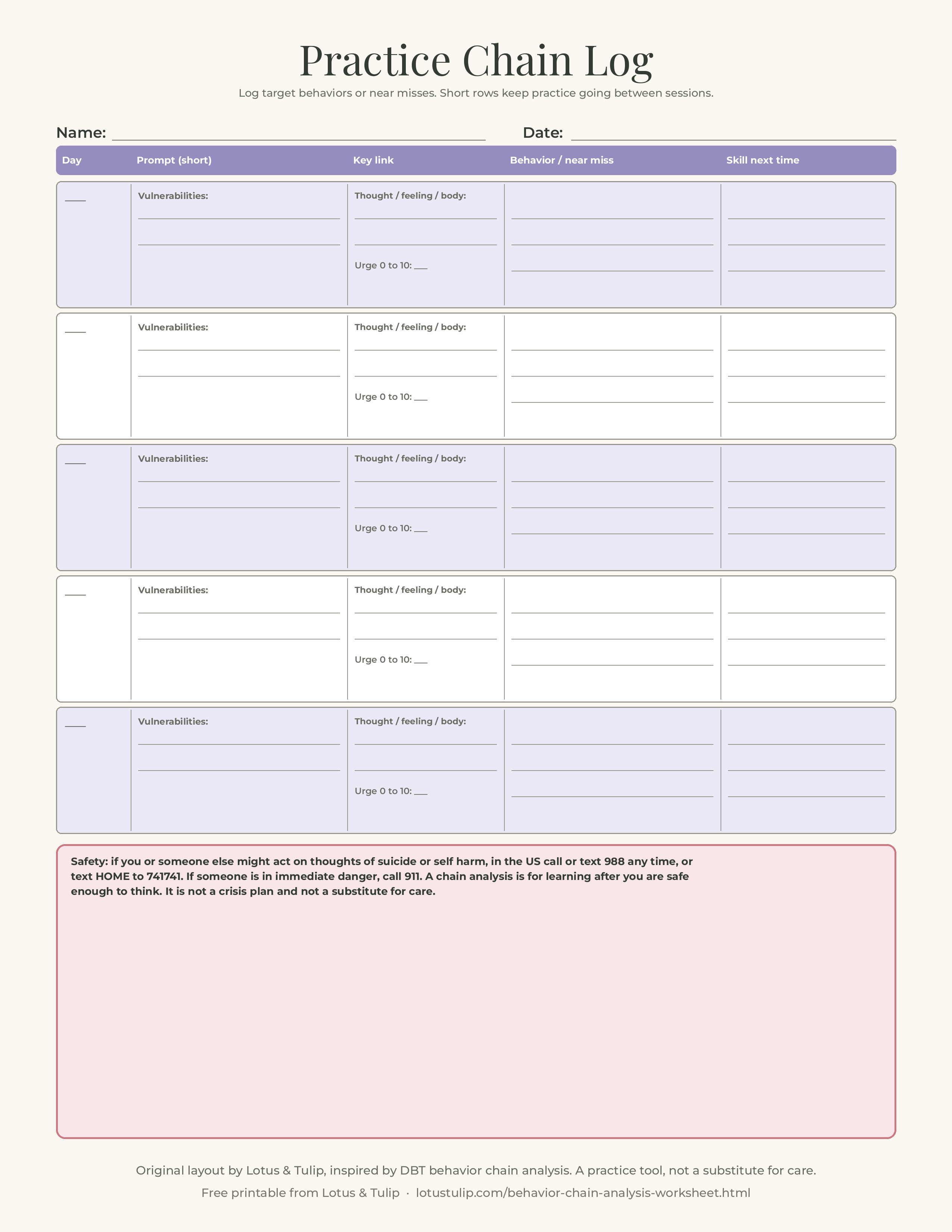
Free to print for your own use and for use with your own clients, students, or groups. This is an original layout by Lotus & Tulip, not a copy of the DBT manual handouts. Please link to this page rather than re-uploading the file.
Related resources
- Cope ahead worksheet: turn the solution analysis into a rehearsed plan for the next time.
- Distress tolerance worksheets: STOP, ACCEPTS, self soothe and IMPROVE when arousal is too high for analysis.
- DBT TIPP skills worksheet: change body chemistry fast before you try to think.
- Opposite action worksheet: act against an unhelpful emotion urge once the facts are clear.
- Check the Facts worksheet: test the interpretations that often sit in the middle of a chain.
- Radical acceptance worksheet: stop fighting facts that cannot be changed after an episode.
- Wise Mind worksheet: the state of mind solution analysis aims for.
- DEAR MAN worksheet: effective asks and nos when interpersonal links are missing.
- Relapse prevention worksheets: triggers, warning signs and coping plans for habit loops.
Sources
- Linehan, M. M. (1993). Cognitive Behavioral Treatment of Borderline Personality Disorder. Guilford Press.
- Linehan, M. M. (2015). DBT Skills Training Manual, second edition. Guilford Press.
- Linehan, M. M. (2015). DBT Skills Training Handouts and Worksheets, second edition. Guilford Press.
- Rizvi, S. L., and Ritschel, L. A. (2014). Mastering the art of chain analysis in dialectical behavior therapy. Cognitive and Behavioral Practice, 21(3), 335 to 349.
- Linehan, M. M., Korslund, K. E., Harned, M. S., and colleagues (2015). Dialectical behavior therapy for high suicide risk in individuals with borderline personality disorder: a randomized clinical trial and component analysis. JAMA Psychiatry, 72(5), 475 to 482.
- Neacsiu, A. D., Rizvi, S. L., and Linehan, M. M. (2010). Dialectical behavior therapy skills use as a mediator and outcome of treatment for borderline personality disorder. Behaviour Research and Therapy, 48(9), 832 to 839.
- Rathus, J. H., and Miller, A. L. (2015). DBT Skills Manual for Adolescents. Guilford Press.
- Mehlum, L., Tormoen, A. J., Ramberg, M., and colleagues (2014). Dialectical behavior therapy for adolescents with repeated suicidal and self-harming behavior: a randomized trial. Journal of the American Academy of Child and Adolescent Psychiatry, 53(10), 1082 to 1091.
- Mazza, J. J., Dexter-Mazza, E. T., Miller, A. L., Rathus, J. H., and Murphy, H. E. (2016). DBT Skills in Schools: Skills Training for Emotional Problem Solving for Adolescents (DBT STEPS-A). Guilford Press.
- 988 Suicide and Crisis Lifeline, 988lifeline.org. Crisis Text Line, crisistextline.org.
Behavior chain analysis worksheet: FAQ
What is a behavior chain analysis in DBT?
A behavior chain analysis is a structured look at one episode of a target behavior. It maps vulnerability factors, the prompting event, links (thoughts, emotions, body sensations, urges, actions), the problem behavior, and short and long term consequences, then looks for missing skills and solutions for next time.
What is the difference between a chain analysis and a thought record?
A CBT thought record focuses mainly on a situation, automatic thoughts, emotions, and alternative thoughts. A DBT chain analysis also includes vulnerability factors, body sensations, urges, actions, consequences over time, missing links, and a solution and repair plan.
When should you not do a chain analysis?
Do not run a chain analysis during acute crisis or very high arousal, when someone cannot think clearly, or when they are intoxicated and cannot remember the episode. Use distress tolerance skills such as STOP and TIPP first, then analyze when regulated.
What are vulnerability factors?
Vulnerability factors are conditions that made a difficult reaction more likely that day, such as poor sleep, hunger, illness, substance use, loneliness, or ongoing stress. They help explain why a smaller prompt was enough to start the chain.
What is missing links analysis?
Missing links analysis asks where a skillful response failed to appear. Examples include not noticing vulnerability, not pausing after the prompt, not checking the facts, not using a crisis skill, or not asking for help. Each missing link becomes a place to practice a solution.
Can teens use a behavior chain analysis worksheet?
Yes, with simpler language and more guidance on the first few chains. Many teens do well with short log rows between sessions after they have completed one or two full maps with a counselor. Phone based prompts such as group chats and photos are common and worth naming plainly.
Can I print the free behavior chain analysis worksheet for clients?
Yes. The free PDF is an original Lotus & Tulip layout you can print for your own use and for your own clients, students, or groups. Please link to this page instead of re-uploading the file.