
Therapist worksheets · DBT emotion regulation · Updated 2026-11-05
DBT PLEASE Skills Worksheet: ABC PLEASE Explained, with Examples, a Daily Tracker and a Free Printable
Ready-made printable: DBT Worksheets for Therapists Fillable PDF, 20 pages: weekly diary card, chain analysis, pros and cons, crisis survival plan and 0 to 10 suffering scales
Holiday 20% off: about $11.04, was $14 (EUR 12) · instant digital download
Try it free first: download a fillable sample (weekly diary card and checking the facts, PDF, 234 KB). Type into it on screen, then get the full pack. No email needed.

Some days a small comment from a coworker rolls off your back. Other days the same comment sends you into tears or a slammed door. Often the difference is not the comment. It is that you slept four hours, skipped lunch, have a cold coming on and had two glasses of wine the night before. Dialectical behavior therapy (DBT) has a name for this: vulnerability to emotion mind. And it has a set of skills for lowering it, remembered as ABC PLEASE.
This guide explains the PLEASE skills (treat PhysicaL illness, balance Eating, avoid mood Altering substances, balance Sleep, get Exercise) and the ABC skills that go with them (Accumulate positive emotions, Build mastery, Cope ahead). It covers why they work, realistic examples, how to teach them step by step, what changes for teens and school settings, a worked example, common mistakes and an honest look at the research. At the end there is a free three page printable: an ABC PLEASE plan, a PLEASE skills daily tracker and a cope ahead worksheet.
Jump to the free PLEASE skills worksheets (PDF) · See a worked example
What the PLEASE skills are in DBT
DBT, developed by Marsha Linehan, teaches four skill areas: mindfulness, distress tolerance, emotion regulation and interpersonal effectiveness. The PLEASE skills sit inside the emotion regulation module, in the section on reducing vulnerability to emotion mind. In the second edition of the skills materials (Linehan, 2015), Emotion Regulation Handout 14 gives the overview, and Handout 20, "Taking Care of Your Mind by Taking Care of Your Body", spells out PLEASE. Worksheet 14 in the same set is a practice log for it.
The acronym is a little unusual, because two of the letters come from the middle of words. That is intentional; it makes the word PLEASE:
- PL: treat PhysicaL illness. Take care of your body. See a doctor when you need to, and take prescribed medication as prescribed.
- E: balance Eating. Not too much and not too little. Eat regularly through the day, and notice foods or patterns (long gaps, lots of sugar, heavy late meals) that leave you more emotional.
- A: avoid mood Altering substances. Stay off nonprescribed drugs and use alcohol in moderation, if at all. This includes noticing how caffeine and nicotine affect your mood.
- S: balance Sleep. The handout suggests aiming for 7 to 9 hours a night for adults, or at least the amount that helps you feel good, and keeping a consistent sleep schedule, especially if sleep is hard.
- E: get Exercise. Do some kind of movement every day, building up gradually. The handout suggests working up to about 20 minutes a day.
None of this is exotic. That is the point. PLEASE is the foundation under every other DBT skill. A person who is exhausted, hungry, sick and hungover has very little room between a trigger and a reaction, and even the best taught skill is hard to reach from there.
What ABC PLEASE means
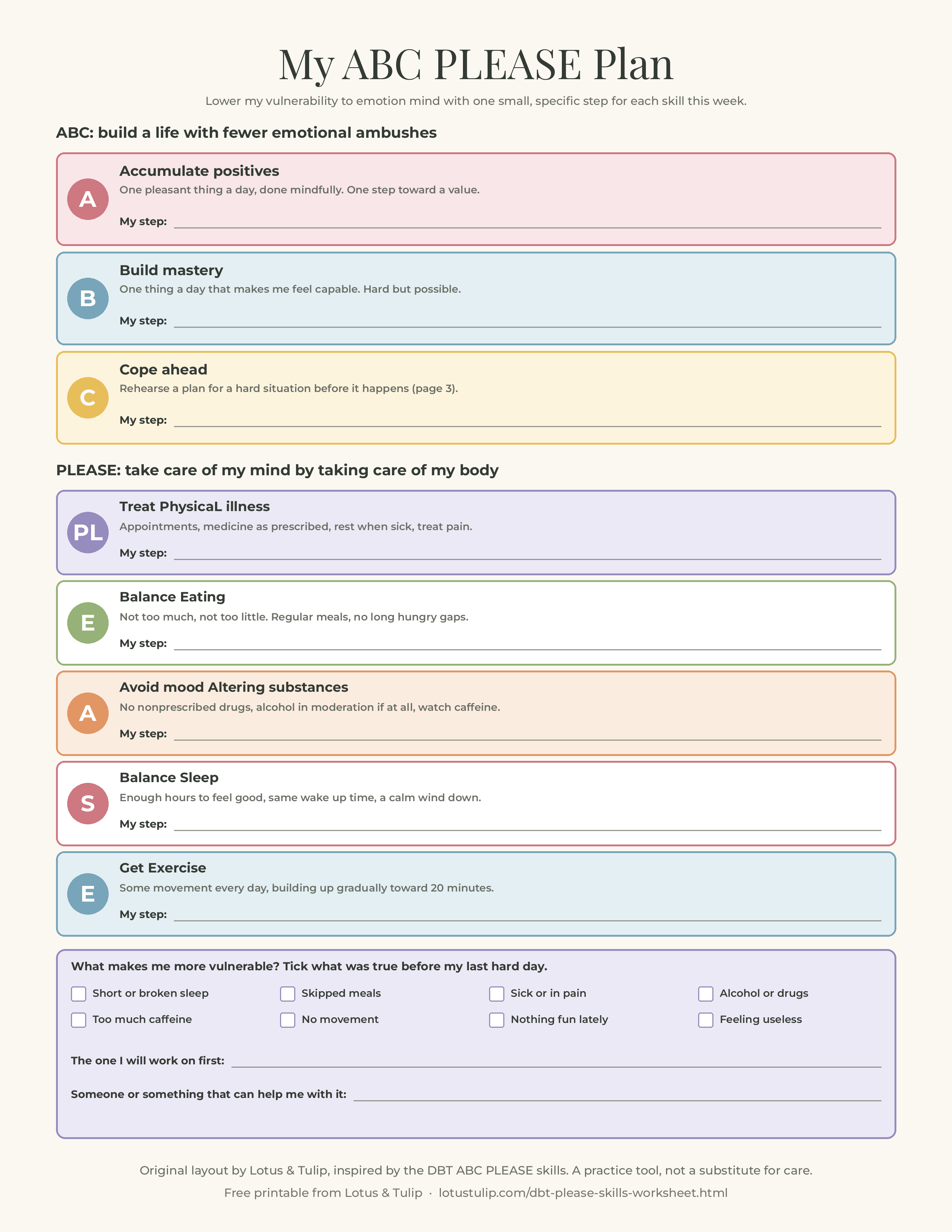
In the 2015 materials the full set of vulnerability skills is remembered as ABC PLEASE. The ABC part is about building a life with more positive experiences and fewer emotional ambushes:
- A: Accumulate positive emotions. In the short term, do pleasant things that are possible now (Handouts 15 and 16 include a long pleasant events list). In the long term, make changes so positive events happen more often, guided by your values, so you are building what DBT calls a life worth living (Handouts 17 and 18).
- B: Build mastery. Do at least one thing each day that makes you feel competent and in control. Plan for success: pick something difficult but possible, then increase the challenge gradually (Handout 19).
- C: Cope ahead. Rehearse a plan for an emotional situation before it happens, so you are ready to use skills when it arrives (also Handout 19).
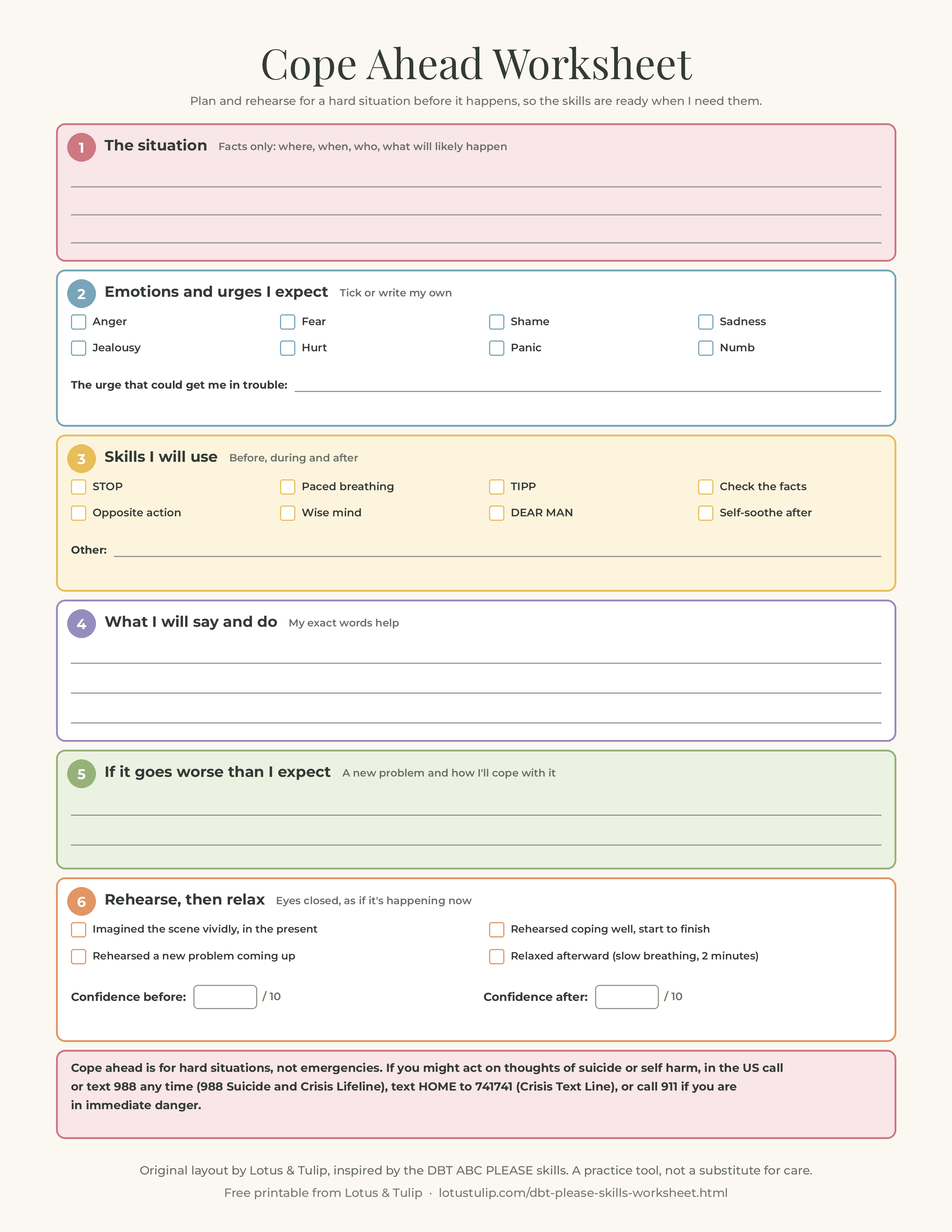
The handout version of cope ahead has five steps: describe the situation that is likely to prompt problem behavior (checking the facts and naming the emotions and urges likely to get in the way), decide which coping or problem solving skills you want to use, imagine the situation as vividly as possible as if you are in it now, rehearse coping effectively in your mind (what you will do, think and say, including handling new problems that pop up), and then practice relaxation after rehearsing.
Put together, ABC PLEASE works on two levels. PLEASE lowers biological vulnerability. ABC lowers the vulnerability that comes from a life with too little pleasure, too little sense of competence and too many emotional situations that catch you unprepared.
Why reducing vulnerability works
DBT is built on a biosocial view of emotion. Some people are born with, or develop, emotions that fire faster, run hotter and take longer to settle. On top of that baseline, everyday factors push sensitivity up or down. Linehan's teaching notes point out that physical illness, unbalanced eating, mood altering substances, poor sleep and lack of exercise all increase vulnerability to negative emotions. The logic is simple: if you cannot change how sensitive you are, you can still change how much extra load you are carrying.
A useful way to explain it to clients is the "bucket" or "battery" picture. Every night of short sleep, skipped meal, untreated pain or extra drink fills the bucket a little more, so the next stressor makes it overflow. PLEASE skills keep the water level down, which leaves room for the hard moments you cannot avoid. ABC skills add things that refill the battery: pleasant events, a sense of competence and preparation.
The research around each letter is broader than DBT itself, and it is worth being accurate about what it shows (see the research section below). Short sleep is linked to stronger negative emotional reactions and weaker regulation. Physical activity reliably reduces symptoms of depression, anxiety and distress in adults. Scheduling pleasant and meaningful activity is the core of behavioral activation, an established treatment for depression. None of these are cures, and none of them replace treatment, but they are solid reasons to take PLEASE seriously instead of treating it as "basic self care".
PLEASE skills examples, letter by letter
Generic advice ("sleep more, eat better") rarely changes anything. What helps is a small, specific, realistic step that fits the person's life this week. Here are examples clinicians and clients commonly use.
PL: treat PhysicaL illness
- Book the doctor or dentist appointment you have been putting off.
- Take medication at the same time each day, with a phone alarm or a pill box.
- Treat pain: chronic pain, migraines and menstrual pain all lower frustration tolerance.
- Rest when you are actually sick instead of pushing through and crashing emotionally.
- For teens: tell a parent or school nurse when something hurts, and keep a water bottle at school.
E: balance Eating
- Eat something within an hour or two of waking, even if it is small.
- Pack a snack for the long gap between lunch and dinner, the classic "hangry" window.
- Notice your personal patterns: a big sugar crash at 3 p.m., a heavy late meal that wrecks sleep, skipping meals on stressful days.
- Eat at least one meal mindfully, without a screen, and notice hunger and fullness.
A caution for clinicians: with clients who have an eating disorder, "balanced eating" goals should come from the treatment team and meal plan, not from a generic worksheet, and talk about restricting foods can backfire.
A: avoid mood Altering substances
- Track drinks per day honestly for one week before deciding on a goal.
- Set a cut off time for caffeine (for many people, early afternoon) and notice the effect on sleep and anxiety.
- Plan an alternative for the moment you usually reach for a substance: a walk, a shower, a call.
- Notice the "next day" effect: how mood, patience and anxiety feel the day after drinking or using.
If substance use is heavy, frequent or hard to control, a worksheet is not enough. That is a reason to talk with a doctor or a substance use specialist, and stopping some substances suddenly can be medically risky.
S: balance Sleep
- Keep the same wake up time every day, including weekends, within about an hour.
- Build a 30 minute wind down with screens dimmed or off.
- Keep the bed for sleep; if you are lying awake and frustrated for a long time, get up and do something calm in dim light until sleepy.
- Avoid long late naps that make it hard to fall asleep at night.
- Note the opposite problem too: oversleeping during low mood is also "unbalanced".
DBT includes a sleep hygiene protocol (Handout 20b) and a nightmare protocol (Handout 20a). For a full sleep page, see our sleep hygiene worksheet. Persistent insomnia is worth raising with a doctor; cognitive behavioral therapy for insomnia (CBT-I) is the recommended first line treatment for chronic insomnia in adults.
E: get Exercise
- Start with what is possible: a 10 minute walk after lunch counts.
- Attach movement to something you already do (stretch while the coffee brews, walk during one phone call).
- Pick movement you do not hate: dancing in the kitchen, a bike ride, a game of basketball, a video workout.
- Build up toward the handout's 20 minutes a day gradually, and check with a health care provider first if you have a heart condition or other medical concerns.
ABC skills examples
Accumulate positive emotions
Short term: one pleasant event a day, chosen on purpose and done mindfully. Coffee on the porch, a funny show, a call with a friend, playing with a pet, music while cooking. The DBT twist is to be mindful of the positive experience while it happens and to let go of worry about when it will end or whether you deserve it.
Long term: pick one value (connection, health, learning, creativity, faith, contribution) and one small step toward it this week. Join a class, text an old friend, sign up to volunteer. Over months, this is how the "life worth living" gets built. Our behavioral activation worksheet uses a closely related approach.
Build mastery
One thing a day that leaves you feeling capable: fixing the squeaky door, finishing a chapter, cooking a new recipe, a hard workout, one difficult email. The handout's guidance is to plan for success, not failure. If yesterday's task was too hard, pick something a little easier; if it was too easy, raise the bar slightly. Mastery is a direct counterweight to helplessness and hopelessness.
Cope ahead
Use cope ahead for a predictable hard situation: a family holiday, a court date, a meeting with a boss, an anniversary of a loss, the first day back at school. Write down the situation, name the emotions and urges you expect, pick your skills, then close your eyes and rehearse the scene as if you are in it, including what to do if it goes worse than expected. Finish with a few minutes of relaxation. Page 3 of the free printable walks through those steps on one page.
A worked example, start to finish
Marcus, 34, is in a DBT skills group for anger and depression. Over two weeks he has had three blow ups at work. In his diary card review, a pattern jumps out: each one followed a night of under five hours of sleep, and two followed evenings with four or more beers.
- Vulnerability check. His therapist asks him to rate how "raw" he felt each morning from 0 to 10, next to his PLEASE log. Mornings after short sleep and drinking averaged 8. Other mornings averaged 4.
- PL. He has untreated back pain that flares after long drives. He agrees to book a doctor's appointment this week.
- E. He usually skips breakfast and lunch on busy days. Goal: a protein bar in the car and a real lunch at least four days this week.
- A. Goal: no more than two beers on work nights, and none on Sunday night before the Monday meeting.
- S. Same wake up time (6:30) every day, phone charging in the kitchen, lights out by 11.
- E. A 15 minute walk at lunch on at least four days.
- A (accumulate). One pleasant event per day: guitar for 15 minutes after dinner. Long term: he values being a present dad, so he books Saturday mornings at the park with his daughter.
- B. Mastery: he has been avoiding fixing the bike; he will do one repair step each evening.
- C. Cope ahead for Monday's meeting with a manager who often criticizes him in front of others. He writes the likely trigger, expects anger and the urge to snap, chooses STOP and paced breathing and a prepared line ("I hear the concern. I'd like to go over it after the meeting."), rehearses it twice in imagery and practices relaxed breathing afterward.
Two weeks later, his tracker shows more consistent sleep and fewer drinking nights, and he has had one heated moment instead of three. He still gets angry. But his baseline is lower, and when the meeting happened, he already knew what he would say. That is what reducing vulnerability looks like: not a different person, a less overloaded one.
How to teach the PLEASE skills, step by step
- Explain vulnerability. Use the bucket or battery picture. Ask the client to recall a day they overreacted and list what was going on with sleep, food, illness and substances in the 24 hours before.
- Introduce the acronym. Walk through each PLEASE letter in plain words, and point out that PL and A come from the middle of words on purpose.
- Take a baseline before setting goals. Have the client track PLEASE for one week without trying to change anything, along with a daily 0 to 10 rating of mood and of how emotionally vulnerable they felt.
- Look for the pattern together. Review the log and find the one or two letters that most clearly line up with bad days. That is usually where to start.
- Set one or two small, specific goals. "Same wake up time five days this week" beats "sleep better". Avoid changing all five letters at once.
- Add the ABC skills. Plan one pleasant event a day, one mastery task a day and one value based step for the week. Use the pleasant events list for ideas.
- Cope ahead for one real situation. Choose a predictable hard event in the next two weeks and complete the cope ahead steps in session, including the imagery rehearsal.
- Track daily for two weeks. Use the daily tracker or a diary card. Praise partial success; a 4 out of 7 week is progress.
- Review and adjust. Compare the vulnerability ratings to the PLEASE log. Keep what helped, make goals easier or harder as needed, and decide whether any letter needs medical or specialist input.
PLEASE skills for teens
Rathus and Miller kept PLEASE in their adolescent adaptation, the DBT Skills Manual for Adolescents (2015), as part of emotion regulation, with simpler wording and family involvement. Teens often respond well to PLEASE once they see the link to things they care about: being less irritable with friends, doing better in a game or a test, getting along with parents. A few adjustments help:
- Sleep is usually the big one. The American Academy of Sleep Medicine recommends 8 to 10 hours per 24 hours for teens ages 13 to 18 (Paruthi and colleagues, 2016), and many get much less. Talk about phones in the bedroom without lecturing; ask them to run an experiment for a week instead.
- Make it an experiment, not a rule. "Track it for one week and see if your mood changes" invites curiosity. Rules invite rebellion.
- Use their language. Caffeine and energy drinks, vaping and skipping lunch are common teen versions of the A and E letters.
- Involve caregivers carefully. Parents can support regular meals, a household wind down time and rides to sports. They should avoid turning the tracker into a surveillance tool.
- Mastery matters. Teens who feel behind or incompetent at school often benefit most from small daily mastery wins outside academics too: a skill in a game, an instrument, a sport, cooking.
For more teen pages, see our DBT worksheets for teens and the guide to coping skills worksheets for teens.
Using PLEASE in schools
School counselors can teach PLEASE without any diagnosis involved, because it is about the basics every student needs. DBT STEPS-A (Mazza, Dexter-Mazza, Miller, Rathus and Murphy, 2016), the DBT based social emotional learning curriculum for grades 6 to 12, includes emotion regulation lessons on reducing vulnerability, including the PLEASE skills. Practical ways to use it:
- A one week class challenge. Students track sleep, breakfast and movement anonymously for five days and graph the class average against a daily mood rating.
- Before testing season. Pair PLEASE with cope ahead for exams: sleep and breakfast the night before, a plan for the moment they blank on a question.
- Small groups. In anger, stress or anxiety groups, open each session with a quick PLEASE check in.
- Be sensitive to food and housing insecurity. Some students cannot control what or when they eat, or where they sleep. Frame goals around what is in their control, and connect families to school meal programs and other supports quietly.
Common mistakes with PLEASE skills
- Treating it as a lecture. Clients already know sleep and food matter. What helps is tracking their own data and finding their own patterns.
- Changing everything at once. Five new habits in one week usually means zero by week three. Start with one or two letters.
- Making goals too big. "Exercise an hour a day" fails. "Walk 10 minutes after lunch" works, and can grow.
- Skipping the ABC half. A well rested person with no pleasant events and no sense of competence is still vulnerable. ABC and PLEASE belong together.
- Using it as blame. "You're upset because you didn't sleep" can feel invalidating. Validate the emotion first; vulnerability factors explain intensity, they do not mean the feeling is wrong.
- Ignoring medical and specialist issues. Untreated sleep disorders, chronic pain, eating disorders and substance dependence need proper care, not just a tracker.
- Forgetting cope ahead. Many predictable crises (holidays, anniversaries, hard meetings) can be rehearsed in advance and are much easier to handle when they are.
What the research says (honestly)
There are few, if any, trials that test the PLEASE skill on its own. The evidence comes from two directions: research on DBT skills training as a package, and broader research on the specific behaviors PLEASE targets. Here is what that work does and does not support.
- DBT skills training reduces emotion dysregulation. Neacsiu, Eberle, Kramer, Wiesmann and Linehan (2014) randomized 44 adults with depression or anxiety disorders and high emotion dysregulation to 16 weeks of DBT skills training or an activities based support group. Skills training reduced emotion dysregulation and anxiety more than the support group, and greater skills use helped explain the difference. It was a small pilot study, with substantial dropout.
- Skills use matters. Pooling data from 108 women with borderline personality disorder across three randomized trials, Neacsiu, Rizvi and Linehan (2010) found that increases in DBT skills use mediated improvements in suicide attempts, depression and anger control.
- Sleep and emotion. Palmer and Alfano (2017), in a review in Sleep Medicine Reviews, concluded that disrupted sleep is a robust risk and maintenance factor for many psychiatric conditions and that sleep loss affects emotional functioning at several stages of emotion generation and regulation.
- Exercise and mood. An umbrella review by Singh and colleagues (2023, British Journal of Sports Medicine) pooled 97 systematic reviews covering 1,039 trials and found that physical activity had medium sized effects on symptoms of depression, anxiety and psychological distress in adults compared with usual care. Many of the included reviews were rated low quality, so the exact size of the effect is uncertain.
- Pleasant and meaningful activity. The accumulate positives skill overlaps with behavioral activation. A meta-analysis by Ekers and colleagues (2014, PLoS ONE) of 26 randomized trials found behavioral activation more effective than control conditions for depression, while noting that study quality was often low.
What we cannot honestly claim: that following PLEASE will prevent emotional crises, treat a mental health condition on its own, or that any single letter has been proven to change DBT outcomes. PLEASE is a sensible, low risk part of a larger treatment, and the most convincing evidence for any one client is usually their own tracker.
Safety notes and when to get more help
PLEASE and ABC skills are about lowering everyday vulnerability. They are not crisis tools. If you or someone you are working with might act on thoughts of suicide or self harm:
- In the US, call or text 988 (988 Suicide and Crisis Lifeline), any time, day or night.
- Text HOME to 741741 to reach the Crisis Text Line.
- Call 911 if there is immediate danger.
For in the moment crisis skills, see our distress tolerance worksheets and the DBT TIPP skills worksheet. Before starting new exercise, changing medication or stopping a substance, it is wise to check with a doctor.
Tips for therapists and group leaders
- Put PLEASE on the diary card. A simple yes or no for each letter, next to emotion and urge ratings, makes patterns visible within two weeks.
- Use the client's own data. Pointing to "the three worst days were all after short sleep" is far more persuasive than any study.
- Connect it to the bigger goals. PLEASE is in service of the life worth living, not a health program for its own sake.
- Pair with change skills. Once vulnerability is lower, skills like opposite action and wise mind become easier to use.
- Normalize setbacks. Illness, holidays and stressful weeks will knock routines over. The skill is getting back to them, not never slipping.
Free PLEASE skills worksheets (PDF)
The free DBT PLEASE skills worksheets have three pages in US Letter size, written for teens and adults:
- Page 1: My ABC PLEASE Plan. All eight skills on one page in plain words, each with space for one small, specific goal for this week, plus a "what makes me more vulnerable" checklist.
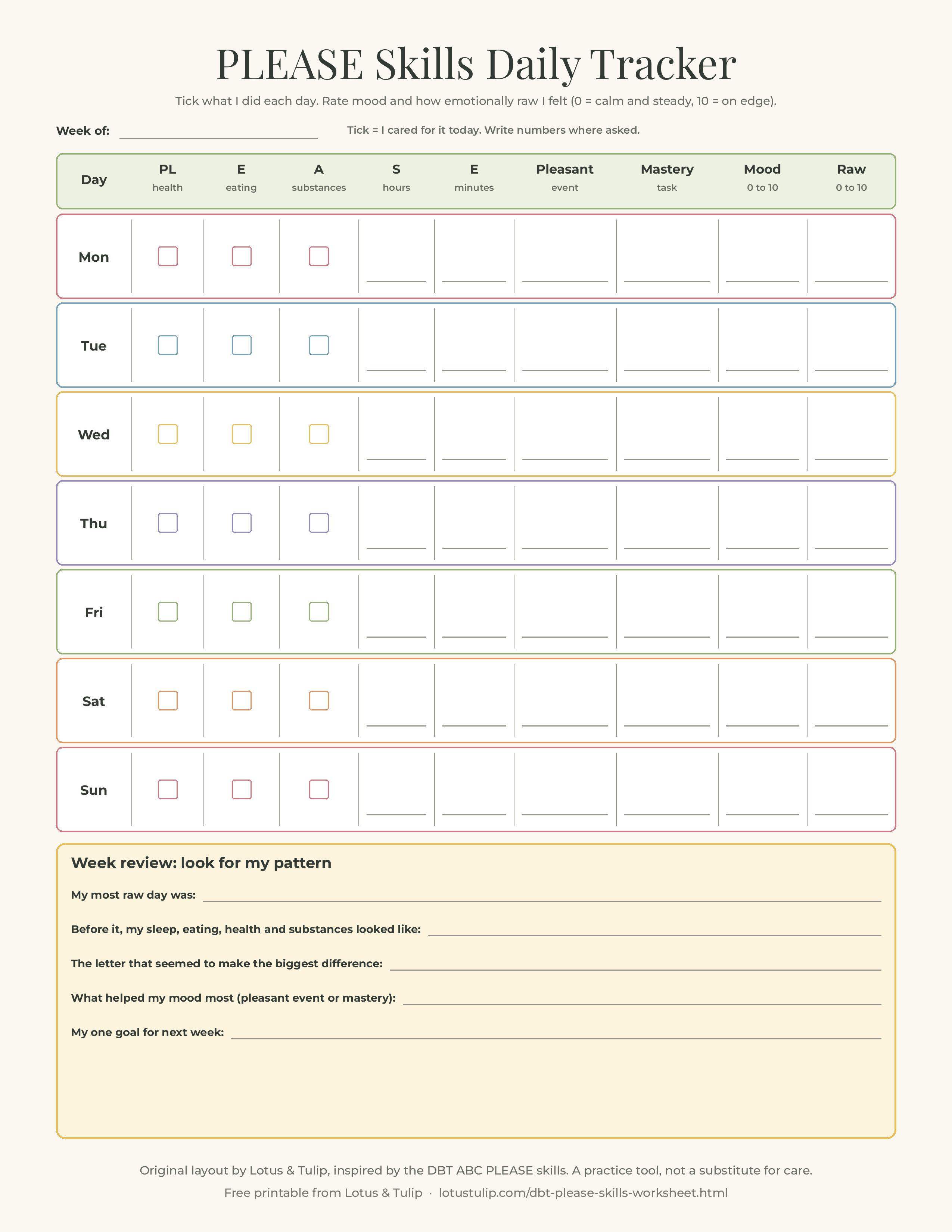
- Page 2: PLEASE Skills Daily Tracker. Seven days, with columns for physical care, eating, substances, sleep hours, exercise minutes, a pleasant event and a mastery task, and 0 to 10 ratings for mood and emotional vulnerability, plus a weekly pattern review.
- Page 3: Cope Ahead Worksheet. The situation, the emotions and urges you expect, the skills you will use, what you will say, a plan for if it goes worse, an imagery rehearsal checklist and a relaxation step, with 988, the Crisis Text Line and 911.
Download the free PLEASE skills worksheets (PDF, 3 pages, US Letter)
Prefer single images? Page 1: My ABC PLEASE Plan (PNG) · Page 2: PLEASE Skills Daily Tracker (PNG) · Page 3: Cope Ahead Worksheet (PNG)
Free to print for your own use and for use with your own clients or groups. This is an original layout by Lotus & Tulip, not a copy of the DBT manual handouts. Please link to this page rather than re-uploading the file.
Related resources
- Cope ahead worksheet: a full 2 page guide to the C in ABC PLEASE, with if then plans and a rehearsal log.
- Distress tolerance worksheets: STOP, ACCEPTS, self-soothe and IMPROVE for crisis moments.
- DBT TIPP skills worksheet: fast body based skills for extreme emotion.
- Opposite action worksheet: the emotion regulation skill for acting against an unhelpful urge.
- Wise mind worksheet: the DBT state of mind that balances emotion and reason.
- Window of tolerance worksheet: why a tired, stressed body has a narrower window.
- Sleep hygiene worksheet: a full page on the S in PLEASE.
- Behavioral activation worksheet: activity scheduling that overlaps with accumulate positives and build mastery.
- Self care plan template: a broader weekly plan for clients and clinicians.
Sources
- Linehan, M. M. (2015). DBT Skills Training Manual, second edition. Guilford Press.
- Linehan, M. M. (2015). DBT Skills Training Handouts and Worksheets, second edition. Guilford Press. Emotion Regulation Handouts 14 to 20b and Worksheets 9 to 14.
- Rathus, J. H., and Miller, A. L. (2015). DBT Skills Manual for Adolescents. Guilford Press.
- Mazza, J. J., Dexter-Mazza, E. T., Miller, A. L., Rathus, J. H., and Murphy, H. E. (2016). DBT Skills in Schools: Skills Training for Emotional Problem Solving for Adolescents (DBT STEPS-A). Guilford Press.
- Neacsiu, A. D., Eberle, J. W., Kramer, R., Wiesmann, T., and Linehan, M. M. (2014). Dialectical behavior therapy skills for transdiagnostic emotion dysregulation: a pilot randomized controlled trial. Behaviour Research and Therapy, 59, 40 to 51.
- Neacsiu, A. D., Rizvi, S. L., and Linehan, M. M. (2010). Dialectical behavior therapy skills use as a mediator and outcome of treatment for borderline personality disorder. Behaviour Research and Therapy, 48(9), 832 to 839.
- Palmer, C. A., and Alfano, C. A. (2017). Sleep and emotion regulation: an organizing, integrative review. Sleep Medicine Reviews, 31, 6 to 16.
- Singh, B., Olds, T., Curtis, R., and colleagues (2023). Effectiveness of physical activity interventions for improving depression, anxiety and distress: an overview of systematic reviews. British Journal of Sports Medicine, 57(18), 1203 to 1209.
- Ekers, D., Webster, L., Van Straten, A., Cuijpers, P., Richards, D., and Gilbody, S. (2014). Behavioural activation for depression: an update of meta-analysis of effectiveness and sub group analysis. PLoS ONE, 9(6), e100100.
- Paruthi, S., Brooks, L. J., D'Ambrosio, C., and colleagues (2016). Recommended amount of sleep for pediatric populations: a consensus statement of the American Academy of Sleep Medicine. Journal of Clinical Sleep Medicine, 12(6), 785 to 786.
- 988 Suicide and Crisis Lifeline, 988lifeline.org. Crisis Text Line, crisistextline.org.
DBT PLEASE skills: FAQ
What does PLEASE stand for in DBT?
PLEASE stands for treat PhysicaL illness, balance Eating, avoid mood Altering substances, balance Sleep and get Exercise. It is an emotion regulation skill from Linehan's DBT skills materials for taking care of your mind by taking care of your body.
What is ABC PLEASE?
ABC PLEASE is the full set of DBT skills for reducing vulnerability to emotion mind: Accumulate positive emotions, Build mastery and Cope ahead, plus the five PLEASE skills for physical care. ABC builds a life with more positive experiences and preparation; PLEASE lowers biological vulnerability.
Which DBT module are the PLEASE skills in?
PLEASE is part of the emotion regulation module, in the section on reducing vulnerability to emotion mind. In the 2015 second edition, it is Emotion Regulation Handout 20, with the ABC PLEASE overview on Handout 14.
Why do the PLEASE skills help with emotions?
Illness, skipped meals, substances, poor sleep and inactivity all make people more sensitive to stress and slower to recover. Lowering that load leaves more room between a trigger and a reaction. Research links short sleep to stronger negative emotional reactions, and physical activity to fewer symptoms of depression and anxiety in adults.
What is cope ahead in DBT?
Cope ahead is the C in ABC PLEASE. You describe a hard situation you expect, decide which skills you will use, imagine the situation vividly as if you are in it, rehearse coping well (including with new problems), and then practice relaxation afterward.
Can teens use the PLEASE skills?
Yes. PLEASE is included in the adolescent DBT adaptation by Rathus and Miller (2015) and in the DBT STEPS-A school curriculum. Teens do best when tracking is framed as a personal experiment, with sleep often the most important letter.
Can I print the free PLEASE skills worksheets for clients?
Yes. The free PDF is an original Lotus & Tulip layout you can print for your own use and for your own clients, students or groups. Please link to this page instead of re-uploading the file.