
Therapist worksheets · DBT core mindfulness · Updated 2026-11-05
DBT What and How Skills Worksheet: Mindfulness Skills Explained, with Examples and a Free Printable
Ready-made printable: DBT Worksheets for Therapists Fillable PDF, 20 pages: weekly diary card, chain analysis, pros and cons, crisis survival plan and 0 to 10 suffering scales
Holiday 20% off: about $11.04, was $14 (EUR 12) · instant digital download
Try it free first: download a fillable sample (weekly diary card and checking the facts, PDF, 234 KB). Type into it on screen, then get the full pack. No email needed.

Mindfulness is the first module in Dialectical Behavior Therapy (DBT), and every other module leans on it. You cannot check the facts if you cannot observe them. You cannot use opposite action if you cannot describe the urge. Yet "be mindful" is too vague to teach. Marsha Linehan's answer was to break mindfulness into six concrete behaviors: three What skills and three How skills.
This guide is for therapists, counselors, DBT skills group leaders, school counselors, teens, and adults learning DBT. It explains what the What and How skills are in Linehan's materials, each skill in plain words with adult and teen examples, a worked example, how to teach the skills in nine steps, practice ideas, common mistakes, an honest look at the research, safety notes, and a free three page printable: a What Skills card with a fact or judgment sort, a How Skills card with a judgment rewrite exercise, and a one week practice log.
Jump to the free What and How skills worksheets (PDF) · See worked examples
What the What and How skills are
In the second edition of DBT Skills Training Handouts and Worksheets (Guilford Press, 2015), core mindfulness opens with Wise Mind and then two handouts titled "Taking Hold of Your Mind." Mindfulness Handout 4 covers the What skills: what you do when you practice mindfulness. Mindfulness Handout 5 covers the How skills: how you do it.
- What skills: Observe, Describe, Participate.
- How skills: Nonjudgmentally, One-mindfully, Effectively.
Linehan's teaching note is simple and worth repeating to clients: practice the What skills one at a time (you either observe, or describe, or participate in a given moment), but use the How skills together. You can observe nonjudgmentally, one-mindfully, and effectively all at once.
The goal of all six is the same as the goal of the whole module: to reach Wise Mind, the place where emotion mind and reasonable mind overlap, and to act from there instead of from autopilot.
Why DBT teaches mindfulness as skills
Linehan built DBT for people with intense, fast emotions, many of whom had tried long meditation and found it unbearable or unhelpful. Breaking mindfulness into small, observable behaviors did three things. It made mindfulness teachable in a skills group. It made it practicable in seconds, not only in 20 minute sits. And it made it measurable: a client can say "I described instead of judged three times today," which is something you can track and reinforce.
The What and How skills are also not religious. Linehan drew on contemplative practice, including her own Zen training, but the DBT skills are taught as secular psychological skills. Clients of any faith or none can use them.
The What skills, one by one
Observe
Observe means noticing through your senses, on purpose, in the present moment, without adding words yet. Linehan's handout describes it as controlling your attention but not what you see: push nothing away, cling to nothing. You can observe outside yourself (the sound of a heater, the color of a wall) and inside yourself (a tight jaw, a wave of sadness, a thought passing through).
Adult example: before answering a tense email, notice your shoulders lift, your breath shorten, and the urge to type fast. Just notice.
Teen example: in the cafeteria, notice three sounds, the temperature of your hands, and the urge to check your phone, without doing anything about any of them.
What Observe is not: analyzing why you feel something, or staring hard trying to make a feeling go away. Observing is closer to watching clouds pass than to solving a problem.
Describe
Describe means putting words on what you observed, sticking to the facts. Who, what, when, where. A thought is labeled as a thought ("I'm having the thought that I'll fail"), a feeling as a feeling ("sadness is here"), a body sensation as a sensation ("stomach tight"). Linehan's handout adds a useful test: if you cannot observe it through your senses, you cannot describe it. You cannot observe someone's intentions, so "she wanted to hurt me" is not a description.
Adult example: "My manager moved the meeting twice this week. I notice heat in my face and the thought 'she doesn't respect me.'"
Teen example: "Three people laughed after I spoke. I don't know what they laughed at. I feel embarrassed."
Describe is the bridge to several other skills. It is the first step of Check the Facts, the Describe step of DEAR MAN, and the "name it" move in cognitive defusion.
Participate
Participate means throwing yourself fully into what you are doing, without standing back and commenting on yourself. Linehan uses the image of a skillful dancer, one with the music. You become the activity: washing the dishes, playing the song, talking with the friend in front of you.
Adult example: playing a board game with your kids without checking work messages or mentally scoring how good a parent you are being.
Teen example: during a pickup basketball game, letting go of "everyone is watching me miss" and just playing.
Participate is often the hardest What skill for anxious or self-conscious clients, because self monitoring feels like safety. It is also the one most connected to joy. Many clinicians treat participating as the long term goal: observe and describe are the training wheels.
The How skills, one by one
Nonjudgmentally
Nonjudgmentally means seeing what is there without labeling it good or bad, right or wrong, should or shouldn't. Linehan is precise here: it does not mean pretending harmful things are fine. You still notice helpful versus harmful and safe versus dangerous. You drop the evaluative layer ("awful," "stupid," "pathetic") and keep the facts and consequences. Her handout also says: when you find yourself judging, don't judge your judging.
Judgment: "I'm such an idiot for crying in the meeting."
Nonjudgmental: "I cried in the meeting. I felt embarrassed afterward. It happened when we discussed the layoffs."
Judgment: "He's a terrible friend."
Nonjudgmental: "He canceled three plans this month, and I feel hurt. I want to talk with him about it."
Notice that the nonjudgmental version is often more useful. It points to what actually happened and what you might do. "Idiot" points nowhere.
One-mindfully
One-mindfully means doing one thing at a time with full attention. Linehan's examples are memorable: when you are eating, eat; when you are walking, walk; when you are worrying, worry. That last one surprises clients. One-mindfully is not "only think pleasant things." It is "if you are going to worry, do it on purpose, then come back to the task."
The practice is the coming back. The mind will wander. Each time you notice and return, you have practiced the skill, not failed it.
Adult example: answering one email with full attention, then the next, instead of switching between eight tabs and a phone.
Teen example: doing homework with the phone in another room for 20 minutes, then taking a break on purpose.
Effectively
Effectively means focusing on what works in this situation to reach your goal. Linehan phrases it as doing what is needed for the situation you are in, not the one you wish you were in, not the one that is fair, and not the one that is more comfortable. It means playing by the rules when the rules serve your goal, and letting go of being right.
Adult example: you are right that the billing error was the company's fault. Effective is staying calm on the call so the charge actually gets reversed, rather than proving the point and getting hung up on.
Teen example: you think a class rule is unfair. Effective is following it this week and asking the teacher about it after class, if your goal is a good grade and a working relationship.
Effectively connects mindfulness to values. It is closely related to the willingness side of radical acceptance: acting skillfully in reality as it is.
What and How skills at a glance
| Skill | Group | Core question | Quick practice |
|---|---|---|---|
| Observe | What | What do my senses notice right now? | Notice five sounds without naming them |
| Describe | What | Can I say it in fact words only? | Describe your last emotion in one camera style sentence |
| Participate | What | Can I fully join this activity? | Sing one song all the way through, out loud |
| Nonjudgmentally | How | Can I drop good and bad and keep the facts? | Count your judgments for one hour |
| One-mindfully | How | Am I doing one thing at a time? | Eat one snack with no screen |
| Effectively | How | What works for my goal here? | Name your goal before a hard conversation |
Worked examples
Adult example: a hard morning at work
Jordan, 41, arrives to find a short email from a director: "We need to talk about the report." Jordan's chest tightens and the thought appears, "I'm getting fired."
- Observe: Jordan stops for one breath and notices a tight chest, warm face, and the urge to reread the email ten times.
- Describe: "The email says we need to talk about the report. It does not say what about. I feel fear at about 7 out of 10. I'm having the thought that I'll be fired."
- Nonjudgmentally: Jordan notices the judgment "my work is garbage" and replaces it with "I don't yet know what the feedback is."
- One-mindfully: Jordan replies to set a time, then works on the next task for 30 minutes instead of rehearsing worst cases.
- Effectively: the goal is to keep the job and fix whatever is wrong. Jordan brings the report and a notepad to the meeting rather than an apology speech.
- Participate: in the meeting, Jordan listens fully instead of monitoring their own face.
The feedback turned out to be two formatting changes. The skills did not guarantee that. They kept Jordan from spending the morning in a fear spiral, and they would have helped even if the news had been bad.
Teen example: group chat drama
Maya, 15, sees a group chat screenshot where friends made plans without her. Her urge is to send an angry message to everyone.
- Observe: hot face, fast heartbeat, thumbs already over the keyboard.
- Describe: "Four friends made plans for Saturday in a chat I'm not in. I feel hurt and angry. I'm having the thought that they hate me."
- Nonjudgmentally: "They're fake" becomes "I don't know why I wasn't included, and it hurts."
- Effectively: her goal is to stay friends. Effective is texting one friend privately later: "Saw the Saturday plans. I felt left out. Is it okay if I come?"
- One-mindfully: she puts the phone down and finishes one episode of a show with full attention before deciding.
How the What and How skills connect to other DBT skills
- Wise Mind: the What and How skills are the route there. Observing and describing slow emotion mind down; nonjudgment and effectiveness stop reasonable mind from turning cold.
- Check the Facts: built almost entirely on Describe. You cannot check facts you never separated from judgments.
- Opposite action: requires observing an urge before acting on it.
- Distress tolerance: the O in the STOP skill is Observe.
- GIVE and FAST: Interested and Validate depend on one-mindful listening; Gentle depends on nonjudgment.
- PLEASE: observing body signals like hunger, sleep debt, and illness is what tells you which PLEASE skill you need.
How to teach the What and How skills, step by step
- Start with why. Ask clients when they last acted on autopilot and regretted it. Frame the six skills as a way to notice the moment before the regret.
- Teach Observe with the senses first. Use an outside object, such as a raisin, a stone, or the sounds in the room, before asking anyone to observe emotions. Outward focus is gentler and builds confidence.
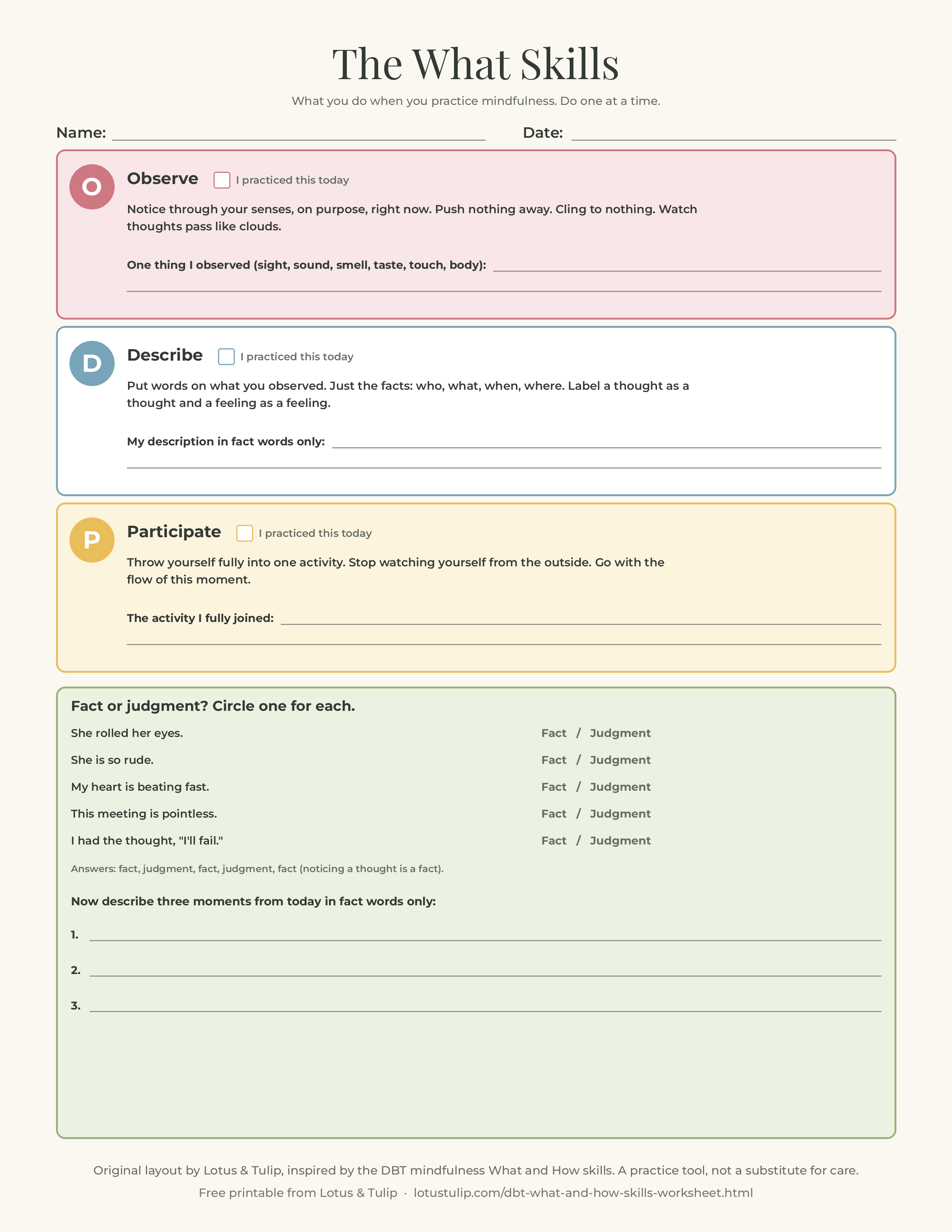
- Add Describe with a fact or judgment sort. Read sentences aloud ("She is rude," "She rolled her eyes") and have the group sort them. Page 1 of the free printable includes this sort.
- Practice Participate with something playful. A song, a ball toss, a silly movement game. Debrief what made it hard to let go of self watching.
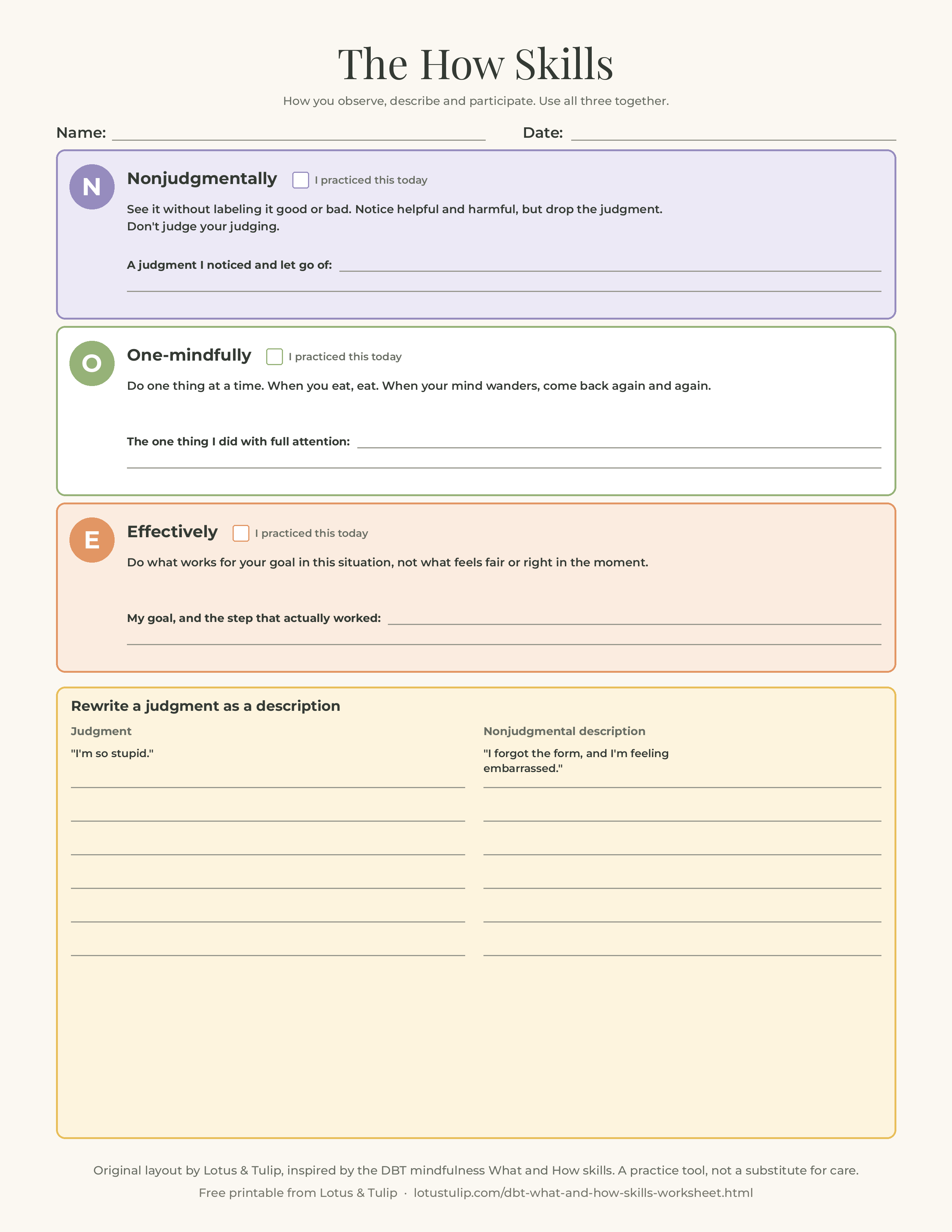
- Introduce Nonjudgmentally with a judgment count. Ask clients to tally judgments for one hour, then rewrite two as descriptions. Page 2 of the printable has rewrite lines.
- Introduce One-mindfully with a one task exercise. Eat a snack, wash a cup, or walk across the room with full attention. Normalize the wandering mind and praise each return.
- Introduce Effectively with a real goal. Ask clients to name one situation this week where being right competed with getting what they actually want.
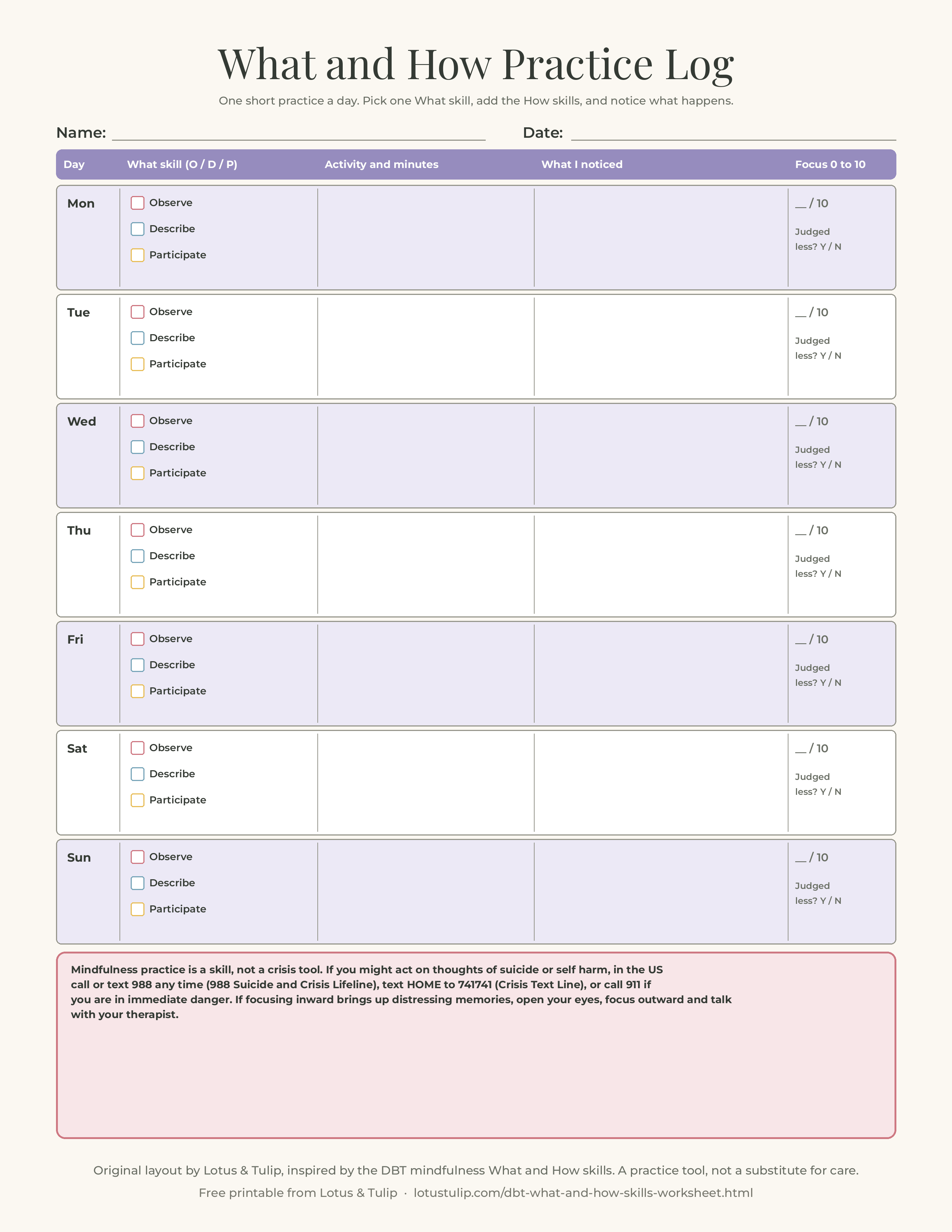
- Assign one short daily practice. Two to five minutes, one What skill, with the How skills layered on. The one week practice log on page 3 keeps it simple.
- Review and reinforce. At the next session, look at the log together. Reinforce attempts, not perfect focus scores, and problem solve what got in the way.
Practice ideas for sessions, groups, and home
- Observe: notice the soles of your feet for 60 seconds; listen to a piece of music and follow one instrument; hold an ice cube and notice how the sensation changes.
- Describe: describe a photo in fact words to a partner who cannot see it; describe your current emotion in one sentence starting "Right now I notice..."
- Participate: group clapping rhythm; one minute dance; cooking a simple recipe with full attention.
- Nonjudgmentally: replace "should" with "I would prefer"; describe a disliked food without the word "gross."
- One-mindfully: mindful walking down a hallway; single tasking one email; brushing teeth with full attention.
- Effectively: before a conversation, write "My goal is..." and keep it in view; ask "Is this working?" halfway through a hard task.
Short practices done often beat long practices done rarely, especially early on. For children, see our mindfulness activities for kids guide, which adapts many of these ideas for younger ages.
Common mistakes
- Treating mindfulness as relaxation. Observing may bring calm, but the goal is awareness. Sometimes observing honestly means noticing more distress, not less.
- Doing all three What skills at once. Narrating while participating pulls you out of participating. Pick one.
- Confusing nonjudgment with approval. You can describe harm nonjudgmentally and still set a boundary or report it.
- Judging the judging. "I'm so bad at being nonjudgmental" is another judgment. Notice it and move on.
- Long practices too early. Twenty minute sits can overwhelm clients with trauma histories or high arousal. Start with one to three minutes and outward focus.
- Using Effectively to excuse anything. Effectively means effective toward your values and long term goals, not whatever ends discomfort fastest.
For teens, schools, and skills groups
DBT for Adolescents (DBT-A), developed by Alec Miller, Jill Rathus, and Marsha Linehan, keeps the same six mindfulness skills and teaches them in teen friendly language, often alongside family members. In school settings, the skills fit naturally into advisory periods and small groups: a one minute observe exercise at the start of class, a fact or judgment sort as a warm up, or a one-mindful homework block.
With teens, use phone and social media examples, keep practices short, and let them choose the activity for participate practice. Avoid forcing eyes closed; offer eyes open, eyes down as an option.
What the research says (honestly)
DBT as a full treatment has substantial randomized trial support, especially for reducing self harm and suicidal behavior in people with borderline personality disorder. A 2015 component trial by Linehan and colleagues in JAMA Psychiatry found that conditions including DBT skills training did better on several outcomes than DBT individual therapy without skills training. Neacsiu, Rizvi, and Linehan (2010) found that increased skills use partly mediated improvement in suicidal behavior, depression, and anger control.
For the mindfulness module specifically, evidence is smaller. Soler and colleagues (2012) found that adding the DBT mindfulness module to general psychiatric management improved attention measures in people with borderline personality disorder, in a modest sized study. The What and How skills also shaped how mindfulness is measured: Ruth Baer's Kentucky Inventory of Mindfulness Skills (Baer, Smith and Allen, 2004) was inspired by DBT's mindfulness skills and measures observing, describing, acting with awareness, and accepting without judgment. Those facets were later carried into the Five Facet Mindfulness Questionnaire (Baer and colleagues, 2006).
What we do not have is a trial testing the What and How skills alone as a standalone treatment. Treat them as well specified building blocks inside DBT and other mindfulness informed care, not as a cure on their own.
Safety notes and when to get more help
Mindfulness practice is generally safe, but turning attention inward can sometimes bring up distressing memories, panic, or dissociation, especially for people with trauma histories. If that happens, open your eyes, focus on the outside world (sounds, colors, the feel of the chair), and talk with a therapist about a gentler pace. Trauma informed clinicians often start with short, outward focused practices and grounding, such as the 5 4 3 2 1 grounding exercise, and use the window of tolerance to pace practice.
The What and How skills are not a crisis tool. If you or someone you are supporting might act on thoughts of suicide or self harm, in the US call or text 988 (988 Suicide and Crisis Lifeline), text HOME to 741741 (Crisis Text Line), or call 911 in an emergency.
Tips for therapists and group leaders
- Practice each skill yourself before teaching it. Clients notice when the leader has done the exercise.
- Open every group or session with a one minute mindfulness practice, then a brief share using Describe.
- Model nonjudgmental language in your own feedback: "you completed two of seven log days" rather than "you barely practiced."
- When a client says "I'm bad at mindfulness," ask what they noticed. Noticing that the mind wandered is the skill working.
- Link every later skill back to these six. It keeps mindfulness from feeling like a separate topic that ended in week two.
Free What and How skills worksheets (PDF)
The free What and How skills worksheets have three pages in US Letter size, written for teens and adults:
- Page 1: The What Skills card. Observe, Describe, and Participate with a short explanation, a practice checkbox and a write in line for each, plus a fact or judgment sort and space to describe three moments in fact words.
- Page 2: The How Skills card. Nonjudgmentally, One-mindfully, and Effectively with prompts, plus a judgment to description rewrite exercise.
- Page 3: What and How practice log. Seven days with a What skill choice, activity and minutes, what I noticed, a focus score, and a "judged less?" check, with US crisis lines.
Download the free What and How skills worksheets (PDF, 3 pages, US Letter)
Prefer single images? Page 1: What Skills Card (PNG) · Page 2: How Skills Card (PNG) · Page 3: Practice Log (PNG)
Free to print for your own use and for use with your own clients or groups. This is an original layout by Lotus & Tulip, inspired by the DBT mindfulness What and How skills, not a copy of any Linehan handout or worksheet. Please link to this page rather than re-uploading the file.
Related resources
- Mindfulness worksheets for adults: a practice log, everyday anchors and a free 2 page PDF
- Wise Mind worksheet: the goal state the What and How skills lead to.
- Check the Facts worksheet: Describe in action for emotion regulation.
- Cognitive defusion worksheet: the ACT cousin of labeling a thought as a thought.
- Radical acceptance worksheet: nonjudgment and effectiveness applied to painful facts.
- GIVE and FAST worksheet: one-mindful listening and nonjudgment in relationships.
- Mindfulness activities for kids: playful versions for younger ages.
- 5 4 3 2 1 grounding worksheet: an outward focused Observe practice.
Sources
- Linehan, M. M. (2015). DBT Skills Training Manual, second edition. Guilford Press.
- Linehan, M. M. (2015). DBT Skills Training Handouts and Worksheets, second edition. Guilford Press. Mindfulness Handout 4, Taking Hold of Your Mind: "What" Skills, and Mindfulness Handout 5, Taking Hold of Your Mind: "How" Skills.
- Linehan, M. M., Korslund, K. E., Harned, M. S., and colleagues (2015). Dialectical behavior therapy for high suicide risk in individuals with borderline personality disorder: a randomized clinical trial and component analysis. JAMA Psychiatry, 72(5), 475 to 482.
- Neacsiu, A. D., Rizvi, S. L., and Linehan, M. M. (2010). Dialectical behavior therapy skills use as a mediator and outcome of treatment for borderline personality disorder. Behaviour Research and Therapy, 48(9), 832 to 839.
- Soler, J., Valdeperez, A., Feliu-Soler, A., and colleagues (2012). Effects of the dialectical behavioral therapy-mindfulness module on attention in patients with borderline personality disorder. Behaviour Research and Therapy, 50(2), 150 to 157.
- Baer, R. A., Smith, G. T., and Allen, K. B. (2004). Assessment of mindfulness by self-report: the Kentucky Inventory of Mindfulness Skills. Assessment, 11(3), 191 to 206.
- Baer, R. A., Smith, G. T., Hopkins, J., Krietemeyer, J., and Toney, L. (2006). Using self-report assessment methods to explore facets of mindfulness. Assessment, 13(1), 27 to 45.
- Miller, A. L., Rathus, J. H., and Linehan, M. M. (2007). Dialectical Behavior Therapy with Suicidal Adolescents. Guilford Press.
- 988 Suicide and Crisis Lifeline, 988lifeline.org. Crisis Text Line, crisistextline.org.
DBT What and How skills: FAQ
What are the What and How skills in DBT?
They are the core mindfulness skills in DBT. The What skills (Observe, Describe, Participate) are what you do when practicing mindfulness. The How skills (Nonjudgmentally, One-mindfully, Effectively) are how you do it. They come from Linehan's Mindfulness Handouts 4 and 5 (2015).
Do I use all the What skills at once?
No. Linehan teaches the What skills one at a time: in a given moment you observe, or describe, or participate. The How skills are used together, so you can observe nonjudgmentally, one-mindfully, and effectively at the same time.
Is being nonjudgmental the same as approving of everything?
No. Nonjudgmental means describing facts and consequences without labels like good, bad, stupid, or awful. You still notice what is harmful or dangerous, and you can still set boundaries and act to change things.
How do the What and How skills relate to Wise Mind?
Wise Mind is the goal of DBT mindfulness, the overlap of emotion mind and reasonable mind. The What and How skills are the practical behaviors that help you get there.
Can kids and teens learn the What and How skills?
Yes. DBT for adolescents teaches the same six skills in teen friendly language. For younger children, use short, playful, outward focused practices like listening games, mindful eating, and simple fact or judgment sorts.
Is there research on DBT mindfulness skills?
DBT as a full package has strong trial support, and skills use has been shown to mediate improvement. Smaller studies support the mindfulness module itself, and the skills shaped widely used mindfulness questionnaires. No trial tests the What and How skills alone as a standalone treatment.
Can I print the free What and How skills worksheets for clients?
Yes. The free PDF is an original Lotus & Tulip layout you can print for your own use and for your own clients, students, or groups. Please link to this page instead of re-uploading the file.