
Therapist worksheets · Mindfulness for adults · Updated 2026-11-13
Mindfulness worksheets for adults: what mindfulness is (and is not), what research shows, and how to build a practice that sticks (free printable)
Mindfulness inside a full skills set: DBT Worksheets for Therapists, skills handouts for adult clients across all four DBT skill areas, including mindfulness Holiday 20% off: about $11.04, was $14 (EUR 12) · fillable PDF, instant digital download
Buy on EtsyTry it free first: download a fillable sample (weekly diary card and checking the facts, PDF, 234 KB). Type into it on screen, then get the full pack. No email needed.
Present moment, defusion and values: ACT Worksheets for Therapists, incl. values, defusion and committed action pages Holiday 20% off: about $9.20, was $12 (EUR 10) · fillable PDF, instant digital download
Buy on EtsyTry it free first: download a fillable sample (values compass and unhooking from thoughts, PDF, 259 KB). Type into it on screen, then get the full pack. No email needed.
A full caseload: Therapist Worksheets Mega Bundle (8 packs incl. CBT, anxiety, DBT, ACT, grief and ADHD) Holiday 20% off: about $35.88, was $45 (EUR 39) · fillable PDFs for all 8 packs plus 160 printable pages, instant digital download
Buy on EtsyYou download a meditation app, manage four days in a row, then life gets busy and the streak dies. Or you sit down to "clear your mind", find it full of emails and old arguments, and decide you are bad at mindfulness. Both are common, and both come from the same misunderstanding about what the practice is.
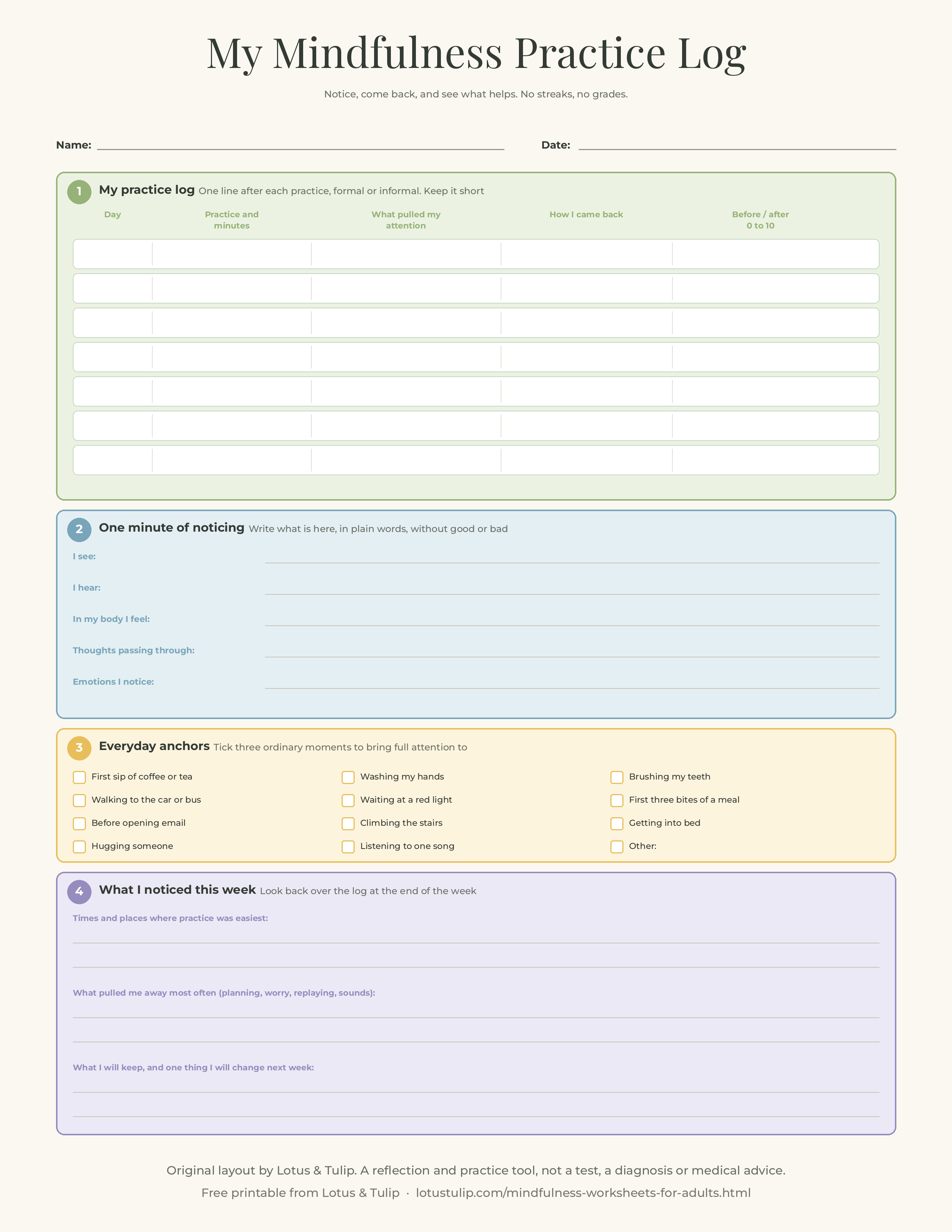
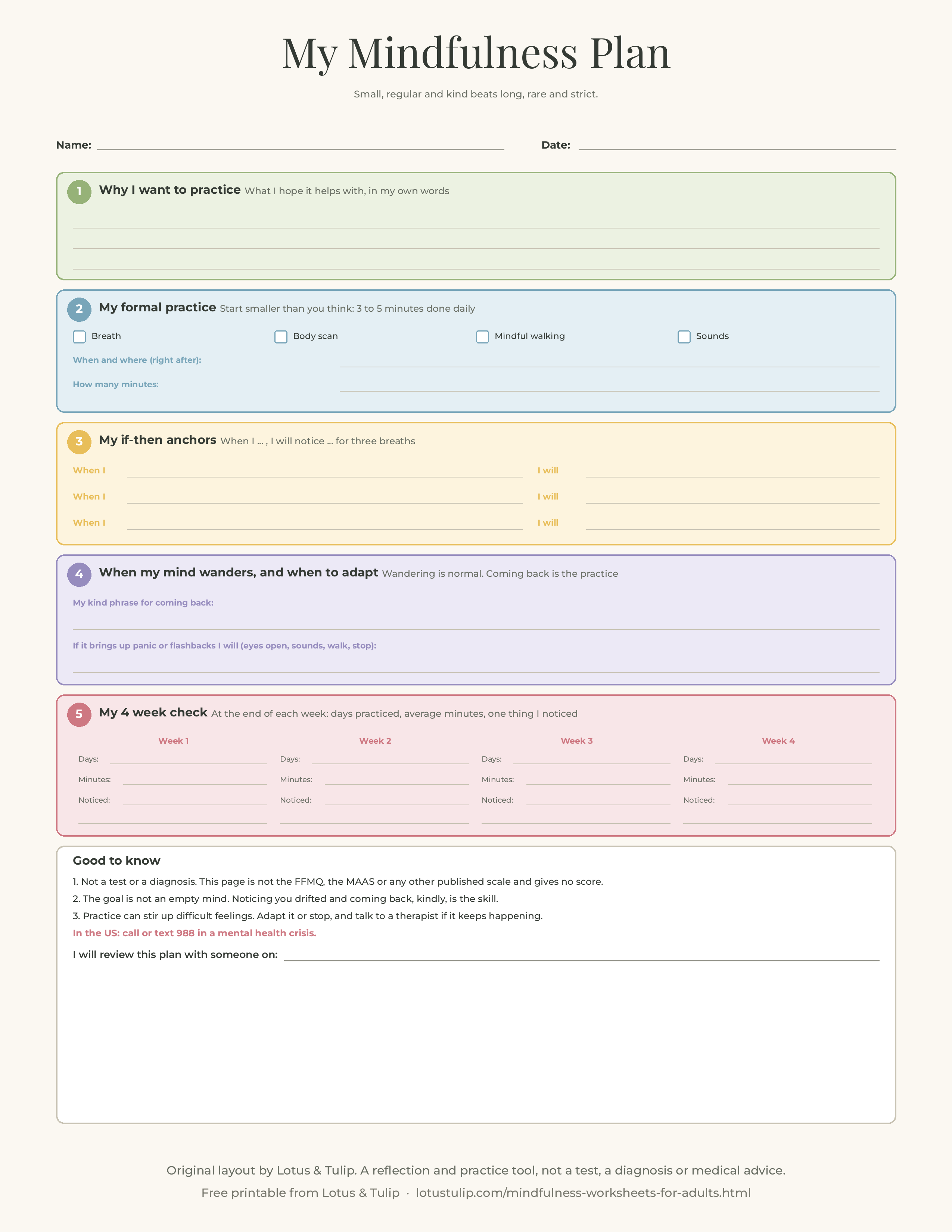
This guide is for adults who want a mindfulness practice that fits a real week, and for the therapists, counselors and coaches who teach it. It explains what mindfulness is and is not, what research shows (including its limits and possible side effects), nine practical steps, common mistakes and examples. It ends with a free 2 page printable: My Mindfulness Practice Log, a weekly log with a noticing exercise and everyday anchors, and My Mindfulness Plan, which covers why you practice, when and how, what to do when your mind wanders, when to adapt or stop and a 4 week check.
Download the free mindfulness worksheets (PDF, 2 pages, US Letter)
Direct download, no email or sign up. See the pages first.
What mindfulness is
Mindfulness means paying attention to what is happening right now, on purpose, without judging it. Jon Kabat-Zinn, who created Mindfulness-Based Stress Reduction (MBSR), described it as paying attention in a particular way: on purpose, in the present moment and non-judgmentally. A group of researchers led by Scott Bishop (2004) later proposed a working definition with two parts: regulating your attention so it stays with present experience, and an attitude of curiosity, openness and acceptance toward whatever you notice.
It is not emptying your mind. Minds wander. In a study that pinged 2,250 adults on their phones at random moments, Killingsworth and Gilbert (2010) found that people were thinking about something other than what they were doing in 46.9% of the samples, and they were less happy when their minds wandered. The skill in mindfulness is not stopping that wandering. It is noticing that it happened and coming back, again and again, without a lecture to yourself.
There are two kinds of practice. Formal practice is time set aside: a breathing practice, a body scan, mindful walking or listening to sounds. Informal practice brings the same attention to ordinary moments: the first sip of coffee, washing your hands, waiting at a red light. Most programs use both, and the worksheet below plans both.
What the research says
- Mindfulness-based therapy helps, about as much as other good treatments. Khoury and colleagues (2013) pooled 209 studies with 12,145 participants. Mindfulness-based therapy had moderate effects compared with waitlist controls (Hedges' g = .53) and smaller effects compared with other active treatments (g = .33). It did not differ from traditional CBT or behavioral therapies. The authors concluded it was especially effective for anxiety, depression and stress.
- Against active controls, effects are small to moderate. Goyal and colleagues (2014) reviewed 47 randomized trials with 3,515 participants that used active control groups. Mindfulness meditation programs had moderate evidence of improving anxiety (effect size 0.38 at 8 weeks), depression (0.30) and pain (0.33), and low evidence for stress and quality of life. They found no evidence that meditation programs were better than active treatments such as medication, exercise or other behavioral therapies. In plain words: useful, not magic, and not a replacement for treatment that works.
- MBCT lowers the risk of depression coming back. In a pooled analysis of individual data from 9 trials and 1,258 people with recurrent depression, Kuyken and colleagues (2016) found that Mindfulness-Based Cognitive Therapy reduced the risk of relapse within 60 weeks compared with not receiving MBCT (hazard ratio 0.69), and also compared with other active treatments (hazard ratio 0.79).
- Practice is linked with results. Parsons and colleagues (2017) reviewed home practice in MBSR and MBCT courses across 43 studies. Participants did about 64% of the practice they were asked to do, roughly half an hour a day, six days a week. More home practice went with somewhat better outcomes (r = 0.26). The link is modest, so a short practice you actually do beats a long one you skip.
- Side effects are possible. Farias and colleagues (2020) reviewed 83 studies with 6,703 meditators. The pooled rate of adverse effects was 8.3%, similar to rates reported for psychotherapy in general, and the most common were anxiety and depression. Some occurred in people with no history of mental health problems. Practicing with your eyes open, keeping sessions short, choosing movement or sound instead of the breath, and stopping when a practice feels unsafe are all reasonable choices.
How to use mindfulness worksheets, step by step
- Write down why you want to practice. On page 2, note what you hope mindfulness will help with: less time lost in worry, calmer evenings, being more present with your kids. A clear reason makes it easier to practice on the days you do not feel like it. If you are a therapist, ask the client to say it in their own words.
- Choose one formal practice to start. Pick one: three minutes with the breath, a body scan, mindful walking or listening to sounds. If focusing on the breath makes you anxious, start with sounds or walking instead. The body scan meditation script is a good guided option.
- Start smaller than you think. Five minutes done daily is a better start than 30 minutes done twice. Write the time, place and length on page 2, and attach it to something you already do, for example right after your morning coffee.
- Pick three everyday anchors. Choose ordinary moments for informal practice and write them as if-then plans: "When I wash my hands, I will notice the water temperature and three breaths." Page 1 has a checklist of anchors to choose from.
- Practice noticing without judging. Use the noticing box on page 1. For one minute, write what you see, hear, feel in your body, think and feel emotionally, in plain words and without labels like good or bad. This is close to the DBT "what" skills of observing and describing; the DBT what and how skills worksheet goes deeper.
- Plan what to do when your mind wanders. It will wander, many times a minute at first. Write a short, kind phrase for coming back ("Thinking. Back to the breath.") on page 2. Each return is the practice, not a failure of it.
- Log briefly after each practice. On page 1, note the day, the practice and minutes, what pulled your attention and how you felt before and after from 0 to 10. Keep it short. The log is there to show patterns, not to grade yourself.
- Know when to adapt or stop. If a practice brings up panic, flashbacks, dissociation or a sense of unreality, open your eyes, ground yourself in the room, switch to movement or sounds, or stop. Note what happened and talk it through with a therapist, especially if you have a trauma history. The 5, 4, 3, 2, 1 grounding worksheet is a useful fallback.
- Review after a week, then check monthly. Look at the log: which practices you did, at what times and what helped. Keep what worked and adjust what did not. The 4 week check on page 2 tracks days practiced and average minutes so you can see the habit forming.
Common mistakes
- Trying to clear your mind. A busy mind is not a sign you are doing it wrong. Noticing that you drifted and coming back is the exercise.
- Using mindfulness to make feelings go away. Practicing in order to get rid of anxiety tends to turn every session into a test you can fail. The aim is to notice what is there with less struggle. Often the feeling eases, but that is a side effect, not the goal.
- Going too long too soon. Long sessions early on make it easier to quit. Build up slowly from a few minutes.
- Only practicing formally. Formal practice builds the skill, informal practice carries it into the day. If you only meditate on a cushion, the skill may stay there.
- Pushing through distress. Mindfulness is not always gentle. If it reliably makes you feel worse, adapt the practice or get guidance rather than forcing it.
- Treating it as a cure. Research shows small to moderate benefits, similar to other good treatments. For depression, anxiety disorders, trauma or anything that feels unsafe, use mindfulness alongside proper care, not instead of it.
Examples
- The busy parent: She had tried a 20 minute app course three times and quit each time. She switched to 5 minutes of breathing after the school drop off plus two anchors: the first three bites of lunch and the walk from the car to the front door. After three weeks her log showed practice on 17 of 21 days, and her evening stress ratings were usually a point or two lower than in the morning.
- The anxious breather: Focusing on his breath made his chest tight and his heart race. With his therapist he switched to listening to sounds with his eyes open and to mindful walking, which he found much easier. He noted in his log that breath practice was a trigger, which helped them plan a slower return to it later.
- The ruminator: A client recovering from depression noticed on her log that her mind went back to work conversations in almost every session. Instead of fighting it, she practiced labeling it ("planning", "replaying") and returning. Over a month she reported catching rumination earlier during the day, not only while practicing. The rumination worksheet helped her with the rest.
Free mindfulness worksheets for adults
This free printable is an original Lotus & Tulip layout on US Letter, in our own wording. It is not the Five Facet Mindfulness Questionnaire (FFMQ), the Mindful Attention Awareness Scale (MAAS) or any other published questionnaire, and it does not give a score. Page 1, My Mindfulness Practice Log, has a 7 line practice log (day, practice and minutes, what pulled my attention, how I came back, before and after 0 to 10), a one minute noticing box, a checklist of everyday anchors and space for what you noticed over the week. Page 2, My Mindfulness Plan, covers why I practice, my formal practice, three if-then anchors, what to do when my mind wanders, when to adapt or stop, a 4 week check and a review date.
Download the free mindfulness worksheets (PDF, 2 pages, US Letter)
Prefer single images? Page 1: my mindfulness practice log (PNG) · Page 2: my mindfulness plan (PNG)
Free to print for yourself or for use with your own clients or groups. Please link to this page rather than re-uploading the file. A reflection and practice tool, not a test, a diagnosis or a substitute for therapy. In the US, call or text 988 in a mental health crisis.
Related resources
- Gratitude worksheets for adults: a weekly journal, savoring and a gratitude letter, with a free printable
- Body scan meditation script: a guided formal practice to read aloud
- Wise mind worksheet: the DBT core mindfulness skill
- Cognitive defusion worksheet: stepping back from sticky thoughts
- Urge surfing worksheet: riding out cravings and urges mindfully
- Self compassion worksheet: meeting a hard moment with kindness
- Emotion regulation worksheets for adults: naming feelings and choosing a strategy
- All therapist worksheets: CBT, DBT, ACT and more
FAQ
What are mindfulness worksheets?
Mindfulness worksheets are structured pages that help you plan, practice and track mindfulness: when and how you practice, what pulls your attention, how you come back and how you feel before and after. This set has two pages: a practice log with a noticing exercise and everyday anchors, and a mindfulness plan.
How long should I practice mindfulness each day?
Start with a few minutes you can manage daily and build up. Courses such as MBSR and MBCT ask for much more, and participants in those courses averaged about half an hour a day (Parsons et al., 2017), but consistency matters more than length when you are starting out.
What is an example of informal mindfulness practice?
Paying full attention to an everyday activity: the taste and temperature of the first sip of coffee, the feel of water while washing your hands, your feet on the ground while walking to the car, or three slow breaths at a red light.
Can mindfulness make anxiety worse?
Sometimes. A review of 83 studies found adverse effects in 8.3% of meditators, most often anxiety or depression (Farias et al., 2020). If breath focus makes you anxious, try sounds, walking or practicing with your eyes open, keep sessions short and talk to a therapist if it keeps happening.
Can I use these worksheets with clients?
Yes. Therapists, counselors and coaches can print them for their own clients or groups. The practice log works well as homework between sessions. Please link to this page rather than re-uploading the file.
When is it a reason to see a professional?
If practice brings up flashbacks, panic, dissociation or thoughts of self harm, or if low mood or anxiety is affecting your work or relationships, talk to a doctor or therapist. If you are thinking about suicide, in the US call or text 988.
Sources
- Bishop, S. R., Lau, M., Shapiro, S., Carlson, L., Anderson, N. D., Carmody, J., Segal, Z. V., Abbey, S., Speca, M., Velting, D., and Devins, G. (2004). Mindfulness: A proposed operational definition. Clinical Psychology: Science and Practice, 11(3), 230 to 241.
- Farias, M., Maraldi, E., et al. (2020). Adverse events in meditation practices and meditation-based therapies: A systematic review. Acta Psychiatrica Scandinavica, 142(5), 374 to 393.
- Goyal, M., Singh, S., Sibinga, E. M. S., et al. (2014). Meditation programs for psychological stress and well-being: A systematic review and meta-analysis. JAMA Internal Medicine, 174(3), 357 to 368.
- Kabat-Zinn, J. (1994). Wherever you go, there you are: Mindfulness meditation in everyday life. New York: Hyperion.
- Khoury, B., Lecomte, T., Fortin, G., Masse, M., Therien, P., Bouchard, V., Chapleau, M.-A., Paquin, K., and Hofmann, S. G. (2013). Mindfulness-based therapy: A comprehensive meta-analysis. Clinical Psychology Review, 33(6), 763 to 771.
- Killingsworth, M. A., and Gilbert, D. T. (2010). A wandering mind is an unhappy mind. Science, 330(6006), 932.
- Kuyken, W., Warren, F. C., Taylor, R. S., et al. (2016). Efficacy of mindfulness-based cognitive therapy in prevention of depressive relapse: An individual patient data meta-analysis from randomized trials. JAMA Psychiatry, 73(6), 565 to 574.
- Parsons, C. E., Crane, C., Parsons, L. J., Fjorback, L. O., and Kuyken, W. (2017). Home practice in Mindfulness-Based Cognitive Therapy and Mindfulness-Based Stress Reduction: A systematic review and meta-analysis of participants' mindfulness practice and its association with outcomes. Behaviour Research and Therapy, 95, 29 to 41.