
Kids and teens · Updated 2026-11-07
Gratitude Activities for Teens (with Free Printable)
Ready-made printable: Self Esteem Worksheets for Kids and Teens Holiday 20% off: about $9.20, was $12 (EUR 10) · instant digital download
Buy on Etsy
Gratitude activities for teens are short, optional practice tools that help middle and high school students notice good moments, received help, effort, and people who matter, write or say one concrete item without toxic positivity, thank someone privately when it fits, pick a tiny next-day plan that fits real teen life, log what actually helped, and know when to stop for safety. Teen gratitude work is not a longer version of gratitude worksheet for kids. Grades, dating, sports, group chats, jobs, college talk, and November Thanksgiving season raise the stakes. So does honesty that gratitude is noticing and naming, not forcing a smile through pain, not a cure for depression or anxiety, and not a requirement to post thanks for applause.
This Lotus and Tulip page is a teen-focused gratitude activities guide with an original free three page US Letter printable. It targets searches families and helpers actually use: gratitude activities for teens, gratitude journal for teenagers, gratitude worksheets for high school, teen gratitude counseling activities, and Thanksgiving gratitude for teens that still works year round. It is distinct from our gratitude worksheet for kids (younger Notice, Think, Feel, Do language), from self-esteem activities for teens (strengths and evidence of worth), from self-compassion worksheet (kindness toward self in hard moments), from growth mindset worksheet (effort and learning language), from mindfulness activities for teens (notice and return attention), from positive self talk worksheet (thought flip practice), from kindness activities for kids (younger kindness acts), and from depression activities for teens (behavioral activation and low mood neighbor). Those neighbors help. This page centers adolescent gratitude: what it is and is not, journal and thank-you practices teens will actually try, digital gratitude without performative posts, school and home tips, honest research including Emmons and McCullough and Froh youth lineages with caveats, and a free practice plan.
We credit research lineages associated with Robert Emmons and Michael McCullough (including the 2003 gratitude intervention tradition) as neighbors for counting blessings and gratitude listing methods, Jeffrey Froh and colleagues youth and adolescent gratitude studies (including 2008, 2009, and later neighbors) as neighbors for school-age gratitude findings, and Renshaw and colleagues gratitude measure neighbors as neighbors for how youth gratitude is sometimes assessed. We credit those lineages with clear non-affiliation. We are not affiliated with those authors, any scale publisher, any branded gratitude curriculum, or any Thanksgiving campaign. This printable is an original educational layout, not a copy of any copyrighted worksheet and not a diagnosis or treatment.
This guide is educational. It is not therapy, not medical advice, and not a diagnosis. If thoughts of ending your life, plans to harm yourself or someone else, or a medical emergency show up, stop the worksheet and get help now: in the US, call or text 988, text HOME to 741741, or call 911. Our safety plan worksheet is a better first tool in that moment. Nearby tools: gratitude for kids, self esteem for teens, self compassion, mindfulness for teens, depression for teens, positive self talk, growth mindset, kindness for kids, and coping for teens.
Jump to the free gratitude activities printable (PDF) · How to use gratitude activities for teens, step by step · Worked examples · Comparisons
What gratitude is and is not for teens
Gratitude (educational working definition for this page) means noticing and naming something good that happened, something received, effort someone gave, or a person who matters, then optionally expressing thanks in a way that fits privacy and honesty. Gratitude can be private (journal) or relational (a text, a quiet thank you). It does not require feeling cheerful.
Gratitude is not:
- Toxic positivity. You do not have to smile through grief, bullying, discrimination, or depression. Naming one good detail does not cancel hard feelings.
- A cure for depression or anxiety. Some teens feel a small lift after listing blessings. That is not the same as remitting clinical depression, anxiety disorders, PTSD, or trauma. Prefer clinical care when problems are severe or lasting. Bridge to depression activities for teens or anxiety activities for teens when those are the main load.
- Forced public thanks. Optional practice beats classroom performance. Never require teens to share trauma gratitude, family secrets, or thanks that feel fake.
- Performative social media posts. A private journal or a one-to-one text can be real gratitude. A staged post for likes is often about image, not noticing.
- Making teens emotional caretakers for adults. Parents should not ask teens to cheer them up with gratitude lists or to thank the parent for staying after conflict. Adult feelings stay adult work.
Teen gratitude response skills include:
- Safety sort first when crisis risk, self-harm talk, or acute danger is present.
- Honest noticing of good, received, effort, or people without erasing pain.
- Choose a short practice teens will actually try: three good things, one journal line, savor a moment, private thank you, or digital thank you (text, not performative post).
- Keep it concrete (who, what, when) instead of vague slogans.
- Pick a tiny plan for the next day that fits homework, sports, and phones.
- Log what helped and bridge to self esteem, self compassion, mindfulness, depression, or coping neighbors when needed.
- Knowing when not to force gratitude: after acute loss, trauma activation, or when the exercise feels like gaslighting, pause and prefer safety or grief support.
Why teens need teen-shaped gratitude (and a note on Thanksgiving)
Teen life raises the stakes. Comparison on social feeds, grade pressure, sports tryouts, jobs, and dating make "be grateful" sound like a dismissive adult slogan if it is forced. Teen-shaped gratitude respects autonomy, privacy, and the right to name hard things first.
Thanksgiving and November season. In the US, search interest in gratitude rises around Thanksgiving. Seasonal prompts are fine for classroom or family use. This page is not only a holiday handout. Year-round use matters: a three-line journal after practice, a thank-you text after a hard week, or a counselor check-in in February still fit.
Why not only the kids page? Younger pages use Notice, Think, Feel, Do games. Teens need language that respects digital life, privacy, and honesty that gratitude can backfire if forced after trauma or loss. This page stays teen-specific for ages about 12 to 18.
How to use gratitude activities for teens, step by step
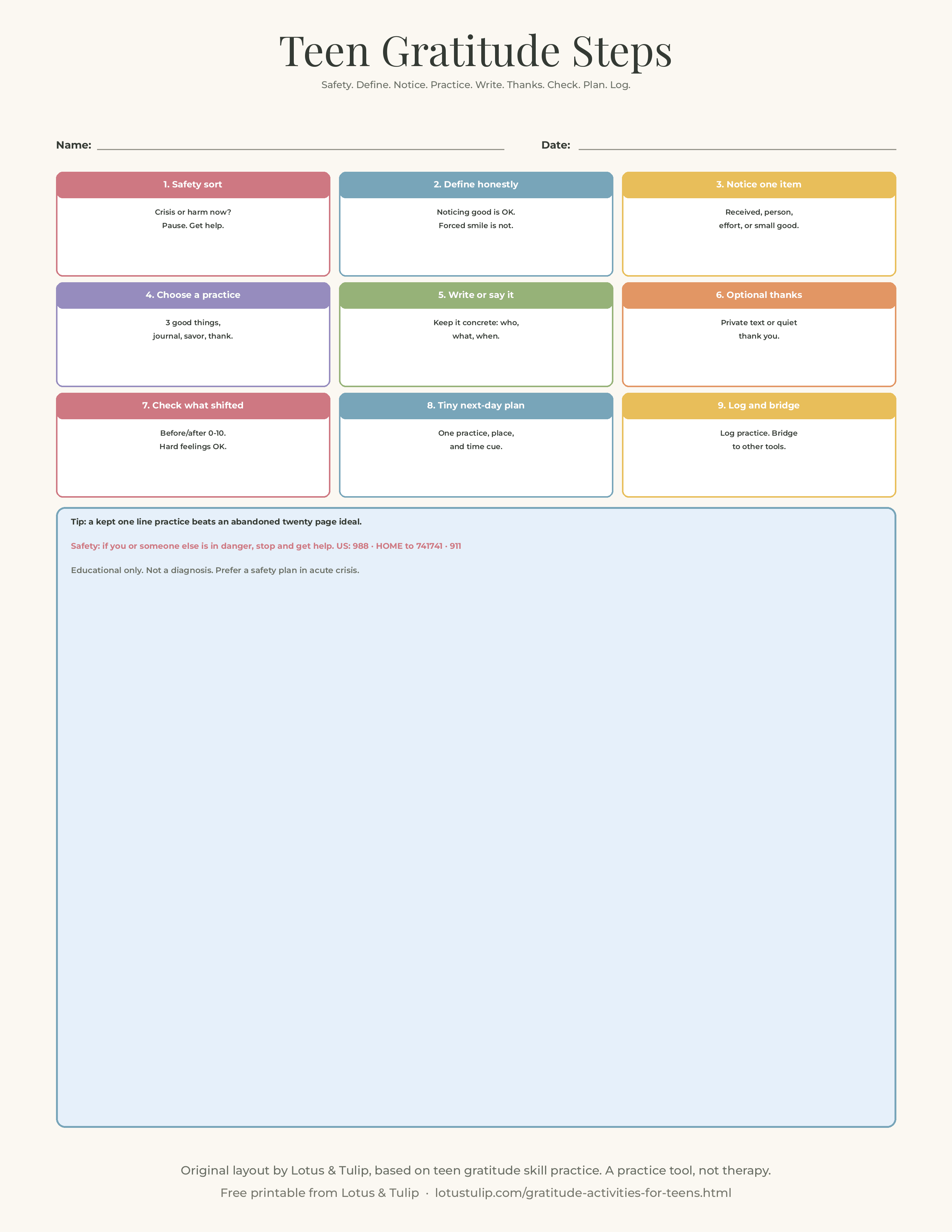
- Safety sort. If acute crisis, self-harm plans, or imminent harm, pause. Use crisis pathways first: 988, HOME to 741741, or 911 when needed. Prefer a safety plan in that moment. Do not force gratitude talk in crisis.
- Define gratitude honestly. Agree out loud: noticing good, received, effort, or people is allowed. Forcing a smile through pain is not the job. Toxic positivity is out.
- Notice one concrete item. Pick something received, a person who helped, effort you or someone gave, or a small good moment. Keep it specific (who, what, when).
- Choose one short practice. Three good things, one journal line, savor a moment for sixty seconds, private thank you, or a digital thank you by text. Prefer one to three minutes over a long essay nobody will keep.
- Write or say it once, kindly. Put the item on paper or say it. Vague slogans ("I'm grateful for everything") count less than one concrete detail.
- Optional: thank someone privately. A text, a quiet in-person thanks, or a note. Skip performative social posts if the goal is real noticing, not image.
- Check what shifted. Rate mood or tension 0 to 10 before and after if that helps. Note what changed even a little. Same is allowed. Hard feelings can stay.
- Pick a tiny next-day plan. One practice, one place, one time cue (after lunch, before bed, after practice). Pair with self esteem for teens when worth is the load, or mindfulness for teens when attention is the load.
- Log and bridge. Record practice on the log page. Bridge to safety plan, depression for teens, self compassion, grief for teens, coping for teens, or gratitude for kids when a younger sibling needs the kids page.
Practice on lower-stakes days first when possible. Skill grows with reps and with adults who coach without shaming or forcing public sharing.
Short practices teens will actually try
Three good things (about two to three minutes). Write three concrete good items from today. Include people, effort, or received help, not only prizes. Classic listing practice sits near Emmons and McCullough gratitude listing neighbors. Credit with clear non-affiliation.
One journal line. One sentence: "Today I noticed ___ because ___." Useful when a long gratitude journal feels fake or heavy.
Savor a moment (about sixty seconds). Pause on one good detail (taste, sound, a kind text). Notice it without rushing to the next notification. Cousin of mindfulness for teens, aimed at appreciation rather than open monitoring.
Private thank you. Say thanks in person or leave a short note. Focus on the specific act, not flattery.
Digital gratitude (text, not performative post). Send a short thank-you text to one person. Avoid staged "grateful for this aesthetic life" posts if the goal is honesty. Group chats can hold quiet thanks without screenshot culture.
Thanksgiving prompt without the whole page. Seasonal lists are fine. Keep honesty: include hard feelings if they are present, and never force public trauma thanks at the holiday table.
Neighbor bridges. When the job is strengths and worth, prefer self esteem for teens. When the job is kindness toward self in failure, prefer self compassion. When the job is effort language, prefer growth mindset. When low mood and withdrawal dominate, prefer depression for teens.
School counselor, therapist, and parent tips
School counselor tips. Short meetings favor: safety sort, honest definition, one concrete item, one short practice, one tiny next-day plan. Groups can use optional three good things with low-stakes prompts. Never force public sharing of family trauma or loss. Follow district crisis protocols if risk appears. Thanksgiving lessons can use this page without turning November into the only time gratitude is allowed.
Therapist tips. Stay in the client's language. Separate depression, grief, trauma activation, and forced positivity out loud without diagnosing from a printable. If gratitude listing increases shame ("I should feel grateful and I do not"), stop and switch to validation, self compassion, or behavioral activation. Measure function: slightly easier noticing of support, one private thank you kept, less all-or-nothing "I am ungrateful."
Parent tips. Offer, do not force. Model a private thank you yourself. Do not turn the worksheet into a new weapon ("be grateful or else"). Do not use gratitude to make teens soothe adult loneliness or conflict. Validate hard days. Ask the school what support exists when mood or safety is the real issue.
Worked fictional examples
Teen example, after a hard test week (fictional): Jordan, age 15, feels drained after midterms, mood rated 4. Safety sort: no crisis. Practice: three good things (a friend shared notes, coach said one specific praise, dinner tasted good). Tiny plan: one journal line before bed for three nights. Log on the free gratitude plan page.
Teen example, thank-you text (fictional): Sam, age 16, notices a sibling covered a chore without asking. Cue: relief, rated 6. Practice: private digital thank you by text, not a public post. Bridge to friendship for teens if peer repair is also needed.
Teen example, forced positivity backlash (fictional): Avery, age 14, is told to "just be grateful" after a friendship rupture and feels angry and shut down. Safety sort: no plan to die, but mood dips. Counselor pauses gratitude listing, validates anger, offers optional savor later, and bridges to self compassion and depression for teens if withdrawal grows.
School counselor note (fictional): In a twelve minute meeting, a counselor helps a student fill one concrete item, choose a short practice, a tiny next-day plan, and a privacy ask (journal vs text). Optional practice, never forced public sharing. Follow district crisis protocols if risk appears. For multi-session groups near Thanksgiving, pair with self esteem or coping menus rather than stacking every worksheet in one period.
Teen gratitude vs kids gratitude, self esteem teens, self compassion, mindfulness teens, growth mindset, positive self talk, depression teens
| Teen gratitude (this page) | Kids gratitude | Self esteem teens | Self compassion | Mindfulness teens | Growth mindset | Positive self talk | Depression teens | |
|---|---|---|---|---|---|---|---|---|
| Main job | Notice good/received/effort/people, optional thanks, plan, log | Younger Notice Think Feel Do | Strengths and worth evidence | Kindness to self in hard moments | Notice and return attention | Effort and learning language | Thought flip practice | Low mood, activate, connect |
| Best early use | When teens want optional noticing and thanks skills | Younger kids with adult coaching | When worth and comparison dominate | When self-attack is loud | When attention and pause are the load | When "I can't" language dominates | When harsh self talk is the target | When low mood and withdrawal dominate |
| Output | Item, practice, plan, log | Kids journal and week tracker | Strengths plan | Compassion break and rewrite | Cues, practice, plan | Not-yet plan | Thought flip cards | Activation schedule |
| Cross link | This page | Kids gratitude | Self esteem teens | Self compassion | Mindfulness teens | Growth mindset | Positive self talk | Depression teens |
These tools cooperate. Teen gratitude builds noticing and optional thanks. Kids gratitude keeps younger language. Self esteem covers worth. Self compassion softens self-attack. Mindfulness trains attention. Growth mindset trains effort talk. Positive self talk flips harsh thoughts. Depression teens activate when low mood is the scene. Teach one tool clearly before stacking four on day one.
What helps vs common myths
What often helps: optional short practices, concrete items, private thanks, tiny plans that fit real schedules, adult coaching without shame, seasonal prompts without making November the only time, and skill printables used as practice aids.
Myths to drop:
- "If you are grateful, you cannot feel sad." Both can be true. Gratitude does not erase grief or anger.
- "Longer journals are always better." A kept one line practice beats an abandoned twenty page ideal.
- "Public posts prove gratitude." Privacy can be more honest than performance.
- "Gratitude fixes depression." It is one optional tool. Therapy, school support, medical care, and safety plans matter when problems are severe.
- "Everyone must share at the Thanksgiving table." Opting out is valid. Forced public practice backfires.
- "Research proves gratitude always wins for teens." Some youth studies find small average benefits with caveats. Effects are not a cure claim. Honesty protects trust.
Common mistakes
- Forcing gratitude after trauma or acute loss so the exercise feels like gaslighting.
- Using gratitude to silence valid anger about unfair treatment instead of problem-solving and support.
- Making teens soothe adult loneliness with thank-you lists aimed at the parent.
- Pushing performative social posts as the main practice.
- Vague slogans instead of concrete who/what/when details.
- Using the kids page language with older teens who feel talked down to.
- Using it in acute crisis instead of safety first.
- Treating the worksheet as therapy. Paper supports practice. It does not replace a clinician, school policy, or crisis care when problems are severe or lasting.
When not to use this worksheet
Good early uses: a teen who can name one concrete good item or received help, mild to moderate stress with adult support available, homework between counseling sessions, school counseling check-ins, seasonal classroom prompts with opt-out, and building a notice-thanks-plan sequence.
Prefer another tool first when:
- Acute safety risk or medical emergency: stabilize and get help (988, HOME to 741741, 911). Prefer a safety plan.
- When younger language fits better: use gratitude worksheet for kids.
- When acute grief or recent loss is the whole load: prefer grief activities for teens and clinician-led care. Optional gratitude later, never forced.
- When low mood and withdrawal dominate: prefer depression activities for teens.
- When self-attack is the loudest voice: prefer self compassion.
- When the exercise increases shame or feels like gaslighting: stop, validate, and switch tools.
What the research says (honestly)
Gratitude activities and worksheets are a skill practice aid, not a standalone RCT treatment. Do not claim this free printable remits depression, anxiety disorders, PTSD, trauma, or any diagnosis.
Emmons and McCullough 2003 lineage neighbor. Gratitude intervention work associated with Robert Emmons and Michael McCullough popularized counting blessings and gratitude listing methods in adult and general samples, often with small to moderate average effects on well-being measures and important caveats about study quality, expectancy, and what transfers to adolescents. Credit with clear non-affiliation. This page is not a copy of their protocols and does not claim those effect sizes for this three page sheet.
Froh et al. youth and adolescent gratitude neighbors. Research associated with Jeffrey Froh and colleagues has examined gratitude in children and adolescents, including school-context studies across roughly 2008, 2009, and later neighbors, often finding promising but mixed average effects with method and sample caveats. Credit with clear non-affiliation. Not proof that this printable remits clinical disorders.
Renshaw gratitude measure neighbor. Measure development work associated with Renshaw and colleagues sits as a neighbor for how youth gratitude is sometimes assessed in research. Credit with clear non-affiliation. This printable is not a validated clinical scale and is not for diagnosis.
Honest limits. Effects are often small. Gratitude can backfire if forced after trauma or loss, or if used to deny legitimate distress. Adult support, sleep, school policy, and clinical care when indicated matter. No study tests this three page Lotus and Tulip printable alone.
Free gratitude activities printable for teens (PDF)
The free gratitude activities printable has three pages in US Letter size:
- Page 1: Teen Gratitude Steps. Sequence matching the HowTo: safety sort, honest definition, notice one concrete item, choose a short practice, write or say it, optional private thanks, check what shifted, tiny next-day plan, log and bridge, plus safety reminders.
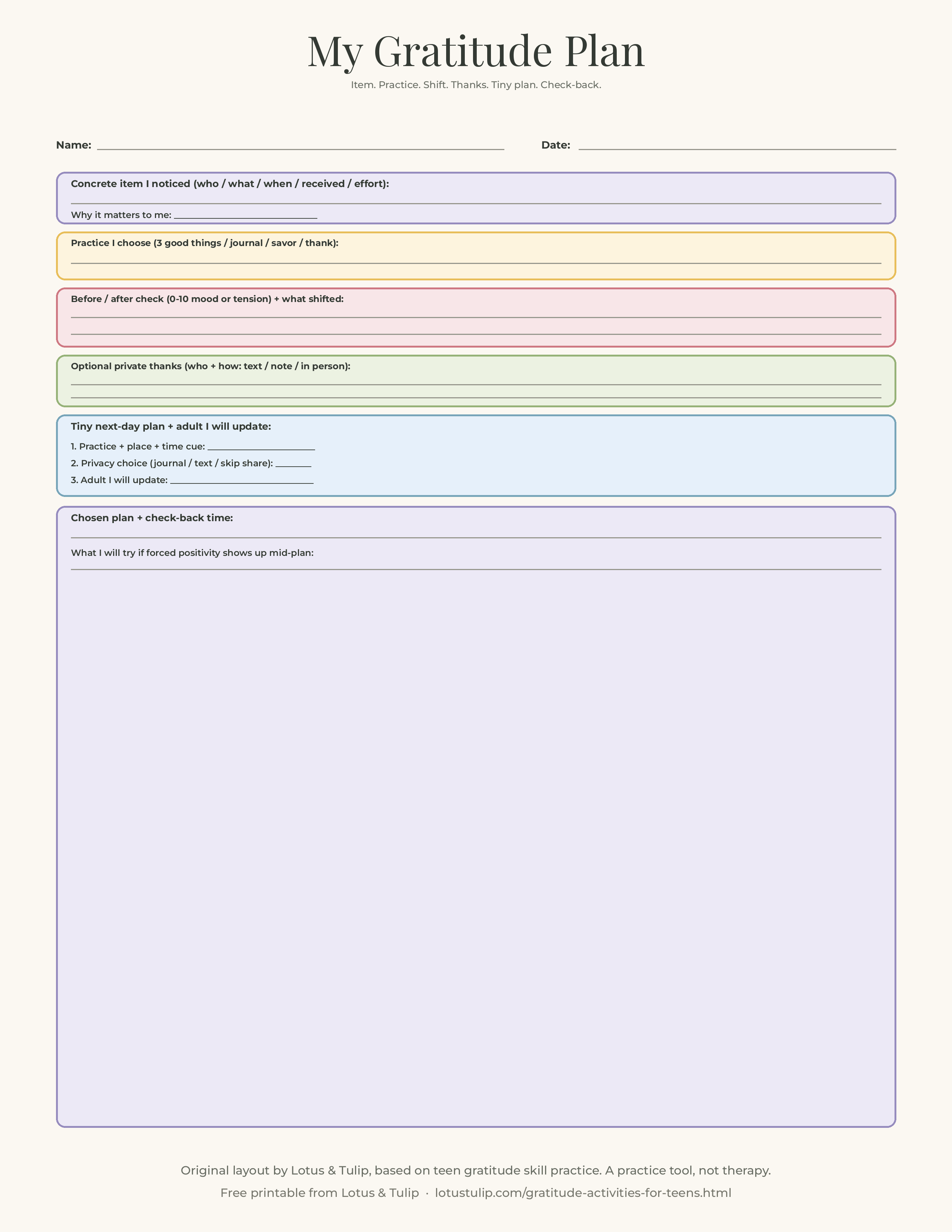
- Page 2: My Gratitude Plan. Fill in concrete item, chosen practice, before/after note, optional thank you, tiny plan, and check-back.
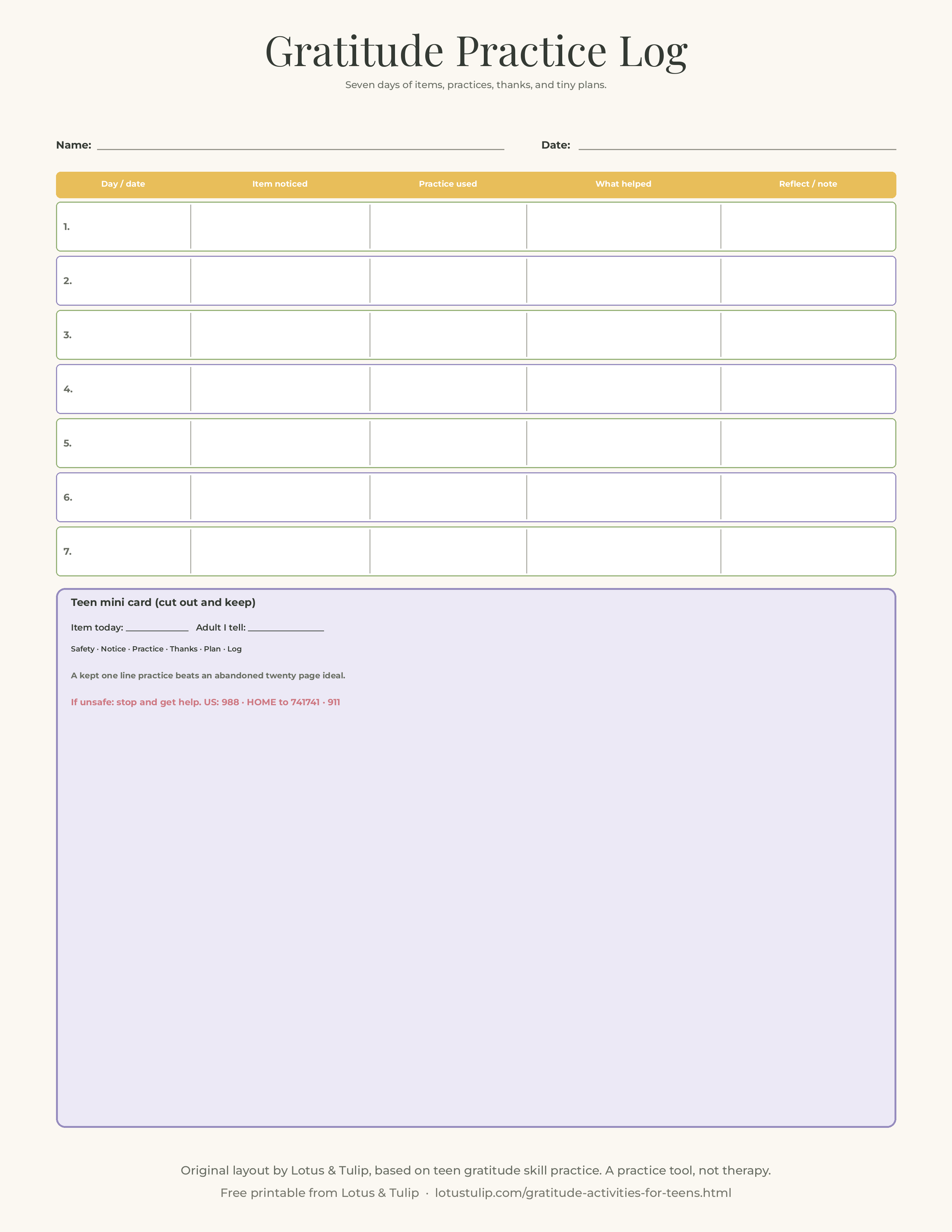
- Page 3: Practice Log + teen mini card. Seven day rows plus a cut out reminder for safety, notice, practice, thanks, plan, log.
Download the free gratitude activities printable for teens (PDF, 3 pages, US Letter)
Prefer single images? Page 1: Teen Gratitude Steps (PNG) · Page 2: My Gratitude Plan (PNG) · Page 3: Practice Log (PNG)
Free to print for your own use and for use with your own clients, students, or groups. This is an original layout by Lotus & Tulip, based on teen gratitude skill practice associated with Emmons and McCullough gratitude listing neighbors, Froh youth gratitude study neighbors, and Renshaw measure neighbors, with clear non-affiliation. It is not affiliated with those authors, any scale publisher, or any specific treatment or curriculum package, and is not a substitute for therapy. Please link to this page rather than re-uploading the file.
Related resources
- Gratitude worksheets for adults: a weekly journal, savoring and a gratitude letter, with a free printable
- Gratitude worksheet for kids: younger Notice, Think, Feel, Do journal.
- Self esteem activities for teens: strengths and worth evidence.
- Self compassion worksheet: kindness toward self in hard moments.
- Mindfulness activities for teens: notice and return attention.
- Growth mindset worksheet: effort and learning language.
- Positive self talk worksheet: thought flip practice.
- Depression activities for teens: low mood, activate, connect.
- Kindness activities for kids: younger kindness acts.
- Coping skills worksheets for teens: broad coping menu.
- Safety plan worksheet: when the moment is about staying safe and alive.
Sources
- Emmons and McCullough gratitude intervention traditions (including 2003 counting blessings / gratitude listing neighbors). Educational credit with clear non-affiliation. Not a claim that this printable remits clinical disorders.
- Froh and colleagues youth and adolescent gratitude study traditions (including roughly 2008, 2009, and later school-context neighbors), with method and sample caveats. Educational credit with clear non-affiliation.
- Renshaw and colleagues gratitude measure neighbors for how youth gratitude is sometimes assessed. Educational credit with clear non-affiliation. Not a clinical scale.
- Honest caveat: teen gratitude drills are a skill practice aid. Reviews and trials are not the same as RCTs of this Lotus and Tulip printable. Forced gratitude after trauma or loss can backfire. Adult support and clinical care when indicated matter.
Gratitude activities for teens: FAQ
What are gratitude activities for teens?
They are short, optional practice tools for noticing good moments, received help, effort, and people who matter, writing or saying one concrete item, optionally thanking someone privately, picking a tiny plan, and logging what helps. They are educational skill aids, not therapy.
Is this the same as the kids gratitude page?
No. The kids page uses younger Notice, Think, Feel, Do language. This teens page centers adolescent life with privacy, digital thank yous, Thanksgiving season without making it the only use, and honest research caveats.
Does gratitude mean I have to feel happy?
No. You can name one good detail and still feel sad, angry, or tired. Toxic positivity is not the goal.
Can school counselors use it with teens?
Yes, often in short meetings with safety sort, one concrete item, one short practice, and one tiny plan. Keep practice optional and school safe. Follow crisis protocols when risk appears. Do not use the page as a diagnosis or as forced public sharing.
Is gratitude proven to cure teen depression?
No. Some youth studies find small average well-being benefits with caveats. Gratitude listing is not a cure for clinical depression or anxiety. Prefer clinical care when problems are severe or lasting.
When should I not use this worksheet?
Do not use it as the first move in acute safety risk, medical emergency, acute grief when forced thanks feels wrong, or when the exercise increases shame. Stabilize and get help when needed: 988, HOME to 741741, or 911. Prefer a safety plan in crisis.
Is this affiliated with Emmons, McCullough, Froh, or Renshaw?
No. This is an original Lotus and Tulip educational layout. We credit research lineages with clear non-affiliation and do not reproduce copyrighted manuals or scales.