
Therapists and counselors · Updated 2026-11-08
Depression Worksheets: Behavioral Activation, Thought Records, and Free Printable
Ready-made printable: Depression and Behavioral Activation Worksheets for Therapists Holiday 20% off: about $9.20, was $12 (EUR 10) · instant digital download
Buy on Etsy
Depression worksheets give therapists, counselors and the adults they work with a concrete way to turn the best supported ideas in depression care into small daily steps: noticing the low mood cycle, logging activity and mood, scheduling a few valued actions, checking unhelpful thoughts, protecting sleep and routine, speaking to yourself with less cruelty and spotting early warning signs before a dip becomes a slide. This guide is written for US clinicians in private practice, community mental health, primary care behavioral health, college counseling and telehealth. Adults who are working on low mood can use the free printable on their own too, though it works best beside a clinician who can help adjust the plan and keep an eye on safety.
You will get twelve worksheet backed practices with timing and debrief questions, a six session starter plan, adaptations for different settings, tips, common mistakes, myths, three fictional examples, a comparison with nearby guides, honest research notes, eight FAQs, a nine step HowTo and a free three page US Letter printable: Depression Care Steps, My Activity and Values Plan, and a Mood and Activity Log with nine pocket cards.
This page is written for adult clients. For adolescents, see our depression activities for teens. If you want a deep dive on one tool, we also have single topic guides for the behavioral activation worksheet, the CBT thought record, the ACT values worksheet and the mood tracker printable. This page pulls those tools into one practical depression workflow.
We draw on published research and clinical guidance without claiming any affiliation or endorsement: the Jacobson and colleagues (1996) component analysis of cognitive behavioral therapy, the Dimidjian and colleagues (2006) trial of behavioral activation, cognitive therapy and antidepressant medication, the Ekers and colleagues (2014) meta-analysis of behavioral activation, the COBRA trial (Richards and colleagues, 2016, The Lancet), the Kuyken and colleagues (2016) meta-analysis of mindfulness-based cognitive therapy for relapse prevention, the MacBeth and Gumley (2012) meta-analysis on self-compassion, the PHQ-9 validation paper (Kroenke, Spitzer and Williams, 2001), NICE guideline NG222 and NIMH data on depression in US adults. The printable is an original Lotus and Tulip layout.
This guide is educational. Worksheets do not diagnose depression, do not cure it by themselves, and do not replace assessment, therapy, medication or crisis care when those are needed. They are skill practice aids. If you or someone you support is thinking about suicide, call or text 988 (Suicide and Crisis Lifeline) or text HOME to 741741 (Crisis Text Line). For immediate danger, call 911. For a written plan for a crisis moment, see our safety plan worksheet.
What depression worksheets are (and are not)
Depression worksheets are short paper tools that help a person see their own patterns, choose one small action, try it between sessions and look honestly at what happened. Good ones are simple enough to fill in on a bad day. That matters more for depression than for almost any other problem, because low energy, poor concentration and hopelessness make long, wordy homework feel impossible. A page with three lines and a 0 to 10 rating will often get done when a five column form will not.
The best depression worksheets move the work from "I should feel better before I do things" to "I will do one small thing at 10 a.m. and then rate my mood." That shift, from waiting for motivation to acting first and letting mood follow, sits at the heart of behavioral activation. Thought records, values work, sleep plans and self-compassion pages each add a different angle, but the common thread is the same: make the invisible visible, then test it.
What they are not.
- Not a diagnosis. A mood check in or symptom list is educational. Diagnosing major depressive disorder, persistent depressive disorder, bipolar depression or a medical cause of low mood requires a clinical evaluation by a qualified professional.
- Not a cure printable. Depression is a real health condition. Worksheets can help people practice skills that are part of effective treatment, but a page on its own is not a full treatment.
- Not a replacement for medication or medical care. For many adults, medication is an important part of care. Thyroid problems, anemia, sleep apnea, medication side effects and other medical issues can also cause or worsen low mood, so a medical check is often wise.
- Not a crisis plan. If someone is thinking about suicide, the first step is safety, not a values worksheet. Use crisis lines, emergency care and a written safety plan.
- Not a test of willpower. If the homework does not get done, that is information about the size of the step, not proof that the person is lazy or not trying.
Used well, depression worksheets give a client something to hold onto between sessions, give the clinician real data instead of vague recall, and give both of them a shared language for what helps and what keeps the low mood going.
Core ideas that shape good depression worksheets
The low mood cycle. Behavioral models of depression, going back to the work of Charles Ferster and Peter Lewinsohn in the 1970s, describe a loop: mood drops, the person does less, especially the things that used to bring pleasure, connection or a sense of achievement, and the loss of those rewards keeps mood low. Avoidance often feels like relief in the moment (staying in bed, cancelling plans, scrolling instead of calling a friend) but it shrinks life over time. A worksheet that maps this loop in the client's own words is often the first moment they see depression as a pattern that can be interrupted, rather than a personal failing.
Act first, motivation follows. People with depression often wait to feel like doing something. Behavioral activation flips the order: plan a small, specific action, do it whether or not you feel like it, and then notice what happened to mood. The point is not to force cheerfulness. It is to run small experiments that test the belief "nothing helps."
Behavior carries a lot of the weight. In a well known component analysis, Neil Jacobson and colleagues (1996) randomly assigned 150 outpatients with major depression to the behavioral activation component of cognitive therapy alone, behavioral activation plus work on automatic thoughts, or the full cognitive treatment. The full package was not superior to the behavioral component at the end of treatment or at six month follow-up. That finding helped launch behavioral activation as a treatment in its own right.
Thoughts still matter. Depression comes with a familiar voice: "I always mess things up," "nobody cares," "what is the point." Thought records, from Aaron Beck's cognitive therapy, help a person catch a thought, rate how strongly they believe it, look at the evidence and write a more balanced alternative. For some clients this is the most helpful part of the work. For others, especially when energy is very low, it works better after some activation has started.
Values give actions a reason. Pleasant activities help, but actions that connect to what matters to the person (being a good parent, learning, faith, friendship, creativity, health) tend to keep going after the novelty fades. Values work, common in acceptance and commitment therapy and built into modern behavioral activation, helps choose actions that feel worth doing even when they are not fun.
Body basics. Sleep, food, movement, daylight, alcohol and routine all affect mood. Disrupted routines are both a symptom and a driver of low mood. A simple routine anchor (a set wake time, a morning step outside, a regular meal) is often the easiest first target.
Self-criticism keeps depression going. Many depressed adults speak to themselves in ways they would never speak to a friend. In a meta-analysis of 20 samples, MacBeth and Gumley (2012) found a large inverse association between self-compassion and symptoms of depression, anxiety and stress. That is a correlation, not proof that self-compassion causes recovery, but it supports making self-talk an explicit target.
Relapse is common, so plan for it. Depression often returns. Knowing your personal early warning signs, and having a written plan for what to do when they show up, is one of the most practical things a worksheet can capture. Mindfulness-based cognitive therapy, a structured eight week group program, was built specifically for relapse prevention and has good trial evidence for people with recurrent depression.
Measure, do not guess. A brief, standard measure such as the PHQ-9, repeated over time, shows whether things are moving. Worksheets add the detail: which activities, which days, which thoughts. Together they keep treatment honest.
Twelve worksheet backed depression practices
Each practice below lists what it is, how long it usually takes and a few debrief questions. You do not need all twelve. Most clients do well with three or four, chosen to fit where they are stuck.
1. Low mood cycle map
Draw the loop together: a trigger or stressor, the mood drop, what the person stopped doing, what they did instead, and what that did to mood a day or a week later. Use the client's own words. Ten to fifteen minutes in session.
Debrief: Where in the loop is it easiest to step in? What did you stop doing that you miss the most? What does avoidance give you in the short term, and what does it cost you over a month?
2. Mood check in (0 to 10)
A quick rating of mood, energy, interest, sleep, connection and hope, repeated at the start of each session or each week. This is not a diagnostic scale. It is a shared snapshot. If your setting uses the PHQ-9 or another standard measure, use that alongside it. Five minutes.
Debrief: Which number moved since last time? What do you think moved it? Which number would you most like to see go up by one point?
3. Activity and mood log
For three to seven days, the client writes down what they did in blocks of an hour or a few hours, and rates mood from 0 to 10 next to each block. Some versions also rate enjoyment and achievement. This is the core self-monitoring tool of behavioral activation. If the hour by hour version is too much, use morning, afternoon and evening blocks.
Debrief: When was mood a little higher? What were you doing, and who were you with? When was it lowest? Were there long stretches of the same thing, such as lying in bed or screens?
4. Things I used to enjoy (and still might)
A list of activities the person enjoyed or found meaningful before the low mood took hold, plus small things they have never tried but are curious about. Ten minutes. Keep it concrete: "walk to the coffee shop on Main Street" is better than "exercise."
Debrief: Which of these could you do in ten minutes or less? Which one would surprise you if it helped a little?
5. Values in six life areas
Rate how important each area is (relationships, work or study, health, home, community or faith, fun and creativity), how much recent action the person has taken, and one small step for each. The gap between importance and action often shows where to start. For a full values exercise, see our ACT values worksheet. Fifteen minutes.
Debrief: Which area hurts the most when you neglect it? What would a person who cares about that area do this week, even on a low energy day?
6. Activity menu by ease and reward
Sort possible actions into a simple grid: easy and rewarding, easy and less rewarding, hard and rewarding, hard and less rewarding. Start with easy and rewarding. Build up to the harder ones over weeks, not days. This is the idea of graded task assignment in plain language.
Debrief: What is one easy and rewarding action you can schedule tomorrow? What would make a hard action one step easier?
7. Weekly activity schedule
Put two to five specific actions into a real week, with a day, a time and a place. Include at least one pleasant action, one achievement action and one connection action. Small and certain beats ambitious and skipped. See the full walk through in our behavioral activation worksheet guide.
Debrief: What could get in the way? What is your backup if it does? Who could you tell about the plan?
8. Thought record
Catch one situation where mood dropped. Write the thought, rate belief from 0 to 100, list evidence for and against, write a more balanced thought and rate belief again. Use the CBT thought record for the full form and the cognitive distortions worksheet to name common thinking traps. Fifteen to twenty minutes.
Debrief: Did the balanced thought feel true, or just polite? What would you say to a friend who had the same thought? Is there an action that could test the thought?
9. Rumination notice and redirect
Rumination is repetitive, passive thinking about problems and feelings ("why am I like this?") that rarely leads to a solution. A simple page asks: when do I ruminate, how long, what does it give me, and what will I do instead next time (a two minute task, a short walk, calling someone, a grounding exercise). Behavioral activation treats rumination as a behavior, not just a thought.
Debrief: Did thinking about it help you solve anything, or did it just make you feel worse? What redirect worked even a little?
10. Sleep and routine anchors
Pick one to three anchors: a consistent wake time, getting outside or near a bright window in the morning, a regular meal, a short walk, a wind down before bed. Track them for a week. For persistent insomnia, see our CBT-I worksheets and sleep hygiene worksheet, and involve a medical provider when sleep problems are severe or there are signs of sleep apnea.
Debrief: Which anchor was easiest to keep? What happened to mood on days you kept it? Where did alcohol, caffeine or late screens show up?
11. Self-compassion and kind words for hard days
Write down the harshest thing the inner critic says, then write what you would say to a close friend in the same spot, then a short phrase to use on hard days. Our self compassion worksheet and positive self talk worksheet go deeper. Ten minutes.
Debrief: How did it feel to write the kind version? What gets in the way of believing it? What small kind action could go with the kind words?
12. Early warning signs and relapse plan
List personal early signs (sleeping more or less, cancelling plans, skipping meals, more screen time, more self-criticism, losing interest in a favorite thing), who notices them, and what to do at each level: early steps, stronger steps, and when to call the clinician or prescriber. Always include crisis lines. Our relapse prevention plan worksheet covers this in detail.
Debrief: What was the first sign last time? Who in your life could gently point it out? What is the one action you will take within 48 hours of noticing it?
A six session starter plan (skills practice, not a protocol)
This outline is a practical starting point for individual work. It is not a manualized treatment and does not replace a full behavioral activation or CBT protocol. Adjust the pace to the person.
| Session | Focus | Worksheets | Between sessions |
|---|---|---|---|
| 1 | Safety, assessment, the low mood cycle | Mood check in, low mood cycle map | Activity and mood log, three days |
| 2 | Patterns in the log, values | Things I used to enjoy, values in six areas | Two scheduled easy actions |
| 3 | Building the week | Activity menu, weekly schedule | Three to five scheduled actions, ratings |
| 4 | Thoughts and rumination | Thought record, rumination redirect | One thought record, one redirect plan |
| 5 | Body and self-talk | Sleep and routine anchors, kind words | Keep anchors, use kind phrase daily |
| 6 | Review and relapse plan | Mood check in, early warning signs plan | Keep the plan visible, book follow-up |
Six sessions is often not enough for moderate or severe depression. Trials of behavioral activation commonly used more sessions, and NICE describes individual behavioral activation as usually involving around eight structured sessions or more. Use a symptom measure at intake and regularly after, so progress is judged by change in symptoms and functioning rather than by how many worksheets were completed.
How to use depression worksheets, step by step
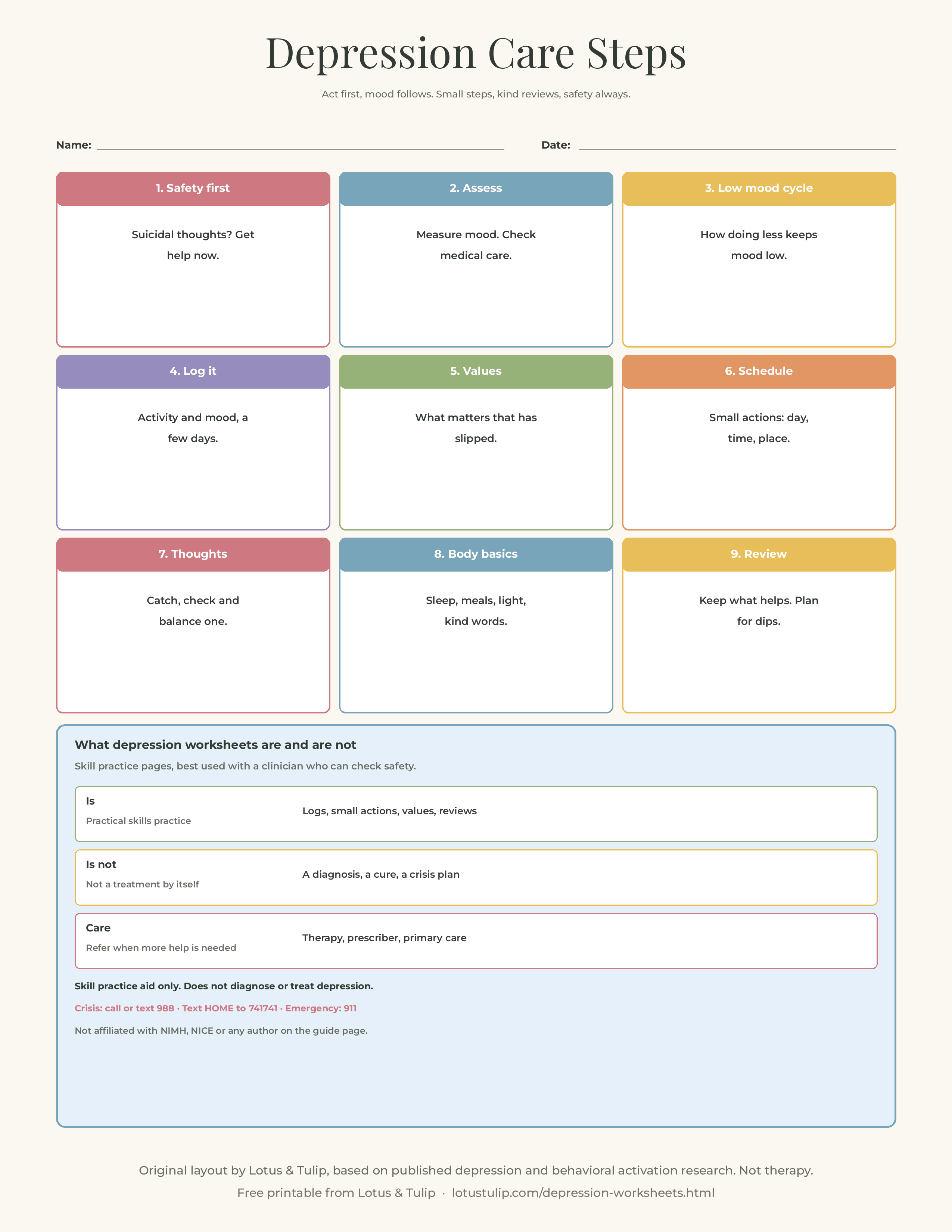
- Check safety first. Ask directly about suicidal thoughts, plans and access to means. If risk is present, use crisis care and a safety plan before skills work.
- Assess and measure. Use a standard measure such as the PHQ-9 and consider medical causes, bipolar history, substance use and current treatment. Worksheets are not diagnostic.
- Map the low mood cycle. Show how doing less keeps mood low, using the client's own examples.
- Log activity and mood. Track a few days to find what lifts mood a little and what drags it down.
- Clarify values. Pick one or two life areas that matter and that have slipped.
- Schedule small actions. Plan two to five specific actions with a day, time and place, starting easy.
- Work with thoughts and rumination. Use a thought record or a redirect plan when a thought keeps blocking action.
- Protect body basics and self-talk. Add sleep and routine anchors and a kind phrase for hard days.
- Review weekly and plan for relapse. Keep what helped, change one thing, and write early warning signs with a clear action plan.
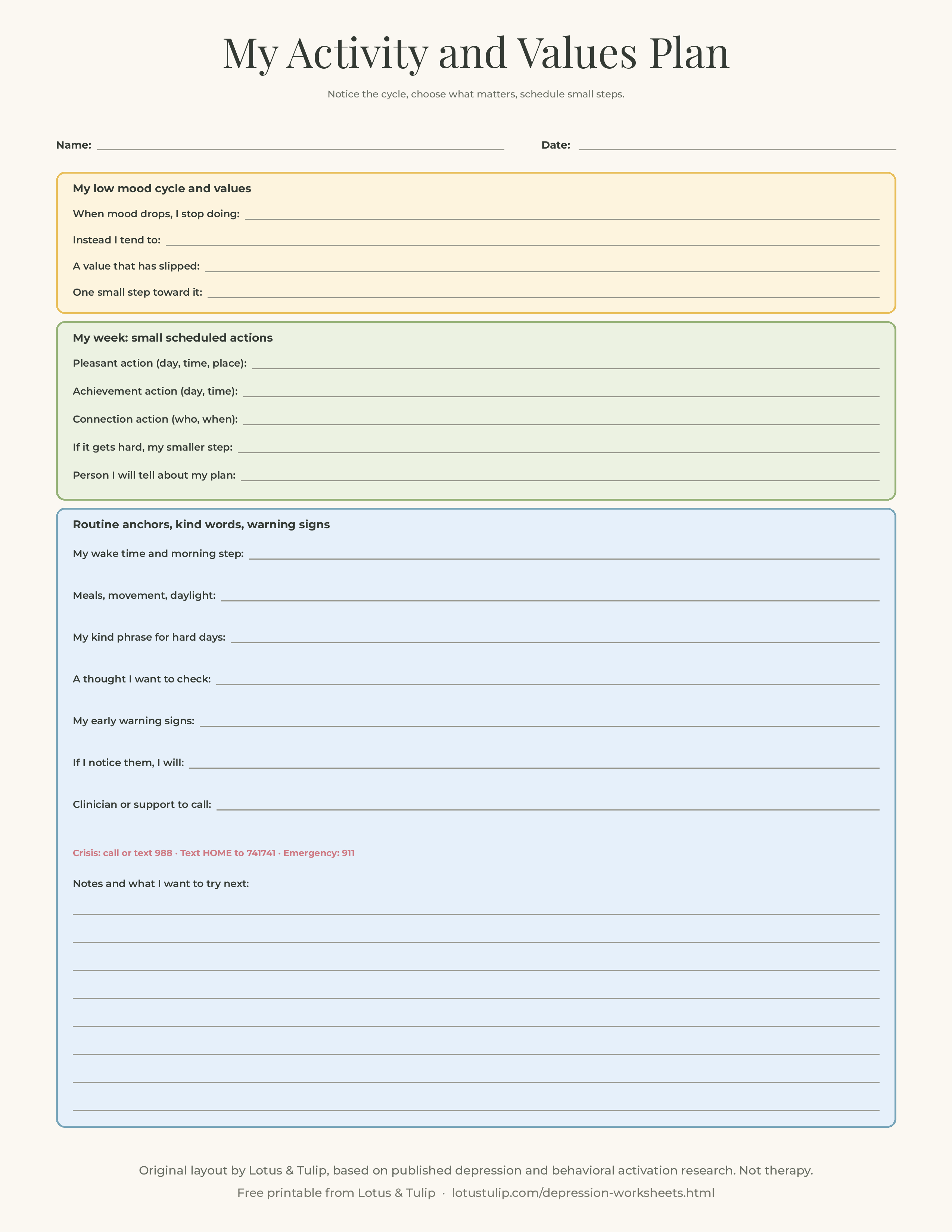
Print the free three page set and keep a stack in your office or share the PDF for telehealth. Page two works well on the fridge or next to the bed, where the plan is visible on the mornings when getting up feels hardest.
Adaptations
Very low energy. Shrink everything. One action per day, two minutes long, at the same time each day. Log in three blocks instead of hourly. Praise the attempt, not the outcome.
Primary care and integrated behavioral health. Short visits suit one page at a time. A mood check in, one scheduled action and a follow-up call can fit in a 20 to 30 minute visit. The COBRA trial found behavioral activation delivered by junior mental health workers was no less effective than CBT from trained therapists, which supports using simple activation tools in busy settings with appropriate supervision.
Telehealth. Share the PDF ahead of time, fill page two together on screen and ask the client to photograph their log before the next session. Agree on a plan if the connection drops during a hard conversation.
College students. Link actions to the academic week (one class attended, one study block, one meal with a friend). Know your campus counseling and disability services, and the 988 Lifeline for nights and weekends.
Older adults. Consider physical limits, grief, isolation and medical causes. Connection actions (a phone call, a community center visit, a faith community) are often the most powerful.
Postpartum and perinatal depression. Keep steps tiny and practical. Coordinate with the medical team, and remember that postpartum depression can be serious and needs prompt care. The National Maternal Mental Health Hotline is 1-833-TLC-MAMA (1-833-852-6262).
Co-occurring anxiety. Many clients have both. Add avoidance and worry tools from our anxiety resources and use graded steps for feared situations.
Grief or trauma. When low mood follows a loss or traumatic events, combine activation with grief or trauma informed work. See our grief worksheets for adults and trauma worksheets.
Cultural fit. Ask what wellbeing, family, faith and work mean to the person. Values, activities and support people should reflect their world, not a generic list.
Tips for therapists and counselors
- Start smaller than you think. If a client says "maybe," the step is too big. Cut it in half.
- Be specific. "Walk around the block at 9 a.m. after coffee" beats "go for walks."
- Do the first one in session. Fill in the first row of the log or schedule together, so the page is not blank when they get home.
- Review every assignment. If you assign homework and never look at it, clients learn that it does not matter.
- Treat missed homework as data. Ask what got in the way and shrink or reschedule the step. Avoid shaming.
- Look for small changes. A mood shift from 3 to 4 is worth naming.
- Mix pleasure, mastery and connection. Activity schedules work better when they are not all chores.
- Keep safety visible. Put crisis lines on every page you hand out. Ours do.
- Coordinate care. With consent, share relevant parts of the plan with the prescriber or primary care provider.
- Use the client's words. "The couch trap" or "the gray fog" will stick better than clinical labels.
Common mistakes
- Giving too many pages at once. One or two pages per week is plenty for most people with depression.
- Starting with thought work when energy is very low. Many clients need some activation first.
- Only scheduling fun. Pleasant events alone may feel hollow. Values and small achievements matter too.
- Making the schedule a to do list. A week packed with chores sets the client up to fail.
- Skipping the safety check. Low mood and suicidal thinking often travel together. Ask directly, every time it is relevant.
- Ignoring possible bipolar disorder. Ask about past periods of unusually high energy, little need for sleep or risky behavior. That changes the treatment plan.
- Treating worksheets as the whole treatment. They are tools inside a relationship and a plan.
Myths about depression and worksheets
- "You need to feel motivated before you act." Behavioral activation is built on the opposite idea: small actions can come first, and mood often follows.
- "Depression is just sadness." Depression often shows up as numbness, irritability, exhaustion, poor concentration, sleep changes and loss of interest, not only tears.
- "Positive thinking is enough." Replacing a harsh thought with a forced positive one rarely sticks. Balanced, believable thoughts and real experiments work better.
- "Worksheets are only for mild depression." In the Dimidjian and colleagues (2006) trial, behavioral activation did comparably to antidepressant medication among more severely depressed participants. That was a full clinician delivered treatment, not worksheets alone, and severe depression still needs careful assessment and often more than one kind of help.
- "Talking about suicide puts the idea in someone's head." Asking directly and calmly is a standard part of good care and opens the door to help.
- "If it worked once, I will never need it again." Depression can recur. A relapse plan is a sign of good care, not pessimism.
Three fictional examples
Maya, 34, after a job loss. Maya's log showed most days spent in bed until noon and evenings scrolling job sites. Mood sat at 2 or 3. She remembered loving early morning runs and baking for friends. Her first schedule had three actions: up by 9 a.m. with coffee on the porch, a ten minute walk on Tuesday and Thursday, and baking muffins to drop off at her sister's on Saturday. Mood on those days rose to 4 or 5. A thought record on "I am useless without a job" helped her write "I am between jobs and still showing up for people I love." Over six weeks her PHQ-9 dropped and she kept the porch coffee as her routine anchor.
James, 58, low mood and isolation after retirement. James rated relationships and community as his most important life areas but had taken almost no action in either. His clinician helped him schedule one call a week with an old colleague and a visit to a volunteer orientation. He found the volunteering awkward at first but kept going because it matched his value of being useful. His early warning signs plan listed "skipping the morning walk with the dog" and "not answering my brother's texts" as first signs.
Rosa, 26, graduate student. In session two Rosa mentioned that she had been thinking it would be easier not to wake up. Her counselor paused the activation work and completed a safety plan with her, including 988, text HOME to 741741, two friends she could call and removing stored medication from her apartment. Skills work resumed only after the safety plan was in place and her campus psychiatrist was involved. Her first scheduled action, a short lunch with a lab mate, was also a connection step on her safety plan.
How this page compares to nearby Lotus and Tulip guides
| Guide | Best for | How it differs |
|---|---|---|
| Behavioral activation worksheet | One tool in depth | Focuses on activation alone; this page puts it in a full depression workflow |
| CBT thought record | Thought work | Full thought record walk through; here it is one of twelve practices |
| Depression worksheets for kids | Children 5 to 12 | Child signs, weather check and little lifts; this page is for adults |
| Depression activities for teens | Adolescents | Teen language and school settings; this page is for adults |
| Mood tracker printable | Daily mood tracking | Tracking only; this page links tracking to action and relapse planning |
| Relapse prevention plan worksheet | Warning signs and plans | Covers relapse across problems; here it is depression specific |
| Self compassion worksheet | Self-criticism | Deeper self-compassion exercises; here it is one practice |
| Safety plan worksheet | Suicide risk | Use first whenever risk is present |
Stuck in replay mode? Our rumination worksheet adds an "is it helping?" test, a why to how switch and a 7 day rumination log.
When not to use these worksheets (or when to refer)
- Active suicidal thinking with a plan or intent. Use crisis care first: 988, emergency services or an emergency department.
- Possible bipolar disorder or psychosis. Refer for psychiatric assessment. Activation plans need care when there is a history of mania.
- Severe depression with inability to eat, drink or care for oneself. This needs urgent medical and psychiatric care.
- Substance use driving the low mood. Integrate substance use treatment rather than relying on mood worksheets alone.
- Possible medical causes. New depression with physical symptoms, after a new medication, or in someone with significant health conditions deserves a medical review.
- No progress after a fair trial. If symptoms are not improving after several weeks, revisit the plan, consider a referral for medication evaluation, a different therapy or more intensive care.
- Outside your scope. If you are a coach, teacher or peer supporter, these pages can support someone already in care, but they are not a substitute for a licensed clinician.
Free 3 page depression worksheets printable (US Letter)
Download the free printable, print on US Letter and use it in session or as optional practice between sessions.
- Page 1: Depression Care Steps. Nine steps that match the HowTo above, what depression worksheets are and are not, and crisis resources.
- Page 2: My Activity and Values Plan. Low mood cycle, values and small steps, a weekly activity plan, routine anchors, a kind phrase and early warning signs.
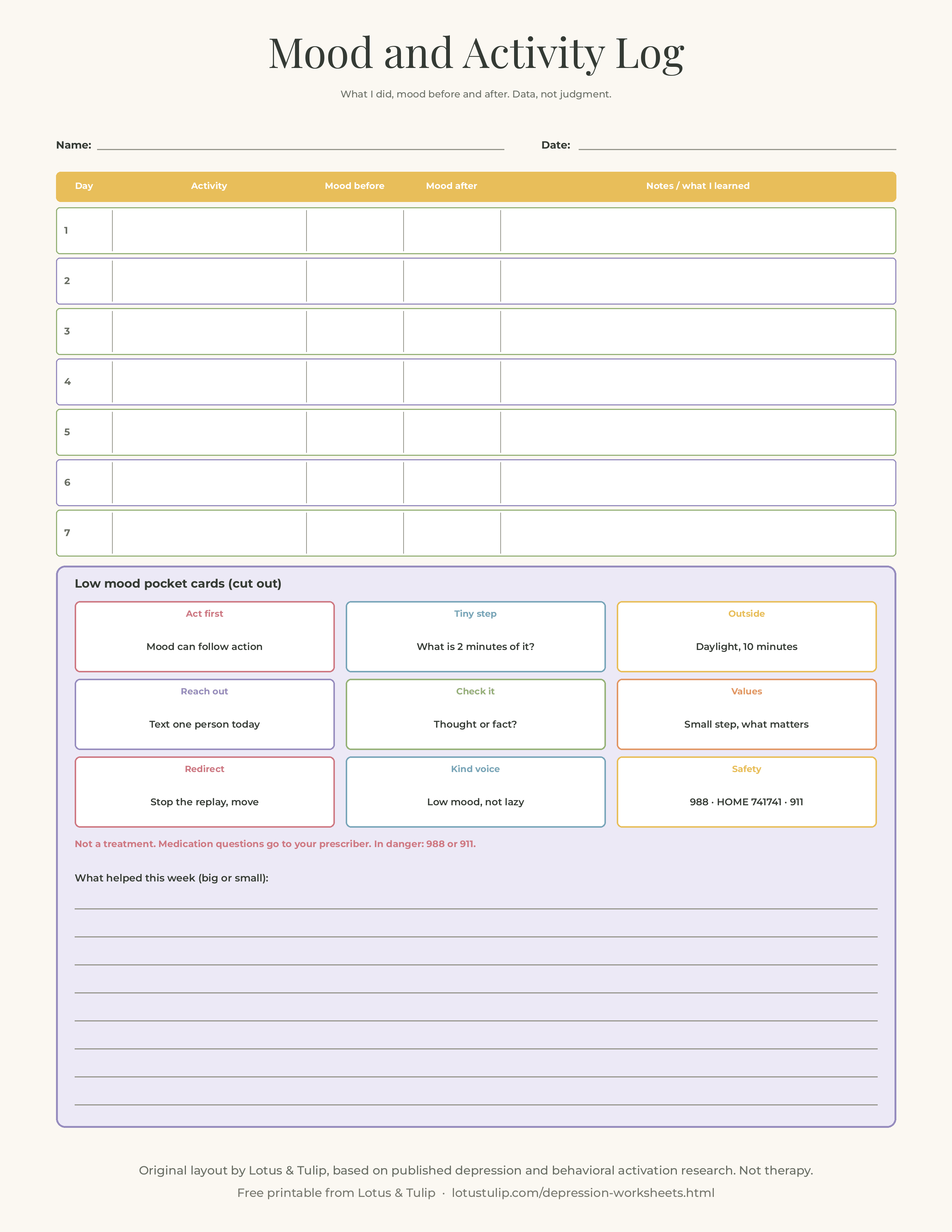
- Page 3: Mood and Activity Log. Seven rows for day, activity, mood before and after, and notes, plus nine pocket cards.
Download free PDF · Page 1 PNG · Page 2 PNG · Page 3 PNG
Research notes (verified, with caveats)
- Jacobson NS, Dobson KS, Truax PA, et al. A component analysis of cognitive-behavioral treatment for depression. J Consult Clin Psychol. 1996;64(2):295-304. 150 outpatients with major depression; the behavioral activation component alone did as well as the full cognitive behavioral package at the end of treatment and at six month follow-up.
- Dimidjian S, Hollon SD, Dobson KS, et al. Randomized trial of behavioral activation, cognitive therapy, and antidepressant medication in the acute treatment of adults with major depression. J Consult Clin Psychol. 2006;74(4):658-670. 241 adults; among more severely depressed participants, behavioral activation was comparable to antidepressant medication and both outperformed cognitive therapy.
- Ekers D, Webster L, Van Straten A, et al. Behavioural activation for depression; an update of meta-analysis of effectiveness and sub group analysis. PLoS One. 2014;9(6):e100100. 26 randomized trials with 1,524 participants; behavioral activation was superior to controls (standardized mean difference about 0.74) with low study quality in most trials and short follow-up.
- Richards DA, Ekers D, McMillan D, et al. Cost and Outcome of Behavioural Activation versus Cognitive Behavioural Therapy for Depression (COBRA): a randomised, controlled, non-inferiority trial. Lancet. 2016;388:871-880. 440 adults in the UK; behavioral activation from junior mental health workers was non-inferior to CBT from psychological therapists at 12 months on the PHQ-9 and cost less.
- Kuyken W, Warren FC, Taylor RS, et al. Efficacy of mindfulness-based cognitive therapy in prevention of depressive relapse: an individual patient data meta-analysis from randomized trials. JAMA Psychiatry. 2016;73(6):565-574. 9 trials, 1,258 patients with recurrent depression; MBCT reduced the risk of relapse within 60 weeks compared with no MBCT (hazard ratio 0.69).
- MacBeth A, Gumley A. Exploring compassion: a meta-analysis of the association between self-compassion and psychopathology. Clin Psychol Rev. 2012;32(6):545-552. Large inverse association between self-compassion and symptoms of depression, anxiety and stress across 20 samples. Correlational.
- Kroenke K, Spitzer RL, Williams JB. The PHQ-9: validity of a brief depression severity measure. J Gen Intern Med. 2001;16(9):606-613. Scores of 5, 10, 15 and 20 mark mild, moderate, moderately severe and severe depression; a score of 10 or more had 88 percent sensitivity and 88 percent specificity for major depression in the validation sample.
- National Institute for Health and Care Excellence. Depression in adults: treatment and management (NG222). 2022. Lists behavioral activation, individually or in groups, among first-line options for less severe depression, alongside guided self-help, CBT and other choices.
- National Institute of Mental Health. Major depression statistics, based on the 2021 National Survey on Drug Use and Health. An estimated 21.0 million US adults (8.3 percent) had at least one major depressive episode in the past year, with the highest rate among adults aged 18 to 25 (18.6 percent).
We do not invent effect sizes. The trials above tested structured, clinician delivered treatments over many weeks, not standalone worksheets. The free printable is a skill practice aid inspired by the same targets and has not been tested in a randomized trial. Guidelines are updated over time, so check current versions before citing them in documentation. The DSM-5-TR criteria for depressive disorders are copyrighted, so we do not reproduce them here. Diagnosis is for a qualified clinician, not a worksheet.
Free depression starter pack: Want more real pages? The free depression worksheets for therapists starter pack adds the low mood cycle, a daily activity and mood log, an activity menu, break it into small steps, a weekly activity plan and a support and safety page from our paid depression and behavioral activation set (8 pages, client use license, no email).
Depression worksheets: FAQ
What are depression worksheets?
They are short, structured pages that help adults with low mood practice skills from evidence based therapies: mapping the low mood cycle, logging activity and mood, choosing values based actions, scheduling small steps, working with thoughts and rumination, protecting sleep and routine, using kinder self-talk and planning for relapse. Therapists use them in session and between sessions.
What is behavioral activation?
Behavioral activation is a structured therapy for depression that helps people notice how doing less keeps mood low, then gradually schedule activities that bring pleasure, achievement, connection or meaning. It treats action as the first step, with mood expected to follow. It has strong research support, including the Dimidjian and colleagues (2006) trial and the COBRA trial (2016).
Can depression worksheets diagnose depression?
No. A mood check in or symptom list is educational. Diagnosis requires an evaluation by a qualified professional who can also check for bipolar disorder, medical causes and other conditions.
Do worksheets replace therapy or medication?
No. They are tools inside care, not a substitute for it. For many adults, therapy, medication or both are important. Questions about medication belong with a prescriber.
Which depression worksheet should I start with?
For most adults, start with an activity and mood log and one or two small scheduled actions. When energy is very low, keep it to one tiny action a day. Thought records and values work can follow once some activity has started.
How long does it take to see a change?
It varies. Some people notice a small lift on the days they complete a planned action within the first week or two. Clinical trials of behavioral activation usually ran for several months. If there is no improvement after a few weeks, talk with your clinician about adjusting the plan.
Can adults use the free printable without a therapist?
Yes, many adults use the activity plan and log on their own. If low mood lasts more than two weeks, affects daily life, or comes with thoughts of death or suicide, please reach out to a clinician. Call or text 988, text HOME to 741741 or call 911 in an emergency.
Are these worksheets suitable for teens?
This set is written for adults. For adolescents, see our depression activities for teens, which use teen language and school examples.