
Kids and teens · Updated 2026-11-06
Emotional Regulation Activities for Teens (with Free Printable)
Ready-made printable: DBT Worksheets for Teens Holiday 20% off: about $11.04, was $14 (EUR 12) · instant digital download
Buy on Etsy
Emotional regulation for teens is the skill of noticing a feeling, naming and rating it, cooling the body when arousal is high, then choosing a response that fits the facts and your values. It is not the same as stuffing feelings down (suppression). It is not the same as blasting them out while the body is still hot (venting). Teens need a middle path that respects adolescent life: phones, friends, grades, tryouts, dating, family rules, and a nervous system that is still under construction.
This Lotus and Tulip page is a teen-focused emotional regulation activities guide with an original free three page US Letter printable. It targets searches families and helpers actually use: emotional regulation activities for teens, emotion regulation worksheets for teenagers, and teen self regulation printable. It is distinct from our emotional regulation worksheets for kids page (ages about 5 to 12, body map and Stop Notice Choose), from coping skills worksheets for teens, from stress management worksheets for teens, from anger management activities for teens, from the window of tolerance worksheet, from the DBT PLEASE skills worksheet, from the DBT TIPP skills worksheet, and from the opposite action worksheet. Those neighbors help. This page centers on the full teen regulation loop: notice, name and rate, cool body, choose a skill, reflect.
We credit research lineages honestly: James Gross and the process model of emotion regulation (with clear non-affiliation); Amelia Aldao and colleagues on strategy meta-analyses and reviews with caveats; Marsha Linehan's DBT skills (STOP, TIPP, opposite action, PLEASE, urge surfing style practice) as educational components inside broader treatment, not as standalone RCT packages for this free sheet; Stefan Hofmann and colleagues on CBT meta-analytic lineages as a neighbor; school SEL reviews such as Durlak and colleagues as context, not proof that this printable remits diagnoses. We are not affiliated with those authors, any textbook publisher, or any treatment package. This printable is an original educational layout, not a copy of any copyrighted worksheet and not a diagnosis or treatment.
This guide is educational. It is not therapy, not medical advice, and not a diagnosis. If thoughts of ending your life, plans to harm yourself or someone else, or a medical emergency show up, stop the worksheet and get help now: in the US, call or text 988, text HOME to 741741, or call 911. Our safety plan worksheet is a better first tool in that moment. Nearby tools: emotional regulation for kids, feelings thermometer, 5 4 3 2 1 grounding, breathing exercises, body scan, mindfulness activities for kids, self compassion, peer pressure for teens, window of tolerance, cognitive restructuring, urge surfing, and distress tolerance.
Jump to the free emotional regulation printable (PDF) · How to use emotional regulation activities for teens, step by step · Worked examples · Comparisons
What emotion regulation is (and is not)
Emotion regulation means influencing which emotions you have, when you have them, and how you experience or express them. James Gross's process model (situation selection, situation modification, attentional deployment, cognitive change, response modulation) is a widely taught map of where regulation can happen. We credit that lineage with non-affiliation. This free page does not reproduce any Gross worksheet or textbook figure.
Regulation is not suppression. Suppression means pushing the feeling out of awareness or face while the body stays activated. Short-term, it can help in a hallway. Long-term, chronic suppression often costs more: rebound intensity, numbness, sarcasm, or delayed explosions. Teens who are told "just calm down" without skills often learn to hide signals instead of skill responses.
Regulation is not venting while hot. Replaying the insult while punching a pillow, sending a rage text, or doom-scrolling the group chat usually reheats arousal. Cool the body first. Talk or solve after intensity drops. See also our anger management activities for teens page for the venting research lineage in anger-specific scenes.
Regulation is not fake calm or people-pleasing. The goal is a workable intensity and a values-based next step, not a perfect smile. A teen can feel furious at a betrayal and still choose a skillful ask, a boundary, or a counselor check-in instead of retaliation.
Core teen loop: notice the cue → name the feeling and rate 0 to 10 → cool the body if needed → choose a skill that fits facts and values → reflect and log. Practice at a 3 or 4 beats waiting until a 9.
Body cues teens actually notice
Emotions show up in the body before the story finishes. Teens often miss the early window because they treat feelings as sudden flips.
- Muscle and posture: jaw clench, fists, shoulders up, restless legs, slumped shutdown.
- Heart and breath: pounding pulse, shallow breath, chest tightness, stomach drop.
- Face and voice: heat, tears, blank stare, clipped words, volume rising or vanishing.
- Thoughts: "They always..." "I can't..." "Everyone hates me..." "I'll show them..."
- Urges: send, slam, storm out, freeze, scroll, restrict, binge, cut, argue until someone "loses."
Pair cues with a 0 to 10 rating and a feeling word (use a feelings thermometer or feelings wheel if vocabulary is thin). A teen who can say "I'm at a 6, chest tight, embarrassed" has more options than a teen who only notices after the phone is already mid-air.
Naming and rating: make the feeling usable
Naming is not fluffy. Putting a word on the experience often reduces fuzziness enough to choose. Rating adds a dial: skills at a 4 differ from skills at a 9. If intensity is already 8+, prioritize body cool-down before analysis or "talk it out." Cross-link to window of tolerance when the question is "am I too high (hyperarousal) or too low (shutdown)?"
Helpful teen prompts: What am I feeling in one word? Where in my body? What is the urge? What is the story my mind is telling? What do the facts support so far?
Cool the body, then choose
High arousal narrows options. Before problem-solving, many teens need a short arousal-down step: slow breathing (see breathing exercises), cold water on wrists or face with care, a walk, stretch, quiet music, 5 4 3 2 1 grounding, or a brief body scan. Prefer skills that lower arousal over rumination that reheats it.
Then choose. Choice means picking a next move that fits the facts and your values: ask, leave, problem-solve, opposite action, check the facts, urge surf, or get adult help. Choice is not the same as "doing nothing forever."
How to use emotional regulation activities for teens, step by step
- Check safety and fit. If acute crisis, medical emergency, or anyone is in danger, pause. Use crisis pathways first: 988, HOME to 741741, or 911 when needed. Prefer a safety plan in that moment.
- Notice the cue. Body, thoughts, urge, scene. Write it on the free plan page while intensity is still mid-range when you can.
- Name the feeling and rate 0 to 10. Embarrassed, furious, shut down, jealous, scared. If already at 8+, go to cool-down before deep analysis.
- Cool the body. Slow breath, cold water with care, walk, stretch, grounding, short body scan. Prefer arousal-down skills. For extreme peaks, see TIPP with medical cautions on that page.
- Check the window. Too high, too low, or inside a workable window? Neighbor tool: window of tolerance.
- Choose a skill from the menu. Brief STOP. Opposite action when the urge does not fit facts or values. PLEASE basics for vulnerability factors. Urge surfing for waves that peak and fall. Cognitive restructuring when the story is catastrophizing (see cognitive restructuring and cognitive distortions).
- Act in line with values. What kind of person do you want to be in this scene? Respectful? Honest? Safe? Kind to yourself?
- Reflect briefly. What helped? What made it worse? What will you try earlier next time?
- Log and bridge. Record cue, number, skill, and outcome on the practice log. Bridge to coping skills, stress management, anger teens, self compassion, or peer pressure when those are the real load.
Practice on ordinary annoyances first (a slow Wi-Fi moment, a short homework snag) before relying on skills in a public hallway fight or a late-night group chat spiral. Skill grows with reps at lower numbers.
CBT and DBT informed skill menu (brief, with cross-links)
These are skill practice aids. They are not a full DBT program and not a standalone CBT package. We credit Linehan's teaching and CBT lineages with clear non-affiliation.
STOP (brief). Stop the automatic action. Take a step back. Observe what is happening inside and outside. Proceed mindfully when you can choose. Full crisis-survival menus live on our distress tolerance page.
TIPP (brief, with medical cautions). Temperature, Intense exercise, Paced breathing, Paired muscle relaxation: short arousal changers for peaks. Cold water on the face and intense exercise have medical cautions. Prefer the dedicated TIPP page rather than improvising unsafe experiments. This free sheet is not a TIPP protocol.
Opposite action (brief). When the emotion urge does not fit the facts or your values, act opposite: soften face, approach kindly, stay when urge is to isolate without reason, leave when urge is to explode. Details: opposite action worksheet.
PLEASE (brief). Treat physical vulnerability factors: illness, eating, substances/alcohol, sleep, exercise. PLEASE is a DBT emotion-regulation style skill associated with Linehan's teaching. See PLEASE skills worksheet. This page is not a full PLEASE curriculum.
Urge surfing (brief). Notice the urge like a wave: rise, peak, fall. Ride without acting on the peak when acting would harm. See urge surfing worksheet.
Opposite of catastrophizing / cognitive restructuring (neighbor). When the mind jumps to worst-case total disaster, gather evidence for and against, write a balanced thought, re-rate, and pick a workable action. See cognitive restructuring and cognitive distortions. Hofmann-lineage CBT meta-analyses support CBT packages as treatments in many trials; they do not prove this three page printable remits diagnoses.
Window of tolerance (neighbor concept). Hyperarousal and hypoarousal both shrink skill use. Map the window, then return to regulation practice inside it. See window of tolerance worksheet.
Mindfulness and grounding neighbors. Mindfulness activities, grounding, body scan, and progressive muscle relaxation support the cool-body step.
Worked fictional examples
Teen example, group chat (fictional): Jordan, age 16, sees a private joke about them shared in a larger chat. Cue: face heat, urge to send a scathing reply. Feeling: humiliated and angry. Intensity: 7/10. Cool body: phone face down, walk to kitchen, cold water on wrists, three slow breaths to a 5. Choose: STOP, then an I-statement later to a trusted friend, plus a request to take the screenshot down. Reflect: "Texting at a 7 makes it worse. Cool first." Written on the free regulation plan.
Teen example, test panic (fictional): Sam, age 15, freezes on a quiz. Cue: blank mind, stomach drop. Intensity: 8/10. Cool body: paced breathing under the desk, feet on floor, 5 4 3 2 1 quietly. Choose: answer the easiest question first (opposite of freeze-and-quit). After class: check sleep and caffeine (PLEASE basics), then a short thought check on "I always fail" with cognitive restructuring.
Teen example, peer pressure (fictional): Avery, age 14, is dared to vape at a party. Cue: tight chest, urge to say yes to fit in. Intensity: 6/10. Cool body: step outside for air. Choose: urge surf the "say yes" wave for two minutes, then use a refusal script from peer pressure worksheets. Values check: "I want to stay safe and keep my word to myself."
School counselor note (fictional): In a twelve minute meeting, a counselor helps a student fill trigger, body cue, 0 to 10, two cool-downs, and one after-plan line. No lecture. Optional practice, never forced disclosure. Follow district crisis protocol if risk appears. For multi-session groups, pair with DBT teens pages or a stress group curriculum rather than stacking every worksheet in one period.
Teen emotional regulation vs kids ER, coping teens, stress teens, anger teens, and window of tolerance
| Teen emotional regulation (this page) | Kids emotional regulation | Coping skills for teens | Stress management for teens | Anger activities for teens | Window of tolerance | |
|---|---|---|---|---|---|---|
| Main job | Notice, name/rate, cool body, choose, reflect for adolescent scenes | Body map and Stop Notice Choose for ages about 5 to 12 | Broad healthy coping menu and plan | Load, sleep, screens, and stress tools | Cool-down, I-statement, repair for anger scenes | Map hyperarousal vs hypoarousal vs workable window |
| Best early use | When teens need a full regulation loop with autonomy-respecting language | Younger kids with adult coaching | When the teen needs a wide skill shelf | When chronic load and habits are the issue | When anger and aggression are the focus | When "too high / too low" is the missing frame |
| Output | Cue, rating, cool-down, skill choice, after-plan log | Feelings signals and kid choose plan | Coping menu and tracker | Stress plan and habit tweaks | Anger cool-down and repair log | Window map and return-to-window plan |
| Cross link | This page | Kids ER | Coping teens | Stress teens | Anger teens | Window of tolerance |
These tools cooperate. Teen emotional regulation builds the loop. Kids ER keeps younger language. Coping and stress widen the shelf and the load plan. Anger teens specialize the cool-down and repair path. Window of tolerance frames arousal bands. TIPP, opposite action, PLEASE, urge surfing, and cognitive restructuring deepen specific skills. Teach one tool clearly before stacking four on day one.
School counselor, therapist, and parent tips
Teens. Prefer concrete scenes over lectures about "emotion regulation as a construct." Let them reject babyish cartoons. "Cue, number, cool body, choose" often lands better than a long theory talk. Keep experiments tiny and within their real control. Pair with DBT worksheets for teens and CBT worksheets for teens when skills and thoughts need more pages. Use self compassion when shame follows every mistake.
School counselors. Short meetings favor a compressed sequence: trigger, cue, rating, two cool-downs, one after-plan. Groups can practice with low-stakes role plays and exit plans that respect hallway safety rules. Follow district crisis protocol if risk appears. Optional practice, never forced disclosure. Avoid shaming "emotional kids"; target the skill gap and the load (sleep, hunger, bullying, ADHD supports), not the teen's worth. SEL programs (including findings summarized in school-based reviews such as Durlak and colleagues) can support social-emotional skill building at a program level. They do not prove that this free three page printable remits diagnoses.
Therapist tips:
- Stay in the client's language. Reflect their cues and values. Do not overwrite with your favorite acronym on day one.
- Separate regulation from suppression and from venting out loud, repeatedly, without excusing harm.
- Lower arousal before insight. Flooded or shut-down teens cannot use fancy worksheets well.
- Use STOP, TIPP, opposite action, PLEASE, and urge surfing carefully. They are components taught inside broader care. Link to dedicated pages. Watch medical cautions for TIPP.
- Bridge to neighbors. Window of tolerance for arousal bands, cognitive restructuring for catastrophizing, coping and stress for load, anger teens for aggression-linked scenes, peer pressure for social dare moments.
- Measure function. Ask what changed: earlier exits, fewer harmful texts, clearer asks, faster returns to the window, lower average peak ratings, better sleep.
Parents. Model regulation out loud ("I'm at a 6, I'm taking three breaths"). Do not demand perfect calm while you yell. After a blow-up, prioritize safety, then repair, then skill practice when everyone is regulated. Do not turn the regulation plan into a new weapon ("fill this out or else") that makes the worksheet feel like punishment.
Common mistakes
- Teaching skills only at a 9 instead of practicing at a 3.
- Confusing regulation with suppression and praising numbness as "maturity."
- Pushing venting that reheats arousal while calling it "healthy release."
- Skipping the cool-body step and jumping straight to "talk it out" while flooded.
- Using babyish materials that teens reject, or adult jargon that teens tune out.
- Ignoring sleep, hunger, ADHD supports, bullying, trauma load, or substances while blaming "emotions" alone.
- Using it in acute crisis instead of safety first.
- Treating the worksheet as therapy. Paper supports practice. It does not replace a clinician when problems are severe or lasting.
When not to use this worksheet
Good early uses: a teen who can name a cue or feeling, mild to moderate dysregulation, homework between counseling sessions, school counseling check-ins, and building a cool-body plus choose plan.
Prefer another tool first when:
- Acute safety risk or medical emergency: stabilize and get help (988, HOME to 741741, 911). Prefer a safety plan.
- Active violence or imminent harm: prioritize safety, supervision, and emergency protocols over worksheets.
- Flooded panic or total shutdown: co-regulate first. Then return to plan work. Window of tolerance framing can help.
- When anger and aggression are the main focus: use anger management activities for teens.
- When peaks need crisis-survival skills: use TIPP and distress tolerance inside a proper plan.
- When younger language fits better: use emotional regulation for kids.
What the research says (honestly)
Emotional regulation activities and worksheets are a skill practice aid, not a standalone RCT treatment. Do not claim this free printable remits mood disorders, trauma symptoms, or any diagnosis.
Gross process model of emotion regulation. James Gross's process model organizes regulation across situation, attention, appraisal, and response stages. It is a conceptual map used widely in research and teaching. Credit the lineage with non-affiliation. This page is not a Gross protocol and does not reproduce copyrighted figures.
Aldao and colleagues on emotion regulation strategies. Meta-analytic and review work associated with Amelia Aldao and collaborators has examined links between strategies (such as reappraisal, suppression, avoidance, rumination) and psychopathology indicators across studies. Findings are nuanced: strategy effectiveness depends on context, and averages are not prescriptions for every teen. Treat those papers as research lineage with caveats, not as validation of this printable.
Linehan DBT skills (STOP, TIPP, opposite action, PLEASE, urge surfing style practice). These are taught components inside Dialectical Behavior Therapy and related skills training. They are not presented here as standalone RCT treatments for teen emotion dysregulation. We credit the lineage with clear non-affiliation. Use clinician judgment and licensed care when problems are severe or lasting.
Hofmann CBT meta lineage (neighbor). CBT packages have substantial meta-analytic support for many conditions. Cognitive restructuring is a common CBT component. That neighbor lineage does not prove technique-only RCTs of this three page sheet.
Youth ER and school SEL caveats (including Durlak and colleagues). School-based social and emotional learning reviews report average benefits for social-emotional skills and related outcomes at a program level. Those reviews are not proof that this free printable remits diagnoses or replaces counseling.
Honest caveat. Use teen emotional regulation practice inside a coherent plan with co-regulation, sleep and school supports, bullying response, and neighboring CBT/DBT tools when needed. For severe mood problems, trauma, psychosis, or acute risk, use disorder-appropriate care and crisis pathways. No study tests this three page Lotus and Tulip printable alone.
Free emotional regulation printable for teens (PDF)
The free emotional regulation printable has three pages in US Letter size:
- Page 1: Teen Emotion Regulation Steps card. Eight step sequence from notice and rate through cool body, window check, choose, values act, reflect, and log, plus safety reminders.
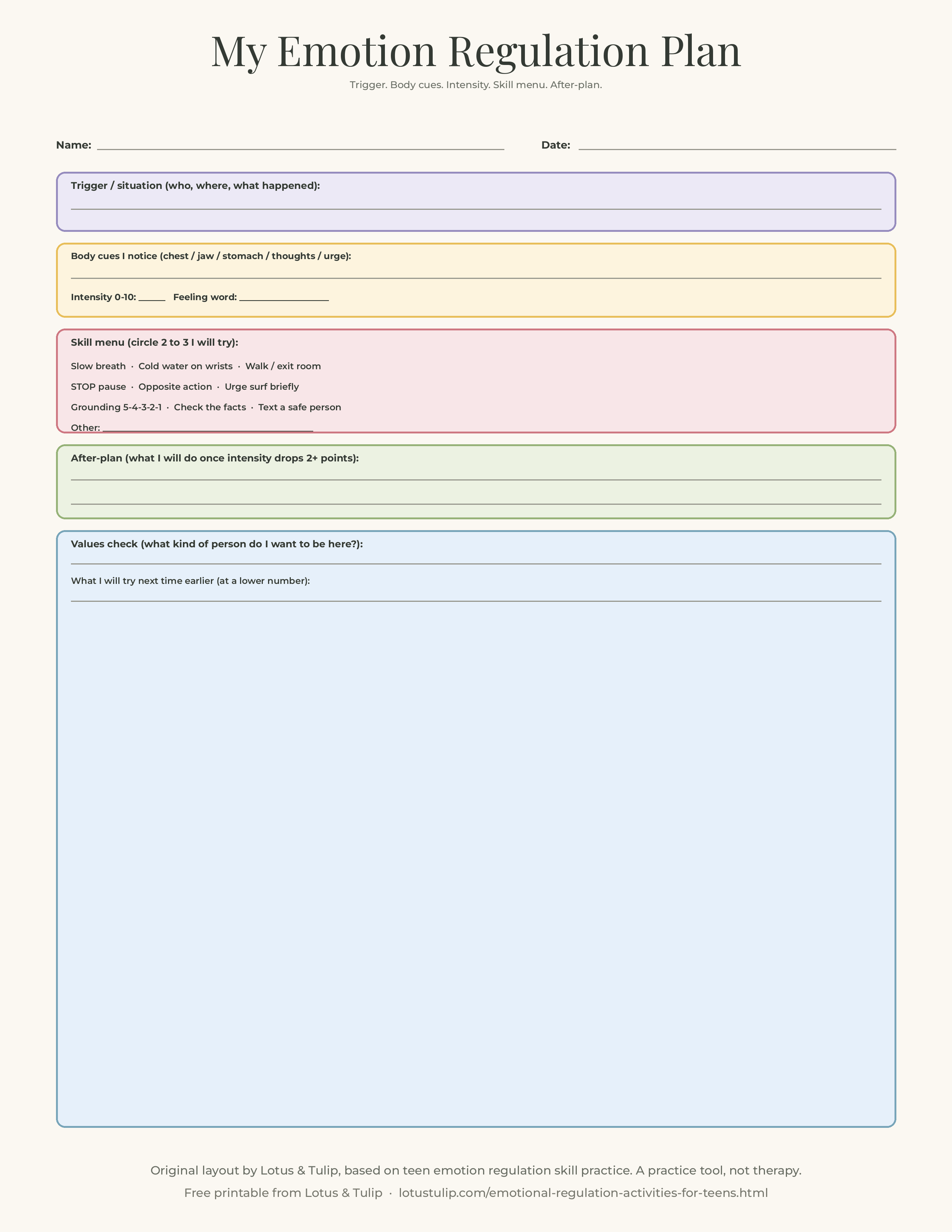
- Page 2: My Emotion Regulation Plan. Fill in trigger, body cues, 0 to 10, skill menu, after-plan, and values check.
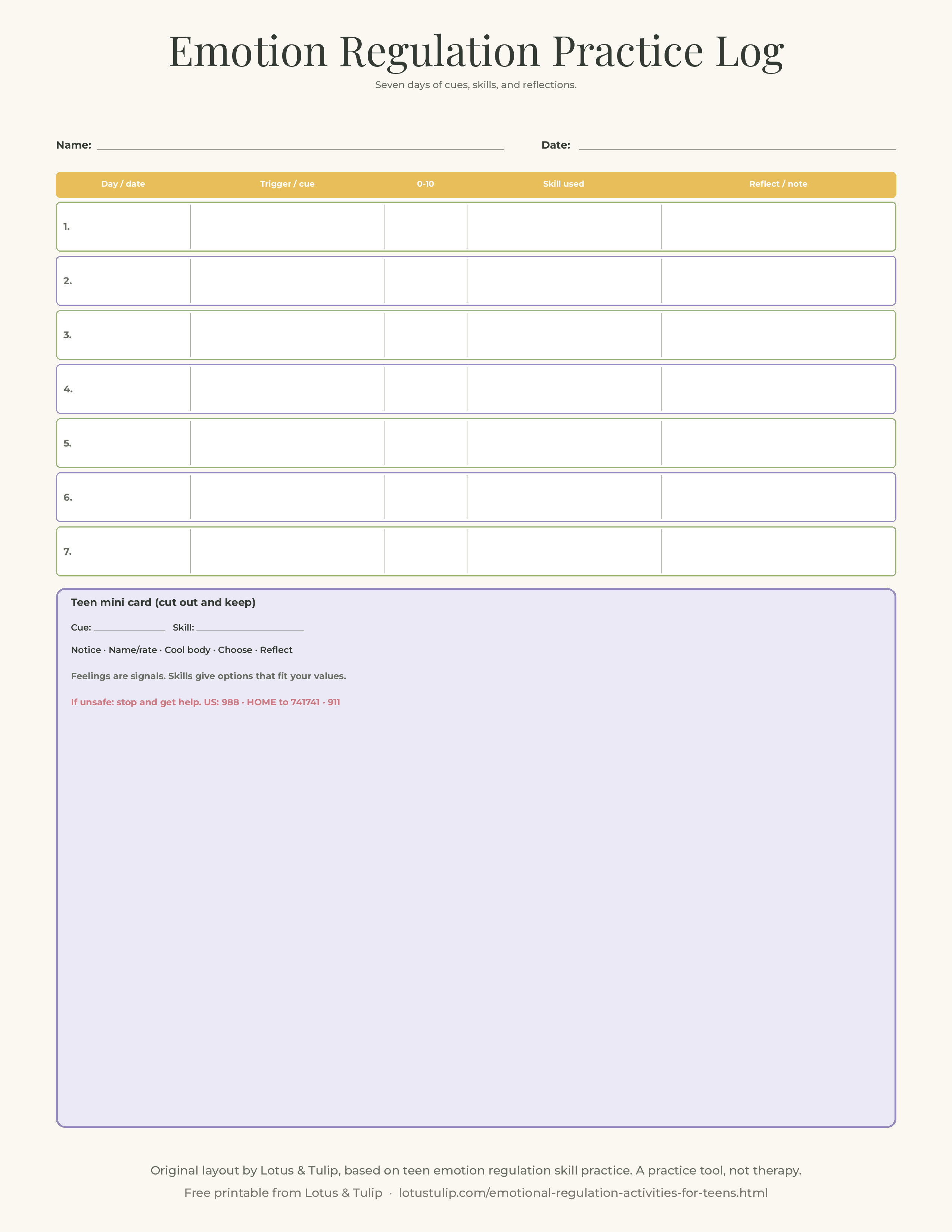
- Page 3: Practice Log + teen mini card. Seven day rows plus a cut out reminder for cue, skill, and the notice to reflect loop.
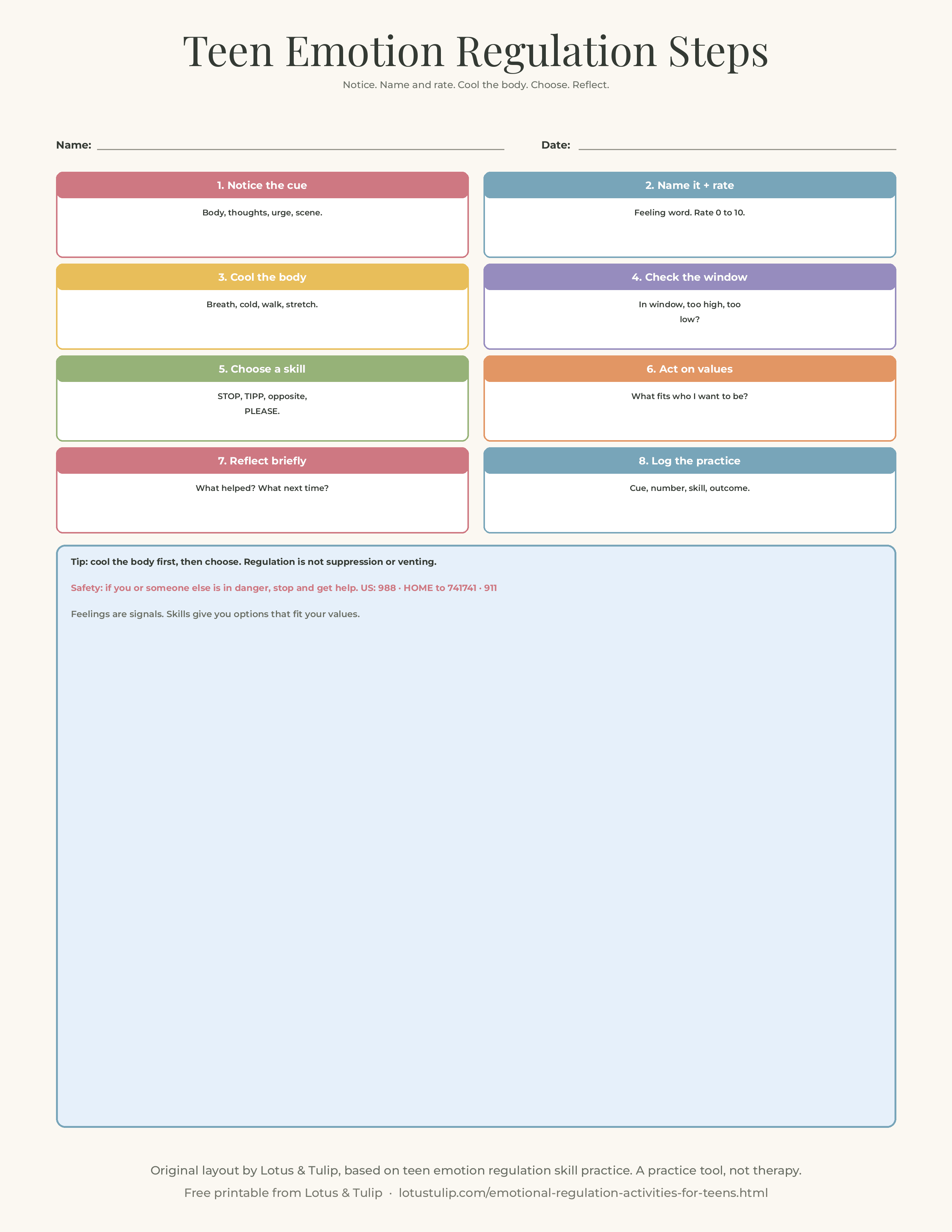
Download the free emotional regulation printable for teens (PDF, 3 pages, US Letter)
Prefer single images? Page 1: Teen Emotion Regulation Steps (PNG) · Page 2: My Emotion Regulation Plan (PNG) · Page 3: Practice Log (PNG)
Free DBT starter pack for teens: Working with a teen? The free DBT worksheets for teens starter pack adds ride the emotion wave and check the facts from our paid DBT set for teens, plus finding my wise mind, a distress tolerance toolkit, a weekly diary card and a safety and care page (8 pages, ages about 13 to 18, client use license, no email).
Free to print for your own use and for use with your own clients, students, or groups. This is an original layout by Lotus & Tulip, based on teen emotion regulation skill practice associated with the Gross process model lineage, with strategy research reviews associated with Aldao and colleagues, with brief educational references to DBT-informed skills (STOP, TIPP, opposite action, PLEASE, urge surfing) associated with Linehan's teaching, and with CBT restructuring as a neighbor skill. It is not affiliated with those authors, any scale publisher, or any specific treatment package, and is not a substitute for therapy. Please link to this page rather than re-uploading the file.
Related resources
- Emotion regulation worksheets for adults: an emotion log, five points to step in and a free 2 page PDF
- Emotional regulation worksheets for kids: younger body map and Stop Notice Choose.
- Coping skills worksheets for teens: wide healthy coping menu.
- Stress management worksheets for teens: load, sleep, and stress tools.
- Anger management activities for teens: cool-down, I-statement, repair for anger.
- Window of tolerance worksheet: hyperarousal, hypoarousal, workable window.
- DBT PLEASE skills worksheet: physical vulnerability factors.
- DBT TIPP skills worksheet: short arousal changers for peaks.
- Opposite action worksheet: act against unhelpful emotion urges.
- Urge surfing worksheet: ride urges without acting on the peak.
- Cognitive restructuring worksheet: evidence and balanced thoughts.
- Feelings thermometer printable: rate intensity visually.
- 5 4 3 2 1 grounding worksheet: senses-based cool-down.
- Breathing exercises for kids: calm breathing techniques.
- Body scan meditation script: guided body awareness.
- Mindfulness activities for kids: age-friendly mindfulness practices.
- Self compassion worksheet: kinder self talk after hard moments.
- Peer pressure worksheets for teens: refusal skills and scripts.
- Safety plan worksheet: when the moment is about staying safe and alive.
Sources
- Gross, J. J. Process model of emotion regulation (situation, attention, appraisal, response stages). Conceptual research and teaching lineage. Educational credit with clear non-affiliation. Not a claim that this printable is a Gross protocol.
- Aldao, A., Nolen-Hoeksema, S., and Schweizer, S. (2010). Emotion-regulation strategies across psychopathology: a meta-analytic review. Clinical Psychology Review, 30(2), 217 to 237. Strategy-psychopathology links with important context caveats. Credit only; not validation of this free page.
- Linehan, M. M. Dialectical Behavior Therapy skills training lineage (STOP, TIPP, opposite action, PLEASE, urge surfing style practice as taught components). Educational reference with clear non-affiliation. Component skills are not standalone RCT proof for this three page sheet.
- Hofmann, S. G., Asnaani, A., Vonk, I. J. J., Sawyer, A. T., and Fang, A. (2012). The efficacy of cognitive behavioral therapy: a review of meta-analyses. Cognitive Therapy and Research, 36(5), 427 to 440. CBT package support as neighbor lineage; not technique-only proof of this printable.
- Durlak, J. A., Weissberg, R. P., Dymnicki, A. B., Taylor, R. D., and Schellinger, K. B. (2011). The impact of enhancing students' social and emotional learning: a meta-analysis of school-based universal interventions. Child Development, 82(1), 405 to 432. Program-level SEL context; not proof that this free sheet remits diagnoses.
- Honest caveat: teen emotion regulation drills are a skill practice aid. Strategy meta-analyses, DBT skills packages, CBT meta-analyses, and school SEL reviews are not the same as technique-only RCTs of this Lotus and Tulip printable.
Emotional regulation activities for teens: FAQ
What is emotional regulation for teens?
It is noticing a feeling, naming and rating it, cooling the body when needed, then choosing a response that fits the facts and your values. It is not suppression and not hot venting.
Is this the same as the kids emotional regulation page?
No. The kids page uses younger language, a body map, and Stop Notice Choose for ages about 5 to 12. This teens page centers an autonomy-respecting loop for adolescent scenes, with brief CBT and DBT informed skills and cross-links.
How is this different from coping skills or stress management for teens?
Coping skills pages offer a wide menu. Stress pages focus on load and habits. This page teaches the regulation loop itself: notice, name/rate, cool body, choose, reflect. They work well as neighbors.
Can school counselors use it with teens?
Yes, often in short meetings with one trigger, two cool-downs, and one after-plan. Keep practice optional and school safe. Follow crisis protocol when risk appears. Do not use the page as a diagnosis.
Do STOP, TIPP, opposite action, or PLEASE work on their own?
They are skill components associated with DBT teaching, not proof that this free page remits diagnoses. Use them inside counseling or therapy, follow medical cautions (especially for TIPP), and get licensed care for persistent or severe problems.
When should I not use this worksheet?
Do not use it as the first move in acute safety risk, medical emergency, active violence, or when the teen is too flooded or shut down to engage. Stabilize and get help first when needed: 988, HOME to 741741, or 911. Use a safety plan when staying safe is the job.
Is this affiliated with Gross, Aldao, Linehan, Hofmann, or SEL manuals?
No. This is an original Lotus and Tulip educational layout. We credit research lineages with clear non-affiliation and do not reproduce copyrighted manual worksheets.