
Kids and teens · Updated 2026-11-06
Anger Management Activities for Teens (with Free Printable)
Ready-made printable: Anger Management Small Group Curriculum for School Counselors Holiday 20% off: about $11.04, was $14 (EUR 12) · instant digital download
Buy on Etsy
Anger in teens is not a character flaw. It is a high-arousal signal that something feels unfair, threatened, blocked, or shaming. Aggression is different: aggression is a behavior choice that harms people, property, or relationships. Teens, parents, school counselors, and therapists need language that separates the feeling from the act, then builds a cool-down and repair plan that fits adolescent life: group chats, tryouts, grades, dating drama, and adults who still hold power over schedules and consequences.
This Lotus and Tulip page is a teen-focused anger management activities guide with an original free three page US Letter printable. It targets searches families and helpers actually use: anger management activities for teens, anger worksheets for teenagers, and teen anger management printable. It is distinct from our anger management activities for kids page (ages about 5 to 12, Stop Breathe Think Choose, child-friendly calm downs), from the anger iceberg worksheet (feelings under the tip), from the size of the problem worksheet, from impulse control worksheets for kids, from the conflict resolution worksheet, from coping skills worksheets for teens, from stress management worksheets for teens, from the opposite action worksheet, from the DBT TIPP skills worksheet, and from emotional regulation worksheets for kids. Those neighbors help. This page centers on teen anger: body cues, triggers, cool-down versus the venting myth, brief CBT and DBT informed skills, I-statements, repair, and a workable anger plan.
We credit research lineages honestly: Brad Bushman and colleagues on catharsis and venting; Sophie Kjærvik and Brad Bushman on arousal-decreasing versus arousal-increasing activities; Denis Sukhodolsky and colleagues on CBT for youth anger; Marsha Linehan's DBT skills of STOP, opposite action, and TIPP as taught components inside broader treatment, not as standalone RCT packages for this free sheet. We are not affiliated with those authors, any textbook publisher, or any treatment package. This printable is an original educational layout, not a copy of any copyrighted worksheet and not a diagnosis or treatment.
This guide is educational. It is not therapy, not medical advice, and not a diagnosis. If thoughts of ending your life, plans to harm yourself or someone else, or a medical emergency show up, stop the worksheet and get help now: in the US, call or text 988, text HOME to 741741, or call 911. Our safety plan worksheet is a better first tool in that moment. Nearby tools: anger management activities for kids, anger iceberg, size of the problem, impulse control, conflict resolution, coping skills for teens, stress management for teens, opposite action, TIPP, emotional regulation for kids, I-statements, assertiveness, and distress tolerance.
Jump to the free anger printable (PDF) · How to use anger management activities for teens, step by step · Worked examples · Comparisons
Anger vs aggression: the distinction teens need
Anger is an emotion. It can be justified, proportional, and useful: it flags injustice, boundary violations, and blocked goals. Aggression is behavior aimed at hurting, intimidating, or damaging. Teens often hear "don't be angry" when adults really mean "don't smash the door / don't send the cruel text / don't escalate the fight." Mixing those messages teaches teens to hide the signal instead of skill the response.
Core idea: feel anger, own the choice about what happens next. A teen can say "I am furious that my post was screenshot and shared" and still choose a cool-down, an I-statement, a counselor check-in, or a planned problem-solving step instead of retaliation. Naming the feeling early (at a 3 or 4 out of 10) is easier than trying to teach skills at a 9.
Not the same as "anger is always bad." Suppressed anger often leaks as sarcasm, shutdown, self-harm urges, or delayed explosions. The goal is regulation and values-based action, not fake calm.
Not a free pass for harm. Skills do not erase accountability. Repair after a blow-up is part of the skill set, not an optional nicety.
Body signals teens actually notice
Teens often miss the early window because they treat anger as a sudden flip. Body cues usually arrive first:
- Muscle: jaw clench, fists, shoulders up, restless legs.
- Heat and heart: face flush, chest heat, pounding pulse.
- Voice and face: volume rising, clipped words, eye roll, glare.
- Thoughts: "They always..." "This is so unfair..." "I'll show them..."
- Urges: slam, send, storm out, punch a wall, argue until someone "loses."
Practice naming cues when intensity is low. Pair with a 0 to 10 rating. A teen who can say "I'm at a 5, jaw tight" has more options than a teen who only notices after the phone is already mid-air. For younger kids, our kids anger page uses simpler Stop Breathe Think Choose language. For teens, keep the language direct and respectful of autonomy.
Common teen triggers (school, peers, home, online)
Triggers are cues that light the fuse. Mapping them is prevention, not blame:
- School: public correction, unfair grades, group project freeloading, tryout cuts.
- Peers: exclusion, rumor, betrayal, "just joking" insults, dating jealousy.
- Home: being compared to a sibling, sudden rule changes, privacy invasions, chores piled after a hard day.
- Online: screenshots, pile-ons, ghosting, viral embarrassment, late-night argument threads.
- Body and load: hunger, sleep debt, caffeine crash, exam week, sensory overload.
Context matters. ADHD related impulsivity, autism related sensory and social load, trauma history, bullying, depression, and anxiety can all amplify anger. Do not slap "anger problem" on a teen and walk away. Ask what the anger protects (respect, belonging, control, safety) and what it costs.
Cool-down vs the venting myth
Popular advice still pushes "get it out": scream into a pillow, smash a bag while replaying the insult, write a rage post then maybe delete it. Catharsis folklore says venting releases anger. Experimental and meta-analytic work on venting and arousal paints a different picture.
Brad Bushman's classic 2002 study found that people who hit a punching bag while ruminating about the person who angered them ended up angrier and more aggressive afterward than people who sat quietly. A 2024 meta-analysis by Sophie Kjærvik and Brad Bushman in Clinical Psychology Review pooled a large set of studies and reported that activities that decrease physiological arousal (deep breathing, relaxation, mindfulness, yoga and similar) reduced anger and aggression on average, while activities that increase arousal (including many classic "venting" moves) were ineffective overall for reducing anger. Treat those findings as a research lineage with caveats: samples and methods vary, and no meta-analysis validates this free three page printable.
Practical teen translation: cool the body first, then talk or problem-solve. Rumination plus high arousal often reheats the fire. Distraction that lowers arousal can help short-term; values talk and repair come after the nervous system drops a few points. Cross-link to TIPP for intense peaks, and to coping skills for teens for a broader menu.
How to use anger management activities for teens, step by step
- Check safety and fit. If acute crisis, medical emergency, or anyone is in danger, pause. Use crisis pathways first: 988, HOME to 741741, or 911 when needed. Prefer a safety plan in that moment.
- Name the feeling and rate it. Angry, frustrated, humiliated, betrayed. Rate 0 to 10. If already at 8+, prioritize body cool-down before analysis.
- Spot body cues early. Jaw, fists, heat, voice, urge to send or slam. Write them on the free plan page.
- Use a brief STOP. Stop. Take a step back (physically or with a pause before posting). Observe what is happening inside and outside. Proceed mindfully when intensity drops. STOP is a DBT distress-tolerance style skill associated with Linehan's teaching; this page is not affiliated with any DBT publisher and is not a full STOP protocol.
- Cool the body (lower arousal). Slow breathing, cold water on wrists or face (with care), a short walk, stretch, quiet music. Prefer arousal-down skills over rumination venting. For extreme peaks, see TIPP with the cautions on that page.
- Check the size of the problem. Is this a 3, a 6, or a 9? Match the response. Cross-link to size of the problem without turning the teen into a little kid activity if that framing feels off; many teens prefer "match the intensity to the stakes."
- Choose a next skill. Opposite action when anger urges aggression that does not fit values (see opposite action). Problem solving when a real conflict needs a plan. Exit and return later when flooded. Assertive I-statement when a need can be named safely.
- Use an I-statement and/or repair. "I feel... when... I need..." Own harm if you caused it. Fix what you can. See I-statements, assertiveness, and conflict resolution.
- Log and bridge. Record trigger, cue, number, cool-down, and repair on the practice log. Bridge to coping skills, stress management, impulse control, or anger iceberg when the under-feelings matter.
Practice on ordinary annoyances first (a slow Wi-Fi moment, a sibling borrowed charger) before relying on skills in a public hallway fight. Skill grows with reps at lower numbers.
CBT and DBT informed skills (brief, with cross-links)
These are skill practice aids. They are not a full CBT anger package and not a DBT program.
STOP (brief). Interrupt the automatic chain. Stop the action. Create space. Observe facts and feelings. Proceed when you can choose. Full crisis-survival menus live on our distress tolerance page.
Opposite action (brief). When the emotion urge does not fit the facts or your values (for example urge to humiliate after a mild slight), act opposite: soften face, step back, use a respectful ask, or leave kindly. Details and examples: opposite action worksheet. Opposite action is a DBT emotion-regulation skill associated with Linehan's teaching. We are not affiliated with Behavioral Tech, Guilford, or any DBT manual publisher.
TIPP (brief, with cautions). Temperature, Intense exercise, Paced breathing, Paired muscle relaxation: short arousal changers for peaks. Medical cautions apply (especially cold water on the face, intense exercise). Prefer the dedicated TIPP page rather than improvising unsafe experiments.
Problem solving. Define the problem, brainstorm options, pick one workable step, try it, review. Teens often skip to arguing. A one-page plan beats a three-hour rumination loop. See also conflict resolution.
I-statements and repair. Own the feeling and the request without character attacks. After harm: acknowledge, apologize without fake excuses, ask what would help, and change one concrete behavior.
Anger iceberg (neighbor). When the tip is anger but the bulk is shame, fear, or grief, map under-feelings with the anger iceberg worksheet.
Worked fictional examples
Teen example, group chat (fictional): Maya, age 16, sees a private joke about her shared in a larger chat. Cue: face heat, urge to send a scathing reply. Intensity: 7/10. STOP: puts phone face down, walks to kitchen, cold water on wrists, three slow breaths to a 5. I-statement later to a trusted friend: "I felt humiliated when that screenshot hit the big chat. I need it taken down and an apology." Repair from the friend who forwarded it includes deleting and owning the mistake. Written on the free anger plan.
Teen example, coach (fictional): Leo, age 15, gets benched mid-game and wants to throw his bottle. Cue: fists, jaw. Intensity: 8/10. Cool-down: exits to the end of the bench, paced breathing, waits until after the game. Problem solve: asks coach for one clear skill to improve, schedules five minutes of feedback. Opposite action: stays respectful instead of storming the locker room.
Teen example, sibling (fictional): Priya, age 14, finds her headphones used without asking. Cue: clipped voice. Intensity: 5/10. Size check: annoying, not catastrophic. I-statement to sibling: "I feel frustrated when my headphones disappear. I need you to ask first." Repair plan if she yelled: short apology plus a shared charging basket rule.
School counselor note (fictional): In a twelve minute meeting, a counselor helps a student fill trigger, body cue, 0 to 10, two cool-downs, and one repair line. No lecture. Optional practice, never forced disclosure. Follow district crisis protocol if risk appears. For multi-session groups, pair with the anger management small group curriculum rather than stacking every worksheet in one period.
Teen anger activities vs kids anger, iceberg, size of the problem, and coping teens
| Teen anger activities (this page) | Kids anger activities | Anger iceberg | Size of the problem | Coping skills for teens | |
|---|---|---|---|---|---|
| Main job | Cool-down, plan, I-statement, repair for adolescent scenes | Child-friendly calm downs and Stop Breathe Think Choose | Name feelings under the anger tip | Match reaction size to problem size | Broad healthy coping menu and plan |
| Best early use | When teens need autonomy-respecting anger skills | Ages about 5 to 12 with adult coaching | When under-feelings are missing from the story | When reactions are oversized or undersized | When the teen needs a wide skill shelf |
| Output | Cue, rating, cool-down, choose, repair log | Calm down plan and kid practice | Iceberg map of tip vs under feelings | Size rating and matched response | Coping menu and tracker |
| Cross link | This page | Kids anger | Anger iceberg | Size of the problem | Coping teens |
These tools cooperate. Teen anger work builds the cool-down and repair loop. Kids anger keeps younger language. Iceberg opens under-feelings. Size of the problem calibrates intensity. Coping and stress pages widen the menu. Impulse control and conflict resolution handle related chains. Opposite action and TIPP cover emotion-specific peaks. Teach one tool clearly before stacking four on day one.
School counselor, therapist, and parent tips
Teens. Prefer concrete scenes over lectures about "anger as a construct." Let them reject babyish cartoons. "Cue, number, cool-down, repair" often lands better than a long theory talk. Keep experiments tiny and within their real control. Pair with CBT worksheets for teens and DBT worksheets for teens when thoughts and emotion skills need more pages.
School counselors. Short meetings favor a compressed sequence: trigger, cue, rating, two cool-downs, one I-statement or repair. Groups can practice with low-stakes role plays and exit plans that respect hallway safety rules. Follow district crisis protocol if risk appears. Optional practice, never forced disclosure. Avoid shaming "angry kids"; target the skill gap and the load (sleep, hunger, bullying), not the teen's worth.
Therapist tips:
- Stay in the client's language. Reflect their cues and values. Do not overwrite with your favorite acronym on day one.
- Separate anger from aggression out loud, repeatedly, without excusing harm.
- Lower arousal before insight. Flooded teens cannot use fancy worksheets well.
- Use STOP, opposite action, and TIPP carefully. They are components taught inside broader care. Link to dedicated pages. Watch medical cautions for TIPP.
- Bridge to neighbors. Iceberg for under-feelings, size of the problem for calibration, coping and stress for load, impulse control for the urge gap, conflict resolution for repair talks.
- Measure function. Ask what changed: fewer aggressive texts, earlier exits, clearer asks, faster repairs, lower average peak ratings.
Parents. Model cool-downs out loud ("I'm at a 6, I'm taking three breaths"). Do not demand perfect calm while you yell. After a blow-up, prioritize safety, then repair, then skill practice when everyone is regulated. Do not turn the anger plan into a new weapon ("fill this out or else") that makes the worksheet feel like punishment.
Common mistakes
- Teaching skills only at a 9 instead of practicing at a 3.
- Pushing venting that reheats arousal while calling it "healthy release."
- Confusing anger with aggression and shaming the feeling instead of coaching the choice.
- Skipping repair so the teen learns cool-down without accountability.
- Using babyish materials that teens reject, or adult jargon that teens tune out.
- Ignoring sleep, hunger, ADHD supports, bullying, or trauma load while blaming "anger" alone.
- Using it in acute crisis instead of safety first.
- Treating the worksheet as therapy. Paper supports practice. It does not replace a clinician when problems are severe or lasting.
When not to use this worksheet
Good early uses: a teen who can name a cue or trigger, mild to moderate anger, homework between counseling sessions, school counseling check-ins, and building a cool-down plus repair plan.
Prefer another tool first when:
- Acute safety risk or medical emergency: stabilize and get help (988, HOME to 741741, 911). Prefer a safety plan.
- Active violence or imminent harm: prioritize safety, supervision, and emergency protocols over worksheets.
- Flooded panic or total shutdown: co-regulate first. Then return to plan work.
- When under-feelings are the missing piece: use the anger iceberg.
- When the mismatch is reaction size: use size of the problem.
- When peaks need crisis-survival skills: use TIPP and distress tolerance inside a proper plan.
What the research says (honestly)
Anger management activities and worksheets are a skill practice aid, not a standalone RCT treatment. Do not claim this free printable remits conduct problems, intermittent explosive symptoms, or any diagnosis.
Sukhodolsky, Kassinove, and Gorman (2004). Their meta-analysis of cognitive-behavioral treatments for anger-related problems in children and adolescents (40 studies) found a medium average effect, with skills training and multimodal programs often helpful for aggressive behavior and social skills, and problem-solving approaches helpful for subjective anger. Modeling, feedback, and homework tended to matter. That supports practice-plus-coaching, not worksheet-only miracles.
Bushman (2002) and Kjærvik and Bushman (2024). Venting while ruminating can increase anger and aggression relative to quiet cooling. Arousal-decreasing activities fare better than arousal-increasing "vent" activities in the 2024 meta-analytic review. Credit the lineage. Effect sizes and samples vary. This page does not claim those papers tested Lotus and Tulip printables.
Linehan DBT skills (STOP, opposite action, TIPP). These are taught components inside Dialectical Behavior Therapy and related skills training. They are not presented here as standalone RCT treatments for teen anger. We credit the lineage with clear non-affiliation. Use clinician judgment and licensed care when problems are severe or lasting.
Honest caveat. Use teen anger practice inside a coherent plan with co-regulation, sleep and school supports, bullying response, and neighboring CBT/DBT tools when needed. For severe mood problems, trauma, psychosis, or acute risk, use disorder-appropriate care and crisis pathways. No study tests this three page Lotus and Tulip printable alone.
Free anger management printable for teens (PDF)
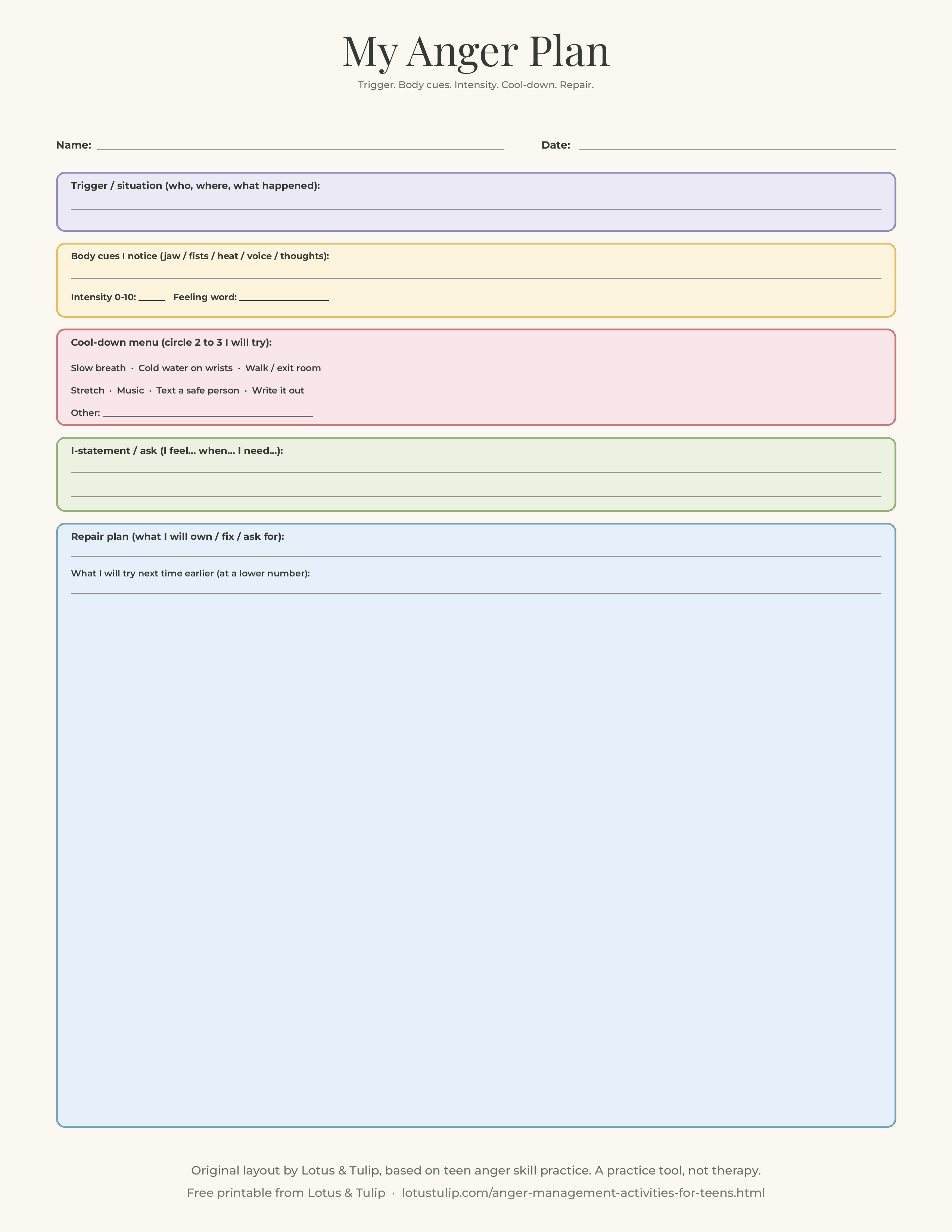
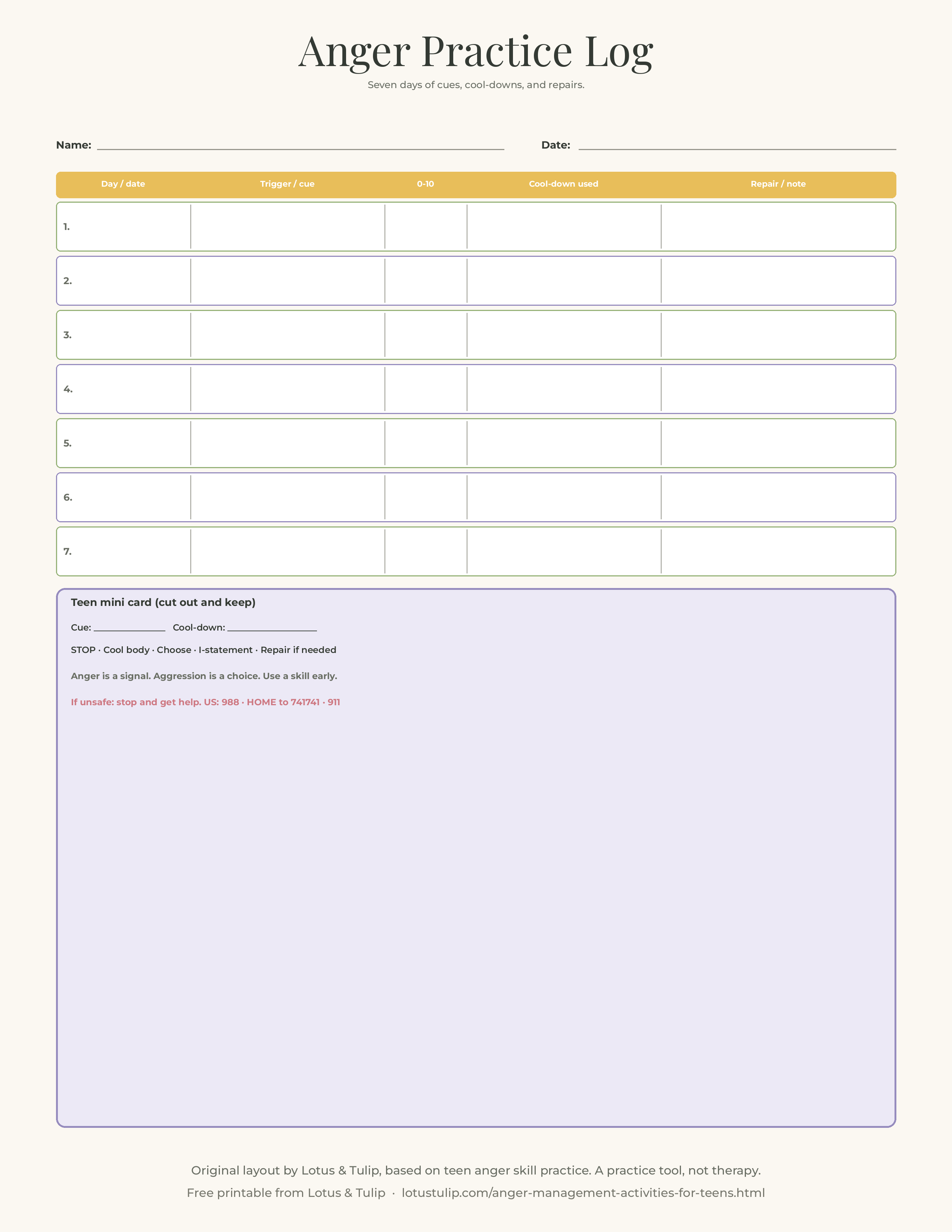
The free anger printable has three pages in US Letter size:
- Page 1: Teen Anger Cool Down Steps card. Eight step sequence from notice and rate through STOP, cool-down, choose, I-statement, and repair, plus safety reminders.
- Page 2: My Anger Plan. Fill in trigger, body cues, 0 to 10, cool-down menu, I-statement, and repair.
- Page 3: Practice Log + teen mini card. Seven day rows plus a cut out reminder for cue, cool-down, STOP, choose, and repair.
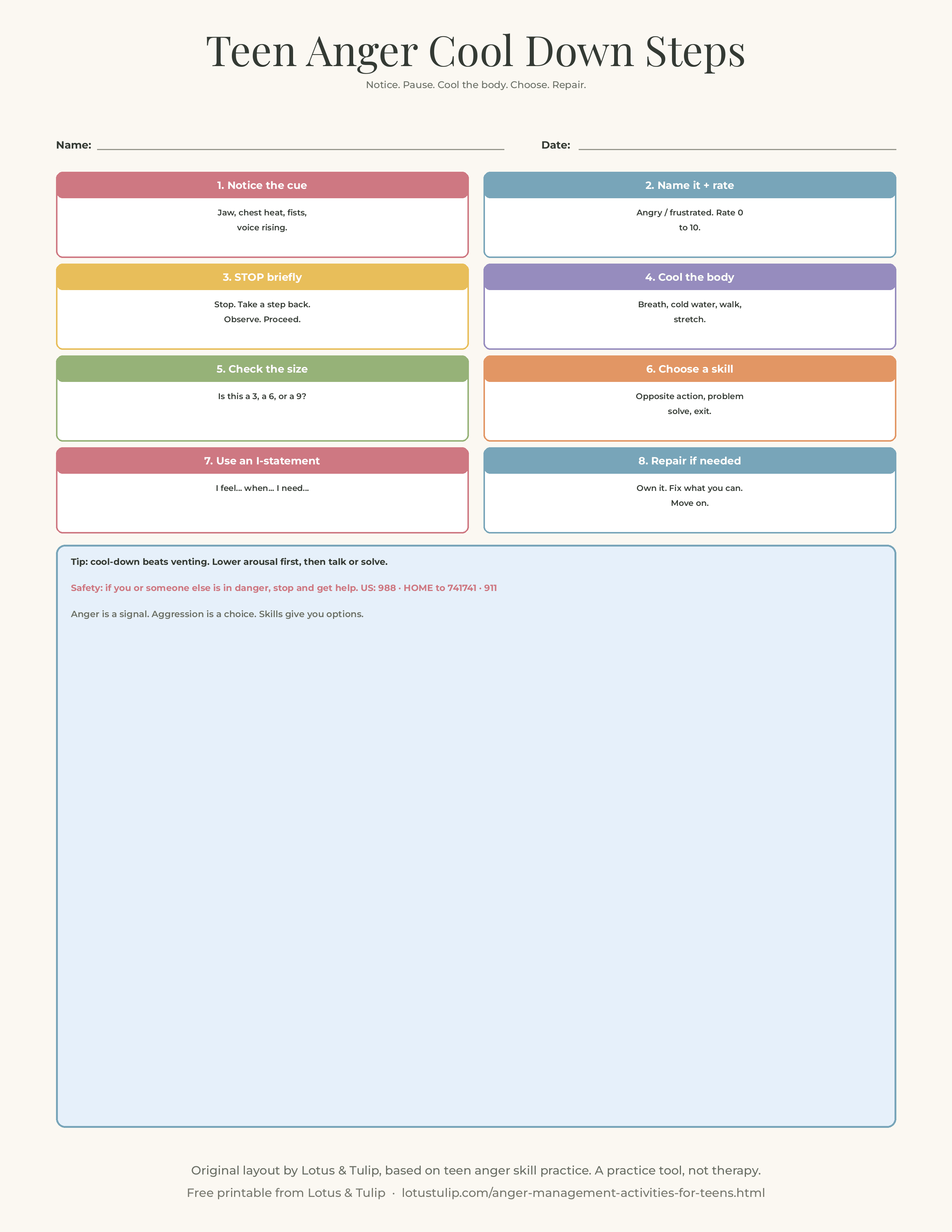
Download the free anger management printable for teens (PDF, 3 pages, US Letter)
Prefer single images? Page 1: Teen Anger Cool Down Steps (PNG) · Page 2: My Anger Plan (PNG) · Page 3: Practice Log (PNG)
Free anger management starter pack: The free anger management worksheets starter pack adds six pages from our paid anger set for ages about 7 to 16: an anger thermometer, the anger iceberg, stop, think, choose, a cool-off menu, a cool-down plan and a support and safety page.
Free to print for your own use and for use with your own clients, students, or groups. This is an original layout by Lotus & Tulip, based on teen anger skill practice associated with CBT youth anger research (including Sukhodolsky and colleagues) and with findings on cooling versus venting (including Bushman; Kjærvik and Bushman), plus brief educational references to DBT-informed skills (STOP, opposite action, TIPP) associated with Linehan's teaching. It is not affiliated with those authors, any scale publisher, or any specific treatment package, and is not a substitute for therapy. Please link to this page rather than re-uploading the file.
Related resources
- Anger management worksheets for adults: the adult version, with a free anger log and plan
- Anger management activities for kids: younger calm downs and Stop Breathe Think Choose.
- Anger iceberg worksheet: feelings under the tip of anger.
- Size of the problem worksheet: match reaction to stakes.
- Impulse control worksheets for kids: pause between urge and act.
- Conflict resolution worksheet: talk through fights with structure.
- Coping skills worksheets for teens: wide healthy coping menu.
- Stress management worksheets for teens: load, sleep, and stress tools.
- Opposite action worksheet: act against unhelpful emotion urges.
- DBT TIPP skills worksheet: short arousal changers for peaks.
- Emotional regulation worksheets for kids: body signals and choose plans.
- I-statements worksheet: feel / when / need scripts.
- Assertiveness worksheet: assertive vs passive vs aggressive.
- Distress tolerance worksheets: crisis survival skill menus.
- Safety plan worksheet: when the moment is about staying safe and alive.
Sources
- Sukhodolsky, D. G., Kassinove, H., and Gorman, B. S. (2004). Cognitive-behavioral therapy for anger in children and adolescents: a meta-analysis. Aggression and Violent Behavior, 9(3), 247 to 269. Medium average effects for CBT-oriented youth anger treatments; skills training, multimodal programs, modeling, feedback, and homework matter. Not a claim that this printable is that treatment.
- Bushman, B. J. (2002). Does venting anger feed or extinguish the flame? Catharsis, rumination, distraction, anger, and aggressive responding. Personality and Social Psychology Bulletin, 28(6), 724 to 731. Rumination plus punching-bag venting increased anger and aggression relative to quiet sitting in that experiment.
- Kjærvik, S. L., and Bushman, B. J. (2024). A meta-analytic review of anger management activities that increase or decrease arousal: What fuels or douses rage? Clinical Psychology Review, 109, 102414. Arousal-decreasing activities reduced anger/aggression on average; arousal-increasing activities were ineffective overall. Credit only; not a validation of this free page.
- Linehan, M. M. Dialectical Behavior Therapy skills training lineage (STOP, opposite action, TIPP as taught components). Educational reference with clear non-affiliation. Component skills are not standalone RCT proof for this three page sheet.
- Honest caveat: teen anger drills are a skill practice aid. Youth CBT anger meta-analyses and DBT skills packages are not the same as technique-only RCTs of this Lotus and Tulip printable.
Anger management activities for teens: FAQ
What is the difference between anger and aggression?
Anger is an emotion and a signal. Aggression is a behavior that harms people, property, or relationships. Teens can feel angry and still choose a cool-down, an I-statement, or a planned problem-solving step instead of aggression.
Does venting help teens with anger?
Often not the way people hope. Bushman-lineage work and the Kjærvik and Bushman 2024 meta-analysis suggest that arousal-decreasing cool-downs tend to help more than arousal-increasing venting, especially when venting includes rumination about the insult. Cool the body first, then talk or solve.
Is this the same as the kids anger page or the anger iceberg?
No. The kids page uses younger language and Stop Breathe Think Choose. The iceberg maps feelings under anger. This teens page centers cool-down, plan, I-statements, and repair for adolescent scenes. They work well as neighbors.
Can school counselors use it with teens?
Yes, often in short meetings with one trigger, two cool-downs, and one repair or I-statement. Keep practice optional and school safe. Follow crisis protocol when risk appears. Do not use the page as a diagnosis.
Do STOP, opposite action, or TIPP work on their own?
They are skill components associated with DBT teaching, not proof that this free page remits diagnoses. Use them inside counseling or therapy, follow medical cautions (especially for TIPP), and get licensed care for persistent or severe problems.
When should I not use this worksheet?
Do not use it as the first move in acute safety risk, medical emergency, active violence, or when the teen is too flooded to engage. Stabilize and get help first when needed: 988, HOME to 741741, or 911. Use a safety plan when staying safe is the job.
Is this affiliated with Bushman, Sukhodolsky, or DBT manuals?
No. This is an original Lotus and Tulip educational layout. We credit research lineages with clear non-affiliation and do not reproduce copyrighted manual worksheets.