
Therapist worksheets · Updated 2026-11-06
Body Scan Meditation Script: Guided Practice for Adults, Kids and Anxiety, with a Free Printable
Ready-made printable: Mindfulness Worksheets for Kids and Teens Holiday 20% off: about $9.20, was $12 (EUR 10) · instant digital download
Buy on Etsy
A body scan is a mindfulness practice in which you move attention slowly through the body, region by region, and notice whatever sensations are present without trying to force them away. Warmth, tingling, tightness, numbness, heaviness, the simple feel of contact with a chair or bed: you observe, name lightly if it helps, and keep going. Jon Kabat-Zinn made the body scan a core formal practice in Mindfulness-Based Stress Reduction (MBSR), the eight week program he developed at the University of Massachusetts Medical School in the late 1970s and early 1980s. Shorter clinical and classroom versions are now common in therapy, school counseling, and home calm down routines.
This guide explains what a body scan is in the MBSR lineage (we are not affiliated with any MBSR institute), how it differs from progressive muscle relaxation, when to use it and when not to, a full original adult read aloud script, shorter kids and teens scripts, anxiety and sleep notes with honest caveats, tips for therapists and school counselors, common mistakes, a nine step how to, and what the research actually supports. You also get a free three page US Letter printable: a Body Scan Steps card, a Body Scan Worksheet with body map prompts, and a Practice Log with a short kids script card.
This guide is educational. It is not therapy, not medical advice, and not a diagnosis. If thoughts of ending your life, plans to harm yourself or someone else, or a medical emergency show up, stop the practice and get help now: in the US, call or text 988, text HOME to 741741, or call 911. Our safety plan worksheet is a better first tool in that moment. For nearby body based skills, see the progressive muscle relaxation script for kids and mindfulness activities for kids.
Jump to the free body scan worksheet (PDF) · How to practice a body scan, step by step · Adult script · Kids and teens scripts
What a body scan is (MBSR lineage)
In a classic MBSR body scan, people usually lie down (or sit if lying is hard), settle the breath, and move awareness from the toes upward through the feet, legs, pelvis, torso, arms, neck, face, and head, or sometimes head to toe. The instruction is not "make yourself relax." The instruction is "notice what is here." Thoughts and emotions will interrupt. That is expected. You notice the interruption, then return attention to the body region you chose.
Kabat-Zinn described mindfulness as paying attention in a particular way: on purpose, in the present moment, and nonjudgmentally. The body scan trains that stance using interoception (sensing the inside of the body) and proprioception (sensing position and contact). Formal MBSR body scans often run about 30 to 45 minutes. Clinics, apps, and schools commonly offer 5 to 15 minute versions. Both can be useful. Longer practice builds endurance with wandering attention. Shorter practice fits a counseling session, a classroom transition, or a bedtime routine.
A body scan is a component practice inside mindfulness based programs. It is not by itself a complete treatment for anxiety disorders, depression, trauma, insomnia, or chronic pain. MBSR and related packages usually also include sitting meditation, mindful movement or yoga, informal mindfulness in daily life, and group discussion. Credit outcomes to the whole program, not to one script on a printable.
This free printable is an original Lotus and Tulip layout. It is not affiliated with the Center for Mindfulness, any MBSR teacher training body, or Jon Kabat-Zinn, and it is not a substitute for treatment.
Body scan vs progressive muscle relaxation
People searching "body scan meditation script" often land next to progressive muscle relaxation (PMR). They are neighbors, not twins.
| Body scan | Progressive muscle relaxation | |
|---|---|---|
| Main job | Notice sensations as they are, region by region, without forcing change | Deliberately tense and release muscle groups to learn the difference between tension and release |
| Lineage | Core formal practice in MBSR (Kabat-Zinn); also used in MBCT and many clinical adaptations | Edmund Jacobson progressive relaxation; widely used in CBT anxiety protocols and school calm skills |
| Instruction style | Observe, allow, return when the mind wanders | Tighten, hold briefly, release, notice the contrast |
| Best early use | Building present moment body awareness, interoception, and nonstriving attention | Reducing muscle tension when a clear tighten and release cue helps the person feel a change |
| Cross link | This page | Progressive muscle relaxation script for kids |
Both can leave people feeling calmer. The path differs. Body scan emphasizes awareness and willingness to feel what is already present. PMR emphasizes a behavioral contrast between tension and release. Some clients prefer one; some use both on different days. If someone needs a more active, muscular skill first, start with the PMR page. If someone braces against sensations or lives mostly in their head, a gentle short body scan can rebuild contact with the body. Shorter noticing games for younger kids live on the mindfulness activities for kids page.
When to use a body scan (and when not to)
Good fits:
- Building a daily or nightly mindfulness habit that does not require clearing the mind.
- Anxiety that shows up as body tension, shallow breath, or "I cannot feel my feet," when the person can stay with mild to moderate sensation.
- Sleep wind down when the goal is settling attention, not forcing sleep (see caveats below).
- Therapy homework after you have practiced together in session.
- School counseling or classroom calm corners with short, optional, eyes open versions and a clear opt out.
- Teens who live in rumination and need a concrete anchor other than "just stop worrying."
Do not use a body scan as the first move when:
- There is acute safety risk: suicidal ideation with plan or intent, self harm in progress, or violence risk. Protect first. Call 988, text HOME to 741741, or call 911.
- There is a medical emergency (chest pain, trouble breathing that needs medical evaluation, severe injury). Seek medical care.
- The person is flooded, dissociating, or reporting that body attention makes panic or trauma memories spike. Stabilize with grounding, paced breathing, or a TIPP style downshift first. Some trauma informed plans shorten, skip, or avoid body scans until the person has more choice and safety.
- Chronic pain or medical symptoms need a clinician guided plan. Mindfulness can be part of pain care; a free script is not a pain clinic.
- The setting cannot protect privacy or consent (forced whole class eyes closed practice with no opt out).
In short: a body scan is a practice for rideable attention. It is not a crisis protocol, not exposure therapy by itself, and not a replacement for licensed care.
How to practice a body scan, step by step
- Choose a time and posture. Lie down if you can stay awake enough, or sit with feet on the floor. Support the neck. Silence notifications. Tell yourself you are practicing for a set time (5, 10, or 20 minutes).
- Set a kind intention. Example: "I am practicing noticing my body as it is, not fixing it." Nonstriving matters. Trying hard to relax often backfires.
- Arrive with the breath. Feel three to five natural breaths at the belly or chest. Do not force deep breathing unless a clinician already taught a specific breath skill.
- Start at one end of the body. Many scripts start at the toes and move up. Kids scripts may start at the feet or hands. Pick one route and stick with it for this session.
- Rest attention on one region. Toes, sole, ankle, lower leg, and so on. Notice temperature, pressure, tingling, tightness, numbness, or "nothing much." Nothing much still counts.
- When the mind wanders, notice and return. Wandering is the workout, not a failure. Label lightly ("thinking," "planning," "worry") if that helps, then come back to the region.
- Move region by region without rushing. Give each area a few breaths. If a region is intense, you can widen attention to the whole limb, open the eyes, or skip ahead. Choice is part of safety.
- Close with the whole body. Feel the body as one field of sensation. Take two easy breaths. Wiggle fingers and toes. Open the eyes if they were closed.
- Write a one line note. On the free practice log: date, minutes, starting and ending calm 0 to 10, and one learning ("Shoulders were tight; mind wandered a lot; I returned five times"). Learning beats perfect stillness.
Practice on ordinary days, not only crisis days. Skill grows with short reps.
Full adult body scan meditation script (read aloud)
Use a calm, unhurried voice. Pauses of a few breaths between regions are fine. Adapt wording to the person. Approximate length: 12 to 18 minutes depending on pace.
Find a position where your body can be supported. Lie on your back if that works, or sit with your feet on the floor. Let your hands rest. Soften your eyes, or close them if that feels okay. There is nothing you need to achieve in the next few minutes. You are practicing noticing.
Take a moment to feel the contact points: heels or feet, back or seat, the weight of your hands. Notice that the body is already being held by the floor or the chair. You do not have to hold yourself up with effort.
Now bring attention to the breath wherever it is easiest to feel: belly, chest, or nostrils. You do not need to change the breath. Just feel a few cycles of in and out.
When you are ready, move attention down to the toes of both feet. Notice any warmth, coolness, tingling, or the fabric of socks. If you notice nothing clear, that is okay. Stay for a few breaths.
Widen to the soles, the heels, the tops of the feet, and the ankles. Sense pressure, pulse, or stillness. If thoughts pull you away, notice that they did, and gently return to the feet.
Travel into the lower legs: calves and shins. Notice tightness or ease. No need to fix. Just know what is here.
Move to the knees, then the thighs. Heavy, light, warm, restless, numb: whatever is true. Let attention rest here for a few breaths.
Bring awareness to the hips, pelvis, and seat. Feel the contact with the surface under you. Notice any holding. Soften only if it happens on its own.
Travel into the belly and lower back. Feel the breath move this area if it does. Anxiety often lives here as flutter or clench. You can stay at the edge of sensation. You do not have to dive into the center of pain.
Move to the chest and upper back. Heartbeat, breath, tightness under the sternum, shoulder blades against the surface. Allow the chest to be as it is for a few breaths.
Shift to the hands and arms: fingers, palms, wrists, forearms, elbows, upper arms, shoulders. Notice temperature and contact. If shoulders are high, simply know that. You are not failing.
Bring attention to the neck and throat. Swallow once if you want. Soften the jaw if it is clenched, or just notice the clench.
Scan the face: mouth, cheeks, eyes, forehead, scalp. Tiny muscles work hard during stress. Notice without a lecture.
Now expand awareness to the whole body at once, from head to feet, as one living field. Feel the breath move through that field. Rest here for several breaths.
When you are ready, deepen the breath slightly. Wiggle fingers and toes. Open the eyes. Take your time sitting up. Carry one thing you noticed into the next part of your day.
Shorter kids and teens body scan scripts
Kids (about 3 to 5 minutes, eyes open okay):
Sit or lie down so your body feels supported. Put a hand on your belly if you want. Feel three easy breaths.
Now be a flashlight of attention. Shine it on your feet. What do your feet feel? Warm, cool, wiggly, still?
Move the flashlight to your legs... your belly... your chest... your hands... your shoulders... your face.
If your mind goes to recess or a worry, that is normal. Bring the flashlight back.
Shine the light on your whole body for three breaths. Wiggle. Done. Nice work noticing.
Teens (about 6 to 8 minutes):
You can keep your eyes open and look at one spot on the floor. Sit with feet planted. Phone face down.
Rate calm or tension 0 to 10. No wrong number.
Feel the breath once or twice. Then scan: feet, legs, stomach, chest, hands, jaw, forehead. At each stop, name one word: tight, okay, buzz, numb, warm.
When thoughts argue ("this is dumb," "I should be studying"), notice the thought, then return to the body part you chose.
End with the whole body for three breaths. Rate 0 to 10 again. Write one line on the log if you can.
Keep kids practice optional. Never force eyes closed. Follow school or clinic safety rules if a student discloses risk. Pair with breathing exercises for kids and the 5 4 3 2 1 grounding worksheet when body attention is too much.
Anxiety notes (honest)
Anxiety often lives in the body: racing heart, tight chest, restless legs, stomach drop. A body scan can help some people notice early signals and respond with skills before a full spiral. It can also, for others, amplify interoceptive fear ("If I feel my heart, something is wrong"). That is why pacing and choice matter.
Use shorter scans first. Allow eyes open. Allow skipping hot regions. Pair with grounding or paced breathing if attention to the chest spikes panic. For worry content work, combine with a worry worksheet, an exposure hierarchy, or therapist led CBT rather than treating the scan as the whole plan. Body awareness is a tool. It is not a promise that anxiety will disappear.
Sleep notes (honest)
Many people use a body scan at bedtime. Sometimes it helps the nervous system settle. Sometimes it becomes another performance ("I must fall asleep during this audio"), which raises arousal. Teach: the goal of a bedtime scan is gentle noticing, not forcing sleep. If sleep does not come, stop after the planned minutes, get up for a short quiet reset if needed, and try again later. Persistent insomnia needs a clinician guided plan such as CBT for insomnia, not only a meditation script. See also our sleep hygiene worksheet.
Tips for therapists and school counselors
- Practice live before homework. Do a two minute version in session so the client knows the voice and the opt outs.
- Offer choice language. "You can keep your eyes open. You can skip any region. You can stop anytime."
- Match length to window of tolerance. If the person is outside the window, stabilize first. See the window of tolerance worksheet.
- Trauma informed caution. For some trauma histories, long silent body focus is activating. Shorten, keep eyes open, use peripheral body regions first, or choose a different skill until collaborative safety is stronger.
- In schools, keep it optional and skills based. No forced meditation. Provide a quiet alternative activity. Follow district crisis protocol if risk appears.
- Bridge tools deliberately. Pair with PMR, mindfulness activities, breathing, TIPP, and anxiety packs when body signals feed worry stories.
- Track function, not vibe. Ask what changed after a week of short practice: earlier noticing, fewer avoidance spirals, better homework follow through. Feelings of "bliss" are not the metric.
Common mistakes
- Trying to empty the mind. The job is noticing and returning, not achieving blankness.
- Forcing relaxation. Nonstriving is the point. Relaxation may arrive as a side effect.
- Only practicing at a 10. Learn the skill on a calm Tuesday.
- Ignoring activation. If panic or dissociation rises, stop, open eyes, ground, and revise the plan with a clinician.
- Making kids sit still forever. Three minutes with a flashlight metaphor beats fifteen minutes of forced silence.
- Confusing body scan with PMR. Observing is not the same as tensing and releasing.
- Treating a worksheet as treatment. Persistent anxiety, trauma, depression, or insomnia need licensed care. A printable is homework inside a broader plan.
What the research says (honestly)
Body scan is a component practice. Most strong evidence sits at the program level (MBSR, MBCT, and related mindfulness based interventions), not at the level of a single free script.
MBSR and mindfulness based therapy packages. Hofmann, Sawyer, Witt, and Oh (2010) reported a meta analysis of mindfulness based therapy with moderate pre to post effects for anxiety (Hedges g about 0.63) and mood symptoms (about 0.59) across 39 studies. Gotink and colleagues (2015), in an overview of systematic reviews of standardized mindfulness based interventions, reported moderate effects versus wait list or usual care for anxiety (d about 0.49) and depressive symptoms (d about 0.37) among other outcomes. Those numbers describe packages that include body scan among several practices, not body scan alone.
Body scan alone. Gan, Galante, and Dunning (2022 style reporting in applied psychology health and well being literature) and related reviews of body scan only interventions find small effects on mindfulness measures in some comparisons, high heterogeneity, often low study quality, and limited evidence that a sole body scan reliably improves broad health outcomes. Treat standalone claims with caution.
Youth mindfulness. Dunning and colleagues (2022 update) meta analyzed 66 RCTs of mindfulness based programmes for children and adolescents (over 20,000 participants). Versus passive controls, small benefits appeared for some outcomes such as anxiety or stress and attention related measures; versus active controls effects were smaller still; and at follow up there were no consistent significant positive effects across outcome categories. Evidence quality was often low or very low. The MYRIAD cluster randomized trial (Kuyken and colleagues, 2022 reporting) found that universal school based mindfulness training was not superior to teaching as usual for adolescent depression risk, social emotional functioning, or well being at one year follow up in a large UK sample. That does not mean short optional body noticing skills are useless in counseling. It does mean we should not sell universal school meditation as a proven mental health cure.
Honest caveat. No trial has tested this three page Lotus and Tulip printable on its own. Use the pages as a practice aid inside therapy, counseling, or a structured mindfulness program. If symptoms are severe, get professional care.
Free body scan meditation worksheet (PDF)
The free body scan printable has three pages in US Letter size:
- Page 1: Body Scan Steps card. Nine practice steps, a 0 to 10 calm or tension scale, and quick safety reminders.
- Page 2: Body Scan Worksheet. Body map style region prompts, before and after ratings, and notes for what you noticed.
- Page 3: Practice Log + kids script card. Seven day rows plus a short kids flashlight script you can read aloud.
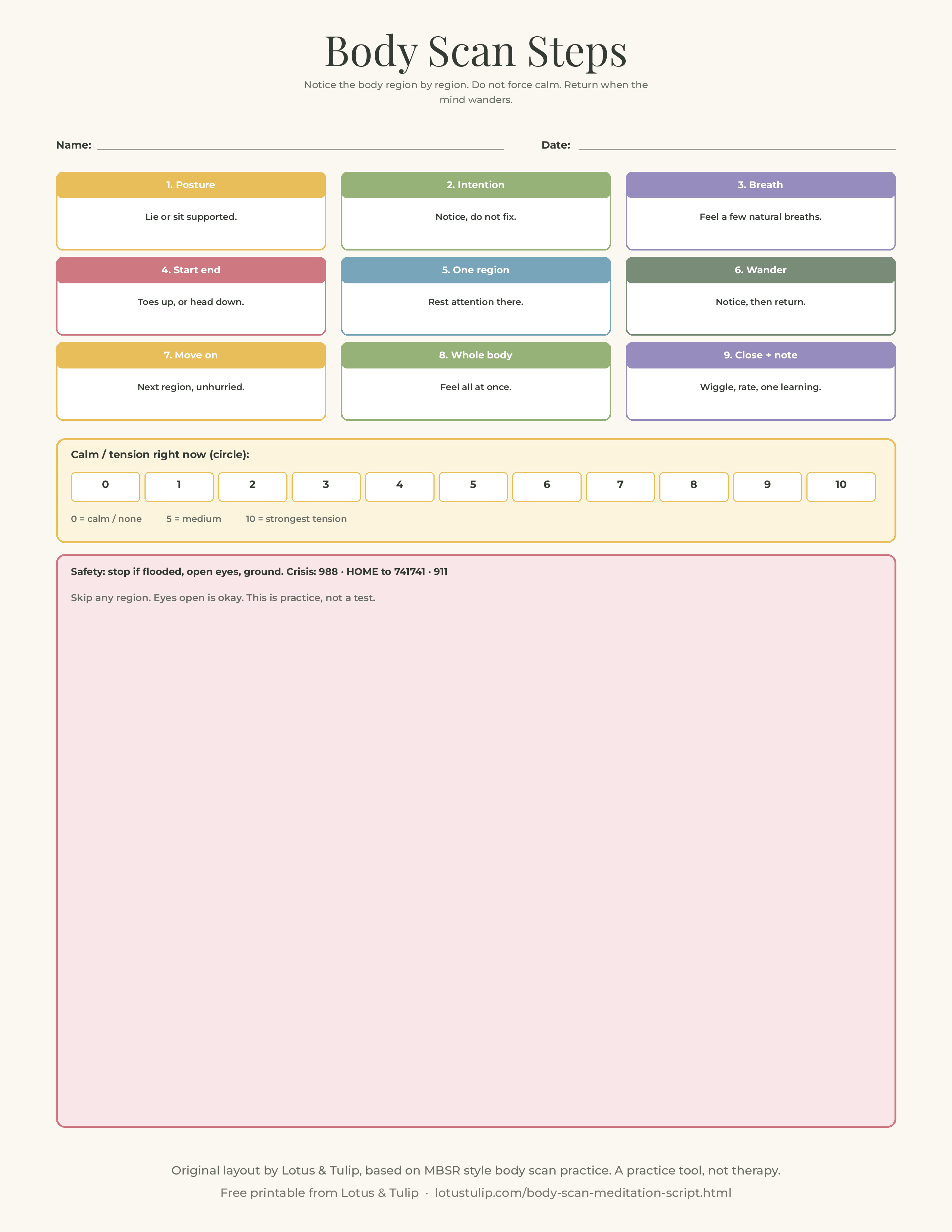
Download the free body scan meditation worksheet (PDF, 3 pages, US Letter)
Prefer single images? Page 1: Body Scan Steps (PNG) · Page 2: Body Scan Worksheet (PNG) · Page 3: Practice Log (PNG)
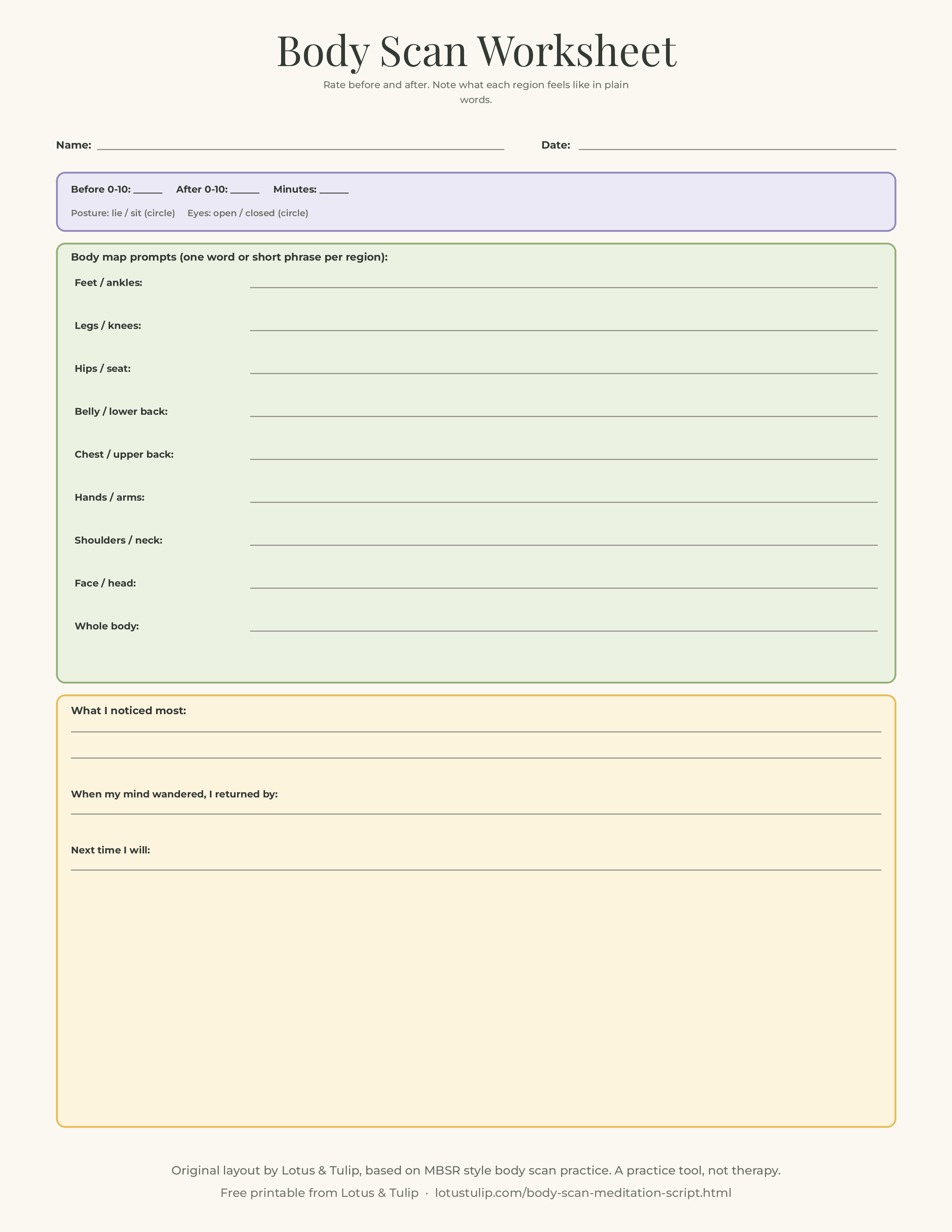
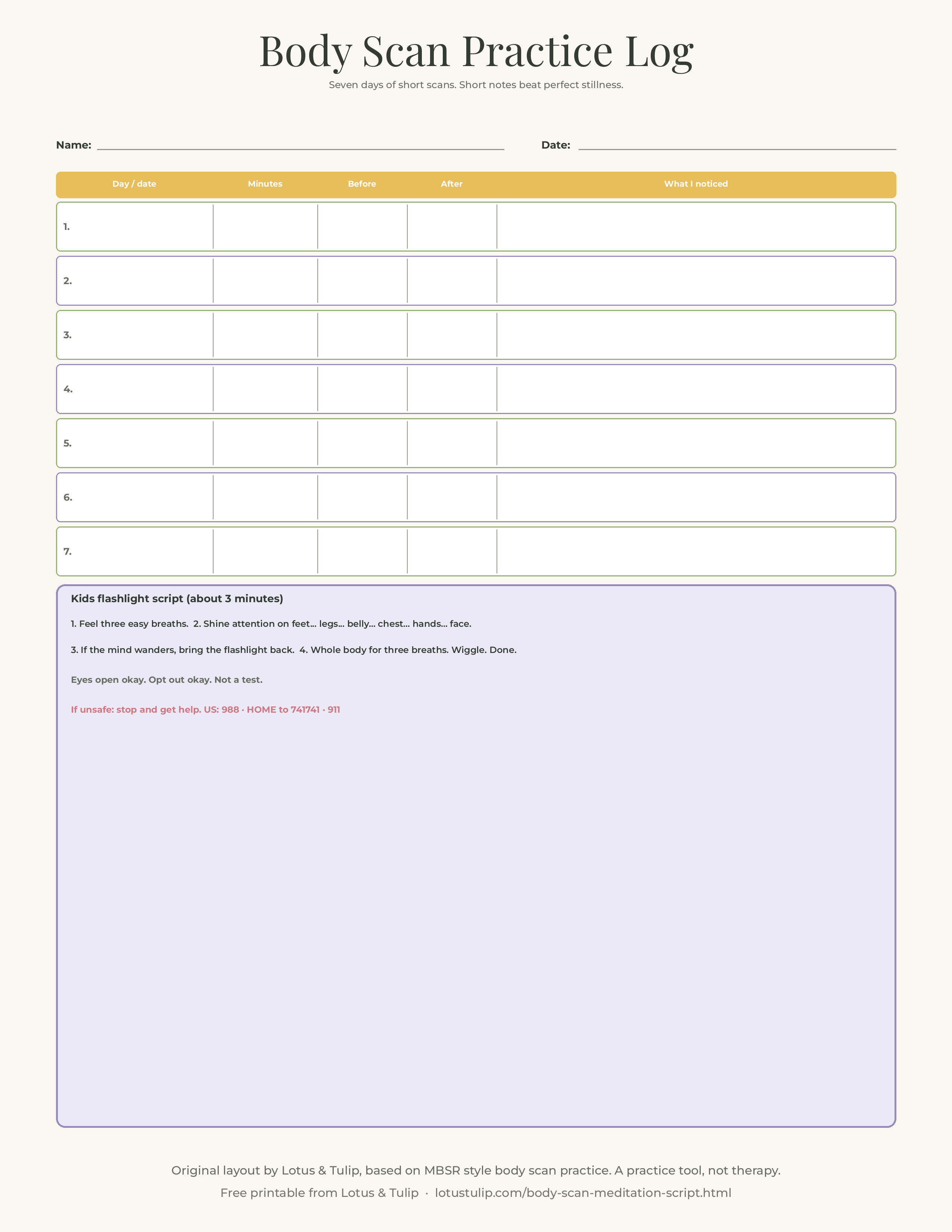
Free to print for your own use and for use with your own clients, students, or groups. This is an original layout by Lotus & Tulip, based on body scan practice as taught in MBSR style mindfulness programs. It is not affiliated with the Center for Mindfulness, any MBSR teacher training body, or Jon Kabat-Zinn, and is not a substitute for therapy. Please link to this page rather than re-uploading the file.
Related resources
- Interoception activities for kids: playful body clue experiments and a free worksheet for children.
- Progressive muscle relaxation script for kids: tense and release alternative to observing only.
- Mindfulness activities for kids: short practices by age, with research caveats.
- Breathing exercises for kids: simple breath skills for transitions.
- 5 4 3 2 1 grounding worksheet: when body attention is too much and senses help more.
- Window of tolerance worksheet: know when to scan and when to stabilize.
- DBT TIPP skills worksheet: fast body chemistry downshift.
- Anxiety worksheets for kids: worry and coping pages for younger clients.
- Sleep hygiene worksheet: bedtime habits beside a wind down scan.
- Safety plan worksheet: when the moment is about staying alive, not meditating.
Sources
- Kabat-Zinn, J. (1990, and later editions). Full Catastrophe Living. Delta / Bantam. Popular book describing MBSR practices including the body scan. Foundational clinical lineage, not a claim of affiliation.
- Kabat-Zinn, J. (2003). Mindfulness based interventions in context: Past, present, and future. Clinical Psychology: Science and Practice, 10(2), 144 to 156. Framing of mindfulness practice and MBSR context.
- Hofmann, S. G., Sawyer, A. T., Witt, A. A., and Oh, D. (2010). The effect of mindfulness based therapy on anxiety and depression: A meta analytic review. Journal of Consulting and Clinical Psychology, 78(2), 169 to 183. Pre to post Hedges g about 0.63 anxiety and 0.59 mood across 39 studies; package level evidence.
- Gotink, R. A., Chu, P., Busschbach, J. J. V., Benson, H., Fricchione, G. L., and Hunink, M. G. M. (2015). Standardised mindfulness based interventions in healthcare: An overview of systematic reviews and meta analyses of RCTs. PLOS ONE, 10(4), e0124344. Overview reporting moderate effects vs wait list or usual care for anxiety (d about 0.49) and depression (d about 0.37) among other outcomes.
- Gan, R., Galante, J., and Dunning, D., and related body scan only reviews (including Gan et al., 2022, Applied Psychology: Health and Well Being). Body scan alone shows limited, often small or mixed effects; study quality and heterogeneity are concerns. Component practice, not a standalone proven treatment.
- Dunning, D. L., Griffiths, K., Kuyken, W., Crane, C., Foulkes, L., Parker, J., and Dalgleish, T. (2022 update). Do mindfulness based programmes improve the cognitive skills, behaviour and mental health of children and adolescents? An updated meta analysis of randomised controlled trials. Evidence Based Mental Health / related BMJ Mental Health reporting. 66 RCTs; small effects vs passive controls for some outcomes; no consistent follow up benefits; evidence often low quality.
- Kuyken, W., and the MYRIAD team (2022). Effectiveness of universal school based mindfulness training compared with normal provision: the MYRIAD cluster randomised controlled trial. BMJ Mental Health reporting. Large UK adolescent sample; SBMT not superior to teaching as usual on primary mental health outcomes at one year.
- Luberto, C. M., Hall, D. L., Park, E. R., Haramati, A., and Cotton, S. (related perspective literature on mindfulness vs relaxation). Body scan (notice) differs from progressive muscle relaxation (tense and release) in intention even when both reduce stress for some people.
- Honest caveat: no study tests this three page Lotus and Tulip printable alone. Program level evidence is not the same as script level evidence.
Body scan meditation script: FAQ
What is a body scan meditation?
A body scan is a mindfulness practice where you move attention through the body region by region and notice sensations without forcing them to change. It is a core formal practice in MBSR and appears in many clinical and school adaptations. It is not the same as progressive muscle relaxation.
How do you do a body scan step by step?
Choose a supported posture, set a kind intention, feel a few breaths, move attention region by region from one end of the body to the other, return when the mind wanders, close with the whole body, then write a short note. The nine step section and free printable walk through the same sequence.
Is a body scan the same as progressive muscle relaxation?
No. Progressive muscle relaxation asks you to tense and release muscle groups on purpose. A body scan asks you to observe sensations as they are. Both can help some people feel calmer. See our progressive muscle relaxation script for kids page for the tense and release version.
Can kids use a body scan script?
Yes, with short optional scripts, eyes open allowed, and a clear opt out. The free printable includes a kids flashlight script card. Universal school mindfulness programs have mixed evidence (including MYRIAD), so keep school use skills based and voluntary rather than a mandated cure all.
Does body scan meditation help anxiety?
It can help some people notice body signals earlier and practice nonstriving attention. Mindfulness based therapy packages show moderate average benefits for anxiety symptoms in meta analyses, but body scan alone has weaker standalone evidence. If body attention spikes panic, shorten the practice, keep eyes open, or use grounding first.
When should I not use a body scan?
Do not use it as the first move in acute safety risk, medical emergency, severe dissociation or trauma activation without a plan, or forced group settings without opt out. Stabilize and get help first when needed: 988, HOME to 741741, or 911.
Does a body scan worksheet work on its own?
A worksheet is a practice aid, not a standalone treatment. MBSR and related packages that include body scan have broader evidence than a single script. Use the pages inside therapy, counseling, or a structured program, and get licensed care for persistent or severe problems.