
Therapist worksheets · Health anxiety, checking and reassurance · Updated 2026-11-13
Health anxiety worksheet: what keeps illness worry going, what the research shows, and how to break the checking cycle step by step (free printable)
Anxiety cycle and safety behaviors: Anxiety Worksheets for Therapists, 20 pages incl. the anxiety cycle, fear ladder and safety behaviors audit Holiday 20% off: about $11.04, was $14 (EUR 12) · fillable PDF, instant digital download
Buy on EtsyTry it free first: download a fillable sample (worry log and fear ladder, PDF, 258 KB). Type into it on screen, then get the full pack. No email needed.
The catastrophic thoughts behind it: CBT Worksheets for Therapists, 20 pages including thought records, core beliefs and an exposure ladder Holiday 20% off: about $11.04, was $14 (EUR 12) · fillable PDF, instant digital download
Buy on EtsyTry it free first: download a fillable sample (thought record and evidence for and against, PDF, 105 KB). Type into it on screen, then get the full pack. No email needed.
A full caseload: Therapist Worksheets Mega Bundle (8 packs incl. CBT, anxiety, DBT, ACT, grief and ADHD) Holiday 20% off: about $35.88, was $45 (EUR 39) · fillable PDFs for all 8 packs plus 160 printable pages, instant digital download
Buy on EtsyA twinge in your chest on Sunday night. You press on the spot, take your pulse, then search your symptoms "just to rule things out". Forty minutes later you have read about three conditions you had never heard of, you feel worse, and you ask your partner whether you look pale. They say you look fine, and for an hour you believe them. Then the twinge comes back. Many adults recognise this loop, and many feel embarrassed by it. It is common, it is understandable, and it is one of the anxiety problems that responds well to structured help.
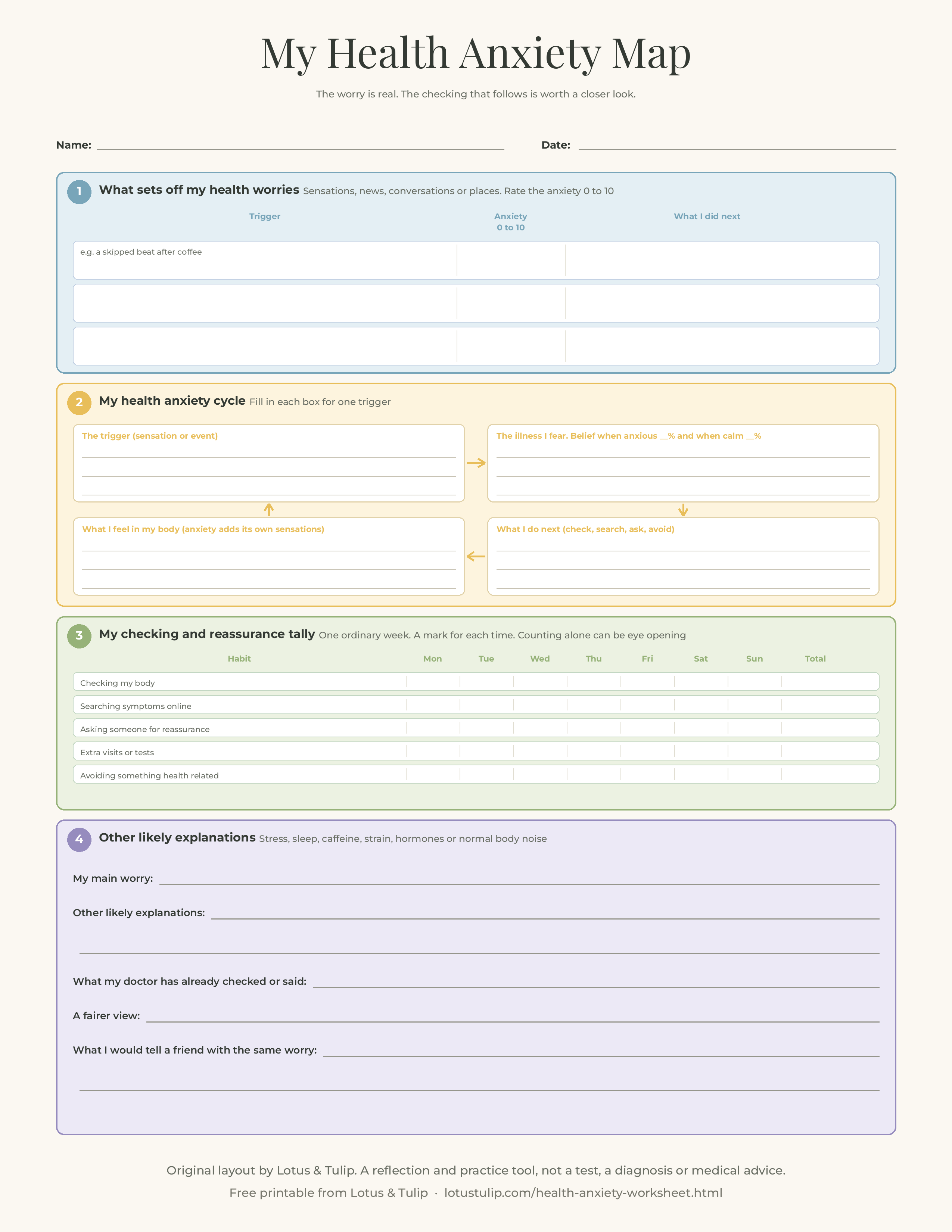
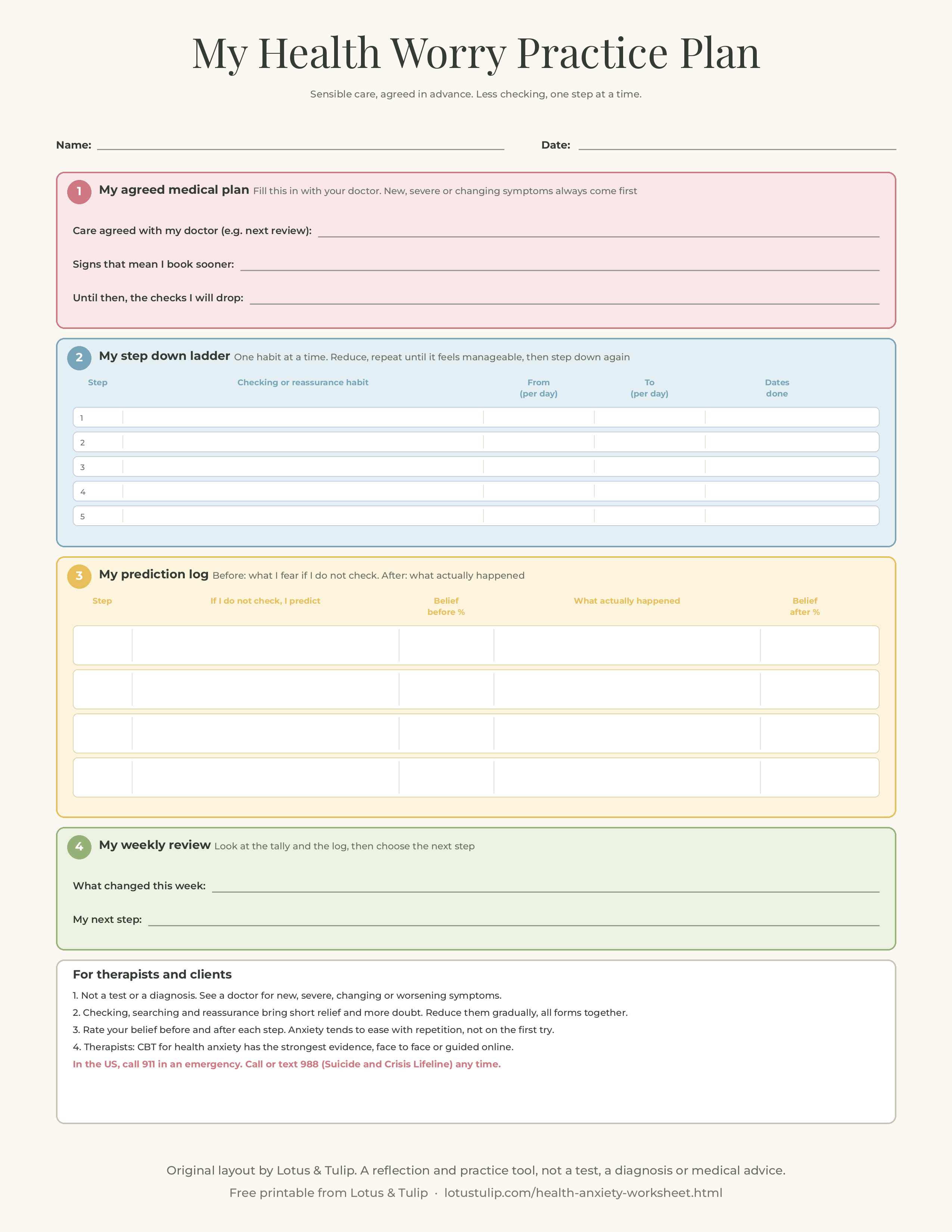
This guide is for adults and the therapists who work with them. It explains what health anxiety is and is not, how common it is, the cognitive model that explains why checking and reassurance keep it going, what the treatment research shows, nine practical steps, common mistakes and examples. It ends with a free 2 page printable: My Health Anxiety Map, which helps you see the triggers, the feared illness, how believable it feels and the checking and reassurance habits that keep the worry alive, and My Health Worry Practice Plan, a plan for cutting back checking, searching and reassurance step by step, with a prediction log and an agreed plan for genuine medical care.
Download the free health anxiety worksheet (PDF, 2 pages, US Letter)
Direct download, no email or sign up. See the pages first.
Medical safety first. This page and the worksheet are not a diagnosis and do not replace medical care. See a doctor for any new, severe, changing or worsening symptoms, and call 911 in an emergency. The aim here is to stop repeated checking of the same, already assessed worry, not to ignore your body.
What health anxiety is, and what it is not
It is not caring about your health. Noticing a new lump and booking an appointment is sensible. Health anxiety is when worry about having or developing a serious illness becomes frequent, hard to switch off and starts to shape your days: hours spent checking your body or searching online, repeated requests for reassurance, or, for some people, avoiding doctors altogether because of what they might hear.
The diagnoses, described, not a test. The older term was hypochondriasis. In the DSM-5-TR, health anxiety usually falls under one of two diagnoses. Illness anxiety disorder describes a preoccupation with having or getting a serious illness when bodily symptoms are absent or only mild, a high level of anxiety about health, and either excessive health related behaviors (such as repeatedly checking the body) or maladaptive avoidance (such as avoiding appointments), lasting at least six months, although the feared illness may change. It has a care seeking type and a care avoidant type. Somatic symptom disorder applies when one or more bodily symptoms are distressing or disruptive and come with excessive thoughts, feelings or time spent on them. Only a qualified clinician can make either diagnosis, and part of that assessment is ruling out a medical cause. You do not need a diagnosis to use these pages.
Real illness and health anxiety can coexist. People with a chronic condition, a strong family history or a recent scare can also develop health anxiety. The question is not "is anything ever wrong?" but "is the amount of checking and worry out of proportion, and is it helping?"
How common is it?
Estimates vary a lot with how health anxiety is defined. Florian Weck, Samantha Richtberg and Julia Neng (2014) reviewed 55 papers based on 47 independent samples. In the general population, full hypochondriasis was rare, with a weighted prevalence of 0.40%, while broader health anxiety was reported in a wide range of 2.1% to 13.1%. In general medical settings such as primary care, the weighted prevalence of hypochondriasis was 2.95%, so clinicians and medical staff meet it often. These figures come from studies using older definitions, so treat them as a rough guide rather than a precise count.
Why it keeps going: the cognitive model
Misreading normal body sensations. Paul Salkovskis and Hilary Warwick (1986) set out the cognitive behavioral approach that most current treatment builds on. In this model, the problem is not the body sensation itself, which is usually ordinary (a headache, a skipped beat, a mark on the skin), but the meaning given to it: "this headache could be a brain tumor". That catastrophic reading, often shaped by earlier experiences of illness, sets off anxiety.
Attention makes sensations louder. Once you are worried about a part of your body, you watch it more closely, and focused attention makes normal sensations easier to notice. Anxiety itself also produces physical feelings, such as a racing heart, tight chest, dizziness or stomach upset, which can look like more evidence of illness.
Checking and reassurance bring short relief, then more doubt. Salkovskis and Warwick described how reassurance seeking and checking work much like the rituals in obsessional problems. Pressing a sore spot, taking your pulse, searching symptoms or asking a doctor or loved one for reassurance lowers anxiety for a while. But the relief fades, doubts return ("what if they missed something?"), and the urge to check again grows. Repeated prodding can even create the soreness you were worried about. Over time, each check teaches you that you only survived because you checked.
Searching online. The term cyberchondria describes excessive or repeated online searching for health information that increases distress rather than relieving it. Ryan McMullan and colleagues (2019) pooled 20 studies with 7,373 participants and found that health anxiety was positively correlated with online health searching (r = 0.34) and more strongly with cyberchondria (r = 0.62). These are correlations, so they cannot show which causes which, but they fit what many people report: searching rarely settles the worry for long.
Avoidance is the other side. Some people steer clear of doctors, news about illness or even words like "cancer". This also brings short term relief while keeping the fear untested. Page 1 of the worksheet maps both checking and avoidance.
What the treatment research shows
CBT has the strongest evidence. Erland Axelsson and Erik Hedman-Lagerlöf (2019) meta-analyzed 19 randomized controlled trials of CBT for health anxiety. The pooled effect against non-CBT controls was moderate to large (Hedges' g = 0.79, or 0.62 after adjusting for possible publication bias), effects were largely sustained 12 to 18 months after treatment, the pooled response rate was 66% and the remission rate was 48%. Therapist guided internet CBT had effects comparable to face to face CBT. The type of control condition moderated the effect, meaning gains look larger against a waiting list than against an active treatment.
It works in medical clinics too. In the CHAMP trial, Peter Tyrer and colleagues (2014, The Lancet) randomized 444 patients with excessive health anxiety attending cardiac, endocrine, gastroenterology, neurology and respiratory clinics to five to ten sessions of adapted CBT or standard care. At one year, health anxiety improved 2.98 points more on the Health Anxiety Inventory with CBT, and twice as many reached normal levels of health anxiety (13.9% versus 7.3%). The gains were still present at two years, and total health and social care costs did not differ significantly between groups. The honest reading: a clear, lasting benefit, while most people still had some health anxiety at the end.
How symptoms are measured. Clinicians often track progress with validated questionnaires such as the Health Anxiety Inventory and its short form, developed by Salkovskis and colleagues (2002). This worksheet does not reproduce or replace those scales. It uses its own simple 0 to 100% belief and 0 to 10 anxiety ratings so you can see change over time.
The caveats. The trials test full therapy programs, not single worksheets, and there is no trial of this worksheet. This printable borrows the shared ingredients of CBT for health anxiety: understanding the cycle, noticing how attention and anxiety create sensations, testing catastrophic predictions, and gradually reducing checking, searching and reassurance seeking while keeping sensible, agreed medical care. If health worries take up hours a day or come with low mood, panic or thoughts of self-harm, see a therapist or doctor.
How to use a health anxiety worksheet, step by step
- Check the medical side first. If a symptom is new, severe, changing or getting worse, see a doctor before doing anything else on this page. Write down what has already been assessed and what your doctor advised. The worksheet is for the worry that remains after that, not a replacement for it.
- List your triggers. On page 1, write the sensations, news stories, conversations or situations that set off health worries, and rate the anxiety each one brings from 0 to 10. "Heart skips after coffee" is more useful than "my heart".
- Name the feared illness and how believable it feels. For one trigger, write the exact illness you fear and how much you believe it right now, from 0 to 100%. Then write the belief again when you are calm. The gap between the two is useful information.
- Map the cycle. Fill in the four boxes: the trigger, the catastrophic thought, the feelings and sensations that follow (including anxiety's own symptoms), and what you do next. Draw the loop back to the start.
- Count your checking, searching and reassurance. For one ordinary week, tally how often you check your body, search online, ask someone for reassurance, book or request extra tests, or avoid something health related. Counting alone often surprises people.
- Weigh the other explanations. For your main worry, write every other likely explanation for the sensation, such as stress, poor sleep, caffeine, muscle strain or normal body noise, and what your doctor said. The cognitive distortions worksheet helps name catastrophizing and fortune telling.
- Agree a medical plan, then step down checking. On page 2, write down the care you have agreed with your doctor, such as a scheduled review, and which new or changing signs would mean booking sooner. Then plan to reduce one checking habit at a time, for example from ten pulse checks a day to five, then two, then none. The urge surfing worksheet helps you ride the urge to check without acting on it.
- Test a prediction. Pick one step and write what you predict will happen if you do not check, search or ask, and how strongly you believe it. Do it, then log what actually happened and your new belief. The behavioral experiment worksheet uses the same logic for any anxious prediction.
- Give worry a time and review fairly. When health worries pop up during the day, note them and postpone them to a short daily slot. The worry time worksheet shows how. Once a week, review your tallies and belief ratings, notice what changed, and choose the next step.
When the fear comes as sudden surges of physical symptoms, the panic attack worksheet maps the panic cycle, and the self compassion worksheet helps when shame about the worry is loud.
Common mistakes
- Ignoring genuinely new or worsening symptoms. Cutting back checking is about the same, already assessed worry. New, severe or changing symptoms still need a doctor, and the worksheet has a box for exactly that plan.
- Swapping one check for another. Stopping online searches but asking your partner twice as often teaches the same lesson. Track all forms of checking and reassurance together.
- Stopping everything on day one. Going from twenty checks to zero overnight often ends in a large relapse. Step down gradually and repeat each step until it feels manageable.
- Arguing with yourself for hours. Rebuttals can turn into mental reassurance. Write the fairer view once, then return to what you were doing.
- Going it alone when it is severe. If health worry takes over your days, or comes with depression, panic or thoughts of self-harm, see a therapist or doctor. CBT for health anxiety, face to face or guided online, has good evidence.
Examples
- The heart checker: After a friend's heart attack, he began checking his pulse more than fifteen times a day and wore a fitness watch to bed. His doctor had found nothing of concern and arranged a routine review. Map: trigger, a skipped beat after coffee; thought, "my heart is failing", 70%; checking, pulse, watch data and searches. Plan: watch off at night, then pulse checks from fifteen to five to two. Prediction: "If I do not check, I will miss a heart attack, 60%." After two weeks, belief 25%, and he noticed the skipped beats were less frequent when he cut back on coffee.
- The late night searcher: Searched every new headache and read forum posts until 2 a.m. Tally: 9 searches and 3 reassurance texts to her sister in one week. Plan: no health searches after 8 p.m., worries written down for a 15 minute worry time, one agreed question for her doctor at the next visit. Her anxiety on the worry nights dropped from 8 to about 4 out of 10.
- The avoider: Had not seen a doctor in six years for fear of "what they will find" and avoided any news about cancer. For him, the first step was not less checking but booking a routine check up, with his therapist helping plan the call. Prediction: "They will find something terrible, 80%." Outcome: routine advice and a follow up in a year. Belief afterwards: 30%.
Free health anxiety worksheet
This free printable is an original Lotus & Tulip layout on US Letter, in our own wording, not the items of the Health Anxiety Inventory or any other clinical scale. Page 1, My Health Anxiety Map, has a triggers table with an anxiety rating, a box for the feared illness with belief ratings when anxious and when calm, a four box map of the cycle (trigger, catastrophic thought, feelings and sensations, what I do next), a weekly tally for checking, searching, reassurance, extra tests and avoidance, and a section for other likely explanations. Page 2, My Health Worry Practice Plan, has a box for the medical care agreed with your doctor and the signs that mean booking sooner, a step down ladder for checking and reassurance, a prediction log, a weekly review and short notes for therapists and clients.
Download the free health anxiety worksheet (PDF, 2 pages, US Letter)
Prefer single images? Page 1: my health anxiety map (PNG) · Page 2: my health worry practice plan (PNG)
Free to print for use with your own clients or for yourself. Please link to this page rather than re-uploading the file. A reflection and practice tool, not a test, a diagnosis or a substitute for medical care or therapy. See a doctor for new or worsening symptoms. In the US, call 911 in an emergency, or call or text 988 in a mental health crisis.
Related resources
- Panic attack worksheet: map the panic cycle when sensations surge
- Worry time worksheet: postpone health worries to a daily slot
- Journaling prompts for anxiety: 39 prompts and a free worry journal page for one worry at a time
- Behavioral experiment worksheet: test an anxious prediction
- Urge surfing worksheet: ride the urge to check without acting on it
- ERP worksheets for OCD: when checking looks more like OCD
- Social anxiety worksheet for adults: the same cycle with fear of judgment
- All therapist worksheets: CBT, DBT, ACT and more
- Catastrophizing worksheet: weigh the worst, best and most likely outcome and log your predictions
FAQ
What is a health anxiety worksheet?
A health anxiety worksheet is a structured page that helps you map what triggers your health worries, the illness you fear, how believable it feels and the checking, searching and reassurance habits that keep the worry going, and then plan gradual steps to reduce them. Therapists use them in CBT for health anxiety, and adults can use them alongside normal medical care.
Is health anxiety the same as hypochondria?
Hypochondriasis is the older name. In the DSM-5-TR, most people who would once have been given that label now fit illness anxiety disorder, when bodily symptoms are absent or mild, or somatic symptom disorder, when distressing symptoms are present. Many people use "health anxiety" as an everyday term for both. Only a qualified clinician can diagnose either.
Why does reassurance not help health anxiety for long?
Reassurance and checking lower anxiety for a short time, but the relief fades, doubts return and the urge to check again grows. In the cognitive behavioral model, repeated reassurance works much like a ritual: it stops you learning that the feared illness was not there and that the anxiety would have passed on its own.
What is the best treatment for health anxiety?
Cognitive behavioral therapy has the strongest evidence. A meta-analysis of 19 randomized trials found moderate to large effects that were largely sustained 12 to 18 months later, and guided internet CBT worked about as well as face to face CBT. A doctor or therapist can help you find it, and medication is sometimes used as well.
Is this health anxiety worksheet free?
Yes. It is free to print for use with your own clients or for yourself. Please link to this page rather than re-uploading the file.
Sources
- American Psychiatric Association. (2022). Diagnostic and statistical manual of mental disorders (5th ed., text rev.). American Psychiatric Association Publishing.
- Axelsson, E., and Hedman-Lagerlöf, E. (2019). Cognitive behavior therapy for health anxiety: Systematic review and meta-analysis of clinical efficacy and health economic outcomes. Expert Review of Pharmacoeconomics and Outcomes Research, 19(6), 663 to 676.
- McMullan, R. D., Berle, D., Arnáez, S., and Starcevic, V. (2019). The relationships between health anxiety, online health information seeking, and cyberchondria: Systematic review and meta-analysis. Journal of Affective Disorders, 245, 270 to 278.
- Salkovskis, P. M., Rimes, K. A., Warwick, H. M. C., and Clark, D. M. (2002). The Health Anxiety Inventory: Development and validation of scales for the measurement of health anxiety and hypochondriasis. Psychological Medicine, 32(5), 843 to 853.
- Salkovskis, P. M., and Warwick, H. M. C. (1986). Morbid preoccupations, health anxiety and reassurance: A cognitive-behavioural approach to hypochondriasis. Behaviour Research and Therapy, 24(5), 597 to 602.
- Tyrer, P., Cooper, S., Salkovskis, P., Tyrer, H., Crawford, M., Byford, S., and colleagues. (2014). Clinical and cost-effectiveness of cognitive behaviour therapy for health anxiety in medical patients: A multicentre randomised controlled trial. The Lancet, 383(9913), 219 to 225.
- Weck, F., Richtberg, S., and Neng, J. M. B. (2014). Epidemiology of hypochondriasis and health anxiety: Comparison of different diagnostic criteria. Current Psychiatry Reviews, 10(1), 14 to 23.