
Therapist worksheets · Anxiety · Updated 2026-11-14
Journaling prompts for anxiety: 39 prompts that help, what research shows about writing it down, and a free worry journal page
Worry logs, the anxiety cycle and grounding: Anxiety Worksheets for Therapists, 20 pages incl. a worry log, the anxiety cycle and grounding Holiday 20% off: about $11.04, was $14 (EUR 12) · fillable PDF, instant digital download
Buy on EtsyTry it free first: download a fillable sample (worry log and fear ladder, PDF, 258 KB). Type into it on screen, then get the full pack. No email needed.
When a journal entry keeps circling one hot thought: CBT Worksheets for Therapists, 20 pages including thought records and core beliefs Holiday 20% off: about $11.04, was $14 (EUR 12) · fillable PDF, instant digital download
Buy on EtsyTry it free first: download a fillable sample (thought record and evidence for and against, PDF, 105 KB). Type into it on screen, then get the full pack. No email needed.
A full caseload: Therapist Worksheets Mega Bundle (8 packs incl. DBT, CBT, ACT, anxiety, grief and ADHD) Holiday 20% off: about $35.88, was $45 (EUR 39) · fillable PDFs for all 8 packs plus 160 printable pages, instant digital download
Buy on EtsyWhen anxiety is loud, a blank page can feel like one more thing to get right. A good prompt solves that. It gives your worried mind a specific job: name the feeling, write the worry down in one sentence, check it against the facts, find the part you can act on and decide on one small step. Done that way, journaling is less about pouring everything out and more about turning a cloud of what ifs into something you can look at.
This guide is for adults who live with everyday anxiety and worry, and for therapists and counselors who give journaling as homework. It covers what research on expressive writing and journaling actually shows (including where the evidence is weaker than wellness articles suggest), 39 journaling prompts for anxiety grouped by what they are for, nine steps to make journaling help rather than feed the worry, common mistakes and three short examples. It ends with a free 2 page printable: My Anxiety Journal Prompts, a one page prompt menu, and My Worry Journal Page, a structured page for one worry at a time.
Download the free anxiety journaling pages (PDF, 2 pages, US Letter)
Direct download, no email or sign up. See the pages first. Want a set time for worry instead? See our worry time worksheet.
Why writing about anxiety can help
Anxiety tends to live in the head as a loop: the same few fears, replayed with small variations, never quite finished. Writing slows that loop down. You have to pick words, put thoughts in order and finish sentences, which makes it easier to see what you are actually afraid of, how likely it is and what, if anything, you can do. Three ideas from research explain why this can help:
- Naming a feeling can take some of the heat out of it. In brain imaging work led by Matthew Lieberman at UCLA (2007, Psychological Science), putting a feeling into words while looking at emotional faces was linked with lower amygdala activity than other tasks. In four later studies (Lieberman and colleagues, 2011, Emotion), people reported less distress while labeling their feelings about upsetting pictures than while just looking at them, even though they did not expect labeling to help. This is called affect labeling, and it is why many prompts below start with "Right now I feel..."
- Writing a worry down can free up mental space. Worry uses working memory, the same limited mental workspace you need to think and perform. That is the idea behind the test anxiety studies below: getting the worry onto paper before a task left anxious students more room for the task itself.
- Structure turns worry into problem solving. Free writing about fears, with no structure, can turn into rehearsing them. Prompts that ask for evidence, what is in your control and a next step borrow from cognitive behavioral therapy and keep the writing moving toward something useful.
What the research shows, honestly
Most journaling research comes from expressive writing, a specific exercise developed by psychologist James Pennebaker, plus newer studies of shorter, more structured journaling. The overall picture: it helps on average, the effects are usually small and some people benefit much more than others.
- The first study. James Pennebaker and Sandra Beall (1986, Journal of Abnormal Psychology) asked 46 healthy undergraduates to write for 15 minutes on 4 consecutive days, either about a traumatic or upsetting experience or about trivial topics. Students who wrote about both the facts and their feelings were more upset and had higher blood pressure right after writing, but made fewer visits to the student health center over the next 6 months. Pennebaker later called the study "horribly underpowered", but it launched hundreds of follow ups.
- Early pooled results looked strong. Joshua Smyth (1998, Journal of Consulting and Clinical Psychology) combined 13 randomized studies with healthy participants and found an overall effect of d = 0.47 on outcomes such as reported physical health and psychological well-being. Writing also raised distress right after each session, and that short term upset was not related to the later benefits.
- Larger reviews found a smaller effect. Joanne Frattaroli (2006, Psychological Bulletin) pooled 146 randomized studies of writing or talking about personal, meaningful topics and found a positive but small average effect (r = .075), with benefits depending on who wrote, about what and how. For depression specifically, Reinhold, Bürkner and Holling (2018, Clinical Psychology: Science and Practice) analyzed 39 randomized trials and found only a very small effect right after the writing (g = 0.09) and no lasting effect at follow up.
- Structured journaling for people with anxiety. Joshua Smyth and colleagues (2018, JMIR Mental Health) randomly assigned 70 adults with medical conditions and elevated anxiety to 12 weeks of online positive affect journaling (15 minutes, 3 days a week, using prompts such as "What are you thankful for?") or usual care. The journaling group showed less mental distress and greater well-being than at the start, and less anxiety and depressive symptoms than usual care after the first month. It was a small, preliminary trial.
- Journaling in mental health care overall. A systematic review by Sohal and colleagues (2022, Family Medicine and Community Health) found 20 randomized trials of journaling for PTSD, anxiety disorders and depression. Journaling groups improved about 5% more on symptom scales than control groups, a small to moderate benefit, but the studies differed a lot and had methodological flaws. The authors suggested journaling as a low risk add on to proven treatment, not a replacement.
- Writing about worries right before a test. Gerardo Ramirez and Sian Beilock (2011, Science) ran two lab and two classroom experiments in which students spent about 10 minutes writing about their thoughts and feelings on an upcoming exam just before taking it. Their scores improved, especially for students who were usually anxious about tests. Daeun Park, Ramirez and Beilock (2014, Journal of Experimental Psychology: Applied) found the same pattern with 80 students and math anxiety: after expressive writing, the gap between high and low math anxious students on hard math problems shrank. A later conceptual replication with 168 college students did not find the benefit, so treat this as promising, not settled.
- Writing a to-do list at bedtime. In a sleep lab study, Michael Scullin and colleagues (2018, Journal of Experimental Psychology: General) had 57 healthy young adults write for 5 minutes before bed, either a to-do list for the next few days or a list of things they had already done. The to-do list group fell asleep faster, and the more specific their list, the faster they fell asleep.
- Gratitude journaling has honest limits for anxiety. Gratitude lists can lift mood, but in a large set of meta-analyses (Davis and colleagues, 2016, Journal of Counseling Psychology), gratitude interventions did not significantly reduce anxiety (d = 0.11). Cregg and Cheavens (2021) pooled 27 studies with 3,675 participants and found only a small effect on depression and anxiety symptoms (g = -0.29 at post-test), and recommended stronger treatments for people who want to reduce anxiety. Gratitude prompts are a pleasant extra, not the main tool.
- Postponing worry to a set time. Scheduled worry time, first tested by Thomas Borkovec and colleagues (1983, Behaviour Research and Therapy), asks you to note a worry when it comes up and save it for a daily 15 to 30 minute worry period. A 2024 meta-analysis of 7 randomized trials with 999 participants (Dippel, Brosschot and Verkuil) found small effects on how long and how often people worried (d = 0.31 and 0.19). A worry journal page works well as the place where postponed worries get looked at.
Two practical lessons come out of this research. First, short and structured is usually enough: most studies used 5 to 20 minutes, a few times. Second, writing about something painful often feels worse before it feels better. Clinical reviews such as Baikie and Wilhelm (2005, Advances in Psychiatric Treatment) describe the classic exercise as 15 to 20 minutes on 3 to 5 occasions, recommend it as an add on to treatment rather than a replacement and advise care for people who become very distressed. Pennebaker's own instructions tell writers to stop or change topic if writing feels like too much.
Journaling prompts for anxiety, grouped by what they are for
Pick one or two prompts per session, not ten. Use the group that fits the moment: naming prompts when you feel flooded, untangling prompts when one worry is looping, bedtime prompts when your mind will not switch off.
1. Name what is happening (when you feel flooded)
- Right now I feel... (name up to three feelings, for example nervous, irritable, dread) and rate each from 0 to 10.
- Where do I feel this anxiety in my body, and what does it feel like: tight, buzzing, heavy, hot?
- What happened in the hour before this feeling started?
- If this feeling could talk, what would it be warning me about?
- What is the one sentence version of what I am worried about?
2. Untangle one worry (when a thought keeps looping)
- What exactly am I afraid will happen? What is the worst, the best and the most likely outcome?
- What is the evidence that this will happen, and what is the evidence that it will not?
- Have I worried about something like this before? What actually happened?
- What would I say to a close friend who told me this worry?
- Which thinking trap might be in this thought: mind reading, fortune telling, all or nothing, catastrophizing?
- If the thing I fear did happen, how would I cope with it? Who or what would help?
- How will I feel about this in a week, a month and a year?
3. Sort what I can and cannot control
- What parts of this situation are in my control, which can I influence and which are outside my control?
- Is this a problem I can act on now, or a "what if" that has not happened?
- What is one small step I could take on the part I can control, and when will I take it?
- What would it look like to let go of the part I cannot control, just for today?
- What am I doing to try to feel certain (checking, reassurance, researching), and is it helping or keeping the worry going?
4. Before a stressful event (a test, interview, appointment or hard conversation)
- For 10 minutes: what am I thinking and feeling about this event? Write it all down without fixing anything.
- What am I most afraid people will think of me, and how would I know if that were true?
- What have I already done to prepare, and what is one thing I can still do?
- What does "good enough" look like for this event, not perfect?
5. At bedtime (when your mind will not switch off)
- What do I need to do tomorrow and in the next few days? Write a specific to-do list.
- Which worry from today can wait until my worry time tomorrow? Write it down and set it aside.
- What is one thing I handled today, even if it was small?
- What would help my body wind down for the next 20 minutes?
6. Calm and ground the body
- Five things I can see, four I can feel, three I can hear, two I can smell, one I can taste.
- After three slow breaths, my anxiety is a... out of 10. What changed, even slightly?
- What helped me feel even 10% calmer the last time I felt like this?
- Where is a place, real or imagined, where I feel safe? Describe it in detail.
7. Be kinder to yourself
- What is my inner critic saying right now, and what would a kind, wise friend say instead?
- What would I write to myself if I accepted that feeling anxious is human, not a failure?
- What is one thing I need right now, and how can I give myself a little of it?
- What am I proud of in how I have dealt with anxiety, even on hard days?
8. Notice what went okay (positive affect prompts)
- What is one thing that went better than I feared this week?
- What is one moment today when I felt calm, interested or at ease, even for a minute?
- Who or what am I thankful for today, and why?
- What is something someone did for me recently?
- What is a strength I used today?
- What is one thing I am looking forward to, and what can I do to make it happen?
How to use journaling prompts for anxiety, step by step
- Choose a time and keep it short. Pick 10 to 15 minutes at the same time most days, such as after work or during your worry time. Avoid the last minutes before sleep for heavy topics; save bedtime for the lighter bedtime prompts.
- Rate your anxiety first. Write a number from 0 to 10 at the top of the page. It takes five seconds and lets you see whether writing helps you over a few weeks.
- Name the feeling. Start with a naming prompt: what you feel, where you feel it in your body and what happened just before. Naming often lowers the intensity a little on its own.
- Write the worry in one sentence. "I will mess up the presentation and lose my job" is easier to work with than a page of loose dread. If there are several worries, pick one for today.
- Pick one or two prompts that fit. Use the untangling prompts for a looping thought, the control prompts for a real problem, the event prompts before a stressful event and the self compassion prompts when you are being hard on yourself.
- Look at the evidence and the most likely outcome. Write the evidence for and against the fear, then the worst, best and most likely outcome. Aim for realistic, not positive.
- Sort what you can control and choose one small step. Write the part you can act on and one step with a time, such as "Email Sam at 9 tomorrow." For the part you cannot control, write what letting go would look like today.
- Re-rate and close the page. Rate your anxiety again from 0 to 10, then close the journal. Ending on purpose helps stop the writing from turning into more worry.
- Review once a week. Look back at your entries: which fears came true, which prompts helped and what patterns repeat. If anxiety stays high for weeks, gets in the way of work, sleep or relationships, or writing makes things worse, talk to a doctor or therapist. In the US, call or text 988 in a crisis, or call 911 in an emergency.
Common mistakes
- Writing the same worry every day without moving. If each entry is a rerun, the journal has become rumination on paper. Switch to the untangling or control prompts and end with a step.
- Using the journal for reassurance. Writing "it will be fine, it will be fine" or researching the fear in your journal can work like checking: brief relief, then more worry. Write the uncertainty down instead and practice leaving it there.
- Writing for an hour. Longer is not better. Most research used 5 to 20 minutes. Set a timer.
- Diving into trauma alone. Writing about past trauma can bring up strong feelings. If memories feel overwhelming, stop, ground yourself and work on them with a trauma informed therapist.
- Only writing gratitude lists. Gratitude is pleasant, but on its own it has little effect on anxiety. Pair it with prompts that deal with the worry itself.
- Making it a test you can fail. Missed days, messy handwriting and short entries are fine. Three honest lines beat a perfect page you never write.
Examples
- Work worry at night: A 34 year old project manager kept waking at 3 am thinking about a deadline. She moved the heavy writing to 6 pm: one sentence worry ("The client will reject the draft"), evidence (two earlier drafts approved with small edits), most likely outcome (some changes requested) and one step ("Send the draft to my colleague for a check at 10"). At bedtime she only wrote a specific to-do list for the next day. Her 6 pm anxiety rating dropped from 7 to 4 after writing, and she found falling asleep easier within two weeks.
- Before a hard conversation: A man in his forties dreaded telling his brother he could not host the holidays. Ten minutes before the call he wrote prompt 18, everything he was thinking and feeling, then prompt 21: good enough meant saying it clearly and kindly, not his brother being happy about it. The call was tense but short, and he wrote afterwards that the worst outcome he had predicted, a big fight, did not happen.
- A therapy client and worry time: A client with generalized anxiety used a worry journal page during a daily 20 minute worry time, one worry per page. After four weeks she and her therapist read back through the pages: most worries had either not happened or had turned out manageable. That record became evidence for later thought record work. For the method, see our worry time worksheet and CBT thought record worksheet.
Free printable: anxiety journaling pages
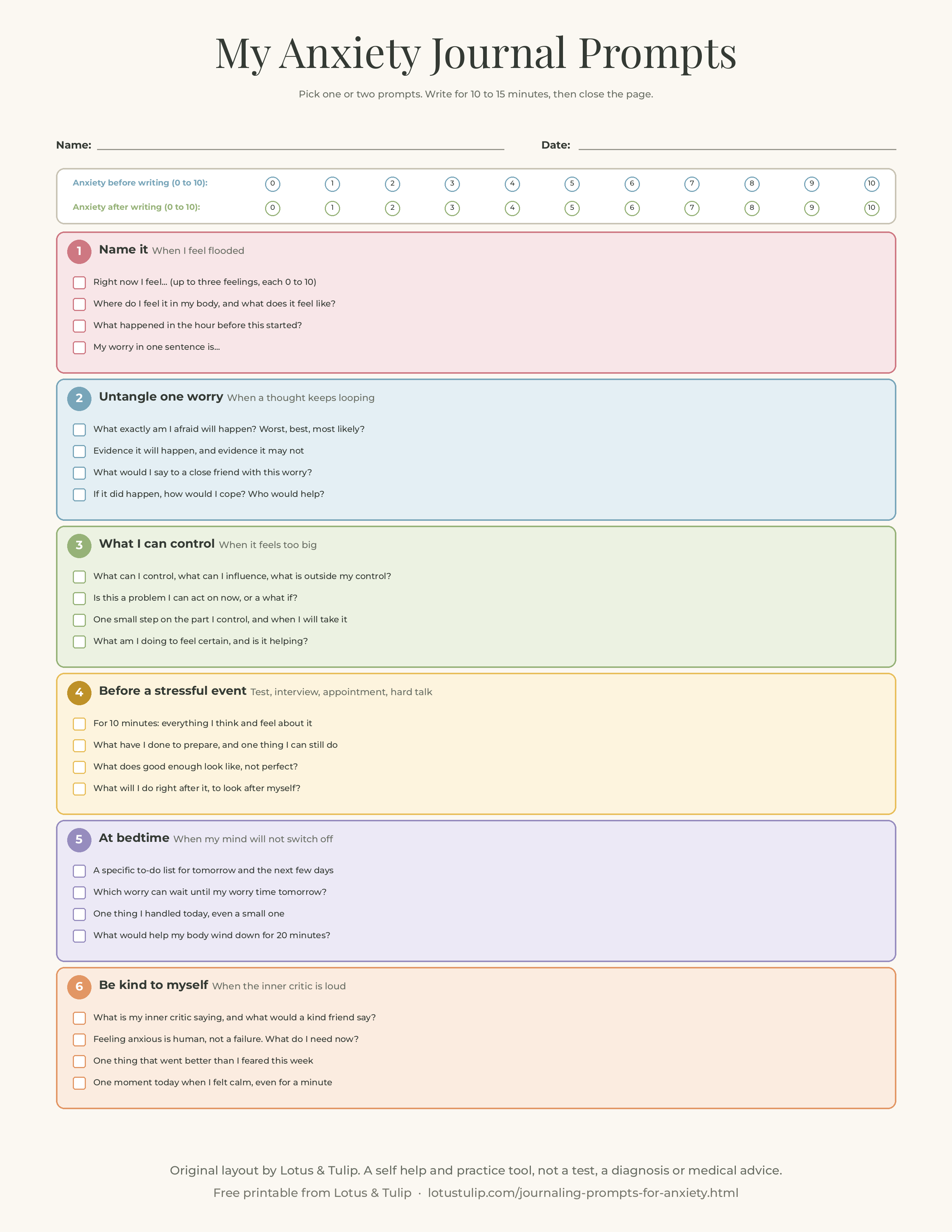
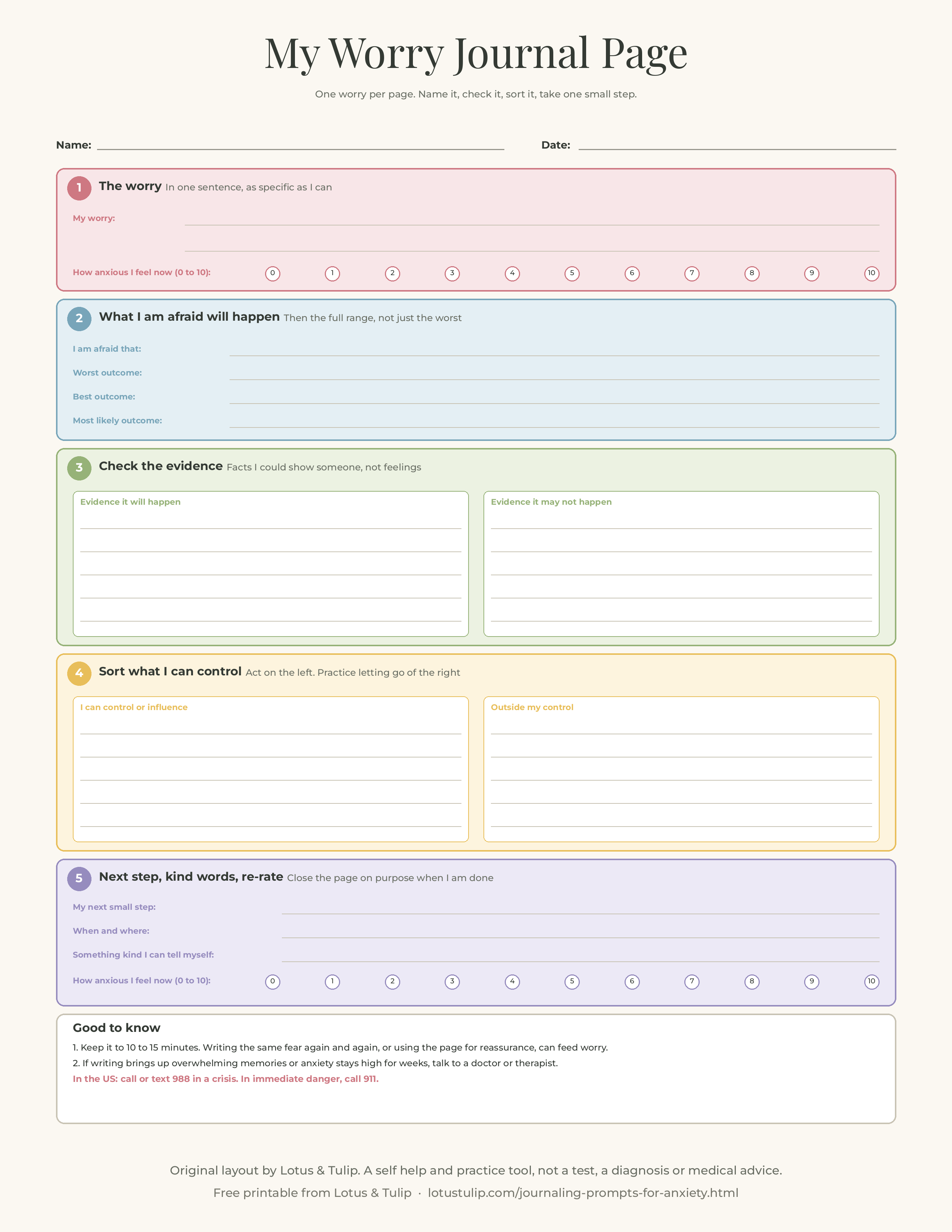
This free printable is an original Lotus & Tulip design on US Letter, in our own wording. It is not a published questionnaire and gives no score. Page 1, My Anxiety Journal Prompts, is a prompt menu with 24 prompts in six groups, most of them from the list above, a box to tick the ones you have tried, and a small check in strip for your anxiety before and after. Page 2, My Worry Journal Page, walks one worry through the steps: the worry in one sentence and a 0 to 10 rating, what I am afraid will happen, evidence for and against, the most likely outcome, what I can and cannot control, my next small step and when, something kind to tell myself and a re-rating, with notes and US crisis lines. Print several copies of page 2 and keep them in a folder or binder.
Download the free anxiety journaling pages (PDF, 2 pages, US Letter)
Prefer single images? Page 1: anxiety journal prompts (PNG) · Page 2: worry journal page (PNG)
Free to print for yourself or for use with your own clients or groups. Please link to this page rather than re-uploading the file. A self help and practice tool, not a test, a diagnosis or a substitute for therapy. In the US, call or text 988 in a mental health crisis. In immediate danger, call 911.
Buy the anxiety worksheets on Etsy
Related resources
- Worry time worksheet: postpone worries to one daily window, then use the worry journal page in that window
- Overthinking worksheet for adults: when the journal keeps replaying the same loop
- Catastrophizing worksheet: weigh the worst, best and most likely outcome in more depth
- Worry tree worksheet: sort a worry into act now or let go
- Circle of control worksheet: what you control, influence and cannot change
- CBT thought record worksheet: test one hot thought against the evidence
- 5 4 3 2 1 grounding worksheet: when the body alarm is too loud to write
- Health anxiety worksheet: when the worries are about your body or illness
- Anxiety worksheets for adults: the anxiety cycle, worry time, fear ladder and more
- All therapist worksheets: CBT, DBT, ACT and more
FAQ
What are good journaling prompts for anxiety?
Good prompts give your worry a specific job. Start by naming the feeling ("Right now I feel... and where do I feel it in my body?"), write the worry in one sentence, check the evidence and the most likely outcome, then sort what you can and cannot control and choose one small step. This page lists 39 prompts in eight groups, and the free printable has a prompt menu and a worry journal page.
Does journaling actually help anxiety?
It can help, but the effects are usually modest. A 2022 review of 20 randomized trials found journaling groups improved about 5% more on symptom scales than control groups, with large differences between studies. Writing about worries just before a test helped anxious students in several experiments, and a 12 week positive journaling trial lowered anxiety in medical patients after one month. Journaling works best as an add on to proven approaches such as CBT, not a replacement.
How long should I journal for anxiety?
Ten to fifteen minutes is plenty. Most research used sessions of 5 to 20 minutes, and the classic expressive writing exercise is 15 to 20 minutes on 3 to 5 days. Set a timer, rate your anxiety before and after, and close the journal when the time is up so the writing does not turn into more worrying.
Should I journal in the morning or at night for anxiety?
Either works if it is the same time most days. Many people do the heavier worry prompts in the late afternoon or early evening and keep bedtime for a short, specific to-do list for the next day, which helped young adults fall asleep faster in a 2018 sleep lab study. Avoid working through your biggest fears right before sleep.
Can journaling make anxiety worse?
Sometimes. Expressive writing often raises distress briefly right after a session, and writing the same fear over and over, or using the journal to seek reassurance, can feed worry. Keep sessions short, end with a next step and a re-rating, and stop or switch to grounding if writing feels like too much. If writing about trauma brings up overwhelming memories, work on it with a therapist.
What is the difference between a worry journal and worry time?
Worry time is a set daily window, usually 15 to 30 minutes, when you allow yourself to worry, after postponing worries that come up during the day. A worry journal is a place to write worries down and work through them. They fit together: note a worry when it shows up, then use a worry journal page during your worry time.
Can therapists use these prompts and pages with clients?
Yes. The prompts and the free printable are free to use with your own clients or groups. Please link to this page rather than re-uploading the file. They work as between session homework alongside CBT, worry postponement or exposure work. For clients in acute distress or with active trauma symptoms, focus on safety and stabilization first. In the US, clients can call or text 988 in a crisis, or call 911 in an emergency.
Sources
- Baikie, K. A., and Wilhelm, K. (2005). Emotional and physical health benefits of expressive writing. Advances in Psychiatric Treatment, 11(5), 338 to 346.
- Borkovec, T. D., Wilkinson, L., Folensbee, R., and Lerman, C. (1983). Stimulus control applications to the treatment of worry. Behaviour Research and Therapy, 21(3), 247 to 251.
- Cregg, D. R., and Cheavens, J. S. (2021). Gratitude interventions: Effective self-help? A meta-analysis of the impact on symptoms of depression and anxiety. Journal of Happiness Studies, 22(1), 413 to 445.
- Davis, D. E., Choe, E., Meyers, J., and others (2016). Thankful for the little things: A meta-analysis of gratitude interventions. Journal of Counseling Psychology, 63(1), 20 to 31.
- Dippel, A., Brosschot, J. F., and Verkuil, B. (2024). Effects of worry postponement on daily worry: a meta-analysis. International Journal of Cognitive Therapy, 17(1), 160 to 178.
- Frattaroli, J. (2006). Experimental disclosure and its moderators: A meta-analysis. Psychological Bulletin, 132(6), 823 to 865.
- Lieberman, M. D., Eisenberger, N. I., Crockett, M. J., Tom, S. M., Pfeifer, J. H., and Way, B. M. (2007). Putting feelings into words: Affect labeling disrupts amygdala activity in response to affective stimuli. Psychological Science, 18(5), 421 to 428.
- Lieberman, M. D., Inagaki, T. K., Tabibnia, G., and Crockett, M. J. (2011). Subjective responses to emotional stimuli during labeling, reappraisal, and distraction. Emotion, 11(3), 468 to 480.
- Park, D., Ramirez, G., and Beilock, S. L. (2014). The role of expressive writing in math anxiety. Journal of Experimental Psychology: Applied, 20(2), 103 to 111.
- Pennebaker, J. W. (2018). Expressive writing in psychological science. Perspectives on Psychological Science, 13(2), 226 to 229.
- Pennebaker, J. W., and Beall, S. K. (1986). Confronting a traumatic event: Toward an understanding of inhibition and disease. Journal of Abnormal Psychology, 95(3), 274 to 281.
- Ramirez, G., and Beilock, S. L. (2011). Writing about testing worries boosts exam performance in the classroom. Science, 331(6014), 211 to 213.
- Reinhold, M., Bürkner, P. C., and Holling, H. (2018). Effects of expressive writing on depressive symptoms: A meta-analysis. Clinical Psychology: Science and Practice, 25(1), e12224.
- Scullin, M. K., Krueger, M. L., Ballard, H. K., Pruett, N., and Bliwise, D. L. (2018). The effects of bedtime writing on difficulty falling asleep: A polysomnographic study comparing to-do lists and completed activity lists. Journal of Experimental Psychology: General, 147(1), 139 to 146.
- Smyth, J. M. (1998). Written emotional expression: Effect sizes, outcome types, and moderating variables. Journal of Consulting and Clinical Psychology, 66(1), 174 to 184.
- Smyth, J. M., Johnson, J. A., Auer, B. J., Lehman, E., Talamo, G., and Sciamanna, C. N. (2018). Online positive affect journaling in the improvement of mental distress and well-being in general medical patients with elevated anxiety symptoms: A preliminary randomized controlled trial. JMIR Mental Health, 5(4), e11290.
- Sohal, M., Singh, P., Dhillon, B. S., and Gill, H. S. (2022). Efficacy of journaling in the management of mental illness: A systematic review and meta-analysis. Family Medicine and Community Health, 10(1), e001154.