
Therapists and counselors · Updated 2026-11-08
Anxiety Worksheets for Adults: Worry, Panic, Exposure, and Free Printable
Ready-made printable: Anxiety Worksheets for Therapists Fillable PDF, 20 pages: worry log, fear ladder, exposure practice log, grounding and 0 to 10 anxiety scales
Holiday 20% off: about $11.04, was $14 (EUR 12) · instant digital download
Try it free first: download a fillable sample (worry log and fear ladder, PDF, 258 KB). Type into it on screen, then get the full pack. No email needed.

Anxiety worksheets for adults give therapists, counselors and their clients a shared, concrete way to work with worry, panic, avoidance and the body alarm that comes with them. Instead of talking about anxiety in general terms, a good worksheet asks for one specific moment: what set it off, what the mind predicted, what the body did, what the person did next and what that cost them later. That level of detail is where change starts. It is written for US clinicians in private practice, community mental health, primary care, college counseling and telehealth. Adults can use the free printable on their own too, ideally alongside a clinician.
You will get core ideas, twelve worksheet backed practices, a six session starter table, a nine step HowTo, adaptations, tips, mistakes, myths, three fictional examples, guidance on when to refer, verified research notes, eight FAQs and a free three page US Letter printable: Anxiety Care Steps, My Anxiety Plan and an Anxiety Practice Log with nine pocket cards.
This page is written for adults. For younger clients, see our anxiety worksheets for kids, anxiety activities for teens and social anxiety worksheets for teens. If you want a deep dive on a single tool, we have single topic guides for the worry tree worksheet, the exposure hierarchy worksheet and the 5 4 3 2 1 grounding worksheet. This page pulls those tools into one practical adult anxiety workflow.
We draw on published research and clinical guidance without claiming any affiliation or endorsement: the GAD-7 validation study (Spitzer, Kroenke, Williams and Löwe, 2006), the follow-up primary care study by Kroenke and colleagues (2007), the Hofmann and Smits (2008) and Carpenter and colleagues (2018) meta-analyses of CBT for anxiety disorders, the Borkovec and colleagues (1983) worry stimulus control study, the Clark (1986) cognitive model of panic, the inhibitory learning approach to exposure (Craske and colleagues, 2014), NICE guideline CG113, the 2023 US Preventive Services Task Force recommendation on anxiety screening and NIMH prevalence data. The printable is an original Lotus and Tulip layout.
This guide is educational. Worksheets do not diagnose anxiety disorders, do not cure them by themselves and do not replace assessment, therapy, medication or crisis care. They are skill practice aids. If you or someone you support is thinking about suicide, call or text 988 (Suicide and Crisis Lifeline) or text HOME to 741741 (Crisis Text Line). For immediate danger, call 911. Chest pain, fainting or trouble breathing should be checked by a medical professional before anyone assumes it is "just anxiety."
What anxiety worksheets for adults are (and are not)
Anxiety worksheets are short, structured pages that help an adult slow an anxious moment down enough to see its parts, test the predictions inside it and practice a different response. The best ones are specific and brief. A page that asks "What did you fear would happen, how sure were you from 0 to 100, and what actually happened?" will teach more than a page of general reflection questions. Anxiety is built on predictions about the future, so the most useful worksheets capture those predictions in writing and then compare them with reality.
Adults bring their own anxiety themes (work, money, health, parenting, driving, public speaking) and years of practiced avoidance: declining invitations, checking, over preparing, reassurance seeking or a drink before social events. Adult worksheets should use plain grown up language and connect practice to the life the person wants back.
What they are not.
- Not a diagnosis. A symptom checklist or a GAD-7 score is a starting point for a conversation. Diagnosing generalized anxiety disorder, panic disorder, social anxiety disorder, a specific phobia or agoraphobia requires a clinical evaluation by a qualified professional.
- Not a way to get rid of anxiety forever. Anxiety is a normal human alarm. The goal is not zero anxiety. It is a smaller, more accurate alarm and a life that is no longer organized around avoiding it.
- Not only relaxation. Breathing and grounding help in the moment, but used alone, or used to escape every bit of discomfort, they can quietly become another way to avoid. The strongest anxiety treatments include facing feared situations in a planned way.
- Not a replacement for medical care. Thyroid problems, heart rhythm problems, caffeine, stimulants, some medications and substance withdrawal can produce or worsen anxiety symptoms. A medical check is often wise, especially when symptoms are new.
- Not a crisis plan. If someone is thinking about suicide, safety comes first. Use crisis lines, emergency care and a written safety plan.
Core ideas that shape good anxiety worksheets
Anxiety is common and treatable. Based on the National Comorbidity Survey Replication, NIMH estimates that 19.1 percent of US adults had an anxiety disorder in the past year and 31.1 percent will have one at some point in their lives. Those figures come from 2001 to 2003 interviews using DSM-IV categories (which then included PTSD and OCD), so treat them as a historical benchmark. Saying plainly that anxiety is common often lowers shame.
The anxiety cycle. Most anxiety problems share a loop: a trigger, a threat prediction ("I will lose control," "they will judge me," "something bad will happen to my kids"), a body alarm (racing heart, tight chest, nausea, restlessness), then escape, avoidance or a safety behavior. Avoidance brings quick relief, and that relief teaches the brain that the situation was dangerous and that avoiding it was what kept the person safe. Over time the world gets smaller. A worksheet that maps this loop in the client's own words is often the first time they see their anxiety as a pattern rather than a personality.
Predictions can be tested. Cognitive models of anxiety focus on overestimating how likely something bad is and how awful it would be, while underestimating one's ability to cope. Writing down the prediction with a 0 to 100 confidence rating, then comparing it with what actually happened, is one of the simplest and most powerful worksheet moves.
Panic feeds on misread body signals. In his cognitive model of panic, David Clark (1986) proposed that panic attacks come from catastrophically misinterpreting normal anxiety sensations, such as a pounding heart or dizziness, as signs of immediate danger, such as a heart attack or fainting. The misreading raises anxiety, which raises the sensations, which seem to confirm the fear. Panic worksheets that track sensation, interpretation and outcome help break that loop.
Worry can be contained. Worry is often a long chain of "what if" thoughts that feels productive but rarely produces a plan. In an early study, Thomas Borkovec and colleagues (1983) taught chronic worriers a stimulus control approach: notice worry, postpone it to a set daily worry period in the same place, and return attention to the present the rest of the day. Over four weeks, the treated groups reported less daily worry than an untreated group. Worry time and a worry tree both grow from this idea.
Exposure is the engine. Exposure means approaching feared situations, sensations or thoughts on purpose, step by step, without escaping or using safety behaviors. Michelle Craske and colleagues (2014) describe an inhibitory learning approach: the point is not only to wait for fear to fade during practice, but to learn something new, especially that the feared outcome did not happen or was more manageable than expected. That shifts how worksheets are written. Instead of only rating fear every few minutes, the page asks "What did I expect? What happened? What did I learn?"
Safety behaviors keep fear alive. Sitting near the exit, carrying a water bottle "just in case," rehearsing every sentence, checking a pulse, asking for reassurance or only going out with a trusted person can all prevent the brain from learning that the situation is safe enough. Reducing them gradually is often as important as the exposure itself.
Uncertainty is part of life. Many anxious adults try to get certainty before acting: certainty that the plane will land, the lump is nothing, the email was fine. Uncertainty tolerance work helps people act on what they value while some doubt remains.
Measure, do not guess. The GAD-7 is a seven item self-report measure, free to use, that takes a couple of minutes. In its validation study across 15 US primary care clinics (Spitzer and colleagues, 2006), a cut point of 10 gave 89 percent sensitivity and 82 percent specificity for generalized anxiety disorder, and scores of 5, 10 and 15 are commonly used to mark mild, moderate and severe anxiety. Repeating a standard measure over time keeps treatment honest. Worksheets add the detail.
Twelve worksheet backed anxiety practices for adults
Each practice below lists what it is, how long it usually takes and a few debrief questions. You do not need all twelve. Most adults do well with four or five chosen to fit their main anxiety pattern: worry, panic, social fear, a specific fear or health anxiety.
1. Anxiety cycle map
Pick one recent anxious moment and fill in five boxes: trigger, thought or prediction, body signals, what I did (escape, avoid, safety behavior) and what happened next, both short term and long term. Use the client's exact words. Fifteen minutes in session.
Debrief: What did avoidance give you in the next five minutes? What has it cost you over the past year? Where in this loop would it be easiest to try something different?
2. Anxiety check in (0 to 10)
A quick rating at the start of each session or week: overall anxiety, worry, body tension, avoidance, sleep and how much anxiety got in the way of life. If your setting uses the GAD-7 or a panic or social anxiety measure, use that alongside it. Five minutes.
Debrief: Which number moved since last time? What moved it? Which one would make the biggest difference if it dropped by one point?
3. Worry log
For one week, the client jots down each notable worry with the time, situation, the worry in one sentence, how anxious they felt (0 to 10) and whether it is a problem they can act on now.
Debrief: What themes keep showing up? How many of these worries came true this week? Which ones had a next step you could take?
4. Worry time with a parking list
Choose a 15 to 20 minute worry window at the same time and place each day, not close to bedtime. (Our worry time worksheet walks through this step by step, with the research and a free plan and log.) When a worry shows up outside the window, write two or three words on a parking list and return to the task at hand. During worry time, go through the list. The worry tree worksheet pairs well with this to sort worries into "act now," "plan a step" and "let it go."
Debrief: How hard was it to postpone? What happened to the worries you parked? Did the worry window get easier or harder by day four?
5. Prediction check (probability and catastrophe)
Write the feared outcome, rate how likely it feels (0 to 100) and how bad it would be (0 to 100). Then write the worst, best and most likely outcome, what evidence points each way, and how you would cope if the worst did happen. Re-rate both numbers. Fifteen minutes.
Debrief: How much did the numbers move? What would you tell a friend who had this prediction? What is one thing you could do this week to test it in real life?
6. Fact or feeling
Anxiety often treats "I feel unsafe" as proof that "I am unsafe." On a two column page, the client sorts statements about a situation into facts that anyone could observe and feelings or interpretations. This is a gentle first step before a full CBT thought record and links well with our cognitive distortions worksheet.
Debrief: Which column was easier to fill? Which "fact" turned out to be a prediction? What changes when you name a feeling as a feeling?
7. Body alarm guide
List the sensations the person notices when anxious, what each sensation means in plain physiology (faster heart to move blood, faster breathing to bring in oxygen, tense muscles to get ready to move) and what the anxious mind says it means. For panic, add a column: "What happened the last time I had this sensation?" Ten to fifteen minutes. If symptoms have not been medically checked, recommend that first.
Debrief: Which sensation scares you most? What has it led to in the past, really? What would you say to yourself next time it appears?
8. Grounding and breathing menu
A short list of two or three in the moment skills the person actually likes: 5 4 3 2 1 grounding, slow breathing with a longer out breath, box breathing, feet on the floor with a slow look around the room, cold water on the hands, or progressive muscle relaxation. The rule of thumb: use these to stay present and keep going, not to escape the situation or to make all anxiety disappear. Ten minutes to choose and practice.
Debrief: Which skill helped you stay in the situation? When did you use a skill to escape instead? What one skill will you practice daily when you are calm?
9. Fear ladder
Build a list of eight to ten situations linked to one fear, each with a distress rating from 0 to 100, from manageable to hard. A highway driving ladder might start on a quiet road and end with a 30 minute solo highway drive. Our exposure hierarchy worksheet walks through this in depth. Twenty minutes, often across two sessions.
Debrief: Which step feels hard but doable this week? What makes a step easier or harder (time of day, who is with you, how long)? What would the top of the ladder let you do in your life?
10. Exposure practice log
Before each practice, write the situation, the prediction, how sure you are (0 to 100) and which safety behaviors you will drop. Afterward, write what actually happened, peak anxiety (0 to 10) and what you learned. The learning line is the most important part. Repeat practices, then vary places, times and people.
Debrief: What did you expect and what happened? Did you stay until you learned something, or leave at peak fear? What will you change next time to make the practice a little harder?
11. Safety behaviors audit
List every subtle way the person protects themselves in feared situations: checking, rehearsing, avoiding eye contact, carrying medication they never take, sitting by the door, asking for reassurance, Googling symptoms, having a drink first. Rate how much each one is used, then pick one to reduce in the next exposure. Ten to fifteen minutes.
Debrief: What do you believe would happen without this behavior? How could we test that safely? Which one is the easiest to drop first?
12. Uncertainty and self-compassion plan
Two short sections. First, a few "I can act even if I am not sure" statements, plus one small daily practice of tolerating uncertainty, such as sending an email without rereading it three times or choosing a restaurant without checking every review. Second, a kind sentence for anxious moments, such as "My alarm is loud right now, and I can still do the next small thing." Anxious adults are often harsh with themselves for being anxious, and that harshness adds fuel. Our self compassion worksheet goes deeper.
Debrief: Where do you demand certainty before you act? What happened when you acted without it? How would you speak to a friend who felt this way?
A six session starter plan (skills practice, not a protocol)
This outline is a practical sequence for a first block of anxiety work with an adult. It is not a manualized treatment, and many clients need more sessions. Adjust the order to the main problem: panic work leans on the body alarm guide earlier, social anxiety and specific fears move to the fear ladder sooner, and generalized worry spends longer on worry time and uncertainty.
| Session | Focus | Worksheets | Between sessions |
|---|---|---|---|
| 1 | Safety, assessment, the anxiety cycle | Anxiety check in, anxiety cycle map | Worry log or anxiety log, five days |
| 2 | Worry and the body alarm | Worry time with parking list, body alarm guide | Daily worry time, one calm breathing practice |
| 3 | Predictions | Prediction check, fact or feeling | Two prediction checks on real worries |
| 4 | Building the ladder | Fear ladder, safety behaviors audit | First exposure practice, log it |
| 5 | Exposure and learning | Exposure practice log review | Three practices, drop one safety behavior |
| 6 | Review and relapse plan | Anxiety check in, uncertainty and self-compassion plan | Keep climbing the ladder, book follow-up |
NICE guideline CG113 describes a stepped care approach for generalized anxiety disorder and panic disorder: education and active monitoring first, then low intensity options such as guided self-help or psychoeducational groups, then high intensity CBT or applied relaxation, or medication, for people with marked impairment or who have not improved. Use a symptom measure at intake and regularly afterward so progress is judged by change in symptoms and daily functioning, not by the number of worksheets completed.
How to use anxiety worksheets for adults, step by step
- Check safety and medical causes. Ask about suicidal thoughts, substance use and new or unexplained physical symptoms. If risk is present, use crisis care and a safety plan first, and refer for a medical check when needed.
- Assess and measure. Use a standard measure such as the GAD-7 and a clinical interview to understand the main anxiety pattern. Worksheets are not diagnostic.
- Map the anxiety cycle. Trace one real moment from trigger to prediction, body alarm, avoidance and the cost over time.
- Log worry and anxiety. Track a week of worries or anxious moments to find themes, times and triggers.
- Contain worry. Set a daily worry time with a parking list and sort worries into act now, plan a step or let go.
- Test predictions. Write the feared outcome with a confidence rating, then compare it with evidence and with what actually happens.
- Build a fear ladder. List eight to ten feared situations from manageable to hard and spot the safety behaviors that come with them.
- Practice exposure and drop safety behaviors. Do planned practices, log the prediction and the outcome, and write what you learned.
- Review and plan for setbacks. Keep what helped, re-measure, add an uncertainty and self-compassion plan and write early warning signs with clear next steps.
Print the free three page set and keep a stack in your office or share the PDF for telehealth. Page two works well on a phone photo or a fridge, where the plan is visible when anxiety rises.
Adaptations
Generalized worry. Lead with the worry log, worry time and the worry tree. Add uncertainty practice early, because the drive for certainty often keeps worry going. Exposure here can mean writing out a feared "what if" in detail or deliberately leaving small things unchecked.
Panic. Lead with the body alarm guide and the anxiety cycle map. A trained clinician may later add planned sensation practice (for example, brief spinning) once medical causes have been considered.
Social anxiety. Prediction checks and a safety behaviors audit are central. Common safety behaviors include over rehearsing, avoiding eye contact and staying quiet. Exposures might include asking a question in a meeting or making small talk with a cashier. For teens, see our social anxiety worksheets for teens.
Health anxiety. Track checking, symptom searching and reassurance seeking on the safety behaviors audit, and coordinate with primary care so checks happen once, not repeatedly.
Primary care and integrated behavioral health. In 2023, the US Preventive Services Task Force recommended screening adults 64 and younger for anxiety disorders, including pregnant and postpartum people (B grade), and found the evidence insufficient for adults 65 and older. Short visits suit one page at a time, such as a GAD-7 plus a worry time plan.
Telehealth. Share the PDF ahead of time, fill page two together on screen and ask the client to photograph the log before the next session. Confirm the client's location at the start of each session in case crisis help is needed.
College counseling. Keep practices short and tied to the academic calendar. For exam fears, see our test anxiety worksheet; campus disability services may also help.
Older adults. Use larger print and fewer sections. New anxiety later in life deserves a medical review, including medications.
Perinatal anxiety. Pregnancy and the months after birth can bring intrusive worries about the baby. Assess for depression and safety and coordinate with the obstetric team. The National Maternal Mental Health Hotline is 1-833-TLC-MAMA (1-833-852-6262).
Anxiety with depression, trauma or sleep problems. Anxiety often travels with other difficulties. If low mood dominates, see our depression worksheets. If anxiety follows trauma, start with stabilization using our trauma worksheets and the window of tolerance worksheet. If worry keeps the person awake, our CBT-I worksheets help separate bed from worry.
Culture and context. Anxiety is described differently across cultures, sometimes mainly through the body. Some fears are realistic responses to real danger; worksheets are for unhelpful alarms, not for talking people out of reasonable caution.
Tips for therapists and counselors
- Start with the client's goal. "Drive to my sister's house" or "speak up in team meetings" is a better anchor than "feel less anxious."
- Make the first step hard but doable. A step that is too easy teaches nothing new. A step that is too hard leads to escape.
- Write predictions down. Memory softens predictions after the fact. A written "90 percent sure I will faint" is hard to argue with when it did not happen.
- Celebrate approach, not calm. The win is doing the thing, even if anxiety was high.
- Coordinate with prescribers. If the client takes medication, especially as needed medication, talk with their prescriber about how it fits exposure work. Do not change medication advice yourself.
Common mistakes
- Using relaxation as an escape hatch. Breathing to stay in a situation is helpful. Breathing to get out of it every time can maintain fear.
- Too much talk, too little practice. Insight alone rarely shrinks avoidance. Plan real world steps.
- Reassuring instead of testing. Telling a client "you will be fine" offers brief relief. Helping them find out for themselves lasts longer.
- Stopping when anxiety peaks. Leaving at the worst moment teaches that escape was needed. Plan to stay long enough to learn something.
- Ignoring safety behaviors. An exposure done with a hidden safety behavior may not count much.
Myths about anxiety and worksheets
- "If I just relax enough, anxiety will go away." Relaxation helps some people, but anxiety shrinks most reliably when people approach what they fear and learn it is manageable.
- "Avoiding it is self-care." Rest and boundaries are self-care. Avoiding everything that feels anxious usually makes anxiety bigger over time.
- "A panic attack can make me faint or go crazy." Panic feels terrifying, but the sensations are the body's alarm system. A clinician can help check out specific medical concerns.
Three fictional examples
These are fictional composites written for teaching. Names and details are invented.
Example 1 (fictional): Dana, 34, project manager, generalized worry. Dana's worry log showed a cluster of worries between 10 p.m. and midnight about work mistakes and her parents' health. Her therapist set a 20 minute worry window at 6 p.m. with a parking list on her phone, and in week one Dana postponed about half her worries. Using prediction checks, she rated "my boss will think I am incompetent if I miss one detail" at 85 percent, then reviewed what had happened after three small mistakes that year: nothing beyond a quick correction. By week four she was sending emails after one read through instead of four, and her GAD-7 had dropped by several points.
Example 2 (fictional): Marcus, 41, panic and avoidance of driving. After a panic attack on the highway, Marcus stopped driving on highways and then avoided bridges. His primary care provider had ruled out a heart problem. His therapist used the body alarm guide to link his racing heart and tingling hands to fast breathing, and built a ten step fear ladder starting with five minutes on a quiet road. His safety behaviors audit showed he always drove with his window down, his phone on speaker with his wife and a bottle of water in hand. He climbed the ladder over six weeks, dropping one safety behavior at a time. His exposure log noted, "Predicted 80 percent I would have to pull over. Did not. Anxiety peaked at 7 and dropped to 4 by exit two." He planned a solo drive to visit his brother as the top step.
Example 3 (fictional): Priya, 27, social anxiety, paused for safety. Priya came in for social anxiety at work. In session two her anxiety check in showed a sharp drop in hope and sleep, and when asked directly she said she had been having thoughts that everyone would be better off without her. Her clinician paused the fear ladder, completed a written safety plan with her, shared 988 and the Crisis Text Line (text HOME to 741741), assessed for depression and arranged closer follow-up. Anxiety work resumed a few weeks later, once safety was steadier, alongside treatment for depression. The lesson: worksheets wait when safety is in question.
How this page compares to nearby Lotus and Tulip guides
| Guide | Best for | How it differs |
|---|---|---|
| Anxiety worksheets for kids | Children | Kid language and caregiver involvement; this page is for adults |
| Anxiety activities for teens | Adolescents | School and peer examples; this page covers work, health and adult life |
| Social anxiety worksheets for teens | Teen social fear | Social anxiety only; here it is one of several adult patterns |
| Worry tree worksheet | Sorting worries | One tool in depth; here it is part of worry time |
| Worry time worksheet | Scheduled worry time | Worry postponement in depth, with the research, 9 steps and a free plan and 7 day log |
| Exposure hierarchy worksheet | Building a fear ladder | Full ladder walk through; here it sits in a complete workflow |
| Panic attack worksheet | Panic attacks | The panic cycle, safety behaviors and interoceptive exposure in depth, with a free cycle map and episode log |
| 5 4 3 2 1 grounding worksheet | In the moment grounding | Grounding only; here it is one item on the coping menu |
| ERP worksheets for OCD | Obsessions and compulsions | OCD specific exposure and response prevention; use that page when OCD is the main issue |
| Safety plan worksheet | Suicide risk | Use first whenever risk is present |
When not to use these worksheets (or when to refer)
- Suicidal thinking with a plan or intent. Use crisis care first: 988, emergency services or an emergency department.
- Unexplained physical symptoms. Chest pain, fainting, new palpitations or shortness of breath need medical evaluation before they are treated as anxiety.
- Substance use or withdrawal. Alcohol, benzodiazepine or other withdrawal can be dangerous and produce severe anxiety. Refer for medical and substance use care.
- Possible OCD, PTSD, bipolar disorder or psychosis. These need specialized assessment and treatment. Our ERP and trauma guides are starting points, not substitutes.
- Severe impairment. If the person cannot work, leave home or care for themselves, consider higher intensity care and a medication evaluation.
- Real ongoing danger. Anxiety about an abusive partner or unsafe situation is not a thinking error. Focus on safety planning and resources.
- No progress after a fair trial. If symptoms are not improving after several weeks of consistent practice, revisit the formulation, consider a referral or a different approach.
- Outside your scope. Coaches, teachers and peer supporters can use these pages to support someone already in care, but exposure for moderate or severe anxiety should be guided by a licensed clinician.
Free 3 page anxiety worksheets printable (US Letter)
Download the free printable, print on US Letter and use it in session or as optional practice between sessions.
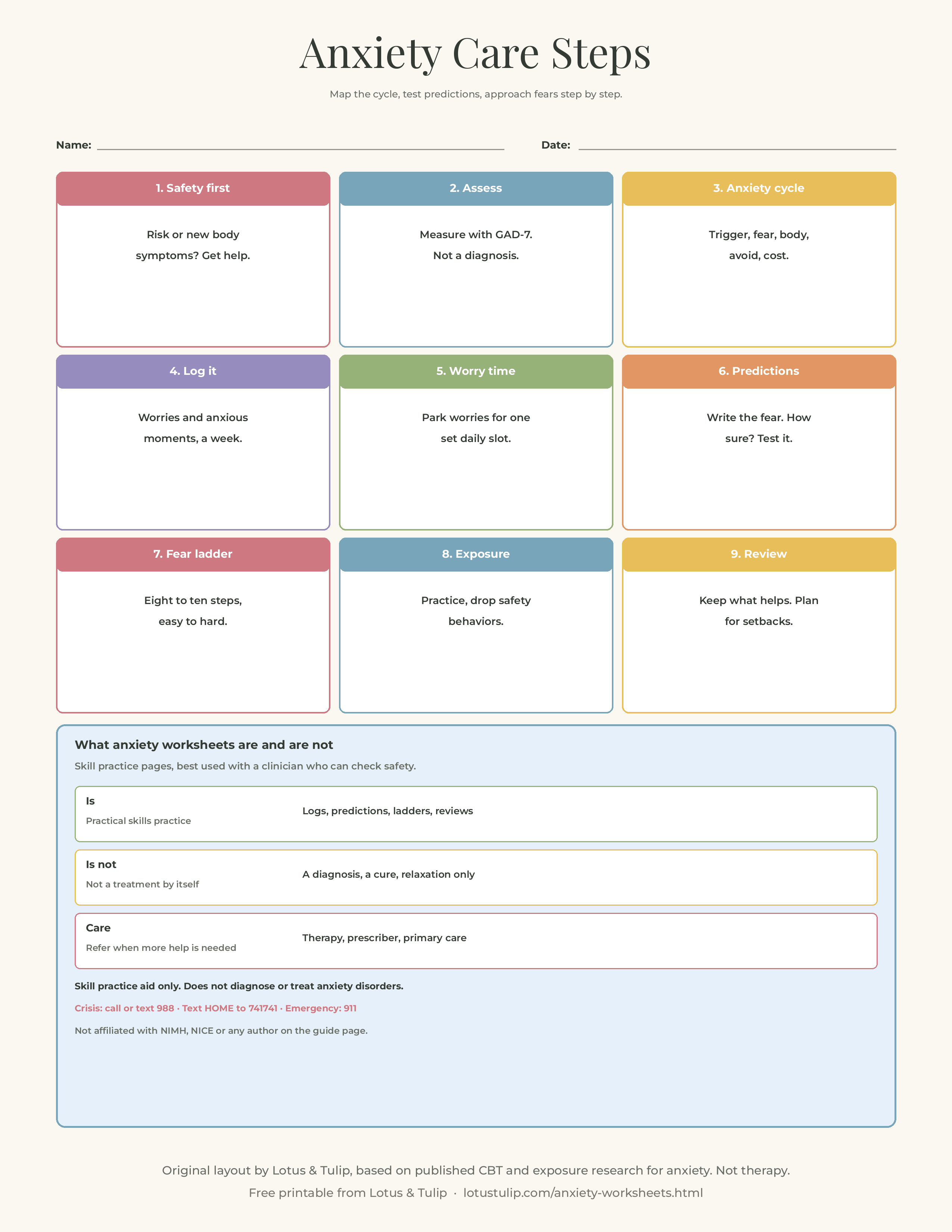
- Page 1: Anxiety Care Steps. Nine steps that match the HowTo above, what anxiety worksheets are and are not, and crisis resources.
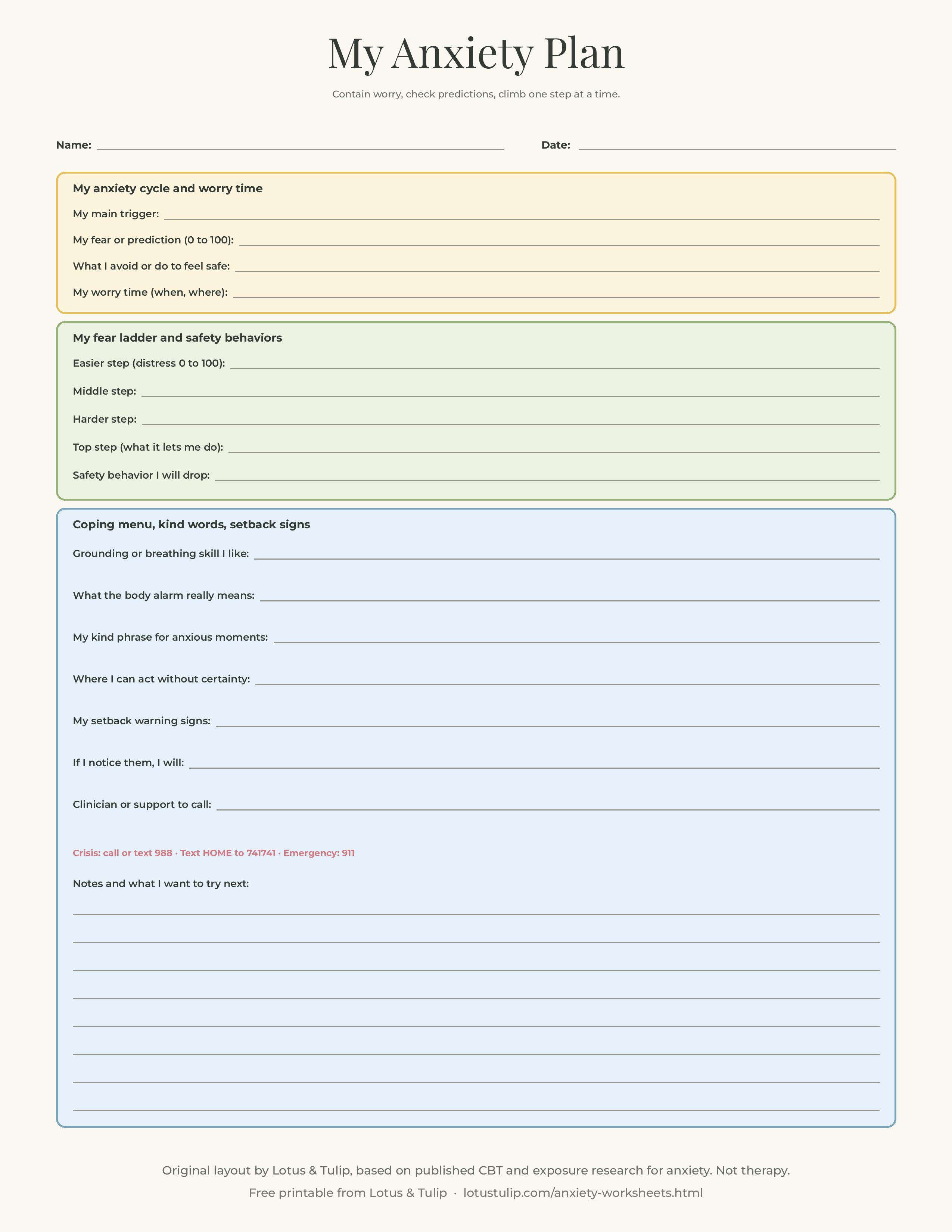
- Page 2: My Anxiety Plan. My anxiety cycle, worry time and parking list, a prediction check, a short fear ladder, safety behaviors to drop, a coping menu and setback signs.
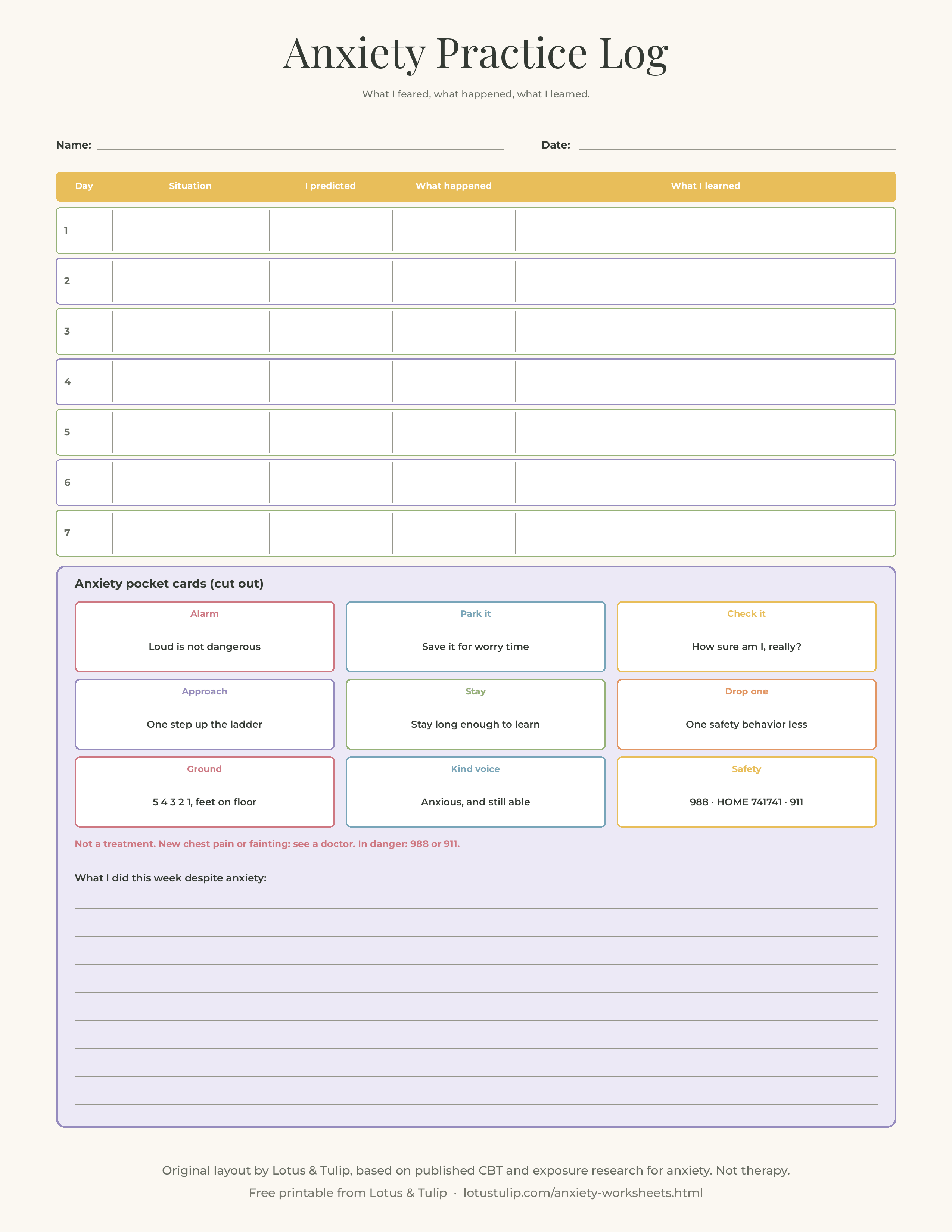
- Page 3: Anxiety Practice Log. Seven rows for day, situation, prediction, what happened and what I learned, plus nine pocket cards.
Download free PDF · Page 1 PNG · Page 2 PNG · Page 3 PNG
Free anxiety starter pack: Want more real pages? The free anxiety worksheets starter pack adds the anxiety cycle, a worry log, probability and catastrophe, a fear ladder, 5, 4, 3, 2, 1 grounding and a support and safety page from our paid anxiety set (8 pages, client use license, no email).
Research notes (verified, with caveats)
- Spitzer RL, Kroenke K, Williams JBW, Löwe B. A brief measure for assessing generalized anxiety disorder: the GAD-7. Arch Intern Med. 2006;166(10):1092-1097. 2,740 adults in 15 US primary care clinics, 965 with a follow-up interview; a cut point of 10 gave 89 percent sensitivity and 82 percent specificity for generalized anxiety disorder, and higher scores tracked with more functional impairment.
- Kroenke K, Spitzer RL, Williams JBW, Monahan PO, Löwe B. Anxiety disorders in primary care: prevalence, impairment, comorbidity, and detection. Ann Intern Med. 2007;146(5):317-325. In 965 primary care patients, 19.5 percent had at least one anxiety disorder and 41 percent of those reported no current treatment; the GAD-7 also performed reasonably as a screener for panic disorder, social anxiety disorder and PTSD.
- Hofmann SG, Smits JAJ. Cognitive-behavioral therapy for adult anxiety disorders: a meta-analysis of randomized placebo-controlled trials. J Clin Psychiatry. 2008;69(4):621-632. 27 trials; in completer samples CBT outperformed placebo on anxiety severity (Hedges' g 0.73), with a smaller effect in intent to treat samples (g 0.33) and considerable room for improvement.
- Carpenter JK, Andrews LA, Witcraft SM, Powers MB, Smits JAJ, Hofmann SG. Cognitive behavioral therapy for anxiety and related disorders: a meta-analysis of randomized placebo-controlled trials. Depress Anxiety. 2018;35(6):502-514. 41 trials, about 2,835 patients; moderate placebo controlled effect on target symptoms (g 0.56), response odds ratio 2.97, larger effects for completers than intent to treat samples.
- Borkovec TD, Wilkinson L, Folensbee R, Lerman C. Stimulus control applications to the treatment of worry. Behav Res Ther. 1983;21(3):247-251. Four weeks of stimulus control instructions (postponing worry to a set period and place) reduced daily worry compared with no treatment.
- Clark DM. A cognitive approach to panic. Behav Res Ther. 1986;24(4):461-470. Proposed that panic attacks result from catastrophic misinterpretation of normal bodily sensations, such as palpitations or dizziness, as signs of immediate danger.
- Craske MG, Treanor M, Conway CC, Zbozinek T, Vervliet B. Maximizing exposure therapy: an inhibitory learning approach. Behav Res Ther. 2014;58:10-23. Describes exposure strategies built around expectancy violation, removing safety signals, variability and practice across contexts.
- National Institute for Health and Care Excellence. Generalised anxiety disorder and panic disorder in adults: management (CG113). 2011, with later updates. Sets out a stepped care model from education and monitoring to low intensity interventions such as guided self-help, then CBT, applied relaxation or medication.
- US Preventive Services Task Force. Screening for anxiety disorders in adults: recommendation statement. JAMA. 2023;329(24):2163-2170. Recommends screening adults 64 and younger, including pregnant and postpartum people (B grade); evidence insufficient for adults 65 and older (I statement).
- National Institute of Mental Health. Any anxiety disorder statistics, based on the National Comorbidity Survey Replication (2001 to 2003). An estimated 19.1 percent of US adults had an anxiety disorder in the past year (23.4 percent of women, 14.3 percent of men) and 31.1 percent at some point in their lives.
We do not invent effect sizes. The trials above tested structured, clinician delivered treatments, not standalone worksheets. The free printable is a skill practice aid inspired by the same targets and has not been tested in a randomized trial. Guidelines are updated over time, so check current versions before citing them in documentation. The DSM-5-TR criteria for anxiety disorders are copyrighted, so we do not reproduce them here. Diagnosis is for a qualified clinician, not a worksheet.
Anxiety worksheets for adults: FAQ
What are anxiety worksheets for adults?
They are short, structured pages that help adults practice skills from evidence based anxiety treatment: mapping the anxiety cycle, logging worry, setting a worry time, testing predictions, understanding the body alarm, building a fear ladder, logging exposure practice, reducing safety behaviors and tolerating uncertainty. Therapists use them in session and between sessions.
Which anxiety worksheet should I start with?
For most adults, start with an anxiety cycle map and a one week worry or anxiety log. Those show the pattern. Then choose tools that fit it: worry time for generalized worry, the body alarm guide for panic, and a fear ladder with an exposure log for avoidance.
Can anxiety worksheets diagnose an anxiety disorder?
No. A worksheet or a GAD-7 score is a starting point. Diagnosis requires an evaluation by a qualified professional, who will also consider medical causes, substance use and other conditions.
What is the GAD-7?
The GAD-7 is a free seven item questionnaire about how often anxiety symptoms bothered someone over the last two weeks. Scores of 5, 10 and 15 are commonly used to mark mild, moderate and severe anxiety, and in its validation study a score of 10 or more had 89 percent sensitivity and 82 percent specificity for generalized anxiety disorder.
Do breathing and grounding worksheets cure anxiety?
No. They are useful for staying present during anxious moments, but anxiety usually improves most when people also face feared situations step by step and drop safety behaviors. Use calming skills to stay in a situation, not to escape it.
Do worksheets replace therapy or medication?
No. They are tools inside care, not a substitute for it. Some adults do well with therapy alone, some with medication and some with both. Medication questions belong with a prescriber.
Can adults use the free printable without a therapist?
Yes, many adults use the worry time plan and practice log on their own. If anxiety lasts for weeks, keeps you from work, relationships or leaving home, or comes with thoughts of death or suicide, please reach out to a clinician. Call or text 988, text HOME to 741741 or call 911 in an emergency.
Are these worksheets suitable for teens or kids?
This set is written for adults. For younger clients, see our anxiety worksheets for kids, anxiety activities for teens and social anxiety worksheets for teens, which use age appropriate language and school examples.